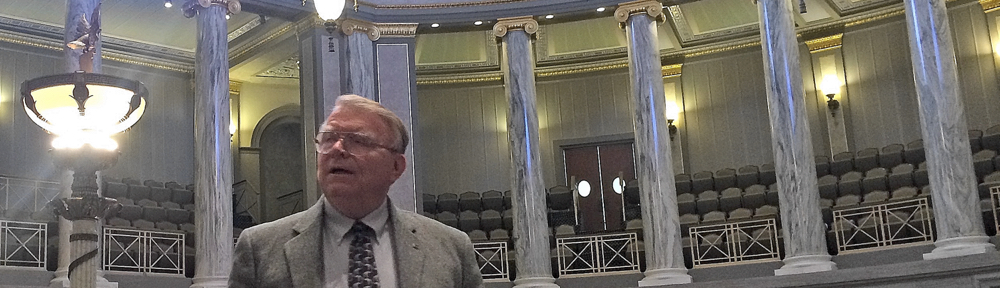
It was an interesting juxtaposition of events last Saturday night at a birthday party for a submarine at the American Legion Hall—the USS Jefferson City, which was launched on February 29, 1992.
The boat is based in Guam but none of us knew where it was at that moment. We hoped it and its crew were safe regardless of whether they were involved in the war with Iran—and I think most of us believe it is in the area.
The Jefferson City isn’t the largest class of submarines; the USS Missouri. It is part of the first class of submarines beneath the group of which the USS Missouri is a part. It’s an attack sub longer than a football field with about 140 crew members. It is loaded with missiles.
So, our capital city has a reason to pay attention to what’s happening and what’s going to happen.
There’s not much doubt that the world is a better place without the Iran’s religious leader and ruler but there’s no guarantee his successor will be any less troublesome.
There are many things that are problems with this conflict, the biggest one being Trump pulling this country out of the landmark Iran Nuclear Deal, more formally known as the Joint Comprehensive Plan of Action. We have heard one talking head suggest the President Trump’s withdrawal from the JCPOA was done because it had been achieved during the Obama administration and we’re all well aware of Trump’s disdain for anything Obama did. Among other things, the agreement required interference-free inspections by an international group looking for any signs Iraq was generating bomb-capable amounts of uranium.
The Obama White House said the agreement “blocks every possible pathway Iran could use to build a nuclear bomb while ensuring—through a comprehensive, intrusive, and unprecedented verification and transparence regime—that Iran’s nuclear program remains exclusively peaceful moving forward.” The deal went into effect in January, 2016 after the Center for Arms Control reported Iran had “significantly reduced its nuclear program and accepted strict monitoring and verification safeguards to ensure its program is solely for peaceful purposes.”
President Obama called the issue the “most consequential foreign policy debate that our country has had since the invasion of Iraq.” The deal went into effect in January 2016 after inspectors for the International Atomic Energy Agency had dismantled and removed two-thirds of Iran’s centrifuges and certified that Iran had shipped 25,000 pounds of enriched uranium elsewhere and dismantled.
President Trump pulled this country out of the agreement, calling it “horrible,” a “decaying and rotten structure,” and “defective to its core.”
It’s too bad nobody has ever been able to pin him down on what was so wrong with the agreement that merited his flamethrower verbiage.
Time and the flow of information will tell us if he is repeating George H.W. Busch’s entrance into a Middle Eastern war because of Iraq’s alleged weapons of mass destruction and an assumption that a populace relieved of the despotic rule of Saddam Hussein would welcome our troops as heroes—and adopt a democratic form of government.
Regime change is acknowledged as one reason for this war—with Israel as our only apparent ally— against Iran. He has not explained how his attack is a guarantee of peace and stability in the region.
Trump promised he would not involve this country in another endless foreign war. But he has not announced any ending goal. Nor has he announced how Iran will be transformed into a peaceful democratic republic that is grateful to him to for eliminating the Ayatollah. It is unlikely the Iranian military will give up easily or quickly. And it is hard to think that this war can be won without American boots on the ground and American bodies in it.
It is already more than an American-Israeli war against Iran. Iranian missiles have hit other countries friendly to the Trumpian effort. Three American lives have been lost. Nine Israeli people are dead. The United Arab Emirates reports three deaths.
Trump has admitted, “Sadly, there will likely be more before it ends.”
“That’s the way it is,” he said.
His actions have united our allies and our enemies. Russia has called it “an unprovoked armed aggression” China has expressed “deep concern” and has urged respect for Iran’s security, territorial integrity, and respect for its sovereignty—-something it has not suggest Russia do in is Ukraine war. Europe is keeping its distance. The European Council President calls the attacks “deeply disarming” and calls for full respect for international law.
Good luck with that one.
France, Germany, and the United Kingdom have condemned the Iranian retaliatory missile attacks that have expanded the conflict to other countries such as Sudi Arabia, Qatar, Kuwait, Jordan and the Arab Emirates agree.
Congress is waiting to hear about all of this, officially, and might soon be considering stiffening the War Powers Act because of Trump’s attack on Iran as well as his miliary action in deposing Venezuela’s leader.
Is it only an effort to take away Iran’s nuclear capability. Or are his conquests, or planned conquests in Venezuela and Iran focused on controlling much of the world’s oil supply and weaponizing it? Trump has offered no cogent reason for his attack, especially after withdrawing from an agreement that might have made it unnecessary.
If he thinks this conflict with Iran is going to reverse his increasing unpopularity, he’ll find that each American soldier death in what we now can call Trump’s War certainly will not improve his standing.
The United States fought a two-front foreign war in the 1940s in Europe and in Asia. But no President ever has fought a war against an enemy abroad and also fought one against people in his own country until Donald Trump.
Lord knows how all of this will end. But there will be more American blood spilled. In every war there has been a first casualty and nobody ever has found a way to calculate how many more there will be.
“That’s the way it is,” says the man who is causing this.
I think the Vietnam War was fought abroad at the same time the President was fighting a war at home. I’d say the same about the Iraq War knowing that at home, those of us against Bush/Cheney felt less powerful.