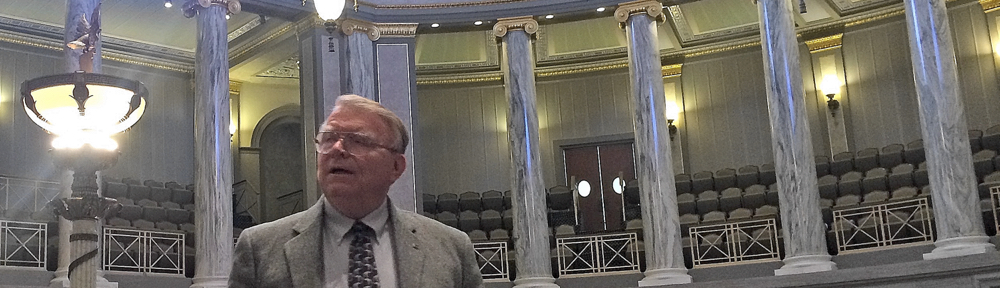
As I recall, something like eight-million dollars had been set aside for continued architectural restoration but when the economy went south after the terrorists attacks, that money had to be withdrawn and put into the general operational budget of the state. Many years later, under the auspices of the Capitol Commission, architectural restoration has resumed, the most prominent feature being the Herman Schladermundt’s epic stained glass window over the grand stairway and the restoration of that entire area to the color scheme of 1917.
Tom has long been fascinated by the state seal and when the House was redone in 1988, the state seal was of special interest. For many years, the bears in the state seal had been painted white. They’re grizzlies, not polar bears so Tom in all of the state seal work he has done through the years has painted the bears brown.

If you want to see his version of the state seal up close, drop in at the Missouri River Regional Library which occupies the area that was the home of Robert W. Wells, the designer of the seal. We have one of Tom’s seals on display there.
Wells was the third Attorney General of Missouri (1826-1836) then was federal district court judge 1836-1864. He died while still serving.
Wells’ design of the state seal was adopted on January 11, 1822. The seal legislation provides the confusion about what color the bears are, but not what kind of bears they are.
Here is the official description—
The device for an armorial achievement for the State of Missouri shall be as follows, to wit: Arms, parted per pale, on the dexter side; gules, the white or grizzly bear of Missouri, passant guardant, proper on a chief engrailed; azure, a crescent argent; on the sinister side, argent, the arms of the United States; the whole with a band inscribed with the words `United We Stand, Divided We Fall.’ For the crest, over a helmet full faced, grated with six bars, or a cloud proper, from which ascends a star, argent, on an azure field, surrounded by a cloud proper. Supporters on each side, a white or grizzly bear of Missouri, rampant, guardant proper, standing on a scroll, inscribed with the motto: `Salus Populi Suprema Lex Esto,’ and under the scroll the numerical letters MDCCCXX. And the great seal of the state shall be so engraved as to present by its impression the device of the armorial achievement aforesaid, surrounded by a scroll inscribed with the words, “The Great Seal of Missouri,” in Roman capitals; which seal shall be in a circular form, and not more than two and a half inches in diameter.
The Missouri Conservation Department has said, “The bears on the Great Seal of the State of Missouri are grizzly bears, which never resided in the state.” Although the Seal specifies grizzly bears, many think the 19th century renderings of the state seal shows semi-cuddly black bears. bears, which were and now again are located in Missouri. Not until late in the 20th Century were they recognized as Grizzlies.
Why, then, was the phrase “the white or grizzly bear of Missouri” get into this law? Tom thinks he has figured it out. It’s the fault of Lewis and Clark. Several entries in their journals refer to bear sightings. The first time they encountered a Grizzly was October 7, 1804 when Clark wrote, “we Saw the Tracks of White bear which was verry large” at a place 15 miles downstream from present Mobridge South Dakota. Note the phrase that refers to “tracks of white bear,” not “a” white bear. Just “white bear.”
Tom thinks they referred to “white” bears to distinguish them from the black bears they had seen and recorded downstream.
The first publication of some of the journals was in 1814 by Philadelphia banker and historian Nicholas Biddle, later know for his feud with Andrew Jackson about the Bank of the United States. In 1810, Biddle met with William Clark. Meriwether Lewis, who was supposed to write it, had died a few months earlier. Biddle became Clark’s choice as Lewis’ replacement.
Tom thinks Robert W. Wells, the circuit attorney in St. Charles 1821-22, then a state representative 1823-1826 when he became Missouri’s third Attorney General and later a federal district judge 1836-1864 (his death) had read the Biddle account.
Although descendants of Rep. George Burkhaltter claim he designed the seal, most sources credit Wells for a couple of reason. He was living in St. Chrles when the first legislative session met in 1821 and Governor McNair complained about the inconvenience of not having a state seal) and thus likely was appointed to design the seal. Burkhartt at the time was a Justice of the Peace in far away Chariton County at that time and was elected to office in 1822, the same year Wells was elected to the House . If he designed the seal, he must have been very quick.
The logic of most sources is that Wells’ proximity to the first legislature meetings in St. Charles and his position that enabled him to mix with the first governor and the timing of the sequence of events leading up to the approval of the seal make him the more likely designer. Burkhartt died in 1828. Nineteen years later Wells wrote a lengthy description of the meaning of the elements of the seal that was published in the March 23, 1847 issue of the Missouri State Times.In the article he referred to himself as “I am the original author of the original suggestion of our coat of arms, I suppose the explanation would come from me as from others.”
He explained the white, or grizzly bears;
“The white or grisly bear is unlike any other and was believed to be unknown except on the Missouri and in the neighborhood and was adopted on account of its vast power, great courage, and prodigious hardihood; emblematical of the great resources of the state and the courage and hardihood of its citizens.”
So Tom has solved the mystery of the white bear and is proud that he has restored the brown color of the “grisly” to its rightful places in our capitol.
Sometimes we wonder if Missourians understand that those bears symbolize—courage and hardihood. Our state seal tells us, however, as the old saying put it:
“If you’re going to be a bear, be a Grizzly.”