Our legal system requires attorneys to represent even the worst of us as well as the best and judges who must find justice from within the passionate arguments on behalf of each.
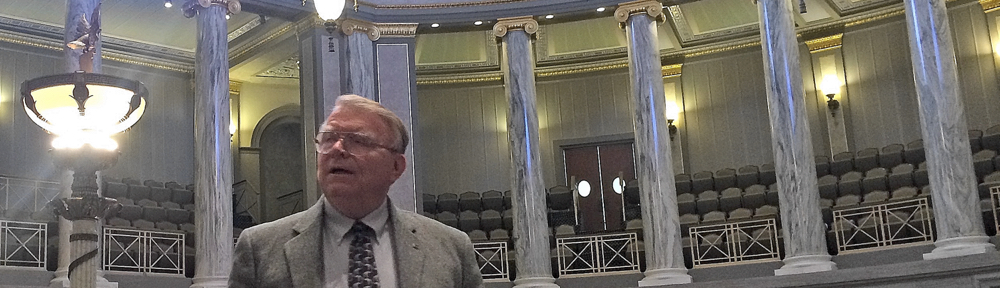
The annual meeting of the Missouri Bar and Judicial Conference held in Kansas City last week featured a luncheon address by Missouri Supreme Court Chief Justice W. Brent Powell. We think his remarks alluding to our times and the judiciary that is immersed in the issues of our times are appropriate to pass along. They are being passed along in hopes we might better understand the role our court system must play, particularly in divisive and threatening times—and how we as those lay people might be better served if we lived by those principles, too.
Powell began by readministering the oath of admission attorneys take upon joining the Missouri Bar, allowing them to legally practice law. One of those in the audience with his right hand upraised was his father. We have done some very light editing for context.

Taking our solemn oath places us in a distinct position of honor and responsibility. Honor, because of the prestige our profession holds in our society – and responsibility, because as attorneys, we are entrusted to tend to the vast legal needs of our fellow citizens and community.
I find it especially fitting to reaffirm our oaths now, 250 years after our nation declared its independence from England. Lawyers played a vital role in that monumental event. Nearly half the colonists who signed the Declaration of Independence were lawyers; many lawyers were elected to serve in the Continental Congress; and lawyers were instrumental in drafting our constitution and shaping our nation’s government. For this reason, our profession is a living bridge, linking us to a time when our founders transformed revolutionary ideals of self-governance and democracy into a new government for a new nation.
Our oath…carries forward the same promises our founding lawyers drafted into our Declaration of Independence and constitution. One of those lawyers was John Adams, who famously proclaimed our nation would be a “government of laws, not of men.” This simple proclamation defined who we are as a people: bound together – not by a monarch or politician – but by the laws enacted through our own self-government. We, as a people, agree to be governed and abide by this law because the law emanates from ourselves. This is our social contract enshrined in our federal and state constitutions, ensuring the rule of law – not autocrats or tyrants – govern our way of life.
But we all must recognize what Adams and our legal predecessors understood: for our government to survive and thrive, the rule of law – this foundation on which we all coexist – must be guarded continuously and preserved purposefully. Recognizing the importance of this civic virtue, Benjamin Franklin famously remarked we have a republic, if we can keep it. This responsibility – the responsibility to preserve our republic – falls to us and all our brothers and sisters in our profession…
One of the first and paramount obligations our oath places upon us is to support the constitution of the United States and the constitution of the state of Missouri. This dual allegiance protects the grand experiment of federalism and the balance of governmental power our founders envisioned. Together, those constitutions establish a system of governance balancing authority between federal and state sovereigns and among three branches of government. They also preserve for all citizens the right to self-governance and guarantee their individual rights.
This balance of governmental authority rests on a precarious fulcrum. The power reserved for our citizens, and the rights guaranteed to them, can easily be overlooked and abused. The scales can also be tipped – improperly shifting power among government authorities. Our oath requires us to safeguard this delicate balance, ensuring neither the people’s rights nor the authority bestowed upon each of our three branches of government are trampled or ignored. This is our collective role in a constitutional republic built on checks and balances.
But today, we face threats – threats from those who seek to detract from the ideals of our republic and to undermine faith in our sacred institutions – including our legal profession and our courts. Unfortunately, some of these threats originate from within our own ranks. We must respond to these threats as our founders responded to the tyranny of an autocrat. It is incumbent on all of us as lawyers and judges to rise up and defend our constitutions and the rule of law.
We must vigorously and emphatically advocate the values of our republic by educating our fellow citizens about how laws are passed, how courts work, how judges make decisions, and how we are bound by these laws and court decisions – even when we may legitimately disagree with them. We owe our allegiance to the constitution and the law, not to our personal or political preferences – even, and especially, when doing so conflicts with our own views and beliefs.
For this reason, the trust endowed in us is extraordinary. Individuals trust their doctors with their health and wellbeing. They trust their accountants and bankers with their money and financial security. And they trust architects and engineers with the soundness of the structures and products they design and build. But they trust lawyers and judges…with the systems and institutions to provide the just and fair society in which we all live.
This trust is immense and carries with it an equally somber recognition – that we must continue to earn that trust every day, through every action we take and every word we speak, to prove to our fellow Missourians we lawyers can carry the weight of their trust.
How we prove we are worthy of this trust is demonstrated in the words of our oath. We promise to maintain the respect due to courts of justice, judicial officers and members of our profession. We promise to conduct ourselves with dignity. We promise never to mislead a judge or jury by any artifice of false statement of fact or law. And we promise to conduct ourselves in accordance with the rules of professional conduct.
Stated simply, our oath as lawyers instructs us to always act with the dignity and uprightness our profession demands. It applies not only inside conference rooms and courtrooms but in the community as well. Being a lawyer is not just a job; it must be who we are and what defines us as professionals. If we act dishonorably, we cannot expect anyone else to honor our legal institutions and the rule of law. If we act dishonestly, we cannot be surprised when others treat our laws and courtrooms with disrespect and disdain.
Never forget it was tyranny of a monarch an ocean away that led the colonists to declare our independence, but history is full of lessons of tyranny reemerging and thriving when citizens lose faith in justice and the rule of law. Citizens rely on us as lawyers and judges – as professionals sworn to uphold the law – to make justice happen every day in every community in our state. Every transaction and every trial conducted fairly and openly reinforces the foundation laid in 1776. In this way, our profession – and our professionalism – are critical to preserving public trust in government.
But professionalism does not require grandiose deeds or acts – and can be accomplished in quiet, effortless ways. We must seek to solve disputes, not create them. We must act with grace, honor, and a moral and just purpose. We cannot let zealous advocacy devolve into malice, acrimony, vitriol, meanness, or nastiness. And in a world in which it is increasingly difficult to tell fact from fiction, and hyperbole from downright lies, it is essential we – as lawyers bound by a common oath – never, ever forget we are bound to tell the truth. Your reputation as an individual lawyer – and the reputation of our entire profession – depends on never letting advocacy get in the way of truth.
I don’t need to tell you that we live in a divided nation and state. This is not a new phenomenon, but technology provides new ways to divide us. Spurred by misinformation, disinformation, and the echo-chamber traps our social media algorithms build, the discord and viciousness in our society has invaded our schools, our churches, and even our family living rooms and dinner tables, where divisiveness was ordinarily absent…
We don’t have to sacrifice our beliefs and values. But we must listen to one another … including those with whom we vehemently disagree. We must show empathy … especially when doing so is uncomfortable. And we must care for others … particularly those we may find distasteful or disdain. These are important lessons I learned from my dad. And it’s what our oath requires of us.
Another lesson I learned from my father is a shared commitment to service. Our oath commits all of us, as a profession, to serve others. Our oath requires us to practice law with consideration for the defenseless and oppressed. This ending to our oath is deeply rooted in our history, as both lawyers and as Americans. Our Declaration of Independence boldly proclaims all people are created equal. Throughout history, it has fallen on lawyers – and judges – to bridge the gap between this founding ideal and the realities in which we live. Because for too many, this promise remains unfulfilled.
The promises secured for us in the Declaration of Independence and our constitution are only as strong as our profession’s ability to deliver them. But today, some of those promises are beginning to collapse around us. Half of Americans think our legal system offers two systems of justice: one for those with money or connections, and one for everyone else. We struggle to provide quality legal services to people in every corner of our state at rates people can actually afford. More than three-quarters of our fellow citizens don’t know where to turn for legal help and they believe they must go to court, draft contracts, probate estates, or get divorced without a lawyer – because they can’t afford one.
With the rise of AI, we must be concerned about pricing ourselves out of our own profession. Everyone in this room understands the value of an attorney in shepherding clients through their legal issues, both inside and outside the courtroom. But a short hop online illustrates the folly of this belief. The internet offers any number of AI “solutions” to address legal needs. But the world-wide web is also full of cautionary tales of what happens when a lawyer or self-represented litigant relies too heavily on AI to “help” them with a case. An AI solution may look like help, it may sound like help, but the whole thing might just be a hallucination. And the types of legal issues people face in their everyday lives – contract disputes, family law issues, probate matters, and other civil disputes – are far too important to be left to hallucinations. People deserve human lawyers like you to assist them with their legal needs.
Make no mistake: AI is here to stay. Every year, every month, every day, and every second, AI continues to revolutionize how things are done, in ways we struggle to comprehend. But we cannot just stand idly by, because others will fill any gap we choose to ignore. Our rules of professional conduct require us to remain vigilant and do our homework – including learning about new technology that may scare us at times.
We also need to do some soul-searching, as a profession. More than ever, the rise of technology requires us all to remember our oath to serve others for the benefit of those in need of affordable legal services. We owe it to our fellow Missourians to demonstrate our value; embrace technology tools appropriately to enhance the services we provide the public; and keep the crucial role of human lawyers intrinsically involved in providing legal services to those who need it…
Our duty is to our clients and the public at large, not our individual concerns. None of us should let personal success make us apathetic toward the needs of our fellow citizens. Instead, we should use our education and privilege to serve others. But giving of oneself – abiding by our oath as lawyers – is not easy. It means devoting our lives to others, overcoming our inherent desire to improve our own condition. I confess, I struggle with this. It’s hard to live up to such a high standard, and far easier to find comfort in serving my own needs and desires.

Fortunately, I have been so very blessed to see my father modeling what being a lawyer is truly all about – diligent, ethical, and honorable service … to his clients, to his profession, and to his community. Throughout his decades of practice, he was a strong advocate, but he also knew how to disagree without being disagreeable, and how to build bridges through compassion and kindness rather than sowing seeds of dissention. In a nutshell, he fulfilled our solemn oath every single day. Let’s all strive to be a lawyer like my father.
If I can ask one thing of all of you – just one thing – endeavor every single day to fulfill the oath you reaffirmed this afternoon. By fulfilling our solemn oath, we can build upon the blueprint of the Declaration of Independence and our constitutions, ensuring the rule of law and our way of life endure for the next 250 years. If we do this one thing, then I have faith and hope the stability of our republic and civil society will be sustained. And you, I, and those who come after us will all be better off because of it.
We appreciate Chief Justice Powell’s remarks, not just in reference to what lawyers and judges should be and should do, but in the kind of citizens all of us should strive to be.
(Photo credit: The Missouri Bar and Google Images)