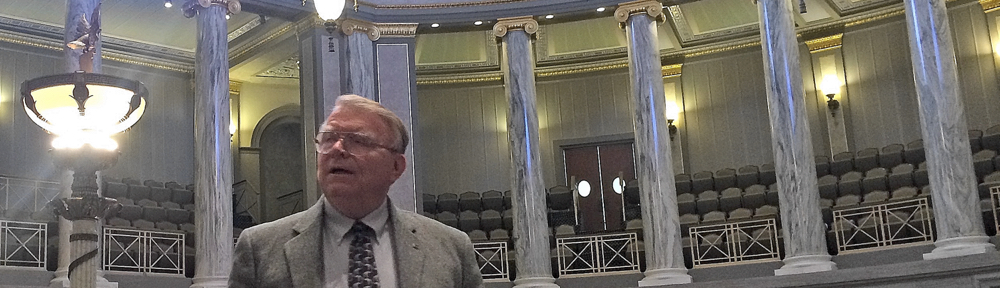
Kind of the way things were back in our courting days.
We went to our GQT Capital 8 Theatre and we bought our popcorn and our sugar-free soft drink and sat down in some nice roomy seats. Just as the pre-movie trivia game was about to start for the three of us in the theatre, one of the theatre employees told us tornado sirens were blowing and we needed to take refuge in the bathrooms.
After an hour or so in what became two unisex bathrooms, the theatre folks gave us passes for some other night.
So we went back Saturday with our visiting daughter Liz, used our free passes and our free concessions tickets and settled into watch A GREAT AWAKENING.
We watched the charming young lady from Noovie host the various short word games or trivia questions and then theatre exploded with a deafening display of the latest in DOLBY sound technology. Then the previews came on—one movie featuring real people and four or five featuring cartoon people. All at beyond maximum volume, apparently to make the explosions that replace plots in today’s flicks more fearful.
Finally, we got to the feature. It was so loud I took out my hearing aids and even then it was so loud that I decided, as I told Nancy and Liz later, that I was eager to see the movie on TV so the sound level wasn’t so distracting as to spoil the story. I walked out of the theatre that night feeling exhausted.
Not only that, but the popcorn was mediocre. I get better popcorn at a convenience store on the other side of town.
Come to think of it, the best part of the experience was being able to go to the men’s restroom without some women in there, too. It was a safe experience in the bathroom but a danger to my hearing in the auditorium.
The movie? Pretty good for an almost-Hollywood production. Interesting story that, on reflection, lacked a little of the sophistication in story-telling and dialogue that the major studios produce.
It was produced by Sight & Sound Films, a Christian-themed spinoff of Sight and Sound Theatres, the company that has produced Biblical-themed shows in Branson for some time. In case you missed the point the movie was trying to make, the producers give it to you during the credits: “True liberty comes through Jesus Christ.” I found the statement in conflict with what I had just watched (or endured).
The movie tracks the unusual relationship between the passionate English Methodist evangelist George Whitefield (he pronounced it as if it had no “e” in the middle), who was trained as a stage actor, and the calculating and politically savvy printer, later inventor and sage who was a key to writing the Declaration of Independence and the U. S. Constitution, Benjamin Franklin, played impressively by John Paul Sneed.
Franklin realized he could profit from printing Whitefield’s sermons. Whitefield realized he could reach more people if he allowed Franklin to print and circulate his words.

(George Whitefield—The Genevan Foundation (With his “lazy left eye” sometimes George Whitefield was derisively called “Dr. Squintum” by his many detractors)
Whitefield is portrayed by a young and handsome actor with no English accent and no resemblance to the real Whitefield an instantly-inspirational figure who spoke to thousands who quickly became “saved” by his dynamic sermons. Franklin is the Franklin of our familiarity—a Christian, generally, who differ from those who think the only way to God is through Christ, which is Whitefield’s message.
The opening sequence shows members of the Constitutional Convention in prolonged shouted arguments that did not deserve the theatre sound system, with the aged Franklin thinking about how he could quiet the tumult. He thinks of Whitefield, one of the Great Awakening preachers who transformed early Americans from followers of traditional European religious practices into independent believers developing personal relationships with the Almighty, a significant part of the transformation of subservient British colonies into a people of a new identity that rebelled against the religious, political, and social structures of the Old World.
Someone asks Franklin in the opening sequence about the Revolution and he responds, “George Whitefield WAS the Revolution,” thus establishing the theme of the movie on a statement that Franklin never made.
The movie also contained another small detail that was slightly irritating. Franklin refers to his grandson as Benjamin Franklin BACH, His last name was BACHE—“baich.”
Franklin never converted to Whitefield’s evangelical Christianity. He remained a deist. In a 1790 letter to a friend who asked his opinion of Jesus, he wrote, “I think his system of morals and his religion, as he left them to us, the best the world ever saw or is like to see; but I apprehend it has received various corrupting changes, and I have, with most of the present Dissenters in England, some doubts as to his Divinity; though it is a question I do not dogmatize on, having never studied it, and think it needless to busy myself with it now, when I expect soon an opportunity of knowing the truth with less trouble.”
We last see Whitefield after he has collapsed with a serious asthma attack and being helped up by Franklin and then insisting that he go outside to preach. He walks through a door, light spilling in as he goes out.
No date is shown for the incident—if it really did occur—but he died in 1770, five years before the first shots of the Revolution were fired but having been a significant part of the religious, social and political influences that evolved into the Revolution.
The closing scene takes us back to the disorderly Constitutional Convention. There, we seen Sneed as Franklin with an eloquent speech that Franklin really did give in which he observed, “In this situation of this Assembly groping as it were in the dark to find political truth, and scarce able to distinguish it when presented to us, how has it happened, Sir, that we have not hitherto once thought of humbly applying to the Father of lights to illuminate our understandings?” At the end he suggests “prayers imploring the assistance of Heaven, and its blessings on our deliberations, be held in this Assembly every morning before we proceed to business.”
The convention was split on the idea and no vote was taken before adjournment.
And there the movie ends with words on a black screen telling us that the convention never did open with prayers although the Congress it created soon began doing so.
And then comes the line as the credits rolled that seemed incongruous: “True liberty comes through Jesus Christ.”
If that is the point of the Whitefield/Franklin relationship, the relationship was a failure. If the implication is that Whitefield’s Jesus was the motivator for the American Revolution or for the Constitution that came afterwards, it fails again. Franklin never adopted Whitefield’s interpretations. The great documents—the Declaration and the Constitution—do not mention Jesus.
The Constitution does not mention God. The Declaration refers to “nature’s god,” not a god of any particular religion.
Those who gave us these documents and this country were products of a larger intellectual revolution—the Enlightenment that argued reason, science and Individual liberty were the tools of reforming government, with religion, particularly the Christian religion, playing only a part.
In truth, liberty came from numerous sources and The Great Awakening was only a part of that movement.
And Benjamin Franklin never had a great awakening. The statement seemed out of place and not in context with the story told in the film.
Whitefield was not, in fact, the Revolution. He was one of many parts and one of the two great preachers of the awakening; Puritan Jonathan Edwards was the other. Several others might have a stronger claim to being the Revolution—Samuel Adams, for example, along with others who risked everything when they signed the Declaration.
Should you see the movie despite my possible nit-picking? Probably, although it simplifies the characters of Whitefield and Franklin and their times and as a whole constitutes proselytizing, punctuated by the troubling line on the screen at the end.
Aside from starting with something never said and ending with something that seems inconsistent with the story, it’s not bad. It is to some degree at least thought-provoking. And it does bring to light a part of the history of the times when we became a nation.
I’m going to watch it again in the peace and quiet of my living room someday.
Here’s another review that takes a somewhat different approach—
Historical Drama ‘A Great Awakening’ A Film That Might Put You To Sleep
-0-