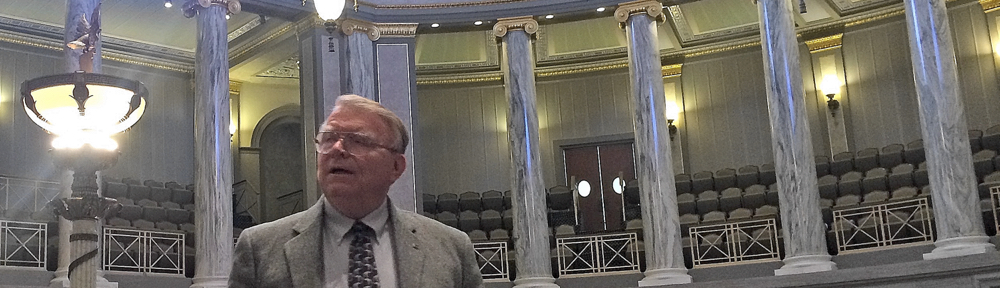
I walked out of the Missouri Supreme Court building last Tuesday and saw large crowd across the street chanting:
“The People,
United
Will Not Be Defeated.”
It was a “People Not Politicians” demonstration urging the court to throw out the new congressional district map enacted by the legislature to protect President Trump from a new Congress that would hold him more responsible for his acts than his timid GOP Solons are doing now.
Later the group crossed the street and paraded in front of the court building.
—-and about four hours later, the court ruled against People Not Politicians on all three cases it had heard that morning.
Please do not take this to suggest people should not gather for this purpose, but protest demonstrations and marches in these situations are of limited utility.
Rallies to get and to keep people involved in public policy-setting are important. But in terms of forcing a change in direction by government far more is required.
Every year during a legislative session, thousands of people representing one cause or another, or one profession or another, organize “Day at the Capitol” events when they bus in dozens of people, many of whom have no experience in Capitol politics, to go to legislative offices to make their cases. For many, perhaps most, of these people, this is the only time they relate to their lawmaker, who usually is in the chamber working on legislative business. So they drop off some brochures or information packets and then check their lists to see whose office they will visit next.
Days at the Capitol join demonstrations and marches, in general, with having little lasting impact.
Here are some things that do work:
Money.
Sayings such as “Money greases the wheels of politics,” or “Money is the lifeblood of politics” are, unfortunately, part of our system of government. This is not to say that those we elect can be bought, at least not directly. But money buys lobbyists. Money for campaigns speaks loudly.
It is often said that money doesn’t buy politicians; it just buys access to politicians. However, the more access you can have, the more influence you might be able to exercise. That is the world they live in. It is wrong, however, to assume that all who live in this world are corrupt. In all my forty-some years of covering Missouri government, probably no more than twenty legislators and state officers were sent to prison or removed from their jobs, less than two percent of all of the people I covered in the pressure cooker of Missouri politics.
When your legislators drive across the bridge or under the viaducts to enter Jefferson City, they are entering a bubble that has a tendency to be all-absorbing of their attention. It is a special world where the focus of those working in it is entirely on the issues in front of them. Home can become a long ways away. The pressure is enormous and it grows even greater as the pages are peeled off of the calendar.
On Tuesday, the day the Supreme Court heard the redistricting cases, the House and the Senate met for the 68th time this year.
The session ended after 71 working days. Here’s what the lawmakers were facing: 1,002 Senate bills and resolutions introduced this year and 2,101 bills and resolutions introduced in the House—by our count. That’s 3,103 proposals, many of them duplicates or more.
The legislative process becomes a highly-selective and highly subjective matter. What goes on in the Capitol is an intense winnowing that will produce, in a good year, 100-125 agreements on legislation. This year, the total was about 90, a big improvement over recent years when a few members of the Senate decided that if they could not get their way, the large majority wouldn’t get anything done.
About twenty of those bills each year detail the way the state will spend money on programs and services that people want or need. Even the most skilled lobbyist for even the wealthiest interest group realizes that legislative sessions resemble a crap shoot. Few things are guaranteed from the outset. Not even the governor is guaranteed approval of his issues.
It is easier to get some things approved when one party occupies two-thirds of both seats in the House and Senate—such as the protect-the-President redistricting plan upheld by the Supreme Court last Tuesday. Many of the protestors likely would have asserted that some words carved into a Missouri Senate wall were clearly ignored: “Nothing is politically right that is morally wrong.”
Noble words carved into Capitol stone are easier said than honored at times, in a system that is shaped by humans.
None of this should be considered excuses. It’s just the real world.
While all of this might sound as if there is no hope for principled protestors such as the People Not Politics demonstrators Tuesday, there is hope.
The congressional districts are drawn presumably to change our 6-2 Republican delegation in the United States House to 7-1. Even some Republicans have admitted publicly that the new maps should not be considered a predetermined result. They know a lot of public opinion can be swayed between now and November.
If that is going to be the case, Tuesday’s marchers will have to be more effective at home than they have been in Jefferson City. One day at the Capitol cannot replace many well-organized days on the streets at home. Their cause is more persuasive among the voters than among the lawmakers and judges. No Republican candidate should feel comfortable in their re-election campaigns this year, especially since the court has upheld that map. Donald Trump can be his party’s own worst enemy regardless of congressional district lines. The PNP demonstrators can become a formidable force if they organize at home and advocate against those who support President Trump in spite of all of his sins—especially those who passed the redistricting bill that manipulates our political system.
The battleground is not in front of the Supreme Court building. It is in the cities and counties of each congressional district and each legislative district. Redistricting can become a major issue against the party that did it, whether it’s the legislators who drew the lines or the congressional candidates who want to take advantage of them.
The Republicans have gotten what they wished for. But you know the old saying about being careful that what you wish for because what you got can become an issue of voter retribution.
This is not a suggestion that all of the rascals should be turned out. It is, instead, an observation of how those opposed to the redistricting scheme can turn it against the scheme’s advocates and a warning to those advocates to be prepared in their own defense.
In 2016, Senator Ted Cruz told ABC’s Face the Nation, ““If we’re given the White House and both houses of Congress and we don’t deliver, I think there will be pitchforks and torches in the streets. And I think quite rightly,” a metaphorical reference to England’s Peasant’s Revolt of 1381 against a perceived unjust government.
Will the Supreme Court marchers from last Tuesday go home and become the organizers and the activists—the pitchfork and torch carriers—whose biggest and most effective protest will be at the ballot box?
Will they create a united people who will not be defeated?
We’ll all see an answer in a little more than five months.
Well said!