Never before in the history of the world—

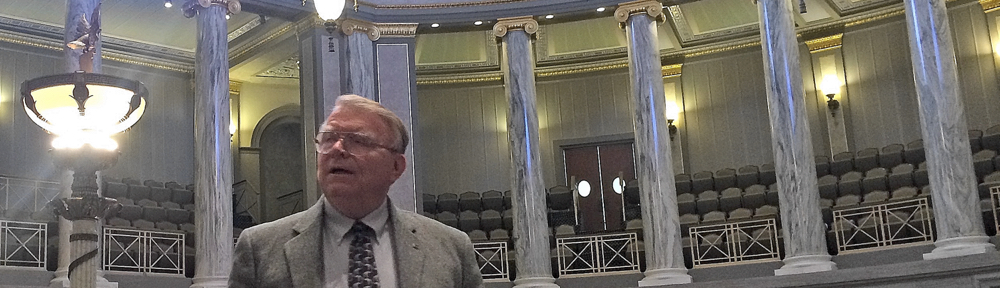
Only a small percentage of visitors to Missouri’s Capitol get to go up to the Whispering Gallery, a place where a person can stand facing the wall and whisper something that is clearly heard by someone facing the wall on the other side of the gallery.  It is unlikely that those who have been there or those who have noticed from their position far below the railing high up in the dome that is the gallery’s home have ever heard that the Missouri Capitol Whispering Gallery was unique in the history of architecture when it was designed.

Never had anything like it been done before.  And as far as we know, the story has never been told before. Or if it has, it hasn’t been told for a long, long time.

Deep in the files of the Capitol Commission Board at the Missouri State Archives is a letter written September 29, 1924 by Egerton Swartwout, the architect whose firm designed our capitol, a few days before the building’s dedication in 1924.  This letter, as is the case with so many of his letters, is an incredibly human document these ninety-plus years after that event.  In it, he recalls his company getting the bid to design the building, the struggles with the contractor over the stone to be used, and other issues that had to be dealt with.  Toward the end of the fourth-page of the five-page letter, he writes of his partner, Evarts Tracy, who had left the firm to help create the Army’s Camouflage Corps during World War I and who had died in Paris in 1921 while helping the French with their postwar reconstruction effort, “Poor Tracy, he was extremely interested in the Capitol and very proud of it and one of the things that appealed to him particularly was the whispering gallery, the only one, by the way, that has ever been made artificially, or rather made on purpose, and that was done by Professor Sabine.   Poor chap, he is dead now but he talked to me about it often and mentions it in his Memoires…”

That mention sent us off in search of Wallace Sabine and his memoirs.  Wallace Sabine was a physics professor at Harvard when Tracy and Swartwout were students there.  When Harvard built the Fogg Auditorium, the school quickly learned the audience could not hear what was being said on the stage and asked Sabine to find out why.  Sabine’s research made him the father of architectural acoustics. The measurement of sound absorption today is the Sabin.  When Tracy and Swartwout were designing the capitol in 1913, they sought Sabine’s advice for ways to make sure members of the House and Senate could hear the speakers in their cavernous, stone-lined chambers.  The sound-absorbing curtains and fabrics in both chambers, including in the ceilings, are the result of Sabine’s study of the original plans.  Some old timers your reporter talked to a long time ago recalled that debate could be heard in the pre-public address system days quite well.

Sabine was only fifty when he died in 1919. His successor at Harvard as the Hollis Chair of Mathematics and Natural Philosophy, Theodore Lyman, edited a volume of Sabine’s papers and speeches and even some unpublished presentation, one of which was about whispering galleries.”

Sabine began that paper, “It is probable that all existing whispering galleries, it is certain that the six most famous ones, are accidents; it is equally certain that all could have been predetermined without difficulty and like most accidents could have been improved upon.”  There six he wrote about in his paper were the dome of St. Paul’s Cathedral in London, Statuary Hall at the Capitol in Washington, The vases in the Salle Des Cariatides in the Louvre in Paris, St. John Lateran in Rome, the Ear of Dionysius at Syracuse, and the Cathedral of Girgenti.  Statuary Hall in our nation’s capitol was the original chamber of the United States House of Representatives until it was outgrown.

Eighteen pages into his discussion of whispering galleries, the father of architectural acoustics wrote that the whispering gallery at St. Paul’s Cathedral in London could have been more efficient had the walls been “slightly, indeed almost imperceptibly curved.” And then he continues, “Such a gallery will be in the dome of the Missouri State Capitol, a gallery unique in this respect that will have been planned intentionally by the architects.”

By the time this paper was published in 1921, editor Lyman added, “The building is now complete. One of the architects, Mr. Edgerton [sic] Swartwout, reports that the whispering gallery in the dome exactly fulfills Professor Sabine’s prediction and has been the cause of much curiosity and astonishment.”

There was some technical stuff in the paper that explained why our whispering gallery works so well and was better than any of the “accidental” ones in previous world history that we won’t get into.   But the fact remains—-

The Missouri Capitol’s whispering gallery was the first one in the entire history of world architecture that was designed specifically to be a whispering gallery.

We just dug that story out in the last ten days or so to put in the next capitol book (don’t ask us when it will be out—maybe 2019 if things work out but look for it when you see it).  But we couldn’t wait that long to tell it.  We’ve known our capitol is an extraordinary place.  But this feature puts it on a whole new scale.

There have been several intentional whispering galleries built in this country and internationally since then.  But the Swartwout/Sabine Whispering Gallery in the Missouri Capitol was the first of its kind.

Ever.

Next time you’re in the rotunda. Look up.  Climb up, if you have permission.  And step through a door to world architectural history.

(The photo is from the blog, “Opulent Opossum,” by Julianna Schroeder, who said some nice things about the Capitol art book back in 2011.  She was a great editor to work with.)

We’ll get around to it eventually. Maybe.

Let us not cast stones at Jefferson City for being a town that likes to talk about things for a long time before doing them.  This is, after all, a government town where many of its citizens spend their days in cubicles, and those citizens are masters at conducting meetings and talking about things and making reports and then putting the reports on shelves until they have another round of meetings.  You probably have heard of the new task force that studied state transportation needs and financing of them—five years after another task force studied state transportation needs and financing of them?

While doing some research at the State Historical Society the other day, I came across a newspaper article headlined, “Mrs. Jas. Houchin Starts Movement for $50,000.00     Y. M.C.A. in Jefferson City.”   It was October, 1915.

The organization of a Young Men’s Christian Association and the construction of a well-equipped building as its headquarters is the plan which Mrs. James A. Houchin has conceived and will carry out within the next year, probably within the next few months.

She already had put down five-thousand dollars on a lot.  “I believe the building should have a gymnasium and a swimming pool.  It will maintain a library, reading rooms and a basketball court,” she said.  She was impressed with the YMCA in Sedalia which had bedrooms on its third floor to rent to club members.

Mrs. Houchin died in 1924.  Jefferson City finally formed its “Y” in 1970.

-0-

We are still waiting on another idea, though.  The Daily Capital News on June 7, 1923 carried a letter on the front page from local lawyer and legislator A. T. Dumm saying it was time the people of the capital city built a convention hall.  Dumm was the president of the Commercial Club—which later was the Chamber of Commerce—and was a member of the state constitutional convention that had recently met.

Editor Capital News:  Responding to your request for a suggestion for the advancement and betterment of Jefferson City, I beg to suggest, for the consideration of your readers and the community, the idea of a convention hall. 

I think we have reached a point in our growth and population where we might confidently launch such an enterprise and that it is highly desirable if not absolutely necessary must be evident…

Jefferson City, like every other city of its class and consequence, must be prepared to meet the demands and requirements, not only of its own people, but of those who, through business or pleasure, become our guests. 

We pride ourselves on the fact that we are the capital of a great state, but we should have a personality and an individuality of our own and not be dependent upon the state for the means of hospitality and entertainment for our visitors.  Outside of the two great cities, we are fast becoming the convention city of the state, and our importance in this respect will increase with every passing year.

A Convention Hall, centrally located, built and paid for by our own people, for the free use of our people and those who come to the capital, would, in my opinion, result in a great increase of our civic pride and advertise us throughout the state more favorably and extensively than any other single factor except good streets in the city and good roads leading to the city.

His friends called him “Tom,” because of his middle name.  He died in 1930.

It took fifty-five years for Mrs. Houchin’s dream of a YMCA to materialize.  It’s now ninety-four years and still talking since Tom Dumm voiced his hope.

Carol

It’s not one of the Christmas carols or hymns we are likely to hear in our churches during this holiday season, but it’s one we need to hear in a year when brotherhood has taken a beating throughout the world.

There are thousands of paintings and other depictions of Jesus, the most ubiquitous—probably—being those of Warner Sallman, particularly his “Head of Christ,” which has been reproduced a half-billion times, some say.  But Jesus probably didn’t look much like the pretty Aryan Jesus made famous by Sallman. And how he really looked is immaterial anyway.  It’s how we see him.

And that brings to Alfred Burt and his wonderful Christmas carol, “Some See Him…”

Alfred Burt was the son of an Episcopal minister in Michigan who began in 1922 the custom of sending special Christmas cards to parishioners that included the words and music for a new Christmas Carol the Reverend Bates Burt had composed. After Alfred graduated from the University of Michigan with a degree in music in 1942, “Dad” Burt suggested he take over the Christmas card custom.  Alfred’s wife, Ann, asked the organist at the Bates’ church to write the lyrics while Alfred wrote the music.

Alfred Burt and Wihla Hudson created fifteen carols before his death because of lung cancer in 1954 at the age of thirty-three.

Their 1951 composition, Some See Him is a favorite in our household and seems appropriate for this year.

Some children see Him lily white,
the baby Jesus born this night.
Some children see Him lily white,
with tresses soft and fair.
Some children see Him bronzed and brown,
The Lord of heav’n to earth come down.
Some children see Him bronzed and brown,
with dark and heavy hair.

Some children see Him almond-eyed,
this Savior whom we kneel beside.
some children see Him almond-eyed,
with skin of yellow hue.
Some children see Him dark as they,
sweet Mary’s Son to whom we pray.
Some children see him dark as they,
and, ah! they love Him, too!

The children in each different place
will see the baby Jesus’ face
like theirs, but bright with heavenly grace,
and filled with holy light.
O lay aside each earthly thing
and with thy heart as offering,
come worship now the infant King.
‘Tis love that’s born tonight!

In a world that sometimes seems pretty short on love and brotherhood, Alfred Burt’s carol seemed to us pretty important—although we aren’t aware of any service where it will be sung.

If you’d like to hear it, we recommend this performance by Santino Fontana and the Mormon Tabernacle Choir:

https://www.youtube.com/watch?v=v83iNif0hEw

And if you are not familiar with the Alfred Burt carols, we invite you to enjoy this first recording of them, in the year after his death, by the Columbia Choir:

https://www.youtube.com/watch?v=RXI6mjujeU8

May we see each other in the spirit of peace this season.

-0-


Waiting for the Nobel Prize

Today we want to recognize an important first step in re-shaping economic thinking so significantly that reducing or eliminating the national debt could be done easily, a concept so brilliant that—if appropriately expanded—could merit international recognition.

The tax bill recently approved by the House of Representatives in Washington proposes to tax graduate student tuition waivers.  For those of us who never got far enough in our higher education to be offered those waivers or who came along before they were widespread in higher education, here’s how they work:

A University tells a student pursuing a master’s degree or a doctorate they will not have to pay tuition if they help teach or do research beneficial to the university.  The university pays those students a small stipend for their work so they can eat and pay their rent.

The House bill wants to consider the tuition waiver as income.   And to tax it.

It is a matter of considering money a person never has and does not spend as income and then levying an income tax on those never-had and unspent funds.   Think of the possibilities!

Paying a tax on the raise you did not get could provide millions of deficit-reducing dollars to the federal government.  Paying a tax on a stock dividend that did not materialize would add even more.  Considering the difference between what you wanted on a car trade-in and what the dealer gave you as income and taxing that amount would add to the deficit-reducing federal income.

Here’s one we thought of the other day when we went to Columbia where the gas price that day was nineteen cents less per gallon than the price in Jefferson City.  We used our grocery store gas rewards card to knock another forty cents a gallon off of the fuel we put in our tank.  Think how much the federal government could collect if it considered supermarket gas refunds as part of our personal income.

Soon the pre-holiday price reductions we are seeing in our stores will give way to the post-holiday sales prices.  If Congress were to take the simple step of taxing the hundreds of millions of dollars that are not spent because of those pre-and-post-holiday price reductions, the annual federal deficit could be eliminated and bites could be taken out of the total national debt.

The car companies are offering multi-thousand dollar incentives to clear their lots of 2017 models.  If Congress were to consider those price reductions as income and tax it, another important debt-reduction step could be taken.

Think of how much money is saved every single day by people who shop at the day-old bread counter at the grocery store.  It might seem like pennies for each loaf, but when applied nationally and for an entire year, taxing the savings on all of those loaves of day-old bread will add up to millions of dollars a year in tax collections.

Oh, and here’s a biggie.  An industry that decides to build a factory, a warehouse, or any other facility in a foreign country instead of in the United States because it can save millions of dollars in construction and operation costs:  If those savings were considered corporate income and taxed—even at the proposed lowered corporate tax rate—the economic benefit would be enormous.

And—oh, wait, there’s one more and it’s particularly appropriate at this time of year.  Further, it’s pretty comparable to the tuition waiver.   We are awash in online and catalog offers to provide customers with a benefit if the customer provides something of value to the merchant in return for which the merchant waives a fee or charge.  Give us money, says the merchant, and we will give you a sweater but we will waive the shipping charge.  Since the customer receives the benefit–a sweater—but spends no money to receive it, the shipping charge is thus income and can be taxed as such, just as a graduate student receives a benefit—an education—by providing something of value to the university (teaching or research assistance) but does not pay the equivalent of a “shipping charge” to get it and therefore faces paying income taxes on money never possessed or spent.

Think of the incredible benefits this economic philosophy of turning unspent dollars into taxable income could provide if applied widely, assuming the federal government doesn’t just increase spending to or beyond the amount of additional funds it would collect.  Congress could wipe out the national deficit and it could provide billions of dollars that could trickle down throughout America in programs and services beneficial to the poor, the hungry, the sick.

And to graduate students.

We’ll be watching for next year’s announcement of the Nobel Prize for Economics to see if this great advance is deservedly rewarded.

Notes from the road–November

(Tick line, Kansas)—Trivia question:

What was the tick line?

Nancy and I crossed it a few days ago on our ten-day excursion to and from Colorado, where we spent Thanksgiving helping our son and his family move into a new house.

Kansas had a tick line.

In the years right after the Civil War, there was a shortage of beef in the northern states.  At the same time, Texas had millions of cattle and no significant market for them. But a lot of those cattle were infested with ticks that killed Kansas farmers’ dairy cows, leading the legislature to pass a law basically banning Texas cattle east of Topeka, an area that was filling up with new farmer-settlers.

A nice tourism magazine we picked up in Abilene tells the story of one Joseph G. McCoy, an Illinois fellow who realized Texas’ two-dollar-a head cattle were worth twenty times that much in Chicago and set out to find a place west of the tick line where trains could haul those infested longhorns to Chicago for slaughter, eliminating contact between them and the Kansas dairy cows.

McCoy settled on Abilene, then a place of “about a dozen log cabins and dugouts” where one entrepreneur was trying to solve the community’s prairie dog overpopulation problem by selling pairs of them to tourists for five dollars.  The town fathers sold McCoy 480 acres of land that became the destination point for those desperate Texas cattle-raisers. The cattle drives enabled Abilene to flourish—but it did so at the expense of a Missouri city. The unsigned article in the Abilene Chamber of Commerce magazine is a little condescending on this point:

Herds were transported in 1866 to Sedalia, Missouri along the first cattle trail.  Why Sedalia isn’t genuinely recognized as the first Cowtown of the West is because very few cattle herds actually made it to their destination.  There were a series of hillbillies guarding the Southern border of Missouri to ensure that the Texas Longhorns carrying the deadly tick fever were not going to cross over. Several drovers lost their lives in an attempt to break through the Missouri wall.  The Sedalia trail was also a nightmare even without the coonskin-capped border patrol because the path would send the drovers through the Ozark Mountains, which isn’t exactly the Rockies, but it wasn’t the best to run thousands of cattle.  Beyond the Ozarks, there was always a possibility of Indian raids in which there were still tribes looking around to establish their dominance in the Wild West even though the government had forced many Native Americans out to unwanted lands.

We suggest the MISSOURI Chamber of Commerce, or at least the Sedalia Chamber, might find itself sipping from the cup of umbrage at that characterization.  Coonskin-capped border patrol?  Hillbilly guards?   Hmmmmmphhhhhhh!

About three-thousand cattle were being brought into Missouri from Texas in the pre-Civil War years but the Texas ticks were hurting Missouri cattle, leading to a proposal in the 1855 legislature to ban diseased cattle from Missouri.

Sedalia, however, became a point for Texas cattle, particularly after the railroad reached there in 1860.  And when the KATY railroad built a line from Sedalia to Texas, the city became a major watering stop for the steam-powered trains that hauled cattle to Chicago in the post-Chisholm Trail days.

But when Joseph McCoy set up shop in Abilene, Sedalia’s development as THE western cattle trail head quickly ended.

The Texas cow boys (it was two separate words in those days) drove a couple million head of cattle up the Chisholm Trail from San Antonio to the railroad at Abilene from about 1867-71. By then, those bothersome Kansas farmers who had learned that winter wheat could flourish in Kansas and argued their land had become too valuable to be tromped on by ticky Texas Cattle, had expanded operations and the tick line kept getting moved farther west and other towns, including rip-roaring Dodge City, had become the cow towns of American West fame.  On March 7, 1885, Kansas enacted a strict quarantine banning Texas cattle everywhere except for December, January, and February—the cold weather months when tick-borne diseases were less likely.

By then the cow boys didn’t need to go to Kansas because the railroads had gone to Texas, including the KATY with its links to our own Abilene-maligned Sedalia.

(Concrete, America)—Covered a lot of miles on I-70—a road that makes any state boring except Missouri, where lax billboard standards just make the state look boring AND trashy—on that trip.

Saw a lot of hybrid vehicles on the road with us including a few Teslas and, as frequently happens, wondered about where they go to recharge.

We recalled that one of the diesel cars we owned years ago had a book in the glove compartment listing gas stations with diesel pumps for cars—they were kind of rare in those days—and we wondered if anybody provided a source for electric car owners that listed places where they could plug in.

Turns out there are at least two sources: Ameren.com and solvingev.com.  Might be kind of nice in MODOT had a webpage with the same information.   But the two sources that we looked at a minute ago show there are a LOT of places to plug in, power up, and go on (kind of a modern Timothy Leary phrase).  And the increasing number reflects the changes that are gaining momentum in our transportation system.  Doesn’t solve the pothole problems, though.  That might be a challenge for the legislature: figure out the equivalent of a gas tax on EV battery fill-ups.

A few years ago we suggested to a national motel chain that it might pick up a lot of customers if it had charging stations for overnight guests.  Still a good idea although we have yet to see a motel with a charging station.

(Wakeeny, Kansas)—This. place. is. starting. to. feel. weird.  Regular readers might recall that last summer we stopped at a motel in this town of fewer than 1800 people three counties away from the Kansas/Colorado border and ran into someone who recognized us from the time many years ago when he worked at the Capitol while I was scratching for news there.  This time we stopped and the young lady behind the desk was from Boonville and used to listen to “Across Our Wide Missouri,” the daily historical program we still do on the Missourinet.

I don’t know, after this, how often we want to stop at Wakeeney in the future.  It’s starting to feel a little Twilight Zoneish, like we’ll wake up some morning and be the only people in the town and we won’t be able to get out.

(Mailbox, Mo.)—Stopped at the post office and picked up our mail held for the last ten days.  46 things.  Ten were catalogs although we were surprised that only one was from L. L. Bean, which usually seems to send us a new one every three days, or from the Duluth people who are almost as prolific.  Of the 46 pieces of mail, only four were personal (cards or letters) unless you count the three bills.  Eleven were solicitations, usually reminders that it’s getting late in the year and you better donate to our cause so you can beat the IRS.  Eight were non-catalog ads, including one from Barnes and Noble which seems to have forgotten that it closed its store here months ago (we also get a lot of email solicitations from Sears, which took their store away from us months ago, too).

Less than ten percent of our mail was from people contacting people.

(Stamp Counter, Mo.)—Mailed a letter the other day and stuck one of those “Forever” stamps on it—you know, the one that’s good no matter what this month’s postage rate is. (We include this in the “notes from the road” entry because we drove to the nearest postal facility to mail the letter instead of raising the flag on the mailbox on the curb.)  The idea came to mind that the postal service should change the image on future “Forever” stamps.    It should be a

Snail.

Why I’m thankful today

It was Thanksgiving Day fifty years ago.  It’s Thanksgiving Day today.

I’m giving thanks for lugging a trombone around for many of the years of the past half-century.  I’m giving thanks for someone who sees cobwebs where I’d never notice them, for someone who says the yard needs improving when I think mowing is good enough, for someone who forced me to accept broccoli a long time ago, for someone who’s been the reason I’m always glad to walk into the house no matter where in the world I’ve been or what I’ve done.

A long time ago my parents got a letter saying I’d been on a date with a girl named Nancy and saying they might be hearing more about her.  I used to carry her trombone to the Missouri Tiger basketball games because she was in Marching Mizzou, which during basketball season was Sitting at the End of the Court Mizzou.  It took a while for things to get serious, couple of years maybe, but personal gravity eventually worked its miracle.

I used to do a “good music” show on a radio station in Columbia, “Matinee at Midnight,” from midnight to 4 a.m.  It was, in those days, the kind of stuff intended to help fog up the windows of cars parked in secluded spots in the Columbia area. Listeners probably figured something was going on when they started hearing Frank Sinatra sing more frequently than the normal music schedule would suggest:

If I don’t see her each day, I miss her
Gee, what a thrill each time I kiss her
I’ve got a terrible case
On Nancy with the laughin’ face

She takes the winter and makes it summer
But summer could take some lessons from her
Picture a tomboy in lace
That’s Nancy with the laughin’ face

Have you ever heard mission bells ringin’?
Well, she’ll give you the very same glow
When she speaks, you would think it was singin’
Just hear her say hello

I swear to goodness you can’t resist her
Sorry for you, she has no sister
No angel could replace
Nancy with the laughin’ face

Keep Betty Grable, Lamour, and Turner
She makes my heart a charcoal burner
It’s heaven when I embrace
My Nancy with the laughin’ face

I never thought of her as a “tomboy in lace,” and she does have two sisters and the first two lines of the last verse stuff about Grable, Lamour, and Turner doesn’t apply (though they probably did for Frank), but the rest of the song pretty much summed things up.  By the time I discovered this song on one of Sinatra’s albums, I was a gone goose.

We got married on Thanksgiving because a college kid and good friend, Jim Pirner, would be home from MU for the long holiday so I could take off four days from the radio station to get married and honeymoon in romantic St. Louis.   In November.

The Hanson farmhouse on a hill outside Rolla was a pretty busy that day with my parents, Nancy’s sisters, and members of the small wedding party spending Thanksgiving Day before that evening’s event.  That evening we all went to the chapel at the Rolla Presbyterian Church for a modest wedding presided over by the minister there and the minister from our student group at the First Christian Church in Columbia. Nancy wore a white wool suit, which was mentioned in the newspaper write-ups in Rolla and back home (for me) in Sullivan Illinois. I wore a three-piece Montgomery Ward blue suit which got no mention whatever in the newspapers. I think we still have those outfits somewhere but they have shrunk a lot in these five decades.

My mother, who enjoyed wearing formals at Eastern Star ceremonies, was disappointed that we were (as she put it) more interested in getting married than in having a wedding.

I don’t know that we thought much about the future although I did calculate how old we’d be when we had been married fifty years.  Nancy and I have ridden the crest of time’s wave and here we are, exactly as old as I calculated we’d be back in 1967.  We’ve had our adventures along the way—buying our first house, deciding we had to get out of the old pile because the winter heating bills were bigger than the mortgage and the water and electrical problems were far beyond our income level to fix, producing a couple of children who have grown up to be smart and handsome adults with families of their own, rafting the Colorado River into the Grand Canyon and hiking out from the bottom to the top of a hot July 5th, finding and mapping ancient pueblos and cliff dwellings in the Four Corners region,

hiking around at Machu Picchu (it’s in the Andes Mountains behind her in the picture), getting face to face with one of the giant tortoises on a Galapagos Island, walking on a glacier at Skagway, following Lewis and Clark’s trail to the Pacific and the Oregon Trail back home, dealing with a ruptured appendix and a broken ankle.  And we can hardly wait until next Spring when we head to Africa.

Here’s another example of how special our lives together are.  We often have driven across Kansas, and do it at least a couple of times a year now that our son lives with his family in Longmont, Colorado, a half-hour north of Denver.   Neither of us minds driving across Kansas.  We swap off every couple of hours which keeps things from being monotonous.  But we’ve decided there must be a mutual genetic disposition toward Kansas.  One side of Nancy’s family has farmed near Larned for more than a hundred years—there are even buffalo wallow in the pastures.  Both sides of my family were from northern Kansas, near Beloit and both of our families were living out there before the Indians were gone.

When navigation systems became options for automobiles, I told dealers I didn’t need one because I had one sitting in the passenger seat with a map in her lap.  We have navigation systems in our cars now.  But Nancy still has a map.  Even on I-70 going across Kansas when getting lost is not an option.  She’s kept me on course in more ways than one and not always on trips.

Seven or eight years ago Nancy heard a city concert band was being formed for people who used to enjoy being in a band in high school or college.  So I’m still carrying her trombone and she is having a good time playing in a band again.  And it’s a good band.

No, it has not just sped by.  It’s been fifty years.  This is our 18,264th day since we put gold rings on each other’s third fingers, left hands (counting leap days).  When we think of all the times we’ve lived through, all the things we’ve done, all the places we’ve been, the children we’ve seen become great grownups, we know that fifty years has been, well, fifty years—a not insignificant length of time.

We don’t mind being as old as we are—although it does give us pause to realize our daughter and our son are plunging toward middle age, which signifies that we must be old, whatever that means.

There have been a lot of those 18,000-some nights when one of my last thoughts has been a little prayer of thanks that we are ending the day beside each other, as we have been beside each other for these fifty years.

Some of you who check in on these entries know how blessed I have been. A girl named Nancy who spent the first 13 years of her life on the Upper Peninsula of Michigan and thinks cold weather is pretty good and Missouri Augusts are insufferable has stayed married to an Illinois boy who loved baling hay on the hottest days of summer and despises winter (although not so much since retirement means staying out of it a lot of the time) for half a century.

Before our household went from two to four, we had season tickets for a few years to the American Theatre in St. Louis, a place now gone but a place where we saw the touring companies of Broadway plays.  One of our favorites was, and is, I Do! I Do! The musical was based on Jan deHartog’s play, The Fourposter. Tom Jones wrote the book and lyrics and Harvey Schmidt wrote the music. We sat in the fifth row to watch the original cast members—Mary Martin and Robert Preston—portray a fifty-year marriage.

Broadway musicals had hit songs that made the popular music charts in those days.  Ed Ames hit the Billboard charts with the song Robert Preston sang:

Sometimes in the morning when shadows are deep
I lie here beside you just watching you sleep
And sometimes I whisper what I’m thinking of
My cup runneth over with love

Sometimes in the evening when you do not see
I study the small things you do constantly
I memorize moments that I’m fondest of
My cup runneth over with love

In only a moment we both will be old
We won’t even notice the world turning cold
And so, in these moments with sunlight above
My cup runneth over with love
With love

Toward the end of the play the characters, Michael and Agnes, look back on their marriage and then look ahead in a tune called “Roll Up the Ribbons.”

Michael-Roll up the ribbons, fold up the papers
Stow all these things away!
This day is done, and another is on its way.
Agnes-Pack up the present; look to the future.
One thing I know is true.
The best day of all is the day that is on its way.
Both-Waiting for you.
The best day of all is the day that is on its way.
Agnes-Waiting for you.
Michael-Waiting for you.
Both-Waiting for you.

So here we are, two Thanksgivings half a century apart.

Forget the Thanksgiving Pilgrim stories.  Nancy and I have lived our own story for fifty years now and it has been good.  And I cannot tell you how thankful I am that I will wake up next to her on the day that is on its way knowing that my cup still runneth over.

Now, if I can get her attention, I’d like a little more gravy.


There used to be some courtesy—

It is hard to imagine that we will ever see something like this article that was in the Jackson Independent, published in Cape Girardeau County on January 5, 1828:

GOOD EXAMPLE TO ELECTORS

The following resolution was unanimously adopted at a meeting of the friends of General Jackson, held in Northumberland County, Kentucky—

Resolved, That we will through the contest for the Presidential Chair, disprove of any vulgar, harsh and unbecoming epithets, or language used, either in relation to our own candidate or the administration party, believing that such things tend to inflame the public mind unnecessarily, and have injurious effects upon the morals of our country.

—Where are those followers of Andy Jackson when we need them?

0000

A 95-year old observation whose time might have come

We are four years away from the centennial of Missouri’s centennial.  Missouri’s bicentennial of statehood also will be the centennial of the Missouri Centennial Road Law.   Not everybody thought it was a good idea then. One editor C. G. Sagaser of the  Huntsville Herald might have been something of a seer when he wrote in his June 10, 1921 edition about an upcoming special session of the legislature that would decide how Missouri’s road system would materialize.

Momentum had been building for a decade to develop a system of hard-surface roads.  Voters in 1920 approved a $60 million dollar bond issue to finance those roads.  The legislature and the governor decided to wait until the summer of 1921 to make that decision.

Four days before the session began, Sagaser said, “Something is about to take place in Jefferson City which means more to Missouri than anything which has happened in the past half century…It is up to this special session to say whether this hard surface road building shall be postponed until road material prices have had an opportunity to decline, or whether we shall blindly proceed to hand out this $60,000,000 at once…”

Then there’s another proposition:  Do we want hard surface roads at all?  I certainly have my doubts about their desirability.  If the legislature will postpone any action on the road building program for two years, we shall then have an opportunity to more thoroughly study and acquaint ourselves with the history of hard surface roads in other states, which would assist us in arriving at a conclusion as to what kind of hard surface roads we want, if any at all. (We have added that emphasis for this entry.)

“…The professional politician does not desire a delay in the road building program, because it would give the people too much time to think things over…It has been a long time since Missouri had a state-wide system of hard surface roads, and we have all lived and been a very happy and cheerful race of people, therefore, we should easily be able to live two years longer without even thinking about hard surface roads.

“And when the machine politician talks about ‘hard surface roads,’ he means concrete roads. The hand of the cement trust is plainly visible. I expect the whole thing to terminate in a gigantic steal if it is put through.

“…I say frankly to the people of Missouri that a system of concrete roads will work havoc with us as a state.  In a few years they would become impassable, owing to our financial inability to maintain them.

  There may be states sufficiently wealthy to maintain a general system of concrete roads, but one thing is certain—Missouri is not included among such states.” 

The legislature met for several weeks in the hot and stuffy Capitol before finally compromising on a system of 1,500 miles of roads of a “higher type than claybound gravel” connecting the population centers.  But one-third of the bond money plus $6,000 a mile from the other two-thirds of the bond issue would be used for secondary roads important to farmers.

It was the kind of legislative compromise that used to be possible—an agreement nobody really liked but something that was acceptable.  The Centennial Road Law of 1921 was the beginning of our 32,000 mile state highway system.

But sure enough, as C. G. Sagaser noted ninety-five years ago, the specter of impassibility looms today owing to our financial inability to maintain them.

Our former press corps colleague, David Lieb of the Associated Press, wrote an excellent analysis earlier this week pointing out that our transportation department not only doesn’t have enough money to build roads and bridges, and make comprehensive repairs on our roads and bridges, it’s having to dip into its capital improvements budget to pay off the latest big bond issue approved several years ago to re-surface our deteriorating highways and replace hundreds of dangerous bridges.

A special committee has been looking for solutions in the interim between legislative sessions and a possible fix is expected to be put on the list of bills to consider next year.

The question then will be whether Sagaser is still right with another observation: “There may be states sufficiently wealthy to maintain a general system of concrete roads, but one thing is certain—Missouri is not included among such states.” 

Really?   Still?    Is Sagaser right after all, these ninety-five years later?


Sport

We have reached the time of year when we face crises galore, when many people become passionate about trivial events, when one’s emotions are strained, where hard feelings are generated and superiority is established, when detailed analysis of events dominates much of the public discussion and arguments—even fisticuffs—are motivated by events that in reality have only passing impact on our daily lives.

It’s World Series time in baseball. College football fans are starting to evaluate the value of life on the basis of bowl eligibility.  Pro football fans bemoan the one misplay that dooms the home team or keeps a Super Bowl dream alive.  Pro basketball and hockey fans already are agonizing over or exulting about the puck or the ball that barely missed the net—or got into it at the last second.   College basketball fans soon will cheer the home team in its quest for the post-season or demonstrate their hate for a traditional rival.  In fact, Missouri has (be still my beating heart!) played Kansas in a basketball game!

This is the time of year when games don’t end when the clock or the innings or the quarters run out.  It’s a time when we forget these are only games that have their most meaning during the time they are played. The world will not be more peaceful and safe because they were played.  Homeless people will still live in boxes or in doorways.  Children will still starve and die in desperate circumstances.

We were reminded of those sentiments recently when we re-discovered one of our favorite sports books that puts all of this in perspective.   It’s Heywood Hale Broun’s Tumultuous Merriment, which came out in 1979, a memoir of the decade he spent as a “color commentator” for CBS Sports.  A better word probably is “essayist.”   He was, in our memory, the sports counterpart to Charles Kuralt, the other CBS correspondent on the road. He was the fellow with the great moustache and the colorful sport coat who always saw sports with more perceptive eyes that did not focus on the final outcome.

If you remember him and/or you have some qualms about the value of sports in general and big-time sport in particular, you might want to search out a copy of this book.

Broun began his book with a definition of “sport” from Samuel Johnson’s eighteen-century dictionary: Play; diversion; games; frolick and tumultuous merriment and then asks, “Who now, save an occasional small child, regards sport as diversion or as tumultuous merriment? How much frolick is there in the Ohio State-Michigan game, the modern Olympics, the Little League championship of a crossroads country town?”

He says it is “somber tosh” to explain play as a way to serve wish-fulfillment, or a way to work off hostility, or a way to burn off excess energy, or something that “builds character, creates a healthy moral climate, builds bonds of fellowship, and gives a chance to earn big money with the pros.”

Coaches, he wrote, dare not admit they are just teaching a diversion.  To avoid being paid like English professors, they must “pose as saviors of youth, muscular alchemists who can take the base metal of bad boys and produce golden lads, saints who can block and shoot baskets.”

“It is to our discredit that we swallow all this stuff,” he wrote.  And he had no patience with those who cited the Duke of Wellington’s contention that the Battle of Waterloo had been won  on the playing fields of Eton.  Better, he argued, to remember what the Duke said as he watched troops whose preparation for war had consisted of playing rugby and cricket: “I don’t know if they frighten Napoleon, but by God, they frighten me!”

Broun charges our games “ruthlessly” root fun out of our games “lest it soften our fiber.”  But he says fun need not disappear as the stakes increase and tension grows.  After all, he says, our games are not open heart surgery—where there is real tension and the stakes are really high.

“We are only grotesque when we apply the standards suitable to the gladiator to our Little League children,” he wrote. “It is unfair to make them the surrogates of our flab-shackled daydreams.”

He did not begrudge the high salaries paid to the professionals by the corporations that own their teams but he finds the talk of money turns the athlete and his agent into dullards and he wonders why he even cares whether they win or lose.   Broun said he could get the same kind of behavior at a sales convention.

“After all, one game is not really more important than another in the cosmic scheme of things,” he wrote. “But it’s wonderful fun to pretend and we all have expended a lot of pretense on the Super Bowls, the World Series, the Triple Crown and football games like Yale-Harvard, Oho State-Michigan, or Texas-Oklahoma.”

Broun notes that “small children, more than their elders, demand a structure of immutable rules in their games” regardless of where the games are played. The rules are made up to fit the circumstances, but the rules must be followed.  And that, he says, is why we are fascinated by games. “They are the only activities of life where the rules are, metaphorically or actually, written on the top of the box.”  Life, on the other hand, is a place where the rules quickly can change for a participant, which is why we find relief to “escape into the small, known, well-defined structure of a game.”

“We agree, for the time we play it at least, to its importance, and everything else is lost in the shadows behind the sidelines,” he wrote.  Cheating only thrusts the participant back into the uncertainty of the real world.  “If winning is overwhelmingly important, and is the only reason for playing, we must break the ‘rule’ if no one is looking, or bend it if someone is.”

Broun discovered a game that he thought represented the purity that “sport” in its truest form should be while covering a story at the D. D. Palmer College of Chiropracty in Davenport, Iowa: Rugby.  Perhaps, he reasoned, the game’s lack of the “war game precision” of football that left spectators unable to have strategic discussions about why a team won or lost, and who was responsible, is why rugby has never caught on here. “What rugby does provide,” he wrote, “is an immense amount of pleasure to its players…The air is always filled with fiercely happy cries as the packed scrum into which the ball is dropped dissolves into a thirty-man whirlpool.

“For all the talk of American coaches about team effort, it is possible in sports like football and baseball to put the blame for a loss on an individual, the man who struck out with the bases loaded, dropped a fly ball in the ninth, couldn’t hold a pass, missed a crucial kick. In true team sports like rugby this finger-pointing is a lot more difficult, which is why I found the players at Palmer, scab-nosed to a man, full of good cheer after bashing about on a cold and muddy day.”

He reminds us:

“The actual importance of the contest is immaterial to both spectators and players once the period of magic has begun.  The level of excitement is subconsciously chosen by those present and after a time exists beyond their control…All of us should play as if life and honor depended on it, and all of us should cheer as if it were Lucifer State versus Angel U. in the arena; but at game’s end all of us should recognize that paradise was neither won nor lost. None of us should emulate those middle-aged men who stare glumly into the bottom of a highball glass when they think of a shot that failed to drop in the last second of some long-ago basketball game…

“Let it not be said, although I’m afraid it will, that young men are preparing for a stern world where mistakes are not forgotten, and that they should have a stern preparation for that world.

Sport is a preparation for more sport and not a businessmen’s ROTC…You can’t tackle economics or block logistics.

“Boys and girls, men and women, can all be distorted by the philosophies that use games to grotesque ends…A coach is not a priest. Games are not life. There is no authority save the Rule, which all players have agreed on, and there is no fun like playing a game for the sake of a game.”

Broun died in 2001.  He was 83.

We’re not sure if his words are any more useful or meaningful in shaping the world of sport and the public’s attitude toward it today than they were in 1979.  Or even whether there is some wisdom in them for the game of politics.

But then again, “There is no authority save the Rule,” and we risk a lot when we decide on or off the playing field that The Rule is expendable.

(Photo credits: paulikreport.com)

Heywood Hale Broun, Tumultuous Merriment, New York, Richard Marek Publishers, 1979

U. S. Grant and Jeff Davis together at the state capital. During the war

U. S. Grant was in Jefferson City. So was Jefferson Davis. Davis gave Grant orders to get out of town.  Grant was on a train about an hour later.

Swear to God, it’s true.

If you know a little bit about Missouri’s Civil War history, you know that U. S. Grant’s first command was as a Colonel in charge of the 21st Illinois Infantry dispatched to rescue another Illinois unit surrounded by Confederate forces on the Hannibal and St. Joseph Railroad near Palmyra, Missouri.  His unit arrived after the attack, stopped in Palmyra for a few days before moving to guard the reconstruction of a destroyed bridge over the Salt River. A couple of weeks later, Grant was ordered to attack a Rebel unit encamped near the small town of Florida.  Grant didn’t find Harris and went back to the bridge after overnighting in the small town.

Grant was named commander of a sub-district and ordered to headquarters in Mexico. It was there, several weeks later that he learned—by reading it in a newspaper—that he had been promoted to Brigadier General and had been ordered to take command of the southeast Missouri district. Upon arrival in Ironton, he met Colonel B. Gratz Brown whose troops’ ninety-day enlistments were running out or had run out. “Brown himself was gladder to see me on that occasion than he ever has been since,” wrote Grant later, undoubtedly reflecting on Brown’s post-war rise to the governorship and his vice-presidential candidacy against Grant’s effort to win a second term as President.

Within ten days, however, he was ordered to St. Louis where he was told to take command of the northwest district, including Union forces occupying Jefferson City.  He succeeded Colonel James Mulligan and found the troops “in the greatest confusion, and no one person knew where they all were.” Plus, the town “was filled with Union fugitives who had been driven by guerilla bands to take refuge with the National troops.”  He was ordered to organize an expedition to remove money from banks in Boonville, Chillicothe, and Lexington before rebels could get it.

But about a week after his arrival, he looked through his office door and saw Jefferson Davis striding toward him.  Davis handed him an order relieving him from command in Jefferson City and ordering him to St. Louis without delay. There undoubtedly were some people in the presumably southern-leaning town of 3,100 who enjoyed the irony of Jeff Davis replacing the commander of the occupying federal force.

Colonel Jefferson C. Davis was an Indiana native. He inherited a force of about 12,000 soldiers in northeast Missouri. By late September he had as many as 20,000 troops under his command, a buildup in response to reports General Sterling Price had about 16,000 men south of the Osage River and was thinking about attacks on Jefferson City, Boonville, or Lexington. One of the first things Davis did was organize his troops in and near the town to build fortifications.  While they proved unnecessary in 1861, their strengthened presence was important three years later when Price did move on Jefferson City.

Davis developed a plan to move against Price’s forces and state commander John Fremont approved them.  But Fremont never provided boats or teams necessary to launch the offensive.  He was frustrated when Price took Lexington and Mulligan’s 3,500-man force shortly afterwards because he thought the results would have been different if Fremont had given him the means to attack Price first.

About then Fremont ordered a reorganization of the southwest department and ordered Davis to the Springfield area where the next March, the Union Army moved south and defeated the South at the Battle of Pea Ridge, ending Confederate hopes of holding Missouri.

By then U. S. Grant had moved to Cape Girardeau and had started building the reputation that put him in charge of operations at Vicksburg in 1863, eventually to his command of the Army in the East, the surrender of  Lee and the end of the war in that theatre, and, ultimately, the Presidency.  The war limped on for several more weeks in the West and, some say, is still being waged socially today.  The other Jefferson Davis did not dissolve the Confederate government until almost a month after Appomattox.

Now-General Jefferson C. Davis operated in Arkansas, Kentucky, and Tennessee after leaving Missouri.  While in Kentucky, he shot and killed another general in a dispute. No charges were filed.  He became part of Sherman’s March to the Sea.  After the war, He became the first commander of the Department of Alaska after our purchase of it from the Russians in 1867. He established a fort at Sitka and ordered all Russian residents to leave their homes so Americans could move in.  He commanded forces in Oregon and California where his campaign against the Modocs forced their surrender.

Davis was back in Missouri where he helped keep the 1877 Railroad Strike in St. Louis from turning violent.  He died two years later in Chicago, a year before Grant lost a bid for the nomination for a third term as President.

Grant died in 1885, the year his family’s financial future was secured by the publication of his memoirs by Charles L. Webster & Company, an arrangement brokered for Grant by former (briefly) Confederate soldier Samuel Clemens, who had been born in the small town of Florida that had been, for one day, the headquarters of Grant’s first command.