The learning curve of the newbies

(Part three of our series leading up to inauguration day looks at the loss of experience Missouri faces in its top offices and ponders what fresh attitudes might mean.)

College students used to call it “cramming.”  Maybe they still do.  “All-nighters,” some said, referring to last-day, around-the-clock studying for finals, sometimes trying to make up for leisure approaches to the books during the semester.

It occurs to us that several of our elected people are having something of an equivalent experience in these weeks leading up to their assumption of office.  We’re trading a lot of experienced leaders for a new group that has a lot to learn before inauguration day and will learn a lot in the first year afterwards.

Consider:

Jay Nixon is leaving the governorship after eight years in that office, sixteen years as Attorney General, and six years in the Missouri Senate.  Thirty years of experience in state government.  Replacing him is Eric Greitens who has never held elective office.

Peter Kinder holds the record as the longest-serving Lieutenant Governor in Missouri history and is just the second person elected to three terms.  Frank Harris, first elected in 1933, died during his third term in 1944, a few days before he would have finished twelve years.  Before becoming Lieutenant Governor, Kinder was a state senator for twelve years.   To illustrate how times have changed, remember this: Kinder was the only Republican elected to statewide office in 2008.  Next month, the only people on the inauguration platform who will raise their right hands in the chill January air will be Republicans. Kinder will be replaced by Mike Parson, a sheriff in Polk County for twelve years before serving six years in the Missouri House, and six years in the Missouri Senate.  Kinder leaves with 24 years in state office.  Parson comes in with 24 years in elective office, half of that time in the legislature.  Although a newbie in statewide office, he’s no stranger to elective positions or to the state government process.

Jason Kander leaves the Secretary of State’s office after four years there and four years at a state representative.  He’s made it clear we haven’t seen the last of him although what that means is open to some speculation that has been fueled recently by a trip to Iowa for a major speech.  His replacement is Jay Ashcroft, who has never held elective office before—although he knows some of the pressures and pleasures of doing so by growing up as his father served as Missouri Auditor, Attorney General, Governor, and U. S. Senator. Looking ahead, we should note that there has been only one time in Missouri history when the son of a former governor was elected to that position.  John Sappington Marmaduke (elected in 1885, died in office in 1887) was the son of Meredith Miles Marmaduke (who became governor in 1844 after Thomas Reynolds committed suicide).

State Treasurer Clint Zweifel became Missouri’s youngest State Treasurer in more than a century when he took office eight years ago at the age of 35.  He was in the House for six years before that. He decided fourteen years in state politics is enough, at least for now.  His successor, Eric Schmitt, won’t be the youngest but is likely to lay quick claim to being the tallest.  He leaves the state senate after eight years.  He was a city alderman in Glendale for four years before that.  Schmitt has enjoyed claiming that he is the tallest person ever to serve in the state senate although our research suggests there was a senator early in the last century who might have been just as tall.  For more on that controversy, you can check our investigative piece on the old Missourinet Blog, http://blog.missourinet.com/2014/04/04/bmis/.

Chris Koster steps down after eight years as Attorney General, four years in the Missouri Senate, and ten years as a county prosecutor.  He’ll be replaced by Josh Hawley who has not held elective office before.

All of this means that three of the five statewide offices that will be filled on inauguration day will be taken over by people who have never served in elective office. We will leave it to another person to determine if this is unique in Missouri history.  It certainly seems to be in our experience.

The raw numbers, which are interesting if not particularly meaningful in terms of measuring capability to do a job, look like this:  Missouri is losing 88 years of experience in state-level office experience and getting twenty years of state-level office experience.

To round things out, we note that State Auditor Nicole Galloway, whose office comes up for election in the off-year of 2018, was the Boone County Treasurer for four years before becoming Auditor less than two years ago.

This is the first time since 1993 that new people will be sworn into these five offices on inauguration day. Mel Carnahan became Governor in ‘93. Roger Wilson was Lt. Governor.  Judy Moriarty became Secretary of State. Bob Holden became Treasurer.  Jay Nixon became Attorney General.

This is only the fifth time in sixty years that we’ve had a turnover of all five offices.  It has happened only seven times in the last 88 years.

The five relative newbies who will take office next month know they will assume a state with a lot of problems, as their predecessors knew they were inheriting the state’s problems. This will be an interesting, maybe an exciting, time for Missouri as we see how government is viewed through fresh eyes and shaped with new hands.

Rookie camp

Newly-elected state representatives have finished a week of rookie camp.  There’s a more formal name for it, but that’s what it is—a week getting to know state institutions and facilities, names and places, finding out where their offices are and where the bathrooms are in the capitol, learning the protocols of being a state rep including how to address one another during debate, how to introduce legislation, and who are some of the people in the hallways who will be their new best friends.

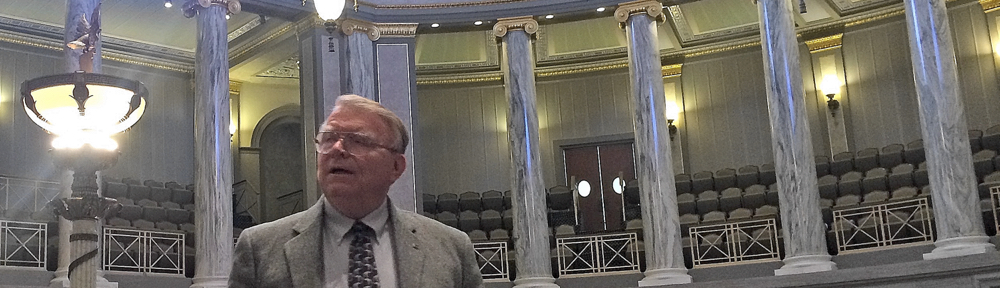
The House has asked your correspondent to come in at the end of rookie camp and talk about the capitol press corps and their relationship to it, the history of the capitol and the legislature, and to admonish these new folks to do nothing that would embarrass themselves, the legislature, or their families back home while they’re serving.

Afterwards we split the group into two segments for behind the scenes tours.  Dana Miller, the Assistant Chief Clerk of the House (also Chairman of the State Capitol Commission) took one group and I took the other, then we switched.  She led her group through some of the hidden spaces of the building and I took my group into the public areas.

The tours gave both of us a chance to talk about the condition of the Capitol—and there’s a lot to talk about these days.  More than a year ago the legislature set aside forty million borrowed dollars to make long-delayed repairs to critical parts of the building’s substructure. The first part of that work was completed during rookie camp, the rebuilding of the south front steps, the east steps, the terraces and the carriage entrance.  For years water has leaked through increasingly chipped steps into the Capitol basement, weakening the entire area and contributing to mold problems in the basement where a lot of people work, eat, and hold hearings.  Several other much-needed repairs also have been made.

Next summer will see the start of phase two that will include repairs to the building’s exterior stone work, rebuilding the plaza on the river side of the building, repairs to the Fountain of the Centaurs, and more terrace work.

My part of the tour involved showing the folks some of the architectural features and decorations on the interior.  While the exterior of the building is getting the repairs and restorations it deserves, the interior continues to deteriorate.  We looked at several places of peeling paint, unrestored paintings by great artists, and poorly-lighted areas that keep visitors from enjoying and learning Missouri history from the artwork that makes our capitol unique.  We talked about the plans that began almost two decades ago to restore the interior of the building, plans that were stopped with the terrorist attacks in 2001 that forced diversion of the millions of dollars set aside for that work to make up for state government’s revenue loss in the wake of the economic drop after the attacks.

It’s hard to know where the restoration of our state’s greatest symbol will go next as it moves through its centennial era to the 100th anniversary of its dedication in 2024.  The bonding money will be used up by the second phase of superstructure work. The state budget is unlikely to grow, or grow very much, in coming years because of the current tax structure while financial demands for basic services and operations are expected to keep growing.  Given priorities such as education, health, mental health, prisons, and social services, it’s hard to think there will be much left over to make the inside of the Missouri Capitol the jewel its designers and builders wanted it to be.

The new people that voters elected to represent them in the legislature got a taste of the enormity of their obligations, possibilities, and responsibilities—as well as the possible pitfalls that await them—during rookie camp.

It has dawned on this observer that he covered his first story in the capitol in 1967, fifty years after the ancestors of today’s legislators held a one-day meeting in the unfinished House and Senate chambers so lawmakers who would not be back for the next session two years later could say they had served in the new capitol.  That means that I have covered and watched people like these rookies for half of the building’s history.  So I took the liberty to sermonize:

State capitols are intended to be grand representations of the greatness of their states. They are intended to be inspirations to citizens, statements of democracy, and symbols of the permanence, the stability, and the power of a state to care for and to protect its people.  The very motto of our state is carved in Latin on the south front: “Let the welfare of the people be the supreme law.”  Not a few people.  ALL of the people.

Understanding that you are here to protect and care for ALL of the people, not just the powerful few who have the capacity to make you feel important will be one of your greatest challenges.

It is easy to speak in phrases of nobility and inspiration, statements of democracy and so forth because it is always easier to speak of nobility and dignity and greatness than it is to recognize shortcomings, deterioration, and decay.

So I urge you to see your capitol in its entirety and be unafraid to acknowledge that it suffers from inattention; that it is easy to say, “My office is fine” while ignoring a cracked column at the top, the quick and easy slathering-on of coat after coat of paint that covers problems but robs the building of its beauty and character, to ignore the cracked and peeling paint, the mold and leakage problems in the basement.  Notice your capitol and reflect on what else it says about government’s attitude toward its people—and whether you will spend your career just slathering on a coat of paint that covers, but will not solve, problems and masks a dingy reality that is easily ignored.  For in truth, this building also represents Missouri in ways too many choose to ignore.  Its deteriorating structure, its peeling paint, and its unrestored great works of art carry a message of needs unmet, problems uncorrected, responsibilities avoided, and obligations covered over. 

So welcome to OUR capitol.  But it is YOUR responsibility.  And it is not just the capitol; it is the entire state that is your responsibility.

There will be thirty-nine new members of the House and one person in the Senate who has not served in the legislature before when the General Assembly convenes under new state leadership in a few days.  While some see glasses half empty, we choose to see them half full—of opportunities that come with the fresh eyes of those who went through legislative rookie camp and those who are still going through their own rookie camps called transition.

So we lift our half-full glass.  Here’s to the rookies!

Protecting the guv

(Editor’s note:  We are now less than a month away from inaugurating a new governor.  We’ve gone back through the notes we have used to cover the dozen inaugurals we’ve covered and we’ve looked at some things we didn’t include in our coverage manuals to assemble several pieces that focus on the new governor and the ceremony that will put him in office. Our “Transitions” entry on November was the first in the series.  This is the second):

My old friend “Cutter” Short, who used to hang around reporters at the Capitol years and years ago, back when the reporters were in Rooms 200 and 318, sent an email after reading the “Transition” entry a few days ago and reading the mention of the security arrangements the new governor will have to deal with.  “Dalton told Amos and me in ’66 that until ’63 he had no protection.  After that, a trooper rode with him but that was about it as I recall,” he wrote.

He was talking about Governor John Dalton (1961-65) and United Press International bureau chief Rael Amos.  Until then, Missouri Governors walked around and drove around pretty much as they pleased, with a couple of exceptions.   

Governor Thomas T. Crittenden (1881-85), who persuaded railroad interests to post $5,000 reward for arrest of Jesse James, kept his .44 caliber Smith and Wesson revolver in his desk.  The pistol is now held by the state museum. 

Governor Lloyd Stark (1937-41) didn’t carry a gun as far as we know, but the Highway Patrol assigned troopers to escort him and to protect the Governor’s Mansion because Stark was working with federal authorities to prosecute a big fraud case in the Insurance Department that ultimately brought down Kansas City boss Tom Pendergast—and several death threats had been received.

Otherwise, governors didn’t have security details.  

The Highway Patrol’s history recounts that Superintendent Hugh Waggoner one day early in 1963 summoned Trooper Richard Radford to his office and told him to report for duty the next morning in civilian clothes.  They went to Governor Dalton’s office where Waggoner introduced Radford to Dalton as his full-time security officer.  Waggoner took the steps because Dalton had gotten death threats.  There was no training available for Radford so he made things up as he went along. 

The security for Dalton’s successor Warren Hearnes, was increased.  Hearnes liked to fly, so the Patrol provided a plane and a pilot who doubled as a security officer.  As time went by, the duties were separated so there was a pilot and a security officer when Hearnes wanted to fly. 

Christopher Bond got a death threat not long after he was elected as the youngest governor in Missouri history.  He issued an executive order not long after taking office in 1973 establishing a special unit within the Highway Patrol to provide protection around the clock. 

Joseph Teasdale increased security at the Governor’s Mansion because prison inmates worked there and he, as a former prosecutor, wanted to make sure he and his family were safe.

There is at least one time when a governor traveled without a security officer—well, twice, that we know of.  One is a personal story. 

Governor Carnahan got his own pilot’s license and one night showed up at the Columbia Flying Service office wanting to fly to Hermann.  Somebody had to fly the plane back to Columbia because Carnahan was going to meet his wife, Jean, and their security officer, have dinner in Hermann and fly on to a fundraiser in St. Louis.  Your correspondent’s son, Rob, was a flight instructor at the time so he flew to Hermann with the Governor.  The Carnahans had him join them for dinner before he flew back.   

Another time Governor Carnahan flew without a Highway Patrol security officer was October 16, 2000.  The security division, as the Patrol puts it, had been “pressed to the limit of its manpower” and chose not to put an officer on the plane but have someone meet the governor when he arrived in New Madrid for a fund-raising event.  Later that evening a Highway Patrolman on duty at the mansion had to tell Jean Carnahan what had happened.  

It was difficult to identify the remains in the wreckage which is why, today, Governor Greitens and his family members will be fingerprinted and will give DNA samples. 

Security was stepped up after the September 11, 2001 terrorist attacks.  The legislature passed a law in 2005 creating the Governor’s Security Division to protect the Governor and his immediate family and to provide transportation. 

What began with one trooper whose only equipment was “a suit, a concealed weapon, and an unmarked car,” is now a corps of specially-trained Highway Patrolmen whose job for at least the next four years is to keep Missouri’s human state SEAL and his family safe. 

The survivors who weren’t at Pearl Harbor

On this 75th anniversary of the attack on Pearl Harbor, I want to tell you about two people who were at the other end of that story.

In 1974, I met an old man who ran a sandwich shop and pinball arcade in Jefferson City.  He had been the first news director of the local radio station I was working for then (just before the creation of The Missourinet) and I had gone to interview him about the days when the station went on the air twenty years earlier.  After we talked about those times, I asked him how he wound up in Jefferson City and for the better part of an hour, Bud Wills and his wife, Phyllis, told me life stories that were jaw-dropping.

Phyllis was born in Canada, raised Japan by English missionary parents, and returned to what was then called Formosa when it was in Japanese hands in the early 1930s.  Bud had gone to Japan about 1928 to work for an English-language newspaper for three years and had stayed after the contract ran out.  In 1938 he and an unidentified American “with money” founded another English-language newspaper, Japan News Week, about the time the increasingly nationalistic Japanese government was putting other English-language newspapers out of business.  About the same time, Bud became the CBS correspondent in the Far East.

In that role, he covered the Japanese war with China, which many consider the real beginning of World War II when it started with the Japanese invasion in 1932. The same year that Bud founded his newspaper, CBS began its World News Roundup program that is best known for building the reputations of the Murrow Boys because of their reports as Europe disintegrated into war.   Forgotten in the telling of the story of the Murrow Boys is the non-Murrow Boy who often concluded the Roundup with his report “from halfway around the world” describing Japan’s increasing threat to peace in the Pacific, W. R. Wills.

Bud and Phyllis were at the home of a Tokyo friend, as usual, on Sunday night, December 7 (Tokyo time) for dinner and evening card-playing.  But instead of card-playing that night the group of people sat around the fire and somberly discussed when they thought war would begin with the United States.

A month, two months, said the others.  “Sooner than you think,” forecast Bud.

A heavy knock on his door at 5:30 next morning awakened him. He found officers of the Kempeitai, the Japanese Gestapo, there to arrest him.  As the bombs were falling at Pearl Harbor, Bud, Phyllis, and about sixty other American and British citizens were being arrested.  Bud and Phyllis were among those taken to the high-security Sugamo Prison (those who have read the Louis Zamperini story, Unbroken, will recognize the place).

They were held in small cells where they had to sleep on mats that would be rolled to the side during the day so they had some small space in which to pace.  They were forced to be in a squatting position for hours each day during interrogation.  Bud lost some teeth from being slapped repeatedly.  Phyllis suffered eye problem to her dying days because of the lights that were always on.  Both suffered from the cold in their unheated cells during the Japanese winter.

She didn’t learn about Pearl Harbor until about Christmas.  He didn’t learn about it until later.

Finally, in June, they were convicted of espionage—Phyllis being the first white woman convicted in a Japanese court of that charge.  He faced two years of hard labor; she, one.  But the sentences were stayed because the Swiss government at last had arranged an exchange of Japanese diplomats for American and British prisoners.  They left Tokyo by ship in June and didn’t land in New Jersey until August. They were married in Canada in September.

Wills,WR_Phyllis_Montreal_9-3-42001

A few years later they wound up in Steeleville, Missouri running a weekly newspaper. In 1954, they came to Jefferson City where Bud worked in radio for a brief time and eventually ran his sandwich and arcade shop. Phyllis became a journalism teacher at Lincoln University, and the foreign student advisor.

I interviewed them in 1974, the year Bud turned 81.  Phyllis, more than fifteen years younger, still spoke with her English accent.

Both died in 1977. Few people, if any, in Jefferson City remember Bud and Phyllis Wills today.  Fewer, perhaps nobody, ever heard them tell their story about being some of the first American POWs of World War II.  They were at the other end of the geography of the Pearl Harbor story.   And the interview that day in that little cubbyhole business at 626 East High Street in Jefferson City is the only recording ever made of them relating their experiences.

When I left the radio station to put a news department together for the Missourinet, I left that interview and many others I had done for the station’s 20th anniversary in one of two boxes of material gathered for a series of commemorative programs that were never produced because of my exit.  As the years went by and the station moved a few times and was sold a few times, old files and old boxes of recordings went into dumpsters.  The Bud and Phyllis interview is in a landfill somewhere now.

BUT:  Not long after I did that interview, their son, Bill, asked for a copy of  the recording and a few months later as I was passing through Indianapolis on a trip, I stopped by his house and gave it to him.  Shortly before my retirement two years and five days ago, a friend—Steve Morse, the chief engineer at Missourinet affiliate KWOS—dropped by my newsroom with a manila folder that had the typed transcripts I had made of all the interviews I had done more than forty years earlier.  The transcript of the Bud and Phyllis interview was in it. Steve and a friend had rescued one of the boxes from the dumpster but the other was gone before they got there.

I wondered if Bill Wills was still around and if he still had the dub of that lost interview.  I tracked him down through the internet, dropped by his home in Carmel, Indiana a few weeks later, and he arranged to provide a copy of the interview.  And he has provided me with a lot more.  I’ve been digging around since then for even more of their story. Someday I’ll be able to tell it to you, I hope.

The CBS World News Roundup is America’s longest-running network newscast. The Murrow Boys are legends in broadcast journalism history.  But there was somebody else who was there at the beginning.  And he and his wife told me their story that day long, long ago.

Bud & Phyllis, taken mid 70's

(Thanks to Bill Wills for the clipping and for the photograph of Bud and Phyllis about the time they told me their stories)


Grace

In a year that will not be remembered for its examples of grace, especially public grace, the sports world provided one at a time when anger and giant disappointment could have produced an example of ugliness.

Columbia racing driver Carl Edwards showed us a prime example of grace in this graceless year. For those who do not follow automobile racing as we do, here’s some background. .

Carl has been competing at NASCAR’s highest level for a dozen years.  He has finished second twice in the championship standings.  He is one of four extremely talented drivers who compete at this level for Joe Gibbs, the former NFL coach whose teams won three Super Bowls.

NASCAR determines is champion each year by taking the top sixteen drivers in points after the first twenty-six races and putting them through a series of elimination rounds until four drivers remain in the last race of the season to compete for the championship.  Carl Edwards made it to the final four by winning a race in the semifinal round at a time when he was on the verge of elimination because an earlier crash had left him far out of contention.

One of his competitors in the last race was teammate Kyle Busch, who had won the championship in a miracle season last year after missing the first eleven races with injuries.  Another competitor was Jimmie Johnson, who was hoping to win the championship for a record-tying seventh time.   The other competitor was Joey Logano, a young driver who has matured and succeeded driving for Roger Penske, one of the biggest names in motorsports competition.  Now, let’s set the scene:

The championship is within Carl’s grasp with just ten laps left after the racers have been slowed under a caution flag caused by an incident with another car.  He is on the inside of the front row, a prime place to reassert his leadership when the green flag is waved to go racing again.   If he can get a good jump, he’ll be running in clean air—a critical factor in cars designed to take advantage of aerodynamics—and headed for that elusive title.

Logano knows he has one shot at getting past him on that restart.  He dives low going into the first turn. Very low.  Carl knows his only hope is to drop low in the track to block Logano.   The front of Logano’s car touches the rear bumper of Edwards’ car, sending Edwards into the inside wall, then bouncing back across the track through traffic where he is hit from behind with such force by another driver that his car goes up on the other car’s hood before spinning off into the outside wall.  All hope of the championship is gone after what he called “the race of my life up to then.”

Few of us ever know the pressures of competing for anything at this level. And the intensity of “this level” is hard for any of us to imagine.  There are no halftimes, no timeouts, no free throws where you can catch your breath.  There are no shift changes as in hockey.  There are no innings that are split into two parts.  This is three or four hours in a fire-protective suit, sitting in a metal oven at temperatures of one-hundred-thirty degrees, travelling at frightening speeds (to you and me) surrounded by thirty-nine other people seeking the same thing you are seeking. And you are doing it at three times the speed limit with no rumble stripes to remind you that you have one of your wheels an inch from where it should be.

You are so close to being the very best in this sport that you can touch it.  And then in two seconds you are sitting in your stopped, wadded-up, smoking car knowing that everything you have worked for during the last nine months is now impossible.  One of your competitors has wrecked your car and your hopes.

NASCAR requires drivers whose cars crash out of a race to go to an infield care hospital to be checked for injuries, including concussions.  Track workers escort the driver from the wreckage of their car to an ambulance which whisks them away.  But that didn’t happen with Carl Edwards, who watched a replay of the crash on a big video screen that tracks have, and then walked with his NASCAR escort through the pits to Joey Logano’s pit.

That is not normally a good sign.  Angry words are often exchanged or shouted.  We’ve seen punches thrown.

Carl Edwards climbed to the top of a stand where Logano’s crew chief and others were sitting.  And he told them the crash was entirely his fault, that he wished Logano well, and shook hands with the guys on Logano’s pit box. “That’s just racing,” he told them. “Good luck to you guys.”

In an interview after getting checked at the infield hospital, he said, “I pushed the issue as far as I could because I figured that was the race there…I couldn’t go to bed tonight and think that I gave him that lane.” Logano finished second in the race behind Johnson, who dodged the crash and led the last two laps for become champion for the seventh time.

“We were racing for the championship and that’s the race,” said Logano afterwards.  And he echoed Carl Edwards, “That’s just racing.”

After the roar of the race, after the take-no-prisoners competition for their sport’s highest honor the neither achieved—

there was grace,

a reminder in this graceless time that the quality still is within us.  And it is not demeaning to show it.

Transition

Several years ago your observer was strolling through the Capital Mall when he spied Lt. Governor Bill Phelps and his wife, Joanne, having a casual lunch in the food court.  They probably had driven to the mall and had done their shopping with few if any distractions from fellow shoppers. I remarked to him as they sat surrounded by other folks who were paying them no mind, “You know, if you win the election this year, you won’t be able to do this.”   Phelps was running in the primary against Christopher Bond who wanted to get his old job back from Joe Teasdale.  It was 1980.

Phelps lost the primary and probably has been eating his meals out for these last thirty-six years without any hassles from the voting public.

But had he won and then defeated Teasdale, his life would have changed. The Phelpses probably wouldn’t have driven their own car to the mall.  They likely would have been chauffeured by a Highway Patrolman.  And they wouldn’t be shopping anonymously because people would recognize that The Governor(!) was in their midst.  They’d be living in a great big house that would not contain much of their own furniture.  Somebody with a badge and a gun—sometimes more than one somebody—would be with them wherever they went.

We recall that John Ashcroft had a Mustang he liked to drive.   He didn’t get the chance to do that much after he became governor.

Ashcroft, Bond, and Phelps had some understanding of the transition to the governorship because they had been in public life at increasingly higher circles. They knew that the private life would diminish markedly when they became the state’s highest-ranking public official.

Transitions for incoming governors involve far more, however, than coming to grips with the fact that your life is not yours any more.  The responsibilities of being a public servant, the state’s highest public official, can be beyond the expectations of the candidates who seek that job.

So while an incoming governor who has no previous public office experience has to spend the two months between election and inauguration preparing to meet the challenges of governing, he and his family also have to come to grips with any number of personal issues.  What do we do with our house?  What about our furniture?  What things are so meaningful to us personally that we want to take them to the Executive Mansion so it feels like home?  What about schools?  How will we adjust to having a security officer with us?   How will we deal with a loss of our personal freedom?  How will the family deal with the things that are likely to be said about the husband and father who happens to be the Governor of Missouri?

Here we offer a slight diversion because the spotlight might be on the new governor but it also shines, at least in its dimmer edges, on his family, particularly on the person who is to become the state’s First Lady.   What are her obligations?

Most First Ladies have adopted a public role in one form or another.  But one First Lady was different and because she was, future First Ladies might owe her a debt.  Theresa Teasdale wanted nothing to do with the spotlight.  She was not Mrs. Governor.  She was Mrs. Teasdale, wife and mother.  She didn’t advocate for a particular cause (as we recall).  She and Joe did not make the mansion a great social event location.  It was their home.  It was where the Teasdale family lived.  It was a house where there was a family that was apart from the intense world of governing. This reporter tried to interview her once and came away almost embarrassed that he had intruded.  Theresa Teasdale was a First Lady who made it alright for future First Ladies to remain private citizens.

The new governor thus has two transitions to deal with—the personal and the public.  He has just two months to assemble a team of people in his office as well as those who will lead state agencies.   He realizes he will inherit a state budget sixty percent of the way through a fiscal year and will have to immediately deal with possible income shortfalls; Governor Nixon already has withheld tens of millions of dollars to keep the budget balanced.  He will have to prepare his first major address to a joint session of the legislature outlining budget recommendations for a fiscal year that will start July 1 and outline issues he hopes the legislature will pass laws about.

And that’s just the surface.  He also is responsible for finding and appointing about 1,700 people to state boards and commissions.  About 1,300 of those nominations will have to be pleasing enough to the Senate to be confirmed.

We checked with Scott Holste, who has been on Governor Nixon’s staff as governor and attorney general for more than twenty years, and Scott reminded us that the governor also has to make appointments to fill vacancies caused by death or resignation or conviction of judge in circuits that aren’t part of the Non-partisan Court Plan.  He also appoints prosecutors and county officials as needed in non-charter counties.  And he has to make appointments of judges from lists submitted to him under that same court plan.

There’s another important component that has to be decided.  How public will the administration of the state’s top public official be?   What will be his relations with the press?  It’s not a parochial question.  How open will he allow his administration to be in providing expertise to those with questions about public policy issues?  Will he allow department staffs with expertise to provide information to the public or will he limit the flow of information by limiting access to them—as, to be frank, the current administration has done in many agencies?  The operative word in the phrase “public official” should be public.

We have scratched the surface of what a governor-elect has to go through to be ready to govern as soon as he takes the oath of office.  It’s a steep, steep learning curve even for those who have been in and around state elective office.  To go from private citizen to public leader relatively overnight is a major test.

All of this is why a two-month well-organized transition effort is essential but why it also is highly stressful, not just on the governor-elect but on his family—because life on January 8th will likely be worlds different by the end of January 9th.

Time to get to work

Some who follow these entries will consider the writer naïve in his outlook but we shall plunge ahead because we cannot give up on our belief that our system is worth working for. And on.  And in.

Elation or disappointment in election results must be short-lived.  Resignation is not an option nor is gloating.  This week after the election is time to get back to work as citizens of whatever leaning. It is time to become even better-thinking, better citizens.

Don’t believe Janice Joplin’s 1960s claim that “Freedom’s just another word for nothing left to lose.”  Whether you have spent the last week celebrating or the last week depressed is immaterial now. Freedom requires effort—because it is in greater danger of being given up than being taken away.

Winston Churchill is often cited as the person who said, “Democracy is the worst form of government, except for all the others,” although he admitted he was quoting someone else.  Here’s something he DID say—in the House of Commons on December 8, 1944:

How is that word “democracy” to be interpreted? My idea of it is that the plain, humble, common man, just the ordinary man who keeps a wife and family, who goes off to fight for his country when it is in trouble, goes to the poll at the appropriate time, and puts his cross on the ballot paper showing the candidate he wishes to be elected to Parliament—that he is the foundation of democracy. And it is also essential to this foundation that this man or woman should do this without fear, and without any form of intimidation or victimization. He marks his ballot paper in strict secrecy, and then elected representatives and together decide what government, or even in times of stress, what form of government they wish to have in their country. If that is democracy, I salute it. I espouse it. I would work for it.”

The election is over.  Our system of democracy, often ungraceful in its practice, remains. Now comes the time to “work for it.”

Notes From a Quiet Street    VIII/2016 

Something seems to be wrong with our telephone.  It only rings a couple of times a day and the only people who seem able to get through are Nancy’s sisters.  We must have said something wrong to President Obama, who called us three days in a row, because he hasn’t called back.

Gary Scharnhorst, in his book Mark Twain on Potholes & Politics, cites a letter to the editor of The New York World published on Christmas Day, 1894:

“It is my heart-warm and world-embracing Christmas hope and aspiration that all of us—the high, the low, the rich, the poor, the admired, the despised, the loved, the hated, the civilized, the savage—may eventually be gathered together in a heaven of everlasting rest and peace and bliss—except the inventor of the telephone.”

If Mr. Twain were with us today he might change the last line to say “except the inventor of the robocall.”

—–

Ashley and Brian let your correspondent play reporter on election night, doing reports on The Missourinet about legislative and congressional races and the ballot proposals. It was a lot of fun and the best part was that now I could go home at 3 a.m. and not worry about getting up an hour later to do morning newscasts until the rest of the staff could return from the victory/loss parties.

—–

Got up and made the usual morning trip to the Y.  Thought it appropriate to wear a red shirt.   The one that says, “Of course I’m right, I’m Bob.”   Because I am.  Bob. Some of you dispute the accuracy of the first part.  But it’s my shirt.

—–

We got a notice from the Social Security people that we’re getting an increase in our monthly benefits next year.   The national average is four dollars a month.  We didn’t get any cost of living increase this year.  Who does the Social Security Administration think we are?  State employees?

Came across an article from Collier’s magazine from 1905 recently that began, “For the first time in forty years there has been no lobby maintained at the capital of Missouri during a session of the state legislature.  Lobbyists visited the Capitol, it is true, but they did so occasionally and their stay was brief.  When they appeared they came only to argue bills before committees; their coming was known, and at the time of their appearance the hour of their departure also was made known in advance.”

Lobbyists were running scared in 1905 after a major bribery scandal of 1903 exposed exchanges of cash and other favors between lawmakers and lobbyists.  New governor Joseph Folk, who earned the office as a corruption fighting prosecutor, added to the concerns when he was sworn in on January 9, 1905 and said “professional lobbying should be made a crime.”

That’s one issue this year’s candidates for governor missed.  Among others.

Given the number of candidates this year who sneered at “career politicians” who apparently think they can retain their status as amateur politicians now that they’ve been elected, perhaps they might think of Holy Joe Folk, as he was called, and pass a law allowing only amateur lobbyists so the field will be level.

Your faithful observer cannot recall the last time he observed so little post-season baseball.                                                                       —

Or in-season Tiger football.

As we travel throughout Missouri we find ourselves increasingly unable to understand why the most expensive gas we put in our car is in Jefferson City.  By far.  We fueled up in Kearney for a dollar-79 and in Nevada for the same amount a week later.  The gas stations on the street leading to our house were charging two-oh-seven and two-oh-nine at the time.  Some fluctuation in prices is understandable. But “absurd” is the word that kept going through our mind as we drove between stations on the way home.

We try not to re-fuel in Jefferson City.  There’s one station that’s usually three to seven cents cheaper and if we must put gas in our car in Jefferson City, we’ll go there.  Otherwise, gas stations closer to home are good only for lottery tickets.

—-

Voters have spoken strongly—again—that limits must be imposed on the financing of campaigns.   Now we will see if there are lawsuits to throw out the limits.  We will be watching one group especially closely if the big money people win in court to see if legislators and other politicians who are quick to blast the court system for “ignoring the will of the people” will say that in this instance.  A lawsuit might be unnecessary, however. Opponents of campaign limits were saying before the election they know an end-around of the new law so they can keep pouring boatloads of money into campaigns.  We’ll be interested to see if the legislature does anything about it—to make sure the will of the people is truly honored.

It’s not cynicism that prompts the observation.  It’s observation that prompts the cynicism.

Where have they been?

Where have they been during this campaign against them, this campaign to control them, this campaign to restore the average citizen’s place in the political campaign world?

Where have they been, those who easily write six and seven-figure checks to buy candidates and laws and parts of the state constitution?

Where have they been in our mailboxes and on our television screens and on our radios, telling us why Constitutional Amendment 2 is bad for us, bad for our political system, unfair and unjust to them?

Where have they been in defending themselves from accusations that they are abusive of the democratic process, arrogant in that abuse, and uncaring about those whose voices they overwhelm by their wealth—because they can overwhelm them?

Their silence on a proposal to limit their contributions to campaigns to relative pennies speaks loudly of the reasons the proposal is on the ballot, for they already know the people cannot control them, cannot limit them; they are too powerful, too cunning.

Their silence hints that they already know how they will render Constitutional Amendment 2 nothing more than an exercise by voters.  Their silence tells us they already know how they will exploit contribution limits or attack them in the courts.

They who are silent already know their arguments before judges who will be asked to dismiss the people’s wishes.  They already believe they will overturn the people’s wishes because, after all, what do the people know?

Let the people think they can control us, their silence says.  Let the people think they can make their voices equal to ours again.   Yes, let them think it.   Let them think they accomplish something by approving the amendment—while we already know otherwise.

In two years, they are thinking, we will let them know what we think of Constitutional Amendment 2.  And we are right.  Because we are rich enough to know what is right.

But the people think, too.   And the people will see what happens if Amendment 2 passes and the next election cycle shows new creative exploitations of the law.  And the people, if they approve Amendment 2, can act again.  And again if they must.

Or perhaps the people might be surprised if Amendment 2 passes to see that enough of the legislators they will elect might find enough courage to fix leaks, seal loopholes, and strengthen weaknesses that become apparent.  But the people shouldn’t count on it.

Big money is silent.  Because big money knows.

Doesn’t it?

Corrupt career politicians

Your observer has thought throughout this campaign of writing something about the demagoguery behind the phrase “corrupt career politicians” that has been thrown around by challengers who seem to lack the intelligence to say how they will solve the problems of the state and the nation and think name-calling is the highest intellectual standard they need to display.

Then we read Jason Hancock’s article in The Kansas City Star Tuesday.  In a year when “corrupt career politicians” has been such a buzz phrase that relies on an intentionally uninformed public’s distrust of government, the Missouri Senate majority appears to have volunteered to become a poster child.

Jason’s article says Republican state senators are soliciting money from people who want to buy “face-to-face meetings with GOP leaders when they return to the state Capitol to begin legislating in January.”

A $5,000 donation will buy, among other things, a dinner with the Senate Republican leadership team during the first two weeks of the session.

Suppose you can’t afford 5K.  No problem.  Senate President Pro Tem Ron Richard of Joplin and Majority Floor Leader Mike Kehoe of Jefferson City would love to have breakfast with you for just $2,500.

If you or your organization don’t have that much, well, you might have to go hungry in more ways than one in the 2017 session.  We say “might” because, despite appearances to the contrary, we don’t want to actually accuse Richard and Kehoe of participating in “pay for play.”

Wonder how much a “hello” might cost as one of the majority senate leaders goes the few steps across the hall from his office into the chamber.

This news breaks less than six months after legislators were patting themselves on the back for working on ethics bills—and passing some, toothless though they were.

Missouri remains the only state in the nation without campaign contribution limits and no ban on gifts to legislators from lobbyists. Nor, it is obvious, is there any limit on how much the leaders can charge those wanting to get close to them for breakfast and dinner. But building confidence in government by the electorate has been one of the lowest priorities of the legislature for a long time.  Now, you might ask, can it get any lower?

Republicans outnumber Democrats in the Senate 2-1.  Of the seventeen seats up for election next week, four Republicans and Four Democrats have no significant challengers.  So before the contested seats are decided, Republicans are guaranteed to hold their majority, 18-7.  If the Democrats are to break the two-thirds GOP control of the Senate, they must win six of the nine contested elections next Tuesday.

Fat chance.

If you’re supremely confident that you will be in total control of a situation, why worry about ethics and appearances of impropriety?  Make it profitable.

Dinner (or breakfast) might be served.  But public confidence sure isn’t.