Tearing up the Senate

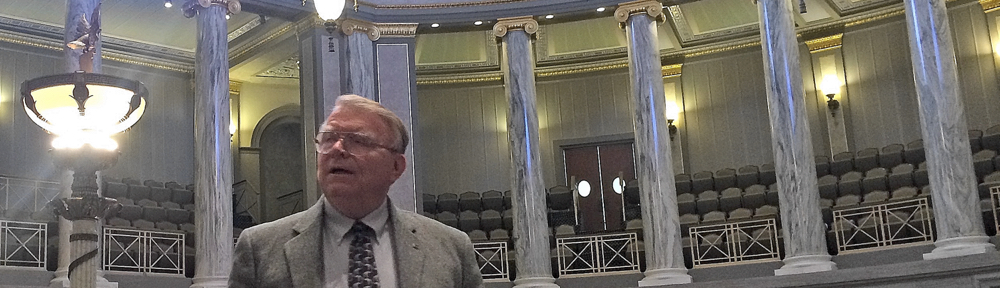
Work crews have started tearing seats out of the place where visitors to the state Senate have watched floor activities since 1919 so the Senate can get those pesky reporters farther away from being able to see and hear what is going on. Or not.

20160525_135451

Seats installed during the restoration of the chamber in 2001 were stacked along a fourth floor hallway wall when we dropped by the other day.  We haven’t heard what will be done with them although it seems the most sensible thing would be to store them somewhere safe so they could be put back in place when a less-vindictive mood runs the place.  We won’t rehash what that’s all about here.  We’ve flailed at that subject in earlier entries that you can find in the archives.

We have preserved a historic moment in this process—the last time (for now, we hope) that members of the Capitol press corps were allowed to sit at what has been the press table since the earliest days of the building.

senate press table2

That’s Bob Watson of the Jefferson City News Tribune, the senior Senate reporter, in the blue suit on the right.  Summer Ballentine of the Associated Press is on the other side of the table, in the orange jacket.   Most of the others are Senate staff members except for the fellow next to Summer.

That’s Senate President Pro Tem Ron Richard, who decided earlier this year that people such as Bob and Summer are so undeserving to cover the Senate from that table anymore that the Senate will spend $12,000 for each of the ten positions around the table to move them and their colleagues to the gallery on the other side of the chamber.

Senator Richard lectured his colleagues during the session about honoring Senate traditions and rules.

One of the Senate rules is that Senators will not sit at the press table when the Senate is in session.  We think it was in session when this picture was taken.  Majority Floor Leader Mike Kehoe was in the Chair.

Will the Senate behave any better or any worse now that the scourge of the Press is removed from its sight?   Will the reporting of the actions of the Senate be better or worse because reporters now will occupy space where spectators have been able to sit for 97 years?

senate press table3

The first test will come during the September veto session.  It would be good, however, for the Senate to remember that the Press might now be out of sight—-but it shouldn’t be out of mind.


A religious experience, not a crime

We’re going to wade into the murky waters of religion and politics today in search of reason and logic.

We’ve had some time to mentally chew on Representative Tila Hubrecht’s thought in the waning days of the legislative session that a pregnancy resulting from a rape is a “silver lining” from God. All kinds of liberal thinkers and organizations have jumped all over her assertion made during House debate on the bill saying a woman’s egg is a person just a soon as a man’s sperm hits it even if the circumstances leading to the presence of the sperm are violent. The bill passed the House but didn’t have enough time to cause trouble in the Senate before adjournment.

The personhood bill did not contain the usual exemptions that allow abortions in cases of rape, incest, or to protect the life of the woman. “It’s not up to us to say, ‘No, just because there was a rape, they cannot exist,’” Rep. Hubrecht said, the “they” referring to a person created by the sperm and egg. “Sometimes bad things happen—and they’re horrible things, but sometimes God can give us a silver lining through the birth of a child.” And she added, “When God gives life, he does so because there’s a reason, no matter what. I’ve met and talked with the different people who have been conceived by rape. There is a reason for their life.” We were not there when she said those things so we don’t know if she gave examples of the reasons for those lives.

She apparently is not alone in her feelings in the Missouri legislature and elsewhere. The Charleston Gazette in West Virginia reported about the same time that Delegate (that’s what they call Representatives in West Virginia) Brian Kurcaba said during a committee hearing, “Obviously rape is awful. What is beautiful is the child that could come from this.”

In Indiana, U. S. Senate candidate Richard Mourdock said in 2012, “I think that even when life begins in the horrible situation of rape, that is something that God intended to happen.” Mourdock lost his race.

All three of these folks might be surprised to consider what they are really saying. If God intended pregnancy to occur, GOD IS INVOLVED IN FAMILY PLANNING! And we pretty well know what these folks think of organizations and individuals offering family planning advice.

Of course, all of this discussion is pointless because Congressman Todd Akin assured us during his Senate bid four years ago that a woman’s body can “shut the whole thing down” in cases of “legitimate rape.” He argued, as Rep. Hubrecht has argued, that the punishment should be of the rapist, not of the fetus. The Akin theory, however, seems to indicate pregnancy can only occur during illegitimate rape, whatever that is.

Not long after Hubrecht’s comments, Octavio Chorino and Peter Greenspan offered an op-ed piece in the St. Louis Post-Dispatch agreeing with Hubrecht and the others that “violence against women is unacceptable.” But they found the “notion that good may come of such a violation to be dangerous at best…and any suggestion that there is a bright side to sexual violence is an offense to all survivors.”

They noted other consequences of rape including transmission of sexually transmitted diseases as well as extensive physical and psychological injuries that can affect a woman for the rest of her life. “These consequences are very real and they should not be diminished by the claim that any rape has a silver lining,” they wrote. Unlike Hubrecht, Kurcaba, Mourdock, and Akin, these professionals have had real-world experience with rape and incest victims. “Exposing sexual assault victims to the risks inherent in pregnancy and childbirth is effectively punishing her for her own assault. This is unacceptable,” they said.

Chorino is the president of the Missouri Section Advisory Committee of the American Congress of Obstetricians and Gynecologists. Greenspan, also a doctor, is the group’s legislative chair. But what do they know? They didn’t even address the issue of God’s will and Rep. Hubrecht’s inclusion of that issue takes the debate beyond the practical issues on which Chorino and Greenspan based their article.

Their experiences and their observations are not likely to concern the “silver lining” believers anyway.   We have seen no indication that those who want Missouri to have the strongest anti-abortion standards in the nation care much about the second life involved—that of the rape or incest victim.   They certainly didn’t show it during debate on the personhood bill in this election session of the legislature.

The comments, “When God gives life, he does so because there’s a reason, no matter what” and “sometimes God can give us a silver lining through the birth of a child” began to percolate in our head on a recent trip. You know how the mind sometimes looks for something to wonder about other than the many miles yet to go. In this case the mind decided to test the validity of an idea by taking it on a logical line and then asked a simple question:

“If God has a reason for causing a pregnancy through a man’s sexual act with an unwilling woman because ‘when God gives life there’s a reason no matter what,’ why should the man face a criminal charge for what logically is an act of God?”

Then the mind went on. “When does God decide a pregnancy should result from the rape or incest? While the act is in progress? Or does God decide immediately after the event that this is an opportunity to create a life? Or—-

“If God has a reason for a rape or incest-caused pregnancy, does it not follow that God had a reason for the rape or incest?

“If God gives life, and does so because there’s a reason, no matter what, what is that reason? Is it punishment for something the woman or the young girl did that was wrong in God’s eyes? Or, conversely, is it some kind of reward for doing something good such as allowing oneself to be a rape or incest victim, or is it a reward for the rapist or the person committing the incest?

“How can a God-blessed result occur except through a God-inspired act?”

The driver, not being a Biblical scholar, could not cite any examples from the Bible of a God-inspired result that did not begin with a God-inspired or directed act so he did not reply.

“But,” said the mind, “Don’t supporters of the position need to provide a definitive logical answer that does not limit an omnipotent God? If God has the power to create physical life, does not God have to ordain the circumstances under which that life is physically created?

“And doesn’t God have to ordain the circumstances under which the life is physically created because the life would not be created without that violent act?

“And if that is the case, isn’t the argument severely weakened that the perpetrator of the act should be punished rather than the life created being ‘punished’ because, as she said, ‘There is a reason for their life?’ Are not the perpetrator and the new life equal partners in this process and therefore equally blameless?

“In a climate that argues that religious freedom needs more protection, how can it be logically argued that an act, even a violent one, that is motivated by God’s decision to begin a new life no matter what should not be recognized as a religious act, not a criminal act?

“Is rape or incest that creates a life, for which God has a reason no matter what, therefore an act of God?

“And further, should not the woman logically forgive her rapist or her incestuous relative because her STD and her physical and psychological injuries were necessary to create the pregnancy God had a reason to create under these circumstances no matter what?”

And the driver finally responded to his mind out loud, “Your arguments are interesting. But they are flawed because you use the word, ‘logically.’ And logic seems to be the farthest thing from the thinking of those who support the ‘silver lining’ concept.”

And the driver tuned the radio to the old-time radio channel that was re-broadcasting a 1951 Jack Benny show and both of them drove on.


Orthodontic thoughts on ethics

Well, the legislature passed four ethics bills this year, didn’t it? 

So what? 

Missouri went into this legislative session as the only state that did not limit lobbyist gifts to lawmakers, had no cooling-off period before legislators could return to the halls to lobby former colleagues, and no limits on campaign contributions. 

One out of three ain’t bad, as somebody who got a “D” in elementary school English might have said.  But while the legislature deserves a little credit for passing four ethics bills this year, they were all singles. Lawmakers hardly swung for the fences.   They didn’t strike out, certainly, but they didn’t hit much more than bloop singles.  We still don’t have limits on lobbyist gifts and the last thing in the world the powers that be in the legislature wanted to do this election year was address campaign contribution limits.  

But they can campaign on how they cleaned up government.  They won’t campaign on the idea that they only used a whisk broom, however.

The bills passed this year say legislators have to wait six months from the end of their terms before they can become lobbyists.  That means they can’t represent you and me at the capitol during the next legislative session (assuming you and I are the ones who would hire them; there are plenty of others who might).  But by the time the veto session rolls around in September, 2017, those whose terms run out in January can be renewing old acquaintances or augmenting the lobbyist corps putting on the pressure for veto overrides, or laying the groundwork for the 2018 session. And it’s likely that a majority of those with whom they served will still be around, particularly those who will be leaders by then.  

Lawmakers also decided they should not be allowed to hire fellow lawmakers as paid political consultants, a bill triggered by one incident a couple of years ago.  It’s okay legislation but this is hardly a political cancer cure.

Another bill requires candidate campaign finance reports to be filed electronically with the state ethics commission.  Some candidates have utilized a provision in existing law to escape filing with the state by filing with local election authorities.  This bill closes the least shortcoming in the current campaign finance law that eliminated all campaign donation limits.  When that bill was passed, the sponsor said eliminating limits was just fine as long as there was proper reporting of donations.  But the legislature ignored the T. Rex in the room this year when it did not require non-profit political action committees, the Super PACs, to report to the ethics commission who was providing them with money that is often used to bludgeon candidates targeted by big donors who don’t want anybody to know they are behind the so-called dark money in politics today. And they didn’t reinstate any limits on direct donations to candidates or to parties. 

The fourth one says former office-holders can’t invest leftover campaign funds and must dissolve their campaign committees before they can become lobbyists six months after leaving office.  An office-holder who has a large pot of leftover campaign money cannot invest it and use the return on the investment to fund other candidates, for example. 

Bloop singles that fall between the shortstop and the left fielder.   Why aren’t they at least line drives? 

Read the bills: HB1983, HB1979, HB2203, and HB1474.   Look for any penalty provisions. 

We’ll save you the drudgery. Folks, there are no penalties in any of these bills. They seem to be toothless.

If Representative Furd’s term ends with the swearing-in of his successor and now-former Representative Furd shows up in the hallway an hour later lobbying on behalf of the Missouri Association of Left-handed Trombonists while still having $43.92 in his campaign account, what will happen?  Will legislators refuse to let him buy them dinners (the bill limiting lobbyist gifts failed this year, you recall)?  Will Thelonious Furd—friends will now call him “Thel” instead of “The gentleman from Melvin County”—be shunned and find himself standing alone in a third floor alcove?  Will former colleagues block his text messages on the cell phones they might check while debating whether music stores should be able to refuse to sell mouthpieces to gay musicians because of a sincerely held belief?   Will somebody be able to get a court order that says he has to stand in the Capitol yard?   

Was the Missouri Ethics Commission given any authority to write rules dealing with the return of Thel?   Not in this bill. 

If Thel decides he wants to be a campaign consultant for a sitting representative with dreams of glory as Melvin County Administrator, is there a penalty for either him or his former colleague?   We didn’t see one. 

And if he files a report with his county clerk showing that he still has $43.92 instead of filing it with the ethics commission, what severe penalty does he face?   Ah!  There he might be in some trouble because the ethics commission can fine people for not filing proper campaign finance reports and THIS new law appears to put him under that jurisdiction.  

All of this speculation comes from a common citizen living on a quiet street in Jefferson City who used to be able to walk over to the sponsors of these bills and check the teeth in any such propositions. There might be some provisions in other sections of the statutes that would be the teeth for these bills but, from this lofty perch it seem the best we can we can say to most of this year’s ethics legislation is, “Nice gums.” 

The best government money can buy

A television show in the days when TV was black-and-white dramatized what happened to people when someone gave them a million dollars, all taxes already paid, to spend as they wished.    That was back when a million dollars was A MILLION DOLLARS!!!!!

I would sometimes sit in study hall trying to figure out how to spend one million dollars.  Just spend it.  Not invest it in something that would gain value.   Just spend the whole darned thing. 

That was back in the days when a new Cadillac cost more than two-thirds as much as my father earned in a year in a pretty good job as a district manager for Massey-Harris, the farm equipment company.  We had a three-year old DeSoto. 

I struggled to think of how I could just blow a million bucks.

One thing that never occurred to me was that I could buy a political candidate.  Or an office-holder.  They were a lot cheaper then.  And I did live in Illinois.  Governor William G. Stratton was a few years away yet from being accused of tax evasion. Unlike several of his successors, however, he was acquitted of his charges. 

What must it be like to have an unlimited amount of money—a million dollars seemed unlimited to me all those years ago?  What must it be like to just sit down one day and write out, say, almost SEVEN million dollars to front groups that can use that money to, shall we say, “favor” certain candidates in the August and November elections?  Or the front group can use the money to personally and politically damage people who won’t sell out?  

Rex Sinquefield and his wife wrote a bunch of checks one day last week. The Associated Press says the checks went to the Missouri Club for Growth, Missourians for Excellence in Government, and the Great St. Louis Committee.  Someday we will reflect on what committees like those really should be named. 

Do you ever wonder, as we sometimes do, what it must be like to just open a checkbook and write a check for $2,800,000 as easily as you might write a check for thirty dollars’ worth of groceries?   Just write it, sign it, and rip it out of the book.

Or maybe $500,000 for the Eric Schmitt for State Treasurer Campaign.  Or another $500,000 for the Kurt Schaefer for Attorney General Campaign.   Or five checks totaling $2,133,128 to convince voters that people in St. Louis and Kansas City should stop paying the earnings taxes that provide the majority of city operational funding?   And when you lose, well, it’s just money.

Just sit down and dash them off. 

We haven’t mentioned that the Sinquefields have donated all of $5,000 (note, only one comma and only four numbers) to the Missouri Republican Party.  Why support a party that encourages all kinds of people to run for public office when you can write a check that supports only YOUR kind of people.   

It’s June. It’s time for the mud and the money to start flowing in mass quantities.  We wonder if many voters will begin to consider mass quantities of money flowing to particular candidates or to particular causes are toxic.  We wonder if many voters will decide the beneficiaries of mass quantities of money or who benefit from the mud thrown at opposing candidates by political action committees financed by those mass quantities of money are good reasons to think somebody is trying to buy somebody else and is using their big-dollar checks to get something they want that the rest of us can’t afford to bid for. 

We wonder if many voters will look at the beneficiaries of these funds and wonder if those candidates can really be THEIR kind of people or if they’re just the kind of people that a few can afford to put in favorable positions.  

If we get the best government that money can buy, be worried that it could be the kind of government the rest of us cannot afford to have, perhaps run by those who will be less responsive to the rest of us because we are not THEIR kind of people.

The Mysterious 4

We’re making our traditional May trip east this week, a trip we’ve made almost every year since 1954.   Thirty-three people who were a long ways from being born then will be racing to see who wins the 100th Indianapolis 500.

If you’re looking for some of the usual political analysis that usually occupies this space, forget it today.  If you don’t care about humankind’s eternal quest to be faster than someone else, move along.  As Lt. Frank Drebin of Police Squad fame used to say, “There’s nothing to see here.” There’s more to life than politics.  One of those things is racin’.

We’re always looking for Missouri story angles when we cover the 500 for the Missourinet.  This is the story of a Missouri angle and a Speedway mystery.

The Indianapolis Motor Speedway is America’s oldest track built for the racing of automobiles.  People were racing cars a decade or more before the first race track in the world to be called a Speedway held its first races in 1909.  But those races were held on roads and streets or on tracks originally intended for racing horses.

The first Indianapolis 500 was in 1911, a time when Ray Harroun’s Marmon Wasp was considered the height of high-tech racing because he installed a rear-view mirror so he wouldn’t have to carry the weight of a riding mechanic who would tell him who was behind him, and because it had a tapered aerodynamic tail with a little fin on the back.

Races weren’t held in 1918 and 1942-45 because of wars.  Otherwise, a 500-mile race has been part of Memorial Day for generations of Americans.

One of the cars in the Speedway museum is Jim Rathmann’s winning Ken-Paul Special from 1960.  At least that’s what the sign in front of it says.

IMGP8717 (2)

It’s a design referred to as a roadster, a car with an engine that’s offset with the driveline running alongside the driver on the left side, not beneath him.  It let the cars corner better and have a lower center of gravity than the designs of 1911 that extended into the early 1950s. It was built by A. J. Watson, one of the wizards of race-car construction in that era.   It carries the number 4.

But is this really the car that won what has been called “the greatest two-man duel in 500 history?”

The 1960 race saw the lead change 29 times, mostly in the second half of the 200-lap race.  That record stood until modern aerodynamics and uniform chassis design led to 34 lead changes in 2012, and  broken in 2013 when there were 68.

Rodger Ward, the 1959 winner, led twenty of the first 95 laps. Rathmann led 33.  Pole-winner Eddie Sachs, 1952 champion Troy Ruttman, and Johnny Thompson split the other 42.  But from the time Rathmann moved back into the lead on the 96th lap, it was just him and Ward.

Rathmann and Ward swapped the lead fifteen times before Ward had to slow down with three laps left because he saw that he had worn his tires down to the cord.  He finished second, about thirteen seconds back. Ward won the race a second time in 1962 and remains one of three drivers in 500 history who finished in the top three six races in a row.

That was an era when the saying, “There are old race drivers and there are bold race drivers but there are no old, bold race drivers” as all too true.  Before that year was out, Johnny Thompson, Jimmy Bryan, and Al Herman—all starters in the race—were killed in racing crashes.  Tony Bettenhausen died in a practice crash at the Speedway not quite a year later.  Shorty Templeman was killed in 1962.  Don Branson was killed in 1966. And Eddie Sachs was killed with rookie Dave McDonald in the horrendous first-lap crash of 1964.

And 1964 brings us to the second part of the story.

St. Louis was celebrating its bicentennial that year and one of the cars in the race was Wally Weir’s Mobilgas Special driven to eighth place by Bob Harkey.

Harkey 1964

The car is now owned by race car collector Bob McConnell of Urbana, Ohio, who has restored it to its 1964 appearance, complete with the “St. Louis Bicentennial 1764-1964” logo on the right side of the engine cover.

He claims this is the car Jim Rathmann drove to victory in that epic duel with Rodger Ward.  Rathman drove the same car in 1961 and practiced with an inverted airfoil mounted over the cockpit in an early experiment to increase downforce.

Rathmann wing 1961

But the wing proved impractical and was discarded for the race. Rathmann also had it in the 1962 race.  Webster Groves (Mo.) driver Paul Russo couldn’t get it up to speed in 1963.  Harkey’s drive in it in 1964 was the last year it made the 500.

By then the roadster era was fading away as rear-engine cars took over.  Many of the roadsters were heavily modified to race as supermodified cars in the northeast at places like Sandusky, Ohio and Oswego, New York.   Eventually those designs became outmoded and many of the old roadsters were junked.  Several, however, have been put back together and restored.  And that’s the case with the Watson roadster that McConnell had at the Speedway last year.   He says the Speedway museum knows about his car and his claim of its lineage.

He was looking for Harkey to drop by to visit the car when we dropped by first.

A couple of things to note:  The tires on this car are not the kind of tires used in the races in the 1960s.  Those tires had little or no tread and they changed a great deal from this car’s first race in 1960 until its last race in 1964.

It might seem extremely dangerous to have the fuel filler cap so close to the exhaust pipe on the left side.  It was and that’s why one of the duties of a member of the pit crew as to slide an insulated cover over the exhaust pipe before the fuel hose was plugged in.  This car ran on methanol, a fuel that burns invisibly, so that insulated cover over the exhaust pipe was critical to safety.

The 1964 race is remembered as the last race in which gasoline-powered cars competed.  That was the year that McDonald’s gasoline-powered car crashed coming out of the fourth turn on the first lap and caught fire.  It bounced into the path of Eddie Sachs’ gasoline-fueled car and the collision caused a second, larger explosion.  Both drivers were killed. The race was stopped for the first time in its history.  Several other cars were damaged beyond repair and some of the other drivers suffered burns as they drove through the wreck site.  Parnelli Jones, who had won the race in 1963, bailed out of his methanol-fueled car later on pit road after a pit stop because it had caught fire. Methanol became the fuel of choice for this kind of racing after that tragic 500.  Racers now run on pure ethanol.

We talked to Speedway Historian Donald Davidson about the 4s—McConnell’s St. Louis Bicentennial car and the Speedway Museum’s Ken-Paul Special.  It’s a difficult issue, he told us, without coming down on either side.   It’s been a half-century since this Speedway devotee watched Jim Rathmann and Bob Harkey drive Watson roadsters with the number 4 on their noses.   A lot can happen to cars in those years.

The provenance of restored racing cars is not always easy to track.  By the time they’re available for restoration, they’ve been wrecked, modified, stuck on tops of buildings as advertising, left to gather dust in a shed—you name it.  They are basket cases sometimes—and the basket is missing a lot of parts, as Bob McConnell explained in his interview. Restoration sometimes means fabricating new pieces or finding parts from other wrecks that once were on a car like the one you’re restoring.   Both claims to the Rathmann car might have some legitimacy. And we join Donald not taking sides.

It’s good to be able to go into the museum and see so many of the cars we remember when they were the hottest, fastest things flashing past us with great roars, driven by legends and heroes.   But it’s also kind of melancholy because of those memories and the quietness of race cars on display. Not to get overly-dramatic about it, but it’s kind of the difference between seeing a living lion and standing next to a stuffed one.

Then there are people like Bob McConnell who not only restore racers such as Harkey’s St. Louis Bicentennial car, but run them.  Part of the celebration of the Speedway’s centennial era has been its invitation to people like McConnell to bring their restored racers back to the track, not only to display them, but to fire them up and get them back on the oval—and perhaps running in triple digits again—as you heard, he doesn’t know how fast they go because there’s no speedometer, but they don’t just cruise around.  They’re back for 2016. Unfortunately, Harkey won’t be.  He died last January.

We understand the Speedway is going to fire up the Marmon Wasp for the 100th race and have it bellow its way around the track again.  Neither it nor any of those old cars will ever push the limits of mechanical operation and human mortality as they once did.  But to see them, to hear them on the race track within hours of when today’s cars do push the limits does quicken the heart.

Wasp (ims)

Ray Harroun’s Marmon Wasp averaged about 74.6 miles an hour in 1911.  Look at some pictures of the cars people drove on the streets in 1911 and with a straight face say you’d be glad to drive one of those down a road at 75 mph today for even a couple of minutes, let alone for almost seven hours at an AVERAGE of 75.  On 1911 tires.

In 1954, when these eyes watched cars at Indianapolis for the first time, they beheld the first official lap run at 140 miles an hour on pole day.  One lap on the two-and-a-half-mile track by Jack McGrath at 141.033 (we remember things like that). Bill Vukovich won the race that year at 130.840.    Three years ago these same eyes, with bifocals now, watched Tony Kanaan go 500 miles at 187.433, the current record.   Whatever you might think about automobile racing, what the men and women on that track in this era are doing is astonishing, as astonishing as what their predecessors did.

Each era is filled with those astonishing performances.  We’re going back this week to savor the history and the history that will be made.

This year’s car with the number 4 is driven by Buddy Lazier who won the race twenty years ago.  His 1996 car is in the museum, too.

It will take about as long to travel from Jefferson City to Indianapolis as it took Ray Harroun to win the first 500.   And then on race day, somebody will cover the distance between a western suburb of Kansas City to Indianapolis is less than three hours.

Astonishing.

(photo credits: Bob Priddy; Indianapolis Motor Speedway; thisdayinmotorsportshistory.blogspot.com; Indianapolis Motor Speedway)

Statistics

The end of a legislative session gives us, the voters, a chance to evaluate what we hath wrought for ourselves through those we have chosen to represent us.   Sometimes what we hath wrought is writ in numbers that are Practical (as opposed to theoretical) Political Science 101.  Lend ear and eye to today’s lesson that begins with statistics.

The Senate Information Office gives out a summary of the legislative session minutes after adjournment each May, a series of numbers that probably wouldn’t mean much to Mr. or Mrs. Joe Missouri if they got these numbers in their mailboxes.  However, let’s spend some time thinking about those numbers and what they might tell us.  The numbers are only part of the story of about seventy days of a legislative session, of course.

What passed and what didn’t pass is the real measure of a session and the motivations of its participants.  Senator Emory Melton once told your observer that passing legislation is only part of the job.  Defeating legislation is as important. Capitol Press Corps members exhaust themselves each year telling that part of the story.  They have to believe that readers, listeners, and viewers care enough to pay attention to their stories. There are times when fatigue is so heavy that only that belief keeps them going.

Two-thousand-forty bills were introduced this year (1,457 of them in the House).  The Senate passed 113 of its 583 bills.  Twenty-five of them were consent bills, non-controversial measures.  That leaves 88 bills that faced confrontational debate, that faced efforts to amend them, and passed with recorded votes of the Senators.  Those 88 bills represent only fifteen percent of all bill introduced in the Senate. Of those eighty-eight, only 57 were approved by the House and sent to the Governor for signature or veto.

The Senate received 254 of the 1,457 House bills.  Of that 254, sixteen were appropriations bills.  Passing a state budget is one of only two responsibilities the legislature has each year.  Actually, its responsibility is even less than that.  It is charged with paying the state’s debts and setting aside money for public schools.  But the legislature could have gone home after providing the money to keep state services flowing to Missourians.  Eighty-one of the 254 surviving House bills were approved by the Senate and sent to the Governor.

Of the 2,040 bills introduced, only 138 made it all the way through the session.  That’s only 6.8 percent.

But there’s more.

Twenty-eight proposed constitutional amendments were introduced in the Senate, 59 more in the House.  Of those 87 proposed changes to the state constitution, only one got final approval.

So, as we interpret the Senate Information Office scoresheet, 139 of 2,127 measures introduced were able to get majority votes in both chambers, 6.5%.

The raw figures are a little deceiving because (a) several bills were identical and (b) several bills passed were combinations of several different bills.  But still, the number of issues that got overall legislative approval is quite small.

Some will look at that final number and think the legislature has wasted a lot of time and money.  While there might be a certain amount of truth in that suggestion (why the House and the Senate each have their own information offices AND partisan information staffs for each party always struck us as an extravagance), the numbers speak of the legislative process.

Sometimes the title of a final version of a bill is an indication of the difficult path legislation follows.  Here’s a pretty extreme example:  CCR#2 SS/SCS/HS/HCS/HBs 3021, 2979, and 3054 with SA1, SA2, SA5, SA6.

Theoretical House Bill 3021 went through a committee hearing.  Other bills had identical wording and also were heard. Several amendments were offered, leading the committee to combine the amendments and the identical bills into a new House Committee Substitute for 3021 and the other two proposals.  During floor debate, several more amendments were added so the sponsor introduced a new substitute on the House floor incorporating all of the amendments to make the bill a cleaner proposal for the Senate to consider.  A similar process happened in the Senate, where a committee combined several committee amendments into a Senate Committee substitute bill that picked up more amendments during debate, leading the floor handler to incorporate the changes into a single clean Senate Substitute that was approved with even more amendments, at least four of the six (actually there had been eight) that were offered being adopted.

The changed bill went back to the House where the sponsor wasn’t sure of the acceptability of the Senate changes so he asked for the formation of a conference committee made up of four members of the House and four members of the Senate to consider the changes and recommend a final version it thought would be acceptable to both chambers. In this case, the first conference committee report faced enough uncertainty that it was sent back for another review and a second report indicated the amended Senate substitute was, indeed, acceptable.  Since the bill originated in the House, it had to be approved there first before the final version was approved by the Senate and sent to the Governor for his consideration.

Not all bills go through that gauntlet but creating the laws that will govern six-plus million people in Missouri every second of every day can be a painstaking process.  Yes, there are times when even more pains need to be taken to get it right, but most of the time the process works.  And yes, sometimes the process works better for some Missourians than for others and, yes, more could be done if less time was spent on fighting over issues that pander to one voting bloc or another.   But it is all part of a process that gives elected humanity equal opportunities to display its worst nature as well as its best. And in the end, voters have a chance to display their worst and best natures and their decisions are reflected in the way the process functions.

In a competition of ideas, ideals, agendas, and ideologies, the gauntlet bills must run is exacting and highly competitive.  We’ve commented from time to time that it is a miracle that anything is accomplished.

Watching that process or being part of that process is an absorbing thing that draws you in and won’t let you go.  And then the gavel falls at 6 p.m. on a Friday evening and the numbers are added up and the pressure goes away and the process has more or less worked again.

When you don’t have to be quiet

Spent some time at the University of Missouri-Columbia the other day and picked up the school year’s last edition of the student newspaper, The Maneater. A special part of the paper was devoted to the turbulent year on the Columbia campus.  The staff ranked events in various categories including the Top Five Worst of the year.

The Biggest Embarrassment was the Missouri Students Association.  The Biggest Letdown was the performance of the football and basketball teams.  Among the other “worsts” was Biggest Frustration.

It was the Missouri legislature.  The school administration for understandable political reasons can’t say things that students can. This has been a turbulent year for the young men and women on the Columbia campus.  Only a few were involved in the campus disturbances last fall but all of them have to live with the results of what the few did and the political fallout from those weeks.  We thought Maneater staff writer Amos Chen’s appraisal of the Missouri legislature was worth passing along because it comes from one of the thousands of students who were swept up in the politics of the year.  Here’s what he wrote:

Ronald Reagan once said, “The nine most terrifying words in the English language are: I’m from the government and I’m here to help.” 

Through their frustrating actions over the past year, the Missouri legislature has more than proven Reagan’s famous words true.

In August, former Chancellor R. Bowen Loftin was called to testify before the Senate by Sen. Kurt Schaefer, R-Columbia, about the relationship between University Hospital and Planned Parenthood.  All this, despite the Missouri Attorney General’s Office later finding no evidence of wrongdoing.

Schaefer was back at it again in January when an email from former UM System President Tim Wolfe surfaced where he claimed Schaefer pressured him to deny then-MU associate professor Josh Hawley’s request for a leave of absence to run for Attorney General.  In a revelation that surprised absolutely nobody, Schaefer also happens to be running for that position.

That’s before getting to the “piece de resistance” of the entire affair—Missouri lawmakers response to the Concerned Student 1950 protests against racial discrimination, and former assistant communications professor Melissa Click’s call for “muscle” making national headlines. 

In March, the House Budget Committee became the latest to jump on the “let’s screw over MU” bandwagon, passing a budget slashing $1 million in funds for MU.  The budgetary hearing produced gems such as an amendment by Rep. Rocky Miller, R-Lake Ozark, reducing state funding for MU from $169,305,944 to $1 (not a typo).  The amendment was later withdrawn, not because Miller thought it wouldn’t pass, but because he was afraid it would.  I would write a joke about this but nothing I think of could possibly match the absurdity of this piece of political theater.

The Senate later came to its senses and restored the cuts, but it retained a $1 million decrease to administration to make sure the university knew who the real boss around these parts is. The final draft cut the UM System budget by $3.8 million.

From dubiously motivated witch hunts to politically influenced legislation, the actions of the Missouri legislature over the past year rightfully earns these legislators the title of Biggest Frustration.

We offer this with no endorsement or comment.  Sometimes the voice of someone who didn’t start a fight but whose life is affected by it says something.

Sometimes we wonder at the end of elections and at the end of legislative sessions whether the candidates or the lawmakers gave any thought to how their actions did anything to improve the public attitude toward government.  Amos seems to have given an answer.

A solution in search of a problem

Or: Whatever happened to early voting?

The legislature has decided to ask voters if they want to make it harder for them to vote.  If voters decide, probably in November, that they want to go through some additional procedures before they’re allowed to cast their ballots, the change will be felt in the 2018 election cycle.

Today, voters show up at the polling places and present their locally-issued voter registration card, sign a document, and get a ballot.  If the change is approved later this year by voters who think they also should prove they are the person listed on their registration card, they’ll have to show some additional identification that satisfies the judges at the polling places they are who they say they are.  Opponents finally got the previously stiff-backed sponsors to build a little flexibility into the proposal. But the basic issue is whether Missourians will support a solution without a problem.

The Secretary of State, the top elections official in Missouri, had estimated the original plan kicked around the General Assembly for the last few years, would disenfranchise as many as 220,000 Missourians.  He, being a Democrat, carried no weight with the legislative majority, being Republican.  Opponents claim the plan will hurt voters who traditionally lean toward Democrats.  Republicans claim the idea is a matter of making our ballots less susceptible to voter fraud.  And they pooh-pooh the Secretary of State’s estimate.

Just how big is the problem this proposal seeks to solve?

How much fraud has there been at polling places in Missouri?

Get out your microscope, folks. It is smaller than the naked eye can perceive.

We’ve consulted the Secretary of State’s election results web page for all state primary and general elections from the 2008 August primary through the November 2014 general election.   We looked at the races in which the greatest number of votes were cast (Total votes decline as one goes down the ballot).  Those races include State Auditor, President, U. S. Senator, and Governor, depending on the year.

Total number of precincts used 2008-2014:  27,931

Total votes cast in highest-drawing races: 11,898,467

Total number of precincts where voter fraud has occurred: 1

Number of Missourians prosecuted for voter fraud: 2

Number of votes in the election in which fraud was prosecuted: 1,342

In a 2010 primary election for a seat in the House of Representatives from Kansas City, two relatives of John Rizzo used fake addresses so they could vote for him.  He won by a single vote. A third candidate got fifteen votes.  His relatives were fined $250 each and were banned from voting in Missouri for the rest of their lives. Rizzo was elected to two more terms in the House and announced last year he would forego his fourth and final House term to run for the Senate.

Two votes out of almost twelve-million have been prosecuted as fraudulent. It takes a lot of zeroes after the decimal point.

But the legislature has taken hours and hours and hours for several sessions trying to get this proposal passed.

And that surely raises questions about motivation.  Doesn’t it?

Those pushing this idea also point to a Heritage Foundation report of seventeen Missouri voter fraud convictions in the last decade (2005-15).  But all seventeen of those convictions stemmed from fraudulent REGISTRATION, not from fraudulent actions at polling places. But true believers in photo-ID don’t want to hear that argument.  Don’t confuse them with facts.

So here’s a new fact that gets to the amount of voter REGISTRATION fraud:

We’ve checked the Secretary of State’s voter registration numbers for 2004-2012 and census numbers for 2014.  The total is 23,929,575 registrations.  Someone who faked a registration in ’04 might logically be prosecuted in 2005 and someone who faked it in 2014 likely would be prosecuted in ’15, so the numbers pretty well parallel the Heritage Foundation study.

Seventeen convictions out of 24-million registrations.

Add up the number of opportunities for voter fraud either at registration or at the polling place and we get eighteen prosecutions about of almost 36,000,000 opportunities.

Our online calculator says that is .000049999999999999996%

We’ll save you the counting time.  Four zeros, a four, fifteen nines and a six.   In those ten years there has been an average of one fraudulent registration or vote out of every 2,000,000 registrations or votes cast.  NOAA, the national weather service, says an average person who lives to be eighty years old has one chance in 12-THOUSAND of getting hit by lightning.

Although the final versions that passed this year began as House bills sponsored by Representatives Justin Alferman and Tony Dugger, the leading voice on this issue in past sessions has been Senator Will Kraus of Lee’s Summit.  And guess what Senator Kraus is running for this year?

Missouri’s top elections position, Secretary of State.

His primary election opponent, Jay Ashcroft, also is a true believer in voter photo ID.

One does not need a very long memory to recall when Secretary of State Matt Blunt, a Republican, and Secretary of State Robin Carnahan, a Democrat, were urging the legislature to pass laws making it easier to vote.  Their early voting proposals did not require people to give a reason for wanting to vote early as is the case now when the voter has to claim he or she will be outside their voting area on election day to cast an absentee ballot.  Early voting eliminated lying and allowed people who might not want to leave their workplace on election day to cast their ballots on some other day.

But easier voting, even with bipartisan support from the state’s highest election officers, was ignored.  The effort, instead, has been on making it harder to vote.

Supporters justify making it harder to vote by saying it takes identification to write checks, get on airplanes, and other things.   They conveniently ignore one important difference.   Voting is a constitutional right.  Writing checks and flying are not.   Many of those who are quick to say that a reading of the U. S. Constitution is all that is needed to set American on the right path again are quite ready in this case to compare a constitutional right to getting an airline ticket.  Do we really think that our Founding Fathers—these advocates also like to cite them—thought voting and (in their times) getting a ticket for a seat in a coach had the same level of importance in the American system of government they were creating?

This issue is going to be on the ballot later this year.  Has anybody else noticed that the last time we might get to vote for President, Governor, U. S. Senator and many other offices without providing more documentation about who we are is the election in which we might vote to forfeit that part of our voting privilege?

And the best the backers of this proposition can do is point to two votes cast out of almost 12-MILLION votes in the last eight state primary and general elections and seventeen cases of REGISTRATION fraud (which is not mentioned in these pieces of legislation) out of about 24-MILLION registrations.

Is our system of a democratic-republic form of government more at risk because of those two votes and seventeen registrations or because of those who claim they want to protect us?


Tramping to oblivion

Here it is at last, the final day of the legislative session.  Before the sun goes down, the roads out of Jefferson City will be filled with cars fleeing the Capitol for the sanity of home and freedom.  By sundown, the record will be writ, partisan appraisals will be offered, and the real campaign season will begin.  For some.

We’ll be interested in the session evaluations, knowing they will be sharply different according to party.  We’ll be interested to see the list of significant bills passed so we can evaluate whether they were for the welfare of all of the people of Missouri or whether this session, in the end, produced a basket of ideology with the main purpose being the retention of power.

For a few dozen lawmakers, the drop of the gavel at 6 p.m. will render them ceremonial figures.  They’ll be back to open their mail every now and then and in September they’ll convene for a few hours for veto override ceremonies.  But their days of writing legislation and advocating or fighting issues are finished. Their time in the cauldron, in the arena, in the daily bath of adrenaline and argument is ended.

Good riddance for some.  A loss to the political system for others.  Term limits means many of these folks will never again be able to do something a lot of them have come to love. Their voters are forever forbidden to keep them in office no matter how exemplary they have been. In fact, many will never return to the Capitol after they clean out their offices later this year.  There won’t be anything for them to do and as time passes there will be nobody who remembers them enough to talk to.

We’ve wondered how often those who have served and who have fought each other or worked closely with each other ever pick up the phone in later years and call a former colleague just to say “hello.”  We’ve wondered if time brings a reflective warmth that even softens old antagonisms into friendships.

We’ve never heard of a legislative alumni gathering.  Maybe there are small ones at funerals.

The lights will be turned off in the House and the Senate tonight and next week the chambers will be dark, quiet, and cool and the Capitol will go to sleep.   Until January, when the building’s heart begins to beat again with new people in office rooms that have been home to those who will be important for their last time today.

It is days like this that remind us of the great sportswriter Grantland Rice who wrote many years ago of those whose day in the arena had passed:

Far off I hear the rolling, roaring cheers.

They come to me from many yesterdays,

From record deeds that cross the fading years,

And light the landscape with their brilliant plays,

Great stars that knew their days in fame’s bright sun.

I hear them tramping to oblivion.

And that’s what many will be doing as dusk falls on Missouri this evening.  Driving home.  Tramping to oblivion.


Capitol credits

If politicians weren’t so self-contradictory, political reporters would have no fun at all.  Saying one thing and doing another, saying different things in different places, taking positions that seem opposite from similar positions provide fodder for those in the press or in the citizenry at large who hope for stability in the political system, particularly stability based on the highest ideals of service to all of the people.  That’s an awfully high bar and probably an unrealistic one but without expecting the highest levels of commitment and service, the alternative can too easily become  the lowest level of results.

The leader of the Missouri Senate, Senator Ron Richard, loves the Capitol.  Even before he became Speaker of the House in 2009, Richard was aware of the building’s deteriorating condition and was looking for a way to restore and maintain the state’s greatest symbol.  We talked during his time as Speaker of his hopes to establish an endowment program, an idea that was worthy but not likely to attract the kind of money that, instead, flows too easily to those who want to hold office in that building.

But what a wonderful thing that would be!   Imagine the endowment that could be established if, say, Rex Sinquefield and the Humphreys family—two entities that throw millions of dollars at candidates every election cycle—would make the same kind of commitment to the Capitol in just one off-year.  It’s not fair to single them out so imagine the endowment that could be created if all of the other special interests and individuals who underwrite campaigns wrote comparable checks to the Capitol endowment fund just once.

But that’s one of the contradictions of our political system.  Restoring and maintaining the building where policy is enacted is always going to be much less important than influencing the people who enact the policies and maintaining that influence.   What value is there in making sure the state’s most powerful symbol of democracy crumbles when money can be better invested in making sure democracy itself, as an institution for the benefit of all, crumbles in the face of protection for the few?

Senator Richard thinks he finally has found a lever that can move his idea for restoring and preserving the State Capitol.  A tax credit program.

About fifty million dollars is being spent fixing some horrible leaks under the south front Capitol stairs.  The water running into basement spaces is causing numerous problems for those who work or store things there.   The money is provided by a bond issue and is therefore limited and has to be paid back out of the general tax collections.  Richard’s plan would provide some ongoing funding without lowering the amount available to pay for state operations.

Richard proposes changes to the present Historic Preservation Tax Credit program that’s important in communities throughout the state.  Some of Richard’s conservative legislative colleagues have a low opinion of them regardless of the value they have to their home towns.  He suggests reducing the historic tax credits by ten million dollars and shifting twenty million dollars into a special fund that could be grown to restore, repair, and maintain the Capitol.

It’s kind of complicated but some of the proceeds from the program would be spent to solicit donations into the Capitol endowment fund.  He thinks his plan would encourage people and trusts and foundations to contribute to the fund, which also would support ongoing needs of the Executive Mansion, the Transportation Department building—which the legislature wants to take over as a Capitol office annex—and, maybe, the Supreme Court Building.

A Senate committee has held a hearing on Richard’s proposal to give it a first public airing.  Richard knows the idea won’t go anywhere this year but he’s gotten it on the table and hopes it can be passed next year.  Some fine-tuning is likely because it seems to raise some concerns in the local historic preservation movement.

But it’s a good start for a proposal to preserve a symbol of the best that Missouri can be.

It’s interesting that Senator Richard wants to raise millions of dollars to preserve and protect the Capitol at the same time he is insisting the Senate spend thousands and thousands of dollars to tear up one of the architectural treasures of the building—the Senate visitors’ gallery—so he can kick the press off of the floor of the Senate where they have sat at a table since the building was brand new, all because of a complaint that grows more petty with the passage of time.

Contradictions.  Reporters love them.  In this case, though, it appears that those who live by the contradiction will suffer by one of them.   Too bad the money earmarked for the effort against legislative reporters couldn’t be invested, instead, in Richard’s more praiseworthy effort to preserve and protect the building—including preserving the Senate visitor’s gallery.