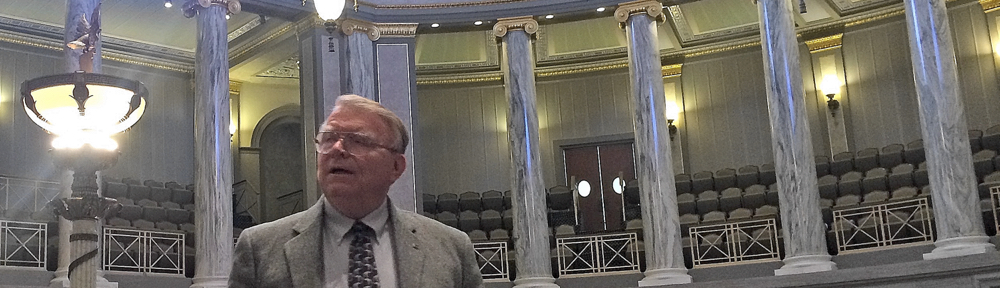
Will This Be Mike Parson’s “Lost Speech?”

It was a pretty good speech, the one Governor Parson delivered Wednesday. It was the annual State of the State speech.  Governors have been giving them since Alexander McNair did the first one on November 4, 1822 at the start of the Second General Assembly of the State Of Missouri. The speech lasted about 17 minutes.  Governor Parson’s speech lasted about 42 minutes.

As far as we can determine, his speech was historic because it was the first SOS address that did not take place before a joint legislative session meeting in the House chamber.  Even in the St. Charles Capitol, where the House and Senate met in adjoining rooms, the Senate joined the House for McNair’s 1822 speech.

And, as far as we can determine, it was the first time a State of the State Address was not given during a joint session.  In fact it wasn’t given during a session of the legislature at all.  Neither chamber was in session. Another historical point.

Mark these circumstances down to an external historical event that had become too internal—the COVID-19 pandemic.  The House leadership decided Wednesday morning that the House could not be used because of fears the event would turn into a super-spreader of the virus.  The situation was so out of hand in the House that it didn’t even meet the previous week.

That near-last hour decision provoked a big scramble that resulted in moving the speech to the Senate where there is far less room for social distancing on the floor or in the galleries. We’ve heard there were concerns the Senate could muster a membership majority for an afternoon joint session.

As a result, neither chamber was in session. The Senate gave permission for the speech to be given there, much as it gives permission for the Silver-Haired legislature and other mock legislatures to use the chamber. Reports indicate about one-third of the Senate membership stayed away.

The House Information Office, which has a pretty sophisticated audio/video system it uses for special events in the House, managed to move all of its gear into the Senate galleries and strung all of its cables, and mounted all of its cameras in a matter of a few hours and produced a high-quality video feed on the governor’s Facebook page (maybe I’ll tell you sometime how close the Missourinet once came to beginning daily video feeds on its webpage many years ago).  I watched it.  I thought it was flawless.

The galleries of the Senate chamber were uncomfortably crowded with Parson cabinet members, guests who would become show-and-tell examples of certain points the governor wanted to emphasize, other special folks and as many House members as wanted to crowd in.

Normally, the House and the Senate appoint a special escort committee to escort the Governor into the House chamber.  But with neither chamber being in session there could be no escort committee—another possible first.

At the appropriate time, the back doors opened and in walked a masked Governor Parson.  Alone.  No handshakes on the way in, as usually happens.  Fist bumps only during the walk down the much-shorter than usual center aisle.

Forty-two minutes (and probably about 6,000 words) later, the governor put has mask back on and he and Teresa walked hand-in-hand back up the aisle and out of the chamber.  I’d never before seen a governor and First Lady walk back down the legislative aisle after a State of the State speech.  Another touch of history on that day.

There was no State of the State message in the First General Assembly—

—because we weren’t a state then.  Congress had given Missouri permission to elect a state legislature and state officers and draft a proposed State Constitution in 1820.  McNair gave the first state governor’s inaugural address on September 19, 1820, almost eleven months before Missouri was a state.  His three-minute speech was so short that a goodly number of legislators were still in a grog shop down the street in St. Charles and missed it. They wanted him to have a do-over and he refused.  Then came the 17-minute SOS in 1822.

As we have researched the history of the Capitol, we have come across a lot of State of the State messages in legislative journals.  Some are amazing.  For a good part of our history the governor did not deliver the message. He sent the message to the House, often with the Secretary of State or his personal secretary carrying it.  Then somebody read it.  And read it and read it.

And read it.

Long ago we learned that the average person speaks at about 150 words per minute.  It’s a natural pace for most of us. Any faster and the listener is tense, waiting for the next work.  Any faster, and clarity of speech might suffer.  So, using the 150 wpm standard, here’s how long some previous State of the State speeches have lasted.

On November 22, 1836 (the legislature in those days met after the harvest and quit in time for spring planting, “Lieutenant Governor and Acting Governor” Lilburn Boggs delivered a speech that covered seventeen pages of the House Journal. The word counter on my computer says the speech was 8,873 words long. Whoever read it probably took about an hour to give.  It’s hard to imaging many applause breaks since the big buy himself wasn’t reading it.  So there was little to keep people awake.  Maybe they didn’t suffer as much as we think because in those days church sermons of two or three hours were not uncommon and the listeners were sitting on split log benches without backs.

John Cummins Edwards, the youngest governor in Missouri up to that time, used 6,681 words in 1846, a more modest 45-minute speech, probably.

Sterling Price’s Christmas Day State of the State speech in 1854 was 7,114 words long, would have lasted a couple of minutes longer than Edwards did.  His speech took 12 pages of the House Journal.  We’re not sure if this was the first time it happened, but after the speech, the House ordered thousands of copies printed, including 2,000 copies in German—as more and more Germans started flowing into Missouri from their country that had been torn by revolutions for several years.

We ran out of energy on the John Marmaduke speech in 1887. It took up 19 pages.

Joseph Folk was a populist who was elected in 1904.  He was so full of ideas for cleaning up a corrupt government that his SOS took 14,071 words to express. All those words probably took two hours and 22 minutes to read.

TWO HOURS AND 22 MINUTES!

Forrest Donnell, the governor that majority Democrats tried to keep from taking office in 1941, gave his final SOS  on January 3, 1945. He could have spent a lot of time talking about his accomplishments steering our state through most of the World War, but he didn’t.  4180 words, 28-30 minutes.

The first State of the State given by Warren Hearnes in 1965 took 3,063 words.

By the time Donnell and Hearnes spoke, governors were delivering their own remarks. That is likely to be the greatest motivation not to talk endlessly.

The longest SOS we ever covered was Joe Teasdale’s first one.  Since the Missourinet broadcast it, we clocked it.  An hour and 17 minutes.  It seemed interminable.  And it was still more than an hour shorter than Folk’s message.

But unlike all of those other State of the State messages, the one given by Governor Parson this week might become a “lost speech.”   Why?

Because it wasn’t given to a joint session. In fact it wasn’t given to a session of either chamber of the legislature.

As we write this, we haven’t seen the journal from yesterday, Thursday, yet. But since the speech was given outside of the legislative day, it doesn’t qualify to be in the journal.  If that’s how it turns out, the speech will achieve still another historic first—-there won’t be an official record of it in either journal.  Perhaps a century from now somebody who has the questionable intelligence to spend hours reading legislative journals will wonder why there was no State of the State message in 2021.

There was one. Pretty good one. Well-delivered. Well-covered by the media. But if it’s not in the journals, it will be Mike Parson’s “lost speech.”

UPDATE:  The unapproved journals of the House and Senate for the day of the speech, which are available on the web pages of the chambers, do not include the speech.  


Our Democracy

We refer to our system as “democracy,” but that’s only shorthand for Democratic Republic.

Our democracy has held, survived, prevailed.

Our democracy is a mental exercise not a gut reaction.

It was created by people of thought who sought to extend the rights of a privileged few to all.

Our democracy is strengthened by progress born of thoughtful consideration, weakened by confrontation encouraged by intentional antagonisms.

It is based on seeking truth, debased by accepting lies.

Our democracy has led to shared progress, often slower and more painful than desired. It has been set back by selfish and unthinking fears of change.

Our democracy respects and expects service. It is damaged by those who grasp only for power.

It is enhanced by firm belief in the ultimate wisdom of many. It is endangered by blind loyalty to the whims of one.

Our democracy is strengthened by respectful differences, weakened by disrespectful demands for conformity.

Sometimes we stray from the former into the muck of the latter.

There has always been someone to pull us out.

But it is our responsibility to be sure our rescuer is worthy of our gratitude.

Our democracy gives us that chance.

Every four years.

We celebrate that opportunity today.

Dr. Crane on the Ticking Clock

(The General Assembly has begun its 2021 session. Governor Parson has begun his four-years as the head of our state government. The work of the legislature and the work of the governor—and other elected officials—is limited by time, of which there is plenty now.  But by May 1, time will have become a fearful enemy. The General assembly must approve a budget about two weeks later and adjourn in less than three.  Campaigns in 2022 and 2024, now so distant, will become a weight on the shoulders of those who hoped their actions would become a praiseworthy legacy.  So it is that we turn to Dr. Frank Crane today and his observations about—–)

TIME

Old Father Time knows more than anybody.

He solves more problems than all the brains in the world.

More hard knots are unloosed, more tangled questions are answered, more deadlocks are unfastened by Time than by any other agency.

In the theological disputes that once raged in Christendom neither side routed the other; Time routed them both by showing that the whole subject did not matter.

After the contemporaries had had their say, Time crowned Homer, Dante, Wagner, Shakespeare, Whitman, Emerson.

Amost any judgment can be appealed, but from the decision of Time there is no appeal.

Do not force issues with your children. Learn to wait. Be patient. Time will bring things to pass that no immediate power can accomplish.

Do not create a crisis with your husband, your wife. Wait. See what Time will do.

Time has a thousand resources, abounds in unexpected expedients.

Time brings a change in point of view, in temper, in state of mind which no contention can.

When you teach, make allowance for Time. What the child cannot possibly understand now, he can grasp easily a year from now.

When you have a difficult business affair to settle, give it Time, put it away and see how it will ferment, sleep on it, give it as many days as you can. It will often settle itself.

If you would produce a story, a play, a book, or an essay, write it out, then lay it aside and let it simmer, forget it a while, then take it out and write it over.

Time is the best critic, the shrewdest adviser, the frankest friend.

If you are positive you want to marry a certain person, let Time have his word. Nowhere is Time’s advice more needed. Today we may be sure, but listen to a few tomorrows.

You are born and you will die whenever fate decides; you have nothing to do with those fatal two things; but in marriage, the third fatality, you have Time. Take it.

Do not decide your beliefs and convictions suddenly. Hang up the reasons to cure. You come to permanent ideas not only by reasoning, but quite as much by growth.

Do not hobble your whole life by the immature certainties of youth. Give yourself room to change, for you must change, if you are to develop.

“Learn to labor and—to wait!”

-0-

Things seemed so normal then

Remember how normal things seemed the last time we gathered on a chilly Monday on the south front of the Capitol lawn for the inauguration of a new governor?

Eric Greitens, a young Republican populist, riding the wave of the Donald Trump-led populist surge nationally, was sworn in as governor in what he referred to in his opening remarks as “our republic’s most revered ritual: the peaceful transfer of power.”

Greitens, who saw the governorship as one step in his eventual trip to the White House, promised to “be loyal to your needs and priorities—not to those who posture or pay for influence.”

Former sheriff and former senator Mike Parson, days removed from open-heart surgery, surprised some of us by being on the platform, taking the oath as Lieutenant Governor.

Jay Ashcroft, son of a former state auditor, attorney general, governor, and U. S. Senator John Ashcroft (only Mel Carnahan matched him by holding four statewide offices in his career), was sworn in as Secretary of State.

Former Senator Eric Schmitt became the new State Treasurer that day.

And University of Missouri law professor Josh Hawley took over as Attorney General after a campaign in which he vowed he would not use the office as a stepping stone to something higher.

Nobody wore masks that day, four years and two days ago.

Eleven days later, another inauguration saw Donald Trump rise to the Presidency, a surprise to many in the Republican establishment and a frightening possibility in the eyes of many who were not his deepest believers.

How normal things seemed even then—despite the uneasiness many felt about the tenor of the campaigns that put Greitens and Trump in office on those days.

A few months after that bright but chilly January day, Greitens was gone, resigning before he could be impeached after refusing to reveal records of his campaign and ongoing finances, and being dragged through the headlines generated by a sex scandal.

His resignation triggered unprecedented chair-swapping in state government.  Mike Parson moved up to governor and appointed term-limited Senate leader Mike Kehoe as the new Lieutenant Governor, an appointment later ruled legal by the Missouri Supreme Court.

Josh Hawley, forgetting his promise not to use his office as a stepping stone, rode the continuing Trump wave to victory over Claire McCaskill two years later, leading Governor Parson to appoint State Treasurer  Schmitt to replace Hawley in the Attorney General’s Office. The House budget chairman, Scott Fitzpatrick, was appointed to become the new Treasurer.

Only Jay Ashcroft remains where voters put him four years and two days ago.

Today is far different from that day four years ago.

Our capitol has emerged from months in a giant plastic cocoon in which workers cleaned and replaced stone put in place more than a century ago, ended serious water leakage problems, and even restored Ceres, the patron goddess of agriculture, to the top of the dome so she once again welcomes those attending today’s ceremonies.

Mike Parson is being sworn in for a term of his own as governor, bearing the scars of dealing with a pandemic, a state economic collapse it caused, and the pain of the budget cuts he had to make–all in an election year.

Eric Greitens’ wife left him; he reportedly is hoping he can rehabilitate himself to seek public office again, although his thoughts of a presidency might be much dimmer than they were when inauguration day was HIS day full of hope.

Josh Hawley, with his own dreams of White House glory, is under intense criticism from former supporters in the public and present colleagues in Washington for his attempt to capitalize on Donald Trump’s conspiracy theories that have led to one of the most alarming political incidents in our lifetimes.

Donald Trump is isolated and increasingly alone, living the bitter final days in power he fears giving up, the idea of a peaceful transfer of power completely foreign to him.

And today we wear masks, our nation still under siege from a terrible virus that has forced us to withdraw from friends and family.

Oddly enough, a sentence from the inaugural address of Eric Greitens on January 9, 2017 comes to mind.

“This state in the heart of America has proven that the worst in our history can be overcome by the best in our people.”

Let us hope and fervently pray that on that, at least, he will be correct.


Stop the Steal—Missouri, 1941

The sordid contemporary events that will forever be a lamentable chapter of American history strongly remind us of a similar lamentable chapter in our own state’s history.

This year is the 80th anniversary of the attempt by majority Democrats to steal the governorship from Republican Forrest Donnell, who had won the governorship by the narrowest margin in state history.  Here is how it went down:

Forrest Donnell, a Sunday-school teacher and lawyer from St. Louis officially defeated one of the pupils in his church class, Lawrence McDaniel, by 3,613 votes. McDaniel was backed by St. Louis Mayor Bernard Dickmann’s political machine that Donnell attacked as a potential successor of the infamous Pendergast Machine of Kansas City, badly weakened because “Boss Tom” had been sent to federal prison for violating tax laws.

Shortly after the election, State Democratic Committee Chairman C. Marion Hulen of Moberly announced the committee would investigate reports of “election irregularities.”  Committeeman Frank H. Lee of Joplin announced he had evidence that McDaniel had actually won by 7,500 votes.

In those days, the Speaker of the House, not the Secretary of State, made the official announcement of winning candidates. The legislature convened on January 8, 1941 but Speaker Morris Osborn made no pronouncements. At a joint session on the tenth, Osborn certified the Democratic candidates for statewide office as winners but refused to certify Donnell.

Traditional inaugural ceremonies on January 13th were cancelled.  Lt. Governor Frank Harris took his oath for a third term in the Missouri Senate, where the Lt. Governor is the chamber President.  The other statewide office holders took their oaths at the Supreme Court.  Donnell refused to be sworn by a Justice of the Peace and, instead, asked the court to order Osborn to declare him the winner. A second lawsuit asked the court to forbid a legislative committee from starting a recount.

Two days later, an angry Stark to a joint legislative session,

Your every thought and every effort should be to prove to the people of this great commonwealth that their faith in democracy is not misplaced, that democracy does and will work in Missouri. Nothing should be done at any time to shake the faith of our people in their democratic form of government. In these perilous times, it is doubly necessary that every public official in the state and in the nation should lean backward in an effort to serve the people strictly according to the constitution and the laws of the land without partisan bias and with only the welfare and the safety of our democratic form of government in mind.

Democrats started a recount anyway.  February was half-gone when the Supreme Court ordered Osborn, under the Constitution, to declare Donnell elected, allowing McDaniel to file a notice contesting the election, triggering a legal recount.  The Joplin Globe editorialized, “Larry McDaniel has at once forfeited the moral support of thousands of Democrats who from the first have been nauseated from the stench from the original office-stealing effort.”

Donnell (left) finally was sworn in on February 26, much to the delight of Lloyd Stark who said he was tired of “living out of a suitcase” while his fellow Democrats tried to overturn the election.

McDaniel’s 226-page contest petition was filed March 4, citing fraud, erroneous tabulations, irregularities, and vote-buying in 56 counties. He claimed that a complete would show that 24,263 votes cast for him were “wrongfully rejected” by election officials and that he was the real winner—by 30,000 votes.  Donnell’s 50,000-word response filed about three weeks later threw McDaniel’s claims back at him claiming problems in 91 counties such as irregular registrations, voting by minors, non-residents, and wards of the government. He claimed he should have an additional 9,000 votes.

The recount started in mid-April and by May had turned into a disaster for McDaniel.  Checked returns from St. Louis City and 81 counties had inflated Donnell’s victory margin by four-thousand votes.  A new joint legislative session was called after McDaniel had arranged for hastily-drawn letters withdrawing his contest. He said he had become convinced that reports by his party leaders and others that there had been massive fraud were “greatly exaggerated” and that he was convinced “beyond question of doubt” that Donnell had been elected. Because the recount was never completed, Donnell’s victory margin remains in our history books and in the official record as 3,613 votes, the second-closest race for governor in state history (Frederick Gardner defeated Henry Lamm by 2,263 votes in 1917).

Forrest Donnell was elected to the U. S. Senate, succeeding Democrat Harry Truman.  He served until 1951 and returned to St. Louis and his law practice. He was the last Republican Governor until Christopher Bond took office in 1973.  Donnell, then 88 years old, attended Bond’s inauguration and took part in the celebration late into the night.  He died in 1980 at the age of 95.

Democrats paid a price for their 1941 shenanigans.  Republicans took control of the House in the 1942 elections by a large margin.

One of the other casualties was St. Louis Mayor Bernard Dickmann who was heavily criticized by winner William Becker for trying to use the election contest of 1941 to establish St. Louis machine control of state government.

A new constitution drafted during Donnell’s term in office took away the power of the Speaker of the House to declare election winners and placed it in the hands of the Secretary of State, the top Missouri elections official, where it resides to this day.

(Photo credit):  Bob Priddy Collection


Fear of the Mob

This will be brief.

The U. S. Senate meets Wednesday to confirm the results of the Electoral College. Many Republican Senators and Representatives are up for re-election in 2022.  We’ve been hearing that some of those people don’t want to antagonize our president and his base by quietly agreeing to the results of the election. He already has threatened to “primary” some Republican office-holders who have repudiated his repeatedly-rejected (by the courts) claims of election fraud.

Those who bow to his intimidation are, in effect, signaling that they fear standing against mob rule, for it is clear that this president is unafraid to promote mob behavior in the streets, on the internet, or even in the front yards of elected officials who dare to stand for the truth.

And when the mob becomes a motivator for political decisions, especially if they are decisions focused on individual political futures, it is a slap in the faces of our founders and endangering the constitutional republic they gave us and for which millions have sacrificed their lives to defend.

This is a time to stand against the mob and against the one who thinks it is an acceptable tool to obtain or retain power.  There is never a time for cowardice. There is always a time for courage.

Wednesday will be one of those times.

(We hope Dr. Crane can resume his normal place on Mondays next week.)

This the First Day of Winter

As far as your conscientious observer is concerned, it is.   We are headed into the worst month of the year. Cold. Nasty. Snowy and icy. Bundle up before you go out. Rearrange your coat so you’re comfortable after you get in the car.  Wrestle with the seat belt when layers of clothing make it hard to reach around in back of you to get the thing.  Then getting it past all that fabric into the slot. Nothing is easy in January.

Scraping the windshield. Waiting for the car to generate enough heat for the defroster to work.

January is one damned hassle after another!

At least the shortest daylight day of the year is ten days past and there’s some benefit to knowing in the back of our mind that the days are starting to get a little “longer.”

BUT IT’S STILL JANUARY!!!

January is only moderately more acceptable now that I am not getting up at 4:30 and suffering my way to the newsroom a little after 5.  Go to work in the dark. Come home in the dark.

A bowl of hot clam chowder helps elevate the spirit a small notch.  Hot cocoa helps, too.  A blanket on the lap with a cat sleeping on top of the blanket brings some peace.

Some of you think you can play in winter.  You’re crazy.  Keep your stories to yourself about going to Vail for a week of skiing.  The last thing I can think of as fun is trying to avoid the trees while hurtling down a frozen slope on snow three feet deep with the temperature hovering around fifteen.

Forget December 21 as the scientific start of winter.  It’s four days before Christmas and the good feelings that go with it.  But when the afterglow of Christmas fades there’s only January.  . It’s just a frigid, grim march to February—a short month during which men begin to play baseball and race cars start to run hot again, and there’s the sweetness of Valentine’s Day and the snow doesn’t seem to last forever and sometimes the thermometer hits 40 or 50, temperatures that bring hope that we might have made it through the worst after all.

A few years ago I found a little book called If This isn’t Nice, What is? It’s a series of graduation speeches given by the famous author, Kurt Vonnegut.  The first entry is his graduation address at Fredonia College, New York on May 20, 1978. In that speech, Vonnegut correctly observed that we are wrong when we think there are four seasons and when we let the sun’s position determine what they are.  There are six, he said.

“The poetry of four seasons is all wrong for this part of the planet, and this may explain why we are so depressed so much of the time. I mean, Spring doesn’t feel like Spring a lot of the time, and November is all wrong for Fall and so on.  Here is the truth about the seasons.  Spring is May and June!  What could be springier than May and June?  Summer is July and August. Really hot, right?  Autumn is September and October. See the pumpkins? Smell those burning leaves.  Next comes the season called “Locking.”  That is when Nature shuts everything down. November and December aren’t Winter. They’re Locking. Next comes winter. January and February. Boy! Are they ever cold!   What comes next?  Not Spring.  Unlocking comes next.  What else could April be?”

I am Vonnegutian in my understanding of the seasons.  I am locked in to January and February, waiting only for the arrival of Unlocking, warmed only by my inner curmudgeon, and comforted only by the fact that I remembered to write “2021” when posting this entry.

Oh, by the way—Happy New Year.

Dr. Crane on a New Year, At Last

(By the end of this week we will have shed ourselves of 2020 and, we hope, soon will shed ourselves of the physical and political ills that have robbed us of our personal and national spirit. The movement of the second hand from one side of midnight to the other side three days hence can move us socially and spiritually to a new place—-at least in our minds, at least for a while. Association Men, the official magazine of the Young Men’s Christian Association, carried this article in its January, 1919 issue, as Dr. Frank Crane reflected upon—-)

THE NEW YEAR AND OPPORTUNITY

The New Year spells Opportunity.

That is its great, outstanding message.

Once a year the old Clock of the Universe strikes, at 12 o’clock on December 31st, and as its strokes thunder around the world they say to men and women everywhere:
“Now, you have a chance to try it again! Begin, begin again!”

Twelve words.

Discouraged boy, tired of waiting, ready to give up, with your heart down and the
devil whispering to you, “What’s the use?” Listen! Don’t you hear the clock? Up
and at it once more! Slough off your discouragement, as a dirty coat, roll up your
sleeves—the world’s your hickory-nut, full of meat, and you’re the boy to crack it.

Young man, wrestling with the Snake called Bad Habit, that is slowly throttling
you, poisoning you, ruining your career, breaking your mother’s heart, and turning
gray your father’s hair—listen! The twelve bells peal across the snow-fields of the earth,
ring out in the mountains and echo in the valleys. They are to you, for you. Begin
again! The Almighty Father thinks of you in every stroke, every beat is a heart pulse
of His meaning, and says, “Life is yours. The Future is yours! Step on your dead
self and rise. All things are yours, for you are Mine.”

Heartsick woman, with your lap full of shattered dreams, there’s resurrection in the New Year. Out of the broken fragments of your hopes you can make something
more beautiful. Heaven and earth are full of unexhausted resources. They are yours.
Only be strong and of a good courage. Don’t give up. No soul can be cheated of its
divine inheritance.

Old man, you’re never too old to come back. A man is only as old as his Will.
Buck up! Don’t you hear the Clock? Opportunity is ringing. There’s a place for
you, work for you, a need for your purpose, a goal still for your high emprise.

No man sinks in the waters of fate but the one cramped with fear. Kick, and
you’ll float.

No man is discharged in the great war of life. Only deserters fight no more.

Come! The Infinite is your friend, surrounds you, presses upon you like the
atmosphere, and will breathe into you tides of power, if you will but open your soul.
And the opener of souls is Courage.

No insuperable calamity can befall me except I be afraid and give up.

What! Have you not lived until this day? Have not the Everlasting Arms held you up till now, even though you be spent, and hungered, torn, bloody, desperate? Still you have Life—then look up to that Concealed One who gave you your Life, and has so far upheld it, and cry, as you tighten your belt, and adjust your gas mask against the asphyxiations of despair, and grasp your good rifle-cry out to Him, who though He seem distant and unknown, is yet “nearer to you than hands and feet, and closer to you than breathing.”

“So long Thy power hath held me, sure it still
Will lead me on
O’er moor and fen, o’er crag and torrent, till
The night is gone, –
And with the morn those angel faces smile
Which I have loved long since and lost awhile.”

-0-0-0-

Dr. Crane in his later years believed himself to be as thorough a Christian as anyone, even though he considered the dogmas and creeds of the churches to be “of little or no consequence.”

-0-

HAPPY HOLIDAYS—-

—-From two old people waiting for their shots…..

And their two furry companions, who got theirs at the veterinarian store a few weeks ago.

Minnie Mayhem and Maximus Decimus McCattimus have been good but occasionally mischievous company in these times of separation.  They’re not worth a hoot at Mexican Train Dominoes, Rumikub, Five Crowns, or other table games we used to get together with human friends to play but then, our human friends didn’t purr when we rubbed their tummies.

Nancy has gardened in the warm weather, and has continued her work with the church bell choir.  But her trombone in the city band hasn’t been touched for almost a year because the band can’t perform well in masks—except for the percussion section. Bob is trying to find acceptable compromises with the publisher of his book about the history of the Missouri Capitol. This year, his research uncovered the fact that Cole County was not named for the person it had been claiming to be named for, for at least 150 of its 200 years.

We are enjoying Christmas with family and friends as much as possible——in this era of church services on Facebook, and meetings and family gatherings at such strange places as Zoom, Webex, Skype, and GoToMeeting.

Our children and our grandchildren (two of the former, four of the latter) have adjusted, as have millions of others, to the “work from home” lifestyle that includes times of involuntary home-schooling when the public schools decide to do remote learning.

The virus has touched our family only lightly but we have lost some friends and acquaintances to this pandemic and will miss their faces when we emerge from this siege. We wish not to lose any more.

We are glad for several reasons to let go of 2020 and look forward to the return of spontaneity to our lives in 2021—and, perhaps, the opportunity to see friends and family we have dearly missed this year.  We wish the blessings of the season for all of you and only good news in 2021. We encourage you to do the things that will make it possible for us to be together again:

Wear a mask:

Socially distance:

And wash your paws.  Often. Max and Minnie do. You should, too.

Most of all:  Be safe.

Merry Christmas from:

Bob, Nancy, Max and Minnie.

-0-


A seldom-told story of the end of WWII

This year has been the 75th anniversary of the end of World War II.  We’ve see a lot of publications about the anniversary, including V-J day, Victory over Japan day.  We have yet to see one that tells you the story we are about to tell you.

Most of us probably have seen photographs of General MacArthur signing the peace treaty with Japan in ceremonies on the deck of the USS Missouri.

But few of us probably have seen these pictures:

A few weeks ago my long-time friend, Hugh David Waggoner, called to see if I would be interested in an old trunk full of pictures from World War II that had belonged to a man named R. Sheldon Gentry (his first name was Rusaw, which might explain why he used “R” so he wouldn’t have to explain or repeat “Rusaw.”)  The name rang a faint bell with me but I have not been able to pin down who he was.

The pictures you see above are from the trunk.  The photographs and some 70-plus years old newspaper clippings tell the story behind the famous pictures of the surrender on the Missouri.  This story from that trunk is a story not often told, one I had not heard. So we’re going to tell it today because we doubt many of you have heard it, either.

One of the people in the third picture above is of extremely special interest because without him the war might have gone on longer than it did with consequences of immensely tragic proportions beyond the tragedies that had been occurring since Japan invaded China in 1931, the real beginning of the war.

A word, first, about Gentry, who went into the Army as a Second Lieutenant and came out a Major. He was a decorated photo intelligence officer who wound up with two Presidential Citations and two Legions of Merit among his medals because of his expertise in advising bomber crews about their targets. In fact, he went on several missions and helped guide crews to their targets in the southwest Pacific Theatre as the allies closed the noose around Japan.

Three days after the second Atomic Bomb was dropped, Gentry was in an American bomber fifty feet over Nagasaki assessing the damage.  A few days after that, Japan accepted the surrender terms laid down at the Potsdam Conference by the United States, Britain, and the Soviet Union. The notification was announced on August 15 by President Truman, the same day the Emperor dramatically announced to his nation that he had ordered all Japanese military forces to stop fighting. It also was the day General McArthur was designated the Supreme Commander for the Allied Powers.

MacArthur immediately ordered the Japanese Imperial Government to send envoys to Manila on the 17th to put the surrender into effect. The delegation was to travel from Japan in a white airplane with green crosses on the fuselage and wings to the island of Ieshima where they would transfer to an American plane that would take them to Manila. The Japanese were granted some extra time to make preparations for the flight—painting an airplane, for example.  On the morning of August 19, the sixteen-member delegation boarded two re-painted Mitsubishi G4M “Betty” bombers and flew to IeShima (the Japanese called it IeJima or Iye Jima), an island in the Okinawa Prefecture.

The Betty was the main bomber used by Japan, often as a torpedo bomber—as it was at Pearl Harbor. It was fast, 265 mph, could fly 3,250 miles. One of its most notable accomplishments was the shocking sinking of the British battleships, Prince of Wales and Repulse during the earliest days of the war, the first battleships sunk in a wartime air attack. But the plane had no armor and no self-sealing fuel tanks, making it vulnerable to a few well-placed shots.  Admiral Isoroku Yamamoto, the commander of the Japanese Navy at Pearl Harbor and Midway, was sought out and shot down in a Betty over Bougainville in 1943.

But that’s straying from our story.

The pictures at the top of this entry were in Gentry’s trunk.  They show the two disarmed Betty bombers, as the Americans called them—Americans gave male names to Japanese fighter planes and female names to the bombers—being escorted by two Army Air Force B-25s.  The second pictures shows one of them landing.

The delegation was met by American officers who escorted them to one of our C-54s for the flight to Manila.   Notice, in the third picture, the man in the white suit, in the center, wearing glasses. He was the only civilian among the seven men who sat at the negotiating table in Manila, across from seven American military representatives who worked out the final agreement in two sessions the evening of the 19th and the morning of the 20th.

In the trunk is the first teletype message that negotiations for Japanese surrender had been completed and Japanese negotiators would arrive later on the 20th in Tokyo.

But things almost did not turn out well.

The man in the white suit at the negotiations was Katsuo Okazaki, a 5,000 meter runner at the Paris Olympics of 1924.  Although MacArthur’s directive was for negotiators only from the Army and the Navy, the Japanese government decided to have a representative of its own with the group and selected Okazaki, the former second secretary of the Japanese Embassy in Washington and then the director of the research bureau of the foreign office.

The surrender flight to Ie Jima had been a nervous trip for those aboard the two bombers. “At that time the Kamikaze corps was still strong.  We had to make our preparations in secret lest the Kamikazes attack us on the way.  It took longer than we expected…

“We flew from Kisarazu airbase,” he recalled in a late 1947 interview with Ray Falk of the North American Newspaper Alliance. “A little after noon we were off Kyushu, Japan’s southernmost island, where we were met by American planes. We had been given the call signal, ’Bataan.’”

(The Battle of Bataan in the Japanese Philippine campaign of 1942 ended with a 65-mile forced march of 75,000 captured American and Filipino troops to concentration camps. The march was infamous for the brutality of the Japanese, who beat bayonetted the starved and weak prisoners who were too weak to walk. Thousands of them died on the march or in the camps.)

“When we called, ‘Bataan! Bataan!’ the American pilots answered, ‘Yes, we are Bataan’s watchdog—follow us…’”

The group returned to IeShima after the Manila conference to find one of their planes was undergoing repairs and split up, with half of the group going back to Japan and the other half waiting to fly back later.

“Half an hour before our expected landing time in Japan, the pilot came back and said, ‘I am sorry but we found our gasoline tank is leaking, and we have very little gas left.’ We were flying over water. We didn’t know whether we could reach land. We knew the bomber would not float more than one or two minutes.  Come what may, I was entrusted with all the documents.”

“Fifteen minutes later, the plane crashed, and I made a compete somersault. A second crash and another tumble followed.  I was ready to jump out when the pilot came back and said, ‘Please remain calm and swim ashore.’  We had landed in shallow coastal water.”

The pilot had managed to land the plane near a beach at Hamamatsu, about 285 miles south of Tokyo.

Okazaki went into the water and swam ashore, holding the vital documents above his head. “We couldn’t see where we were for it was so dark,” he continued. “Eventually a full moon rose and we went ashore. Two fishermen from Hamamatsu helped us to get to the Hamamatsu airbase.  The villagers had been reluctant to help us when they saw the plane crash because they thought I was a B-29. We were lucky not to have been attacked as enemies.

“Anyway, we reached Prime Minister Prince Higashi Kuni’s office at 9 o’clock the following morning, only seven hours late.  The cabinet had waited for us all night.

“I can’t imagine what would have happened if I had drowned. General headquarters already was mistrusting us because we were two days late in getting to Manila. What measures the allied armies might have taken are pure conjecture. But they would have been unpleasant. It might have caused the war to continue in view of the fact that our party had to escape from the anti-surrender Kamikaze corps which wanted to continue the war.”

There might have been conjecture on Okazaki’s part in 1947 but there was no conjecture on the part of the allies of 1945 who already had been planning one of the largest amphibious operations in history, Operation Downfall, to start in November.  The second phase would have been launched in early ’46 near Tokyo. Japan knew the invasions were coming but hoped the cost to the allies would be so great that the war would end with an armistice, not a defeat.

The forecasts for casualties varied widely. One estimate from Secretary of War Henry Stimson forecast 400,000 to 800,000 fatalities and as many as four-million total casualties, not counting the 100,000 allied prisoners of war who were to be executed if Japan was invaded.

But for Russia’s late-war invasion from the north and the incineration of Hiroshima and Nagasaki with threats of more such attacks—and a swimmer named Katzuo Okazaki—history might have been a great deal more “unpleasant” as Okazaki put it in 1947.

The first advance party of American soldiers arrived in Japan on August 26 with greater numbers arriving two days later, with the surrender ceremonies taking place on an American battleship in Tokyo Bay September 2. Okazaki was part of the Japanese delegation on the Missouri that day.

And what became of him?

The man in the white suit was elected to the Japanese House of Representatives in 1949. Two years later, Prime Minister Shigeru Yoshida name him Chief Cabinet Secretary and state minister without portfolio. He became Foreign Minister in 1952 and during his three years in that office, signed a Mutual Security Assistance Agreement with American Ambassador John Allison. He retired but was called back to service to be Japan’s delegate to the United Nations from April, 1961 to July, 1963.  He died two years later at the age of 68.

And the Betty bomber, the Mitsubishi G4M1 that carried Okazaki and the others on those historic surrender flights? The Japanese called it the Hamaki, meaning “cigar,” a reference to its shape. Wrecked remains of hundreds of them are scattered throughout Southeast Asia and in the Southwest Pacific. The Smithsonian Air & Space Museum has pieces of one it is slowly restoring. A wrecked one is on display at an air museum in Chino, California.  Two years ago Warbird Digest reported two of the bombers had been recovered from the Solomon Islands for possible restoration. There are no flyable Bettys in existence.

There are more stories in that old trunk, It now resides at the Museum of Missouri Military History at the Ike Skelton Training Center near Jefferson City. We might tell more about Gentry in some later entry.  We haven’t learned much about his post-war years, but his trunk sure has some interesting things about that part of his life and the war he saw and helped fight. Now his trunk and the stories in it are at a place where they will be cared for and appreciated.