Notes From a Quiet Street (Before We Forget Edition)

We’ve been on the road quite a bit for the last month, the last couple of weeks in particular (as noted Monday).  We’re going back through some notes we jotted down during the regrettably unprogressive legislative secession that seems to have ended a long time ago (Thank God!), and entering them before they age out.

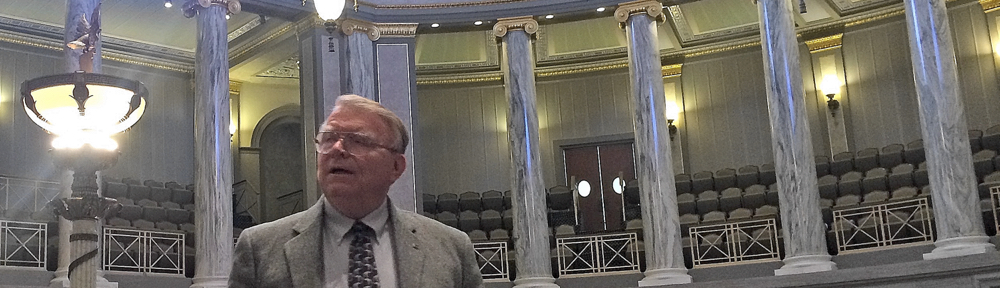
For much of the session, I did not wear a necktie.  The proper professional dress for male legislators and for those who tell them how to vote is business casual at the least.  But a January tumble that dislocated my left shoulder made it impossible to tie a necktie for a few weeks, very uncomfortable to struggle to tie one for a few more, and then a moderate struggle to do so as the end drew near..

I rather enjoyed having a good excuse for not wearing a tie, even if I had to have my left arm in a sling to be convincing.

I was comforted on Easter Sunday by a blog piece by Robert Reich, the diminutive (4-feet-11 inches) former Secretary of Labor in the Clinton administration.

The Washington Post  reported two decades ago, when he ran for Governor of Massachusetts, “His tie hangs an inch and a half beneath his belt buckle, or just above his knees.”

If you are a guy and you have ever wished for a tie-less society, you might find Reich’s ruminations on the issue valuable:

(4) The end of the necktie? – Robert Reich (substack.com)

0-0-0-0-0

Saw a newspaper article a few weeks ago about the reopening of closed church in Chula, a town of about 200 folks, near Chillicothe.  The church closed five years ago.  Seems that the place had become a large bee hive since the last chord was played on the piano or organ.

The article in The Pathway, a Missouri Baptist Convention publication described how Amanda Hicks, her husband, and a friend went in to clean the place and make it presentable for worship again only to be attacked by “a huge swarm of bees” that stung all three people several times before they could get to safety.

The bees eventually were uprooted, unhived, smoked out—there must be an appropriate phrase for such things—and the cleaning went on.

Among things removed—77 pounds of honey.

The newspaper says 20-25 people worship there now.  Wonder if they ever sing a hymn that should be the church theme song:  Sweet Jesus.

0-0-0-0-0

No other sport can match baseball for having statistics that go beyond being obscure.  Here’s one from the early games.

Pitcher Marcus Stroman of the New York Yankees has set a record for most strikeouts by a pitcher no more than five feet-seven inches tall.  The record was first written down in 1901.  He has now struck out 1,131 batters in his career, surpassing former Cincinnati pitcher Dolf Luque, a 21-year big leaguer.

-0-0-0-0

One reason the Missouri legislature has been so unproductive is that video lottery terminal operators, although insisting their machines are legal, want to pass a law legalizing them.  The casino industry complains that the “VLT” is just a pseudonym for “slot machine,” and casinos are the only ones who can have legal slot machines and they don’t want anybody horning in on their business, even if the VLTs are far, far away from any of our 13 designated casinos.

Neither side will compromise and the legislature seemingly lacks the intelligence or the courage to draft a compromise and pass it, pressure from the VLT and Casino lobbyists notwithstanding.

Three years ago, Platte County Prosecutor Eric Zahnd became the only county prosecutor take serious action, getting a court to rule the machines illegal and crushing five of those machines in 2021.

Now there’s a second player—Springfield passed an ordinance in February declaring the machines illegal.

We’ve been kind of a vigilante on this issue.  We won’t do business with a convenience store that has the things.  At least, not locally.  Well, there is one—but it’s the only one I know of that pops popcorn every day.  I’ll spend a buck-50 maybe once a week there. But no gas.

Wonder if I can program my in-car GPS to show me stores without the machines?

0-0-0

These machines bring to mind the tough old sergeant we had at the University of Missouri in the days when male students had to do two years of ROTC (Reserve Officers Training Corps to those too young to remember) who referred to Fort Leonard Wood as “the pimple on the butt of humanity.”  We consider VLTs to be pimples on the convenience store industry, bodily part not specified.

0-0-0-0

We had another of life’s adventures a few weeks ago.  A sleep study.

From about 10:30 p.m. when we were ordered to bed and to go to sleep (I probably heard that order for the last time when I was about seven, if not earlier) until about 6 a.m., I tried to sleep in a strange bed with about two dozen wires attached from the top of my head down to my calves.

It did not go especially well but I was told afterwards that the machines had recorded “enough sleep” for a doctor to render an opinion about whether I was sleeping well, or well-sleeping.

The test recalls a joke Abraham Lincoln once told of a man who was being ridden out of town on a rail and when asked what he thought of the experience replied, “Well, if it wasn’t for the honor of the thing, I think I would rather walk.”

0-0-0-0

The transfer portal is swinging both ways for colleges and universities these days. A lot of young men and women are moving from place to place almost yearly, looking for more money from the name-image-and-and likeness industry or more playing time to expose their talents to pro teams.

Wouldn’t you like to hear of one of these folks saying they’re transferring because the school of agriculture offers a better education?  Or the school of business?  Or the School of Education? Or Engineering?  Or the pre-med programs is better?

Collegiate sports is interesting but should fans be loyal to programs whose carpetbagging players have no loyalty in return?  I’ll watch the games on the teevee, and I often remember to do so, at least for football.  But I haven’t bought a ticket in years.

We think the NCAA needs a rule requiring schools to report the grade point averages of the carpetbagging players, some of whom already have their degrees. We’d like to know how many of these athletes even get a degree.

And that’s it for the sports curmudgeon today.


The Power Under Our Feet

If you think fossil fuels are the only way to power our lives, you need to go to Iceland. If Iceland doesn’t tickle your fancy (and don’t underestimate Iceland on this score; it’s surprising.), go to Texas.

If you think windmills should be forbidden because they kill birds, that nuclear power should be abolished because it leaves behind tons of dangerous waste, that electric-powered vehicles are actually uneconomical because it costs a lot of gas, oil, and coal for power plants to generate full  battery charges, that the use of oil, gas, and coal shorten lives, that water cannot turn enough turbines to light our cities—-you need to go to Iceland.  Or Texas.

Iceland first. We learned about this on a trip there just before the pandemic set in. We were attracted by the opportunity to see the northern lights.

And we did on a really cold night (we went in November).  Our guide—we called him “Fred” because we would have dislocated our jaws trying to pronounce name—took this one.

A 2020 study, the latest study we have seen, shows at least 90% of all homes in Iceland are NOT heated by nuclear, wind, or fossil fuel-generated power.  That study shows, in fact, that 99.94% of electricity generated in Iceland was geothermal or hydro-generated. Underground hot water and the water that powers the great waterfalls, in fact, provided 99.94% of all electricity generated in Iceland that year. And more than 70% of the total energy used in that country came from geothermal sources. The country wants to be carbon neutral by 2040.

Iceland has a lot of waterfalls—a lot!

Many of them are spectacular and they flow year-around. Why? Because glaciers melt from the bottom up in Iceland, even as winter puts down several feet of snow on top of them every year. The result is a lot of hydropower generation.

As far back as the Vikings, people have taken warm baths and washed their clothes in warm water even on the coldest days because of geothermal water-–water heated by the volcanic activity that created Iceland thousands of years ago and continues to alter its size today.

The number one use of geothermal heat in 2020 was space heating, then heating swimming pools, melting snow, fish farming, industry, and greenhouses (This is the Fridheimar     greenhouse that covers about 2.7 acres that uses pure  glacier water heated in a thermal pool to grow eighteen percent of the tomatoes used by the country—370 tons of them a year—on 20-foot high, or more, tomato vines throughout which about 1200 peaceful bumbleees maintain pollination, each of them capable of pollinating 2,000 flowers a day. The incredible tomato soup and bread for lunch are to die for.)

The Capital of Reykjavick, where about sixty percent of the country’s people live, has clear streets and sidewalks on snowy days because those streets and sidewalks are heated.  Water ranging from 100-300 degrees centigrade heats homes and is then diverted under the streets and sidewalks at 30 degrees centigrade (about 86 of our Fahrenheit degrees).

This issue has been highlighted by recent news coverage of some volcanoes that have become active in recent months. Some of the coverage has focused on the closure of the Blue Lagoon, the country’s most popular tourist attraction.  We were there.  And we floated in the geothermal waters.  The only way we could have drowned was by turning over and having somebody sit on us.

The lagoon’s water is a mixture of freshwater discharged from the Svartsengi Power Station and seawater.

Iceland didn’t officially recognize the power beneath national feet until about fifty years ago.  That’s when energy price inequities forced the national government to address the issue.   Orkustofnun, the National Energy Authority, recommended increased use of hydro and geothermal power to stabilize energy costs.  The Arab Oil Embargo that created an energy and economic crisis throughout the world led the Icelandic government to speed up its adoption of geothermal alternatives.

You might think that’s great for Iceland but the only significant place for geothermal activity here is Yellowstone National Park.  You are wrong. Take a look at this map of geothermal resources prepared by the Southern Methodist University  Geothermal Laboratory.

Texas might not look so hot in this map but it is a hotbed of geothermal energy development. The state well-known for its oil industry, says writer Saul Eblin for The Hill, is poised to dominate what boosters hope will be America’s next great energy boom: a push to tap the heat of the subterrnean earth for electricity and industry.”  He says Texas “is fueling a boom in startups that seek to take the issue nationally.

In March, he says, solar generation in Texas “eclipsed coal both in terms of power generation and market share.  Texas also has more utility-scale wind and solar capacity than any other state” although California still leads in rooftop solar power generation.

Last year, the Texas legislature passed four bills with only one “no” vote that will create new opportunities for geothermal drilling. Eblin says eleven of the nation’s 27 geothermal startups last year were in Texas and the momentum is building.

A few days ago, he reports, Bedrock Energy had a display at a commercial real estate company in Austin showing a new geothermal-powered heatng and cooling system. A few days earlier, Quaise, a drilling company, filed for a permit from state regulators to start field-testing drills that use high-powered radio waves to drill through dense rock. A company in Houston called Dervo, is building a 400-megawatt facility in Utah and the military is looking at geothermal source of electricity. Sage Geosystems soon will start using a fracked well to store renewable energy, a big step toward its goal of producing a reliable source of geothermal energy.

There are those who laugh at the electrification of America, particularly the growing emphasis on electric vehcles, claiming that the production fo electricity still requires fossil fuels and windmills and solar farms are nice but they limit use of land increasingly needed for food production.

But the heated water beneath our feet leapfrogs those arguments.  The SMU map indicates Missouri can produce 50-60 Milliwatts per square meter from underground water. One watt equals one millon milliwatts. Our calculation says Missouri has 180,540,000 square meters.  If we understand the math, that means 9,027,000,000-10,832,400,000 watts of geothermal power generation is beneath our feet.

If we do our math correctly, our largest utility, Ameren, generates 10,000 megawatts a year in Missouri, or about 10,000,000 watts per year.

Whether geothermal generation is an alternative for Ameren, we don’t know. But the company came under new federal pressure recently with the adoption of EPA new rules requiring coal-fired power plants to have new carbon pollution controls. The Post-Dispatch has reported more than half of Ameren’s power is generated by coal. Only Texas generates more power with coal. And Ameren’s Labadie plant in Franklin county is the number two power plant producer in the country.

So it appears we have enough thermal energy under our feet to generate as much as Ameren produces from all of its power plants, whether fossil or nuclear fueled in a year.  And Missouri isn’t even close to the geothermal potential other states who not only can serve their customers well but can export energy to other parts of the country, including to Missouri.

We have mentioned in earlier posts, one advantage to studying journalism in college was that no math courses were required.  If we have misunderstood these calculations, we welcome corrections.

Even if we are wrong, the experience of Iceland and elsewhere as well as the growing experience in Texas shows there is non-fossil energy enough beneath our feet to keep our lights on and to fuel our commerce indefinitely. But energy is politicized here. The fossil fuel industry slings a lot of money around in Washington and on campaign trails.  The Greenies, however, are making progress, incremental though it might be.

We might not be able to operate our cars on water but they can operate on the electricity generated by water, steaming hot water.  A 500-mile affordable electric car is growing closer.  But if we want to see the reality of a society powered by non-fossil fuels, Iceland is a flight of only five hours from Chicago O’Hare Airport. Take a coat, even in summer. It’s pretty far north.

Iceland as a country is one big ground source heat pump, north to south, east to west.

Super hot water beneath OUR feet is something to think about even here in relatively cool Missouri.

(Photo Credit: Bob Priddy)


Guillotines for Fun and Profit

Alpha Media owns more than 200 radio stations across the country.  Its recruiting web page is loaded with corporate-speak buzzwords about “having a passion for great radio” and a “highly-functioning, best-of-class team on all levels” that goes about “building strong relationships in our local communities.”

“If you are looking for an environment where management has a passion for our business; in working hard to provide the best possible live and local radio in the industry; and in having fun, then Alpha Media is for you,” it says.

You will excuse a lot of people in Moberly, Festus, Lebanon and the Farmington/Park Hills areas if they gag on those words. They’ve been stabbed in the back by the owner of their legacy radio stations.

Alpha Media assassinated local radio in those communities last week, laid off—with no notice—entire on-air staffs including some folks who had been everybody’s neighbors for decades.

In place of the voices who talked about local things including local sports, weather, and events, listeners of radio stations in those markets will be hearing syndicated programs from Alpha. Unfortunately, this kind of thing is not new.

Local radio has been dying by self-inflicted corporate wounds for a long time.

Your loyal observer, who believed throughout his professional career and continues to believe in the value of local radio, is astonished by the total hypocrisy of Alpha Media claiming it is “working hard to provide the best possible live and local radio in the industry and having fun.”

That’s precisely what these stations have been providing for decades.

Having fun?

If you think running a guillotine is lots of yucks, you’d probably be in total agreement with Alpha’s actions in these three communities. .

These radio stations were once owned by a man named Jerrell Shepherd, a small market radio entrepreneur who believed radio stations should not just be IN communities, they should be OF communities. The idea that grandpa or grandma might hear their grandchildren’s names mentioned during broadcasts of local high school sports events; the idea that the new president of the Lions Club would talk about an upcoming peanut sale fund-raising event; the county fair livestock auction; the hospital auxiliary ice cream social; Sunday morning church services; what the city council or school board did last night; that people might instantly go to their local radio station when bad weather approaches or has arrived—street closings, lunches at the schools or the senior center, obituaries—-are immaterial.  But those were and are part of being a locally responsible corporate citizen, especially in markets this size.

But that was then; this is now. The Hell with being a locally responsible corporate citizen.

The big-growth media companies, more interested in bottom lines than community responsibility and identity, only want to make money. And that’s why the familiar voices went to work one day last week and were told they would no longer have a job at the end of their shifts.

The “best possible live and local radio in the industry” became a lie that day in those towns.  And the definition of “having fun” became gallows humor.

Reporters from various central Missouri media who contacted Alpha to get an explanation have received nothing back.  A full-page ad in the local newspapers explaining, without the corporate doublespeak, why ditching true local radio is justified would be a courteous thing for Alpha to do. But don’t count on it.

There is no doubt that local newspapers and local radio stations have faced some struggles as more business is done through the internet.  And the issue with some businesses is not that they don’t make a profit—they just don’t make a big enough profit.

Employees reduce profits in all kinds of businesses which is why all kinds of businesses are finding ways to dump workers (Notice how few people at McDonald’s take orders at the cash registers lately?).  It would be nice if Alpha explained that to the people in these towns who no longer have a radio station they cared about because it cared about them.

Satellites and the internet allow for cutting the overhead of a radio station by allowing layoffs of as many of those dollar-consuming staff members as possible, replaced by voices of strangers from who-knows-where and who are unlikely to ever set foot in places like Moberly, Festus, Lebanon, or Farmington.

Broadcasting used to be regulated by the Federal Communications Commission which required broadcasters to operate “in the public interest, convenience, and necessity.”  But the industry back de-regulation in the Reagan years and got it.

I was part of a national professional organization that supported de-regulation because we thought some regulations stifled public discussion of important issues more than it promoted it.

We supported it because it required stations to meet certain standards of public service that really were hollow standards.  We believed that serving the public did not mean government dictating, in some instances, what had to be said before a counter argument could be aired.

We were wrong.

We never anticipated the homogenization of broadcasting that comes with owning hundreds of stations, with the death of local programming thanks to satellite-delivered syndicated shows—Rush Limbaugh being the first of the great influencers, a man who is considered the savior of AM Radio.

But now, we are faced with asking, “Saved from what?”

Radio began to lose its soul when communities became markets; when stations became properties, and when staffs became overhead expenses.

Part of the answer to “saved from what?” was delivered last week in Moberly, Farmington, Lebanon, and Festus.

Alpha Media is advertising for new employees at the Missouri stations it has hollowed out. The openings listed on the company web page say something about how it will provide “the best possible live and local radio in the industry.”  The company wants a business office part-timer and a part-time board operator/production assistant and a business office/sales assistance person. They want an Integrated Marketing Consultant (Sales) for their stations in Bethany and Moberly and on-air programmer/board operators in Farmington and Festus.

Local news people? Local sports people?  Local talk show hosts?  Those are the people who are “live and local.” The company isn’t looking for any of them.  Board operators are the ones who throw a switch in the studio to bring in a syndicated show off the satellite or internet.  Production assistant?  Well somebody has to record or produce commercials—if sponsors want to buy them now.

What has happened in these markets and is happening in broadcasting generally also is happening in the newspaper industry. We’ll look at that on Wednesday.

Doing Business, or being Done to by Business 

A couple of merchandising practices have grabbed our attention lately and we imagine you might have had a passing thought or two about this kind of thing, too.

It’s another sign that our high school graduation speakers were correct: it’s a cruel world out there.

We have several in-store credit accounts that we always pay off each month when we use them.  We’d pay cash but the lure of “points” that we can use to save on something else cannot be ignored.

We used one of our in-store credit cards to buy $1,740 worth of things recently. Our credit card statement told us that our annual interest rate is a tick under thirty percent.

The minimum payment is $29.  The statement told us that if we made the minimum payment, our new appliance would be paid off in just FOURTEEN YEARS. And the total we would have paid for our $1,740 appliance would be a dollar short of $7,000.

However, if we paid $74 a month, the new appliance would be ours free and clear in just three years and we would have saved $4,300 dollars and change.  And the chances would be much better that the appliance would still be working in three, not fourteen years.

All of this assumes we didn’t buy anything else along the way with this store’s credit card.

At least they’re honest about all of this. But they are leaning pretty hard on people to pay off the credit card promptly.

Maybe we could go back to college, fold this expense into a student loan, and wait for the President to forgive it.

There’s a second merchandising practice that is less direct.

A certain kind of refund.

We just can’t accept the idea that a store that says you will get X% rebate on your purchases couldn’t be more fair to their customers.

To claim your rebate, you have to go to the time and effort to mail in your receipt and after a time you get back some kind of a certificate that is not a refund of X% of the purchase price you just paid; it’s a few dollars off of the price you are charged the next thing you buy at that store—if you remember to take your certificate to the store with you.

We wonder what percentage of these rebates are ever filed with the store and how much revenue the store keeps because nobody ever turns in their certificates.

Next:  Do the stores ever pay interest on the customers’ funds that they are holding onto until the certificate is redeemed?   If I inherited a certificate issued fifteen years ago, is it still only worth $1.50 or have I been getting, say, 30% interest each year for grandma’s rebate certificate?

Why not?

We have long thought that if the customer is given the impression that they can save X% on a purchase that the cash register price should be X% less than the shelf-posted price.  In our computerized business world it should not be difficult to hit a cash-register key to signify an item has been purchased at the discounted price so the store’s bookkeeping can keep track of such things.

It just seems more honest to have rebates made by the store at the point of purchase and not play games such as this with customers.

Maybe someday the legislature will pass a law saying all discounts and rebates will be recognized at the cash register at the time of purchase.  That’s a matter of basic honesty in our book.

Yes, yes, yes, we know rebates are not the same as discounts.  But, really, that’s just wordplay.  And rebates that apply only to future purchases aren’t really discounts.  Close.  Kind of like a deer is like a moose, perhaps. Both have horns and four legs.

Maybe we need a law (always the simplest solution) that says any rebates will be made at the cash register upon purchase of the item.  If the item is worth the money, the customer will return to do more business. Customers don’t need carrots on sticks if the product is good and the price is reasonable to begin with.

Capitalism.  Ain’t it Wonderful?

-0-

One Man’s Vision—8   

We’ve shared with you in the last four weeks one man’s vision for a greater Jefferson City (well, actually two men, as we wrote about Mayor C. W. Thomas—who inspired this series—in our first entry).  Our list is far from inclusive of all good ideas nor is having a vision my exclusive domain. You have been invited to share your visions and I hope you will do that now that we are wrapping up this series.

All of this ambitious talk about places to meet, places to visit, and places to live has overlooked a lot of our people who have few or none of the opportunities to participate.  If we are to be a great city, we cannot overlook them.

At the library, we sometimes hear about our “homeless problem” and there are those who tell us they won’t visit the library or bring their children there because of “them.”  Those patrons and other critics demand we “do something” about them.  “They” make people uncomfortable.

The library does not have a homeless problem. The CITY has a homeless problem and the public library is an uncomfortable participant in it—because we have to be.

We are a public institution and whether a person owns a mansion or sleeps in a box, that person is part of “the public.”  There is no place for them to go during the day after their overnight accommodations shut down.  We are their warm place on frigid days. We are their cool place on oppressively hot days.  We are their bathrooms.

I’m sorry that some people are offended because “they” don’t dress as well as most of us…or smell as good as most of us and they hang around our building.

We do not often have any problems with these folks although there have been times when we have called police and some have been banished from our premises.  We have signs throughout our building reminding our homeless visitors not to sleep there. Our staff can’t be a dozer police, though, because of their regular duties.

But most of them are okay. We do not judge them on various criteria any more than we judge any of you. You are the public, constituents using a public place in a personal way, too.

I have not had a chance to ask our critics what their solution is.  But ignoring the issue or saying it is someone else’s problem to solve is something for the Old Jefferson City—-at a time when a BOLD Jefferson City should be our goal.

Celebrations of things such as bicentennials of becoming the state capital can work in more ways than one. We should make sure our bicentennial observance doesn’t leave “them” out.  They are people, the public, fellow citizens.  And they deserve—by their presence among us—respect.

Great cities do not become great by only catering to people who smell good.

To do any of the things I have discussed in this series to move a good city toward greatness without facing the problems of those to whom greatness is just a word is irresponsible.  As citizens of this community we are responsible to and for one another. That’s what the word “community” implies.

I can’t tell you how to make these things discussed in these entries happen. Many of you have the expertise I lack.

Leonardo daVinci made drawings of flying machines. The Wright Brothers made the machine that flew.  Humphry Davy, Warren de la Rue, and Joseph Swan made electric lights but Thomas Edison created the incandescent bulb. Carl Benz created a gasoline-powered automobile but Henry Ford showed how to manufacture them.  John Fleming invented the vacuum tube but Guglielmo Marconi created radio.

Some have ideas. Others have the expertise to realize them.

So I’m going to leave you with three statements that have motivated me most of my life and I hope they encourage you to become active in this quest.

The English playwright George Bernard Shaw wrote a lengthy play called Back to Methuselah, retelling some of the earliest stories of the Bible. He creates a conversation in which the snake convinces Eve she should want to learn, that she should eat from the tree of knowledge instead of just living mindlessly in the Garden of Eden.  The snake appeals to her curiosity by saying, “You see things, and you say ‘Why?’   I dream dreams that never were, and I say, ‘Why not?’”

I am asking today, “Why not?”

The German philosopher Johan Wolfgang von Goethe continued that thought when he advised, “Dream no small dreams for they have no power to move the hearts of men.”

I am asking you to dream bigger dreams than we have dreamed, bigger even than a new convention center.

Goethe’s  tragic masterwork, Faust, includes this observation:

Lose this day loitering—’twill be the same story
To-morrow–and the next more dilatory;
Then indecision brings its own delays,
And days are lost lamenting o’er lost days.
Are you in earnest? seize this very minute–
What you can do, or dream you can, begin it,
Boldness has genius, power, and magic in it,
Only engage, and then the mind grows heated—
Begin it, and the work will be completed!

I am asking our city to be bold.

A bicentennial’s greatest value lies not in dwelling on the past, but in building a foundation for the TRIcentennial. It still will not be good enough to be the Capital City.  What more can we be….if we lay the foundation for it now?

I want our bicentennial to be characterized by a sense of boldness that turns a “good enough” city into a great one, that discovers the genius, power, and magic in boldness.

A century ago, a mayor who had seen this city become a modern city that in his lifetime fought off two efforts to take the seat of government elsewhere—Sedalia’s 1896 statewide vote on capital removal and efforts after the 1911 fire to build a new capitol somewhere else—and who modernized our town died dreaming of a convention center.

His spirit of progress is worth recalling and becoming a motivator for becoming a greater city.

You’ve read one man’s vision for accomplishing that.  What is yours?

How can we do it?

One Man’s Vision—7 

We recognize that not everyone wants change.  The status quo is comfortable, predictable, and requires little effort or participation. Life is good as-is.

And it’s cheaper than trying to be better.  Better equals more taxes. More taxes advocated by those who want their city to BE more are a burden to those who think they cannot afford to live in a greater city.

It’s hard for some to see the benefits that come with a desire to be better.  But the business world shows us that people want better things, will buy them, and the commerce generated with those purchases lifts both ends of economic boats.

But still, there are those who will say “no.”

Decades ago, while working at The Arcola Record-Herald, a small-town Illinois newspaper that provided my first journalism paycheck, I came across “The Knocker’s Prayer,” published in 1918.  Some of the language is dated but the sentiment is contemporary for some people.

Lord, please don’t let this town grow.  I’ve been here for thirty years, and during that time I’ve fought every public improvement.  I’ve knocked everything and everybody, no firm or individual has established a business here without my doing all I can to put them out of business.  I’ve lied about them, and would have stolen from them I had the courage.

I have done all I could to keep the town from growing and never have spoken a good word for it. I’ve knocked hard and often. I have put ashes on the children’s slide and I’ve made the Marshall stop the boys from playing ball on my vacant lot.  Whenever I saw anyone prospering or enjoying themselves, I’ve started a reform to kill the business or spoil the fun.

I don’t wany the young folks to stay in this town and I will do all I can by law, rule and ordinance to drive them away. It pains me, O Lord, to see that in spite of my knocking, it is beginning to grow, Someday, I fear I will be called upon to put down sidewalks in front of my property and who knows but what I may have to help keep up the streets that run by my premises.  This, Lord, would be more than I could bear. It would cost me money, though all I have was made right here in this town. 

Then, too, more people might come if the town begins to grow, which would cause me to lose some of my pull.  I ask, therefore, to keep this town at a standstill, that I may continue be the chief calamity howler. Amen.

But great, or even good, futures are not made by those who choose to stand pat, who argue against daring to be better.

The American Revolution was led by a bunch of rabble-rousers who found British subservience intolerable.  The frontier was expanded by those who dared to cross the Alleghenies. The Civil War was fought because the status quo that allowed one people to own other people was no longer acceptable. The Santa Fe, Oregon, and California Trails were populated by the minority who left comfort behind for greater opportunities (and, we have to admit, destroyed the status quo of the Native Americans in their way) west of Missouri.  Everything of modern society comes from those who saw beyond what-is to what can-be.

The status quo and its costs are not static. The expenses of maintaining the status quo, usable streets for example for example, increases.

The future IS expensive but so is maintaining the present. For a little more, we can reach for a little greatness. And history shows leaders always drag the “knockers” along with them.  And the “knockers” enjoy the benefits of progress, too.

There are always going to be “knockers,” the people who say, “We can’t do this” or “Why do this?”

The pioneers, the leaders, the people who still embody the American spirit of making life better for themselves and those they know and will never know, are the ones who ask, “How can we do this?” and then find the answer to their own question.

The first gubernatorial inauguration I covered as a reporter was that of Warren Hearnes, who was sworn in, in 1969 for his historic second term, and said in his inaugural speech:

To do and be better is a goal few achieve. To do it, we are required to make sacrifices—not in the sense of shedding our blood or giving of our lives or the lives of those we love, but sacrifice in the sense of giving of a part of those material things which we enjoy in abundance. A great people will sacrifice part of that with which they have been blessed in order that their children will be better educated; their less fortunate more fortunate; their health better health; their state a better state.

We must never fear as a city to ask better of ourselves, for ourselves, and for those we drag along with us.

There’s another group that risks staying behind when others reach for something better.

In our concluding post in this series, we’ll talk about those we should not overlook in our search for greatness.

One Man’s Vision—6 

The day that the announcement of the downtown convention center was made might have been the day that Mayor Fitzwater got a letter from me congratulating him for abandoning the old prison.  MY suggestion, written in that letter, was that the city buy the Capitol Plaza Hotel, eliminating a competitor for convention business, and to overhaul the hotel as a convention center, working with the state on building a big exhibition hall and a big parking garage on the vacant state land behind the hotel.

(In truth, I have no idea whether the present owners would sell the hotel or sell it at a reasonable price.  But some time ago, I checked the owners’ webpage and it seemed to be one of the smaller and least attractive hotels in the portfolio. I also am told it needs a good freshening-up.)

I am comfortable with the city exploring the site it is exploring and I am likewise comfortable with the questions that have been asked about the long-term adequacy of the current plan. I am confident they will be answered during the long process ahead. And we should not be surprised if the final design is substantially different from the preliminary drawings we have seen. The process of completing a project this ambitious involves a lof of adjustments and evaluations.

I was the president of the State Historical Society of Missouri when we built our $37-million Center for Missouri Studies in Columbia and I know that what we built is far different from what we first thought we would build—-and it’s not on the site we originally hoped to use. But we kept asking, “How can we do this?” We were unafraid to adjust and to evolve and our finished product is still breathtaking to me five years after I helped cut the ribbon at the front door.

I imagine the city officials behind the convention center understand the finished product might be different from the early drawings we have seen.  The important thing is that the city has started moving on this project and I am confident the final result will not be hastily-drawn or carelessly-built.

As mentioned earlier—from my various viewpoints, I see this as the beginning of a series of bold moves that can make us a greater city today and be an example to the people of the next hundred years that being “good enough” is a mindset of the past.

But what happens if the planned convention center location doesn’t work out?

It’s ways good to have a Plan B. In this case, my Plan B focuses on the Capitol and Madison site.  I will leave a new convention center location to others if one is deemed more practical and advisable. The ultimate decision will be up to the mayor, the city council, and the citizens who will be asked to finance it.

But how will the city recover its Capital Avenue investment if that site ultimately proves to be less feasible than originally thought?

Here’s one man’s vision:

Downtown condominiums for middle-to-upper-middle income residents that will contribute to a broader renewal of downtown beyond improving the bar and restaurant trade.

Why middle-to-upper middle class condos?  Think of how many thousand state workers come into downtown every day to work who would like to live within walking distance of their jobs.

Those condos coupled with the Simonsen redevelopment, Capitol Avenue restoration and additional re-development of upstairs areas of downtown stores would revitalize the city core and lead to more close-in redevelopment spirit that could spread to the south side.

Of course, if people are to return to our central core, they will need services.  If I were one of the bigger grocery stores, I would be thinking of opening a satellite store downtown; there’s plenty of available spaces, and anything not available from the downtown store can be easily delivered from one of the main stores on our periphery.  And that might be just a start.

I will leave it to your thoughts about how this could revitalize a wide area of our city’s heart in several different ways.

Understand I am not hoping for the failure of the Madison and Capitol convention center concept. Right now, the proper question is being asked: “How can we do this?”

But it’s always good to think about a Plan B.

One Man’s Vision—4 

A state-of- the-art comprehensive Jefferson City/Cole County History Museum, at the old prison—discussed in the previous entry in this series—should be only a start.

Let’s shoot for the moon.

What really would be a giant step toward greatness would be he acquisition of another museum, one destined for a Smithsonian-quality reputation.

Six years ago we had a shot at getting the Steamboat Arabia museum to move here from Kansas City. But our planning group never got beyond talking, talking, talking and the expertise I hoped would develop when the group was formed never did develop. In effect, we decided we are good enough, as is. And one important business leader straight-out told me it wouldn’t work here.

None of the people I thought would take the practical lead did. But another smaller, more ambitious town went beyond talking and what it discovered for itself speaks volumes of what Jefferson City would have discovered had there been some initiative generated by all of that talking and should be a challenge to Jefferson City to show it wants to be more than the state capitol, more than a convention center can give us, more than we are.

City leaders in Marshall reportedly raised $150,000 for a feasibility study of a steamboat museum at I-70 and Highway 65. The initial investment would be high. The payoff will be large and long-lasting

The findings show that the payoff of this major commitment will be multiples of what was forecast for the Marshall/Sedalia/Lexington area.

I took a lot of notes at the meeting where the findings by the consulting firm of Peckham, Guyton, Albers & Viets (PGAV) were revealed three years ago.

PGAV called the museum proposal “a chance to put something iconic in Central Missouri.’  It described a state of the art museum with a national and regional strategy. It addressed continued investment that renewed the museum’s life cycle, the development of supporting amenities, the financial sustainability for generations, and the leadership the project would provide for future development.

The company looked at tourism strategies—attracting people to the area, creating support for the project, and connecting the museum to other parts of the country by defining a larger region to draw from.

They saw the museum as being a local draw and, more important, a destination attraction. PGAV calculated the trade area for the museum south of Marshall at more than 7.5 million people within a three-hour travel time.  The study forecast the operating costs would be about $2.4 million a year, based on an $18 adult admission fee, retail sales, and food and beverage income, among other things. It could be operated with 18 fulltime employees.

The first phase would be a 77,000 square foot museum (about double the present footprint, that would hold the Arabia and a second boat (we’ll discuss that later) and provide support and storage space on 3.7 acres, including parking. Estimated cost: $37 million.  That’s what we built the Center for Missouri Studies for in Columbia—a three-story, 77-thousand square feet building.  By the time the third phase of the steamboat museum would be completed, the complex would cover 8 acres, including parking

PGAV’s site analysis pointed to the great visibility of the museum from I-70 and to the great amount of open land at Marshall Junction.

The company found that museums are “economic engines” for an area—that non-profit art and culture attractions have an economic impact of more than one-billion dollars in Missouri (that’s a 2015 study).  They calculated that $1 generated by such a museum would generate $3.20 for the economy.

The study identifies several financial tools created by state law—Community Development Block Grants, Neighborhood Assistance tax credits, Community Improvement Districts, and ta exempt bonds issued by the Missouri Development Finance Board.

Additionally, PGAV calculated the national 250th anniversary celebration in 2026 will create federal funding capabilities for projects with about two-billion dollars allocated for state signature projects—and the museum, they said, would be a prime choice that a signature project (Jefferson City benefitted from the Bicentennial in 1976 by getting funding for restoration of Lohman’s Landing when it was declared a statewide bicentennial project).

In Summary, PGAV concluded that the Marshall-centered market would be enough to support a destination museum that would be an anchor for other tourism assets in the region (Arrow Rock, Sedalia and the State Fair, Santa Fe Trail sites, etc.  It would develop tourism synergies for local tourism in a three-county region (or broader), it would trigger multiple development opportunities near the Marshall Junction interchange and would create an economic development opportunity when combined with other attractions.  The study indicated the museum would draw 3.7 million visitors when phase one opens in 2026.

If that is true for Marshall, consider what it would mean for Jefferson City.

The population of Columbia, Jefferson City, and Fulton tops 182,000.  The combined populations of Marshall, Sedalia, Lexington, Boonville, and Moberly is about one-third that.

Seven state or private institutions of higher education within thirty miles of Jefferson City have more than 44,000 students. Another thirty miles, north and south, are Moberly Area Community College and the Missouri University of Science and Technology that add another 12,000 students. Sporting events and parental visits bring tens of thousands more people to those schools.

Add tto that, that Jefferson City is on the way to the Lake of the Ozarks. Lake Expo recently estimated 2.5-million people visit the Lake every year, 75% of them between May and September.

Increased tourism is only part of the benefit. The steamboat museum here could offer academic opportunities in technology, archaeology, textile preservation, museum management, American Western history, and other programs at or through those higher education institutions. The museum could benefit them and could gain benefits from them.

And think what a museum dedicated to grow in coming years or decades to capture the history of  the golden decades of Missouri River commerce and frontier development (1820-1880) could do.  The goal of the museum is to have artifacts—and maybe complete steamboats—excavated from past river channels, now farm fields from each of those decades.  Arabia museum President Dave Hawley has one of those boats located and test borings indicate the Malta might be complete enough to bring up as whole as possible. He would love to open a new museum with an 1841 steamboat in it.

Think about that.

Six years ago, we had the chance to raise about five million dollars to pay the costs of excavating the Malta and having it here, keeping the museum project highly visible while he rest of the project developed. Only one person was asking, “How do we do that?”  Nobody answered.

At the time, major fund-raising was focused on the Bicentennial Bridge or on the Missouri River Port.

I wrote at the time that I didn’t see hundreds of school buses with thousands of school children and their adult chaperones visiting a river port or taking in the view from Adrian’s Island as they would visit a steamboat museum.  To be clear, I think Adrian’s Island will be appreciated more in ten years than it was then or might be appreciated now. I can’t recall the last time I heard anything about the riverport but it’s not likely something I will take visiting relatives to see.

The Arabia museum is running out of time before it closes and the collection possibly moves to Pennsylvania, significantly, in November, 2026. Making the acquisition of that museum for our city as the official Capital City Bicentennial Project would be about a $50 million initial commitment. But it would transform our city and it would be an incredible driver to prison redevelopment as well as an incredible complement to the convention center/capitol avenue restoration and redevelopment effort.

Based on my conversations with Joe and Josephine Jeffcity, the steamboat museum would enhance chances for approval of a bond issue for the convention center, the library, and the historical museum, together or separately.

How can we make this step toward greatness happen?

Why should we do it?

Some of us are old enough to remember President Kennedy’s September 12, 1962 speech at Rice University when he set the goal of a manned moon landing within the decade:

“But why, some say, the Moon? Why choose this as our goal? And they may well ask, why climb the highest mountain? Why, 35 years ago, fly the Atlantic?…We choose to go to the Moon in this decade and do the other things, not because they are easy, but because they are hard; because that goal will serve to organize and measure the best of our energies and skills, because that challenge is one that we are willing to accept, one we are unwilling to postpone, and one we intend to win.”

The steamboat museum can be, should be, Jefferson City’s moonshot.

At the risk of sinking into hyperbole, bringing this museum to Jefferson City could be the greatest reach for greatness in city history since civic leaders organized the construction of our first Missouri River bridge that helped blunt Sedalia’s effort to steal the capital in 1896.

How can we organize and measure the best of our energies and skills to make it happen?

How can we do it?


One Man’s Vision—3 

I am writing this series of entries—six of them in all at this point—not entirely comfortably because they are intimately personal thoughts, and suspecting that they might be perceived as self-aggrandizing and presumptuous, two characteristics I have not much appreciated in the people I covered in my long life as a political reporter.

Why am I indulging in this exercise that involves unflattering questions about whether our city is so self-satisfied as the capital city that it is reluctant or even resistant to striving to be not just good but great?

And who am I to do it?

Asking the second question is a partial answer to the first question.  Why sholdn’t we expect more from ourselves, FOR ourselves, and for those who come after us?

This city is where I have had a successful career, where I have raised my family, where I have participated in its activities, and where I long to return to regardless of what part of the world I have been in.

I have never sought or wanted to seek public office—-although I have been asked a few times if I was interested. I’m just one of forty-thousand or so citizens living on a quiet street, retired from daily job responsibilities but involved in a few church and civic activities.

I care passionately about my town and what it can be.

—-because I know what it has been and what it is.

That’s right. MY town.  I have a proprietary interest in it, as do you, or as should you. And I want it to be better.  I look around and I see ways that it could be and I wonder if it has the courage to reach for greatness.

I came to Jefferson City fifty-seven years ago to report news for a radio station that no longer has its studios here.  Fifty years ago this November, I joined with one of my best friends, Clyde Lear, to create The Missourinet.  At the time, I was the Secretary of the Jefferson City American Revolution Bicentennial Commission—-I count the successful 18-month effort to bring the American Freedom Train to the town named for the principal author of the Declaration of Independence as one of the best things I’ve ever done for my city.

I am now the president of the regional library board, a member of the Cole County America 250 Committee—a group formed to commemorate, in just two years, the 250th anniversary of the Declaration of Independence—a life member of the Cole County Historical Society, and Past-President of the State Historical Society of Missouri.

My sixth book, all of which deal with some part of Missouri and/or Jefferson City history, is under consideration for publication with the University of Kansas Press.

It is a mistake to think that historians live in the past.  We don’t. We use the past as lessons to consider the future, and I have been thinking a lot recently about the future of my town, and yours.

A coincident combination of recent events and circumstances has triggered all of this:

—The decision to give up on the penitentiary as the site for a hotel and convention center.

—A “for sale” sign in the window of our former family pharmacy

—The defeat last August of the library’s proposed levy increase to bring our 1970s library system into the third decade of the 21st century, thanks to a secret committee that spread a giant lie to voters throughout the county.

—An ongoing effort to keep an irreplaceable historical resource from leaving the state

—A legislative refusal to fund a major restoration project filled with the lessons of history, and

—-And a citywide social problem

All of this has come together as we look the bicentennial of the City of Jefferson becoming the seat of state government on October 1, 1826, and the bicentennial of the first legislative session held here, beginning that November 20th.

So far I have heard of no plans to celebrate the city’s bicentennial as the state capital.  And I think that says something about the cultural character of my town.

I believe the celebration of the 200th anniversary of Jefferson City becoming the capital city of Missouri could change the way we see ourselves and the way others see us going forward.

Inspired by the story of Mayor Cecil Thomas, recounted in the first episode, I am offering this one man’s vision requires us to be better—no, to be GREATER—than we are.  I hope you have, or will have, your own vision.

I have formed the opinion through many years of observing my town that we have a split personality.

First, we seem to think that being the state capital is good enough.

That has never been true.

Being “good enough” is not good enough.  Great cities do not become great by being “good enough.”

I do not want to hear anyone tell me, “We can’t do this.”  Cities don’t become great because they think they cannot accomplish great things.  They become great by asking, “How can we get this done?”

Another impression I have is that we waste too much time comparing Jefferson City to Columbia.  If that is, indeed, the case, we need to get over it. And this is a good time to focus on what we can be, not what we are in comparison, or what they have that we don’t.

And third, I wonder if we are in some respects a cubicle city in which many of us go to work each day, spend the day in our own little cubicle—seldom standing to look around or to communicate with people in other cubicles—and then go to a larger cubicle that is our home. It is hard to think outside the box if you spend your life in a cubicle.

Our family drug store closed last fall. The historic soda fountain that was a landmark part of our city culture remains.  When the “for sale’ sign went into the window late last year, I began to worry about what would happen to that soda fountain under new ownership of the building—and how it needs to be saved and preserved somewhere if it is to be removed.

But Jefferson City has no place to put it, or to preserve other important artifacts from our county’s past that tell the story of how we have become what we are..

While all of this was happening, I was asked to speak at a fund-raising Tea sponsored by the ladies of the Cole County Historical Society. They wanted me to talk about the history of the society, which this year celebrates the 80th anniversary.

And the Cole County America 250 Commission was being formed about then to celebrate the 250th anniversary of the Declaration of Independence.

After I saw the “for sale” sign in the Whaley’s window, I sent an email to the Historic City of Jefferson and to the Cole County Historical Society suggesting it is time for the two groups to get together and start planning a meaningful county history museum.

We do not have a museum that preserves the history of our other communities in Cole County.  There are no exhibits about Wardsville or Taos or Russellville or Osage City, Elston, or others including the little communities that winked out; no exhibits about The Foot or Munichberg.  Where can we go to learn about what an international city we are?  Where will we find the stories of Steve the Tailor, Arris the Pizza-maker, Helmut the Restauanteur, Yannis the Coffee Merchant, the pioneers of Temple Beth-el, the stories of those who serve us food from Thailand, China, Japan, Vietnam, India, Mexico—and Ireland.

Where can we learn of the migration of African-Americans, northern Missouri slaves, who crossed the river to come here to escape guerilla warfare, knowing they were safe in the first state capital to be occupied by the U. S. Army in wartime?  We need to show how Lincoln University came to be and how it has transformed through many decades into an institution of higher learning that has served this community far better than we seem to acknowledge. Hundreds, perhaps thousands, of people of all races in our area are walking around with degrees and advanced degrees from Lincoln.

And sports—where can we learn about Pete and Ray (Adkins and Hentges), and who WAS Dwight T. Reed?  Or where can we learn about our five (at least) major league baseball players and the five, so far, Jefferson Citians with careers in professional football? Or even the story of tennis star Althea Gibson.

We have two historical organizations, neither of which tells the story of our city and county as well as many local museums I have visited—in much smaller towns—have told about their cities and counties.

We need a city/county history museum built inside the old prison that meets modern museum standards for story-telling and is a true value to the people here and to visitors—a museum within a museum. I mentioned this at the most recent meeting of the America 250 Committee as a project that would be our legacy and committee members seemed attracted to the idea.

Developing such a museum would mean a new location for the Cole County Historical Society museum, which now occupies a 150-year old building with severe limits on space with costly upkeep costs that impede expansion.  The building would be desirable to associations or entities such as those that already occupy large amounts of building space close to the Capitol. Instead of the building being a financial drain, the sale of it would provide part of the financial foundation for a truly representative center of Cole County history.

That’s not the only important public institution that needs a new home that would fit well within the renovation of the old penitentiary and be a legacy from this generation to tomorrow’s  greater city.  We’ll explore that possibility next.

(We are sharing our vision for a greater city.  We are interested in what others hope for a better city for our grandchildren’s grandchildren.  Take some time and let us know in the response box below)

One Man’s Vision

I was reading a newspaper the other day and I came across this comment from the mayor:

“Jefferson City cannot obtain conventions of any size because of our lack of a suitable hall. Conventions and public gatherings are the finest sort of advertising for the city, and would naturally gravitate to Jefferson City, as the capital of the state if we had a hall. Then, too, we should have a community center such as all the progressive cities of the time are establishing which could house public charities, civic organizations and the like and at the same time furnish an auditorium space for local gatherings and celebrations. I think the time has come when the people of the city should take the lead in this behalf, and build the hall themselves. It will pay for itself in the volume of business and the expenditure of money by visitors brought here as a convention city.

“I would not advocate for these improvements, nor advocate for a bond issue if I did not believe the town could not afford it.  We are in excellent condition financially and our taxes are not high. Our credit is perfect and now is the time to extend ourselves to the point of providing these things which the prosperity and growth of the city demand.”

You probably missed seeing that article, because—

The Mayor was Cecil Thomas who had been elected by a large majority to his fifth two-year term and was speaking to the DAILY CAPITAL NEWS 99 years ago, on April 9, 1925.

Now, in 2024, an important step is being taken to finally realize the dream of Cecil Thomas. The abandonment of the prison as the site for a hotel and convention center is the first major step. The agreement with a developer is the continuation of a bold step finally being taken to materialize Mayor Thomas’s dream.

His announcement came just six months after a huge event was held to dedicate our new state capitol.  It came about eighteen months before the centennial of Jefferson City becoming the state capital city.

Today, we are about seven months away from the centennial of the Capitol dedication and we are about 18 months away from the BIcentennial of Jefferson City becoming the capital city.

A century has passed during which we have talked and talked and talked about a convention center.  Two centuries have passed since we became the capital city—-and it is time to examine the character of our city and the foundation you and I are laying for the people who will live here for the Capitol’s bicentennial and the capital city’s TRIcentennial.

Will we just talk and talk and talk or will we start a spirit of boldness that will lift a city that sometimes seems too satisfied with the things as they are, with the image of being the Capital City being enough?

I propose we begin to confront that issue and that we opt for boldness and Mayor Thomas is an inspiring example.

Why use this long-forgotten mayor as our guide?

Cecil Thomas’s vision of a convention/community center died with him on October 3, 1928 when he suffered an apparent stroke or cerebral hemorrhage (the phrase at the time was “apoplexy)” while on a business trip to Chicago.  He was just 56 years old and was nearing the end of his sixth term. Congressman William Nelson, who turned aside Thomas’s bid for Congress in 1924, said, “This city of beauty, progress, and achievement is a fitting monument to him who was so long its mayor.” Nelson represented Central Missouri for nine terms in Washington.

First National Bank President A. A. Speer, a former House Speaker and Vice-Chairman of the commission that built the capitol, called him, “Jefferson City’s foremost citizen” and suggested, “Jefferson City should build a monument and on that monument I would inscribe, ‘He lived for Jefferson City.’”

The DAILY CAPITAL News commented, “A history of his activities would read like an account of the growth and improvement of Jefferson City.”  Among the civic enterprises in which he had a hand:

—Construction of the street railway system.

—Construction of the High Street Viaduct

—Development of several additions including Forest Hills

—Promotion of the plan whereby the Missouri River bridge was taken over by a local company and is to be made a toll-free bridge.

—Promotion of the place which led to the construction of the new Missouri Hotel here.

—Active in building up the sewer system and all major projects for improvement of the city, including fire and police departments, and street improvements.

He was one of the founders and early presidents of the Jefferson City Commercial Club, now the Chamber of Comerce, a member of the Rotary Club and an active member of the Presbyterian Church.

One last project Mayor Thomas backed never materialized—a concrete tunnel on West McCarty Street “to improve and open up that section of Mccarty in order that Vista Place might be connected with a main artery of the community.”   At the time, the street was unimproved and was considered impassable.

The newspaper reported news of Thomas’ s death came “like a thunderbolt out of a clear sky” and “cast a pall and shadow of gloom and regred over the Capital City…He was so much a part of the integral life of the community, so closely connected with every activity looking toward a bigger and better city, and such a familiar figure upon the local streets that the full realization that he was no more dawned but slowly.

“The uptown business district streets were lined with flags, all at half-mast out of respects to the departed mayor—one of the best friends Jefferson City ever had or ever will have.”

The city was reported to be “at a standstill” during his funeral. “All businesses were closed, street cars were stationary, and the middle span of the bridge over the Missouri River…swung open for a brief period.”

The POST-TRIBUNE of August 21, 1929—about ten months after Thomas’s death—reported that returning visitors to Jefferson City were ‘surprised” by the city improvements.  “The automobile and the determination of the late Mayor Cecil W. Thomas, backed by a citizenry that favored street building were definite factors favoring this progress,” said the article. “Gone are the miles of muddy, dusty streets, which even with oiling, brought despair to women who attempted to rid their homes of the dust.”  It also cited the lighting of High Street and later other parts of town and the development of new subdivisions such as Wagner Place, Vista Place, Forest Hill, the Jordan Addition, the increased building-up of the Houchin Tract, and to the south the Morris subdivision, and of Washington Park as major improvements in the city.

The newspaper forecast the improvements had paved the way, literally and figuratively, for “still greater growth in the next ten years.”

But it didn’t happen.  Mayor Thomas was dead.  Two months later, the stock market collapsed and the Great Depression set in.  World War II and post-war developments wiped out Thomas’s thoughts of continued growth toward greatness for his city.

Thomas’s widow, Celeste, was the granddaughter of Jefferson City’s first mayor, Thomas Lawson Price.  Their marriage in 1902 in the Price Mansion was the last social function in the historic house that stood where the Missouri Supreme Court building is today. It drew 500 friends and relatives.

When they returned from their honeymoon, they moved in with Celeste’s widowed mother at 428 East Main Street (now Capitol Avenue). Celeste outlived Cecil by 25 years. Their home, advertised for sale in the Jefferson City News Tribune          after her death, is now the site of the Missouri Chamber of Commerce  and Industry state headquarters

Only John G. Christy, for whom the present city hall is named, served longer than Cecil W. Thomas, who died six months short of twelve years in the office.  Christy served three full four-year terms.

A city hall is named for Christy.  But there is nothing—yet—-that honors Cecil Thomas, who suggested a century ago that Jefferson City have the convention center it is now more seriously than ever finally considering building.

Cecil Thomas was a man who saw Jefferson City as a good city and who had a vision to make it a greater city.

The convention center was then and remains now a step toward that greater city and at last, Jefferson City leaders are re-kindling that dream from a century ago.

We offer a gentle hint about the convention center, however, whenever, and wherever it becomes real, at last, for our city.  Should A. A. Speer’s 1928 comment about a monument to this forgotten mayor and his vision for our city be considered when naming the center?

Jefferson City doesn’t even have a street named for him.

What else can be done? We are going to explore those possibilities in subsequent entries.

What is YOUR vision for the City of Jefferson?   Let us know.

0-0-0-0-0

(“One Man’s Vision” is the title of a speech I gave to the Noon Rotary Club a few days ago that began with the story of Cecil Thomas’s wish for a convention center and covers several other possibilities in addition to the proposed center.  If you have a group that would like to hear them, stick around for later articles here, or invite the author in for a talk.  Meals served at such meetings are not required but are always appreciated).