Two Worlds

The General Assembly is spending this week on its annual spring break, a few days to relax, unwind and reload. And to do a little campaigning or campaign planning perhaps.

They’re back in the real world this week.  For those who haven’t seen their other world, the differences are hard to understand.

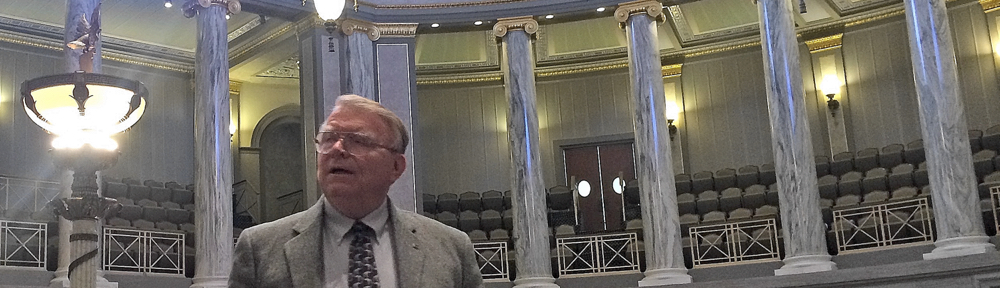
When a member of the Missouri General Assembly steps through an entrance of the Missouri Capitol, that person is stepping into a small, confined, hot world with little respite that tends to consume even the best of people for most of the first five months of the year before it spits them back out into the world from which they came.

And they’re glad to come back seven months later to step out of their comfortable home world through those doors and back into the collision of wills, the competition of ideas, and the fight over the words yes and no.

They move from a world of service to others into a world of demands from others. And the demands are unrelenting, sometimes with consequences implied if the demands are not met.

They might be active at home on issues of poverty, food shortages, spouse and child abuse, veterans needs, church work, homelessness, and other social issues that can’t afford high-powered influence in the hot little world that is the Missouri Capitol. And as they deal in the capitol with pressures from those that can afford to apply them, it might be hard to think of their gentler work at home.

Imagine lives lived in fifteen-minute segments, each segment featuring someone who wants something, or a world of one or two-hour meetings to listen to proposals pleasing to those in the Capitol hallways, and days of increasingly long sessions arguing about the propriety of answering demands and which ones to answer.

Imagine all of this far from the comfort of home, family, friends, and co-workers with whom they share their streets, or coffee, or church pews.

It is hard to remember in those eighteen weeks or so who is more important—the people they meet on the street back home or the people they meet in the hallways of the State Capitol.

Seldom is there time or opportunity to think about things in depth, to study issues in depth, to look for pitfalls in legislation in depth. The pressure to take what they are given, often not knowing all that is within the proposition, is enormous. Sometimes the pressure squeezes out reason, leads to action counter to what is best to those back home, and demands action without burden of thought.

This is the world of unrelenting movement, of unrelenting asks and demands, a world far detached from the freedoms enjoyed where they live.

Furthermore, it’s more than consuming. It’s addictive.

Plaques on the office wall from those whose bidding they have done. Checks in the campaign account to encourage or reward a vote.  Intense seeming friendships today that disappear when the last vote is cast that can benefit a person, a group, a cause.

This is the other world of the people we send to represent us in Jefferson City. As individuals, they return home the same people.  As a group, however, in the capitol they become “government,” an enemy to many.

Is there is a way to improve this system?

Ideally, yes.  Sometimes it’s a matter of those sent to Jefferson City to show courage in the face of pressures, to question more closely the things asked of them. But sometimes it’s the case of those who vote to send others to represent them in this small stone world we call the Missouri Capitol meeting a citizen’s responsibility to pay attention to issues that are not always “my backyard” issues.

Government does not take place only in the Capitols of our country.  Its roots are in the home towns of those who are sent forth. And the folks at home need to care, to pay attention, and to hold accountable those who are to speak for them in that hot little world.


The Whirlwind

This year is the thirtieth anniversary of two major decisions made by Missouri voters.  One has proven itself to be a disaster for Missouri’s political system and the other has led to proof of the fallibility of the first.

Missouri voters hypocritically approved legislative term limits with a 75 percent favorable vote on November 3, 1992.

On the same day, Missourians went 62 percent in favor of what was then called “riverboat gambling.”

These two events have become a toxic political brew in our system of government.

In today’s discussion we are going to look at term limits.  Later we will discuss casino gambling.

The Old Testament minor prophet Hosea, a contemporary of more important prophets Isaiah and Micah, warned metaphorically of the downfall of Israel for its various sins—lying, murder, idolatry, and covetousness, along with spiritual and physical adultery, these latter two characteristics personally experienced by Hosea and his wife Gomer.  Gomer carried on with another man.  The faithful Hosea accused Israel of spiritual adultery.

He warned that Israel and Judah would fall:

“They sow the wind and reap the whirlwind. The stalk has no head; it will produce no flour.”

Term limits was the wind.  We are reaping the whirlwind in the Missouri General Assembly—most particularly in the Missouri Senate.  But the term limits whirlwind is not just blowing in the Senate which heads towards its spring break at the end of this week with only one bill approved in weeks of division, derision and disrespect. It is felt less in the House where its impact is less visible because it is more controlled.

It rages in the Senate where unlimited debate among the 34 members is still considered a virtue—as it should be if members respected it more than they abuse it.  The House has rules that are necessary in a chamber of 163 members to limit the time a member may speak on an issue.

The public, which has little interest in the more subtle or arcane factors of lawmaking, bought the idea that politicians should be limited to a maximum of eight years in the House and eight in the Senate because politicians are basically—

Crooked.

—Except for their own representative or senator.  While voting to limit House members to four terms and Senate members to two terms, many of those 1992 voters were electing their Representatives and Senators to terms five or three in many districts.

The voters voted to restrict their own right to vote when they for term limits.  This year, voters in will be prohibited from considering whether five of their Senators deserve a third term. In most of those cases, those Senators will never again have the privilege of representing their citizens on the floors of the House or the Senate.  Voters in 1992, most of whom do not live in those senatorial districts, decided these five are no longer fit to serve regardless of how distinguished their work might have been.

But terms limits is more dangerous than that.

Those of us who voted in that election were warned that term limits would destroy the institutional memory that is vital to lawmaking. Senior lawmakers who knew the value of respecting the other side of the aisle, of knowing that today’s enemy is tomorrow’s friend, who understood that collegiality benefitted the people of Missouri more than hostility, disappeared.  With no one to teach newcomers the importance of legislative control of the lawmaking process, that control passed to outsiders.

I watched the first crumbling of the legislative process.  The first piece fell the first time I heard the sponsor of a bill ask a colleague offering an amendment, “Have you run this past so-and-so in the hall?,”  clearly an indication that a blessing from a lobbyist (lobbyists are not allowed within the floor of the chambers during debate) was necessary for acceptance of the amendment.

Later as cell phones became more ubiquitous, I watched debaters with their cellphone in their hands checking for text messages that influenced the debate.  Technology has put the lobbyists in the chambers.

There also have been other indications that much of the power of lawmaking has shifted from the bests interests of constituents being argued on the floors of the House and Senate to the best interests of those in the hallways being transmitted into the discussion from outside.

I watched the disappearance of lawmakers capable of amendments written by hand during the debate, replaced by pauses in debate so a legislative staff member could write what he or she was asked to write—the origin of the amendment sometimes in a text message from outside.

In the entire first half of this legislative session, only one bill has been approved by both chambers and sent to the governor. Just one.

The wind the voters sowed in 1992 is the whirlwind of 2022 and in the splintered and often dedlocked Missouri Senate, at least, (and in the Congress as well) “The stalk has no head; it will produce no flour.”

And legislative bodies—Congress and state assemblies alike—seem unwilling to prove they serve above the low regard the public has for them.


“We should look for common honesty”

He signed his letter, “A Voter,” which many newspaper editors would not allow today and rightfully so. Whether you let off steam or offer calm advice, the writers of letters to the editor should have the courtesy and courage to sign their names.

But hear the voice of “A Voter” from a time when our state was but three years old and the first presidential election since Missouri joined the Union was only weeks away.  He wrote to the editor of the Missouri Intelligencer, our first outstate newspaper—published in Franklin. The words in the June 5, 1824 issue are valid today.

It is…common, in all governments, for those who seek for offices, to woo the power that can bestow them; and, in our government, the man who cannot, or who will not, flatter the people, may content himself in private life…

To facilitate his design, the first object of a candidate is to discover our hobby; and when found, mount it and ride without mercy…My heart misgives me every time a new circular is announced, or whenever a fresh candidate mounts a stump, lest the poor jade should not be able to hold out to the end. It is thought, however, if a candidate rides gracefully, he will do…I cannot suppose that this is a general belief—but some, we know, have more confidence in vicarious power than others.

The time is approaching when we shall be called on to exercise that inestimable franchise of free men, the right of suffrage, to its full extent. And, as all power is primarily in the people, the right of suffrage is not only a privilege, but a duty obligatory on all; and to him that is remiss in this duty, the sin of omission may be fairly imputed.

In performing this duty, then, it is incumbent on us to deliberate before we act; and before we give our voices to any man to perform any of the functions of our government, if he has not passed the ordeal of a public trial, let us first, if possible, ascertain if he is the man he professes to be. 

I am aware of the impracticability of personally knowing every man who offers his services. But every man who is constitutionally eligible to important trusts under our state government is known by some in whose probity and impartiality others may justly confide. And, where we cannot obtain personal knowledge, the information of men of integrity and who have had opportunity to possess that knowledge, may be relied on.

I admit that it is vain to look for perfection in man…We should not look for great talents and splendid acquirements to fill every office.  But we should look for common honesty and if a man possess no other qualifications but such as would entitle him to a diploma from an academy for horse-jockeys, I think he is not entitled to any post of trust or profit under our government.

A lot of words are thrown around during election seasons, as we saw in 2020 and will see again this year, some irresponsibly and some sincerely. “Common honesty” might be a high goal, but it’s one we should demand of those who want our votes. To fail to do so is to sell ourselves cheaply.

What to do with him

It surely has occurred to many people watching investigations from Georgia to Washington and New York that criminal charges against former President Donald Trump are growing more possible.

There is no joy in writing that sentence or in contemplating the issue we address today.  But the issue cannot be ignored.

What is to be done if a president or a former president is charged and convicted of serious crimes?

Based on almost daily reports that a new rock is turned over and something disappointing crawls out from under it, there is no avoiding the possibility that the former leader of the free world, as we like to think of our president, could be found guilty of an offense that could mean imprisonment.

We have witnessed first-hand several public officials at the state level being sent to prison. It hasn’t been that hard to watch it happen without concern for or about them.

But if it’s a former President of the United States?

The mental image of a man whose dark suit and red or blue tie are so familiar trading those clothes for an orange jumpsuit is jarring.

If the betrayal of public trust is so severe that not even a Gerald Ford/Richard Nixon-type presidential pardon can be contemplated, where does he go?  Does he become part of the general population, even if it’s a so-called “country club prison” some think disgraced public officials occupy?

Inmates do have rights within a prison. They aren’t left in a bleak cell 24 hours a day. But what kind of cell should an ex-president occupy? A cell/suite?  Or the same kind of cell occupied by the state official doing time for campaign embezzlement?

Would he take his meals in the same room with the other inmates and at the same time—even if surrounded by guards because someone might want to become infamous by doing him (possibly fatal) harm?

Should restrictive house arrest be off the table?  Depending on the severity of the offense(s), should any be proven, should the ex-president be allowed to stay at Mar-a-Lago? Being punished by staying in the big house and not being allowed to play golf has a ludicrous aspect to it.

Should an ex-president be given a job in a prison?  Kitchen work.  Janitorial work.  Tending to the prison garden.  Mopping bathroom floors.  Working in a prison industry (making furniture for example).  Should he be allowed to attend a class and earn an associate college degree?

We know, of course, that if things get this far, thousands and perhaps millions of people will feel that the justice system is more rigged than they think the most recent presidential election was.  How should justice be meted out in the face of that kind of conspiratorial thinking that could produce widespread civil unrest?

With courage, we think.  Our court system knows it must operate despite any mob behavior.

None of this is something any of us wants to think about.

But we should.

Just in case.


The sphere of her usefulness

We were reading Tessa Weinberg’s Missouri Independent article a few weeks ago about the eleven women members of the Missouri Senate who have put together a children’s book that tells the stories of the 36 women who have served and are serving in the Senate.  We thought, “I need get some copies of that book for my granddaughters.”

And then I’m going around office-to-office and have the authors sign them.  .

I have known all 36 of those women senators which says (a) I’m an old guy, or (b) women were late in arriving in the Senate. Actually, there is no “or” about it.  Both observations are true.

A few days ago, while looking for something else, I came across this article from the St. Louis Daily Evening Herald Newspaper and Commercial Advertiser of June 10, 1836.

EMIGRATION OF THE RIGHT SORT

The predominance of the female over the male sex, in the ancient commonwealth of Massachusetts, is very great. In some towns, according to the last census, the proportion is more than two to one, and the excess in the whole state is more than 14,000. Of course, there must of necessity be 14,000 old maids in Massachusetts, over and above the number that goes to offset the old bachelors, (the fools) which may perhaps account for half as many more. Twenty thousand old maids in the single commonwealth of Massachusetts! Now although we have no antipathy to an old maid (we have to an old bachelor though) having always found that much abused class sensible, good-natured, and conversible, yet it must be admitted that in this position, the woman can never manifest the higher qualities of her nature. It is as a wife, a mother, at the head of a family, presiding over the destinies of an infant and miniature commonwealth, that the woman shines forth in all the loveliness of those moral excellences of which she is capable.

Without this, the sphere of her usefulness is greatly circumscribed, and although we may confidently expect that she will not do much harm, neither can she do much good.  We are therefore glad to learn that a company of “industrious, capable and intelligent” young women are about to start from Northampton, Mass., for the valley of the West.  They are needed as school teachers, to fulfill the various mechanical employments which are the province of their sex, and above all, they are needed as the sweeteners of the toil and hardships of our young men who now, in great numbers, are laboring in unblessed loneliness over the vast domains of the west. These young women come out under the protection of a gentleman, and we do not hesitate, in the name of all that is pure and lovely, to promise them a hearty welcome from all classes of our fellow citizens.

-0-

There are a lot of things to read into this article. Dismissing it as “quaint” might not be fair, though.  It’s part of our history, an understanding of the role of women in society—which was largely and quietly accepted on both sides of the gender line—an appreciation of a sort of the contribution women even in those un-emancipated times played in the home and the community—a comment on the loneliness of life on the frontier (1836 was the year that the Platte Purchase added the northwest corner to our state), and other issues.

It also is a commentary on the Missouri pioneer editor, a more colorful purveyor of that profession than we seem to have today.  I think many of these guys just had more fun in those days, whether it was in the gentle writing of this story or the more partisan pronouncements that were not uncommon in the columns of the time.

A little less than ninety years later, a woman’s place was in the House (of Representatives) in Missouri, and fifty years after that the Senate became a woman’s place, too.

These eleven senators did something important in putting together this book that the menfolk in the Senate might want to learn from.  These eleven women recognized they could do something good by forgetting about party politics, getting together over food and drink, and accomplishing something useful not for themselves but for those whose futures are far from determined.

Would that more people could do that in these times when fighting seems more important than accomplishing, when concerns about power supplant commitments to service. .

We hope that not too many years in the future a woman—perhaps one of these eleven or a young woman who reads their book—manifests “the higher qualities of her nature” by occupying the governor’s office.

As the title of the book says, “You can, too.”

YAKYAKYAKYAKYAK

It is Valentine’s Day.  And there’s not much love in the Missouri Senate.

I recently listened to the killing filibuster in the Senate on the confirmation of the state health director’s appointment. Afterwards I spent a couple of more rewarding hours watching some paint dry.

That was nothing, however, compared to the long-running tantrum that was started last week by a minority of the majority party who objected to a proposed congressional district map. It is still ongoing as this new week begins.

I am afraid that by the time it ends, three species will have gone extinct and become fossils.

I was reminded of an article in the Boonville Missouri Register of July 16, 1840 about a speech given in Jefferson City by A. G. Minor, a Whig—the newspaper leaned Democratic:

“He opened his speech with a flowery declamation…He then went on for quantity…It was one of those stereotyped editions of Whig oratory you may hear any time and place where a number of Whigs are congregated together…Thus he trudged along through a two hours and a half speech, and left us as wise as we were when we commenced.”

Been there.  Know that, from many hours listening to filibusters in the State Senate. I always started legislative sessions with a new Filibuster Book, something to read while somebody exhausted themselves saying nothing worth remembering for hours on end—-which is okay as a tactic but makes one desperate for a newly-painted wall for sanity maintenance.  Unless the one enduring the display has a good book.  One way or another, I was determined to survive these events MORE than as wise as I was at the start.

Old-time speech-making was often colorful—and lengthy.  Two-hour speeches from the stump were not rare.  Two-hour sermons weren’t either. We have become significantly more sophisticated now.  Our televangelists can take only about 18 minutes to convince us we’re all going to Hell although we might face better alternatives if we help them for their next executive jet.

We have examples of those sometimes more eloquent expositions because newspapers sometimes printed speeches in their entirety or printed lengthy excerpts. Representative John E. Pitt of Platte County introduced legislation in January1859 to print 100 handbills announcing the celebration of the Battle of New Orleans on January 8.  He told his colleagues:

Gentlemen keep continually talking about economy. I, myself, do not believe in tying the public purse with cobweb strings, but when retrenchment comes in contact with patriotism, it assumes the form of “smallness.”

Such economy is like that of an old skinflint, who had a pair of boots made for his little boy, without soles, that they might last longer. (Laughter.)

I reverence “the day we celebrate.” It is fraught with reminiscences the most cheering; it brings to mind one of the grandest events ever recorded in letters of living fire upon the walls of the temple of time by the god of war!

On such occasions we should rise above party lines and political distinctions.

 I never fought under the banner of “old Hickory,” but, “by the eternal” I wish I had. (Laughter and applause.) If the old war-horse was here now he would not know his own children from the side of Joseph’s coat of many colors—Whigs, Know-Nothings, Democrats, hard, soft, boiled, scrambled and fried Lincolnites, Douglasites, and blather-skites!

I belong to no party; I am free, unbridled, in the political pasture. Like a bob-tailed bull in fly time, I charge around in the high grass and fight my own flies. (Great laughter.)

Gentlemen, let us show our liberality on patriotic occasions. Why, some men have no more patriotism than you could stuff through the eye of a knitting needle. Let us not squeeze five cents till the eagle on it squeals like a locomotive or an old maid. Let us print the bills and inform the public that we are as full of patriotism as are the Illinois swamps of tad poles.

I don’t believe in doing things by halves. Permit me, Mr. Speaker, to make a poetical quotation from one of our noblest authors. “I love to see the grass among the red May roses, I love to see an old gray horse, for when he goes, he goeses.” (Convulsive laughter.)

The comments were reported in the Weekly California News, published in Moniteau County, on January 29, 1859.

John Brooks Henderson, seeking to be a state representative in his first try for public office, remarked at a July 4th event in Pike County in 1847:

Though all former governments have fallen and yielded to the corroding influences of time, and shared the fate of all other human concerns, yet there are principles, firm as the unchangeable rocks of Adamant, upon which the fabric of government will stand, until human affairs shall have ceased and Heaven’s Messiah shall fill the throne of peace. These principles are founded upon the equality of mankind, upon truth, reason and justice; and the government whose foundations rest upon these, and whose strength is dependent upon the free will of a virtuous people, will only fail when time shall grow hoary with age, and nature herself shall decay.

In the days long before audio and video recordings, the only way people could learn what was said in those patriotic speeches was to read them in newspapers such as the Democratic Banner, published in the Pike County seat of Louisiana, in this case, on August 16, 1847.

Henderson, by the way, became a Union Army officer whose troops “conquered” Callaway County early in the Civil War. Later, as a U.S. Senator, he was one of those who voted against impeaching President Andrew Johnson, a courageous step that cost him his senatorship.

One more example of rhetoric of the 19th century that puts speakers of today to shame.  Walter B. Stevens, in his Centennial History of Missouri (The Center State), published in 1921, tells of an Ozarks preacher of the early 1800s who might have offered this prayer over a young man bitten by a rattlesnake:

We thank Thee, Almighty God, for Thy watchful care over us and for Thy goodness and tender mercy, and especially we thank Thee for rattlesnakes. Thou hast sent one to bite John Weaver. We pray Thee to send one to bite Jim, one to bite Henry, one to bite Sam, one to bite Bill; and we pray Thee to send the biggest kind of a rattlesnake to bite the old man, for nothing but rattlesnakes will ever bring the Weaver family to repentance. There are others in Missouri just as bad as the Weavers. We pray Thee to stir up Missouri, and, if nothing else will bring the people to repentance, we pray Thee to shower down more rattlesnakes. Amen!

We say “might have offered” because the story might be apocryphal.  But it’s too good a story to go untold to future generations.

This prayer offers something to all of us who are tired of the obviating, posturing, and prevaricating in our political discourse.  For those who do not consider being inspiring, humorous, and uplifting while they fill the air, instead, with boring verbosity, “we pray thee to shower down more rattlesnakes.”

Somebody could file a lawsuit

—So we said last week in writing about the difficulties of re-drawing congressional or legislative districts after each census.

Those of us who are of a certain age (I think I am beyond it, actually) remember a St. Louis mover and shaker named Paul Preisler (rhymes with Chrysler, as I recall) who was a pain in the neck on redistricting after census counts in 1950, 1960, and 1970.

Preisler was a Ph.D. biochemist, lawyer, photographer, civil libertarian, photographer, and once an instructor at the Washington University School of Medicine.   He also was a Socialist back in the days when it wasn’t quite the curse word that it has become.

In the 1930s he helped found the St. Louis chapter of the American Federation of Teachers and as its first president he led a successful effort to let the public school teachers there organize.

He joined the Socialist Party during the Depression and sued the Board of Election Commissioners when the board refused non-partisan candidates and minority parties the right to have poll watchers and challengers. The Missouri Supreme Court came down on his side, giving minority parties the authority to have poll watchers and challengers.

This guy never seemed to runout of gas.  Two years after the St. Louis chapter of the AFT was created, he ran for a place on the city board of education.  The school board rejected his candidacy because the board’s constitution made it non-partisan.

The Missouri Supreme court ruled three days before the election that the school board had to let Preisler run.  The board had to print new ballots. Preisler lost but he says he was running on principle, so the loss was okay.

When he got back from the war, he went after the city school board again because of its policy banning married women teachers from being teachers.  He won that case, too, and shortly thereafter decided, at the age of 48 that  he wanted to be a lawyer.

And he did.  In fact he was a professor at the Wash-U law school and became professor emeritus in 1969.

By then he had gotten into challenging redistrict maps.  His first target was again the St. Louis Board of Education. In 1952 he challenged the way the city Board of Election Commissioners had drawn new district maps. He won again and new maps were drawn.

Not one to be satisfied just filing lawsuits, Preisler filed himself in 1954—as a non-partisan congressional candidate. When Secretary of State Walter Toberman refused to accept his filing fee, saying that splinter parties (such as the Communists, and this was at the height of anti-communist feeling in the country) and Communists could not have candidates if the party didn’t get a lot of votes in the preceding election. Preisler argued that he should be able to run as a person rather than as a representative of a political party. The Missouri Supreme Court agreed with Preisler, again.

Not content with shouting from the sidelines, Preisler ran for office several times: twice, as a Socialist, for the legislature (1934 and ’36), six times as a non-partisan for a spot on the St. Louis Board of Education with campaigns starting in 1937 and continuing to 1971. He ran as a non-partisan for the St. Louis Board of Aldermen.

He never won any of the several offices for which he ran, which was fine with him because he ran to make a point.

In the 1960s he targeted the state. He decided the new congressional districts drawn after the 1960 census were not as compact and as nearly equal in population as the law required.  That was 1962.  When the legislature tried again and the public accepted the map in ’65, Preisler refiled his lawsuit in early in ’66 and the State Supreme Court agreed with him in the summer of 1966 that THAT map was unconstitutional.

The cases all led to landmark rulings on compactness of districts and the legislature’s authority to exercise its discretion, the court writing in the 1962 case naming Secretary of State Warren Hearnes as defendant that, “[A]ny redistricting agreed upon must always be a compromise. Mathematical exactness is not required or in fact obtainable and a compromise, for which there is any reasonable basis, is an exercise of legislative discretion that the courts must respect.”

For a time Preisler did pro bono work for the American Civil Liberties Union.  The State Historical Society of Missouri, which houses 22 cubic feet of his papers at its St. Louis Research Center, says, “He defended the right of students to wear long hair, hold anti-war demonstrations, and the publish uncensored newspapers. He also defended prisoners and women against discrimination.”

He was also involved in municipal affairs, once filing a suit against the City of St. Louis that eventually killed city plans to build a roadway through Shaw’s Gardens.

When he died in 1971 at age 69, Paul Preisler had another challenge to congressional districts pending. He lost that one, posthumously, in 1975.

There has been no one like him since.

But every time there’s a redistricting map drawn for congressional or legislative districts, there’s always that uncertain time.

If It Were Only This Easy

Filing-for-office season is approaching.  Many who would like to serve, and would be good public servants, will never seek an elective office because of the sacrifices they and their families might have to make, and the pressures to do and say things they are told they must say—rather than be true to their own character.

Or they might be like Robert Cutler.

From the Jefferson City Daily Tribune, December 4, 1909

Robert Cutler is the name a man gave who called at the governor’s office Friday afternoon and asked for a commission to represent Missouri in the United States Senate. He said he was elected last January unanimously, but had since been busily engaged on his Webster county, Missouri, farm near the town of Seymour, that he did not have time to look after his duties in Washington.  The governor was out when he called and he left saying that he would probably return tomorrow.

Chas. H. Thompson, the governor’s private secretary, questioned the caller about his business and his supposed election to the United States Senate from Missouri. He said Col. Phelps would identify him as would also Judge J. McD. Trimble of Kansas City.

Cutler is about 65 years old, bewhiskered like a Kansas Populist, but very gentle in his demeanor. He said the United States Senate had not yet organized and consequently had been doing nothing since his election, so he thought he could put in his time more profitably farming than in loafing about Washington.  The man is a total stranger here.

–Colonel Phelps was William Phelps, considered the most powerful lobbyist of his time. He later was a member of the State Senate that he had once spent years manipulating.

—Governor Hadley’s staff in 1909 numbered five: Thompson, Pardon Attorney Frank Blake, Stenographer Mary Lee, Clerk Sam Haley, and Janitor T. B. Carter. The current Official Manual shows 28 people working for Governor Parson.

—There are no follow-up stories indicating “Senator” Cutler ever went back to the governor’s office.  We have found one reference indicating he died in December, 1916.

We think someone so practical that he would rather spend his time “profitably farming than in loafing about Washington” would have a certain attractiveness to voters looking at the current campaigners for Roy Blunt’s seat.

Bicker, Bicker, Bicker

We begin this week at the Capitol with the State Senate trying to work out a conflict with Republican ranks on a new congressional district map.

It’s not a Republican-Democrat fight. It’s a Republican-Republican fight.  Should lines be drawn to eliminate a Democratic Congressman?  Or should the lines be drawn to protect a Republican Congresswoman?  Should Missouri Democrats have only one member of Congress?  Or Two?

Heaven help us if a district might be drawn as a swing district, where the Rs and the Ds might be close enough for a campaign to be competitive.  And interesting.  And challenging for the candidates.

Last week the Senate dissolved into bickering between Republican factions.  Should the map be 7-1 Republican or might it be 6-2 with big city Democratic enclaves guaranteed places at the table?  Neither R faction could pass the bill on its own. An alliance with Democrats might provide the margin needed but the Ds would demand a 5-3 map or one that would give them a better shot at getting a third district.

And that is a bridge too far to cross for the either faction of the Rs.

There was concern that the original proposed district lines (approved by the House) would put the Second Congressional District in jeopardy of turning blue, giving the Ds a third seat. Incumbent Ann Wagner barely has survived the last two elections, drawing less than 52% of the vote each time. Republicans might have to work hard to keep that district under the House-passed map because the Democrats surely would work hard to take it, especially given its new borders.  The ultra-conservatives in the Senate don’t want to worry about that so they filibustered until the other Rs agreed to fiddle with the boundaries and make things look better for Wagner’s chances.

It appears we are to be spared the situation after the 2010 census when the lines were drawn to make our delegation 6-2 Republican by putting two Democratic incumbents in the same district.  William Lacy Clay defeated fellow incumbent Russ Carnahan after Carnahan’s district was re-drawn to include a big chunk of Clay territory in St. Louis.  There are no incumbents running against each other this time.

Lawmakers are working hard to avoid having judges draw the lines. A lawsuit after the 1980 session led to a federal district court drawing new districts for the 1982 election, the first election since Missouri lost its ninth congressional seat.  The court’s map put forty percent of Wendell Bailey’s district into Bill Emerson’s district.   Bailey, whose home was barely inside the new district, established a residence in a new district then represented by Democrat Ike Skelton.  Republicans thought Bailey was the best possible candidate to take out Skelton, and he did run strongly but Skelton, who kept 60% of his old district won—although Baily held him to a 54% majority.

That result points to something important.

Congressional districts that are not drawn to protect incumbents provide better contests for voters to decide which competing ideas best represent them. But in practice, that is not the goal of those drawing the lines.  Protecting the dominant party is the ultimate goal when the lines are approved by a partisan body.  We’ve seen that pendulum swing both ways through the years.

Democrats have a point—that the 2020 presidential race broke 60-40 Republican. Therefore, they argue, the most representative congressional map would be one with which Democrats might be able to win another seat, making the delegation 5-3 and more representative of the overall political face of Missouri.

Republicans have a point—that the most recent legislative elections left the chambers of the legislature two-thirds Republican. Thus, the real-world Golden Rule prevails: He who has the gold, rules.

So the divided Republicans in the Senate bickered the week away last week, seemed to iron out some of the intra-partisan wrinkles as the week ended, and are likely to have a map that makes Second District Republicans more comfortable to start things this week.

Then a period of uncertainty arrives. Somebody could file a lawsuit.

And when this game goes into that overtime, the two teams (or three) that have been playing the game so far will be on the sidelines while a third team controls the scoreboard. And that’s not what the majority party wants.

The Casinos in Our Pockets

We lived in an “appointment” world in 1993, when the first Missouri laws governing casino gambling were written.  Voters had approved riverboat gambling, as it was called then, in 1992. The first casinos on boats would open in the spring of 1994.

Many of us still got our national news with the 5:30 network newscasts on television and our local news at 6 and 10 p.m. when those laws were written.

If we wanted to buy new clothes, we went to a clothing store during the hours it was open.  We went to grocery stores during their open hours to get our food.

We knew when each day we could go to the mailbox to get letters from friends and relatives.

And by the end of the year we knew that if we wanted to gamble we would have to go to the riverboat at a certain time to be admitted.

The Station Casino-St. Charles and the President Casino on the moored Admiral riverboat opened May 27, 1994. Gamblers could board the boat in St. Charles from 9 a.m. to 1 p.m. for a two-hour cruise (for which they paid three to five dollars, depending on the day). If they missed the cruise time, they had to wait for the boat to come back so we could pay to get aboard for the next trip.

The President never cruised. It was permanently moored near the Gateway Arch because the old aluminum Admiral had no engines. Gamblers would pay two dollars during the week and five dollars on weekends and could board every two hours from 10 a.m. to midnight.

But the world was changing and the change accelerated each year. “Appointment living” was beginning to diminish although many of us did not realize it at the time.

There were some hints, however.

The Pew Research Center reported in 1994 that the percentage of Americans getting news from the internet at least once a week had more than tripled since 1991, going from 11-million to 36-million news users.

The number of hosts on the internet tripled from January, 1994 to January, 1996, the year something called a “browser” was created—Netscape, the same year that the island nation of Antigua and Barbuda passed a Free Trade and Processing Act allowing licenses to be given to companies wanting to allow internet users to gamble. By the end of the year there were fifteen gambling websites. The next year there were 200 and by 1998, a study was published showing online gaming revenues had topped $830-million. Modern online gambling in this country dates from November 22, 2010 when the New Jersey Senate passed a bill allowing certain forms of online gambling.

It was about that time that the casino industry was starting to see an erosion in patronage. In Missouri, casino admissions reached almost 54.3-million in FY 2005 then declined for three years before climbing back to almost equal 2005’s number. Admissions began annual declines after FY 2011.  In FY 2019 (the last full year before the pandemic crippled casino business), casino admissions had declined by 49%.

Various reasons for the decline can be suggested but the end result seems to be the same—people just don’t go to where casinos are.

So the casinos have to go where the people are.

The situation is not unique to the casino industry. It is part of our changing lifestyles and those changes have become more obvious with the COVID-19 Pandemic that has forced casino closures for in-person business and quarantines for many who would patronize them.

We no longer live in an “appointment” world.  We can buy clothing at any time of the day off the internet.  We can use the internet to get our groceries delivered.  We can order deliveries to our homes from our favorite restaurants.  The same with our pharmaceuticals. Telemedicine is eliminating some office and hospital trips.

Casino betting can happen 24 hours a day because, as one source has observed, “everyone has a casino in their pocket.”  Casinos are looking for new products that can be offered through the ubiquity of the internet that we call up on our ubiquitous cell phones.  First is sports wagering. But later, Missouri legislators are likely to be asked to let table game betting to take place remotely.

Those who find gambling a reprehensible sin will find nothing redeeming about gambling on the internet.  But thousands of other Missourians will welcome the opportunities—as they welcome opportunities to grocery shop from home.

In a world where less and less of life is lived by appointment, the gaming industry knows it must change. And it is, as it should.

Missouri’s casino gambling laws must change, too.  Laws written and fees created in the days of physical customer presence in casinos need to be changed to account for virtual presence.  State services relying on gambling fees and taxes will be increasingly diminished as appointment gambling diminishes.  Casinos, profiting from laws of the 1990s appointment culture, resist modernization of the law. It is understandable that they do.

What is not understandable is why the Missouri General Assembly would not want to protect the state’s interests by bringing our laws from the appointment era into the virtual, but very real, era.