Tennial Time, Boat Edition

Bi and Cen.

The new year starts an ten-year run of tennials.   Between now and August 4, 1828 we will observe a series of 200th and 100th anniversaries:

2019 is the first of the bicentennials.  We doubt that anybody was here to see these two events.  It was two years before the legislature decreed this area become known as the City of Jefferson City. On May 15, 1819 the steamboat Independence under Captain John Nelson became the first steamboat to challenge the dangers of the Missouri River .  It arrived at the now-vanished town of Franklin on May 28. It got as far as the community of  Chariton, near the mouth of the Chariton River, called by some “Missouri’s gran divide” because streams east of it flow towards the Mississippi and those to the west flow into the Missouri or into its tributaries.

A month later, on June 21another steamboat, the Western Engineer, left St. Louis.  The boat had been built for an exploratory expedition organized by the U.S. Topographical engineers and led by Major Stephen Long.  It was the first steamboat to make it all the way across Missouri, wintering at Fort Lisa near present Council Bluffs, Iowa on September 17 before going back to St. Louis in the spring.

Steamboating seems to be slow developing on the Missouri, perhaps because it took time to develop boats strong enough to run the great river.  Five boats were regularly running the river in 1836.  But travel on the river was assuming such importance a short time later than when the original government building in Jefferson City burned in 1837, a new capitol put up on the first hill to the west was built facing east. Travelers coming upriver, therefore, saw the new capitol’s impressive face as they approached.  In 1839, James Crump, built a stone building to serve as a landing point for riverboats. The upper story became a hotel popular with river men and legislators.  The building, known locally as “Lohman’s Landing,” still stands, one of the few early nineteenth century river port buildings remaining. Today it’s part of the state museum system and has been renovated to represent the kind of general store that a riverboat landing structure might have been.

May Stafford Hilburn wrote in the local Sunday News and Tribune, in 1946 that, “In 1840 fruit trees were shipped into Jefferson City by boat and sold for twelve and one-half cents each. In 1840 Captain Dunnica, a pioneer builder of the city, reported that “the Steamer Camden on key passage down the Missouri struck a snag and sunk in eight feet of water. Ship and cargo were a total loss. In 1841 a stranger who came into Jefferson City by steamboat wrote home to a relative in Lancaster Pa., this statement: ‘The boating trade of the Missouri River is increasing annually. This insures a ready market for all produce of every kind.’”

James E. Ford, who wrote a history of Jefferson City and Cole County eighty years ago, said, “In 1841 twenty-six steamboats were engaged in regular trade on the Missouri River. These boats made 312 arrivals and departures at Glasgow with freight and passengers.  The Iatan, regular packet, made twenty regular weekly trips from St. Louis to Glasgow. About forty-six thousand tons of freight were transported during the year 1841, according to the Columbia Patriot.”

The St. Louis Western Journal observed in 1842, “Two years ago it was considered foolish and dangerous to navigate the Missouri River at night, and the time by steamboat from St. Louis to Jefferson City was forty to forty-eight hours. Just one year ago thirty-six hours was considered a speedy trip. In 1842, the trip was made in twenty-four hours by several boats. The steamboat Empire made the trip last week in twenty-two hours and fifteen minutes. Now Jefferson City, one hundred and fifty miles distant from St. Louis, is within a day’s travel.”

But steamboats transported more than politicians and trade goods.  Sometimes they transported death to Jefferson City.  City Clerk James E. McHenry recalled in 1893 that when he was fourteen years old in 1849:

“On a bright May morning, I sauntered down to the river to see if there were any boats in sight, when I was surprised to see the James Madison lying at the wharf, apparently deserted.  She had no steam up, no one on board, and the passengers with their baggage lying around loose on the levee, some were vomiting and all looking forlorn and distressed. I learned the boat had arrived sometime the night before, from St. Louis, with a number of cases of cholera, had docked and abandoned the trip; her Captain and other officers had deserted the Monroe and struck out across the river for their homes and firesides, leaving the poor sick passengers to take care of themselves.

When the citizens learned of the situation, they organized and took charge of the sick passengers, gave the dead and dying all of the attention possible. After a few days I ventured uptown—we lived at the foot of Richmond Hill on Main street. I found the town a deserted, desolated looking village. There was no business in the stores, no wagons on the streets, and but few people and they were gathered in little squads talking low and looking scared and anxious. The only places doing business were the “groceries,” as saloons were then called.  After going uptown and seeing the hearse constantly on the move, going and coming, the doctors hither and thither, and the good citizens bracing himself at the “grocery,” I picked up courage enough that day to take a peek into the Episcopal Church. I saw men in all stages of the cholera; some vomiting in the first stage, some in agony of pain, some dying and some dead. I became an errand boy, going after soup and medicine for the sick. The James Monroe landed here on that May morning with 75 people on board, now only two of whom escaped death by cholera. Most of them were California emigrants. The Captain and other officers who deserted their posts, we learned afterwards died either before or after they reached home.”

On August 26, 1854, the steamboat “Timour” (number 2) was tied up at the Edwards wood yard about three miles below Jefferson City when it exploded.  Former State Treasurer Phil E. Chapell, then a barefoot boy just turned 17, was standing on the Jefferson City levee waiting to be rowed across the river, when he saw and heard “a loud report as of a tremendous blast, and the boat was enveloped in a great cloud of steam and smoke.  In a moment the cloud had blown away but alas! The boat had disappeared. The ferryman and I at once realized what had occurred, and jumping into a skiff, rowed as rapidly as possible to the wreck…We were the first to arrive, and what a horrible scene met our gaze.  All of the boilers of the boat, three in number, had exploded simultaneously, wrecking the entire forward part of the boat, and causing the hull to sink after of the forecastle. The shrieks and groans of the dying, and their piteous appeals that they be put immediately out of existence to end their sufferings were heartrending, and resound in my ears to this day, although more than a half-century has passed.  Many lives were lost—how many was never known, as many bodies were blown into the river and never recovered. Those still alive were so badly scalded as to have but little resemblance to human beings.”

The New York Times on September 6 carried a report from the St. Louis Democrat that, “There had been no record of deck hands kept, and, doubtless, there are some who have been blown into eternity whose names will never be heard again, and whose fate will always remain a mystery within the circle of relatives and friends from which they will be missed. We have learned that the complement of hands which the boat had in leaving this port was 45 or 47, and that of these but 25 have returned.”

By then, however, a competitor was making its way toward Jefferson City and it eventually would kill steamboat traffic as it is fondly remembered. In fact, a Cincinnati newspaper reported two of the Timour’s boilers had been thrown onto the nearby railroad tracks by the explosion. The third was blown into the river and some pieces of the boat were found a mile away.

The Pacific Railroad planned to start began passenger and freight service from St. Louis to Jefferson City in November, 1855, prompting this ad from the Jefferson City Inquirer on November 10, 1855.

June, 1861 brought not death, but a military invasion. When Confederate-leaning Governor Claiborne Jackson hurried back to the capital city after negotiations with federal officials in St. Louis failed to produce a promise the U. S. Army would stay out of Missouri, and fled to Boonville with several state lawmakers in tow, the Army was in pursuit.  General Nathaniel Lyon and his troops disembarked from the steamboat Iatan (a replacement of the earlier one that helped open shipping on the river) east of the penitentiary, marched behind the prison to Lafayette Street, then marched through town to occupy the Capitol. A special correspondent for the St. Louis Missouri Democrat described “an enthusiastic reception from the loyal citizens, headed by Thomas L. Price…(They) marched in good order through the city, cheered at several points, and finally occupied Capitol Hill, amidst tremendous applause.”  Price had been the city’s first mayor and long remained a prominent civic leader.

Long-time Jefferson City banker and politician Julius Conrath remembered a happier experience in about 1868:

“I can remember as a boy of about five years seeing my first circus.  It came up the river on a steamboat and landed at what was called the levee, or Lohman’s landing, at the foot of Jefferson Street. A large crowd and especially the small boys went down to see it unload…

“In those days Jefferson City boasted a wharfmaster who was one of the city officials. He had charge of all loading and unloading of steamboats.  Steamboats were plentiful on the river then, and three or four passed up and down every week.  Every boy in town knew every boat by its whistle. In summer time, as soon as we heard a boat whistle we grabbed a basket filled with peaches, apples or grapes, or whatever fruit might be in season, and rushed to the levee and sold our wares to the passengers for in those days many passengers traveled by boat.”

But the days of the steamboat being a lifeline to Jefferson City were numbered, as they were for communities along the Missouri River.  By the 1880s, the railroad had reached the farthest most point on the river served by steamboats.

It was a glorious era, however. But it was a dangerous one.  The average lifespan for a steamboat on the Missouri was only about three years.  It’s estimated more than three-hundred steamboats sank between St. Louis and Kansas City.

In 2019, we’ll observe the bicentennial of steamboats on the Missouri River, kicking off what we are calling the “tennial era” in Missouri.  We’re thinking of the best way to commemorate our steamboat history.

Christmas: Just another working day

Merry Christmas from the Missouri Capitol.
Governor Mike Parson’s office is fully involved in the Christmas season. We don’t recall anything like this in all the years we have covered the capitol. Don’t expect to see him at his desk on Christmas day, however, although there were many times when a lot of people were at their capitol desks at Christmas.
The governor’s office often has been on display during this Christmas season because of something else Governor Parson has done that we’ve never seen done before. The double doors between the capitol hallway and the big oval office are open often with a glass barrier that people can walk up to and look into the office. The doors are closed when he’s doing governor business but at other times they’ve been opened so the visiting public can see the office and its Christmas decorations.
We’ve often thought it’s a shame that capitol visitors don’t get to see that magnificent room.
History tells us that Christmas has been through a lot of changes through the decades. For decades, it was just another day. Not until Victorian times did it begin to assume the secular commercial bonanza it is.
When the state legislature moved from its temporary home in St. Charles to the City of Jefferson, the fourth session of the General Assembly convened on Monday, November 20. Christmas day was just another regular business day, as was New Year’s Day. A reading of the House Journal for December 25, 1826 sounds similar to the House Journals today. It is—as it is now—pretty dry stuff.

MONDAY MORING, DECEMBER 25, 1826
The house met pursuant to adjournment.
Mr. Speaker appointed Messrs., O’Bryan, Grant, Thornton, Jewell, Canole, Bollinger, Nash, Johnson, Bruer, Brinker and Brock as a select committee on an engrossed bill from the senate, entitled an act supplementary to an act to organize, govern and, discipline the militia, approved 11th Feb. l825.
Mr. Grant of the committee of ways and means introduced bill appropriating money for defraying the expenses of government, which was read a first time and ordered to a second reading. On motion of Mr. Watkins, the rules of this house requiring a bill to be read three several times [sic] on-three different days was dispensed with, two thirds of the members present concurring therein, and said bill was read a second time on to-day.
On motion, said bill was committed to a committee of the whole house. Mr. Harris of the select committee to whom was referred the petition of sundry inhabitants of the counties of Chariton and Ralls, praying for the formation of a new county, reported a bill to establish the new county of Marion which was read a first time and ordered to a second reading.
On motion of Mr. Burckhartt, the rules of this house requiring bills to be read three several times on three different days was dispensed with, two thirds of the members present concurring therein, and said bill was read a second time on jo-day,
On motion of Mr. Cook, said bill was committed to a committee of the whole house.

The journal continues for several more paragraphs of routine business before the House adjourned until the next day. Representative Jewell, by the way as Dr. William Jewell of Boone County, a founder of Columbia for whom William Jewell College was named. Bollinger was George F. Bollinger, who represented Cape Girardeau in the territorial and state legislatures from 1812 until 1840. When a new county was formed of Cape Girardeau County, it was named for him.
Working on Christmas was not all that unusual in those times. It was seventeen years yet before Charles Dickens’ A Christmas Carol was published or that Sir Henry Cole, an Englishman, printed a couple thousand Christmas cards that sold for a shilling each. Christmas would not be declared a federal holiday for forty-four more years.
In 1828, the second general assembly to meet in Jefferson City took December 25 off but was back at work the next day. The practice was common for several years. In 1840, the House took the day off but the Senate did meet on Christmas day, a Friday, and on Saturday the 26th but adjourned both days because it could not achieve a quorum. Business as usual resumed in both chambers on Tuesday the 29th.
The House met on Saturday, December 21, 1844 and transacted business before adjourning until Monday the 23rd. But not enough people showed up to make a quorum again until the afternoon of December 30. The Senate met on Christmas day but only five members answered the roll call. It tried to meet each day after that but didn’t get enough members in the chamber to do official business until the 30th.
Then we get to this entry:

JOURNAL OF THE SENATE OF THE STATE OF MISSOURI, At the First Session of the Fifteenth General Assembly, begun and held at the City of Jefferson, on Monday, the Twenty-Fifth day of December, in the year of Our Lord one thousand eight hundred and forty-eight.
The Senate was called to order by the Hon. JAMES YOUNG, Lieutenant Governor and President of the Senate, and FALKLAND H. Martin, Esq., acted as Secretary pro tem.

That’s right. The 1848 legislative session began on Christmas Day. And it happened again just six years later:

JOURNAL OF THE SENATE OF THE STATE OF MISSOURI, AT THE FIRST SESSION, BEING THE REGULAR SESSION, OF THE EIGHTEENTH GENERAI ASSEMBLY, BEGUN AND HELD AT THE CITY OF JEFFERSON, ON MONDAY THE 25TH DAY OF DECEMBER, IN THE YEAR OF OUR LORD ONE THOUSAND EIGHTEEN HUNDRED AND FIFTY-FOUR, THAT BEING THE DAY FIXED BY LAW FOR THE MEETING OF THE GENERAL ASSEMBLY OF THE STATE OF MISSOURI.

The Senators were called to order at 11 o’clock, A. M., by the Hon. Wilson Brown, Lieutenant Governor, and President of the Senate.

Lt. Governor Brown was one of about thirty people killed in the Gasconade bridge disaster on Nov. 1, 1855, the day the first passenger train was to have arrived from St. Louis.


In this building, long ago, Christmas was just another day for many years. There were times, though, when it appears some members of the general assembly left town for a few days, leaving the House and Senate without enough members to transact business although a few members who lived too far from home in those pre-highway, pre-bridge, pre-railroad days when the rivers were too icy to travel by boat stayed in Jefferson City, a town of no paved streets, few amenities, and fewer than three-thousand people before 1860.
The new Missouri Constitution adopted in 1865 established the January start date for the legislature, ending the winter sessions. Although the observance of Christmas had been slowly building, it was not until the Reconstruction years that December became the biggest month of the year for retail sales.
In a couple of weeks, today’s legislators will start a new session in today’s capitol. By then the Christmas decorations will be gone and the present capitol will feel, as the old one undoubtedly felt, the quickening pulse within it. Christmas and the old year are gone. A new year and new careers soon will begin to take shape. And so will the new journals that somebody else might read 170 years hence.

A GODDESS COMES TO EARTH

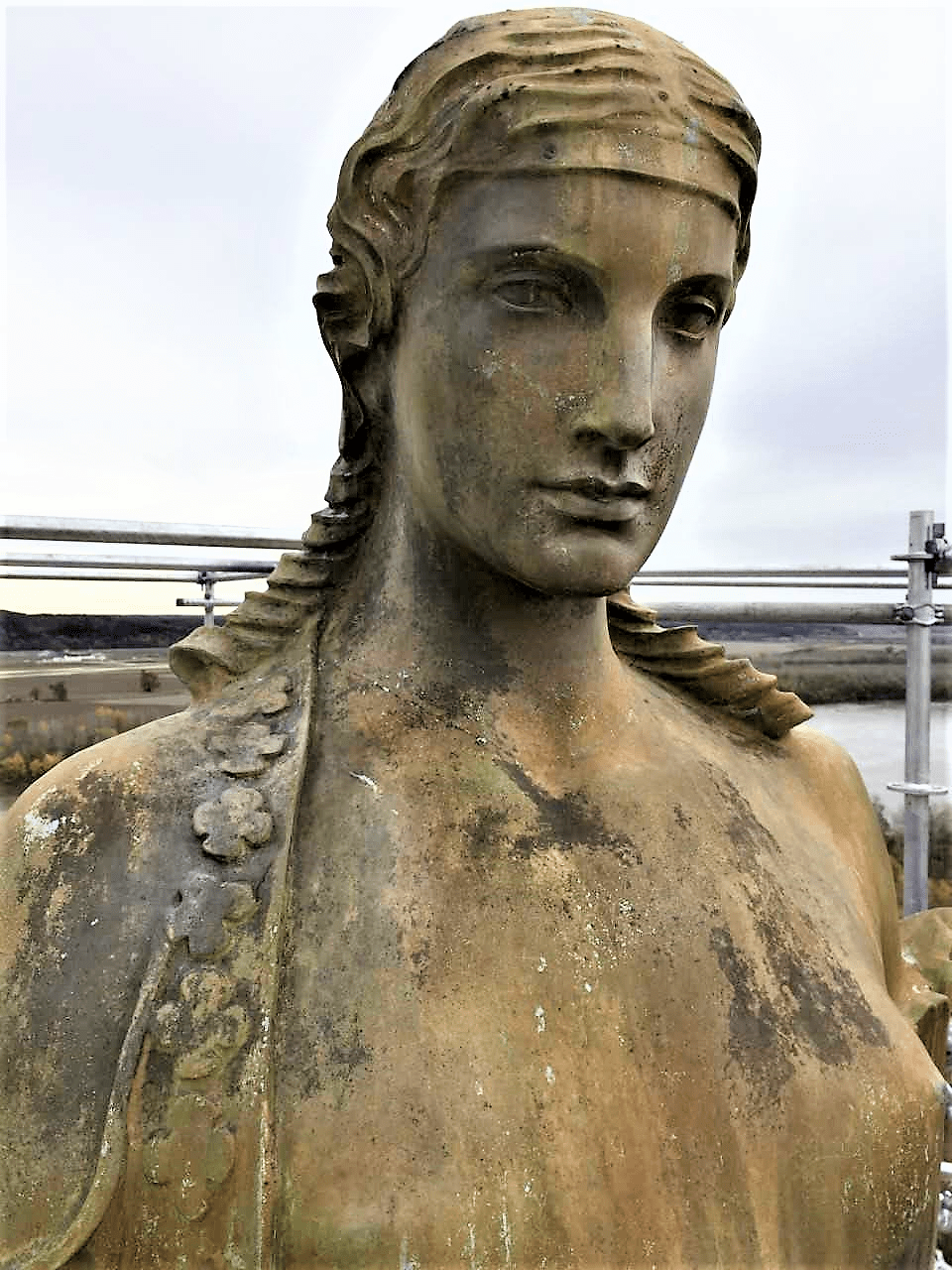
Ceres, a lady of myth and mystery who has extended blessings to state capitol visitors for ninety-four years, has been brought to earth by mortals who love her and care for her.
She’s in Chicago now and will be staying there about a year before she comes home to the capitol.
She’s a ten-feet four-inches tall, two-thousand pound bronze statue whose presence among flesh-and-blood humans was an emotional event for many of those who spoke quietly in loving terms as they walked around the flatbed trailer on which she’d been carefully laid after days and hours of preparation for her removal from the capitol dome.
She’s beautiful.
We’re going to spend some time in this entry telling her story, which is as ancient as the Greek and Roman empires, as recent as last week, and is beginning a new chapter. We’ll be drawing on the research we did for The Art of the Missouri Capitol: History in Canvas, Stone, and Bronze and for the upcoming book about the history of the building.

WHO IS CERES?
Ceres is a figure from Roman mythology whose Greek counterpart is Demeter. She’s the goddess of grain, of agriculture, of fertility, a representative of Mother Earth. We’ll use the Roman version of her story here. She was a sister of Jupiter who was impregnated by Jupiter (family relationships among gods and goddesses apparently were not frowned upon in the myth
The family weirdness continues with Pluto kidnapping Proserpina with plans to marry her and live in the underworld. Mama Ceres, as you might expect, was not favorably disposed to such an arrangement. As she searched for her daughter, she stopped the growth of crops and caused deserts, acts that alarmed Jupiter to send Mercury to the underworld to convince Pluto to let Proserpina return to the surface.
Pluto blackmailed Proserpina. He forced her to agree to return to the underworld for part of the year. When Proserpina showed up, Ceres was happy and as long as the two were together the earth was fertile and crops grew, trees had leaves, and the grass grew. But when Proserpina has to return to Pluto, Ceres becomes depressed and the earth begins to lose its productivity and the trees start to lose their leaves and the lawn finally stops growing.
So we have brought Ceres to earth at a time when she supposedly becomes depressed because she misses Proserpina—which might explain the chilly and snowy day of falling leaves and dying lawns when she came down. Although the capitol restoration workers say she’ll be put back up in a year, regardless of the weather, we think it would be more appropriate to put her back in place at a time when the wind blows warmer, the trees are budding, the days are growing longer, and so is the grass.
That’s the best we can figure out this complicated family relationship of gods and goddesses in ancient Rome and ancient Greece.
Regardless, let’s hope that Proserpina, unknown to her mother, already is living in Chicago (known for many years for its underworld history) and hears that Mom is going to be in town, and that they get together. We’re ready for a quick return of spring.

WHY CERES?

Simple. She’s the goddess of agriculture, among other things.  Although Missouri is becoming more urban, its number one industry remains agriculture. It was even moreso when she was commissioned, cast, and put into place.

THE MISSOURI CAPITOL WAS NOT HER INTENDED SITE
It not only was not the intended site, but the statue of Ceres appears to be less than an original design.
For example, the Smithsonian Learning Center has this statue titled “Maidehood,” a version of which also is in the Brookgreen Gardens in South Carolina.
The hand is up, not down, and the gown is more revealing than the attire of Ceres. But the design similarities are unmistakable.
Then there is this work from the Panama-Pacific Exposition of 1915, also by Sherry Fry:
She’s called “Peace” in this version.
Fry originally intended the statue to fulfill a commission for Grant’s Tomb in New York. But an undated newspaper clipping in the papers of Decoration Commission member Cora Painter says, “When he visited the Missouri Capitol, he was struck with the thought that there was the building to which his theme was fitted and he executed the model for Missouri instead of New York.”

SHE’S NOT THE ONLY CAPITOL CERES
We aren’t the only state capitol with a statue of Ceres. Vermont’s capitol in Montpelier has had a Ceres statue since 1858. As this is written, sculptor Chris Miller is carving—from Honduran Mahogany— the third Ceres statue to adorn the statehouse dome. The clay model he is working from was done by Jerry Williams, who usually works in granite. The first two wooden statues fell victims to rot after about eighty years each.
(The picture is from Sevendaysvt.com)

WHO DECIDED SHE SHOULD BE UP THERE?
The original decision was made by the State Capitol Commission Board, the predecessor of the Capitol Decoration Commission. And for a time, there was some consideration of making her out of something else.
The capitol architectural firm of Tracy and Swartwout (pronounced Swart-out) proposed a ten-foot statue of Ceres, the goddess of agriculture “fully robed and head erect.” They suggested, “In her right hand she carried the torch of education and in her left, which hangs by her side, are a few blades of wheat.” The Capitol Commission Board approved the idea in September, 1915 then wondered whether the statue should be made of sheet copper instead of bronze, what the thickness of copper should be if that was the material of choice, and what would be the cost difference.
By mid-1916 the board was waiting for the great bonze doors to arrive for the south front of the building and had started casting up sums to see what else it could buy. It thought there would be enough for a statue of Ceres on the dome, among other things. The W. F. Norman Sheet Metal Manufacturing Company of Nevada, the home town of commissioner Theodore Lacaff, sent the board a plaster model of a proposed twelve-foot ball statue that could be made of 48-ounce of sheet copper for $2,480.
But the board was hit with a Missouri Supreme Court ruling that almost drained its bank account, leaving it without funds for the statue or to hire sculptors to carve figures for the main pediment.

Architect Egerton Swartwout called the board’s suggested cost of the statue “absolutely inadequate” and noted the price of bronze had gone up so much since war broke out in Europe that the board could not afford the bronze for the statue much less pay for casting it. He warned of vendors who would “sell you a lot of junk which they too often put on court houses and other such buildings, like the Civil War Memorials that are scattered through the land, made out of stamped tin.”
Swartwout suggested the statue be made of hammered sheet copper, the material used in the Statue of Liberty. Norman said copper and bronze were scarce because the government was not allowing their use for anything but war work. Norman endorsed the idea of Ceres “since such stress is being laid upon the importance of cereals” at the time and the Missouri War Production Board was encouraging, and getting, great improvements in state agriculture production. Although Norman later got an option on some copper of the same weight used in the Statue of Liberty, the Ceres project wound up on the Capitol Commission Board’s scrap heap.
The Jefferson City Daily Capital News observed that the war had caused Ceres “to gracefully sidestep the honor of standing on top of the capitol dome and beaming down upon a peaceful world. Gallantly Ceres gives way for old glory who will proudly wave over the most beautiful state capitol in the Union.” But, forecast the newspaper, “When victory ends the war, Ceres will have her inning.” Sherry Fry’s bronze Ceres statue was hauled to the top of the dome in the fall of 1924, made of bronze. It would be more than six decades before the Norman Company got some of its products in the capitol, when it installed the tin ceiling in the office of Senator Harold Caskey.

THE SCULPTOR
The statue was designed by Sherry Edmundson Fry, an Iowa-born sculptor who began his career when he shaped a figure from clay scooped from a ditch near his Creston, Iowa home. His father refused to support his desire to study are in college so Fry picked potatoes to work his way through Grinnell College.
After graduation, Fry worked with sculptors Lorado Taft and Charles Milligan in Chicago before moving to New York to work for Karl Bitter, who created the original “Signing of the Treaty” panel that is on the river side of the capitol. He signed on as a crewman aboard a cattle boat bound for France so he could study at the leading art institutes in Paris. Fry continued his studies in Italy before returning to France where he met Des Moines businessman James Edmundson who hired him to create a sculpted image of his father. Fry so admired Edmundson that he took the man’s last name as his middle name. (The Archives of American Art in Washington, D. C., has the only photograph of Fry we have been able to track down.
)During World War I, Fry was part of the newly-formed Army Camouflage Corps, one of the leaders of which was Evarts Tracy, whose architectural firm designed the Missouri Capitol. Tracy appears to have been the connection that got Fry the Ceres commission. He was paid $15,000 for this work (about $215,000 today).

THE REAL WOMAN, PERHAPS
We have suggested that the inspiration for the figure on our capitol’s dome might have been Audrey Munson, considered the country’s first supermodel. We have only circumstantial evidence because the records of the Capitol Decoration Commission have disappeared (we maintain a hope somebody will find some dust-covered file boxes in their attic or in a long-forgotten closet corner that will contain those records) and we have not located any of Fry’s personal papers

 Audrey was the favorite model for New York sculptors—the New York American referred to her as the “queen of Artists’ Studios”—including those who decorated our capitol, for more than a decade. She was such a popular subject that the organizers of the 1915 Panama-Pacific Exposition in San Francisco published a guide book of the exposition statues that featured her face and body. More than half of the statues at the exposition were of Audrey.
Audrey Munson went into movies and became the first woman to appear nude in an American mainline movie. Her family put her in a mental institution in 1931. She died there in 1996 at the age of 104, thirty years after Fry’s death.

SIZE

Some of those who saw Ceres on the trailer after she was brought down were surprised that she isn’t bigger. It’s a matter of proportion and the Capitol Decoration Commission that commissioned the statue wanted to make sure the statue did not overwhelm the building’s design nor would it be insignificantly small. When Sherry Fry submitted a design, a steeplejack made a two-dimensional wallboard silhouette that he hoisted into position atop the dome. Commission members and others on the ground walked around the dome to study the figure from all angles and found, as one chronicler put it, the statue “stood out, bold, distinct, and beautiful.”
By contrast, Thomas Crawford’s statue of “Freedom” on our nation’s capitol is nineteen feet-six inches high and weighs fifteen-thousand pounds. The statue was cast in Rome, where Crawford had his studio. It was shipped to this country in six crates and put together atop the capitol in 1863. Your loyal observer frankly thinks that she is too large for that dome but—to the surprise of some, perhaps—he was not around in 1863 to protest. Neither was Crawford, who died in 1857.

BRINGING HER DOWN

No one is alive today to see her return to earth who saw Ceres, or at least the top part of her, hoisted to the dome in 1924. For most of a century we have had only photographs from airplanes or long lenses to show us her beauty.
Unless you went to Columbia.
Before Sherry Fry was allowed to cast a bronze statue, he had to submit a half-size preliminary sculpture to the Decoration Commission. Many of the preliminary drawings, paintings, window designs and sculptural models were taken to the University of Missouri School of Art and Archaeology by commission chairman John Pickard, the founder of the university’s art history department. Some preliminary painting are in the Ellis Library. The plaster models of the south front frieze line some of the hallways on the top floor of Jesse Hall, the main administration building. Unfortunately (as of our last visit there) there are no signs telling anyone what those encased things are.

For years, Fry’s preliminary model of Ceres was in Pickard Hall on the Francis Quadrangle but when that building was closed after it was found to be contaminated by radioactive elements left from research in the early 1900s the museum was moved to what’s known as Mizzou North, the former Ellis Fischel Cancer Hospital on the business loop. The statue is still there although it has lost a hand and some toes.

In 1995 some folks made their way to the top of the dome to check on Ceres’ condition. A few days before she was brought down, the Office of Administration had a photographer on the dome with her. Until workers started preparing to bring her down several days ago, nobody had gone face-to-face with the goddess since ‘95. Unless they’d been to Columbia.

It’s hard to compare the face of the plaster model with the face of the final bronze statue because of light and perspective. But it appears to us Fry made a slight alteration in the face of Ceres, perhaps slightly lengthening it, when he made the final version. (Compare with the statue’s face at the end.)

Two guys were essential to the safe return of Ceres to earth. One was Zack Franklin who ran the big crane that reached up and over to Ceres and gently lifted her from her perch and gently lowered her to the trailer below. Lt. Governor Mike Kehoe (who commemorated their roles) called Franklin “the most important man in Missouri during the five to seven minutes Ceres was in the air.”

The eyes for Franklin on the platform far above was James Stafford, talking by radio to the crane operator as the delicate task of attaching the hook to the carefully-wrapped harness around the statue. It was fitting that Stafford should be intimately involved in the process. His great-grandfather had been one of the workers who constructed the building that Ceres has presided over all this time.


So she came down, wrapped in a state flag that was a last-minute thought earlier that morning, turning to seemingly bless the building over which she presided or maybe to wave goodbye for a little while, and then for the first time in more than nine decades, she was allowed to lie down.


FACING THE WRONG WAY?
We don’t know where this got started, the idea that when Ceres was winched to the dome in 1924 that workers turned her the wrong way before anchoring her. We have never found any contemporary accounts saying that.
We’re not sure what the rationale is for that idea other than north Missouri is the state’s main corn, wheat, and beans producing region while the south (except for the Bootheel) is better at raising rocks.
One person has suggested she faces south to reflect Missouri’s Confederate heritage, in effect turning her back on the North. Again, we have never found any contemporary comment or account indicating that is the case. It is true that “Dixie” was part of the inauguration ceremonies for new governors in those days but we do not believe the Capitol Decoration Commission was in any way motivated to turn its goal of appropriately decorating the building into a political statement.

So why does she face south—and WILL face south when she returns from Chicago (as shown in Lloyd Grotjan’s photo from our Art book)? Because the south front of the Capitol is where the people come for admittance to the halls of their government. Her hand is extended in blessing to the people of Missouri who gather below her for inaugurations, rallies, concerts—-for some years in the hot summers the mainline Protestant churches held joint worship services on the lawn—or just to visit the state’s greatest symbol. It would be extremely poor manners if the patron goddess of Missouri turned her back on her people.
We wouldn’t be surprised if that was what the commission thought when Ceres ascended in 1924.

AND A FINAL NOTE—
Some of us think the beauty of Ceres should not be so far away that Missourians cannot be touched by it for another century or so. Perhaps those restoring the Capitol would consider doing what has been done with “Freedom” in the National Capitol.
The full-size plaster model for that statue that was used to cast the bronze statue on top of the building was stored in pieces for more than 130 years before it was restored by the Architect of the Capitol in 1929. It stands today in Emancipation Hall of the U. S. Capitol’s Visitor Center.
The United States Capitol Historical Society sells a nine-inch tall version of the statue made of crushed marble removed during the renovation of the east front of the building and mixed with resin. It sells for forty-six dollars. An much smaller replica is available as a Christmas ornament.
Oklahoma, which finally put a dome on its Capitol is topped by a twenty-two foot tall statue, a nine-foot replica of which is in the rotunda.
Today’s laser scanning and 3-D printing technology could produce an accurate reproduction of Ceres that would make a striking attraction in the Capitol Museum or to the Capitol visitor’s center that is talked about from time to time. And a small but well-detailed version made of the dust from the stones removed during the present restoration and repair project could be a solid seller at the tour desk.

Beauty should not be hidden, even if it is in plain sight, 250 feet above those who would admire it.


Notes from a quiet street—elections issue

A week from today is elections day.  We look forward to elections days for the wrong reasons.  Instead of being excited about taking part in the voting process we are excited because it’s the end of that interminable period when our intelligence is assaulted 30 seconds at a time—all the time, it seems, on the television.

—and when our mailboxes are stuffed with mailers of questionable veracity usually provided by people without the courtesy or the courage to admit they paid for the appropriately-named junk mail.

Interestingly, at the end of the day, a lot of people will transfer from being the kind of people they campaigned against to being those people. And what will they do to correct the impressions their voters have about government?

-0-

We have been interested in some of the reasons various groups don’t want us to vote for a new system of drawing legislative districts after the 2020 census.  One side says it would be a mistake to let the state demographer (a person who spends his or her life analyzing population and population trends) draw new districts because they’ll just use statistics and will come up with districts that are more gerrymandered that some districts from the last go-around.  Others worry that letting the demographer draw the districts will weaken the political power of this or that group.   We must have been mistaken all these years because we thought reapportionment dealt with representation rather than power. Silly us.

Could it be that the state demographer won’t care if two legislative incumbents wind up in the same district instead of benefitting from a process that is suspected of protecting incumbents or at least their party majorities?  As far as the demographer coming up with screwball districts, surely that person couldn’t do worse than the creation of the present Fifth Congressional District that I dubbed the “dead lizard” district after the last congressional redistricting (it looks like a dead lizard lying on its back with its feet in the air) that has a former Mayor of Kansas City representing a rural area as far east as Marshall.

What the heck.  We can always change the constitution back to the present system if the legislative districts after the 2020 census are as bad as some interest groups forecast they will be, can’t we?

-0-

Elections almost always have issues created by petition campaigns.  It’s an important freedom we have as citizens to propose laws or to ask for a statewide vote on something the legislature did that raises questions in the minds of enough people that they want citizens to have the final say.  But that freedom can carry with it unintended consequences because petitions don’t go through the refining process of legislative committee hearings, debates, votes, and compromises where possible.   Of course the legislature sometimes fumbles an issue and in both cases ballot issues can be issues financially backed by a special interest if not an individual.

Voters have an often-overlooked responsibility to get out the spy glass and read all the fine print in the election legal notices.  We haven’t talked to very many folks who have done that. So we get what we get and the courts often have to figure out what we got regardless of what we thought we were getting.

-0-

The best part of election day is that all of the junk mail campaign propaganda that goes straight to our waste baskets will be replaced by Christmas catalogues.  We prefer Christmas catalogs for several reasons.  They don’t forecast national or international catastrophes if we buy something offered by another catalog.  They usually are honest about their products (the pictures usually are more accurate than the pictures of the hamburgers at fast foot joints). We have never gotten an L. L. Bean catalogue that suggests the products in a Land’s End catalogue are dangerous to our well-being because of who wears them or because of who the wearers hang out with.

And they don’t proclaim exclusive knowledge of what our “values” are.  The Vermont Country Store is filled with traditional values—soap on a rope, Adams Clove chewing gum, old-fashioned popcorn makers or hand-cranked ice-cream makers, or dresses whose styles are timeless.  Coldwater Creek is for people whose values tend toward the stylish with a little “bling” thrown in.   We have yet to see the Vermont Country Store catalogue that says the Coldwater Creek catalogue is too liberal to be good for us.

In short, the catalogues have a lot more things that we will buy than most of the campaign junk mail that winds up in landfills instead of recycle bins.

-0-

Jefferson City is building a new fire station, replacing an older one in the east end of town (the building will be for sale, by the way, in case you want a unique home, assuming you can get a zoning change).  News of the planned sale of the old fire house brings to mind our old friend Derry Brownfield, who used to occasionally remind us why fire engines are red:

“Because they have eight wheels and four people on them, and four plus eight is 12, and there are 12 inches in a foot, and one foot is a ruler, and Queen Elizabeth was a ruler, and Queen Elizabeth was also a ship, and the ship sailed the seas, and in the seas are fish, and fish have fins, and the Finns fought the Russians, and the Russians are red, and fire trucks are always ‘russian’ around.”

Uh-huh.

-0-

Go vote next Tuesday.  Do yourself and your state a favor and spend the next seven days with your reading glass studying all that fine print.

-0-