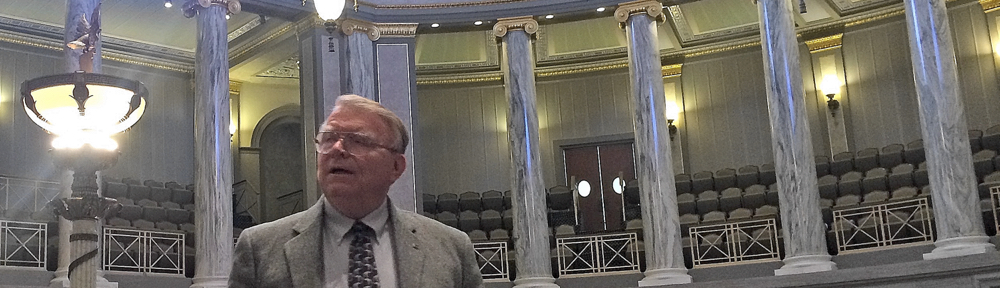
Lincoln

(Before we dip our pen in acid for this entry, please let us observe a bit of a milestone. This page represents page 3,000 of these entries. Today we will plod toward word number 1,300,000. We are sure that we are the only one who has read every word and every page.)

If you’ve been along for a long, long time, maybe you should send yourself a sympathy card.

Now, on with the show:)

Lincoln

Some people just have the right names.

Lincoln Hough SOUNDS like a Republican Senator’s name.

He is one.

But he’s in trouble—

—-because Lincoln Hough is not above thinking. And speaking his mind.

Because he had the nerve to suggest that the Missouri Senate was going against everything the Missouri Senate has stood for, he has been slapped down by his party.

Hough objected to the final dismantling of the Senate’s legacy as a deliberative, respectful, collegial part of government when his party’s majority leadership rammed two questionable bills through a short special legislative session to satisfy the self-serving demand of an increasingly dictatorial President and a desire by his party to mangle the concept of majority vote.

His party leaders have increasingly through the years stifled minority opposition to issues by passing motions to limit or prohibit discussion.  Hough is one of two Senate Republicans who had the courage to vote against the bills in the special legislative session, and to vote against ending debate on them.  Within minutes after the session adjourned, the leader of the Senate majority went to his office and fired him as the chairman of arguably the Senate’s most important committee, the one that writes the Senate’s version of the state budget.

Lincoln Hough told The Missouri Independent that as far as he was concerned, the Missouri Senate died at 1:42 p.m. on Friday, September 12 when debate was blocked on the bill weakening the First Amendment right of citizens  “to petition their government for a redress of grievances,” as it is put in the Bill of Rights.

This was one of the darkest weeks I’ve served during my time in the senate.

If the votes that I cast this week that I believed were in the best interests of my constituents in Springfield, the State of Missouri, and the institution of the Missouri Senate put me at odds with the President Pro Tem of the Senate cost me my chairmanship of the Appropriations Committee then so be it. I wouldn’t change any of them.

I’m looking forward spending my time and energy during my last session on the floor of the senate working every day to restore this institution to place of honor I inherited from Senators Richard and Wasson.

Ron Richard, from Joplin, is the only person in Missouri history to serve as Speaker of the House and President Pro Tem of the Senate. Bill Wasson was Hough’s predecessor in the Senate.

I believe in a process where members are given an opportunity to have a conversation about a piece of legislation, two, to ask questions about a piece of legislation, and, three, propose changes through an amendment process on the floor. When all of that is circumvented, that’s a problem.

This was not the first time Hough had voiced opposition to his party’s legislation by steamroller. He objected to shutting down debate at the end of the regular session in May on a bill repealing two issues voters had approved last year—protection of abortion rights and expansion of sick leave.

He called those actions and the special session experience “a dismantling of what the Senate is supposed to be.”

His party leader wasted no time dropping the axe. Less than half an hour after the session adjourned President Pro Tem Cindy O’Laughlin went to Hough’s office and took away his appropriations committee chairmanship. He has been the vice chairman and then chairman since he came to the Senate six years ago.

She said, ‘we are tired of fighting with you. To which my response was, ‘did you fight with me this week, or did I just go out here and vote no on something that was handed down to the Missouri Senate and a bunch of elected members who are not allowed to talk?’

O’Laughlin assured Springfield television station KYTV there really aren’t any hard feelings involved.

“Every good business has a succession plan. We should not expect less for the Missouri Senate. Leadership on the budget includes not only planning expenditures, but being responsible for outcomes. Eight senators are terming out next year and that is a full 1/3 of the Republican caucus. Planning and executing those plans is a complicated process requiring constant work and oversight. In my view we need an appropriations chair who can get acclimated to the job before the turnover occurs. It has been my plan to appoint a chairman who can gain experience and continue on after the seats change next year. In my view this gives them the best chance of success.

Senior senators can help in this process prior to terming out. I implemented that plan yesterday and it is one I spoke to Senator Hough about last November. He is one of the most talented senators l’ve met and the change has nothing to do with votes as some have conjectured. Serving Missouri is not just about prestige but also about doing what is best for Missourians. I greatly appreciate Senator Hough and the immense amount of work he has performed on behalf of Missourians.

That might be true. Or it might be so much eyewash. Regardless, the optics—to use a phrase that has gained some purchase in our politics today—are pretty bad.  As for continuity, the vice chair of the committee is Chillicothe Senator Rusty Black, who is in his first Senate term and faces the voters for a second term next year. Three other Republican members of the appropriations committee are in their first terms and one other was just elected his second term last year. The committee also includes four Democrats, none of them eligible for committee leadership unless an unlikely switch of majority occurs. But committee members are hardly rookies and will have even more experience after the 2026 budget process.

Hough told The Missourinet O’Laughlin’s statement is “completely disingenuous,” noting that she had not replaced any of the other term-limited chairs of other Seante committees.

Here’s something else that speaks for the character of Lincoln Hough.  He has a picture of Harry Truman in a prominent place in his office.

He hasn’t done it because he’s some kind of a maverick. He’s done it because of the history of his office.

He put up the Truman picture after I saw David Balducchi’s article in the Missouri Historical Review in April, 2021 detailing Truman’s brief Missouri directorship of the National Reemployment Service. From October of 1933 until mid-May of 1934, Truman spent three days a week in Jefferson City where his office was in rooms 419A and 419B of the Capitol.

I took the article to Senator Hough’s office in those rooms and as soon as he read it, he set about getting a nice farmed picture of Truman with a note included in the frame noting Truman’s use of that space.

It was while Truman held that job that Kansas City political boss Tom Pendergast offered him a chance to run for the U.S. Senate, a move some say Pendergast engineered because Truman had been too honest in his job as Jackson County Presiding Judge and Pendergast expected him to lose the Senate bid at the same time his administrative judgeship ran out so a Pendergast crony could be installed in the county position. Truman surprisingly won the first of his two terms before he became President.

It seems kind of appropriate that a portrait of a man who was too honest to suit his own party’s political boss in 1934 should be inhabited by a state senator today who had the courage to call out his party’s willingness to do the biddings of a President who acts as a political boss today.  Hough:

It’s pretty easy to pass legislation in the Missouri Senate if you don’t have to talk about it, and you can just bring it before the body and say, we’re not, we’re not going to have any discussion whatsoever. It seems that if you have any independent thought, or even just raise a question, you have a problem with this Republican Party and that is not the Republican Party that, 15 years ago when I first ran for the House, that I was part of.

There is a penalty sometimes for courage. Hough wasn’t told when he was fired as appropriations chairman if he is even still a committee member.

He lost a Republican primary bid for Lieutenant Governor last year.  I noticed on Facebook a few days after the session ended that someone thinks he’d be a good Congressman. At a time when President Trump’s support seems to be slipping within the Congress, a Republican such as Lincoln Hough, who has an independent streak, might be the kind of Republican the party needs for its future.

A Republican named Lincoln with a big picture of a Democrat named Harry in his office.

Those are pretty good optics.


Your Vote Won’t Mean a Thing OR it Might Mean Everything

—if the legislature passes a crazy initiative petition reform proposal suggested by Governor Kehoe.

Gerrymandering our congressional districts to eliminate one of our Democrat members of congress—because President Trump wants no congressional limits on his power—is not the only threat to our republican (small “r”) form of government on legislators’ desks in the special session.

It is widely recognized that the petition process by which citizens can demand a new law be passed (because the legislature won’t pass it) has its problems and it has its perils that arise from mass expenditures of money to, in effect, buy part of our Missouri Constitution or part of our state statutes.

But a proposal that means 7/8 of Missouri’s voters’ ballots will have no meaning whatsoever is simply absurd.

The governor wants a law passed that says any proposal put on the ballot by citizen petition not only must achieve a majority to pass, it must get a majority in every one of our eight congressional districts.

One of the problems with the current process is that votes in our heavily-Democratic metropolitan areas have been enough at times to pass a proposal opposed throughout the rest of the state.

Governor Kehoe did not address that issue in announcing his recommendation in issuing the call for the special session. He said, “For far too long, Missouri’s Constitution has been the victim of out-of-state special interests who deceive voters to pass out-of-touch policies.  It’s time we give voters a chance to protect our Constitution.”

The answer to this problem is NOT, however, in killing a sacred part of this country—majority rule.

If Governor Kehoe’s idea had been in effect last year, we would not have sports wagering coming to Missouri regardless of how many millions of dollars the gambling interests spent. You’ll recall that the industry spent more than $40 million to get its petition issue passed by 3,000 votes. The industry fits like a glove the governor’s description of “out-of-state special interests who deceive voters.”

The proposal lost in three counties that have casinos—Lewis, Cooper, and Cape Girardeau. It carried in the metro areas that have casinos by tens of thousands of votes. Only one outstate county with a casino—Pemiscot—approved, but by only about 340 votes. It failed not in just one congressional district but probably in five (we haven’t seen a breakout according to district but the county-by-county plus St. Louis and Kansas City totals are available).

This is a ridiculously BAD idea.  Under this idea, a petition-proposed law or amendment could pass in seven of our congressional districts but fail by a single vote in the eighth. That single vote would negate every other vote in every other part of the state.

The proposal deals with a problem that is largely of the legislature’s own doing. By refusing to pass bills that have significant public support, our lawmakers are clearing the way for citizen petition campaigns. Sports gambling is the biggest and most recent such failure. The refusal to pass a law has led the gambling to put sports wagering in the Constitution and therefore make in extremely hard to deal with the problems this new form of gambling cause by changing a law. If it’s in the constitution, correction is manifoldly more difficult.

Here’s something else that’s kind of tragic—

This proposed law does not require a public vote.  You and I will have no right to vote on whether the state should be able to take away our votes, even if we are in the majority, at least not as the proposal is now written.

Law by petition has its problems.

Such laws do not go through the rigorous examination and refining process of legislative procedure. That can be frustrating for those hoping for a change in something. But writing a law that says specifically what it is meant to say, no more and no less,  is a finely-developed talent. Once it is written, it goes through committee hearings where shortcomings can be highlighted and corrected. Then in each chamber of the legislature, it goes through a “perfecting” process that again can be a rigorous review before it is finally passed.

But that doesn’t mean the right of petition given us by our ancestors more than a century ago should be rendered meaningless by this proposal.

The system does need some careful tweaks, but not surgery by meat cleaver. One tweak is a requirement that entities wanting to put a petition issue on the ballot should file only one version of the proposal with the Secretary of State whose elections staff spends time reviewing for correctness.

The Secretary of State’s web page has numbers that dramatically point to the problem. Last year, 174 petitions were filed. Nine were rejected, 24 were withdrawn, and 139 were approved for circulation. Only four were submitted with signatures and put on the ballot. Four out of 174. Large numbers were slightly different versions of the same matter. But each required review by the Secretary of State staff.

A law saying a group gets one shot would be helpful. If there are problems, then the group can submit a better proposal. But the shotgun approach needs to stop.

Secretary of State Denny Hoskins has some ideas about improving the process:

Limit abuse of process, by instituting modest filing fees and banning duplicate or near-duplicate submissions.

Ensure broad geographic support, strengthening the constitutional “district distribution” requirement so that petitions reflect statewide, not concentrated, backing.

Ban foreign or out-of-state fundraising, and stiffen penalties for fraudulent signatures or circulator misrepresentations.

Increase transparency, with public comment periods and clear, plain-language explanations available before signature gathering begins.

Generally, these aren’t bad ideas although the funding ban might be a little shaky because of  First Amendment speech problems and whether limits on raising the money to do the speaking infringes on the right to petition by groups who say they can’t enjoy that right unless they can raise money from whatever source.

The secretary’s idea, however, of allowing one congressional district to be, in effect, a killing entity that makes votes in all of  the other districts meaningless is simply undemocratic.

These are statewide issues and the votes from throughout the state mean something today. But they won’t tomorrow if this proposal passes. “Broad geographic support” sounds good. But it’s shorthand for “forget majority rule.”

Missourians already have given up their right to vote. Twice. First, it was term limits that means we have no right to vote for a lawmaker who has served us well and that we would like to represent us for more than eight years. Second is the adopted initiative petition proposal requiring votes every five years in Kansas City and St. Louis on whether to continue their earnings taxes. One provision of that issue says none of our other cities can ever ask voters to approve a similar tax for their city. Proposals might not pass, but we have a law—again, submitted by initiative petition—that says we can’t even vote on it.

Now we are being asked to approve an idea that says a statewide majority is useless if one-eighth of the state, by as little as one vote, can wipe out the votes of everybody else.

The governor’s plan doesn’t take onerous amounts of money out of the process. Doing so has to be through a way around First Amendment protections of free speech and right to petition. Nobody has figured out how to do that in a way that the court system will buy.

A undemocratic proposal that says votes from 7/8 of our state can be rendered meaningless by the barest of majorities opposed in one district is just plain wrong.

Suppose we applied the idea to legislative races saying no one can be elected to the House or the Senate if one precinct in their district fails to give them a majority. That’s “broad geographic support” brought home to roost.

If they’re not willing to put themselves in that predicament, they shouldn’t put everybody else in the state in it.


A REALLY Special Session

Our lawmakers are back in Jefferson City to help decide what kind of a country we will have, and what kind of country we will be. That’s a pretty strong observation. But if we are honest, it is also pretty strongly true.

Governor Kehoe has called them back because President Trump worries he won’t have continued absolute power for the last half of his term unless legislatures in various states take unprecedented action to change congressional district lines to eliminate Democrats.

Forget what the voters decided in the 2024 Congressional elections. Make sure some of them can’t have the representative they elected because a President who brags about his popularity is worried that, in truth, he is so unpopular in poll after poll that Americans might vote in 2026 to impede his seizure of absolute power.

The Missouri legislature wants to take Representative Emanuel Cleaver’s elected job away from him by splitting his district so about half of his biggest supporters can’t vote for him in 2026.

It is interesting that Republicans, who have so many chest-thumping evangelical Christians supporting them, want to eliminate a member of Congress who is a Christian minister. Perhaps Emanuel Cleaver isn’t Christian enough. Perhaps they think he is spiritually lost or spiritually bankrupt because he’s a Methodist, a mainline Christian group that has split in a dispute about whether God creates gays.

Wouldn’t you think that a president who peddles Bibles, poses holding a Bible in front of a D. C. church, and says in commercials that he has several Bibles and it’s his favorite book would want someone like Congressman Cleaver in Washington as a moral force?

That’s Trump’s problem. He is not a moral force himself. In fact, there are plenty who wonder if he has any morals at all.

Donald Trump, who is so scared of losing power that he will disrupt the entire system of picking a representative government, wants the legislature to just turn over the keys to the democratic process in Missouri to him.

He talks about American exceptionalism but cares not for the government system that gives us that distinction and he will do anything to make sure his power goes unchecked for as long as he and his political offspring can keep it.

Have the people of Missouri asked for this change in who represents them?

No.  There has been no public outcry that our congressional delegation has betrayed the people who elected it. But those we have chosen to represent us at the state level are facing a demand that the legislature go against its own public’s wishes so Missouri can help keep a man in power who day after day advances policies that are antithetical to a heritage that millions have lived and died to defend and to perfect.

Now we have the spectacle of our chosen state representatives and our chosen state senators meeting to undermine our representatives in the national government that we voted to support less than one year ago, and in the process throw out a Black Methodist minister who has served our state with great honor and decency in Washington since January 3, 2005, a man dedicated to public service in the pulpit as well as in the places of power—a dozen years on the city council in our largest city, eight years as its mayor, and more than two decades representing Christian values and his district’s needs.

He rightfully threatens to fight this ill-conceived realignment in court: “It will render people in Kansas City essentially silent and powerless,” Cleaver said. “The reason I’m saying this is Kansas City is roughly 70-something percent Democratic. If you tear Kansas City apart — put one portion of the Kansas City area in one district, the other in another — the chances are they have no representation.”

He is correct although today’s majority party does not seem to care.

What hammer does Donald Trump hold over our lawmakers that makes them so craven in doing his bidding? It’s a big one. It’s the power to withhold or even take back the billions of dollars in federal funding that underwrite about half of the state budget.

It is awfully hard to look down the barrel of that gun and not wilt. Trump wants no defiance from Missouri and from other Republican states. He and those who are pulling his strings daily prove they care not one whit for most of us but expects our voices in government at state and federal levels to say only two words: “Yes, sir.”

Some key questions emerge: Is there time to make all of this happen?  Can opponents drag out the special session before the bill passes and the court battles begin and how long will that process take before it clears state courts and goes through the federal court system, which will take even more time?

When will filing for these offices begin if this issue is tied up in courts?  Candidates cannot file in districts that will not legally exist until the courts rule which map will be THE map. When will primary elections be held, ditto? When will lawsuits challenging the results begin and be processed? Will the court fights be  done  before time for a November election?

This is going to be a long and ugly process that will do nothing to improves public confidence in Missouri’s, and the nation’s, government.

One man wants to take away one of our members of Congress with a new map THAT IS UNLIKELY TO BE PUT OUT FOR VOTER APROVAL before an election is held specifically to oust a congressman who has been elected eleven times by people in a district that Trump wants the Missouri legislature to destroy.

Here is the final question:

How much does the Missouri General Assembly want to disgrace itself for a man who has been considered by almost 150 of the nation’s most distinguished historians one of the worst presidents in history—-eve before he started swinging a sledgehammer in his second term.

Despite the words of a long-ago popular song, Freedom IS a word for everything to lose.

Our legislators will tell us at the end of this special session if they think it is, as the song also says, “just another word.”

Be Careful What You Wish For 

It’s an old idiom with several variations but it has a currency in today’s politics as some states are hopping to President Trump’s demands to redraw congressional districts so a cooperative Republican majority will not offer any checks or balances to his policies throughout the rest of his term.

Republican friends, you would be well-advised to tread carefully into this Trumpswamp.

We have witnessed numerous lawsuits stemming from the seven redistrictings we have covered or observed. The authors of the realigned districts always deny they have gerrymandered districts either to protect an incumbent or to oust an incumbent the majority party wants to target.

But this is different. The President has specifically asked legislatures to gerrymander districts to make sure more Republicans are elected to the U. S. House in 2026. He has a small and shrinking majority there now and he is seeing some ferment within his MAGAites and his response is not to correct any of his own behaviors but to ask state legislatures to make sure he doesn’t have to.

Some leaders of the Missouri legislature would not be surprised if Governor Kehoe calls a special session to redraw our congressional districts to oust one of our two Democrat members of the House, in this case the Rev. Emanuel Cleaver of Kansas City, one of our senior congressmen.

They tried to do that once before, putting him in what I called a “dead lizard” district (because its outline looked like a dead lizard, lying on its back with its feet up) that stretched as far east as Marshall, thus putting more rural conservative voters in play. But the legislature made a mistake by letting him keep too many of his Kansas City constituents and he won anyway.  It is unlikely the legislature will make that same mistake this time.

In the past, legislators accused in lawsuits of gerrymandering denied doing so intentionally, forcing critics to prove their defenses untrue.  This time, however, there will be no denying intentional gerrymandering; the President has ordered it.

It will be blatantly intentional, therefore harder to defend.

There are other issues in play, too. They must consider whether they are enacting a boomerang.

First, there is the question of the population basis for the new plan. Trump wants a new census that can be used in apportionment. That’s a reason to delay redrawing the lines. His desire to exclude some people in that census will draw lawsuits. More delay.

Why, therefore, the rush?  No census. No determination of the census’s legality. How can the numbers used to calculate new districts be accurate without that census and the determination of its constitutionality?

Whether the districts will exist a year from now, in the 2026 election cycle, depends on the court attacks on the plan—and there will be attacks. The timing of the challenges, the hearings, the appeals, the appeals hearings, the rulings and the appeals to an even higher level will chew up a lot of time.  The legislature can approve the plan. But whether it will withstand vigorous court challenges on numerous fronts from the accuracy of population numbers as well as the overt partisanship behind it is uncertain. Whether opponents can run out the clock on the plan also is uncertain.

It also is possible that Trump’s continued misadventures politically, legislatively, socially, and judicially will have further inflamed his existing and his new critics by election time in ’26 and voters will take it out on Republicans generally and the Republican running to oust an incumbent Democrat in particular.

If this plan goes into effect, Democrats can launch numerous attacks and use it to put forward attractive candidates than will have a significant ready-made issue to make a strong run at Republicans. It could backfire.  Some concerns already are being heard in the GOP ranks.

Sometimes it is better to let incumbent dogs lie (read that how you prefer) than it is to stir up a public that is capable of switching to the other party on election day. Experience shows that the public is a fickle creature.

It’s a risk/reward situation for Republicans no matter how they cut it. They should consider the potential hazards of getting what they wish for because they easily could get what they don’t desire, especially if Trump continues in the next year to alienate his base and Americans generally with his Big Ugly Bill and subsequent actions and legal problems.

Present trends seem to indicate his behavior is doing potentially prospective Republican candidates no service, something incumbents might consider as they ponder their own futures. Is he worth the risk in which they might be placing themselves?  And if they decide he isn’t, will they have the courage to stand up?

Rigging the Election

A normally sane person might think that a person who has claimed a rigged election is wrong would be reluctant to try to rig one himself.

But we are living in Trumpworld.

President Trump wants red states such as Missouri to adjust their congressional districts so more Republicans might be elected next year. A president’s party historically loses congressional seats in midterm elections and Trump and his party don’t have any seats he can spare.).

Texas Republicans have jumped at the opportunity to make the master happy although the GOP already dominates the state’s delegation in the U. S. House of Representatives 27-12.  That’s not good enough for Trump. The effort has led to a confrontation with their Democratic colleagues that has become, our mind at least, a national embarrassment for Texas politics and politicians.

What’s going on here?  Trump is scared.  Of what?  National Review correspondent Audrey Fahlberg said recently on CNN, “The White House is driving this because clearly they are worried about losing the midterms.  They’re convinced that if House Democrats flip the House, that Trump is going to get impeached again…The ‘big beautiful bill’ is not polling super well right now, so they’re going on offense here. They’re driving this into motion in Texas. They’re looking at other states, as well. We may see this continue in states like Florida, Indiana.”

And Missouri appears likely to get into this, too. Republicans have six of our eight House seats but apparently that’s not enough. Senate leader Cindy O’Laughlin has told the Missouri Independent that it is “likely” the governor will call a special session to redraw lines so Republicans would be likely to take away the seat held by one of our senior members, the Reverend Emanuel Cleaver of Kansas City. He’s one of two Missouri African-Americans in our congressional delegation.

Missouri is not out of whack in the D/R balance of our congressional districts.  Last year, President Trump got 58 percent of the popular vote in Missouri. Kamala Harris and minor candidates got 42 percent.  A 6-2 congressional breakdown fits those results.

The Missouri legislature is more than 2-1 Republican so a walkout by Democrats similar to the Texas walkout wouldn’t stop the GOP from aiding and abetting Trump’s need to have a pliant Congress. The Missouri House Minority Leader, Ashley Aune of Kansas City, has told the Independent, “Everyone I’ve talked to, especially on my side of the aisle, expects to go down and get steamrolled…during a special session.”

In about a month, legislators will reconvene to consider overriding any vetoes dispensed by Governor Kehoe after the regular session and a special  session could meet concurrently with that veto session. It’s been done a few times before.

We can anticipate one of the arguments opponents will make. Our state constitution’s Article III, Section 45 says:

 When the number of representatives to which the state is entitled in the House of the Congress of the United States under the census of 1950 and each census thereafter is certified to the governor, the general assembly shall by law divide the state into districts corresponding with the number of representatives to which it is entitled, which districts shall be composed of contiguous territory as compact and as nearly equal in population as may be.

The average citizen is likely to think this language is clear—the state constitution provides for redistricting after each census but has no authorization for redistricting midway through a census decade. The language about “contiguous territory as compact and as nearly equal in population as may be” has been used from time to time to challenge redistricting plans that critics think wander too far from “contiguous” and “compact.”

Missouri has revised congressional district maps after the decennial census is taken beginning, as noted in the language, after the 1950 census. The only time the legislature redistricted between census counts was in the 1960s with a case that went to the United States Supreme Court that ruled against a redistricting map. A key part of the ruling said:

Missouri contends that variances were necessary to avoid fragmenting areas with distinct economic and social interests and thereby diluting the effective representation of those interests in Congress. But to accept population variances, large or small, in order to create districts with specific interest orientations is antithetical to the basic premise of the constitutional command to provide equal representation for equal numbers of people. “[N]either history alone, nor economic or other sorts of group interests, are permissible factors in attempting to justify disparities from population-based representation. Citizens, not history or economic interests, cast votes.”

If we understand Trump’s demands, he wants the Missouri legislature to create “districts with specific interest orientations.” The U. S. Supreme Court is much different than it was in the sixties so we’ll have to see if this precedent carries any weight with today’s Trump-dominated court.

Not all Missouri Republicans are in lock step with Trump. One is Senator Mike Moon of Ash Grove, a member of the so-called Freedom Caucus, a minority group within the Republican Party that took control of the chamber and blocked action on hundreds of bills in the last three years. Another is the Speaker Pro Tem of the House, Chad Perkins of Bowling Green who worries that “a 7-1 map is easily a 5-3 map in a year that doesn’t go the way that conservatives want it to go.”

Perkins also makes the point that Democrats should not moan and wail too loudly about Republican attempts to hold their advantage by changing districts in the middle of a decade because the Democrats in Illinois and California are doing the same thing to gain an advantage to offset any pick-ups Trump might make in other states.

The latest wrinkle in the planned rigging is Trump’s order for his Commerce Department to run a new census that does not include undocumented immigrants, the U. S. Constitution notwithstanding.

Article I, Section 2 does not seem to allow what Trump demands, at least for your observer’s untutored reading.

Representatives and direct Taxes shall be apportioned among the several States which may be included within this Union, according to their respective Numbers, which shall be determined by adding to the whole Number of free Persons, including those bound to Service for a Term of Years, and excluding Indians not taxed, three fifths of all other Persons. The actual Enumeration shall be made within three Years after the first Meeting of the Congress of the United States, and within every subsequent Term of ten Years, in such Manner as they shall by Law direct. 

The Constitution recognizes the census taken every ten years as the only legitimate census. By including “the whole number of free persons,” it does not exempt immigrants, which at the time the Constitution was written was a considerable number. Indians were not counted (although they were probably the freest people in the nation’s history until the Europeans showed up). Slaves WERE counted but since they were not free they were considered only three-fifths of a person—a provision the southern states demanded so representation would be balanced with states in the north.

And the article says the only census that will be constitutionally recognized is the one done every ten years.

Trump’s order is not helpful to his demand that new congressional districts be drawn. Right now. The first part of Amendment 1, section 2 says the districts will be drawn based on census figures.  The census has to come first, then the districts, a constitutional provision that seems to say Texas is jumping the gun and Missouri would be doing the same. Doing a census the way Trump wants it done could be pretty difficult and time consuming because a lot of Latino people whether here legally or illegally are making themselves as scarce as possible.

To coin a phrase, Trump seems to be engaged in unconstitutional bundling.

Trump’s political cynicism does nothing to reduce the general public’s distrust of our political system. In fact, he has played upon it to get elected.

Politics sometimes has been a mud-and-blood-and beer wrestling match although not as untrustworthy as many see it today. Some observers have suggested this state of decline began with Ronald Reagan’s inaugural remark 44 years ago that, “In this present crisis, government is not the solution to our problem; government IS the problem.”

Reagan had it right but he sure didn’t foresee the much different way the statement is true today.

The central issue in this frantic competition to diminish a minority within a state’s congressional delegation is this:

We have a President and a GOP House and Senate that recognize their statements and their actions are counter to the public’s increasingly self-recognized best interests. They are uncertain that the public, if given the chance, will let them keep doing to the country and its people the things they are doing.

Thomas Jefferson and the Second Continental Congress had the answer many of today’s  politicians want to ignore:

Governments are instituted among Men, deriving their just powers from the consent of the governed, –That whenever any Form of Government becomes destructive of these ends, it is the Right of the People to alter or to abolish it, and to institute new Government, laying its foundation on such principles and organizing its powers in such form, as to them shall seem most likely to effect their Safety and Happiness. Prudence, indeed, will dictate that Governments long established should not be changed for light and transient causes; and accordingly all experience hath shewn, that mankind are more disposed to suffer, while evils are sufferable, than to right themselves by abolishing the forms to which they are accustomed. But when a long train of abuses and usurpations, pursuing invariably the same Object evinces a design to reduce them under absolute Despotism, it is their right, it is their duty, to throw off such Government, and to provide new Guards for their future security.

Read that last sentence again.  When a despotic government becomes destructive of the inalienable rights of citizens like you and me, WE have the RESPONSIBILITY to resist and to form a new government that provides for our “future security.” The Trump bunch is afraid the people might want to do that now that the see that Trump was less than honest (to put it mildly) in his campaign.

Too many in today’s politics care less about life, liberty, and pursuit of happiness than they care about power, especially power that can be abused to benefit the few by harming the many. Re-drawing congressional district lines by those focused on power more than on the government our forefathers imagined helps assure that the people have reduced chances for benefitting from their inalienable rights.

There is an odor of desperation in the air on the part of those who believe in power above service as they see public sentiment for them weaken.

The redistricting game is being played by people who have come to believe they cannot win if they do not rig next year’s elections for Congress—-and they’re flouting their ambitions right before our eyes when they consider a mid-term re-drawing of congressional district lines based on ignoring counting “the whole people” to protect a President who now seems far less confident in his future than he did six months ago.

They might be imperiling themselves if they proceed, these legislators, as we will discuss in our next entry.

Here We Go Again

We’ve seen this scenario played out before. Republicans cut some taxes and the economy goes into the toilet soon after with the state having reduced its ability to fund programs that people rely on during economic downturns, especially lower-income Missourians.

The national economy isn’t in the toilet (yet, perhaps), but Congress has approved President Trump’s budget that will harm thousands of Missourians.  At the same time, Governor Kehoe is thinking about signing the bill eliminating some taxes that will produce revenues.

He already has vetoed hundreds of millions of dollars from the budget approved by the legislature, citing concerns about state finances in the fiscal year that is  newly underway.

We must be missing something. This doesn’t seem to add up to us. On one hand, there is concern that the state can afford the things the legislature approved and on the other hand there’s—

Wait a minute.

Aren’t we on the same hand?

Finger one: Cut the budget because of uncertainty of state finances, much of it caused by federal cuts in some important programs.

Finger two: Cut Missouri taxes to reduce total revenues even more?

One estimate is that the tax cuts reduce program funding by about a half-billion dollars at a time when not-so-beautiful bill in Washington eliminates a lot of federal money coming here.

To be sure, there are some good things in the bill he plans to sign.  A capital gains tax reduction will be welcomed by many who have capital gains but that’s one reason the liberal-leaning Missouri Budget Project isn’t a fan of the bill.   The MBP says five percent of Missouri taxpayers will get eighty percent of the benefits.

But it’s not all for the high-rollers. The Circuit Breaker property tax program will increase the income levels of people eligible for it, a change that will affect almost 200,000 households. The state sales tax is being lifted for diapers and women’s hygiene products. And there are some other things the MBP admits are badly-needed.

The conventional Republican wisdom is that if you reduce taxes, the infusion of those moneys into the general economy will generate more revenues to offset the taxes. We can’t say that we have noticed significant improvements in the economy when the legislature reduces Missourians’ taxes.

We are in sympathy with the stated reasons for lowering these taxes but we wonder if freezes are more protective of the overall well-being of state services than cuts at this time.

For more than fifty years we have listened to all kinds of people complain about the lack of money for schools, health and mental health, prisons, law enforcement, housing, nutrition and a host of other issues.  This scenario is kind of like the old saying, “Everybody talks about the weather but nobody does anything about it” except the talk about taxes also includes doing something about them.

Sometimes though, it is best to heed the phrase-altered advice, “Don’t just do something. Sit there.”

To be honest, we admit having no grasp of the subtlety of economics that one probably needs to understand the rationale for these cuts.  We only took one economics course in college. Everything else we know about the economy is reflected in our utility bills and grocery prices. And in our taxes.

Jim Mathewson, who served in the legislature from Sedalia and was the President Pro Tem of the Senate for eight years, a record that will never be broken in this unfortunate era of term limits, said several times, “People don’t remember that you cut their taxes. But they sure remember when you raise them.”

It’s a nice bill today but the people who remember it are the ones who won’t benefit, especially those hit with the federal cuts.  One thing we’ll watch is to see whether there’s a political fallout in state politics that will be anywhere the fallout being predicted at the national level.


SPORTS—Stadium Money Faces Crucial Week; Competitive Cardinals; Breakout Rookie in KC; Battlehawks Lose in Playoffs, Again

By Bob Priddy, Missourinet Contributing Editor

(THE CAPITOL)—-Whether the state lays out hundreds of millions of dollars to build the new stadium that will keep the Kansas City Royals on this side of the state line could be determined tomorrow at the Missouri Capitol.

The House will consider the Senate-passed bill would have the state as much as half of the total costs of a new stadium for the Royals and for major upgrades to Arrowhead Stadium.

Kansas is putting on the pressure by offering to pay as much as 70% of the costs of building new stadiums on its side of the state line.

The bill also requires the state to pay as much as a quarter-billion dollars to upgrade Busch Stadium III.

(CARDINALS)—The Cardinals took on the third-best team in the National League during the weekend and won two out of three from the Dodgers. The Dodgers avoided a sweep with a Sunday win. But the Cardinals continue to gain confidence as they won the series.

Redbird shortstop Masyn Winn thinks the result shows the Cardinals can compete. He told reporters after the game, “We don’t have the payroll that a lot of teams do have. We have a lot of guys in here who are just grinders. We don’t have a standout superstar. We have a lot of guys in here who are just grinders.”

St. Louis finished the week four game behind the Cubs, in second place in the division,  seven games ahead of break-even and four games behind Chicago, the team with the second-best record in the National League. The Mets are on top at 42-24.

(PITCHING)— The Cardinals continue to tinker with their pitching staff, calling up relievers Riley O’ Brien and Chris Roycroft, both righthanders, and sending Matt Svanson and Michael McGreevey to Memphis.

They’ve also decided to take a flyer on Zach Plesac, a former starter for the Cleveland Guardians who had been moved in and out of the rotation for the past few years. The Guardians finally let him go to the Los Angeles Angels last year.  He was out of baseball as 2025 began but picked up a minor league deal with the Long Island Ducks of the Atlantic League. He’s averaged about eight strikeouts per nine innings with the Ducks.

(ROYALS)—The Kansas City Royals still are waiting for the spark that moves them above mediocre and they might have found it in Jac Caglianone, who went 4 for 4 Sunday against the White Sox. Caglianone, called down from Omaha last week, had been just 2 for his first 21 at-bats.  But against the White Sox, he went 4 for 4, one of he hits a 113 mph double.

First baseman Vinnie Pasquantino led the Royals to a 3-3 week in games against the White Sox and the Cardinals with a performance that earned the Player of the Week honors. He batted .500 with 13 hits, 20 total bases, and seven runs batted in during the road trip.

Catcher Salvador Perez made a little history last week with his two-run homer that tied game against the White Sox. It was his 30th game-tying home run, moving him past Alex Gordon into number two on the team records list. Only George Brett had more.  35.

(BATTLEHAWKS)—We’ve heard this before:

It’s one and done for the St. Louis Battlehawks in the UFL playoffs, and the defeat smarts even more because it happened in front of the home folks.

The DC Defenders, beaten by the ‘Hawks a week earlier, rolled over St. Louis 36-18 to grab the XFL title.  The win sets up the Defenders to play the Michigan Panthers for the  UFL championship Saturday in (ouch!) St. Louis.  Michigan beat Birmingham 44-29 for the right to go to St. Louis.

Now: Where the rubber really meets the road—

(INDYCAR)—If  you want to watch the winner of the Indianapolis 500 try to go back to back on an oval, you’ll want to go across the river from St. Louis to World Wide Technology Raceway for Sunday night’s Indycar race.  Alex Palou made the 500 his first career win on an oval three weeks ago.

It’s a full weekend of competition with a race for 500 hopefuls in the IndyNXT series and a race for Silver Crown drivers.

(NASCAR)—Denny Hamlin has become one of the few drivers to win a race after running at least 700 Cup races when he minded his fuel until he needed to go all-out in the closing laps at Michigan.  He led only the last five laps and finished more than a second ahead of Chris Buescher and Buescher’s teammate, Ty Gibbs.

The race was the 701st of his career and his 57th win.

Carson Hocevar seemed to have the race in hand until he his car developed a flat tire, giving William Byron a lead he held until he had to make a splash-and-go fuel stop, handing the lead to Hamlin.

Only ten other drivers in NASCAR history have won at least one race after making 700 starts. Kevin Harvick had seven wins, a record Hamlin wants to beat. He is 44

The win at Michigan is his third checkered flag this year. He has said he wants to win at least sixty races in his career.

NASCAR runs its first international race next week, in Mexico City.

(F1)—Formula 1 runs the Grand Prix of Canada next weekend, in Montreal.

(Photo Credit: Visit Kansas City)

The contest

The legislature and the Secretary of State are involved in a urinary contest and the only people getting wet are 22 public servants who have been caught in the middle of the streams.

And I am personally in a state of high urinary agitation because of this match.  I was president of the Friends of the Missouri State Archives for nine years and remain on the board. I was there when the organization was founded many years before that. I have used the archives extensively for the Capitol books I have written or am waiting to be published. I have used the archives for other projects as well.  Some of those who’ve gotten the axe are on the staff of the state library, which also has been an important resource for my work dating to the 1970s.

In a few days, the Friends will hold their annual meeting. At least, I think they will.  The person who does a lot of the planning was one of those given a few minutes to collect their personal items from their desks before they were escorted out of the building.

Losing your job is one thing. Being humiliated by being thrown out of the place where you’ve worked for many, many years is an insult.

But who cares about who is being hurt?  The Secretary of State and some Senators who should have worked things out as grownups don’t seem to.

All that I care about, and that many people who rely on these two services should care about, is restoring these people to the important work they do, whether it is working with citizens at the front desk or whether it is the behind-the-scenes sorting, cataloging, and filing that is necessary for a huge archival facility.

As usual, sorting out whether these cuts are legitimate or whether they are a grudge contest played out by senators who remember Secretary Hoskins’ involvement with a Freedom Caucus that virtually enslaved the legislature for three historically unproductive years, or whether it is a misunderstanding of fiscal policy is difficult to determine from our distance.

Whatever is going on here, there are more than twenty people who are hurt by it who do not deserve to be treated as they have been treated.

One good thing is that the legislature is meeting in special session on budget matters and can fix this—and be quick about it. Spitting at each other across a fence isn’t going to do it.

These people can get their jobs back; we have heard of some who are just short of reaching retirement eligibility, which makes this situation even more deplorable.

An adult needs to get the legislative and bureaucratic perpetrators of this petty dispute together and straighten this out. Who should that be?

Governor Mike Kehoe needs to be the adult in the room.  Being the state’s adult is an unwritten qualification for the job. These 22 people are his constituents, and many of them have been even closer constituents, dating to his days as a state senator.

There’s a big round table in the governor’s office that is one of the original pieces of furniture when the building was constructed before World War I.  That table has seen a lot of deals worked out around it.

It’s time for the Governor to convene a meeting around that historic table not to make policy with the big names of government, but to restore jobs and dignity to the 22 littler people who deserve far more respect than they’ve been given.


Sports: Trying to Stay Even; Swinging Portals, And Big Wins

By Bob Priddy, Missourinet Contributing Editor

(STADIA)—as in more than one stadium.

The discussion about whether Kansas City can keep either or both of its major league football and baseball teams ratcheted up yesterday when several civic leaders, including team officials, put out a joint statement calling for “swift and decisive” action to keep the Royals and the Chiefs on the Missouri side of the state line.

“All of our major league franchises are more than teams; they fuel our economy, strengthen our community, and are a beloved part of the region’s identity,” said the statement signed by the city sports commission, the area development council, tourist group Visit KC, and the Civic Council of Greater Kansas City.

John Sherman, the CEO of the Royals, said in a separate statement, “Greater Kansas City is our team’s home. For our fans, our partners, and our major league community, we want to keep it that way.”

Chiefs CEO Clark Hunt told KSHB-TV the team is glad to see the local support and said, “We remain committed to the continued growth and success of our entire region.”

State officials have been talking, secretly, with the teams and Kansas City officials but no specific plan has come but of the discussions. Some bills have been filed to create a funding system to keep the teams on our side of the line but the only one that is moving is one that was approved by the Missouri Senate yesterday that would make it possible for one of the teams to move to Clay County.

Clay County could create an organization  similar to the Jackson County Sports Authority which presently hands the leases for both Arrowhead and Kauffman stadiums. The bill would allow a new Royals stadium or a new training facility for the Chiefs.

Either proposal, particularly the stadium, would draw three million dollars a year from the state—a far cry from the anticipated cost of either facility.

The bill still must be approved by the House of Representatives and signed by the governor. The session ends in a month.

(CARDINALS)—Back to back quality starts by Matthew Liberatore and Sonny Gray have boosted St. Louis back to the .500 mark.

Gray shut down the Houston Astros last night, going seven innings and giving up only three hits while the offense pummeled Houston starter Framber Valdez for ten hits and six earned runs in four innings. St. Louis wound up with 14 hits and eight runs. Nolan Arenado was 3 for 4 with a homer. Behind him, Bendan Donovan was 4 for 4. Roddery Munoz gave up a three-run homer in the ninth for the Astros’ only runs.

Liberatore and the bullpen shut out the Phillies Sunday, giving the Redbirds their first series win since the opening weekend. Liberatore went six innings, gave up only three singles, and struck out seven to get his first win of the year. The last twenty Phillies batters went hitless.

Wilson Contreras is swinging one of those “torpedo” bats now and doing it effectively. Saturday, he had two hits and Sunday, he got the Cardinals on the board with a two-run homer.

Masyn Wynn, who left the series opener Friday with back spasms was put on the ten-day disabled list Saturday. As he was going on the injured list, the Cardinals reactivated Norman Gorman off the DL where he had dealt with a right hamstring pull..

(ROYALS)—The Yankees got four solo home runs, three in the fifth inning, against the Royals last night and won the series opener 4-1. Starter Seth Lugo gave up all four of them. Bobby Witt homered after a ten-pitch battle with starter Carlos Carrasco to put the Royals’ only number on the scoreboard.

The Royals drop to 8-9. The Yankees reach 9-6.

(COMINGS AND GOINGS)—It’s portal time for college basketball and it’s getting hard to keep up. Here’s where we think the Missouri Tigers are:

Center Peyton Marshall is jumping ship after his first year of college b-ball. He was a four-star recruit. Mashall was a seven-foot 300 pounder was in 22 games for an average of 4.4 minutes and one point. Another member of his 2024 class, Marcus Allen, also is looking for pastures with more green in them.

Replacing Marshall is 7-foot center Shawn Phillips Jr., who has decided Missouri has greater opportunities than Arizona State. His agency has made the announcement. Phillips has been a basketball gypsy, starting at LSU in the class of 2022 before going to Arizona for the last two years. He hits 56% of his field goal attempts, none of which have been tried from outside the arc.

He is the fourth transfer through the portal for Dennis Gates’ newest-look Tigers. Jontay Porter, Luke Norwether, announced earlier, and now-former UCLA guard Sebastian Mack announced heir plans earlier.

The Mizzou football team is going to lose at least four players when the football portal opens in a few days.

One of those taking off is linebacker Mikai  Gbayor just transferred to Missouri from Nebraska.  He leaves without ever taking the field for Missouri.

Also leaving is cornerback Ja’Marion Wayne, defensive end  Jahkai Lang, and backup quarterback Drew Pyne.

Coach Drinkwitz says he would not be surprised to lose four more guys.

Coming to Missouri is linebacker Josiah Trotter, who has some bigtime genes as the son of former NFL all-pro linebacker Jeremiah Trotter, and the brother of Jeremiah Trotter Jr., who was a member of the Super Bowl-winning Philadelphia Eagles, who have put Jeremiah Senior in the tam’s hall of fame. Josiah comes over from West Virginia, where he was the Big 12 Freshman of the year last year.

Now, let’s look at the people who come and go even faster:

(INDYCAR)—Andretti Global doesn’t have Michael Andretti in the ownership structure anymore but it has kept the Andretti name and now it has an INDYCAR victory.  Kyle Kirkwood started P2 and finished in the same place at the 50th Long Beach Grand Prix Sunday.

Kirkwood’s win is his first since he won at Long Beach in 2023, his third series in overall. To win, he had to hold off Alex Palou, the winner of the first two races of the year.

The race was a milestone for last year’s winner, Scott Dixon. Dixon came  home eighth for his 300th career top ten finish. The 11th place finish of Santino Ferrucci might not seem particularly noteworthy—except that he started 27th.

There were no caution flags in the race. In fact, the only crash in INDYCAR this year was on the first lap of the first race.

(NASCAR)—Denny Hamlin, who had won the two previous NASCAR races, outran everybody but Kyle Larson in the 500-lapper at Bristol Sunday.  Larson led 411 laps and gave up the lead under the green flag only once. Larson and Hamlin have finished 1-2 seven times but this was the first time Larson was ahead at the end. Ty Gibbs got close to ending his 81-race winless streak with Joe Gibbs Racing, the longest any JGR driver has gone without picking up his first win for the team. He’s the grandson of the former NFL coach who owns the team. He called his finish “really nice” and says he thinks “we’re really capable of winning a lot this year.”

(FORMULA ONE)—F1 was in Bahrain last weekend with Oscar Piastri started in his McLaren from the pole and holding the lead throughout. Mercedes’ George Russell finished 15 seconds back. Piastri teammate Lando Norris overcame penalties to come within less than a second of giving McLaren a 1-2 finish.

Disgrace

Friends: This entry was programmed to go up on the website at 1:01 Wednesday morning. For some reason, the computer failed to post it.

We normally would just try to re-post it without comment.  But an event today surprised (and to be honest, gratified) your loyal observer. The House elected Representative Jon Patterson the new Speaker of the House.  He is starting his fourth and final term in the House, which means he was part of the freshman class of 2018.  He told House members, “It is the people that we serve; it is the areas that we represent that supersede us, long after we’re gone and we’re but pictures on a wall,.”

You will learn why this statement was especially meaningful to this observer when you read what we wrote last weekend and posted on Monday for release early this morning—that didn’t go out on time.

-0-

The 2025 legislative session begins this week.  There are more than fifty new members of the House of Representatives. The Senate will gain ten new people, only two of whom have not been in the House. The Senate will have a President who has had no elective office experience.

For a long time, I have been asked to speak to the incoming class of new state representatives. Whether it has been a briefing on the history of the Capitol or an hour explaining the Thomas Hart Benton Mural in the House Lounge, I always try to work in some points that, I have been told, takes some of the air of importance out of their balloon.

I tell them that one of the messages of the mural is that the greatness of a state depends on the greatness of its people and less on what 197 of them do each year. You are just temporary, I say, but the people are forever.

I tell them that if they ever start feeling self-important, they should go out in the halls and look at the composite photographs of members of past sessions, and look at one from as recently as ten or twelve years back and see how many of the names and faces they recognize and whether they know of anything those people said or did.  “With luck, eight years from now you will only be pictures on the wall,” I tell them, “and someday someone will point to your picture and say, ‘there’s great grandma or grandpa; he served in the House of Representatives,’ and the child will look at the picture for a couple of seconds and then want to go downstairs to see the stagecoach again.”

I also tell them, “Do not do anything here that would be an embarrassment to your family at home, that will lead to your children or grandchildren being asked at school, ’Why are people saying those things about your dad or mom, or grandpa or grandma?’  You can be as crooked as you want but you never want to face a day when a reporter walks into your office and starts asking questions you don’t want to answer.”

But there’s always at least one that doesn’t get the message.

The newbies will find their personal values and ethics challenged from the beginning; some might already have been contacted by people with political action committees and big checking accounts.  And they’ll have to decide who they listen to the most—the people in the hallways or the people in the coffee shops at home.

But they need to understand this; no lobbyist can give them as much money as the people of Missouri do—about $37,500 a year, guaranteed for two years.

They will leave their normal lives each Monday and walk into a bubble that is a completely different culture from what they have at home.  How will they handle it?  How will they keep up  because things move awfully fast—although the general public thinks it doesn’t move at all.

It’s a pressure cooker few of them have experienced in normal life. It might be hard for them to realize, but it is easy to be a different person in the bubble than they are at home.  The challenge each will face is how much different they will be.

Citizens have a responsibility in this game of politics. They have to understand that what a district wants is not necessarily the best thing for the state as a whole and their people in the House and Senate might be represent District X, but their title is STATE Representative and STATE Senator.

Watch how they deal with those pressures, those scenarios, those responsibilities. Care enough about your state and your community that  you don’t just read their press releases and newspaper columns—check on their voting records, especially on bills that are important to more than you.

Of course, citizens can adopt the position that it doesn’t really matter; they’ll be gone in eight years because of term limits anyway—that’s why voters saddled Missouri government with them.

That’s exactly the wrong way to go about being a citizen.

What’s the correct way to serve in the legislature? Read the top half of this entry.  The people will outlast those who represent them in Jefferson City.  The important people in shaping the greatness of a state, or limiting the greatness of a state, are—in the long run—the people who are on the wall of the House Lounge in the Benton mural, the hard-working, struggling people.

A lot of pictures have been hung in the Capitol hallways since Benton painted people who have always been there when all of those in the pictures have come and gone.

So for those who will take or re-take their oaths of office this week—don’t think you are more important than your neighbors at home just because you have been given a temporary title.

And for he folks back home:

You are the ones who have to hold those who will be here temporarily to account—and to make their terms are limited to less than eight years, if necessary. Voters still have the power to limit their representatives to two, three, or four years. Voters still have the power to limit their senator to four years.  After that, the law—unfortunately approved by the voters—takes away the citizen right to determine who their legislators will be.

We hope those beginning their service, whether for the first term or for an additional term heed the advice. And we hope those who sent them here meet their responsibilities.

Rep. Patterson’s remarks are at:

Jon Patterson becomes Missouri House speaker

-0-