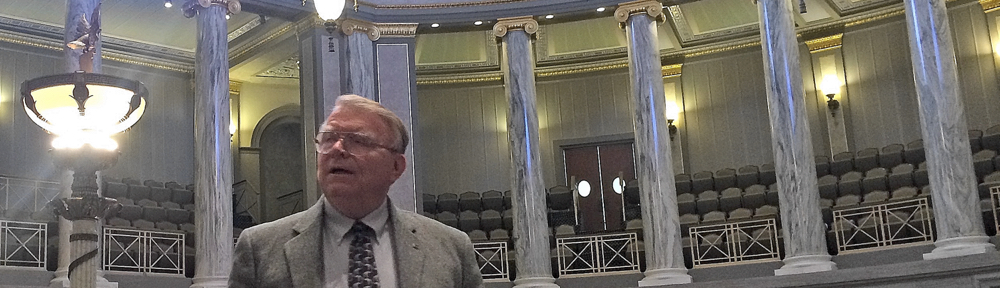
When a Missourian won the Indianapolis 500

“Put in front or burn it up,” August Duesenberg told Joe Boyer midway through the 1924 Indianapolis 500.

And he did.

Joe Boyer is the only Missouri native to win the Indianapolis 500 although Missouri’s connection to The Greatest Spectacle in Racing is long and varied, stretching from its earliest days to today.  The story of his victory has been equaled only one other time in the 105 runnings of the race.  The 106th edition will be run Sunday.

The race had changed engine rules in 1923, cutting engine size by one-third to only 122 cubic inches.  The average speed of Tommy Milton’s winning car was about 3.5 mph slower than the winner’s speed in 1922.

But new technology powered Boyer’s car in 1924. It was the first 500 that allowed superchargers and the impact of them was immediate.  Motor Age magazine told readers, “The perfected and groomed 122 cu. in. racing cars not only thrilled the ardent admirers of motor car racing with a new and unexpected record for average mileage but brought them to the ecstasy of sheer joy by setting a pace that rolled the first five over the finish line at greater speeds than the old record.”

The eight fastest qualifiers for the race all ran more than 100 mph with Jimmy Murphy’s Miller Special leading the way at 108.037.  Boyer started fourth, the inside position of the second row, in the field 22 cars, at 104.84.

Joseph Boyer Jr., was 34 years old the day of the race. He was born in St. Louis, the son of the inventor of the first successful rivet gun.  Boyer senior helped one of his employees, William Seward Burroughs develop a “calculating machine” in the company machine shop. Burroughs put Boyer in charge of the American Arithmometer Company that then absorbed a competitor.  The Boyer family moved with Burroughs to Detroit when Joseph junior was 15. The company became the Burroughs Adding Machine Company and Boyer senior served as its president until his death in 1930.

The Boyer family was quite wealthy and Joe Junior soon got into boat and car racing. One day before his 29th birthday, Joe Boyer Jr., started 14th in his first Indianapolis 500.  He lasted only 30 laps before his rear axle failed. The next year, he was the second fastest qualifier but crashed out of the race eight laps from the end and finished 12th.  In 1921, he started fourth again but was sidelined by a failed rear axle again after only 74 of the 200 laps. He missed the 1922 race and Differential failure in 1923 left him 18th.

It appeared his fortunes were changing in 1924, at least for one lap. Reporter Clarence Phillips, in the press box, records, “As they pass the starter Murphy, in his gilded chariot, sprigs ito the lead. ‘Look at Murphy,’ I hear someone say excitedly. But Boyer shoots past Murphy like a streak and finishes the lap in first place…” But by the fifth lap he was “out of the immediate picture suddenly.”

A key was sheared in his supercharger. He could still run but not at competitive speeds.  His teammate, L. L. (Lora Lawrence) Corum (on the left), who started 21st because he was a late qualifier despite having the 16th quickest speed, had worked his way up to ninth at the 150-mile mark.  He was fourth at 200 miles.  Just past the halfway mark, the 109th lap, Corum made a pit stop. Boyer had turned his crippled car over to another driver shortly before and Duesenberg ordered Corum out, put Boyer in and issued his famous order.

He was third behind Murphy and Earl Cooper after 120 of the 200 laps. Twenty laps later he was a minute-25 seconds behind Murphy and Cooper. When Murphy popped a tire on the 146th lap and had to pit, Boyer moved to second and started to close the gap on Cooper and was only 52 seconds back at 375 miles.

The lead shrank to only 37 seconds with 100 miles to go, down to 30 seconds with 30 laps left.

And then on lap 178, “Cooper goes into the pit…, Boyer springing into (the) lead and crowding his supercharger for full benefit…Each time the leaders pass the stands now there is yelling…Cooper gains four seconds…”

Twenty laps left and Boyer has expanded his lead to a minute-to seconds.

“Only ten more laps for Boyer. If he has good luck and drives the rest of the way as consistently as now he’ll win handily.”

Lap 195: “’Boyer is increasing his lead. He wants to finish strong. The starter is getting the flags redy. In one hand he has the green flag and in the other the checker.  Boyer is given a big ovation on the next to the last lap. They know he is the winner unless he falls dead or some other calamity occurs.

“The checkered flag is waved in front of Boyer as he comes down the stretch. He wins.”

He finished the race in five minute more than five hours, an average speed of 98.24 mph, four miles an hour faster than the record set two years earlier.  Cooper finished second and Murphy was third.

Boyer and Corum were recognized as the first co-winners in Indianapolis 500 history. In three other races (1911, 1912, and 1923) the starting drivers had relief drivers for part of the race but they got back behind the wheels and finished the race. This was the first time a winning car started with one driver but finished with a second one in control.

The only other time it has happened in race history was 1941 when Mauri Rose relieved Floyd David on the 72nd lap and went on to win the race. Davis is the only driver in the race’s history to win without leading a single lap. Rose also won the race by himself in 1947 and 1948.

Bowyer remains the only driver to lead the first lap and the last lap of the Indianapolis 500 in different cars.

Boyer drove during an era when some tracks were made of wooden boards and had high banks and featured motorcycle as well as automobile races.  One of those tracks was the Altoona Speedway in Pennsylvania.

The annual Altoona Fall Classic, held about Labor Day, attracted the big names in auto racing.  Boyer again was trying to run down Jimmy Murphy when his car blew a tire and crashed into the guard rail at 125 mph.  Boyer was pinned in the car, his legs crushed.  Rescuers got him to a hospital where both of his legs were amputated and he received blood transfusions. But he died on September 2, 1924, four months after he became the only Missouri driver to win the Indianapolis 500.

Motor Age concluded its article about Boyer’s 500 win, “As a result of this race the talk that has been heard heretofore about the maximum speed of the rack having been reached has been dissipated and some of the experts now confidenty believe that more than 100 miles an hour can be maintained for the 500-mile circuit of the famous speedway.”

On the 97th anniversary of Joe Boyer becoming the first (and so far, only) Indianapolis 500 winner from Missouri Helio Castroneves, using an engine about the same size as the one in Boyer’s car, averaged 190.690 mph in winning his fourth Indianapolis 500.

(Photo credits: Corum and Boyer—Bob Priddy, taken at the IMS Museum; all other illustrations are from Motor Age magazine, June 5,1924)


Maybe He Has It Backwards

We saw a news account last weekend that our past president was suffering a severe case of the grumps.  Not sure why that’s news anymore. We’ve never known a grumpier politician, a person who’s just plain sour about almost everything.

It must have rained a lot at Mar-a-Lago this weekend, so much that he couldn’t occupy his mind chasing his golf ball around and was thus left to ruminate on why the world is so unfair to him.

He loves to use a phrase to discount the legitimacy of anybody who suggests he’s not his self-proclaimed genius.

Because the Wall Street Journal had the temerity to differ with him about the voting process in the Pennsylvania race for the U. S. Senate seat, he announced that the WSJ is a…

RINO.

Oh, dear.

We are sure the Journal is worried about mass subscription cancellations now that its secret has been revealed.

Here’s a novel thought.

Maybe it’s Donald Trump who is the RINO.

Maybe there are a lot of Republicans out there who would like to see their party reclaim itself with that simple revelation.

The very election results in Pennsylvania might point to that.

Trump’s man, Mehmet Oz, has 31.2% of the vote, as we write this.

That means 68.8% of the Republican ballots were cast for someone else.

So who’s the outlier here?  The two thirds of the voters who might consider themselves the real Republicans or the Oz supporter who is quick to call those he can’t convince by a name.

Donald Trump, the real RINO?

Just askin’.


Protest Ground Rules, Chapter Two

Last Wednesday, we shared some observations about protestors gathering at the homes of Supreme Court Justices after the leak of a purported preliminary ruling throwing out Roe v. Wade.

Last weekend, the host of FOX News Sunday Night in America, Trey Gowdy, pointedly identified these targeted protests as more than illegal.  He argued they strike at the foundation of our nation and its liberties.

In an era where liberty and license are too easily confused—and where that confusion is often deliberately stoked by those who seek to grow their power from it to the detriment of the nation—one word seems expendable.

But Gowdy maintains that that single word is essential to our existence.

America has a rich history when it comes to protests. You can argue that our nation was formed as a protest. And the First Amendment certainly contemplated people would want to express their beliefs and assemble and petition the government. But there’s a very important word in the First Amendment that doesn’t get a lot of attention: the word “peaceably.” 

—as in the right of the people “peaceably” to assemble.

You may recall Chris Cuomo once asked, “show me where it says protestors are supposed to be police and peaceful.” Okay, Chris, it’s right there in the First Amendment, the same amendment which allows you and others to make a living on television. It requires peace, and if you’re not peaceful it’s a crime.

You are welcome to protest and you don’t have to be polite or fair or even accurate but you do have to be peaceful. 

Our next guest, Esther Salas, is a federal judge who was also the very proud parent of an outstanding young man. A little less than two years ago, they were at home enjoying each other as loving families do; the doorbell rang and her son Daniel bounded up the stairs to answer it. It was not a neighbor. It was not a deliveryman. It was a disgruntled lawyer armed with a gun and her home address and he shot her only son to death and seriously injured her husband.

This judge and her family were targeted because she was a judge. Becoming a federal judge is the pinnacle of a legal career. But it provides no insulation to the pain of losing a child to an act of violence.

And now there are people showing up at the homes of Supreme Court Justices. And to what end? For what purpose?

How does showing up at someone’s home advance your argument?

How is it persuasive to intimidate family members and neighbors? Do you really think you will change minds or change the way that judges look at cases and issues, by posing a threat? 

It’s against the law to show up at a judge’s house trying to intimidate or influence a decision. You are welcome to disagree with judges. You can take issues with their rulings, if you think a judge is wrong, you can appeal, you can defeat that judge at the ballot box or through impeachment. But you are not welcome to show up at a judge’s house to intimidate or influence that judge. 

And to that end, why are the home addresses of federal judges publicly available in the first place, especially as threats and security incidents against judges are on the rise?

Something is going on in this country and it is not good. Heckling people at restaurants, accosting them as they leave a rally or a political event, storming the Capitol, trespassing on other people’s property—to what end?

Your protest doesn’t have to be fair or accurate, although it would be much more persuasive if it was. Your protest doesn’t have to be polite although it’s ironic you are using bad behavior to complain about somebody else’s perceived bad behavior. But protests so have to be peaceful. And when they’re not, you give license on both sides of the ideological spectrum to do the same.

Protesters should be peaceful and law-abiding. Whether it is in pursuit of criminal justice reform, the counting of the electoral college, or decisions about what rights lie in the penumbra of other rights.

The law is about the only thing holding this country together right now. You are free to disagree with the law, argue against it, seek to change it.

You are not free to disregard it, because when you disregard the law, even in your pursuit of some perceived higher ideal, you weaken the law. And once it’s weakened, it is weakened forever. And you’re most assuredly not welcome to show up at a judge’s house to complain about a decision, no matter how strongly you feel. 


Slouching into adjournment

Jacques reflects on life in Shakespeare’s As You Like It:

 All the world’s a stage,

And all the men and women merely players;

They have their exits and their entrances;

And one man in his time plays many parts,

They’re gone.  They’re done.  The chambers are dark and cool.  The hearing rooms are empty and quiet.  The unpopulated rotunda echoes with the sounds of a few footsteps.

The players have departed, some to return but others now of no further use, their importance immediately extinguished because they can no longer do things for people who want things done.

Some of those who have served will never be seen again in these hallways.  Their offices soon will be occupied by some other temporary presence who will come to this time, too.

And what have they left behind? What lasting benefit was there of their service?

The fact that they served, that they sought the responsibilities and the obligations of office, can be enough.

Some—those who will never again do anything as consequential as vote on some pages of words that establish allowable behaviors for six million people—might have time now to ponder their legacies.  Did they benefit all Missourians or just a few?  Did they protect the many or place a few ahead of them?  Will their time in the Capitol matter in the arc of history.

Or does it make any difference?

We have found ourself wondering during this session what some departing members will consider their legacy. When the last newspaper article is written about them, will one of their distinguished accomplishments be that they shut down the Senate for half of the session, for purely partisan and sometimes personal reasons?

For those who won’t be back in either the House or the Senate, will they be remembered because they almost were part of the least productive legislative session in modern history?  If the House had not approved twenty Senate-passed bills on Friday, the day after the Senate quit a day early, this session would have approved only 23 non-budget bills. The record low number in modern times is 31 in 2020, when the pandemic scrambled everything.  What scrambled everything this year was the conservative caucus in the Senate that believed its seven members should tell 17 other Republican Senators and ten Democrats how to run the place.

Our friend Rudi Keller says the average number of bills passed since 1981 was 155.

Senator Emory Melton, who served 28 years from Cassville, once opined that “it is not the bills that pass sometimes; it’s the bills that DON’T pass.”  A lot of bills didn’t pass this year, good ones and bad ones that were sentenced to death, early, by seven of 197 legislators who thought the congressional redistricting map should be about partisan politics rather than about public representation in Government.

We wonder if anyone considers whether a law they sponsored will still be on the books twenty-five years from now.

Will two legislators who talked to each other during debate almost every stay in touch even one year after leaving the capitol?

All glory is fleeting, said Patton.  All glory is fleeting but obscurity is forever, said Napoleon. How many years will elapse before one of their townsfolk is surprised to learn they once served in the Missouri General Assembly?

What’s done is done. The session will be recalled for the stalemate that froze the Senate for half the session.  It will be recalled because one chamber threw in the towel a day early and the other gave up before the statutory deadline on the last day.  Well after any memories of individual accomplishments, this session will be recalled for those things.

Grantland Rice, the dean of sportswriters in the 1920s, 30s, and 40s—–the man who described the Notre Dame backfield as “The Four Horsemen”—wrote a poem titled, The Record:

When the game is done and the players creep

One by one to the League of Sleep,

Deep in the night they may not know

The way of the fight, the fate of the foe.

The cheer that passed, the applauding hands,

Are stilled at last — but the Record stands.


The errors made, and the base hits wrought;

Here the race was run! There the fight was fought.

Yet the game is done when the sun sinks low

and one by one from the field they go;

Their day has passed through the Twilight Gates,

But the Scroll is cast — and the Record waits.


So take, my lad, what the Great Game gives,

For all men die — but the Record lives.


Protest Ground Rules

There are few, apparently.

The Hill, a political newspaper in Washington, D.C., reported a couple of days ago that “Abortion rights activists in recent days have gathered outside the homes of three conservative Supreme Court justices to protest Roe v. Wade’s potential demise, taking their advocacy in an intensely personal and politically divisive direction.”

The homes are those of Justices Brett Kavanaugh and Samuel Alito and Chief Justice John Roberts. The article says the protests have “forced the White House to navigate a thorny question about the proper bounds of political discourse…” While outgoing press secretary Jen Psaki denounced threats of violence but stopped short of condemning the demonstrations—“We certainly allow for peaceful protest in a range of places in the country. None of it should violate the law,” she said.

But violating the law might be what they’re doing.  A friend of ours has pointed out Federal U.S. code 1507 that says any individual who “pickets or parades” with the “intent of interfering with, obstructing, or impeding the administration of justice, or with the intent of influencing any judge, juror, witness, or court officer” near a U.S. court or “near a building or residence occupied or used by such judge, juror, witness, or court officer” will be fined, or “imprisoned not more than one year, or both.”

We’ll wait to see if the Justice Department steps in.

These protests, while posing some liability for the participants, are not likely to be severe enough to launch a May 9th investigative committee.

But the circumstances do raise related issues about protests whether at courthouses, capitols, or street corners. Some are constitutional. Some are practical.

We have witnessed a lot of protests in a lot of years, including the storming of the local newspaper by Lincoln University students upset about an editorial highly-critical of Martin Luther King just days before his death, and disturbances on the campus (Lincoln in an HBCU, for those unfamiliar with the school) for a couple of years that resulted in a National Guard presence.

We have seen people standing quietly in front of the post office holding signs urging us to get out of Vietnam, Afghanistan, the United Nations, etc.

Many years ago when gay rights was in a much earlier stage we remember seeing members of a group called ACT-UP! Marching around the state seal in the Capitol rotunda chanting, “You say ‘don’t f—k,’ we say ‘f—k you!”’  That pretty well ended organized political protests in the Capitol.

We watched the Medicaid 23 interrupt Senate debate on Medicaid expansion one day with prayers and songs. They wound up being charged and dragged into court.

Prayers, cursing, burning, quietly holding signs are all part of our rights as American citizens to protest. It’s right there in the First Amendment: “Congress shall make no law… abridging the freedom of speech…or the right of the people peaceably to assemble, and to petition the Government for a redress of grievances.”

So protesting grievances is an inborn right of Americans. The accompanying responsibility for doing so in a way that does not violate the word “peaceably” belongs to the demonstrators and the subjective judgment of what is beyond propriety lies with the justice system that has the U.S. Code on one hand and the First Amendment on the other.  .

Attached to that system is another value judgment that lies with the protesters: Will the event do harm or good to the causes of the protestors?

Frankly, we doubt demonstrations at the Supreme Court building  influence the opinion-makers inside the building very much if at all.  We do find targeting the private spaces of the judges by demonstrating at their homes is an unwarranted invasion of their lives and certainly the lives of their families and their neighbors.

Your quiet observer doesn’t even like it when a car goes slowly through my neighborhood with the bass turned all the way up in the large speakers in the backseat and shakes the windows of his house.

In our fervid proclamations of our rights, it is easy to overlook the responsible, reasonable, and respectful exercise of them. Trying to use statements of our rights as bludgeons doesn’t seem from this lofty view to be a responsible action to take.

But what is left when leaders appear to be unmotivated by the responsible, the reasonable, and the respectful?

Whatever it is, it must be a principle of our freedoms that the mob cannot be allowed to rule. It can express itself.  But decisions must be made in cooler surroundings than on the passionate streets.  And the likely best decisions are most often made in the quiet regardless of whether they please us.

Decisions by the courts can be protested in the courts with better arguments than those shouted outside the fences that protect the decision-makers.


A Reading List

This is the last week of the legislative session.  Time is even more precious now and the risk that some worthwhile things will be talked to death is greatest.

This session already will be remembered as the year the Missouri Senate became a reading club.  A lousy one.

Not only were the choices of reading material poor, the reading of the material was fingernails-on-the-blackboard irritating.

Not only was their choice of material and their delivery of it lifeless, spiritless, colorless, arid, tedious (we could go on—we found a listing of 50 synonyms for “boring”), it set a low bar for being educational.

If unrecoverable hours of members’ lives will be taken from them, they at least should have the opportunity to turn the torturous time into a learning experience.

To solve this problem, we suggest that the Senate set aside funds to hire temporary personnel who have professional reading skills and employ them as part-time reading clerks—overnight reading hours would demand heftier salaries but it would be a small price to pay for making the Senate a more enlightened chamber.  Accompanying this recommendation is a suggested rule change that any group fomenting a filibuster must commit to staying in the chamber for the duration of the readings, thus guaranteeing that SOMEBODY will learn something.

Herewith, then, we offer a reading list for filibusters in hopes that consumption of those hours will provide participants and listeners alike some value.  We regret that we cannot guarantee that the readers can do a better job than they did this year.

Our Declaration: A Reading of the Declaration of Independence in Defense of Equality by Danielle Allen, a professor at the Institute for Advanced Study at Princeton. While most of us have read the Declaration or have heard it read, this book is a highly-informative explanation of the care that went into each paragraph and sometimes each word of our nation’s foundational document and how the elements of the Declaration fit together and constitute the legal framework that led to the writing of the United States Constitution.

America’s Unwritten Constitution: The Precedents and Principles We Live By, by Akil Reed Amar, who teaches Constitutional Law at Yale College and Yale Law School. Amar is considered “one of America’s pre-eminent legal scholars” who explains why the Constitution does not set forth all of the rights, principles, and procedures that govern our nation. He maintains that the Constitution cannot be understood in textual isolation from a changing world and the laws that change with it.

The End of White Christian America by Robert P. Jones, a former psychology professor at Missouri State University who now leads the Public Religion Research Institute, that examines what is happening because our nation is no longer an evangelical majority white Christian nation and the political and cultural effects of that change. The book explores that change, its implications for the future, and why those who fear the future should instead understand how the positive values of white Christian America will survive.

New World, Inc., by John Butman and Simon Targett. The authors explain that it was commerce, not religious freedom, that was the motivating factor for the earliest explorations and settlements of our nation.

The Wordy Shipmates, by Sarah Vowell. Ms. Vowell is greatly entertaining in explaining who the Puritans on which so much of our standard history is based really were as human beings—and they were pips and not necessarily pure..

Marooned: Jamestown, Shipwreck, and a New History of America’s Origin, by Joseph Kelly, takes us to the dangerous, desperate times overlooked in our usual histories. We do not often consider that those who came to this side of the Atlantic placed themselves in a hostile world for which most were unsuited to settle with no guarantees that new supplies to sustain them would arrive later  It also explores the papal-approved concept that if a land was not populated by Christians, it was proper—a duty, in fact—for Christians to take that land regardless of the cost to those who inhabited it.

El Norte: The Epic and Forgotten Story of Hispanic North America, by Carrie Gibson.  Long before the Pilgrims and the Puritans arrived on this side of the pond, the Spanish were here as conquerors, settlers, enslavers, missionaries, and adventurers.  But most of our history is based on, as poet Walt Whitman put it, the idea that this nation was founded as a second England.

There are several others that could broaden understanding of who laid the foundation for our country and the opportunities and the missed opportunities to recognize them that shape our attitudes today, and not always in a positive way.

If the Senate, or a small part of it, wants to kill time and possibly beneficial legislation (for somebody) in the process, it should at least contribute to improving the general knowledge of our nation, at least for the Senator who should fill his mind while killing everybody else’s time, and for those who might stick around if there’s something worthwhile to listen to.  And with these books, there is.

We offer these suggestions with no hope that they will amount to anything.

But that doesn’t keep individual members of the legislature—and the public—from becoming better citizens by broadening their understanding of our nation’s roots.


Premonition

Your faithful chronicler was invited to speak to a group of freshman, sophomore, and junior State Representatives last week. It turned out they all were Republicans, including some Republican candidates for the House.

If Democrats want to hear the nonpartisan speech, I’d be glad to do it for them.

In fact, the words of a Democrat had a prominent role in the early part of the speech.  I had recited some facts about being raised in a Republican family. But I came of age in the Camelot era, a pedigree that I hope is somewhat behind my efforts as a reporter to harass both parties equally.

As I was researching some of the material for the speech, I came across the speech President Kennedy would have delivered at the Texas Trade Mart. As history records, the world ended for him ten minutes or so before he was to arrive there. The conclusion of the speech reaches across the generations since that day in Dallas.  Here’s the part of that speech that made it into part of my remarks last week:

“In this time of division and hostility, of narrowness and demagoguery often fueled by fear of the different instead of the opportunities presented by the things we have in common, it might be good to reflect on some of President Kennedy’s words again.  The other day I came across some words he would have spoken at the Dallas Trade Mart on November 22, 1963, a day I remember vividly as a young reporter.

Ignorance and misinformation can handicap the progress of a city or a company, but they can, if allowed to prevail in foreign policy, handicap this country’s security. In a world of complex and continuing problems, in a world full of frustrations and irritations, America’s leadership must be guided by the lights of learning and reason or else those who confuse rhetoric with reality and the plausible with the possible will gain the popular ascendancy with their seemingly swift and simple solutions to every world problem.

There will always be dissident voices heard in the land, expressing opposition without alternatives, finding fault but never favor, perceiving gloom on every side and seeking influence without responsibility. Those voices are inevitable.

But today other voices are heard in the land – voices preaching doctrines wholly unrelated to reality,…doctrines which apparently assume that words will suffice without weapons, that vituperation is as good as victory and that peace is a sign of weakness…

We cannot expect that everyone, to use the phrase of a decade ago, will “talk sense to the American people.” But we can hope that fewer people will listen to nonsense…

We in this country, in this generation, are – by destiny rather than choice – the watchmen on the walls of world freedom. We ask, therefore, that we may be worthy of our power and responsibility, that we may exercise our strength with wisdom and restraint, and that we may achieve in our time and for all time the ancient vision of “peace on earth, good will toward men.” That must always be our goal, and the righteousness of our cause must always underlie our strength. For as was written long ago: “except the Lord keep the city, the watchman waketh but in vain.”

It has been too long since we heard that kind of uplifting challenge. And it’s time for leaders with courage to speak that way again.”

The crowd provided a standing ovation at the end of the talk, which was nice. I hope that means they didn’t think they were listening to nonsense.  And that they won’t go out and deliver it.

Motivational posters

Your correspondent dislikes walking into a room—usually somebody’s office—decorated with motivational posters.  You know them.  Lovely pictures with some syrupy words about success, or greatness, or achievement, or—motivation.

The motivational poster industry probably has been around forever; I think I have read of some motivational sayings painted on the walls at Pompeii.  But they’ve become noticeably popular in the last two decades or so.  We will leave it to various “ologists” to study what has changed about us to warrant such treacle.

There always was this feeling that anybody who really needed one of these saccharine decorations must have been short of self-esteem—or working for bosses who think a treacly poster can be a transformative influence on the employee.

I know several apparently well-adjusted folks who have these things on their offices.  As far as I know they do not spend any time every day meditating on them and pondering the significance of the message. They seem to be perfectly normal people who do their work competently every day.  I’ve known some of them long enough to know that the poster in their office has not changed the high-quality work they have always done anyway.

All of this is why my newsroom work station, for several years, sported a calendar from Despair.com (https://despair.com/collections/demotivators) that countered the hard-hitting soupy sayings on walls elsewhere in the building.  Every couple of months there was a new mini-poster taped under my name thingie.

Now, understand that news people have a tendency to be kind of anti-establishment, independent, unruly, and untidy souls who have an inborn pride in being to some degree as manageable as a wheelbarrow full of frogs.  Or cats.  Or Beagle pups. We are only slightly more manageable than a wheelbarrow full of canaries.

But my work area used to be decorated with beautiful pictures such as one showing several hands hoisting a trophy with the big word, “Winning” beneath and the ensuing paragraph: “Because nothing says, ‘You’re a loser’ more than owning a motivational poster about being a winner.”

There are several others—enough that I did not have time to acquire them all.

One that some legislator with a sense of humor might want to hang in the outer office where visitors can see it. If features a lovely early evening sunset-illuminated Nation’s Capitol and its reflection in a mall pool.  It says “Government,” and beneath it are the words, “If you think the problems we create are bad, just wait until you see our solutions.”

Apparently there is an alternate contemplation: “They may seem inefficient and feckless at times, but your Representatives in Washington just want what’s best for you assuming you’re a major corporation. Otherwise, you’re pretty mush screwed.”

Another poster shows a stack of newspapers with the big word “Media,” followed by, “What lies behind us and what lies before us are tiny matters compared to what lies right to our faces.”

And there’s one labled “Conspiracy” that says, “Never attribute to stupidity that which can easily be explained by a pathological blood lust for control.”

Or one showing hands raised in high fives and labeled, “Teams,” with the note, “Together we can do the work of one.”

And of course the poster reading “Motivation,” which advises, “If a pretty poster and a cute saying are all it takes to motivate you, you probably have a very easy job.  The kind robots will be doing soon.”

I’m waiting for the poster that says “Treacle.”  The accompanying line should be a pip.

Abdicating Authority

The Senate Appropriations Committee has sent a House-passed bill on sports wagering to the floor for debate.  The bill taxes proceeds from sports wagering at eight percent rather than the 21 percent rate for all other forms of gambling.  Committee Chairman Dan Hegeman says there will be a substitute bill offered on the Senate floor that changes some of the provisions of the House bill.

I could have opposed this bill when it was before the committee a couple of weeks ago but decided not to do it because I’ve told this committee and House committees for about three years why the legislation written by the casino industry should be rejected—-because it does nothing or almost nothing for the state’s interests and, in fact undermines them.

The worst thing the bill proposes—so far—is a series of deductions from the taxes the casinos will pay the state.  The goal, plainly stated in the bill, is to let casino accountants turn profitable days into unprofitable days and then to carry over any paper losses to the next day’s calculations. And if the accountants can show enough days were losers, then an entire month will have no revenues that can be taxed.

This is what I told the committee—with some editorial modifications because this is a column not testimony.

First: The fiscal note on this bill talks about how much the state will gain, which isn’t much, but it does not talk about how much the state will lose because of the ultra-low tax rate proposed and other factors in the bill.  Eight percent of nothing is the same as 21% of nothing, and “nothing” is the goal.

The other two points unfortunately are combined.

This not only is the thirtieth anniversary year of the vote to legalize casino gambling, it also is the thirtieth anniversary of approval of term limits.  This legislation represents an unfortunate combination of these two issues.

We have seen the realization of two important things that critics warned would happen if term limits were adopted.

One was that imposition of term limits would eliminate the institutional memory of the General Assembly.

Institutional memory is passed along by the Elders in any society to newcomers.  It consists not only of previous experiences in what works and what does not. In the legislature’s case, it was a matter of teaching new members about traditions, practices, rules (written and unwritten), and behaviors that are essential to good governing.

It is a matter of understanding why people are “Ladies” and “Gentlemen” in the House and why the phrase, “Everyone is a Senator” is vital to the operations of the Senate.  Both standards are matters of respect and based on the idea that policy is shaped by debate among equals.  A debate between two gentlemen, two ladies, or a lady and a gentleman is a debate between equals. It is a matter of parliamentary discipline and political respect regardless of party, geography, color, gender, faith or any other factor.

“Everyone is a senator” is the same.  Senators debate Senators.  It is not us-versus-them.  Senator-to-Senator does not infer that one is superior to the other.

Institutional memory used to teach respect for the understanding that today’s opponent likely will need to be tomorrow’s friend. It was a system that worked for about 175 of Missouri’s 200 years. The sad result of the loss of that memory has been played out in the Senate this year.

The third warning we heard is that after institutional memory is gone, the General Assembly would lose the structure that protects its role as the people’s policy-maker.  Without that structure, without that discipline—critics warned—the power to make policy shifts to two elements that are permanent parts of government outside the chambers—the bureaucracy and the lobbyists.

The warning was that while legislators will come and go, both the bureaucracy and the lobbyists are permanent and their power grows.  And so it is with this bill.

In the last five years, the gaming industry has given legislators 29 bills on sports wagering with the expectation those bills will be passed.  In these five years, not one member of the House and the Senate—I haven’t counted but probably 230 or more people have served in either chamber during that time—not one member of the House or the Senate has independently introduced a bill that puts the General Assembly in charge of this issue.

Not one bill has been written by any member of the Missouri Legislature that legalizes sports wagering on the state’s terms, that asserts the General Assembly’s authority to act on behalf of the people who elected its members. 

And so the warnings from 1992 have come sadly true.  For five years the Missouri General Assembly has abdicated its authority—on this issue—to those who are not physically Ladies, Gentlemen, or Senators, none of whom have any responsibility for, or obligation to the people who sent you here.

And that is why you are being asked by backers of this bill to tell the people who sent you here that it is okay with you if your veterans continue to see declines in financing for their nursing homes, why it is okay with you if the state’s promise of education funding from casino gambling is broken, why it is okay with you if the cities some of you represent that play host to casinos will continue to lose thousands and millions of dollars every year because the gambling industry tells you not to update outdated laws.

It’s not too late to regain control of the process. Committee or floor substitutes, or committee or floor amendments can do it.

But the industry doesn’t want you to do it.  So you have a choice.

When you go home on the evening of May 13th and you have coffee the next morning with some constituents and one asks if you did anything good here this year—what will you say?

—that you stood up for your teachers and your veterans and your home dock cities…..

Or will you say, “I voted to let you bet on a baseball game tonight.”

-0-0-0-0-

Time is running short and pressure to pass what the industry wants in this election year is likely to increase. Now we will learn if the legislature has the spine to act on behalf of the people they meet at home or whether they’ll go with the people they meet in the Capitol halls.

We hope the teachers and the veterans and the college kids looking for state scholarship help, or the city leaders of towns with casinos—and even families of those who become addicted to this industry’s product—ask in these weeks before the election whether their legislator abdicated policy-making power to the people in the halls.

Theatre of the Inane

Elon Musk, insanely wealthy and looking to fend off boredom, has decided he wants to buy Twitter. He says he’ll pay $43 Billion.  Twitter doesn’t want to be bought and thinks it has a poison pill that will keep it Muskless.  He has suggested these are just the opening rounds of what can become an increasingly nasty fight.

We don’t twitt. We don’t Facebook. Both refusals probably are to our disadvantage when it comes to sharing this twice-a-week wisdom. But, frankly, we have a life and it’s not spent focusing on what’s between our thumbs.

When Twitter first came along, the Missourinet news staff was told it was going to have to start using it because it was the coming thing in communication.  The example given of its usefulness was a narrative series (forgive me, friends, I abhor the word “tweets”) of a friend of ours who was going somewhere and reported at various times that he had arrived at the airport, had been checked in, was waiting to board, was boarding, and was sitting on the airplane that was spending too much time packing in the passengers..

The Missourinet staff was unimpressed beyond description.

A few days later, your observer, the now-retired Missourinet news director saw a message from a friend who told the world that she was going to have to stop on her way home from work to get a new sump pump.

The news director quickly dubbed Twitter “the theatre of the inane.”

While Twitter has proven to be useful in distributing news in real time (as well as lies, conspiracies, accusations, and general trash), it still is awash in inanities.

Representative Harry Yates of St. Joseph would not have liked Twitter if it had existed in his day. He introduced a bill in the 1925 legislative session making gossip and scandal-mongering a criminal offense.   He proposed fines of ten to one-hundred dollars or a ten-to-fifty day jail sentence for anyone “maliciously repeating or communicating any false rumor or slander detrimental or harmful to another person.”

Yates would, of course, be apoplectic about Facebook.

His bill never made it into the statute books. It had some obviously serious First Amendment problems. And worse yet, if people couldn’t gossip or be mongers of scandals, there would be little to talk about, especially at the Missouri Capitol.  The place is a hothouse for gossip of varying degress of veracity.

But then again, imagine how nice would be the Silence of the Thumbs, at least in some places, if Representative Yates had succeeded.