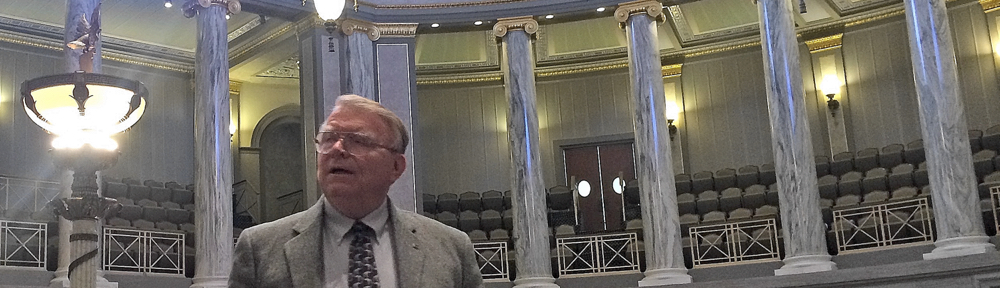
Convening the session

Almost 200 men and women you and I have chosen to represent us in writing the laws that govern our lives begin their work today at the Capitol.  Some are rookies with high ideals and others are weather-beaten veterans facing the last of their eight or sixteen years making those decisions.

Governor John S. Phelps speaking to the General Assembly on February 8, 1877, said: “I trust we are assembled, not as partisans, but as patriots, with a sincere determination to support the right and to condemn the wrong. We are assembled not to carry out our own wishes, but to respect and speak the voice of the people, restrained within constitutional limits. For a time the destinies of the people of this State have been confided in us, and it is to be hoped our deliberations will be characterized by wisdom, patriotism and justice.”

It would be interesting for this year’s rookies to write down their goals and ambitions, their ethical standards that they hope to carry into their service, and their thoughts about who they represent and seal them into an envelope that will not be opened for, say, twenty years.

Then, as they start their final year in the capitol—whether it be their eighth or their sixteenth—they write their accomplishments, the ethical standards they have at the end and the challengers to them they have faced and the alterations in them they are brave enough to acknowledge, and who they really represented in the end.  Those statements should be sealed in an envelope and not opened until they open the first envelope, enough time having passed that they have a perspective on their years in office that they might have lacked when they closed that second envelope.

We have a lot of documents at the State Historical Society of Missouri.  It would be interesting for future generations of Missourians wanting to study Missouri’s political system to read the contents of those two envelopes.

A year ago a young State Representative facing his last year in the House and with no plans to try to move to the Senate did something like that and what he wrote, published in his constituent newsletter is worth saving. And it’s worth reading every two years by rookies.

Ten years ago, a former State Senator who was seen as a rising star in his party wrote of how his political ambition cost him a career.

We offer these two reflections for consideration by those who begin the 100th session of the General Assembly of the state of Missouri.

Representative Jay Barnes of Jefferson City will be most remembered as the chairman of the committee that investigated the machinations of Governor Eric Greitens and his earlier investigation of the Mamtech scandal in Moberly.  In his newsletter of January 5, 2018, he wrote, in part:

There have been great moments of satisfaction from feeling of a job well done – and moments of gloom from failure. Such is life. Sometimes when I think of the things I’ve learned over these eight years, I think of Bob Seger – “wish I didn’t know now what I didn’t know then.”

As I reflect on my eight years, I noticed something on the House website that puts things in perspective – this week we are beginning the second regular session of the 99th General Assembly. It is the 198th time in our state’s history that this has happened. For those nearly 200 years, our statehouse has been filled with men and women of goodwill – and also a fair share of opportunists, con men, and people whose ambition you could see through a brick wall.

 …Governments are inherently prone to corruption — both the criminal kind and the softer corruption that settles in over time. Soft corruption happens when a legislator sponsors a piece of legislation just because a lobbyist asked, without knowing anything about the subject or asking any questions. It happens when a legislator grows lazy and makes decisions about votes without reading the actual bill or considering what it does, but just asking who’s for it and against it.  

It also happens when their heart or head tells them a vote is wrong, but they do it anyway because of pressure, inertia, an unwillingness to stick their neck out, or for some favor to be traded later. Instead of doing what is right, the path of convenience and personal advantage is taken instead.  Of course, it’s human nature to avoid confrontation and to have ambition. The question is not whether it will happen, but how often and whether it will happen on votes that have serious impact on the lives of people beyond the Capitol’s marble halls.  

A colleague once explained the “favor to be named later” idea to me when he tried to flip my vote on a bill. “I disagree with your no vote, but even you can’t say this is a huge deal,” he said. “And, you know, you may have a bill that comes along where someone else might be on the fence, and you’re gonna need their vote. Why don’t you just throw a vote here, and then when your bill comes up, the favor will get returned?”

This is legislative utilitarianism: the idea that good ends justify bad means to get there. It may help clear a legislator’s conscience if they don’t think too hard about it, but it’s just as flawed as utilitarianism anywhere else. Doing something you believe to be wrong (even if it’s just a little wrong) under the belief that it will have a good result on an unrelated issue can justify nearly anything so long as you are an optimist about that potential good result in the future. And it’s addictive. Once you do it once, it’s all the more difficult to resist the logic the next time around.  I feel that I have resisted the temptation more than most, but I speak from experience: these trades are not worth it. Not even the little ones. They whittle away at your soul, and, as Jesus said in Mark 8:36, “For what shall it profit a man if he gains the whole world, yet forfeits his soul?”

There’s no legislative cure for human nature. So, what is to be done? I think the answer for the individual legislator is no different from the answer in the real world: when delusions of grandeur tempt, where ambition or fear of political consequences threaten, it’s time to take a step back and consider the larger picture. Individually, we are insignificant. Legislators do not have legacies. (Nor do governors for that matter.) As a general rule, people do not remember politicians other than the president. The realization of one’s own insignificance and the humility that emanates is a better antidote to corruption than any law ever passed. Instead of serving oneself and ambition, better to serve the Lord, our families, and our communities.

In my eight years, I’ve seen the worst and the best aspects of human nature: greed, pride, vanity, laziness, and vindictiveness are here every day. And so are diligence, humility, sacrifice, charity, and compassion. The Missouri state legislature, is a place where, in spite of our human weaknesses, when things go right — paraphrasing Gov. Nixon —people of goodwill can work together in service to make great differences in the lives of people who will never meet, who will never know our name, and who will never know we ever did anything to help them.

The second document is from another young lawmaker who entered office with high ideals but who found his career far shorter than he thought it would be—-because he failed his own principles. The Post-Dispatch ran an op-ed piece on September 8, 2009 from former State Senator Jeff Smith under the headline “I was stupid and wrong.”   It complements Jay Barnes’ reflection. And it’s from someone who buckled to political utilitarianism.

I once held a position of public trust. I write today as a felon, having broken that trust, and I don’t want anyone to make the terrible mistakes I made.

I thought I could get away with it. If anyone learned of what happened, it would be my word and the word of my friends and staffers against that of a loner with a shady past.

It was easy to think this way. I had arrived on the political scene.

When I decided to run for Congress in 2004, I was a nobody. It was a familiar role. As a boy I was the smallest kid on the court, scrappy and hypercompetitive, and I tried to overcome my political weaknesses with the same drive. Eventually I went from a non-entity to a contender.

As Election Day drew near, I authorized a close friend and two aides to help an outside consultant send out a mailer about my opponent but without disclosing my campaign’s connection.

Fiercely competitive, I was seeking any advantage I could get. I knew that hiding my campaign’s involvement was against the law. I was raised better than that, but I thought the ends justified the means. I was stupid and wrong.

When my opponent filed a Federal Election Commission complaint against me, I wanted to preserve my political future and concealed the misconduct. Instead of taking the hit, I stonewalled, assuming the FEC would not connect the dots.

I was elected to the Missouri Senate in 2006 and was honored to serve my constituents. My dream was fulfilled, and I had a platform to effect social change and fight for the city I love.

In 2007, the FEC cleared my campaign of wrongdoing. It was the worst thing that could’ve happened to me.

Because the lesson I took wasn’t that “I got lucky. What I did was reckless, illegal, and wrong. I won’t break the law again.” My takeaway was, “Whew. I’m home free.”

Wrong again.

In 2009, the FBI obtained new information indicating a cover-up of the original misconduct. They approached me, and I stuck with my earlier account. It was easier for me to lie than to face the scrutiny and embarrassment that would come with accepting responsibility.

I was terrified of admitting anything. My nightmare was for all this to come out: my betrayal of what I thought I stood for and wanted to achieve; my betrayal of supporters and constituents; my parents’ embarrassment reading about my actions in the newspaper, and their shame as friends and neighbors searched for what to say to them and how to say it.

Well, it all came out, and it is worse than I had feared.

I’ve lost what I loved most: serving my district and teaching political science. I have lost the respect of others I cherished and my self-respect — even the ability to look strangers in the eye. And I haven’t even been sentenced yet.

I apologize to my constituents, my Senate colleagues, my family and friends and to anyone who has lost faith in government because of my actions. Telling the truth is the basis of public trust: the minimum I owed my constituents, my family and myself. I am a reminder of the obligation to always be truthful, particularly for those honored to serve the public.

(Jeff Smith resigned from the Missouri Senate effective August 25, 2009 and was sentenced to one year and a day of prison. He also was fined $50,000. Smith was sent to the federal prison in Manchester, Kentucky. He was released early in November, 2010.

Since his release, he’s written a couple of books, lectured at the New School for Social Research in New York, and co-founded Confluence Academies, an organization of charter schools in the St. Louis area.  And he’s done a lot of other stuff.

Jay Barnes has been promoted to private citizenship (as Harry Truman once said after his presidency) and is a lawyer in Jefferson City.  He said in last weekend’s Jefferson City newspaper that he has no interest in returning to politics.

It might be useful every now and then for those who will sit behind the century-old desks the lawmakers first sat behind in January, 1919 to re-read these two reflections, especially toward the session’s end when the challenges are greatest—and think about how the four-and-a-half months they are starting today will have changed them.

-0-

Grasping to retain power, regardless

We’re watching with interest efforts in Wisconsin by Republicans to limit the power of a newly-elected Democratic governor who will replace Scott Walker.                The New York Times reported yesterday:

“The long list of proposals Republicans want to consider also includes wide efforts to shore up their strength before Tony Evers, the Democrat who beat Gov. Scott Walker last month, takes office: new limits on early voting, a shift in the timing of the 2020 presidential primary in Wisconsin, and new authority for lawmakers on state litigation. The Republican plan would also slash the power of the incoming attorney general, who is also a Democrat…In recent years, single parties have come to dominate state legislatures, allowing lawmakers to make significant policy changes in states even as Washington wrestled with gridlock. But in states like Wisconsin and Michigan, where Democrats regained governor’s offices in capitals that Republicans fully controlled for years, Republicans are making last-minute efforts to weaken their powers…It is a model pioneered in North Carolina, where Republican lawmakers in 2016 tried to restrict the power of the governor after a Democrat was narrowly elected to the post. That set off a bitter court battle that continues to this day.”

There is nothing new in this.  In fact one of the most egregious examples happened here in Missouri. Only then it was Democrats who had controlled the state government including the legislature during the depression in a way that could make today’s two-thirds Republican legislature jealous. The state constitution then in effect required the Speaker of the House to make the official announcement of the election results at the start of the next legislative session so the winners could be inaugurated a few days later.

Governor Lloyd Stark, who had broken with the political boss in Kansas City, Tom Pendergast, could not succeed himself but in the process of what happened after the election he became the longest-serving single-term governor in Missouri history. With the demise of the statewide Pendergast machine, the organization run by St. Louis Mayor Bernard Dickmann became the dominant machine power within the Democratic Party.

Forrest c. Donnell (whose name was pronounced as if it was “Donald” without the “d”) campaigned heavily against Democrat machine politics and beat Lawrence McDaniel, his former Sunday School pupil, by 3,613 votes, the second-closest margin in state history. Democrats retained the other statewide offices.

Two weeks later, Democratic State Committee chairman C. Marion Hulen of Mexico proclaimed there was “an imposing array of reports, evidence of illegal use of large sums of money and of vote buying, of irregular voting and of alleged frauds.”  Another committee member claimed there was enough evidence to show McDaniel had won by 7,500 votes.

When the House convened on January 8, 1941, it passed a resolution barring Speaker Morris Osburn from announcing the results until a ten-member committee (of which six were Democrats) examined the ballots. Attorney General Roy McKittrick, one of those re-elected in November, held such an action was legal.

The committee recommended that Osburn certify the re-election of all of the Democratic candidates but it said Donnell should not be certified because of mistakes and fraudulent voting in the governor’s race.  The Republican committee members called the report a fraud and noted nobody had presented the committee with any evidence of fraud.

Inauguration day was January 13.  But there was no parade, no big event in the rotunda (inaugurations were indoors then), no inaugural ball.  Secretary of State Dwight Brown, Auditor Forrest Smith, and Attorney General McKittrick were sworn in for their third terms at the Supreme Court.  Lieutenant Governor Frank Harris, also a third-termer, took his oath in the state senate chamber because he constitutionally was the President of the Senate. Wilson Bell was sworn in as treasurer for his first term.

Donnell could have been sworn in by a Justice of the Peace (an office later replaced by magistrate judges who were even later replaced by associate circuit judges on the government charts) or some other qualified officer but he rejected the suggestion, saying he wanted to avoid further chaos.  Instead, he went to Jefferson City and asked the Supreme Court to order Osburn to announce him as the winner.

With those actions, Lloyd Stark could not leave office. He was to serve until his successor had been elected and qualified to take over. He was, to put it politely, urinarily agitated.

In what was to have been his final State of the State speech he announced he had vetoed the joint resolution seeking an investigation and said he would not approve spending any money for any such thing. He called for Donnell to be seated as governor and for any dispute about the results to “proceed in a legal and proper manner.”

His fellow democrats, not happy with his position, started an “absolutely bipartisan” recount anyway.  In mid-February the Supreme Court ordered the legislature to declare Donnell governor.  Osborn read the official document on February 20 declaring Donnell the winner.  The Senate majority leader immediately announced that McDaniel would file a declaration contesting the results.

Newspaper editorial writers from both sides of the aisle flayed the Democrats, the Joplin Globe saying “thousands of Democrats” had been “nauseated from the stench from the original office-stealing effort.”

Donnell finally was sworn in on February 26, in the rotunda. Stark, who said he had been “living in a suitcase since January thirteenth,” quickly headed back to St. Louis and his private law practice.

McDaniel’s 226-page election contest petition claimed that a complete recount would show him the winner by 30,000 votes.  State Republican Chairman Charles Ferguson laughed, particularly at the claim that hundreds of non-residents had voted for Donnell in Newton County in southwest Missouri: “It stands to reason that five or six hundred strangers could not show up to vote in a town as small as Neosho and get away with it.”  Neosho’s population that year was 5,318.

Donnell’s response was fifty-thousand words long and accused Democrats of the things they had said his campaign did.

The chairman of the recount committee, Senator Phil M. Donnelly of Lebanon, said the recount would not start until mid-April.   When it did, it was a disaster for McDaniel and the Democrats. By late May reports indicated recounts in eighty-one counties and St. Louis City had ADDED four-thousand votes to Donnell’s total. McDaniel met with Donnelly and agreed to file a letter withdrawing his request for a recount.  He did so without consulting party leaders who had pushed him to demand the recount and who had cooked up the claims of massive Republican vote fraud. McDaniel’s statement later seemed to be a slap at Hulen and his party allies when McDaniel said he had been “misled” by those who claimed he should be declared the winner.

The House and Senate met in joint session and in ten minutes declared the recount over with Donnell the winner.  Because the recount was never completed, his official victory margin remains 3,613 votes.

Democrats paid a heavy price for this escapade.  Several saw the writing on the wall and did not run again in 1942.  Several who did run lost their primary elections and many of those who got through the primaries were whipped in November as Republicans regained control of the House and pulled into a tie in the Senate.

Donnell was succeeded by Senator Donnelly, the senator who led the aborted recount effort. Donnelly later became the first governor to serve two full terms although he had to serve them separately because he was barred from succeeding himself but not prohibited from being governor again.

While Donnell was governor, a constitutional convention was called.  The new constitution, approved after he left office, prevents another effort to “steal” the governor’s election.  It says the Secretary of State, not the Speaker of the House, will certify the winners.


Appointment King

Governor Parson is making a new place in Missouri history for himself with each appointment of someone to an otherwise elective office at the top level of state government.   By the time he appoints a new state treasurer, he will have appointed three of the remaining top five state government officials and four of the top six jobs will be filled with people who were  not chosen by a public vote to fill those offices: governor, lieutenant governor, attorney general, treasurer.

But this is not the first time most top state offices have been filled by people not elected to those positions. But the only other time involved war/

As Missouri was being sucked into the Civil War, pro-South Governor Claiborne F. Jackson called a convention of 99 men to decide if Missouri should join the confederacy.  He was shocked to find that not a single secessionist was elected.  When he fled the capitol in the face of advancing Union troops in June, 1861, twenty members of the convention went with him.

The executive committee of the Convention of 99 met in Jefferson City in late July and called for remaining members of the convention to reassemble.  On July 30 the remaining convention members declared all existing state offices vacant.  It then installed former Missouri Supreme Court Judge Hamilton Gamble as the provisional governor and appointed other Union loyalists to other state offices.  All seats in the legislature were declared vacant and the convention members became the acting government.  The constitutional propriety of all of these actions has been a matter of speculation from that time to this but as historian Duane Meyer, the author of the standard Missouri history book used for decades has noted, when the U. S. Army is present to make sure the actions of the governing group are carried out, the niceties of the law or the constitution are secondary. Meyer wrote that the state convention

obviously …had no authority to take such actions (as vacating offices), since Governor Jackson was the popularly-elected chief of state. However, in the time of war, legality is frequently supplanted by expediency, and in so acting, these Missouri politicians established an illegal provisional government to fill the breach left by the secessionist exiles…In retrospect, we must admit that the actions of the state convention were unprecedented, brash, and illegal. However, since federal troops in Missouri upheld the actions of the convention, no one could argue.

Former Congressman Willard P. Hall of St. Joseph was appointed Lt. Governor and succeeded Gamble when he died at the end of 1864.  The office, incidentally, remained vacant until Lt. Governor George Smith was elected in the election of 1865.  Former Congressman Mordecai Oliver of Richmond became Secretary of State until ‘65’s elections.  When Treasurer Alfred W. Morrison refused to take a loyalty oath after being caught by federal troops while he was fleeing with thousands of state dollars in his pockets, he was replaced by artist George Caleb Bingham.  When Attorney General J. Proctor Knott refused to take the loyalty oath he was replaced by Aikman Welch of Johnson County.

William S. Moseley of New Madrid County took the loyalty oath and remained as state auditor.

So during the Civil War when the remains of the Convention of 99 replaced the legislature, FIVE  of  our six state officers were not elected by the people to their positions.

We’re waiting for the Missouri Supreme Court to rule on whether Mike Kehoe can continue to occupy the Lt. Governor’s office and Eric Schmitt won’t be the new Attorney General until January.  But it appears Governor Parson will be remembered as the governor who appointed three top state leaders and this will be a time when four state leaders are serving in offices they were not elected to fill.

The nice thing about the current situation is that it hasn’t taken a war to create it.

Political fashion statement

Overalls.

There was a time in our younger years when it was easy to identify the farmer boys at school.  They were the ones wearing the bib overalls.  The rest of us wore Levis or Lee Riders or just denim jeans from Monkey Ward or Sears. The rich kids wore slacks, eventually the kind with buckles in the back.

For a while not long ago, bib overalls became fashionable, especially for girls.  They came in bright colors—which made them fashionable.  Some even had short legs. Can’t recall any of the green or pink overalls with the “Big Smith” label.  Big Smiths had loops to hold hammers and were built for working comfort not for style.  And, like all REAL bib overalls, they were blue.

Almost a hundred years ago, however, overalls were political statements.  There were overalls clubs formed.  The craze started in the southern and southwestern states.  In April, 1920, W. H. Pahlen, an automobile accessory salesman walked into the St. Louis City Hall and announced he was a representative of the American Overall Club.

Pahlen met with F. W. Kuehl, the head of the Municipal Employees Union, and got permission to circulate lists for city employees to sign up as club members. Workers in Kuehl’s office, the Water Rates Office, quickly signed up, promising to wear overalls “whenever possible” until the prices of clothing had been lowered to a fair level.

That’s what the movement was all about.  Clothing costs had taken off (to coin a phrase) in the post-war years and a lot of folks thought the situation was out of hand.

Mayor Henry Kiel refused to pledge to wear overalls but he didn’t object to employees showing up at city hall in denim.  “I have lots of old clothes at home which I can wear in the time to come if I find the prices of new clothing too high…I have no objection to overalls; in fact, I have worn them myself long enough and I might wear them again but I have no interest in the overall club.”

City Sewer Commissioner William Clancy said his workers already had organized an overall club.  In fact, his statement sounded like a mandate. “Until the cost of men’s clothing is reduced to a price commensurate with the ability of the employees of the sewer division to pay for same, all employees in the future will wear overalls.”

Real estate salesmen peddling lots in a new subdivision pledged to greet possible purchasers while wearing overalls until clothing prices came down.  Other real estate salesmen were considered likely to follow suit (to coin another phrase appropriate to the discussion).

Ninety men at the Wagner Electric Company had formed a club, pledging to wear a standard khaki uniform each work day.

The members of the Central YMCA announced they planned to attend church services that day dressed in blue denim.

The Financial Corporation and Development Company chartered, under the common law, an Overall Club to solicit membership from “white-collared” citizens.  Company Secretary E. Kreyling told a reporter, “Lawyers, office men, business men, are all getting in line with the army of blue denim-clad fighters against the profiteers. The association will equip its members with the uniform of the overall brigade and muster them in as high privates in the antiprofiteering army.  There are no generals or colonels or other officers; all are privates.

Three-hundred students and three professors at Washington University signed the agreement to organize the Overall and Old Clothes Club at the school, promising to wear overalls or old military uniforms “or any other cast-off apparel” until “the objective of the national overall movement is attained.”  A dance was scheduled at the school gymnasium with entrance restricted to those wearing old clothes.

About forty Wash-U coeds pledged to refuse to speak to any “gentleman friend” and refusing to be escorted to any event by any guy not dressed in overalls, old military uniforms, or old clothes.

In Washington, D. C., Congressman William D. Upshaw of Georgia caused something of a sensation when he showed up in the House of Representatives wearing overalls.  Nothing unusual about it, he claimed.  It was just a move “to strike at the high cost of clothing.”

But the movement had detractors.  President Robert K. Rambo of the Southern Wholesale Dry Goods Association, not surprisingly, thought the whole thing was foolish because, “It will run the price of overalls up to a figure that cannot be paid by those who of necessity must wear them.”  He thought it made as much sense for overall club members to refuse to buy cars until prices dropped 25 percent. “So long as people are willing to pay any price for the things they want and are not willing to practice self-denial, all talk about cutting down the high cost of living is gabble,” he said.

Owners of cotton mills in New England charged southern cotton-growers had started the whole thing in an effort to drive up the prices of cotton.

Our governor, Frederick Gardner, refused to join the overall club when it was formed in Jefferson City.  He preferred to be a member of the W. Y. O. C., the “Wear Your Old Clothes” Club.  One newspaper observed that it was hard to believe the governor’s claim that his newest suit had been made in 1914, six years earlier.

The Jefferson City Democrat-Tribune was an even harsher critic. It noted a week after the formation of the city’s club that it had not seen any of the signers of the pledge going around “in their best blue denim bib and tucker.”  Instead of driving up the price of denim clothes, said an editorial, “Wear out you old clothes.  Send them to the cleaner. Let’s wear patched clothes as we did in our youth, and we will do more to reduce the price of clothes than all the overall clubs in the world. Cut out useless spending and extravagance and the price of living in every community will be reduced.”

And a few days later, it called the overall movement the latest example of American “pinheadedness” and observing, “Why any sane-headed citizen, whose occupation does not require the wearing of apparel of this kind, should wear overalls to bring down the high cost of living is about as clear as a mud puddle.”

The movement played out in a few months—midsummer, probably.  Its legacy might have been expressed by American Medicine magazine in April, as the movement was gaining momentum. “It is the first indication of protest to come from a class which has been a silent and patient sufferer during all the clashes that have taken place between capital and labor in recent years,” said an op-ed article.

Capital and labor remain part of our national dialogue today. We wonder what new clothing statement will emerge.

Notes from a quiet street—October, 2018

Get your speculation machines turned on.   Someone asked the other day, “If Josh Hawley is elected to the U. S. Senate in November, who do you think Governor Parson will appoint to finish Hawley’s term?”

Well…..?

-0-

In a long life, a person is likely to make some interesting friends.  Well, all friends are interesting or they wouldn’t be friends, would they?  And if you’re lucky, you get to go to interesting places that broaden your perspective on the world and your place in it.  Some who read these entries might be scornful of those, such as your correspondent, who can see beyond the concrete, steel, and glass of the big cities and can cherish the big and the small worlds that surround us.

A friend in Indianapolis is the Executive Director of the Indianapolis Prize, the world’s leading prize for animal conservation.

https://www.youtube.com/watch?v=UARcO8jTVk0

This year’s prize went to Dr. Russell Mittemeier.

https://www.youtube.com/watch?time_continue=207&v=OqeoeDg-CTo

Harrison Ford flew to Indianapolis to attend the awards dinner.  Nice guy, said those who met him.   Why are we surprised to learn that big-time people we admire from afar are nice?

-0-

In my news director days I sometimes reminded myself and my reporters that it was not always necessary to do a story about an event if nothing was done or said worth reporting.  If a committee or a commission or a council met for three hours but did nothing newsworthy, there was no reason for any of us to waste our listeners’ time by saying a meeting was held and then trying to find something in our notes or on our recorders to write or let people hear that had no purpose other than to justify our presence at the meeting.  “It’s just three hours of your life that you’ll never get back,” I sometimes counseled the news staff.  “Don’t spend any more time trying to find something not worth the time to put on the air.”

Somebody else had the same philosophy a long time ago. From the Jefferson City Daily Capital News of May 10, 1945:

Gov. Phil M. Donnelly yesterday held his first press conference in four days but it was unproductive of printing news.

We were told by a reporter who covered him that Donnelly used to hold two news conferences a day. One in the morning was for reporters from afternoon newspapers.  The one in the afternoon was for reporters from morning papers. He had more news conferences in a month than some governors have in a year.  Or two.

We also had a lot more reporters covering the capitol.

-0-

Some of the saddest places are baseball diamonds in city parks and baseball parks in the big cities when there’s no more baseball to be played. Especially by January. With a little snow. Even hope has left.

But we’ll find it in Arizona and Florida in February.

-0-

A restaurant sign seen from across the room recently:

It raises a question.  Does the sign mean the place isn’t all that dangerous?  Or does it mean that people who eat there live longer?

I rolled the dice.  I had a big breakfast.  So far, so good.

What makes a city also makes a state

More than eight decades ago a study was done to determine what makes a city a worthwhile place for people to live.  It probably wasn’t the first study and it sure hasn’t been the last.

The same factors that make a city a good place to live make a state a good place to live.  In our political discussions, however, contemporary talk seems to focus on one element that diminishes the importance of other factors and, in fact, makes some other factors harder to achieve.  But the other factors often don’t manipulate political emotions as effectively as the one that year after year gets the greatest attention.

The Jefferson City Post-Tribune ran an editorial on December 17, 1937 about the survey on the qualities of good cities.  Then, as now, the politically popular supposed solution to all problems was not a factor in determining what makes a livable city.   Here’s the editorial that could be as applicable today as it was then.

More than three hundred cities of our United States recently were investigated by a group of researchers from an eastern college to learn the difference between a city where people live and where they merely exist or serve time until the job runs out.

They found among other things that the character of the cities’ inhabitants more than economic advantages make for civic goodness. 

In studying a given city, the university investigators asked questions like these:

What are the general and infant death rates?  How much money, per capita, is spent on libraries, on education, on recreation? How common is extreme poverty?  What percentage of the people own their own homes?  What percentage own automobiles? How many doctors, nurses, and teachers are there in proportion to the population?  What are the per capita expenditures for highways, for light, for sanitation, for police, fire and health departments?  What is the homicide rate?  How much unemployment was there in the census year 1930?  What is the average income of the citizens?

Answer all those questions—and a lot more along similar lines—and you get a pretty fair picture of a city.  Furthermore, you get a picture which is not necessarily the same as the one you would get simply by adding up the city’s tangible, visible assets—its transportation facilities, its industries, its natural resources and so on.

In other words the man who works for decent municipal playgrounds is doing as much for a city as the man who goes out and gets a factory. One is essential to the well-being of the community and the other to its prosperity in dollars and cents. A first rate mayor, chief of police or street commissioner can be a civic asset of incalculable value. And so, of course, can a first rate Chamber of Commerce, civic club, women’s organization, that has the general welfare at heart.

A city is a place to live as well as work and it is what we do to make the idle 16 hours pleasant and worthwhile that goes a long way to measuring the worth of the community.

We thought it interesting that the editorial’s list of questions asked “How much money, per capita, is spent on…?”   But our state policy makers so often find themselves saying, “There isn’t enough money for….” as they discuss the newest proposal to have even less.

A state is a place to live as well as to work and it is what we do to make the idle 16 hours pleasant and worthwhile that goes a long way to measuring the worth of a state. Unfortunately there aren’t many lobbyists or major campaign donors who have “the general welfare at heart.”

There is a difference between a state where people live and where they merely exist or serve until the job runs out.

Which way are we headed?

Sounding the bugle call to public office

—and why it’s a good idea to know who’s blowing it and how.

We pause this week in our reveries about Africa as we reach the halfway point between the primary election and the general election to share a story that we hope reminds voters that it is wise to be careful about all of the rhetorical horn blowing that is part of today’s campaigns.

Your faithful observer and listener once heard Hughes Rudd tell the story, “Bugle Call of a Georgia Mule,” at an economic development conference at the old Ramada Inn in Jefferson City. This was in the early to mid-1970s.

Rudd (in this old CBS News photo) was a Texas-born fellow who still had a pronounced Texas twang in his gravelly voice as he told stories on newscasts, commentaries, and on the speaking circuit.  He was called by various observers “bright and bristly,” or “deft (and) sardonic,” or “puckish (and) curmudgeonly.”  He achieved his greatest popularity as a correspondent for CBS and then for ABC. He used to finish his daily newscasts with two-minute commentaries that Ted Koppel referred to as “evenhanded malice.”

Rudd didn’t read the news. He told news stories. And that’s why he was so popular. Rudd, who died at the age of 71 in 1992, had come north to study journalism at the University of Missouri but quit after three years to join the Army Air Corps early in World War II.  He had 20/40 vision in one eye so the AAC sent him to the regular Army where he became a spotter pilot for artillery batteries.

Somebody, somewhere (maybe Rudd for all I know), wrote the story I heard Hughes Rudd tell that day in Jefferson City to an audience that became increasingly amused as the story went along.  We pass it along to remind political candidates they’d best know what they’re talking about.

One fine Georgia evening a Mrs. George Wood, now deceased, called a Dr. Marvin Satterfield, a veterinarian in Hardwicke, from her home in Bryan County. It was about her mule, Horace.  She was upset and said, “Doctor, Horace is sick and I wish you would come out and take a look at him.”

The sun was setting, but there was still plenty of daylight to see by.  After asking a few questions and hearing the answers, Dr. Satterfield said, ”It’s after six o’clock and I’m eating supper.  Give him a dose of mineral oil and if he isn’t all right in the morning, phone me and I’ll come and take a look at your mule. 

She wanted to know how to give the mule the oil so the doctor said it should be through a funnel.  Mrs. Wood protested that the mule might bite her. Then Dr. Satterfield, a bit exasperated, said, “You’re a farm woman and you should know about these things.  Give it to him in the other end.’ 

Mrs. Wood went down to the barn and there stood Horace, moaning and groaning and banging his head. He certainly looked sick.  She searched for a funnel, but the nearest thing she could find was her Uncle Bill’s fox hunting horn hanging on the wall. It was a beautiful gold-plated instrument with silver tassels. She took the horn and affixed it properly.  Horace paid no attention so she was encouraged.

Then, she reached up on the shelf where the farm medicines were kept. Instead of picking up the mineral oil, nervously, she grabbed a bottle of turpentine and poured a liberal dose of it into the horn.

Horace’s head shot up with a sudden jerk and he stood dead still at attention for maybe three seconds.   Then he let out a bellow that could be heard a mile down the road.  He reared up on his hind legs, brought his front legs down, knocked out one side of the barn, cleared a five-foot fence, and started down the road at a mad gallop.  Since Horace was loaded with gas, every few jumps he made, the horn would blow.

All the hounds in the neighborhood knew when the horn was blowing, it meant Uncle Bill was going foxhunting. So out on the road they went, following close behind Horace the mule.

People who witnessed the chase said it was an unforgettable sight. First Horace, running at top speed with a horn in a most unusual position, the mellow notes issuing therefrom, the silver tassels waving and the dogs barking joyously.

They passed the home of old man Harvey Hogan, who was sitting on his front porch. It was said that Mr. Hogan had not drawn a sober breath in 15 years.  He gazed in fascinated amazement at the sight before his eyes. Up until this day he hasn’t touched another drop.

By this time, it was good and dark. Horace and the dogs were coming to the Intracoastal Waterway.  The bridge tender heard the horn blowing frantically and figured that a fast boat was approaching.  He hurriedly went out and cranked up the bridge. Horace went kerplunk into the water and drowned.  The pack of dogs went into the water, too. They all swam out without much difficulty.

What makes the story doubly interesting is that the bridge tender was also the sheriff of Bryan County and was running for re-election at the time.  When the election day came, he managed to get only seven votes and those were from kinfolks.

Those who took the trouble to analyze the election said the people figured any man who didn’t know the difference between a mule with a fox horn up his caboose and a boat coming down the Intracoastal Waterway wasn’t fit to hold public office anyway.  

That’s the story Hughes Rudd told that day in Jefferson City.  We offer it in this campaign season to those who think they have heard a bugle call to public service.  We guess citizens will be the ones who decide which end of the mule summoned the candidate to the ballot and will vote accordingly.

Homecoming

This is the old home place.  It’s changed quite a bit since my folks left it a long time ago.

We think they lived here.  The story has gotten kind of foggy in the last three million years or so.  The old home place actually could be in one of several places in Africa.  Cousin Lucy, for example, was living in nearby Ethiopia 3.2 million years ago.

This is Oldupai Gorge.  “Oldupai” is a Masai word.  This place usually is called “Olduvai” Gorge because a German butterfly hunter named Wilhelm Kattwinkel stumbled on this place in 1911, and asked the Masai people who live in the area what the place was called. They thought he was referring to a plant that flourishes there, the Oldupai, and he misunderstood what they said and furthermore mispronounced it and the gorge has been stuck with Olduvai ever since..

That’s the Oldupai plant growing outside the museum. The more formal name is Blue Sansevierra or Sword Sansevierra.  It has a tuxedo-formal name but let’s just leave it at being a Sansevierra plant.  The old timers such as Uncle Nutcracker Man used it for all kinds of things, much like a more modern people in this country we erroneously call the Anasazi used Yucca plants.

The Masai have used it for clothing, or thread for sewing. They use it to fix problems with leather products.  They make the fibers of it into rope. It’s also good for baskets and roofs.  And bandages. In fact it has a natural antiseptic quality.  Almost fifty years ago one of the scientists working in the gorge used the plant for a natural bandage over an injury.  It worked so well that he went into pharmaceutical research with it.  And cattle like it during the dry season.

Oldupai Gorge is a thirty-mile long feature of the Great Rift Valley—as some call it—which is an area of tectonic activity that eventually will produce a rift deep enough for water to flow into it, splitting this part of eastern Africa away from the main continent. Don’t worry about it.  It will happen long after you have been there and have returned safely.

The Leakey family, starting in the 1930s, found fossils here that started to rewrite the human evolutionary record.  They found in soil layers about three-hundred feet deep four kinds of hominids, each showing an increase in brain size.  In related levels, they found increasingly sophisticated stone tools.

For a few minutes we were face to face with old Uncle Nut, as we like to call him. He originally was named Zinjanthropus boisei.  Well, we don’t know what his contemporaries called him, assuming they had names for each other 1.84 million years ago.  The Leakeys gave him that name and then they changed it after deciding he was part of the Paranthropus genus.  He gained the nickname “Nutcracker Man” because he had small incisors and large molars that led the Leakeys to think he fed on grains, nuts and seeds. Later studies have revealed he lived on grass and leaves.

How do we know that Uncle Nut should actually be Uncle Grass?   A Smithsonian article in June of 2012 says there was another Paranthropus genus in another part of Africa.  And an analysis of  the fossilized teeth of Paranthropus robustus, who lived in South Africa suggest he was the one who ate hard foods.  Chemical tests of robustus’ enamel, indicates as much as sixty percent of their diet was fruit and hard-shelled nuts. Imagine that—there’s enough food residue on those teeth after almost two-million years that scientists can figure out what their diet was.

Uncle Nut, P. bosei in scientific terms, had a bigger jaw and the biggest molars of any hominid found up to 2012, indicating that species was a strong chewer.  At the time, eastern Africa was open grasslands and woods, much different from southern Africa. But Uncle Nut’s molars don’t have the pitting one might find in animals that eat hard objects. Carbon isotopes from his teeth also show as much as 77 percent of his diet was sedges and grasses. The study of the teeth also indicates the area of Oldupai Gorge was quite a bit different from the arid area it seems to be today.

So Uncle Nut was a vegetarian, a trait that hasn’t crossed to this particular possible descendent in the millennia since. This possible descendant is a confirmed carnivore. If there’s going to be pizza, let’s make it a meat lover’s pizza.

To be clear, we call him “uncle,” but he might be more of a cousin.  Some scientists say the Paranthropus genus is an offspring of Australopithecus, the line that they think led to Homo erectus and then to Homo sapiens, which is us.

Frankly, I don’t see much of a family resemblance in the pictures at the museum but as time went by and as his descendants and contemporaries moved throughout Africa and then later into what we call “The Holy Land” and ultimately into northern Europe or along the Mediterranean seacoast—and the rest of the world—they gained some new looks.

Now, we realize some who read this chronicle disagree with the whole evolution thing.  That’s okay.  But Nancy and I have let National Geographic analyze some of our spit and our DNA shows we might have had some relatives in common with Nutcracker Man or at least some of his contemporaries.

Things are pretty up-to-date in ancient Oldupai or Olduvai Gorge. Power lines are not strung across national parks to reach this place. Tanzania is big on what we call alternative energy.  Hydropower.  Solar power.  And wind.  There is oil but it’s under some areas that are too precious, not to mention too dangerous, for drillers.  And we hope it is always so.  If the Alaskan National Wildlife Refuge had some of the critters lying in the grass that we saw in the nearby Serengeti National Park, there would be no controversy about drilling for oil there as there does not seem to be, so far, at Oldupai.  It’s not wise to drill for oil in an area where the drillers are considered food.

Just before we headed to Africa, I started reading Yuval Noah Harari’s book, Sapiens: A Brief History of Humankind.  He writes that at least seven different kinds of Sapiens eventually evolved from areas like the Gorge.  But we, Homo sapiens, have survived and we’ve done it by eliminating the others.  We have been the lone human species for the last twelve-thousand years and that, he says, has left us arrogant but uncertain.

“We are more powerful than ever before, but have very little idea what to do with all that power. Worse still, humans seem to be more irresponsible than ever. Self-made gods with only the laws of physics to keep us company, we are accountable to no one. We are consequently wreaking havoc on our fellow animals and on the surrounding ecosystem, seeking little more than our own comfort and amusement, yet never finding satisfaction.  Is there anything more dangerous than dissatisfied and irresponsible gods who don’t know what they want?”

A group of Homo sapiens gods from a place their kind call Missouri looked down into an ancient gorge that day, the place where Paranthropus bosei ate grass and leaves in what they call Tanzania, African-Americans many generations removed visiting the old home place.


The last eden

There were three zebras munching on the grass outside our patio on the edge of the Ngorongoro Crater on our last morning in Tanzania.  Monkeys frolicked on the sidewalk as we walked to the lodge for breakfast.  And we realized after two weeks of civilized travel in dangerous places what an amazing adventure we had had.  And it is likely we would never return. But we took a lot of pictures that we will look at time and again because—–

Well, because we were someplace magic, I guess.  That might be the closest we can come to describing being in another world, one that wasn’t a human world.

Imagine being in a place so sublime that you can sit on your patio after dinner and watch what we were able to watch.

It doesn’t take long to realize why Serengeti National Park in Tanzania is called “The Last Eden.”  But dangers lurk in these places.  Not long after we got home, we saw a news article that a tourist at a park where we watched zebras and gazelles graze was killed by a hippo.  We were told that the hippos came around our sleeping places in that park late at night to graze.  They are very territorial and surprisingly quick.  We were in a boat on a Kenyan lake one day and we made sure we kept our distance.

So did the hippo.

Visit all the zoos that you want to visit, but until you have seen the broken line of hundreds of families of approaching elephants stretching to the horizon on your left to a similar line headed to the horizon on your right, these elephants crossing the road twenty yards in front of you, you have not seen elephants.

Until you see a black line in the distance and realize it is thousands of migrating Wildebeests, you cannot imagine the Great Plains in our country as our ancestors in covered wagons saw buffalo.  Nor can you imagine the grasses of that era until you have gazed at the grass of the Serengeti that extends as far as you can see.


See the giraffe in a zoo and you have not seen a giraffe until you see a half-dozen of them gliding in their awkward dignity across an open area, nor can you appreciate the magnificence of these creatures until you walk past one of them munching on the leaves of the tree over your head as you head to your room from the dining hall.

And seeing a lion in its zoo “habitat” is not really seeing a lion.  Peering into the tall, tan, grass trying to differentiate between what is grass and what is fur, listening to it eat and then watching something  of powerful grace emerge and walk away, perhaps with a dismissive glance toward you, that is seeing a lion. But it’s often hard to see them, and that’s the way they like it.

For most of us, zoos are where we can appreciate these animals. In some cases, zoos are places where these animals have their greatest hopes of survival as species and we should appreciate the people who want to make sure we see something more than skeletons of extinct animals in our natural history museums.

But friends, if you ever have the opportunity to see them where they really live, save your money for however long it takes to afford the trip, and take it. We signed up for a Central Bank Classic Club tour, knowing we would spend hours in an aluminum tube high in the air, sometimes so crowded we couldn’t stretch out our legs all the way, hoping our tray tables didn’t cut us in half because a dolt in front insisted on lowering his (or her) seat back all the way.  We knew we might get little sleep, would eat microwaved food (which isn’t all that bad) and snacks and might get to watch a movie to help pass the time. More than seventeen hours on three flights each way, and vehicle travel for two weeks that often made us dearly appreciate seat belts might be discouraging to some.  But every inconvenience was worth every penny—and then some.

We endured the worst roads we’ve ever traveled to get to some of the most magnificent areas we have ever seen. (Come along with us for several minutes on a stretch of road that led to one of our lodges. Understand that our guide, James, did an excellent job making our ride as smooth as possible by swerving all over the road to minimize the beating we were taking).  It is worth noting that the tires on our vehicles were TWELVE-ply radials.  The tires you and I drive on our tame Missouri roads are four-ply. Some of our party who wore the wrist-bands that measure how many steps are taken in a day (10,000 is considered healthy) were seeing numbers beyond twenty and thirty-thousand. One even got a reading of 42,000—because of the daily bouncing, twisting, turning and grabbing the OS handle in our Land Cruisers.  At the end of the day we could understand how tennis shoes feel after they’ve been through the clothes dryer. We were surprised when we got home to see that we had each lost about five pounds although we had eaten well.

But, oh, my goodness.  The things we saw—some of them things that are disappearing in the wild.

The rhinoceros is under dire threat from poachers who are killing them for their horns that are ground into a powder and sold for high prices in some countries because of the belief the powder cures cancer or hangovers or improves virility or produces a cocaine-like high.   This is the only time we saw rhinos and these were white rhinos.  We saw no black rhinos because they are considered critically endangered and only about 5,500 are known in all of Africa.

Marvel at the trees, the Acacias with their leaves that seem to grow as clouds over the top branches, but also with thorns similar to the thorns on our locust trees—a reminder that in the wild, beauty and danger often are the same.   And sometimes it’s not the thorns that are the most dangerous things in those trees.

No, we did not get out of our Range Rover to go stand under the tree to take this picture.  On trips such as these, we worship the telephoto lens and the high-megapixel camera.  In fact, we worshipped them more than 3,500 times, probably and we worshipped the big memory card when we got home.

But the eaters and the eaten are facing uncertainty.  The National Geographic we bought at Downtown Book and Toy after our trip had an article about Kenyan farmers who were crowding the habitat of the magnificent creatures we saw poisoning the animals who were there in the first place to protect their crops and livestock.

Did you know that you can tell if an elephant is right-handed or left-handed?  Yep.  And that leads us to the difference between the elephants we saw in Africa compared to those we would see if we ever go to India.  African elephants such as this fellow (and we were a safe distance from him, too), both male and female, have tusks. Asian elephants don’t all have tusks. Those that do are males.  About half of the Asian lady elephants have tusks but they don’t have any pulp in them and they’re called tushes, a word that has a different meaning in our country.  something else.

Yes, the tusks are weapons against predators. But they’re mostly used for foraging, or digging, or stripping bark off trees or just moving things out of the way. And you can tell if an elephant is right-or-left handed (tusked?) by checking which tusk is shorter.

We saw the “Big Five,” the animals the big game hunters most covet—Lion, Cape Buffalo, Rhinoceros, elephant, leopard—throughout our safaris although we saw the rhinos only that one day and leopards were elusive. We didn’t start seeing them until our last couple of days.  We saw them from a safe distance, too, and we wouldn’t have seen them at all if our guides and their trained eyes didn’t spot them for us.

Leopards like to take their food up a tree to eat it.  Otherwise a lion will take it away from them, we were told.  We knew we were in leopard territory when our guide pointed out the horns of a former gazelle dangling from a tree branch.

And if we needed any reminders that the furry friends at home are related to these beautiful, lethal, creatures, this one reminded us that a cat like this, awakened from a nap and ready for action, acts just like our lap-warmer at home.

Okay, that’s enough for this edition of the summer vacation slide show.

Find a way to do what we did.  Find a way to explore cultures and economies and habitats far different from ours and witness some animals who dismiss you as long as you are in your vehicle but who will gladly and quickly kill you if you step outside.

You won’t find anybody named “Puff” out there.


See it before it’s too late

Sunrise.  Masai Mara National Reserve, Kenya. 6:55 a.m. July 23, 2018. It is a winter day in Kenya, according to the animals who float above the animals below.

There is no time in nature; there is only light and darkness.  There are no calendars, no seasons in nature; there is only instinctive behavior driven by heat and cold, dry and wet. There is no war in nature; there is only those who eat and those who are eaten—and all ultimately fall into the latter category.

But it is not the lion or the leopard, the angry elephant or hippo or rhino that is the most dangerous animal in those places. Only the most intelligent of nature’s creations—and therefore the most dangerous of nature’s creations—divide the world into measurable segments called time.  Only the most intelligent—and most dangerous of nature’s creations—apply names to places, to the cycles of heat and cold, dry and wet, define the world around them in terms of beauty, and declare war on each other and sometimes on nature itself.

There are a few places in the world that prompt such reflections by the most intelligent and dangerous species. And those places are endangered by these most intelligent creatures who long ago abandoned an understanding that nature is a place for living and have accepted the idea that it is, instead, a place for having.

We have returned from places to which our fellow species have bestowed names: Aberdares, Naivasha, Nakuru, Masai Mara, Amboseli, Tarangire, Ngorongora, and Serengeti and in this and succeeding and perhaps irregular entries we propose to tell you about them.

But being part of the most intelligent and most dangerous species imposes a challenge because these places must be absorbed as much as seen. In the end, we suppose, there is a desperate hope that our species will—before it is too late—understand that we need places where there is no time, no seasons, no names.

There were times when we realized we were seeing some things reminiscent of what the a-westering pioneers in our own country might have witnessed when crossing the Great Plains and its high, tan, grass more than 150 years ago.  The wildebeest migration was under way, their numbers blackening the horizon as the American Bison must have blackened our horizon then.

In our recent travels, we have gone from cities so crowded, so deadlocked by social and economic structures, so stifling of life itself, places with no horizons, to places where the heart may expand in a seemingly limitless world.  Our species needs places where we are not forced to live inwardly but where we are free to fill national lungs (a phrase that originated with former Missouri Senator George Graham Vest when he defended Yellowstone from a plan by the federal government to let private commercial interests develop the area).

One of our group asked one of our guides in Tanzania if the country had natural resources it could exploit to build its economy.  “We have oil,” said the guide. “But we prefer to leave it underground where it belongs because refining oil causes wars.”  Tanzania uses hydropower, which supplies a lot, but not enough, of its electrical needs. It is extensively exploring development of biomass, particularly in agricultural areas, and it is aggressively moving toward the use of solar power, not surprising in a country with 2,800 to 3,500 hours of sunshine every year. 

We stayed in lodges with limited hours of electric lights and limited hours of hot water because generators are used; no power lines are constructed across these lands. But these lodges had seemingly unlimited numbers of employees who walked with us between the main building and our rooms to keep us from crossing the paths of the animals who freely roamed the area: the giraffe along the walkway, the zebras and the antelope and the monkeys that roamed freely in our presence.  And especially the hippos that came out of the water late at night to graze near our rooms.

In Tanzania and in Kenya, at least, there are some who realize some places are more important to the national character and to the future well-being of all species than what is beneath the soil.  All of us need to see these places. And if our arrogant intelligence will let us learn from these places, perhaps we will learn there is an innate value to us in them that once lost can never be regained.

We are the smartest and therefore the most dangerous of all animals because we can think in abstract terms.  Instead of communicating to others of our species, as the wild creatures we saw communicate to their own species, “Lion, run!” we are able to think, “Lion. What a great trophy,” or “Rhino. Horn.  Better Sex.”  Or “Land. Resources beneath it. Lions and rhinos and giraffes and wildebeest are dispensable. There is money here.”

The ancient scriptures tell us that God gave man dominion over the earth and all of the creatures created earlier. And they tell us that man and woman lived in harmony with those creatures—until they ate from the tree of knowledge and in doing so destroyed Eden.  But they became the smartest animals.

There are too many who do not understand there is a difference between “dominion” and “domination.”

Domination is an excuse.  Dominion is an obligation.  Domination is a rationale for selfish and uncaring consumption. Dominion is a responsibility to save, to preserve, to create that which is lasting and which touches the spirit. Domination is short-sighted.  Dominion is a long-term understanding that we, the smartest animals, cannot survive in ignorance of and disrespect for the land that give us life.

Domination is a destructive narrowness of immediate gratification. Dominion is an understanding that there are, as Aldo Leopold wrote, “things in this world more important than dollar signs and ciphers.”

If you trust your fellow intelligent species to accept Leopold’s words, you have no worries.  Otherwise, do what we have done.   See it before it is too late.