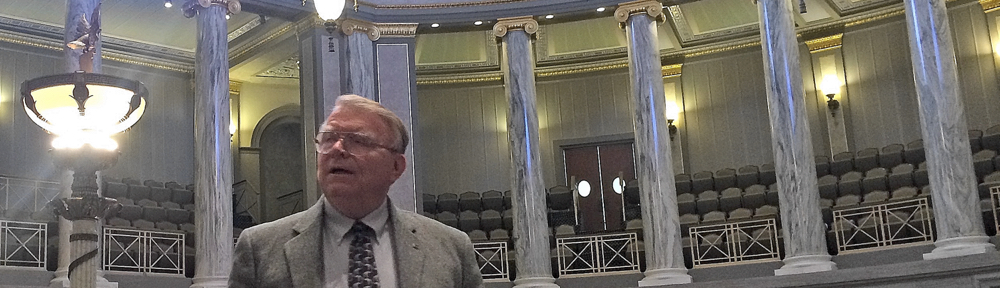
Squirming

One of the biggest jobs of any reporter is to hold public officials accountable for their remarks or their actions.  Sometimes the official cannot prove a point he wants to sell to the public.

You know they’re in trouble—and they know they’re in trouble—when they refuse repeatedly to answer a straight question with a straight answer.  And all that does is make a good reporter bore in.

It should make voters ask questions themselves, chiefly, “Why is he dodging, ducking, and bobbing and weaving?” and next, “Can I trust what he’s saying.”

In our long experience of challenging the veracity of political rhetoric (and I absolutely loved doing it), I made sure our listeners heard the verbal dance of the politician who didn’t know what he (or she) was talking about or who was tripped up by issues of truth.

Governor Joe Teasdale once told me, “I’ll never lie to you but there will be times when I won’t tell you the truth.”

???

The public, as well as the reporter should always have their antennae up for such moments.  Such as a news conference in Washington—– when one of our Congressmen became a prime example last week.  Southeast Missouri Congressman Jason Smith, the Chairman of the House Ways and Means Committee, held a press conference to announce that he had 700 pages of evidence that President Biden had been involved in son Hunter’s business dealings overseas and that involvement merited impeachment.

The only problem, as pointed out by NBC reporter Ryan Nobles, is that the supposedly damning evidence was about events that supposedly happened three years before Biden was President or even a candidate for President.

Watch Smith squirm:

It is not uncommon for the person being pressed for a straight answer to cast an aspersion on the questioner or to simply refuse to take any more questions.  That, my friends, is usually a clear reason to doubt the validity of the statements.

The public should watch or listen to these kinds of events—and should wonder why this public official cannot give the public a straight answere or in some cases no answer at all. It is so frequent in our political system today that I fear the public has become inured to it.

Does Smith have legitimate information? The first hearing, which lasted six hours, has been roundly criticized from both sides as a nothingburger, to use an old phrase Ted Cruz once used to describe questions about some actions by then-Attorney General Jeff Sessions. FOX News Channel’s Neil Cauvoto agreed: “None of the expert witnesses today presented any proof for impeachment.”  Under questioning, the Republican’s own witnesses said there wasn’t enough evidence in the huge pile of “evidence” Smith was pushing to impeach President Biden.

Smith’s conduct in that press conference did little to build confidence in his “evidence.” And six hours of rhetoric from both sides and from chosen witnesses didn’t either.

Is his pile of paper big enough to hide a bombshell?  Not based on the other evidence—-against his evidence, apparently.

-0-

Today’s Adlai 

Last week we introduced you Adlai Stevenson, grandson of as United States Vice President, two-time presidential candidate, and historic UN representative for our country.  And we said we’d ponder some of the things he says before more of the modest number of readers of these columns were born.  His intelligence and his eloquence are, in some cases (perhaps too many) accurate for our times.  Such is the case of these remarks delivered in 1948, seventy-five years ago, in Springfield, Illinois, when he was the governor of the state:

Ours is a sad, disillusioned world.  Too many people on this blood-soaked, battered globe live in constant fear and dread; fear of hunger and want, dread of oppression and slavery.  Poverty, starvation, disease and repression stalk the world, and over us all hangs the mence of war like a gloomy shroud. But everywhere people cling to their hope and their faith in freedom and justice and peace—though fear, anguish, even death are their daily lot.

The remarks were three years after the end of a worldwide war when Europe was still putting its civilization back together after the scourge of Naziism presumably had been wiped out and only two years after Winston Churchill had warned in Fulton, Missouri that a new war, a Cold War, was underway as the Soviet Union expanded its borders.

Japan was a two-time nuclear victim and the idea that other nations would develop an A-bomb cast a frightening shadow on our futures.  The next year, on August 29, 1949, The Soviet Union conducted its first successful test of a bomb—based on the design of our “Fat Man” A-bomb.

In many ways, we still live in the world of 1948 and 1949.  Millions still live in constant fear; millions seek relief from “fear of hunger and want, dread of oppression and slavery.”

Our world has gotten smaller.  No longer are those living with these fears confined to their faraway continents.

And we have people in this country who seek to stoke fear within all of us of THEM, the people the Greatest Generation wanted to help at home and abroad when Stevenson made his speech.

In another speech we’ll refer to at another time, Stevenson spoke of the need for Christian humility.

Christian humility.

Where is it in our country today?

And why isn’t it more in evidence among those who expect us to let them lead us?


Eggheads, Unite! You Have Nothing to Lose but Your Yolks!”  

I recently came into possession of a little book from 1965 called A Stevenson Sampler, 1945 to 1965,  a compilation of quotations from Adlai E. Stevenson II, the former Governor of Illinois who had the misfortune of running twice as the Democratic Party nominee for President against Dwight D. Eisenhower.  When John F. Kennedy was elected in 1960, he made Stevenson the United States Ambassador to the United Nations, where he played a historic public role and a largely unrecognized backroom role in the Cuban Missile Crisis. There are things to be learned from that time.

Stevenson was an unrepentant intellectual, one of several eggheads chosen by Kennedy for key posts in his administration.  When the Cuban Missile Crisis exploded in our headlines, Stevenson was the one who delivered this country’s response in the United Nations to Russia’s installation of guided missiles that could easily reach the United States in Cuba.

Many in my generation felt that we were staring down the deep black barrel of an atomic cannon.  Those days are a couple of generations past and we think it’s time for the young folks to learn about how close we came to a nuclear war, and why it didn’t happen at a time when many of us woke up each day and turned on the radio to see if we had a future.

Stevenson played a major role in keeping the crisis from becoming the war we (as we recall those days) were scared to death would happen.  But his role often is overlooked although it was Stevenson who proposed the ultimate solution.  Peter Kornbluh, writing for Foreign Policy magazine a year ago, says much of the reason for the lack of recognition dates from a Saturday Evening Post article in late 1962 by Stewart Alsop and Charles Bartlett that claimed Kennedy and his associates came up with the solution to the dangerous deadlock. They also claimed that Stevenson was the only one around the strategy table who “preferred political negotiations to the alternative of military action,” as Kornbluh put it.

The article, to use a current phrase, threw Stevenson under the bus when, actually, he was driving it.

A major question for most of the crisis was whether Russia really did have ICBMs in Cuba.

It all became clear on the tenth day when Stevenson, far tougher than he had been credit for being until then, confronted Soviet delegate Valerian Zorin at a meeting of the United Nations Security Council.  It is one of the most dramatic moments in UN history. Here is a long version of that confrontation and a short version of it.  The longer version is good for the background leading up to the event. The shorter one is the denouement only.

Long version of the session and challenge:  (30) Adlai Stevenson and Valerian Zorin on Soviet Missiles in Cuba (1962) – YouTube  (Audio quality varies)

Short version: TWE Remembers: Adlai Stevenson Dresses Down the Soviet Ambassador to the UN (Cuban Missile Crisis, Day Ten) | Council on Foreign Relations (cfr.org)

If you want to follow along, here is a transcript of the confrontation in which Stevenson accused the Soviet Union of being less than honest about its missiles in Cuba:

 I want to say to you, Mr Zorin, that I do not have your talent for obfuscation, for distortion, for confusing language, and for doubletalk. And I must confess to you that I am glad that I do not. But if I understood what you said, you said that my position had changed, that today I was defensive because we did not have the evidence to prove our assertions, that your government had installed long-range missiles in Cuba.

Well, let me say something to you, Mr.  Ambassador: we do have the evidence. We have it, and it is clear and it is incontrovertible. And let me say something else: those weapons must be taken out of Cuba.

Next, let me say to you that, if I understood you, with a trespass on credibility that excels your best, you said that our position had changed since I spoke here the other day because of the pressures of world opinion and the majority of the United Nations. Well, let me say to you, sir, you are wrong again. We have had no pressure from anyone whatsoever. We came in here today to indicate our willingness to discuss Mr U Thant’s proposals, and that is the only change that has taken place.

But let me also say to you, sir, that there has been a change. You, the Soviet Union has sent these weapons to Cuba. You, the Soviet Union has upset the balance of power in the world. You, the Soviet Union has created this new danger, not the United States.

And you ask with a fine show of indignation why the President did not tell Mr Gromyko on last Thursday about our evidence, at the very time that Mr Gromyko was blandly denying to the President that the USSR was placing such weapons on sites in the new world.

Well, I will tell you why: because we were assembling the evidence, and perhaps it would be instructive to the world to see how far a Soviet official would go in perfidy. Perhaps we wanted to know if this country faced another example of nuclear deceit like that one a year ago when in stealth, the Soviet Union broke the nuclear test moratorium…

Finally, the other day Mr. Zorin I remind you that you did not deny the existence of these weapons. Instead, we heard that they had suddenly become defensive weapons. But today again if I heard you correctly, you now say that they do not exist, or that we haven’t proved they exist, with another fine flood of rhetorical scorn.

All right, sir, let me ask you one simple question: Do you, Ambassador Zorin, deny that the USSR has placed and is placing medium and intermediate range missiles and sites in Cuba? Yes or no. Don’t wait for the translation, yes or no?

[Zorin] This is not a court of law, I do not need to provide a yes or no answer…

[Stevenson] You can answer yes or no. You have denied they exist. I want to know if I understood you correctly. I am prepared to wait for my answer until hell freezes over, if that’s your decision. And I am also prepared to present the evidence in this room.

And he did. Stevenson’s show and tell exposed the Soviet duplicity to the world.  By then, Kennedy had offered to take obsolete United States nuclear missiles out of Turkey bases in exchange for Russia’s withdrawal of its missiles in Cuba. Most tellings of the story do not mention who originated that strategy.  That was Adlai Stevenson.

The possible nuclear war was averted not by threats of attacks on sites in Cuba and deadly confrontations at sea but by Premier Nickolai Khruschev’s acceptance of the base-swapping plan.

Today we have a Russian leader threatening nuclear war and there are those who are suggesting strong military action against Russia.  Kornbluh suggests the not well-known story of how diplomacy, not military confrontation, disarmed a possible Armageddon in 1962, is forgotten by those dealing with events in Ukraine and threats of atomic conflagration.

Kornbluh wrote last year, “Iit would seem prudent to revisit the story of how and why Kennedy sacrificed both Stevenson and the truth about the resolution of the missile crisis and what lessons that history really holds. Documents and transcripts now accessible to the world from government archives allow us to tell the story more fully and accurately than ever before.”

Today, as a Russian leader threatens the use of nuclear weapons in a war of his own making, we edge close to the events we dodged in 1962—-but we are yet a distance from those tense hours before the Soviet ships turned around. You and I are not privy to secret diplomatic discussions while more threatening words are flung into the air evoking frightening possibilities.

Talking is always better than shooting, as Adlai Stevenson and John Kennedy knew.

Some suggest we have no business being involved with Ukraine and the conflict.  Adlai Stevenson, the defender of eggheads that included himself, had an answer for them in a 1954 speech at Harvard:

There was a time, and it was only yesterday, when the United States could and did stand aloof.  In the days of our national youth, Washington warned against “entangling alliances,” John Adams spoke of that “system of neutrality and impartiality” which was to serve us long and well, and Jefferson enumerated among our blessings that we were “kindly separated by nature and a wide ocean from the exterminating havoc of one quarter of the globe.”  But those days are gone forever.”

Unfortunately, almost ninety years after Stevenson’s remarks, far too many reject their reality and want to believe the United States is not separate from the rest of the world and its troubles, challenges, and opportunities.

Adlai E. Stevenson II (1900-1965) was the grandson of Grover Cleveland’s vice-president, and great-grandson of Jesse Fell, the campaign manager for Abraham Lincoln.  I think there will be some days when we offer another comment from A Stevenson Sampler, a collection of excerpts from a man dead for almost sixty years who still has something to say to us.

(Photo credit:  JFK Library)


Legal?  Illegal?

The legality of VLTs, Video Lottery Terminals, remains up in the air with a recent court ruling and because of the uncertainty of their legality and a powerful influence group at the Capitol that opposes them in their present state, we can already see the 2024 session of the General Assembly degenerating into another mud fight in the closing day that winds up killing many bills on which legislators have worked hard to put into position for final passage.

The casinos say VLTs are slot machines and casinos are the only places in Missouri that can operate slot machines.  VLT supporters say they’re some kind of different animal and, as such, are not covered by state law or regulation.

Neither side wants to talk to the other. Forget about compromise. As the clock winds down on the legislative session, both sides get more angry and more desperate and a filibuster in each of the last two years on this and some other tender issues has set lawmakers home frustrated and disappointed.

Whether VLTs are illegal is disputed not only in legislative halls, but in county prosecutors’ offices throughout the state. Only Platte County has declared them illegal and has fined a VLT operator $7,500 for promoting gambling.

The machines are not regulated by either the State Gaming Commission that regulates casinos or the State Lottery Commission that regulates lotteries. The machines generate no income for state programs and services that draw financing from gambling.

Last week, a federal judge decided seven plaintiffs who claimed they are problem gamblers (some of whom have put themselves on the state casino exclusion list) had no standing to file a lawsuit accusing Torch Electronics, a VLT operator, of violating the federal Racketeer influence and Corrupt Organizations Act with its machines. The judge held they had not shown a “tangible injury to business or property.”  He also said losing money in the machines was a voluntary act by the player—who could avoid losing money in VLTs by not playing them. He says he dismissed the part of the case dealing with the RICO act and that any further challenges belong in state court.

Torch has a lawsuit in state court. It’s scheduled to be argued next month.  It, and Warrenton Oil, want an order banning the Highway Patrol from investigating Torch’s operations. Warrenton Oil operates 54 Fast Lane convenience stores with VLTs in them.

Some people have urged Attorney General Andrew Bailey to take action against the machines. He says the issue is “too complicated” for his office to get into.

The legislature seems unwilling to be the adult in the room, telling two feuding children to shut up and telling them, “This is how it’s going to be done.” Of course, it’s hard to take that initiative. when there are thousands of dollars in campaign donations from both sides floating around.

In an election year.

Somebody has to write a rule and the legislature needs to adopt it to keep the 2024 session from turning into the sessions of 2022 and 2023.  But it is our observation that our legislature has become passive, perhaps because of term limits—that legislators don’t propose alternatives to bills like these that put lawmakers, not casinos or VLT operators in a position of authority.

After watching this show for a couple of years and growing tired of it, this helpful citizen suggested a compromise late last year.  It was given to only a couple of people but is offered here for mass consideration.

First: On the effective date of this act, all VLTs will be illegal. The Missouri Lottery Commission is authorized to establish regulations that protect the interests of the state.  Upon approval of those regulations, VLTs can operate within the parameters of this act.

Second: The Missouri Gaming Commission is authorized to  VLT districts which shall consist of the home county of any casino and all surrounding counties. Revenue derived from VTLs in that district shall be distributed to the casinos on the basis of admission numbers. The casinos  (shall be responsible for paying all taxes and fees on VLT revenue established by state law.

In districts in which there are multiple casinos whose territories would overlap, a large district will be established that incudes home counties and surrounding counties (St. Louis, St. Louis County, and St. Charles County would comprise one such district.  Kansas City and St. Joseph casinos will be in a district together (they share Platte County) and their revenues also will be determined on an admission fee basis).

Third: The Lottery Commission will be free to establish additional districts as the constitution is amended to create new casinos.

Fourth: This policy will not be applied to any tribal casino unless it is included in a compact between the tribe and the state that is approved by both chamber of the Missouri General Assembly.

The plan protects the interests of casinos while leaving much of the state (the part not served by the present river-based casinos) open to independent VLT companies.

There’s no pride of authorship here. This is a result of being tired of the annual mud fight.

Of course, this stands no chance.  He who offers it has no Political Action Committees with fat checkbooks that are essential to establishing public policy that protects the interests of the constituents of those who set that policy.

But somebody has to start a conversation if the protagonists of our ongoing drama refuse to be part of it. It might be time to an otherwise passive legislature to become active before more lawmakers see their four months of work fall into the annual mid-May mud hole.


NOTES FROM A QUIET, HOT, HUMID STREET

This series of observations began a long, long, time ago as “Notes from a Battered Royal,” which were notes sent out to Missourinet affiliate stations about what we were planning and what they had done to help us.

With the coming of the computer, then the internet, and then the requirement that the Missourinet have a blog, it became “Notes From the Front Lines.”  But the author is no longer on the front lines. He lives on a quiet street.  And its getting quieter.  The folks who used to live in the house across the street now are in an assisted care place in Columbia.  One of the houses next to us hasn’t been occupied for more than a  year because the man living there also is in assisted living. Three nuns who lived in a house just across the street and up one driveway have moved out.

It’s been a while since we made some observations that don’t qualify for fully blogness.  Let us proceed.

Saw a letter to the editor in the local paper the other day that said Missouri’s state motto, Salus Populi Suprema Lex Esto means “The will of the people is the Supreme Law.”  That’s wrong. And it’s dangerous.  Maybe we’ll go into in more depth later but for now, the correct interpretation is, “The welfare of the people is the Supreme Law.”  For now, just think of how different our freedoms would be if the word “will” actually was the philosophy of our government.  The quote, by the way, is from Marcus Tullius Cicero, who we know by his last name, the author of “On the Law.”

0-0

Is there a more pitiful figure in American politics today than Rudi Giuliani?  Of all the people whose lives and reputations have been destroyed by their association with and defense of Mr. Trump, the wreckage that is Rudi is the most pitiful.

0-0

I have a friend who lives in Tucson, Arizona who comes north for a couple of months every summer to find cooler weather (even 10-15 degrees cooler is significant).  I call her a Sunbird.

0-0

There are certain words that have become so politicized that all of the honor has been crushed out of them.  I recall when words such as “liberal” and “conservative” were not said with a sneer and were not spoken as if they were scarlet letters.

0-0

The latest word that falls into this category is “evangelicals.”  The people I heard described as such while I was growing up—-and the people who had the word on their churches—were perceived as fervent believers in God and Jesus, more fervent than us Disciples, Methodists, Presbyterians and my grandmother’s Baptists.  But then came those who discovered evangelical techniques could be applied to achieving political power, making it a third word that is being abused in “the politics of personal destruction.”

0-0

We were talking recently with some friends about the totally trivial things we remember for decades.  I remarked that I still remembered the Army service number of a high school friend who joined the service shortly after we graduated—RA18541439.

Now there’s a new number that I’d like to remember sixty years later—P01135809.  It has a certain rhythm to it, too.

And to think this person was once known only as 45.

We’ve seen the official portrait of PO-1135809.  We are sure that Fulton County, Georgia prosecutor Fani Willis is soooooooo intimidated.

0-0

This is about the most enthusiastic your correspondent has been for the start of the football season in decades. Maybe it’s because this year, it will bring relief from the near-daily disappointments of baseball.

0-0

Can’t help it.  Everytime I see a major sports team or league sign a deal with a sports-betting company, I start thinking its time to cast Cooperstown plaques for Shoeless Jackson and Pete Rose.

0-0

The Capitol regains its heartbeat for a couple of days soon. The lawmakers will decide whether to override some of Governor Parson’s vetoes.  There’s a lot of money available to pay for the things he differs with the legislature about.

0-0

But having a lot of money now means there’s a cushion for the bad days.

0-0

Or we can forget about the bad days and just blow it all now.

0-0

Or we can enact tax cuts so our tax base is even less able to deal with the eventual downturn.

0-0

Anybody else have deer in the yard that just watch you come home and go in the house without ever getting up?  I think that in our case, they’re just resting while they digest  their latest serving of Hostas from Nancy’s garden a/k/a the deer buffet.

0-0

A longtime friend of mine died a few days ago.  He didn’t want a memorial service.  He was a retired reporter who didn’t want his death reported in the newspaper.  Steve Forsythe, whose byline for United Press International read “A. Stevenson Forsythe” was a helluva reporter. Governor Teasdale blamed us, at least in part, for his failure to win a second term.

We could have thanked him for the compliment but we never did.


Taking the Initiative (Away)

Ohio residents voted a few days ago on a proposition that would make it harder for citizens to enact laws if the legislature refuses to do so.  Or to correct a legislative enactment many think based on something other than the general public welfare.

Ohio voters approved initiative and referendum in 1912, about the time Missourians approved it.  In the recent statewide Ohio vote, 57% of the voters rejected an effort largely led by those who do not want to see a pro-abortion amendment added to the Ohio Constitution.

In Missouri, constitutional amendments proposed by the people need only a simple majority to be approved.  This year, the Missouri House voted almost two-to-one (Republicans control the House by about the same ratio) to require 57% approval for any amendment proposed by the people.  Only another end-of-session mud fight in the Senate kept the proposal from a vote there sending the issue to the ballot.

Abortion was (is) the principle issue behind the failed legislative effort in Missouri. One major House supporter of the increase went on record during the session admitting the increased threshold was intended to keep a petition allowing abortions from being sent to the voters for their approval. The people, in turn, sent a message back to the legislature.

One of the key arguments for the supermajority threshold is that the change is needed to keep the state constitution from being further cluttered by amendments that should be only statutes.

The concern is legitimate. The proposed means of answering that concern, though, are questionable—and the legislature largely is to blame for the situation to begin with.

Some amendments have been added to the Missouri Constitution because the legislature has refused to pass a statute to address an issue.  The legislature has at times rewritten a statute approved in an election, a perceived rebuke to the will of the people who then can petition for an amendment to the constitution that is harder for the legislature to alter. The legislature cannot, on its own, rewrite a provision in the constitution. It can, however, suggest a replacement amendment that takes the place of the citizen-adopted language inserted into the constitution.

Government can be a little dizzying sometimes but at least the governed and the government are on the same level playing field. A national movement has materialized to tilt the field, however.

The initiative process does need some changing.  But making it harder for the people to propose and pass a law or an amendment on an issue the legislature has ignored, fumbled, or is not favored by the majority (or supermajority) party is not the proper approach.

There is a hypocrisy in this proposed change of the political process. Members of the legislature elected by a simple majority can pass a proposed law or amendment with a simple majority, even a proposal to require the people to get a supermajority to propose or pass a measure the legislature has ignored or bungled.

This is a philosophical problem that is often lost in the different worlds of politics versus popular sovereignty.  Benjamin Franklin defined popular sovereignty when he wrote, “In free governments, the rulers are the servants and the people their superiors and sovereigns.”  Or as the Declaration of Independence reminds us, “Governments are instituted among Men, deriving their just powers from the consent of the governed.”

A simple majority governs.  A super majority dictates within the political system.

There are two kinds of supermajorities.  The human first one is a legislative majority capable of enacting laws with no regard to the presumed political equality of a minority. The second is an  entity on paper that keeps a simple majority from speaking or acting.

Supermajorities in their different forms are dangerous because they can ignore the unalienable mutual right to, in particular, liberty.

In this case, the Missouri legislature has a supermajority that wants to ban abortions with a fifty-percent-plus-one vote while requiring those who oppose the ban to get 57% support.  Changing the constitution to tilt the table against the minority is a tilt away from democracy.

There is an argument that the proposal likely to be back in the legislature next year will infringe on the right of citizens “to petition the Government for redress of grievances.”  That’s a basic right in the U. S. Constitution.  Although the document does not specifically address what it takes to petition government, our history has established the simple majority as the rule.  Making  it harder to petition for a redress of grievances hardly seems to keep faith with the founders.

The process needs improvement.  But limiting access of the people to an original right in our national charter is not the best way to handle the issue.

Here are some things—top of the head thinking so take it for what it’s worth—that could be done to improve the process. You might have others or prefer others:

—Limit the number of proposed propositions by one organizaiton to one.  Too often, petition campaign organizers file multiple versions of a proposal that vary only slightly, a process that places an unnecessary burden on the Secretary of State’s staff that has to review each proposal.

—Require clear reporting of the source of funding for the petition, identifying by name the donors and any organizations through which the financing is delivered. If someone wants to buy a part of the constititon or a state statute, voters need to know who it is and why.

—Require pre-filing public hearings in x-number of locations throughout the state so the people have chances to hear the specifics of the proposal and to criticize it within an audience of their peers, giving an early public airing of the issue which otherwise might go to the ballot with a well-financed and heavily one-sided campaign.

—-Require a hearing by a joint committee of the legislature before circulation begins. Neither the House nor the Senate could change the proposal but the hearings could explore shortcomings in a process that could be made by petition sponsors.  One of the major—and justified—criticism process is that petitions lack the refining process that legislative review offers for issues recommended for the ballot by the General Assembly.

The petition process is a right that is to be reserved and preserved for the citizens.  To limit citizens’ right by forcing on them an obligation not forced upon the people who purportedly represent them is to repudiate Franklin’s idea of a republic in which “the rulers are the servants and the people their superiors and sovereigns.”

We hope Missourians are as cognizant of their rights and responsibilities as citizens as the good people of Ohio are—regardless of any measure the Missouri General Assembly might try to enact that makes citizens lesser participants in their own governance.


1,078

Heather Cox Richardson is a history professor at Boston College whose “Letters from an American” daily Substack newsletter place contemporary events within a historical context. USA Today named her one of its Women of the Year honorees last  year.

Joyce Vance is a former United States Attorney for the Northern District of Alabama and now a Distinguished Visiting Lecturer in Law (criminal justice reform, criminal procedure, and civil rights are her specialties) at the University of Alabama School of Law.

We are borrowing from a couple of things they wrote when our immediately former president was arraigned on criminal charges on August 3.

Donald Trump is charged with crimes linked to the January 6, 2021 events at the United States Capitol.  Richardson cites the federal prosecutor for Washington D. C. is observing that Trump is the 1,078th person charged with federal crimes connected to those events. And he was arraigned in the same courtroom where many of those 1,077 others have appeared, or will appear.

She also cites Yale history professor Timothy Snyder, responding to defense claims that the charges infringe on Trump’s constitutionally-protected right to free speech even if his remarks were repeated lies.  The charges, however, appear not to attack his free speech remarks but instead focus on the greater issue of his illegal efforts to reverse the results of the 2020 election.

Snyder thinks we should not be distracted from the real point of the charges: “That Trump will be tried for his coup attempt is not a violation of his rights. It is the fulfillment of his rights.  It is the grace of the American republic. In other systems, when your coup attempt fails, what follows is not a trial.”

We would add that in most failed coup attempts we have read about in our long life, what follows is a quick assumption of guilt and often a quick dispatching of what is called justice.

Richardson also notes in that day’s “letter,” that the arraignment took place on the same days that Republicans on the House Oversight Committee released a transcript of their interview with a Hunter Biden business associate that GOP committee members claim proves then Vice-President Biden was personally involved in some shady business deals involving Hunter.  She says the interview transcript undermines the Republicans’ claims although they’re overlooking that issue.

(If you want to read Richardsons full “letter,” you can find it at:

August 3, 2023 – by Heather Cox Richardson (substack.com)

Joyce Vance’s column, “Civil Discourse” says that, “Many people…have become inured to Trump’s behavior…A real problem with Trump is that there is just so much of it that he is exhausting. For some people it is easier to tune it out than it is to try to keep all of it in focus.”  But she says the people need to re-connect and follow the process by which these charges are dealt with “so they can assess the evidence and the proceedings for themselves…It is every American’s obligation to follow this process.”

One subtle thing she mentions is that in court, the former president is just “Mr. Trump,” a designation that applies generally to (male) trial participants.  No matter what your station is life is, or has been, you are equal in the eyes of the law to every other person who has gone through this process…Donald Trump was treated like anyone else in his position would be. Investigation having found that there is sufficient evidence of significant crimes, he has been charged by a grand jury. He now has the same opportunity to defend himself that anyone would have.”

She explains that, “Arraignment is usually a perfunctory matter, as it was for Trump… It is governed by Rule 10 of the Federal Rules of Criminal Procedure, which requires that a defendant be advised of the charges against him and enter a plea to them. The traditional plea at the time of arraignment is one of not guilty. The defendant has not yet seen the government’s evidence against him—there is no informed basis for knowing whether the government can prove what it has charged. So it is no surprise that the plea Donald Trump entered…was one of not guilty.”

But this arraignment has an unusual twist, she says. While judges normally tell the defendants not to commit any new crimes while they are free on the streets, this instruction was different. The judge warned Trump not to try to influence a juror or witnesses.  If he violates that admonition, he could find himself sleeping on government-issues sheets at night and wearing government-issued clothes.

Was Trump listening to the Judge’s admonition?  Vance thinks he wasn’t. A day after he was released on pre-trial bond, Trump went on Truth Social and said, “IF YOU GO AFTER ME, I’M COMING AFTER YOU!”

Vance says  on X (the former Twitter) that Trump crossed the line. “Free speech is one thing, but this is over the line. As a prosecutor, I’d be sorely tempted tomake a motion to removke Trump’s pre-trial bond and put him in custody. Let him explain it to the judge.”

Newsweek reports that Trump spokesperson has belittled Vance as “a moron (who) loses sleep because she has Trump Derangement Syndrome.”

So, apparently, does former prosecutor Andrew Weissmann, the former lead prosecutor against former Trump aides Paul Manafort and Rick Gates, who says—in what until recently would be called a tweet—“Not addressing this will only cause it to metastasize with undue deadly risks.”

A Trump spokesman, not surprisingly, defended the threat as “the definition of political speech,” and then went into full Trump irrational rant, saying it “was in response to the RINO, China-loving, dishonest special interest groups and super PACs, like the ones funded by the Koch brothers and the Club for Growth.”

Forget getting out the hip boots, folks. It’s so deep that you’ll need a full body suit.

Friday night, assistants to federal prosecutor Jack Smith filed a notice with U. S. District Court Judge Tanya Chutkan expressing concerns Trump might improperly share evidence in the case on Truth Social. They urged the judge to order Trump to keep any evidence given to his lawyers by the prosecutors away from public view.

The judge ordered Trump’s lawyers to respond by 5 p.m. today.  When they asked for a three-day extension, she refused to let them have it—which set off another Trump tantrum aimed directly at the judge—not a wise thing even from a self-proclaimed stable genius:  “There is no way I can get a fair trial with the judge ‘assigned’ to the ridiculous Freedom of Speech/Fair Elections case. Everybody knows this, and so does she!”  It was all in capital letters, followed by more capitals announcing plans to seek a new judge and a new location for the trial.

We will be watching to see if the old saying manifests itself—Don’t poke a tiger with a twig.

The prosecution says it wants a speedy trial. Normally it’s the defendant that wants a speedy trial. But in this case, it’s to Mr. Trump’s political advantage to stretch the process as far as possible.

Both Richardson and Vance believe the most important charge against Trump is the final one—the one Vance says “tears at my heart….the conspiracy by an American president to take awy our right to vote…and to have one’s vote counted.”

Vance concludes that a dozen people in the courtroom will decide Trump’s fate but all of us are a “jury in the court of public opinion.”

“The outcome of the 2024 election really is every inch the most important election of our lives. The indictment itself is not evidence, but it lays out the narrative of the facts we saw unfold before our eyes and helps us make sense of the crimes that Trump is charged with committing. It is an important document for every American to read. Not everyone will, but that’s where we can come in, sharing details, and helping people around us, understand the procedures that begin today. It’s the real work of saving the republic.”

You can read her full Civil Discourse insights at Arraignment – Civil Discourse with Joyce Vance (substack.com)

Federal court rules do not allow live broadcast coverage of trials. But the standard is a rule, not a law and the exigent circumstances of this case, which will be a transcendant event in American history and will involve questions basic to the survival of our republic, should create an exception to the rule so that all of us canbe witnesses to these evens. It is of such overwhelming importance that our grandchildren’s grandchildren should be able to see and hear how our generation responded to this crisis.

We agree that the 2024 election will be “the most important election of our lives.”  It is far more important to all of us and to our nation as a whole that all of us pay close attention to the truth that emerges in the trial of 1708 than it is to give heed to anything the interpreters of that testimony on the left and the right want us to think.


No.  No?  Yes, No. (Corrected)

(This story contains corrected information.  Former Congressman Richard Gephardt’s position on “No Labels” was incorrectly stated in the first version of this post as being part of the organization. This story clarifies his that he not only is not, but that he is opposed to it.)

The “No Labels” political party is beginning to form itself out of the fog of idealism announced several months ago.  It has drawn former Governor Jay Nixon into its ranks.  But former Congressman and futile (1988) presidential candidate Dick Gephardt wonders if the effort puts the anti-Trump movement in peril.

Organizers say the party is for people who are disgusted with what the long-dominant Republican and Democratic Parties have become and who want to have a middle-ground political outpost upon which to hang their hopes.

Gephardt, who was the House Majority Leader and in line to become Speaker before the Republican takeover ended that possibility, is part of one of three Democratic organizations hoping to stop the movement.

For those who claim that both parties are being run by their extreme wings, this group that has labeled itself the “No Labels” party might seem to be a refuge. But two Democratic groups, Third Way and MoveOn, want to put a stop to the “No Labels” movement because they fear it will sap votes away from the mainline Democratic ticket and hand the presidency back to Donald Trump.

A spokesman for Third Way says “No Labels” is “dangerous.”

Gephardt is part of a super political action committee called Citizens to Save our Republic.

Nixon has told the APs Steve Peoples that the opposition groups are entitled to their opinion but “No Labels” is “entitled to use our constitutional and statutory rights to allow American to have another choice.”

The question now becomes whether the party formed to be a middle ground can find a middle ground with three groups that want to snuff out its movement early.

Regardless of how this intra-party turmoil is resolved—if it can be resolved—“No Labels” adherents need to address, and quickly, what it stands for in terms of policies instead of being some kind of ill-defined safe house for the Middle.

If “No Labels” is to survive, it needs a surface identifier, a logo.. It’s not enough to say it stands for The Middle.

Sooner or later it will have to define itself in terms of positions on issues. And finding an acceptable middle of The Middle will become a difficult challenge.

But before then, there’s another crucial issue.

What will the party symbol be?  The William Jennings Bryan-William Howard Taft election of 1896 provided party adherents with symbols that are familiar to us today.

Earth & World, a website that specializes in lists and charts showing “different and unknown facts” about our planet has a list of the ten friendliest animals in the world. A new party certainly doesn’t want a threatening image (roaring lion, water buffalo, crocodile, vulture, shark, etc.).

Perhaps this guy would work (it is #1):

This is a Capybara,  E&W says they are “immensely social and trainable; thus a dear friend to everyone.” There are a couple of problems, however.  They’re not native to the United States.  And they are considered the world’s largest rodent.

Some cynical observers might find a large rat to be an appropriate emblem for a political party but we’re not going to go there today.  Mankind’s best friend, the dog, might be appropriate but who wants to be known as a member of “a dog of a party?” Besides, what kind of a dog would be most appropriate?  Pit Bulls might fit the wing nuts of either party.  But mainline folks night struggle with the dog to represet them. Something that is an edgy Golden Retriever might do.

A cross between a Golden Retriever and a German Shepherd might do.  DogTime.com told us Golden Shepherds are good watch dogs and all-around family companions, “not especially barky, they will alert when strangers approach. These dogs are protective of their loved ones and friendly with people, children, and other dogs.”

A few Golden Shepherds in Congress would be good to have right now. Replace a few Dobermans.

Number three on the E&W list is the Dolphin.  There’s some possibilities with that one. Intelligent. Communicative. Comfortable in deep water.

Number four is the cat. Not good. Nobody wants a party headquarters that would be known by detractors as the “cat house.”  Their independence is a good cat/bad cat value. But they cover up their own messes and government coverups should not be appreciated no matter how badly the mess smells. Then again, a litter-box trained politician might be better than some that we have now.

The Panda?  Nope.  We’ve enough trouble with the Chinese owning our farmland. A Chinese animal symbolizing one of our political parties is a Yangtze Bridge too far.

Rabbit?   No.  Rabbits are favorite food items for Hawks. And our national government in particular is full of hawks.  And we already have too many people, including a few in politics, who have rabbit-like moral standards.

Guinea pig?  They also are part of the rodent family.  Some people in the Andean part of Peru keep a lot of them in and around the house.  For food. Dinner-under-foot. Cuy (pronounced “kwee”) is considered a delicacy.

Horse.  The horse is one of the world’s most useful animals. Durable, unless they’re throughbreds.  Dependable.  That’s worth discussion.

Sheep.  Heavens, no.

Nixon has refused to criticize either Biden or Trump during the years since he left office. As far as becoming part of a party with no name, he says, “I feel calm.  I feel correct.”

Very Capybaric of him.


A New County—part II, A New Book

Before hostilities in pre-Civil War Missouri turned deadly with the Camp Jackson incident in St. Louis, Governor Claiborne Jackson and his associates were gathering supplies they would need to repel an “invasion” of Missouri by federal troops if one happened.  A large quantity of gun powder was procured in St. Louis and taken to Jefferson City by two companies of the Missouri Volunteer Militia, one of which was Kelly’s.  From Jefferson City, some 12,000 kegs of powder that had been stored at the fairgrounds about a mile from town were distributed throughout much of the state to be hidden away until needed by Jackson’s forces. Kelly and his unit took about half of the supply to Cooper, Saline and other nearby counties where they were carefully hidden.  The stored powder was a factor in the Confederate victory in the Battle of Lexington.  One of those involved was Michael K. McGrath.

The Irish unit fought at Boonville, Carthage and Wilson’s Creek, where Kelly was wounded in the right hand, (as seen in his picture) and in the Confederate capture of Lexington. The unit also was at the Battle of Pea Ridge, in Arkansas then in 1862, he became part of the regular Confederate army that fought in Mississippi and in the Atlanta campaign against Sherman and his Union troops.

St. Louis researcher Doug Harding indicates that McGrath would have been one of the 23 survivors out of the original 125 members of Kelly’s unit. Kelly surrendered in Louisiana in 1865 and took the oath of allegiance to the Union and was paroled in Shreveport.

It is not clear if McGrath also took the oath there or at some other time and place.  But signing it allowed him to take a bar examination and become a lawyer, paving the way for him to return to public office.

Kelly, his health broken by the war, died in 1870 and is buried in the McGrath family plot in St.  Louis’ Calvary Cemetery.

(Official Manual of the State of Missouri, 1913-14)

McGrath in 1866 became a deputy clerk for the United States district and circuit courts. In 1868 he was elected to the clerkship of the St. Louis City Council.  Two years later he was elected clerk of the criminal court and in 1874 he was elected to the first of his four terms as Secretary of State (his first term under the 1865 Constitution was for only two years; the 1875 constitution established the term at four years.

He decided the State of Missouri government had grown large enough to require some kind of a directory.  He produced the first one in 1878.

(Missouri State Archives)

McGrath wrote in the two-page introduction, “It is a truth that must be admitted, that many outside and some even in it, know but little of the vast resources or of its immense wealth and unexampled prosperity, and when told scarcely believe it, so great is the extent and magnitude thereof…No location in the republic represents a more encouraging field for the honest laborer or the aspiring citizen. The contentions of the war have long since disappeared. Liberalism and tolerance in politics and religion are noted characteristics of her people. They are generous, hospitable and enterprising. Among them poverty and humble birth present no barrier to the attainment of wealth, distinction and honor.

“True merit is the criterion of success, and is fostered by hearty encouragement and profitable recognition. Occupying, as she does already, a front rank among the States of the Union, it is easy to forecast her future as one of glory and renown!”

This first manual was 72 pages long.

His term was the longest in Missouri records until James C. Kirkpatrick served five four-year terms.

He was elected to the Missouri Senate to fill a vacancy and served in the Senate during the 1889 session.

McGrath was never far from the public trough, it appears.  The Columbia Daily Tribune observed upon McGrath’s death that “He has been inspector and attorney in the office of the building commissioner, assistant state examiner of building and loan associations…” He also had a brief and unsuccessful stint as a publisher of a Sedalia newspaper. He was nominated in 1909 to be St. Louis City Register of Deeds and was nominated for another city job in 1911 but lost both times.

In 1912, McGrath was elected to the Missouri House of Representatives. He introduced some bills, including the one to chance St. Louis County to Grant County, but failing health forced  him to go home where heart trouble and bronchitis became too much to overcome and he died on January 28, 1913 at his home in St. Louis.

A resolution of mourning passed by the House of Representatives said, “The House lost a useful, honest, and courageous member, the State a valued and Patriotic citizen, and society an influential and sympathetic member.”

The St. Louis Times wrote, “It is much to say that a man can spend all his mature thought in a lifetime covering seventy-nine years upon the chances and changes of politics and go to his grave ithout surrendering the belief that reform in politics is possible, and that it is worth while to keep on fighting.  Such was the experience of Michael McGrath, of whom men ar easing toda, ‘Yes, he was a politician—but he was square.”

A New County

We’ve commented in the past about whether some of our county names should be changed to honor more contemporary heroes—and maybe reject some scalawags who we learn from history weren’t really worth honoring in the first place.

110 years ago a distinguished Missouri politician introduced a bill to change the name of one of our major counties.

We discovered his suggestion among our clippings.  It’s part of a column from the Taney County Republican, January 30, 1913

The column began, “Until a few years after the war, the city of St. Louis was the seat of St. Louis County. When, by authority of an act of the legislature, the voters of the city and the county adopted the “scheme and charter,” St. Louis became a separate jurisdiction, a county within itself, under the name “The City of St. Louis” and the county became known as “the County of St. Louis.”  The county seat was established at the city of Clayton and a courthouse was erecte don land donated by a citizen of that name. It has never since had any legal connection with the city of St. Louis, although comparatively few of the people of the Stat know yet that St. Louis is not in St. Louis County. Deeds and legal documents intended for county officials and courts and lawyers are often mailed to St. Louis and important legal documents affecting property and persons in the city of St. Louis are often mailed to Clayton. The confusion created by the use of name St. Louis for the county has been a source of annoyance for many years to both city and county.”

It continues:

It was doubted, of course. One reason Michael McGrath’s bill didn’t make it is because Michael McGrath didn’t make it either.  By the time the newspaper published this article, McGrath had been dead for two days.  But it was something of a remarkable gesture—-because Michael McGrath had been a Confederate soldier whose unit took part in important early battles in the Civil War.

His name means nothing to most of those who labor in the halls of the Capitol now.  But in his time, Michael McGrath was a political power.  And his influence is still felt in Missouri government today. In fact, he has a presence in thousands of homes, libraries, offices, and schools.

McGrath was born in 1844 in Ballymartle, County Cork, Ireland and was raised on a farm and educated in a parish school.  He went to the National School in Kinsale, a small village in the southeast corner of Ireland where he studied to be a teacher and became one at age 16 (Kinsale is the home to a lot of famous people we Americans have never heard of except for William Penn, the founder of the colony of Pennsylvania.  Nearby is Old Kinsale Head, a piece of land jutting into the Atlantic that has a lighthouse and the remains of an old castle.  About elven miles out to sea from Kinsale Head, the wreckage of the torpedoed liner Lusitania. sunk in 1915, lies 300 feet down.)

A blight that infected the potato crops throughout Europe, causing “The Great Potato Famine,” led to thousands of deaths and thousands of emigrants fleeing Ireland and other European countries to the United States. McGrath arrived here in 1851. He hung out at the library in New York where his reading of copies of The St. Louis Republic convinced him to come to Missouri in July, 1856.

His good handwriting landed him a job with the St. Louis County Recorder.  He became a deputy clerk in the criminal court in 1861, a position he lost when Radical Republicans in the legislature passed an Ouster Ordinance that declared all offices not held by citizens loyal to the Union to be vacant.

We don’t know how soon McGrath came under the influence of Father John O’Bannon who at that time was raising money for the construction of St. John the Apostle and Evangelist Church, but he soon became involved a local militia unit tied closely to O’Bannon’s Total Abstinence and Benevolence Society. The unit, known as the Washington Blues, was led by Captain Joseph Kelly, another Irish immigrant, who ran a grocery and became McGrath’s father-in-law. A drill by the Blues helped raise money for O’Bannon’s church that later served as the cathedral church of the St. Louis Archdiocese and remains an active congregation today. O’Bannon was a Confederate chaplain in the war.

Kelly’s Irish Brigade was sent to Missouri’s western border in late 1860 to repel Kansas invaders, part of the infamous Missouri-Kansas border war, and became one of the first units in the Missouri State Guard, a pro-confederate force organized by Governor Claiborne Jackson and former governor Sterling Price.  McGrath was a private in what became a regiment of the Sixth Division of the Missouri State Guard.

Irish Immigrants were more likely to join the Union army but some historians think many of the immigrants in Missouri were felt they were disrespected by the anti-Irish German Unionists in St. Louis, and further identified with the Confederacy because it reminded them of Ireland’s long-standing struggle to become independent of England.

Whatever his personal motivation, Michael K. McGrath was a rebel who apparently spent the entire war fighting against the forces of the man for whom he later wanted to name a county.

Come back next time to see how this Confederate survived the war and became a distinguished political figure in Missouri.