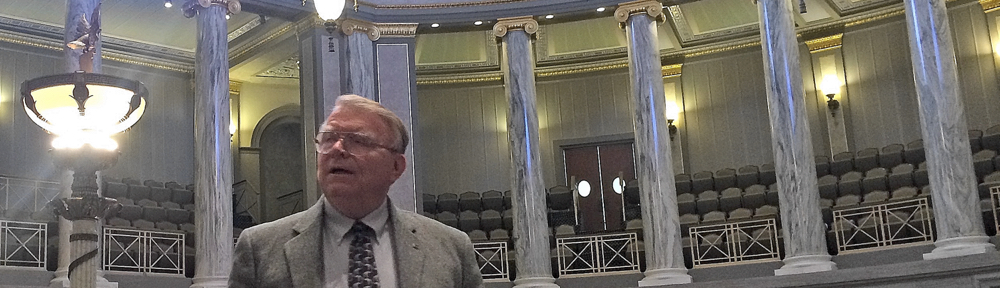
The Peace Speech

Less than six months before his murder, President Kennedy spoke to the graduating class at American University in Washington, D.C.  It became known as his “Peace Speech.”

Today we are going to recall those remarks, delivered June 10, 1963 because they speak of a nation to which we should yearn to return and to be dissatisfied with leaders who want to deliver anything less.

We are not engaging in nostalgia with this entry. We are engaging in hope as it was embodied in a President who believed in doing for his country, not for himself, and summoning his generation to follow in that spirit.

(If you wish to hear President Kennedy’s voice as you follow along, go to Bing Videos.)

The ‘Peace Speech’

It is with great pride that I participate in this ceremony of the American University, sponsored by the Methodist Church, founded by Bishop John Fletcher Hurst, and first opened by President Woodrow Wilson in 1914.

This is a young and growing university, but it has already fulfilled Bishop Hurst’s enlightened hope for the study of history and public affairs in a city devoted to the making of history and to the conduct of the public’s business. By sponsoring this institution of higher learning for all who wish to learn, whatever their color or their creed, the Methodists of this area and the Nation deserve the Nation’s thanks, and I commend all those who are today graduating.

Professor Woodrow Wilson once said that every man sent out from a university should be a man of his nation as well as a man of his time, and I am confident that the men and women who carry the honor of graduating from this institution will continue to give from their lives, from their talents, a high measure of public service and public support.

“There are few earthly things more beautiful than a university,” wrote John Masefield in his tribute to English universities — and his words are equally true today.

He did not refer to towers, or the campuses. He admired the splendid beauty of a university, because it was, he said, “a place where those who hate ignorance may strive to know, where those who perceive truth may strive to make others see.”

I have, therefore, chosen this time and this place to discuss a topic on which ignorance too often abounds and the truth too rarely perceived – and that is the most important topic on earth: Peace.

What kind of a peace do I mean? What kind of a peace do we seek? Not a Pax Americana enforced on the world by American weapons of war. Not the peace of the grave or the security of the slave. I am talking about genuine peace, the kind of peace that makes life on earth worth living, the kind that enables men and nations to grow and to hope and build a better life for their children — not merely peace for Americans but peace for all men and women — not merely peace in our time but peace for all time.

I speak of peace because of the new face of war. Total war makes no sense in an age where great powers can maintain large and relatively invulnerable nuclear forces and refuse to surrender without resort to those forces. It makes no sense in an age when a single nuclear weapon contains almost ten times the explosive force delivered by all the allied air forces in the Second World War.

It makes no sense in an age when the deadly poisons produced by a nuclear exchange would be carried by wind and water and soil and seed to the far corners of the globe and to generations yet unborn.

Today the expenditure of billions of dollars every year on weapons acquired for the purpose of making sure we never need them is essential to the keeping of peace. But surely the acquisition of such idle stockpiles — which can only destroy and never create — is not the only, much less the most efficient, means of assuring peace.

I speak of peace, therefore, as the necessary rational end of rational men. I realize that the pursuit of peace is not as dramatic as the pursuit of war — and frequently the words of the pursuer fall on deaf ears. But we have no more urgent task.

Some say that it is useless to speak of peace or world law or world disarmament — and that it will be useless until the leaders of the Soviet Union adopt a more enlightened attitude. I hope they do. I believe we can help them do it.

But I also believe that we must reexamine our own attitude — as individuals and as a Nation — for our attitude is as essential as theirs. And every graduate of this school, every thoughtful citizen who despairs of war and wishes to bring peace, should begin by looking inward — by examining his own attitude toward the possibilities of peace, toward the Soviet Union, toward the course of the Cold War and toward freedom and peace here at home.

First, examine our attitude toward peace itself. Too many of us think it is impossible. Too many think it is unreal. But that is a dangerous, defeatist belief. It leads to the conclusion that war is inevitable, that mankind is doomed, that we are gripped by forces we cannot control. We need not accept that view.

Our problems are manmade. Therefore, they can be solved by man. And man can be as big as he wants. No problem of human destiny is beyond human beings. Man’s reason and spirit have often solved the seemingly unsolvable and we believe they can do it again.

I am not referring to the absolute, infinite concept of peace and goodwill of which some fantasies and fanatics dream. I do not deny the value of hopes and dreams but we merely invite discouragement and incredulity by making that our only and immediate goal.

Let us focus instead on a more practical, more attainable peace, based not on a sudden revolution in human nature but on a gradual evolution in human institutions, on a series of concrete actions and effective agreements which are in the interest of all concerned. There is no single, simple key to this peace, no grand or magic formula to be adopted by one or two powers.

Genuine peace must be the product of many nations, the sum of many acts. It must be dynamic, not static, changing to meet the challenge of each new generation. For peace is a process, a way of solving problems.

With such a peace, there will still be quarrels and conflicting interests, as there are within families and nations. World peace, like community peace, does not require that each man love his neighbor, it requires only that they live together in mutual tolerance, submitting their disputes to a just and peaceful settlement.

And history teaches us that enmities between nations, as between individuals, do not last forever. However fixed our likes and dislikes may seem, the tide of time and events will often bring surprising changes in the relations between nations and neighbors.

So let us persevere. Peace need not be impracticable, and war need not be inevitable. By defining our goal more clearly, by making it seem more manageable and less remote, we can help all people to see it, to draw hope from it, and to move irresistibly toward it.

And second, let us reexamine our attitude toward the Soviet Union. It is discouraging to think that their leaders may actually believe what their propagandists write. It is discouraging to read a recent authoritative Soviet text on Military Strategy and find, on page after page, wholly baseless and incredible claims, such as the allegation that “American imperialist circles are preparing to unleash different types of wars, that there is a very real threat of a preventive war being unleashed by American imperialists against the Soviet Union, and that the political aims of the American imperialists are to enslave economically and politically the European and other capitalist countries and to achieve world domination by means of aggressive wars.”

Truly, as it was written long ago: “The wicked flee when no man pursueth.” Yet it is sad to read these Soviet statements to realize the extent of the gulf between us. But it is also a warning — a warning to the American people not to fall into the same trap as the Soviets, not to see only a distorted and desperate view of the other side, not to see conflict as inevitable, accommodation as impossible, and communication as nothing more than an exchange of threats.

No government or social system is so evil that its people must be considered as lacking in virtue. As Americans, we find communism profoundly repugnant as a negation of personal freedom and dignity. But we can still hail the Russian people for their many achievements in science and space, in economic and industrial growth, in culture and in acts of courage.

Among the many traits the peoples of our two countries have in common, none is stronger than our mutual abhorrence of war. Almost unique among the major world powers, we have never been at war with each other. And no nation in the history of battle ever suffered more than the Soviet Union in the Second World War. At least 20 million lost their lives. Countless millions of homes and families were burned or sacked. A third of the nation’s territory, including nearly two-thirds of its industrial base, was turned into a wasteland, a loss equivalent to the destruction of this country east of Chicago.

Today, should total war ever break out again, no matter how, our two countries will be the primary targets. It is an ironic but accurate fact that the two strongest powers are the two in the most danger of devastation. All we have built, all we have worked for, would be destroyed in the first 24 hours.

And even in the cold war, which brings burdens and dangers to so many countries, including this Nation’s closest allies, our two countries bear the heaviest burdens. For we are both devoting massive sums of money to weapons that could be better devoted to combat ignorance, poverty, and disease. We are both caught up in a vicious and dangerous cycle with suspicion on one side breeding suspicion on the other, and new weapons begetting counterweapons.

In short, both the United States and its allies, and the Soviet Union and its allies, have a mutually deep interest in a just and genuine peace and in halting the arms race. Agreements to this end are in the interests of the Soviet Union as well as ours, and even the most hostile nations can be relied upon to accept and keep those treaty obligations, and only those treaty obligations, which are in their own interest.

So, let us not be blind to our differences, but let us also direct attention to our common interests and the means by which those differences can be resolved. And if we cannot end now our differences, at least we can help make the world safe for diversity. For, in the final analysis, our most basic common link is that we all inhabit this small planet. We all breathe the same airWe all cherish our children’s future. And we are all mortal.

Third, let us reexamine our attitude toward the cold war, remembering that we are not engaged in a debate, seeking to pile up debating points. We are not here distributing blame or pointing the finger of judgment. We must deal with the world as it is, and not as it might have been had the history of the last 18 years been different.

We must, therefore, persevere in the search for peace in the hope that constructive changes within the Communist bloc might bring within reach solutions which now seem beyond us. We must conduct our affairs in such a way that it becomes in the Communists’ interest to agree on a genuine peace.

Above all, while defending our own vital interests, nuclear powers must avert those confrontations which bring an adversary to a choice of either a humiliating retreat or a nuclear war. To adopt that kind of course in the nuclear age would be evidence only of the bankruptcy of our policy, or of a collective death-wish for the world.

To secure these ends, America’s weapons are non-provocative, carefully controlled, designed to deter, and capable of selective use. Our military forces are committed to peace and disciplined in self-restraint. Our diplomats are instructed to avoid unnecessary irritants and purely rhetorical hostility.

For we can seek a relaxation of tension without relaxing our guard. And, for our part, we do not need to use threats to prove we are resolute. We do not need to jam foreign broadcasts out of fear our faith will be eroded. We are unwilling to impose our system on any unwilling people, but we are willing and able to engage in peaceful competition with any people on earth.

Meanwhile, we seek to strengthen the United Nations, to help solve its financial problems, to make it a more effective instrument for peace, to develop it into a genuine world security system — a system capable of resolving disputes on the basis of law, of insuring the security of the large and the small, and of creating conditions under which arms can finally be abolished.

At the same time we seek to keep peace inside the non-Communist world, where many nations, all of them our friends, are divided over issues which weaken Western unity, which invite Communist intervention or which threaten to erupt into war. Our efforts in West New Guinea, in the Congo, in the Middle East, and in the Indian subcontinent, have been persistent and patient despite criticism from both sides. We have also tried to set an example for others by seeking to adjust small but significant differences with our own closest neighbors in Mexico and Canada.

Speaking of other nations, I wish to make one point clear. We are bound to many nations by alliances. These alliances exist because our concern and theirs substantially overlap. Our commitment to defend Western Europe and West Berlin, for example, stands undiminished because of the identity of our vital interests. The United States will make no deal with the Soviet Union at the expense of other nations and other peoples, not merely because they are our partners, but also because their interests and ours converge.

Our interests converge, however, not only in defending the frontiers of freedom, but in pursuing the paths of peace. It is our hope, and the purpose of allied policies, to convince the Soviet Union that she, too, should let each nation choose its own future, so long as that choice does not interfere with the choices of others.

The Communist drive to impose their political and economic system on others is the primary cause of world tension today. For there can be no doubt that, if all nations could refrain from interfering in the self-determination of others, the peace would be much more assured.

This will require a new effort to achieve world law, a new context for world discussions. It will require increased understanding between the Soviets and ourselves. And increased understanding will require increased contact and communication. One step in this direction is the proposed arrangement for a direct line between Moscow and Washington, to avoid on each side the dangerous delays, misunderstandings, and misreadings of the other’s actions which might occur at a time of crisis.

We have also been talking in Geneva about our first-step measures of arms control designed to limit the intensity of the arms race and reduce the risks of accidental war. Our primary long range interest in Geneva, however, is general and complete disarmament, designed to take place by stages, permitting parallel political developments to build the new institutions of peace which would take the place of arms.

The pursuit of disarmament has been an effort of this Government since the 1920’s. It has been urgently sought by the past three administrations. And however dim the prospects are today, we intend to continue this effort, to continue it in order that all countries, including our own, can better grasp what the problems and possibilities of disarmament are.

The one major area of these negotiations where the end is in sight, yet where a fresh start is badly needed, is in a treaty to outlaw nuclear tests. The conclusion of such a treaty, so near and yet so far, would check the spiraling arms race in one of its most dangerous areas. It would place the nuclear powers in a position to deal more effectively with one of the greatest hazards which man faces in 1963, the further spread of nuclear arms. It would increase our security, it would decrease the prospects of war. Surely this goal is sufficiently important to require our steady pursuit, yielding neither to the temptation to give up the whole effort nor the temptation to give up our insistence on vital and responsible safeguards.

I am taking this opportunity, therefore, to announce two important decisions in this regard.

First: Chairman Khrushchev, Prime Minister Macmillan, and I have agreed that high-level discussions will shortly begin in Moscow looking toward early agreement on a Comprehensive Test Ban Treaty. Our hopes must be tempered with the caution of history but with our hopes go the hopes of all mankind.

Second: To make clear our good faith and solemn convictions on this matter, I now declare that the United States does not propose to conduct nuclear tests in the atmosphere so long as other states do not do so. We will not be the first to resume. Such a declaration is no substitute for a formal binding treaty, but I hope it will help us achieve one. Nor would such a treaty be a substitute for disarmament, but I hope it will help us achieve it.

Finally, my fellow Americans, let us examine our attitude toward peace and freedom here at home. The quality and spirit of our own society must justify and support our efforts abroad. We must show it in the dedication of our own lives, as many of you who are graduating today will have a unique opportunity to do, by serving without pay in the Peace Corps abroad or in the proposed National Service Corps here at home.

But wherever we are, we must all, in our daily lives, live up to the age-old faith that peace and freedom walk together. In too many of our cities today, the peace is not secure because freedom is incomplete.

It is the responsibility of the executive branch at all levels of government — local, State, and National — to provide and protect that freedom for all of our citizens by all means within our authority. It is the responsibility of the legislative branch at all levels, wherever the authority is not now adequate, to make it adequate. And it is the responsibility of all citizens in all sections of this country to respect the rights of others and respect the law of the land.

All this is not unrelated to world peace. “When a man’s ways please the Lord,” the Scriptures tell us, “he maketh even his enemies to be at peace with him.” And is not peace, in the last analysis, basically a matter of human rights, the right to live out our lives without fear of devastation, the right to breathe air as nature provided it, the right of future generations to a healthy existence?

While we proceed to safeguard our national interests, let us also safeguard human interests. And the elimination of war and arms is clearly in the interest of both. No treaty, however much it may be to the advantage of all, however tightly it may be worded, can provide absolute security against the risks of deception and evasion. But it can — if it is sufficiently effective in its enforcement and if it is sufficiently in the interests of its signers, offer far more security and far fewer risks than an unabated, uncontrolled, unpredictable arms race.

The United States, as the world knows, will never start a war. We do not want a war. We do not now expect a war. This generation of Americans has already had enough, more than enough, of war and hate and oppression. We shall be prepared if others wish it. We shall be alert to try to stop it.

But we shall also do our part to build a world of peace where the weak are safe and the strong are just. We are not helpless before that task or hopeless of its success. Confident and unafraid, we labor on, not toward a strategy of annihilation but toward a strategy of peace.

-0-

The speech was delivered only eighteen years after Hiroshima and Nagasaki and only eight months after the Cuban Missile Crisis that frightened leaders of both countries into starting back-door discussions. Soviet leader Nikita Khrushchev called it “the greatest speech by any American president since Roosevelt.”

A few weeks later, the United States and Russia signed the first nuclear test ban treaty outlawing tests in the atmosphere, under water, and in outer space.

But that was then. This is now.

Maybe in looking back we can find hope in moving forward

(Photo credit: Google Images)

Don’t you just wish he would just shut the Hell up? 

I was almost desperately wanting to post something today that wasn’t about the most disreputable, dismal, destructive, disruptive, delusional politician of my long lifetime. And then he did something so sleazy that the only relief I can have is the steam pouring out of my fingers as they type these letters.

Actor and director Rob Reiner and his wife were stabbed to death in their home last week and our President could not wait to post a typically utterly distasteful and disgraceful rant about it on his social media page.

There is no class, no dignity to this man—especially after some graceful things Reiner said about the assassination of one of the president’s most loyal and most-recognized supporters.

Reiner was an unabashed active liberal but he was capable of respecting those starkly different from him in numerous ways.  When Charlie Kirk was murdered, Reiner told talk show host Piers Morgan who asked him how he felt about the killing, “Absolute horror and I unfortunately saw the video of it. It’s beyond belief what happened to him. That should never happen to anybody. I don’t care what your political beliefs are. That’s not acceptable. That’s not a solution so solving problems.”

“And I felt like what his wife said at the service at the memorial they had, was exactly right. I’m Jewish but I believe in the teachings of Jesus and I believe in ‘do unto others’ and I believe in forgiveness and what she said, to me, was beautiful. She forgave his assassin. And I think that is admirable.”

Contrast that with this disgraceful attack from someone who enjoyed being idolized by Charlie Kirk:

Rob Reiner, a tortured and struggling, but once very talented movie director and comedy star, has passed away, together with his wife, Michele, reportedly due to the anger he caused others through his massive, unyielding, and incurable affliction with a mind crippling disease known as TRUMP DERANGEMENT SYNDROME, sometimes referred to as TDS. He was known to have driven people CRAZY by his raging obsession of President Donald J. Trump, with his obvious paranoia reaching new heights as the Trump Administration surpassed all goals and expectations of greatness, and with the Golden Age of America upon us, perhaps like never before. May Rob and Michele rest in peace!

To their credit, a significant number of Republicans have repudiated Trump’s comments, but not Trump influencer Laura Loomer, who thinks Trump is spot on, commenting, “Rob Reiner had a level of TDS that likely exuded a level of craziness around those he spent time with. Many people who have crazy kids have psychiatric issues themselves.”

Reiner’s son, who is reported to have mental health issues, is considered the suspect in the killings, prompting Loomer to say he’s typical of children of celebrities who often become “total dead beat losers because many were raised to have no accountability by parents who subscribe to hardcore liberalism. Trump is right. Reiner himself sounded insane when he would speak. Imagine how crazy his own kid was… on drugs. We have a mental health crisis in America.”

Good Lord!

Rob Reiner, no matter how his liberality might be interpreted, is far more of a man than a president who could not resist immediately spitting venom on his life. The only person who truly suffers from TDS is Donald J. Trump, a political Typhoid Mary who has infected tens of thousands of others with help from vocal manure-spreaders such as Loomer.

I want to live long enough to read Trump’s obituary. Whatever good he does will be buried under descriptions of his lack of character and lack of empathy, his arrogance and his narrowness.

Chilon of Sparta, one of ancient Greece’s Sages, said about 600 BC, “Of the dead man, do not speak ill.”  I doubt that Trump knows about Greek philosophers or Roman stoics but I suspect the tone of his comments about Rob Reiner will lead many other to violate Chilon’s advice with Trump’s own demise.

He wants only praise when that time comes—and afterward.  Surely he knows or fears it’s not going to happen. But he still believes he can bully his way to some kind of political immortality—by repeatedly displaying political immorality.

Thankfully, most of us want to be remembered as being better people than he is. And we will be.

Kakistocracy

My fellow scribes have used various “tocracy” words to describe the deplorable condition of our national government but I think I have found the correct one.

Writers have a tendency to collect volumes of famous quotations, historical quickfacts, and thesauri, dictionaries—-I even have one by James Lipton that gives the proper word to describe flocks of various animals (a murder of crows,

The other night I was loafing through Peter Bowler’s The Superior Person’s Book of Words, a tiny thing packed with words such as usufruct and bucentaur and manque or noyade or quakebuttock or (the last word in the book) zzxjoanw.

Bowler defines “kakistocracy” as:

Government by the worst citizens. For reasons which can only be speculated upon, there is no word for government by the best citizens. Aristarchy means government by the best-qualified persons, but the latter are not necessarily the best—indeed, an aristarchy could quite conceivably be a kakistocracy. 

‘Nuf said.

Traditional?

Donald Trump, who often has accused his accusers of engaging in witch hunts, appears to be off on a witch hunt of his own, a witch being anyone who does not advocate “traditional views.”  HIS “traditional views.”

We hope somebody asks him for a comprehensive definition of “traditional views” so that I know whether I am involved in “domestic terrorism,” another subject that it would be entertaining to hear him define.

During the weekend a memo written by loyalist Pam Bondi, whom Trump has designated to supervise the Justice (rather loosely defined these day) Department, was leaked. It tells the DOJ to put together a list of “domestic terrorism” groups.

What constitutes such a group?

It is what the Trump/Bondi DOJ chooses to consider “extreme viewpoints on immigration, radical gender ideology, and anti-American sentiment.”

In other words, it’s those who disagree with President Trump who, in our observation, is never going to rival Noah Webster in defining words and terms.

Reporter Ken Klippenstein revealed the memo.  And who is he?

An interesting character. Young, used to work for The Intercept, a nonprofit news organization considered to be well into the political west wing, a former correspondent for The Nation, a  liberal magazine, and a part of the growing online news world. His father is a theoretical chemist at the Argonne National Laboratory. He says his mother’s family was undocumented immigrants from El Salvador.  College grad with a degree in English literature. He has broken other stories using leaked material, too.

We wonder how quickly his name is in a Pamagram sent to the list.

Trump is not the first ruler to impose his “traditional views” on the people.

Tomás de Torquemada, the Grand Inquisitor of the Spanish Inquisition from 1483 to 1498 under appointment of King Ferdinand and Queen Isabella of Spain, the patrons of Christopher Columbus who ventured forth during a period of extreme persecution of Jews and Muslims to spread those traditional (Christian) views to whatever heathens he found when he arrived someplace that he did not know he was going to.

Going back even earlier, we can talk about Pope Stephen VI, who in a remarkable fifteen months pulled all kinds of stunts including the calling of the infamous Cadaver Synod in which he put his dead predecessor on trial for perjury and the illegal assumption of the papacy.  He dug up the corpse of Pope Formosus, put papal vestments on it, propped it up on a throne and had a mock trial.

The corpse did not mount much of a defense and after being found guilty was stripped of his vestments and ceremonially maimed (three of his fingers were cut off) before the remains of his remains were thrown into the Tiber River. There was widespread disapproval of Pope Steve’s definition of “traditional views” and he wound up in prison where he was strangled to death, apparently by non-traditionalists.

Long before Russia had Stalin and his “traditional views,” it had Ivan the Terrible—Ivan IV—who reigned for more than fifty years. He, too, started by promising reforms but quickly was consumed by paranoia and formed his own secret police that terrorized and murdered his subjects by the thousands, one of who was his own son.

Romania in 15th century had Vlad III who once ordered 20,000 enemy soldiers impaled, their bodies remaining on display as a warning against disloyalty. Vlad the Impaler, he is still called.

His cruelty wasn’t just reserved for outsiders; he targeted his own people as well. Vlad would punish dishonesty and laziness with extreme torture, sometimes impaling entire villages. Laziness and dishonesty also were abhorred by our Puritan ancestors, but they just stuck people in the stocks for a few hours—

—Unless they were witches.  Hanging, pressing, and drowning seemed to have been the Puritan Christian cures for those tendencies.

As far as I know, nobody has accused President Trump of being a Puritan. So we’d appreciate it if he’d offer a clear explanation of his terms sometime when he’s awake and not playing the Game of Invective all night on his social media account.

We don’t want to spend any more time—although we could—listing other rulers who sought to protect “traditional values” as they defined them. And we certainly don’t want to suggest that President Trump fits the mold of those we have cited and others on various lists of vengeful rulers. But punishment for differing with any ruler who considers himself the only one to define “traditional values” has a past that must raise questions about a person of questionable personal ethics setting a national agenda for you and me.

The Trump memo also demands creation of “a national strategy to investigate and disrupt networks, entities, and organizations that foment political violence so that law enforcement can intervene in criminal conspiracies before they result in violent political acts.”

The President’s definition of “domestic terrorism threat” as being any organization that uses “violence or the threat of violence” to oppose “law and immigration enforcement, extreme views in favor of mass migration and open borders, adherence to radical gender theology, anti-Americanism, anti-capitalism, or anti-Christianity; support for the overthrow of the United States Government” and the aforementioned “hostility towards traditional views on family, religion, and morality.”

Except for MAGA and January 6, 2021 celebrants.

You will excuse me, I hope, if I cannot consider Donald J. Trump in any way fit to determine nation’s views “on family, religion, and morality.”

The Constitution aside, this is a pretty broad mission for our national ruler. Just about everybody falls into one of these categories in one way or another, including me. And you.

Apparently, however, there is a way that we can become immune to prosecution under this policy. We just have to cough up a nine or ten-figure amount to pay for decoration of the monstrosity of a Trump Worship Center that will stand for decades as a tribute to his bad tase and his desire to have more monuments to himself than anybody since the ancient Egyptian pharaohs.

I’m going to put an orange jumpsuit on my Christmas gift list to make sure I’m properly dressed when the traditional values Pamgoons come for me.


The Magnetic Personality

Magnetism is a property of certain metals that causes them to attract or repel one another. Iron, cobalt, and nickel are among the metals having those properties. There is nothing rare about these metals.

Magnetism has provided President Trump with another opportunity to cause jaws to drop, heads to shake, and speculation about his mental faculties (we’ll have a serious discussion about that in a little bit).

A few days ago, during an Oval Office press conference, CNN’s Kaitlan Collins asked him about Congresswoman Marjorie Taylor Green’s suggestion that he put more focus on domestic policy.  His answer was an all-too-common digression into nonsense. He eventually got around to talking about China.

The transcript of his remarks was published by the internet side Mediaite.

“China was going to hit us with rare-earth. Now, everybody says, ‘Oh, what does that mean?’

“Magnets. If China refused to give magnets, ’cause they have a monopoly on magnets ’cause they’re allowed to happen over a 32-year period, there wouldn’t be a car made in the entire world. There wouldn’t be a radio. There wouldn’t be a television. There wouldn’t be internet. There wouldn’t be anything because magnets are such a part.

“Now, nobody knows what magnets are. And not overly sophisticated, but to build magnet system would take two years. So if I weren’t able to say to China, “Look, if you’re gonna do that to us, we’re gonna charge you a 158% tariff.” It was 100% on top of 58%. And China called up immediately and, “Listen, we will make peace.” And we made peace. We made a great deal. We made an unbelievable deal. China’s paying tariffs to the United States. Not the United States paying tariffs to China, which has always been the way it was. Nobody can believe these deals.”

Did he just call himself a “nobody?”  Or did he admit he’s ignorant?   Or both?

I’ve known what magnets are from my youngest years when I played with a couple of little scotty dogs, one black and one white, who were attracted to each other by magnetism.  We don’t know if he had a similar toy although we do know he doesn’t have a pet—dog, cat, hamster, or what seems appropriate—a gold fish. He has indicated, however, that he thinks he has a certain animal magnetism.

A few days ago he came up with an astounding scientific theory.

Somehow, it appears, Trump knows how to make magnets quit working, information that might earn a Nobel Price in Physics to make for the peace prize he is unlikely to get. He told a campaign rally in Iowa last year, “Now all I know about magnets is this, give me a glass of water, let me drop it on the magnets, that’s the end of the magnets.”

He got on the topic a few weeks ago in his dislocated ramblings with American soldiers in Japan. “You know, the new thing is magnets,” he advised them before wandering into even deeper into his mental swamp. “So instead of using hydraulic that can be hit by lightning and it’s fine. You take a little glass of water, you drop it on magnets, I don’t know what’s going to happen.”

We need some clarification, Mr. President, on a couple of things. First, you apparently do not know what will happen when you pour water on magnets.  But would you please explain what you mean by “hydraulic that can be hit by lightning and it’s fine?”

We think we know what he thought he knew that he was talking about.

Somebody must have mentioned to him that the newest aircraft carrier, the Gerald R. Ford, uses an electromagnetic launch system and an advanced system of arresting gear for landing planes.  The Navy has spent years perfecting the technology replacing the steam launch systems and the hydraulic cable-arresting system.

He has a tendency to seize on something he doesn’t understand and babble about it, unaware of the level of ignorance he unabashedly displays.

He does this so much that there is real concern that he is deteriorating mentally. An interview with a psychologist on a Times Radio podcast offers in-depth concern:

‘Trump will not make it to the end of this term compos mentis’ | Psychologist analyses Trump

Times Radio is part of the London Times and The London Sunday Times, two Murdoch-owned newspapers in the United Kingdom.

(Photo credit: Vermont Country Store)

-0-

A Museum is Dying—And We Should Be Ashamed

Something more important than Kansas City sports stadiums has come up so I’ll wait to encourage some thinking about that issue until later.   An announcement late last week takes precedence—the planned closing of the Steamboat Arabia museum in Kansas City.

Some readers of these entries know that for almost eight years I have been trying to convince the Missouri General Assembly to keep this irreplaceable historical resource from closing and probably leaving our state.

We have tried to convince the legislature to meet its responsibilities to the people of Missouri by updating an important part of our gambling laws—the casino admission fee. One part of that proposal would have that industry finance a new home for the Steamboat Arabia Museum in Kanas City—or in some other city as long as it stays in Missouri.

But the legislature has refused to end the multi-million dollar scam gave them more than $60 million in unearned profits in the most recent fiscal year, weakened the financial ability of the Missouri Gaming Commission to regulate it and, even worse, has brought our system of seven state-operated veterans homes to the verge of closing one of those homes.

Last Thursday, the Arabia Museum announced that it would be closing a year from now. Many of you know what an incredible experience the museum provides in telling the story of life in Missouri and on the frontier five years before the Civil War.  There is nothing like this museum anywhere.

For those unfamiliar with the story, here it is.

The Steamboat Arabia, bound upstream to deliver winter supplies to sixteen then-small communities and outposts struck a submerged log above Kansas City and sank withing half an hour, taking 200 tons of cargo with it. The boat sank into the soft river mud so quickly that the cargo would not be recovered—-until the winter of 1988-89 when five men located it in a Kansas farm field a half mile away from the present river channel.  They went far in the hole financially and realistically, finding the wreckage fifty feet down and recovering the entire cargo that had been perfectly protected from the deteriorating effects of light and air.

They decided their discovery was too important to be sold and three years later opened the museum that has never take a dime of government funding but has given hundreds of thousands of visitors an unequalled window into the mid-19th century and how our ancestors lived.

I invite you to look at a video at 1856.com to get a taste of what is and what can be—if the state steps in and for once does not allow itself to be influenced or intimidates by a predatory industry untruthfully claiming to be a good corporate citizen.

Our plan has been to increase casino admission fee, set at two dollars per person in 1993, to contemporary dollar values with part of that money going to finance a new building for this incredible historical resource.

Why the casinos?  Because the very existence of casinos in Missouri is based on our riverboat heritage. The industry never promoted “casino gambling” in winning voter approval for it in 1992.  Instead, it promoted “riverboat gambling,” avoiding the red-flag word that might have incited increased opposition.  We still see the results of that campaign in our laws and in our Constitution where casinos are called “excursion gambling boats.”

Thirty years of inflation have greatly increased the contemporary equivalent of two dollars in 1993 money to $4.56 as of September, 2025.  So it is that the state and host cities still split the two dollars for each admission but the casinos keep $2.56. However, inflation works both ways by lowering the buying power of the two dollars they do receive. Two 1993 dollars have the buying power now of 90-cents.

The admission fee is equally split between the gaming commission with its worthy causes that include veterans nursing homes, and the casinos’ host cities.

These calculations mean that the host cities of our casinos are getting 45 cents in today’s valued money while the casino on the riverfront of those cities is making $2.56.  That is not how the legislature thirty-some years ago planned for the situation to be.

These are the five men who spent a cold, wet, muddy and miserable four months digging down to the Arabia and recovering history as it really was lived in 1856 on the frontier.  Two of them have died—Bob Hawley and the older of his two sons, Greg, (the left of the two men in or near the cab). The other three are (L-R)_ Jerry Mackey, Dave Hawley, and David Luttrell.

These five men decided their findings were too important to be sold. They have protected the museum and its teachings and dreamed of expanding it to include, among other things, an entire boat that might have escaped extensive damage in its sinking.

The dream is fading and the museum will disappear if private philanthropists or philanthropic organizations do now act quickly to raise money and if the legislature continues to let the casino industry dictate what state policy will be for that industry.

I have compiled almost 200 pages of charts, tables, and other information showing how this industry, not the legislature nor the gaming commission, is serving the general public as it should.

One of the sad facts accompanying the situation is that the Missouri Gaming Commission has let all of this happen without public comment even as it has watched its own financial resources decline because of decreasing admissions and the decreasing value of the funds the casinos have agree to let it have.  It publishes an annual report but never has put the industry-supplied numbers in any context that would tell the public how the industry has annually mugged the state.

In the most recent fiscal year, the casino industry kept $64.1 million in unearned income that would have stayed with the state and the host cities if the admission fee had been adjusted for contemporary values.  Because inflation also has diminished the purchasing power of the money the casinos DID pay, the state and the cities lost another $30 million.  The lost revenue/unearned profits are on track to be a nine-figure amount this year.

Maybe, now that the museum has announced its planned closure, enough members of the legislature will recognize the seriousness and the urgency of this issue and will find the courage to meet their responsibilities more to the people at home than to the casino people in the Capitol hallways, and will provide funding to keep that museum open and in Missouri.

Leavenworth, Kansas has made a strong offer and the state of Kansas is supporting it.

This is make or break time for Missouri. Frankly, I am pessimistic. I do not believe our legislators have the will to act in the people’s interests rather than the gambling industry’s interests.

All of the numbers I have cited here, and much more, are from a lengthy study, year by year, of how the industry has exploited a flaw in the original admission fee law and now refuses to let the legislature fix it.

Do not misunderstand me. The Missouri General Assembly seems incapable of exercising its policy-making authority on this issue.

The situation is more desperate than ever. The clock is ticking at an increasing rate. The people must act, whether it is in pressuring their elected officials or seeking out those with philanthropic sympathies.

We cannot lose this museum.  We will lose a major part of ourselves and of our history if we do not act now.  As we view the situation at this hour, though, Leavenworth and Kansas will not so much gain the museum as Missouri and Jefferson City will shamefully abandon it.

If you can help or if you know someone who can offer major help, we will be giving ourselves history—and saving history is a reward in itself and a legacy of this generation to generations we will never know.

There’s another video I hope you will watch— One Last Chapter: The Arabia Steamboat Museum.

You know what’s worse than personal disappointment?  The feeling that Missouri will have let down the dreams of the five men who gave us this incredible gift recovered during those cold, wet, muddy months in the winer of 1988 and ’89 because it puts the will of the powerful few above the benefit of the common many.

I’m not sure how much I can believe in the state motto very much:

“Let the welfare of the people be the supreme law.”

Notes from a Quiet Hill (Dork edition)

Would Donald Trum’s campaign for the Nobel Peace Prize be more successful if he could get a truce between Republicans and Democrats in the House and the Senate?  That would be—what? the tenth war he has ended?

What a great ceremony that would be!

In the Trump Ballroom.

So far, he hasn’t suggested the nation’s capital be renamed Trump, District of Columbia.

What did the members of the United States House of Representatives do during the longest government shutdown in our country’s history?

There is one thing they did NOT doing with all of this free time—visiting the folks back home, going around to the cities in their districts, holding meetings or shaking hands with constituents who are shopping at Wal-Mart.

Given the continued deterioration of the economic situations of millions of Americans, it is logical that they would prefer to hide out instead of holding community meetings.  In a time when wisdom is in short supply, perhaps they are wise not to show their faces in their districts after all.

We cannot recall the last time the congressman representing Jefferson City visited here and met with the good folks who sent him to Washington. Coming to Jefferson City to file for another term doesn’t count.

Come to think of it, his predecessor was no prize either. I went to his office once, found the door locked, and when somebody opened it I was greeted with an attitude that asked, “What are you doing here?”

Maybe next year we should elect somebody who won’t ignore us for a change.

-0-

Does anybody else think the President looks like a Dork in his baseball cap?


Dork squared.

Does he wear it to cover his apparently expanding bald spot?  Or does he wear it because he didn’t shampoo his mane?

At least he didn’t wear it during his visit with the King of England or in his recent United Nations, uh, speech.  Had he done so, this is the one that would have been appropriate, if any cap was appropriate.

This is the cap he wore while speaking to the Ameircan troops during his recent visit to  Japan. If we were a person in uniform engaged in the serious business of defending our country, we might struggle with our composure while listening to some old guy in a necktie and a ball cap ramble on about how he’s so abused by critics. I’m not sure I could salute my commander in chief who thinks dorkiness is fashionable.

-0-0-

Speaking of wretched excess (a White House ballroom, a marbleized Lincoln bedroom bathroom, a $400 million used jetliner), there is this home in Jefferson City where “going overboard” is woefully inadequate in describing Halloween decorations.

What better time to display “wretched” excess than Halloween?

These folks in Jefferson City obviously like Halloween but we wonder where they store this stuff the rest of the year—-especially since they put up comparable decorations for Christmas. If it’s at their house, where do they live?

A second thought occurred to us that maybe they do this to make it impossible for trick or treaters to make their way to their door.

They have a lot of fun with Halloweek and Christmas. Can’t wait to see what more they add to their Christmas decorations in a few weeks. We’ll try to remember to show them to you.

But will Santa be able to find the house?

The Only Thing We Have to Fear is Fear (of Ourselves)  

It was a cool-ish morning, a few degrees above chilly and several degrees above cold, the early sun making the warmth inside my car welcoming a few hours after results of this week’s elections had been announced.

As I had fast-walked my mile around the track at the Knowles YMCA in Jefferson City a few minutes earlier, two moments in history came to me as I thought about the first elections since Donald Trump began his second term.  Two phrases from those events  seemed appropriate:

“The people are coming, armed with pitchforks”  and “We have nothing to fear but fear itself.”

And I thought the Tuesday results amounted to the people armed with political pitchforks, a story springing from the French Revolution of 1789. And my mind added a phrase: “and the grooves in the guillotine are being greased.”

It was October 5, 1789 when 7,000 angry women, armed not only with pitchforks but with pikes and muskets, marched six miles in the rain from Paris to the palace at Versailles to confront Louis XVI and Marie Antoinette about the people in Paris who were starving while the Royal First Family of France ate well in their palace. There had been significant events preceding the march including the famous Storming of the Bastille, the infamous Paris fortress and a prison for Parisians charged with various offenses against the crown, and the circulation of “The Declaration of the Rights of Man and the Citizen.

Four days before the march, a banquet was thrown at the palace, welcoming the troops that had arrived to protect the royal family. There were toasts and expressions of loyalty to the throne, a lavish banquet that outraged the hungry people in Paris when the newspapers publicized it.

Now, on October 5, those 7,000 rain-dampened working women were at the palace chanting “Bread, Bread,” to the rhythm of a beating drum, a moment captured two centuries later in the Broadway musical Les Miserables:

When the beating of your heart
Echoes the beating of the drums
There is a life about to start
When tomorrow comes!

The twenty-thousand French National Guardsmen were unable to keep the women from breaching the gates and demanding Marie face them alone, which she did from a balcony. The mob by now recognized the strength of its position and demanded that she and the King accompany them back to Paris to witness the misery of the people from whom bread had been withheld.

They had no choice. The next day, they became prisoners of the revolution and two years later went to the guillotine.

The dropping of the blade on the neck of Louis XVI meant the future of France would involve no kings.

We will learn more a year from now how much the story of the No Kings movement in France almost 250 years ago will be played out in our streets against President Trump, who held a sumptuous Great Gatsby Party at Mar-a-Lago hours before the Food Stamp Program expired, leaving millions of his citizens wondering how they could afford bread and other necessities of life as he and his friends dined on fine food.

Tuesday’s election results from coast to coast showed an undeniable revolt against Donald Trump.  It is easy and perhaps simplistic to draw parallels with his party and the banquet at Versailles in 1789, when a ruler and his supporters ate very well at a time when many Americans wondered if they could afford bread—and other necessities.

Trump’s reaction to the results illustrates his tone-deaf self-centeredness, his attitude that he is above the mob: “Trump wasn’t on the ballot, and shutdown, were two reasons that Republicans lost elections tonight, according to pollsters,” he wrote in all capital letters on his social media page.  As usual, he did not cite any pollsters supporting his attitude.

The fact is, Trump WAS on the ballot Tuesday.  And his party loyalists who have tried to blame the shutdown entirely on minority Democrats clearly have not convinced a lot of voters they are speaking the truth.

Trump never campaigned for any of his party’s candidates in this election cycle. In the New York Mayor’s race, he didn’t even endorse his party’s candidate and his name-calling against the eventual winner failed bigly.

Our two political parties face important decisions in the aftermath..  Democrats need to keep the public pot boiling for 2026, perhaps not a huge problem as long as Donald Trump keeps doing and saying Donald Trump things.

Is it already too late for Republicans to keep control?  A year is a long time in politics. Candidates and parties historically have found ways to get off the mat.  The Democrats did it Tuesday. But Republicans surely must be questioning how much continued slavish loyalty to Donald Trump will be a major liability for them as individuals and as a party in 2026.

How relevant will Donald Trump be to what the party needs to do in the next year to avoid being irrelevant to voters?  The party surely must confront the reality of the danger Donald Trump embodies to its continued power.  How will the party move beyond him for its self-preservation?

Mayor-elect Zahron Mamdani of New York told well-wishers Tuesday night, “We can respond to oligarchy and authoritarianism with the strength it fears, not the appeasement it craves.  After all, if anyone can show a nation betrayed by Donald Trump how to defeat him, it is the city that gave rise to him.”

On March 4, 1933, Franklin D. Roosevelt opened his first inaugural address this way:

This is preeminently the time to speak the truth, the whole truth, frankly and boldly. Nor need we shrink from honestly facing conditions in our country today.

This great Nation will endure as it has endured, will revive and will prosper.

So, first of all, let me assert my firm belief that the only thing we have to fear is fear itself – nameless, unreasoning, unjustified terror which paralyzes needed efforts to convert retreat into advance. In every dark hour of our national life a leadership of frankness and vigor has met with that understanding and support of the people themselves which is essential to victory.

Republicans surely understand that they have been warned, that the No Kings rallies are now emboldened, the pitchforks are out, and the pikes are ready for Republican heads next year. The beating of the drum and the beating of the national heart will intensify.

After Tuesday’s elections, it appears the only thing the Republican Party has to fear is itself.


Brent

Last weekend, Nancy and I drove to St. Joseph for the retirement party of my longtime Missourinet managing editor, Brent Martin.  Brent and I sat about four feet apart in the Missourinet newsroom for fifteen years before the company sent him to Lincoln, Nebraska to breathe new life into the Nebraska News Network.

He built the organization into a respected part of the Nebraska Capitol Press Corps before our parent company decided there just wasn’t enough money in Nebraska to continue support of the NRNs and abruptly shut it down.

We had hired Brent from our affiliate in St. Joseph, KFEQ, a historic station serving northwest Missouri, northeast Kansas, southwest Nebraska, and southeast Iowa.  But we had known Brent since he was a student at Central Missouri State (now the University of Central Missouri) in Warrensburg where he did the news on affiliate KOKO.

Brent wrapped up a 45-year career in broadcast journalism last week, having returned to his St. Joseph roots at KFEQ after the abrupt shutdown in Nebraska.

Brent was on top of a number of major stories in St. Jo and in Jefferson City and in Lincoln. CBS relied on him to cover the 1993 flood and its impact on northwest Missouri’s biggest city.  I trusted him implicitly to maintain the quality of the Missourinet operations when I was out of town.

That included the night 25 years ago when we lost Governor Carnahan.  Nancy and I were in Albuquerque, having just come down from our annual archaeological work in southwest Colorado, and watching the 10 .p.m. news on KOB-TV when the anchor reported that the airplane carrying Missour Governor and senatorial candidate Mel Carnahan was missing. We immediately switched to CNN and got the updated information that the plane had crashed.

I knew that Brent would be in the newsroom along with the other members of our staff and other staffers who would be drawn there by the events, and I knew he would have things well in hand.

And he did.  I told him to send someone to the Capitol and find Lieutenant Govenror Roger Wilson, who would become the new governor at almost any time.  One of the people who had rushed to the newsroom that night was my former assistant news director at KLIK, a Jefferson City Station that no longer exists—Clyde Lear, now the owner of Learfield Communications.

Brent gave Clyde a recorder and sent him to the Capitol to stick to Wilson. When Wilson was sworn in and, understandably under the circumstances, said he didn’t have anything to say, Clyde—ever the journalist—asked him one and got an answer.

Brent told me that as the a time grew closer to our first newscast of the day, at 5:55 a.m., he paused and collected himself after the intensive hours that had passed, and reminded himself that in a few minutes, thousands of Missourians would learn from him that Mel Carnahan was dead.

Throughout that long day, as Nancy and I drove almost 1,000 miles back to Jefferson City, the Missourinet, led by Brent, told Missourians about what things were developing in the wake of the tragedy.

Less than a year later, I was in Nashville for the opening of the national convention of radio and television news directors, due to start on September 12. Just as we were to start our pre-convention board meeting, the first airplane crashed into the first of the World Trade Center towers in Washington.   Again, it was Brent in charge of the Missourinet newsroom, running our coverage of state events that were affected by those two crashes.

Fortunately, I had driven to Nashville so I was not trapped as were several other news directors because all airline flights had been grounded indefinitely. When I got back to the newsroom, our operation hadn’t missed a beat.

I missed him when he went to Nebraska—-more because he was a dear friend more than anything else.  We talked about all kinds of stuff in our years together; politics, government, religion, families, cars—-Brent bled blue and white during the Kansas City Royals seasons and he bled red and yellow during the NFL season.  Our sports director, Bill Pollack, once confided to me, tongue in cheek, that he was always glad to see me back in the newsroom so he could get his sports business done because Brent always wanted to talk about the Royals or the Chiefs or the Tigers.

Being a journalist requires enduring energy for a long number of years. It’s exciting to be on the front row of history, whether it’s in city hall or a state capitol.  Sometimes it is frustrating. Sometimes it is boring. But it is always human and the role of a reporter is vitally necessary to our state and country. Brent spent his fifteen years as Missourinet Managing Editor covering the House while I camped out in the Senate trying to make the complicated process of making laws simple enough to explain to Missourians who need to know what their government does to, with, and for them.

Sometimes, it wasn’t fun at all—the Carnahan crash, the floods, the twin towers attacks.  And executions.  Brent and I covered 34 of them; he covered twelve before going to Nebraska where he became not only a reporter but also a source for other reporters when Nebraska had its first execution by lethal injection in 2018. We felt that the state should not exact its most serious penalty against someone without witnesses from the two statewide media organizations as witnesses.

Brent’s wife and daughter planned the retirement party at the church the family attends in St. Joseph.  One of the gifts he was given was a Chiefs jacket.  And there was a special guest:

Brent is looking forward to time to read and to write poetry and to spoil his two granddaughters. The big retirement gift from his family and friends is a trip to England next year. I gave him a small gift, something a baseball fan might appreciate—an official 1994 World Series baseball. The Royals weren’t in it but a baseball fan such as Brent Martin would appreciate it because nobody was in the World Series that year because of a players strike.

He’ll have plenty of time for Royals games after missing so many because he had to be up early the next morning to tell the people of St. Joseph, and for a few years the people Missouri and Nebraska what was going on around them.

I wrote a little poem in the card we gave him that began something like:

Guilt-free naps

With a cat on the lap

And the Chiefs on the TV….

And it went downhill from there.

I reminded him and Tammi of something Christopher Bond told me after he had retired from the U.S. Senate—that his wife said she married him for better or worse, but not for lunch.

We hope the Martins have better luck at figuring out the lunch thing that we have had. We’re okay with Monday through Wednesday and the weekends. But after eleven years, we still havne’t figured out Thursday and Friday.

I hope my friend Brent is more successful than I have been about lunch.


Redistricting and You—and Me

You and I have no business questioning the Missouri Legislature’s quick obedience to an order from President Trump to redraw our congressional districts so longtime incumbent Democrat will have to leave his congressional office and presumably give President Trump an additional Republican seat in the House of Representatives.

At least that’s what the latest occupant of the Attorney General’s office thinks.

A group called People Not Politicians is gathering referendum petition signatures to put the legislature’s Trumpmandered congressional district map to a statewide vote. Attorney General Catherine Hanaway says they have no business doing that. Congressional redistricting, she says, is sacred to the Missouri legislature.  She issued a statement to St. Louis Public Radio saying her lawsuit to block the referendum on the map drawn by the legislature is an effort to “stop out-of-state dark-money groups from hijacking Missouri’s electoral process and silencing the voices of Missouri voters.”

That is a stunning statement. Absolutely stunning.  A politician, especially one whose party has a chokehold on state government, saying “out of state dark-money groups” should be prohibited “from hijacking Missouri’s electoral process” is a landmark statement.  Since when is out of state dark money something either of our political parties is against?

We will believe accepting out of state dark money is a political sin when we see the state Republican party pass a law outlawing it. We expect Democrats would be excited to work with their GOP colleagues to take that step.

But all of us know the Sun will go dark before that happens.

As for “silencing the voices of Missouri voters:” Doesn’t her lawsuit keeping Missouri voters from having a say on the issue doing exactly that?

Did I even need to ask that question?

Missouri’s constitution allows its citizens to propose laws  and to question actions by the General Assembly. There is no carve-out for congressional redistricting.

Congressional redistricting is, indeed, the job of the legislature IF IT IS DONE LEGALLY AND THE DISTRICTS MEET LEGAL STANDARDS. The petition campaign represents the people’s voice expressing concerns about the legality of what the legislature did.

We have a character in Washington who believes he is above the law and above the U.S. Constitution and he’s looking around and seeing a lot of the public has come to the realization of how dangerous he is to our country—and he is scared to death that voters next year will elect a Congress that is not afraid of him.

His solution is to do everything he can to rig next year’s elections. Unfortunately, Missouri has said “Yes, sir (“sir” is one of his favorite words) how high do you want us to jump?”

It’s one thing for the legislature to pass a law protecting him.  But to say the people who elected the legislators to protect their interests have no right to object when those legislators choose, instead, to protect the interests of one individual who is deathly afraid of facing voter consequences for his actions is flatly un-American.

At least, it used to be—-

back when being an American was not anti-American.