Who is insulted more? The animal or the person?

For some, it’s an honor. To others, it’s an insult when an animal is named for them.

For Prince Charles, the word that a tree frog had been named for him (Hyloscirtus princecharlesi) was an honor (or as he might say “honour.”). He has worked to protect tropical rainforest habitat.

As far as we know, President Trump has not found it tweet-worthy since his name was attached to a creature by a British company interested in environmental issues. The company paid $25,000 in an auction for the rights to name a legless, blind, tiny burrowing amphibian from Panama “Dermohis donaldtrump.”

If you think we are going to offer some clever comment about that, think again.

But apart from scientific names involving famous people, we don’t often hear of regular animals being named for people in the news or historical characters very much. At one time it was a pretty proper thing to do. In fact, Lucy Wales, who ran Columbia’s first school for women, used to take her students to the county fair and have them discuss the famous people whose names were carried by the livestock on display.

A fellow named Ed. H. Smith, the former publisher of a newspaper in the small Livingston County town of Chula, once suggested that Missouri needed a law restricting the right of Missourians to name animals for prominent people. He wrote to the Chillicothe Tribune in 1909:

 I don’t know how to frame a bill, but I am going to try to tell you in my weak way what I want and give you a few reasons why a law of this kind ought to be passed. Now, you will notice at this time of the year the papers in small towns and even in cities like Chillicothe are full of advertisements of breeding stock. Fine horses—Belgians and Percherons—and big mealy-nosed jacks, Herefords, etc. These are all noble animal, and I know full well what these splendid new breeds are doing for old Missouri. That’s all right. What I object to is the names they give these animals. It don’t look quite right to name a jack after a senator without his consent. At any rate it don’t hurt the jack or the senator, but there is something unpretty about it.

 Suppose now, I was sent to the legislature and Jim Raney would name his bull calf Ed H. Smith and print a lot of bills with a picture of the calf and say (our) names under it. How would I like it? I tell you, Mr. Editor, about half the fine breeding animals in the country are named after celebrated people. There was a rooster at our poultry show named Herbert S. Hadley. A man up by Chula has a pig named Carrie Nation. I tell you where the greatest objection to this rural nomenclature comes in. And when I am done you will be of my opinion about this matter.

 Comes now a man to your print shop and wants a horse bill printed on manila cardboard. This bill contains a description of the splendid horse and his pedigree, which reads as follows: Jos. Cannon was sired by Grover Cleveland, dam Ida Tarbell, she by Hod Scruby, dam Mrs. Langtry.

Now, you print them bills with good job ink and this man tacks one on a telephone pole in front of Swetland’s drug store. Suppose now, the next day there is an eruption of Shalehill at Utica, and Chillicothe is buried five hundred feet deep with ashes and limestone and shale and lava, and sandstone and hell fire and brimstone. Two thousand years from now comes a band of geologists from some big university and they did down to find old Chillicothe. They strike the top of a telephone pole and follow it down. They find this bill tacked to it and quit work at once. You get. They have made a find. They have founds something that upsets all ancient history they have ever learned. All over the land the school children have been taught that the Scrubys were a fine old English family in no way related to Grover Cleveland and Ida Tarbell’s name in all histories is written Miss. School marms all over the country will say, “my goodness gracious,” or words to that effect. Millions of schoolbooks will have to be destroyed and new ones printed. family histories and biographies will be knocked galled west. You know it. So there you are. You see what I want. I can’t frame the bill but don’t you think Fred Hudson and Hod Scruby ought to take it up. They are more interested than I am.

I don’t think anyone will ever name a clay pigeon after me. It is altogether an unselfish motive which prompts me in this matter, and a bill like this preventing any one from naming their breeding animals after our great men, ought to pass with a whoop. I rest my case.

Joseph Cannon was an Illinois congressman who was the Speaker from 1903 until 1911, the longest-serving speaker until another Illinois congressman, Dennis Hastert, eclipsed him. Grover Cleveland is the only President to serve two non-consecutive terms. Ida Tarbell was one of the biggest names among muckraking journalists of that era. “Hod” Scruby was Horace P. Scruby, the state representative from Livingston County at the time. Mrs. Langtry was the famous actress Lilly Langtry. Fred Hudson was the state senator representing the county.

The issue Ed Smith raised so long ago isn’t something we confront much today. But animals often show up in our editorial cartoons, sometimes bearing names of our leaders, sometimes representing broader themes.

Wonder when President Trump will comment on the Panamanian amphibian.


Unity

We offer today a vision of a different world, a plea to recognize that good things come from working together in common cause. In this time of division and derision, perhaps we can find some comfort in these long-ago words that sought to bring us together for our mutual benefit.

We found this poem in an 1894 newspaper published in the small town of Higbee and in several other communities in Missouri.

All Men Are Brothers

We are all a band of brothers, And should have regard for others, And with sisters, fathers, mothers, We should work for all alike.

Yes, we’ll work for all together, Both in clear and stormy weather, And our labor without measure Shall supply the wants of all.

For there’s room enough for all, And there’s plenty at our call;  No misfortunes will befall While in friendship we unite.

So we’re brothers all united, And our wrongs shall be righted, For our word we all have plighted, That our union shall endure.

Nature treats all men as brothers, Does the same for us and others, So, with sisters, fathers, mothers, Let us live in unity.

Am I the only person who hears these words as a potential hymn? Perhaps they are a song heard and forgotten, we don’t know. The sentiment might be unrealistic in these times of political crudeness and rudeness. But there seems to be a longing in many people’s hearts for this poem to prevail in our discourse.

But here comes what will be the bucket of cold water for some who have read these words and found them wistfully welcome.

This poem was published in the Higbee Altruist. The newspaper also was published as the Sulphur Springs Altruist, and the St. Louis Altruist. There might have been other communities that published it as an addition to local reading material in the days when reading prevailed, before radio, television, the internet, and hand-held devices intruded into thoughtful sentiments.

Alcander Longley published the newspaper from 1885-1917, the year before his death, and a predecessor with a different name from 1868 until changing the title to Altruist. He’s not widely recalled in Missouri newspaper publishing history despite that half-century career.

Longley’s newspapers were aptly named because he really did believe in the words of that poem. And he did more than just write about it. He founded communities based on the philosophy at the end, “Let us live in unity.”

Longley was living in a rapidly-changing post-Civil War Missouri. The growth of industry was changing the economic climate; the healing of war wounds was altering politics; and the movement of people from rural to urban areas was among the economic, social and political alterations to the Missouri in which Longley had grown up (he was almost thirty when the war began).

Robert Jeffrey David Wells wrote his master’s thesis at Missouri State University in 2008 about Longley and his newspapers. He recorded that Longley founded the secular utopian community of Reunion in southwest Missouri’s Jasper county in 1868. It winked out three years later. He created the Friendship Community in Dallas County a year later. It failed in 1877. His next attempt was the Friendship Community of Bollinger County, in 1879, the Principia Community in Polk County in ’81, The Mutual Aid Community in Jefferson County, which lasted from 1884 to ’85, followed by the Altruistic Society of 1886 there. In 1889 he formed the Mutual Aid Community of St. Louis before forming The Altruist Community in several locations between ’89 and ‘91. He established the Altruist Community in Randolph County in 1895 and Altro 1898, which lasted until 1900.

Missouri has had s number of communistic societies. Travelers driving through the few that survive, Longley’s or anyone else’s, might never know the unusual ideals behind their foundings unless there are signs.

The St. Louis Communist was his first newspaper, before the Altruist that contained the poem. Longley died in 1917, the year of Russia’s Bolshevik Revolution that re-defined “communism” in dark, repressive terms. Perhaps it is best that someone who believed life is better if everyone contributes to the mutual benefit of all did not live to see Lenin’s longer-lasting definition become reality.

Today the words “communism” and “socialism” are political swear words. But once upon a time, they were sincere ideals. And, after all, what’s wrong with a poem that sounds like a lot of the songs in church hymn books today?

Nature treats all men as brothers, Does the same for us and others, So, sisters, fathers, mothers, Let us live in unity.

Courage

I find myself using the word “courage,” or at least thinking of the word, too often in observations about our political world at state and national levels. It takes courage on both sides to break from partisan ideology, to challenge entrenched and powerful private influences, and to take stands that benefit the benign many more than the influential few. We wonder if lack of courage by those entrusted with leadership translates into lack of trust by those who think courage to truly provide for the common good is needed.

A poem by Yevgeny Yevtushenko comes to mind often these days. Yevtushenko was a Russian (and Soviet) writer, poet, novelist, and film producer whose works questioning and challenging Soviet authority led to his expulsion from the Gorky Institute for Literature, and a ban on travel. (Both of his grandfathers had been declared by Stalin to be “enemies of the people” twenty years earlier.)

In 1961, he wrote a poem he called “Conversation with an American Writer.”

“You have courage,” they tell me.

It is not true.

I was never courageous.

I simply felt it unbecoming

To stoop to the cowardice of my colleagues.


I simply mocked at pretense and inflation.

I wrote articles, scribbled no denunciations,

And tried to speak all on my mind.


Yes, I defended men of talent,

branding the hacks, the would-be writers.

But this, in general, we should always do,

And yet, they keep stressing my courage.


Oh, our descendants will burn with bitter shame

To remember when punishing vile acts,

That most peculiar time

When plain honesty

Was labeled “courage.”


We suspect many people today would appreciate that kind of courage, seeing instead only bowing to power in the interest of personal security.

-0-

Notes from a quiet street (Autumn edition)

It’s still warm, 90s lately, and some leaves are starting to fall. But we are reminded of a rolling snowball as we watch the developments in Washington. We seldom have observations about the national scene, but we have lived long and seen much in state and national politics. And we know that once a snowball starts rolling, it gets bigger and bigger and it starts going faster and faster.

A friend of mine once advised a roomful of public officials, “It is better to admit you have a skeleton in the closet than to try to bury a body. A skeleton doesn’t stink as much as a body when it’s dug up.”

That’s not an exact quote but it catches the idea.

The problem we have seen in politics is that the tendency is to try to heap more dirt onto the grave.   And in heaping more dirt on the grave, the person under scrutiny is only digging the hole deeper.

Richard Nixon, Bob Griffin, Rod Blagojevich, Eliot Spitzer, Mark Sanford, Tom Pendergrast and insurance director R. Emmett O’Malley, Eric Greitens, and now, Donald Trump. And there are a lot more.

We don’t know what the case will be against President Trump or whether it is a sustainable one meriting an impeachment action by the House. But it just feels as if there’s a snowball starting to roll. And past experience tells us snowballs don’t stop until somebody is swept away.

-0-

Nancy and I helped some of our church friends work on a Habitat For Humanity project backed by another church last week.  After several hours of standing, carrying, holding, and scraping, we went home and promptly stiffened up as we recovered in our recliner chairs for a short time.  As I got up, I dropped the TV remote and I tried to pick it up.   I found myself wishing I had one of those button things people wear around their necks. Except mine would be wired backwards so that the emergency responders would hear me say, “Help, I’m up but I can’t get down!”

-0-

Cardinals are playing in October.  Milwaukee got knocked out early.  The only thing better would have been if it had been the Cubs.

-0-

And what in the world is it doing being hockey season already?

-0-


Bob

More than forty years ago, in the months before we set up The Missourinet, when we were still in local radio in Jefferson City, a new guy showed up to cover city council meetings. He was working for a then-new FM station that hadn’t shown much in terms of news coverage but he’d been hired as the news director and he arrived determined to carve a place in this market for a new news voice.

I was impressed with this kid right away. And I was impressed with him right up to the day he died, Sunday, a third day after gall bladder removal surgery.

I liked Bob Watson’s ambition and his work ethic right away. He wanted to be part of the Missourinet when we started it and I kept putting him off through several cycles of new reporters on our staff because I didn’t want to tell him he just didn’t have the kind of voice we wanted to have on the air. I respected his commitment to reporting, his desire to be a good reporter, the persistence he brought to his work. On top of that, he was a good guy. But finally, I forced myself to break the news to him. I was sorry I had to disappoint him.

Bob left the radio station and worked for the local television station where his conscientious behind-the-scenes role shaped the content of the newscasts. Fortunately, Betty Weldon, the owner of the News-Tribune, saw in Bob Watson the kind of reporter she wanted on her newspaper staff. She hired him more than thirty years ago; Bob said it was the best thing that ever happened to him. That is where he carved his place. In years to come, when people look at the microfilms of the newspaper for the last thirty years they will find the byline of Bob Watson everywhere in the News-Tribune. I used to joke that there were times when he wrote the entire front page. While he might not have really done that, he came darned close a lot of times. His passion for reporting is reflected in the volume and the quality of solid reporting on those pages.

Mrs. Weldon died several years ago and the family sold the newspaper to an Arkansas-based company that, unlike many businesses that are buying the media today, maintains a high standard of local news coverage. A few months ago it named Bob its employee of the year.

He was the statehouse reporter for the newspaper and was a tenacious questioner of governors and lawmakers—-there were times when some of his colleagues had to force themselves to interrupt him to get OUR questions in. He, as all good reporters, hated vagueness and contradictions from the newsmakers. He never backed down in questioning their statements or their intentions. I knew when I read a Bob Watson story that it was accurate, balanced, and thoroughly-developed.

We sat at the Senate press table for many years, both of us at times going into what I call “screen saver mode,” Bob because he dealt with a sleep disorder and me because my work day had passed the eight-hour mark by 1 p.m. most of the time. Both of us always had our recorders running so we didn’t miss anything.

Bob’s coat pockets always bulged with pens of multiple colors. He had a color-coded system of note-taking of some kind that I never asked him to explain. His notes were always neat, his handwriting always clear—while most of us at the table filled notebooks with scrawls that only we could read.

One of his last stories was published on the anniversary of the first moon landing. It was about the reunion of the Apollo 11 astronauts with their space capsule that happened to be at the state capitol on July 20, 1970. Bob knew that I had broadcast the event and he tracked me down at a family gathering in Colorado for an interview. He wasn’t feeling well and had taken a rare day off from work the day before and still wasn’t back up to snuff but he had to get the story, had to find the person he wanted to interview, wanted to tell the tale.

That’s a good reporter for you. As long as you can drag yourself to the keyboard, there’s reporting to be done, a story to be told.

One thing Bob did that I never have done—-a Facebook page: https://www.facebook.com/reporterbob

You’ll find a lot of his own words and informal photos that capture the spirit we’ll remember, his joy of being a journalist, his love of his family (official and unofficial families), a bit of his self-deprecating humor, and a face that says kindness, steadfastness, and  “character” in both senses of the word.

We have lost invaluable institutional memory. We have lost a good friend, a man who committed his life to good journalism, a newsroom mentor. His church has lost a willing worker, a good soul. His children have lost a proud parent, his grandchildren a proud grandfather. All of us have richer lives because God gave us Bob.

When I dropped in at his room at St. Mary’s hospital Saturday, the day after his surgery and shortly after the nurses had gotten him up for his a post-surgery shuffle to the end of the hall and back, I asked him, “Watson, what’s a good Presbyterian boy like you doing in a place like this?” He took it in all good humor. We talked for a few minutes but just before I left I said, “You know, people are going to start asking, ‘How can you have the gall to ask that question?’ after this.”

“You don’t have to have a gall bladder to have gall,” he answered with a weak smile.

That was Bob Watson.

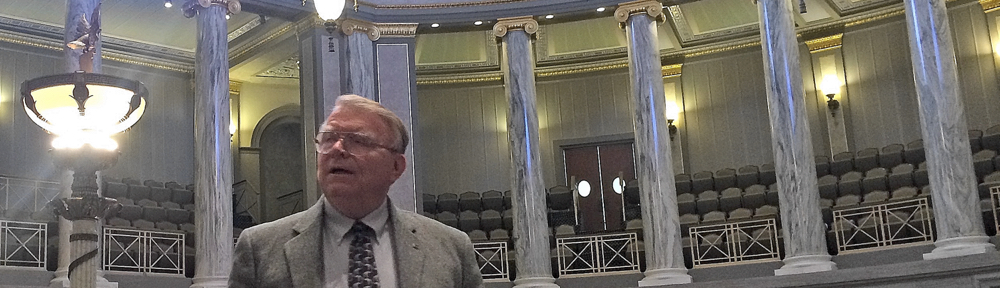
(The photo is from the News Tribune “contact” page)


Damon and Jimmy

Jimmy Breslin, the New York City author and columnist died a couple of years ago at the age of 88. He wrote more than twenty books including a biography of a fellow New York author and columnist, Damon Runyon. It’s an entertaining read. Breslin wrote, “Damon Runyon invented the Broadway of Guys and Dolls and the Roaring Twenties, neither of which existed, but whose names and phrases became part of theater history and the American language.” Twenty-six of his short stories became movies.

Something Breslin wrote about the way Runyon’s world was created before he got to New York when real estate lawyer Henry Morgenthau instituted the development that became the Broadway-42nd Street area. Something Breslin wrote about the process caught our eye.

Whenever successful politicians and businessmen are together, it is a moment of hope being reawakened. The politician, who is impoverished by comparison to the man he stands alongside, always is at once frightened and enticed by the thought of entering the business world and earning a fortune. The merchant with his money in his pocket is in awe of a person who can stand before grubby crowds and earn their cheers. Each in the other’s presence secretly wishes he had the other’s role, and off by themselves they are insanely jealous of each other. Yet merchants and politicians seem extraordinarily friendly with one another, and form a closed society to which strangers never are admitted readily, unless the stranger has wondrous amounts of money, at which point he rapidly ceases to be a stranger. The money is often never brought into use, but the stranger must own much of it. How can you yearn to be the other guy if he doesn’t have any money? The merchant by using courtesy to the point of groveling, so flatters the politician that the impossible occurs and the politician become momentarily secure, and immediately feels a need to make the merchant richer. While it is understood that the politician takes money out of this, nobody realizes the miserable amounts of money they often accept. No amount is too small for a politician to grab, nor for a rich man to offer. As nearly all great fortunes in America are made on land stolen while the public’s back is turned—and by people who want money but don’t want to work for it, by men who use the title of builder and yet never have driven a mail into a board—nowhere was the relationship between politician and merchant closer than at the time the subways of New York were built.

If you are interested in Breslin’s take on New York subway construction, go find a copy of his book about Runyon. Otherwise, we hope you just enjoy—as we did—Breslin’s essay on business and politics, offered here without comment except that we thought it was a fun paragraph to read in a book we’re really enjoying.

Breslin and Runyon make quite a combination.


Sponsorships

State government never has enough money to fix the roads, educate our kids, take care of those of us in our declining years, pay our prison guards and state employees  enough to get off of food stamps, maintain hundreds of buildings it owns, keep our air and water safe, and a lot of other things.

I woke up on a Monday morning a few weeks ago with the solution.  I think it was the day after I’d watched the Indianapolis 500 in person and the NASCAR 600-mile race at Charlotte that evening on the telly.  It came to me that state government could make millions if it followed an economic model based on racing.

A few years ago the stock car race at Indianapolis was called something like the Your Name Here Crown Royal Brickyard 400 Powered by Big Machine Records.  Each year the name of some citizen—a private citizen who was a veteran or someone who had voluntarily done something of public benefit would be picked to fill in the “Your Name Here” part of the event name—a nice thing to do to recognize the importance of people like most of us who do good stuff just because we do good stuff.

And if you watch any of these events, you know that the first thing the winners do in the post-race interview is thank all the sponsors whose logos adorned their cars and are sewn onto their fire-resistant driving suits. “You know, Goodyear (Firestone) gave us an awesome tire today and our (Chevrolet, Honda, Toyota, Ford) had awesome power.  I’d like to thank Bass Pro, M&Ms, Budweiser, Coke, Monster Energy, Gainbridge, NAPA, and all my other sponsors who make this possible—and the fans, you’re the BEST!!!”

Suppose state government was run like that.

At the end of a legislative session, the Speaker and the President Pro Tem, in their joint news conference, began with “We have had an awesome, productive session here at the Anheuser-Busch Capitol powered by Ameren.”

“The Monsanto Department of Agriculture driven by the Missouri Farm Bureau will be better equipped than ever to regulate corporate farming through the Tyson CAFO Division.

“The Master Lock Department of Corrections employees are getting a significant pay increase; The Depends Division of Aging is expanding its services significantly; the Tracker Marine Water Patrol is able to hire more officers; and the Dollar General Department of Revenue is going to install new computers to get our H&R Block tax refunds out faster.

“The Cabela’s Department of Conservation sales tax renewal has been put on the ballot next year.  The Wikipedia Department of Higher Education driven by Nike has been given more authority to approve such programs as the Shook, Hardy & Bacon Law School at UMKC, the Wal-Mart Business School in Columbia, the Eagle Forum Liberal Studies program at UMSL, and technology developed at the Hewlett-Packard 3-D Missouri University of Science and Technology will now be capable of building new football facilities on our campuses for pennies..  And we found additional funding for the Cologuard Department of Health and its Purdue Pharma Division of Drug and Alcohol Abuse.

We also were able to put a proposal on the ballot next year to increase funding for the Quikcrete Department of Transportation.

“We couldn’t do all of the great things we’ve done in the 101st Session of the Citizens United General Assembly fueled by Laffer Economics without the support of all of our state’s other great sponsors.

“And we appreciate the participation of you citizens out there.  We couldn’t do this without all of you. You’re the BEST!!!”

And the confetti made from 1,994 un-passed bills would rain down and the legislative leaders would spray champagne (or, more likely, shaken-up Bud) all over each other in the Chamber of Commerce and Industry Legislative Victory Circle (previously known as the rotunda) and the legislative mascot dressed as the Official State Dessert would dance to a celebratory song performed by Sheryl Crowe, who next year will be chosen as a project by a third-grade class studying state government to be the subject of a bill designating her as the Official State Country Singer.

This would never work, of course.  We can’t see members of the legislature in uniforms that have state government sponsors’ patches all over them during the sessions or campaigning in outfits that have the logos of their donors.  And the Senate would just flat out refuse to tolerate anything that would eliminate Seersucker Wednesdays.

Even if government tried something like this, the Supreme Court would be tied up for years in lawsuits determining whether sponsorships should be calculated as Total State Revenue under the Hancock Amendment, thereby triggering tax refunds that would undermine the entire idea.  And Clean Missouri would get another ballot proposal approved by voters that would tie the Missouri Ethics Commission into knots trying to define whether sponsors constitute campaign donors.

Hate to say it folks.  In the real world, if we want better services or more services or better roads or prison guards who don’t have to hold two other jobs, it’s us taxpayers who will have to be the sponsors of state government.    And after all, shouldn’t we want to be

THE BEST?

Food for thought

We stopped in Terre Haute, Indiana on our annual trip to cover the Indianapolis 500 for the Missourinet and as we nibbled on our bad-for-us hamburger and fries, we found an article in the local newspaper, the Tribune-Star, by Morton J. Marcus that we know will upset the Missouri Farm Bureau and other farm-advocacy organizations, Governor Parson, our friends at the Brownfield network, and numerous other people who continue to advocate for something Marcus thinks is an anachronism: agriculture as an important part of Missouri’s (and Indiana’s) economy.

We offer this as food for thought in a changing world—which has an unchanging reliance on the subject on which Marcus’ appears to have some relevant points. You are welcome to add your grains of thought to his observations in our “comments” section.

The article appeared in the Tribune-Star on May 22. It was published in the Indianapolis Business Journal the next day.

Last week, the governor of Missouri was interviewed on NPR and stated that farming was the number one industry in his state. I’ve heard the same claim from Indiana politicians. In fact, one Hoosier solon claimed farming was “the backbone of Indiana’s economy.” I responded, “Every corpse has a backbone.”

Why do people in Missouri and Indiana believe such exaggeration? Perhaps, at one time (in the 19th century) it was true. Farming does take up a lot of the land we see when traveling from one place to another. Plus, the farm lobby is still disproportionately strong.

How important is farming? Folks from Purdue love to say, “If you eat, you’re are part of farming.” Oh, so true! Plus, if you eat, you’re part of trucking, dentistry, and waste disposal.

Let’s look at three different measures not provided by the biggest farm lobby of all, the U.S. Department of Agriculture:

First, value added, the part of Gross Domestic Product (GDP), our basic measure of economic activity, attributed to Agriculture nationally (including farming, forestry, fisheries and hunting) is 0.8%, or 19th of 19 private sector industries. Number one is (drum roll… ) real estate, rental and leasing at 13.3%, followed by manufacturing at 11.4% of GDP.

To be blunt, total value added from farming is less than 0.8% of the U.S. economy. What will the farm lobby say? “Well, you’ve got to remember farmers buy lots of stuff and lots of money passes through their hands that wouldn’t be spent if we didn’t have farming.”

No one is talking about not having farming! That’s the argument of a child, not an industry. We measure economic activity as the value of the goods sold less the value of goods purchased. That’s what we call value added. And the sum of value added by all economic activity in the marketplace is GDP.

For Missouri, agriculture (Ag) is 1.1% of the state’s GDP. For Indiana, Ag is 0.9% of the state’s GDP. In each of those two states, Ag is 19th of the 19 major private sector economic activities in GDP. Only in South Dakota does Ag exceed 5% of the state’s GDP.

Second, personal income, the sum of earnings, rent, dividends, interest, and transfer payments (Social Security, Medicare, unemployment compensation, etc.) are received by — guess who? — persons. Farm earnings are net of the expenses of farmers, but include government subsidies. How many carpenters, janitors, teachers, surgeons can say the same?

In the nation, farming accounts for 0.4% of total personal income. In Missouri, the figure is 0.46%, in Indiana 0.33%.

Third, jobs. Farming, fishing and forestry account for a lofty 0.34% of jobs in the U.S., 0.18% in Missouri, and 0.12% in the Hoosier Holyland.

These are data for 2018. Not 1820, which might have been the source for the governor of Missouri. They are from the U.S. Bureau of Economic Analysis and the U.S. Bureau of Labor Statistics, not the fake news agents working in the speech-writing cubicle of every statehouse.

A couple of observations from your, uh, loyal observer:  I grew up in a farming community, on a five-acre farm. We rented our pasture to people with horses. I spent summers baling hay and cutting weeds out of Illinois bean fields in the days before pre-emergent herbicides.  Today, it seems, the phrase “small family farm” is a phrase for a time long gone.  HOWEVER, there is no doubt that the people who farm, whether they are a dwindling number of individuals or operations that have become corporations for various reasons, raise the food that feeds a growing population.  But whether agriculture is the “backbone” of our state’s economy in the 21st Century is an issue that Morton Marcus has rightfully raised.  Perhaps it is time to find a new defining phrase for the importance of agriculture.  But in doing so, we cannot forget that this industry that is a shrinking part of our total GDP is the source of our food.

A modern assessment of the economic value of agriculture in the greater scheme of the nation’s economy does not violate the old bumper sticker that says, “Don’t criticize agriculture with your mouth full.”  If anything, the comments from Marcus should make us appreciate, on a personal level, the importance to our well-being of agriculture in whatever business model its participants follow.

(Who is this Morton J. Marcus fellow?  He writes entertaining, informative, and sometimes provocative columns, a compilation of which you can find at https://howeypolitics.com/Content/Columns/Morton-Marcus/10/23.  He is director emeritus of the Business Research Center at Indiana University’s Kelley School of Business.  He taught economics there for more than thirty years and was an advisor on economic development and taxation to a half-dozen Indiana governors. One of his degrees in economics is from Washington University in St. Louis.  He has a bunch of other qualifications.  One write-up of his qualifications for his columns notes, however, “None of his advice has been taken.”)


Adjournment!


The sound of a gavel at 6 p.m. on the last day of a legislative session is the sound of freedom, of welcome relief for lawmakers, lobbyists, staff members, reporters, and others who for weeks have been under growing pressure to grasp success in the face of rapidly shrinking time. Within minutes after the gavel falls, the roads out of Jefferson City will be occupied by cars with license places beginning with the letters S and R, followed by their district numbers, speeding homeward and back to real life.

The members of the first session of the 100th General Assembly of the State of Missouri will repeat actions hundreds of their legislative ancestors knew well long ago. The capitol press corps will have a few hours to recap the day for it can go home, also exhausted but buoyed by the relief that adjournment brings them to.

The correspondent for the Liberty Tribune wrote at the end of a very long March 2, 1855, “As it is late at night and I am worn down with fatigue, and constant application, I beg leave to do as the Dutchman’s team did in the sands of the Mexican desert—just quit.”  His column was published in the March 16 edition.

Yet, before I take my final leave of you, Mr. Editor, I would like to picture to your mind’s eye the scene of the last day of the session.  The day was bright and balmy—a lovely spring day with its light and shade—its sun and its showers—gay groups of ladies in and about the Capitol—Old Nature was loosing the bands of winter, and the tide of the mighty stream that sweeps the base of the capitol was rapidly increasing in strength. The shrill whistle of the steamboat at the wharf called away one-third of the members, with hearts buoyant to see their long-absent wives, sweet-hearts and little ones. The stage coaches were all filled and crammed with departing members and their trunks and sacks of public documents to enlighten the dear people. Private vehicles were rattling along the streets loaded to the guards with absconding legislators. All was bustle, hurry, confusion, mixture and disorder. The confusion of tongues at Babel, or the cloven tongues on the day of Pentecost, could scarcely have been more wonderful or picturesque. The Speaker’s hammer, the very symbol of authority, was as little heeded as the woodpecker’s tattoo, on the hollow tree.  Several ineffectual efforts were made to introduce bills—to call up bills—to make reports—to pass resolutions &c.  A member would rise at his desk and at the top of his voice cry out Mr. Speaker! A dozen voices at the same time, still a little louder. Mr. Speaker! Rap, rap, rap goes the Speaker’s gavel. Another member shouts out Mr. Speaker, I move to have the St. Louis riot act read, as this appears to be “an unlawful assemblage of persons!” At length, after many attempts to do business, within a thin and disorderly house, a resolution was passed deferring all the business on the clerk’s table and in the hands of the committees, until the first Monday in November next. Resolutions were then passed by both houses, notifying his excellency, Gov. Sterling Price, that they had completed their business for the present sitting, and appointing a committee to wait upon him with a copy of the resolutions.—In a short time the committee returned stating that the Governor had no further communications to make with either house of the General Assembly. A motion was then put and carried to adjourn over to the first Monday of November next.  Then, sir, scatterment took place which I shall not further attempt to describe.

Yours respectively, Publius.

The legislature in those days met in the winter months after the crops were in and before the next planting season.  It was allowed to carry over unpassed bills from one year to the next within the two-year session.  A lot of things have changed in the 164 years since “Publius” filed his report. But one thing remains.

When the gavel falls at 6 p.m. today, scatterment will take place once again.


They never give up, do they?

The newest trick by the casino industry to escape any taxes on another slug of money removed from customers’ pockets has been heard by a House committee.  No action’s been taken and it’s likely too late in the session for this latest scheme to make it into the statute books. But there’s always next year.

If the bill somehow passes this year, that casinos will take another $100,000,000–plus out of Missouri in the next four years. And big boatloads annually after that.

It’s another broken promise by the industry.

Since the day casino gambling was legalized in Missouri, most of the tax on the industry’s adjusted gross receipts has been earmarked for education. For 25 years, that’s been okay with the casinos.

Not anymore.

A trend that could, in time, wipe out all of the gambling money going to education has been gaining momentum in the last four years.  The casinos are giving out coupons to customers allowing them to get free plays at machines and gaming tables. And they seem to be giving out more and more.   The legislative fiscal oversight office says the growth in taxes collected by the state in the last four years from these free play coupons has averaged 8.73%.  In Fiscal 2018, the state collected $37.8 million dollars from those taxes. Thirty-four million went to the “gaming proceeds for education” fund. The rest went to the home docking cities.  More about that later.

The casinos think there should be no tax charged on the money casinos take in from people using those free play coupons. None. They propose completely phasing out the 21% tax on money they make from these promotions in the next five years.

Some if this is kind of technical so I ran it past an accountant who gave me some help. When you read the technical stuff, that is the part from my advisor.

Here’s how it would work.

Suppose you wager $100 at the casino, twenty dollars from the coupon the casino has given you and eighty more out of your own pocket. You win $40 (half of it from the coupon and half of it from your own pocket).  You walk out of the casino sixty dollars in the hole.  The casino, by giving you a twenty-dollar coupon has made sixty dollars.

That’s how the current law works.  The state collects 21% of the sixty dollars you left behind, or $12.60.

The argument from the casino side seems to be that the $20 coupon comes from the casino’s previously-taxed adjusted gross receipts.  So it shouldn’t have to pay tax again when the $20 comes back.

The industry claims it recognizes only $80 in revenue, that it paid out $40, so its adjusted gross receipts are forty dollars, not sixty and therefore owes the state only $8.40, one-third less than the present law requires.

Whatever.

What the casinos want is to pay NO tax. The bill says, “Promotional play receipts shall not be taxed after June 30, 2023.”

Thus, the bill seems from here to say the casino that gets a business tax deduction with its promotional coupon would be excused from paying any gaming taxes on adjusted gross receipts generated by that coupon when it is gambled.

My accountant friend thinks the casinos are creating an un-level playing field (imagine that, casinos have tilted tables!) where the wagers are not taxed but the patron winnings from those wagers are still allowed to be deducted from the casino gross receipts, thus lowering the casino’s AGR taxes.

There’s an even greater hazard here.

The casinos want to pay no taxes on promotional play receipts. There is nothing in this bill that prohibits casinos from issuing promotional play coupons to every customer. And as the oversight division of fiscal research points out, the casinos’ use of promotional play has been increasing.

Fiscal research estimates the state will collect $244,650,481 under the existing 21% tax on promotional play between this fiscal year (FY2019) and FY2023.  If the present tax says in effect—as it has all this time—the state would collect an additional $62,457,772 in FY2024 and each year after that.

BUT if this bill passes this year and the tax rate is gradually reduced to zero, the state would collect only $138,624,390 during that same period, and would collect nothing in FY2024 and every year after that.  That’s a loss of $106,026,891 during that phase-in period plus the $62.4 million each year afterwards. .

But it’s not just the education fund that will get hurt with this demand from the casinos.  Ten percent of the adjusted gross receipts tax goes to the home dock cities that already are seeing their funding reduced because the dollar they get from casino admission fees isn’t worth anywhere near a dollar.  Fiscal research estimates they will lose $10,602,610 by the end of FY2023 and will lose $6,245,777 each year after that.

Many years ago the casino industry agreed that the tax on adjusted gross receipts would go for education with a little bit to the home dock cities.  At that time all of the promotional play was taxed. If this bill passes, hundreds of millions of dollars more will go to casino corporate headquarters instead of being used to underwrite a small percentage of Missouri’s school funding and meet additional costs the home dock communities have because they have welcomed a casino.

As usual, the casinos get richer and richer while the causes that are supposed to benefit from casino taxes get poorer and poorer.

Just another example of an industry that cares not one whit about the people of Missouri, its education system, or even for the communities that think they’re great corporate citizens.

They’re not.

But they never give up, do they?