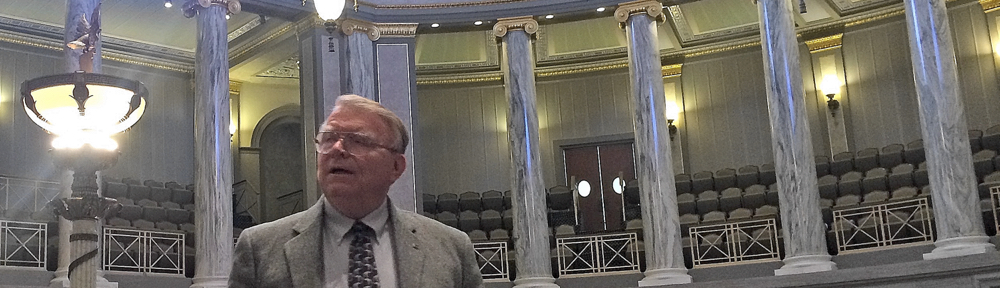
An ethics blizzard

Nothing like a little sex scandal or two to prompt lawmakers to make sincere noises about ethics reform and to file a blizzard of paper proposals to put their own houses in order.   We’ve seen blizzards at the start of other legislative sessions. One even delayed the start of the session one year.   But legislative sessions last until mid-May and by then there’s not a sign of January’s blizzard.  Whether it’s a snow blizzard or an ethics paper blizzard, things melt away by mid-May.

About a dozen ethics bills have been filed for the legislature to consider in its upcoming session.  Filing of ethics bills is easy. We’ve seen it done dozens of times.  Ethics legislation has been a topic for lawmakers to thump their chests about before sessions for many years.   But all of that blather turns to butter and melts away once the legislative session begins and “ethics” is a forgotten word by the time adjournment rolls around.

Government ethics is a never-ending issue.  Buying influence is hardly new although it always is news. There have been times when personal reputation has become less desirable than political power to those in important positions.

Chairman Mao’s observation that “political power grows out of the barrel of a gun” has been replaced in America by the political power that grows out of the checkbook.  What is the public to think of those it perceives as beneficiaries of the checkbook-as-power philosophy?   A Missouri Governor who served more than a century ago defined that perception.

Joseph Folk was elected governor in 1904 after leading a nationally-recognized fight against corruption in local, state and state capitol politics.  The Lieutenant Governor resigned during that campaign after admitting he was a bag man for people giving legislators bribes and the legislators who took them.  Four Senators were indicted and convicted although an elected state Supreme Court later tossed the convictions.

Folk talked about lawmakers who sell their votes.  And he noted, in terms that seem pretty contemporary more than eleven decades later, there are different ways to be a sell-out:

The legislator who sells his vote traffics in the honor of a sovereign people and prostitutes the trust reposed in him. There can be no offense which, if allowed to go on, is fraught with graver consequences. It is more fatal to civic life than any other crime, for it pollutes the stream of law at its source. It makes the passage of laws mere matters of bargain and sale, thwarts justice, enthrones iniquity, and renders lawful government impossible. If all official acts were for sale, we would have a government not of, for, and by the people, but a government of, for, and by the few with wealth enough to purchase official favor. It is the highest duty of every legislator, of every official, and of every citizen to do all that he can to eradicate this evil, which is the greatest enemy to free government and the greatest danger that confronts this nation today, It is not always by taking money that an official may prostitute his trust. He does it whenever he uses the power given him to be exercised for the public good for any other purpose. An official can embezzle public power as well as public money.

Legislative sessions in election years are great opportunities for both parties to push legislative issues, hold legislative hearings, and pass legislative bills that benefit their base of support. Ethics legislation has a tendency to get in the way of those actions, particularly if the legislation limits the flow through the natural cash pipeline.

The proposals we’ve looked at so far keep the flow going full blast this year. They won’t go into effect until 2017.  And none of them give the state ethics commission some badly-needed big and sharp teeth.

Joe Folk warned more than 110 years ago about the use of power for anything but the broad public good.

Ethics.  Power.  Which will prevail in the 2016 session?

Will we look around in May, recalling the blizzard in January, and see that everything has melted away,

Again?

Carding voters

We got our new voter registration cards a few weeks ago. The next time there’s an election, we’ll go to our new polling place, show the clerks our registration cards, get a ballot, and play one of our roles in the system of government.

The annual effort to require us to do more than that to exercise our right to vote is about to begin at the Capitol where the majority party seems to think that it’s not enough to be a registered voter and to show a registration card to the clerks on election day.  They seem to think nobody should be allowed to vote unless they also can show a government-issued identification card that has the voter’s picture on it.

The minority party says the additional requirement would adversely impact on many elderly, poor, and minority voters.  The minority party says those people are more important to it than they are to the majority party Although they don’t come right out and say it, they see the voter photo-ID legislation as another effort to undermine the political base that Democrats see as helpful (the other major effort to do that is right-to-work legislation that could curtail union membership and, therefore, funding for labor which generally supports Democrats).

[As an aside, we should note the contradictory attitude of the majority party. The Republican-led legislature in 2009 passed legislation prohibiting Missouri participation in the Homeland Security Department’s “Real ID” program. 2005. Governor Nixon signed the bill. The state has now been notified that Missourians who want to visit federal facilities can no longer use their Missouri driver’s license to identify themselves.  The policy also could mean Missourians won’t be able to use their driver’s licenses to get on an airliner. They’ll have to have some additional kind of U. S. Government photo identification such as a passport. It’s okay, therefore, for the legislature to tell Missourians they can’t vote unless they have state-issued photo ID, but it’s not okay for the federal government to tell Missourians they can’t visit federal facilities without a federally-issued photo ID.]

Back to the topic:

Republicans use phrase such as “ballot security,” or “voter fraud” to justify their positions on voter photo-ID. Democrats use phrases such as “voter suppression.”

There’s a certain irony in the Republican push to require a driver’s license or some other state-issued picture document if we want to exercise one of our most fundamental rights as United States citizens.

Republicans occupy two-thirds of the seats in the House and in the Senate through a system they have been implying is rife with voter fraud and crippled by ballot insecurity. If, however, you were to go to your state senator or your state representative (chances are that if you live outstate, that person is a member of the GOP) and ask how many fraudulent votes were cast for them in their most recent election, they’ll be unable to tell you if any fraudulent votes were cast in their districts. Or the election before that. Or before that.  Or in the decade before that.  Or the two decades before that. What could validate the majority party’s position would be notarized statements from each county clerk listing the number of fraudulent votes cast in those counties in the last, oh, twenty years, including the number of people charged by the county prosecutor with fraudulent voting.  Of course, such documents would undermine their case, too.

If the legislators won’t ask their county clerks for that information, perhaps the Missouri Association of County Clerks could assemble it for them and present the findings to the public.   Which side is on the side of the angels on this issue?  This is one of those issues where the word “transparency” is something to think about. But the operative word so far is “agenda.”

It’s been a few years (like, maybe, seventy-five or eighty) since the Pendergast political machine had thousands of ghosts voting in Kansas City.  Walter Cronkite, the great CBS newsman, recalls in his early days in broadcasting in Kansas City when the manager of his station sent him out to vote several times under several different names.

We had hoped in the years we sat at the Senate press table that the supporters of voter photo-ID would produce a list of people who had been charged in, say, the last ten years, with pretending to be someone else when they cast a ballot, or tried to cast a ballot, in state or local elections.  Just how big a problem is this?  How dangerous is this issue to the state and national civic health?  How many results at the state and local levels have been affected by voter fraud.  Just how insecure ARE our ballots?

The sponsor of the photo-ID bill told the Associated Press the election for Kinloch mayor last April justifies his bill.  Only 58 votes were cast.  The city attorney says 27 of those voters were illegally registered.  The sponsor of the bill is a smart-enough guy that he flew helicopters while he was in military service (we heard him go on at painful length about helicopters during a filibuster early one morning) and as such, he surely knows the problem with shooting at the wrong target.  In Kinloch, the problem was with people proving their identity at REGISTRATION.  And the responsibility for that issue is with the registering clerk.  If the workers at the polling place cannot trust the clerk’s certification, why even have registration?

Ask yourself as you stand in line to get a ballot whether you would rather have to wait a few minutes in a much shorter line at the clerk’s office while someone proves their identity to get a registration card or whether you would rather stand in a longer line at the polling place while an elderly polling clerk who has been on the job since 5 a.m. waits for a voter to search through pockets or purse for something other than or in addition to their voter registration card.

Under the bill, a voter who cannot produce photo-ID at the polling place can cast a provisional ballot that will only be counted if later checking verifies the person’s identity, a seemingly cumbersome process that becomes unnecessary if the registration clerk, city or county, already has certified the person with the registration card is who they say they are.

Proponents argue that we have to use photo-ID whenever we check into a motel or cash checks or use a credit card to make a large purchase or get stopped for speeding, so why shouldn’t be have to use one to vote?   Opponents will argue that checking into a motel, cashing a check, or using a credit card to make a large purchase are not rights of citizenship but are only privileges.

One side argues that the policy protects citizenship.  The other side argues it’s a barrier to many people to enjoy citizenship.  What, a cynic might ask, is a greater threat to the republic: so-called ballot insecurity, allowing Syrian refugees to come to Missouri, or letting a woman, her doctor and her own understanding of the scriptures make medical decisions?

What it comes down to is simple. The R’s and the D’s at the Capitol are playing for political advantage and the card-carrying citizens, are caught in the middle.  But that’s the penalty we pay for a free country.  About 4.2 million registered Missouri voters are at the mercy each year of 100 of the 197 people we have elected to represent us–82 in the House, 18 in the Senate, the number needed to pass bills.  And sometimes agendas trump the broader public welfare.

You’d think from the photo voter-ID annual battles that the only ones who are not frauds are the 197—who are not fettered by any statutory ethical standards.

Feeling secure?

Reading hymns

It occurred to us a few years ago as we were singing a Christmas hymn in church, reading lyrics without music that were on the screens at the front of the sanctuary, that the hymns—beautiful as they are at Christmas—are sometimes not as good as the poetry or the prose behind them.

We become so accustomed to the pace and structure of the music that the words come from us unthinkingly.   If we remove the music and the false structure it imposes on the lyrics, we might find some of our Christmas hymns have different meanings and many of them could be sung year-around.  In fact, many could be sung year-around by removing one verse.

If we read hymns instead of singing them, we might find ourselves asking questions about the story that is told in the lyrics and sometimes even wondering about the origins of those lyrics. We’re not much of a student of music but we love it, especially at this time of year, but it seems that the lyrics come first and then somebody writes music for them.

Here’s a f’rinstance.  One of the nicest, lightest, Christmas hymns begins with the words, “Bring a torch….”   I bet you hear it in your mind right now, just because of those three words.  But who is “Jeanette Isabella?”

This is an example of how singing the lyrics changes the lyrics.   In this case, the music eliminates a comma.  If you read the lyrics of the poem, which goes back about seven centuries to the Provence region of France, you see that it is about TWO girls, not one.   The original title was Un Flambeau, Jeanette, Isabelle. (We appear to have Anglicized the names of the girls.)  Various sources we’ve checked say it originally was a dance tune for the nobility and didn’t show up as a Christmas tune until 1553 and an English version of the hymn wasn’t published until the middle of the eighteenth century.

One interpretation of the lyrics links this Christmas song to the Jewish celebration of Chanukah, the eight-day festival of lights that celebrates, as Chabad.com, puts it “the triumph of light over darkness, of purity over adulteration, of spirituality over materiality,” a theme with which many Christians identify as they celebrate the birth of Jesus.  The website makingmusicisfun.net tells us, “The torches, or candles, of ancient Hanukkah’s Festival of Lights played an important part in Christmas celebrations in Provence and southern Europe,” and calls this song, “a wonderful example of the torch songs of that time.”

The New-born *oil on canvas *76 × 91 cm *1600-1652

(Musee des Beaux Arts de Rennes)

“Bring a Torch” is one of those songs that draws the participant into the beauty of the music to the extent that the words are sung but the story they tell is not appreciated.   So let’s look at the lyrics (which might be slightly different depending on your faith traditions).   We’re going to change some punctuation and some of the structure of the poem for reading-out-loud purposes.

“Bring a torch! Jeanette, Isabelle! Bring a torch!

Come swiftly– and run! Christ is born!

Tell the folk of the village (that) Jesus is sleeping in His cradle!

Then we change from excitedly telling these two young girls to grab their torches on this night and dash into the village telling the villagers to approach in haste—but quietly.  Adore the child but do not create a disturbance.  He is sleeping the sleep of the newborn.  And although the song does not refer to his mother, she also probably is resting after the strain of childbirth.

Hasten now, good folk of the village. Hasten now, the Christ Child to see. You will find Him asleep in a manger. Quietly come and whisper softly.

Ah, ah, beautiful is the mother, Ah, ah, beautiful is her Son.

Hush, hush, peacefully now He slumbers. Hush, hush, peacefully now He sleeps.

We have seen a translation of the early French lyrics that places heavier emphasis on urging villagers to not disrupt the rest of the child and his mother.  They’re harsher than the more familiar lines of the hymn.  We don’t recall singing or hearing these words but this part of the poem begins with noise and disruption.  Perhaps it is Joseph who asks, or maybe an angel–the wording is not clear.

Who is that, knocking on the door?

Who is it, knocking like that?


And someone in the crowd gathered outside answers:


Open up!

We’ve arranged on a platter lovely cakes that we have brought here!

Knock! Knock! Knock! Open the door for us!

Knock! Knock! Knock! Let’s celebrate!


We can envision Joseph cracking the door open and slipping out to confront the crowd.  Speaking in a loud whisper, he tells the villagers:


It is wrong when the child is sleeping.  It is wrong to talk so loud. Silence, now as you gather around lest your noise should waken Jesus.


And as the crowd heeds his wishes, he opens the door and reminds them as they go in:


Hush! Hush! see how he slumbers.

Hush! Hush! see how fast he sleeps!

Softly now unto the stable,

Softly for a moment come!

Look and see how charming is Jesus,

Look at him there, His cheeks are rosy!


And we hear the whispered voices of the people as they file through the room:

Hush! Hush! see how the Child is sleeping;

Hush! Hush! see how he smiles in dreams!

We still don’t know who these two girls are or were.  Perhaps the names were plucked out of the air by the original writer of the poem to fit the meter of the poem.  But the more popular version seems to rely on a painting by Georges de La Tour (1593-1652), a French Baroque artist who did a lot of religious scenes lit by candlelight.  The story behind his painting is that Jeanette and Isabella (Isabelle in the French lyrics) are milk maids who have gone to the stable to milk the cows and find Jesus has been born there.  We don’t know who tells them to light the torches and spread the good news in the village.  But we are told the custom remains in France for children to dress up as farm folks and as they go to midnight mass, they sing the song that begins, “Bring a torch….”

If you want to take the time today—if you have the time today—and you have a hymnal in your home, you might want to read some other hymns.  It might be hard because there will be the tendency to read them the way the music has them sung.  But you might find reading hymns as poetry or prose is interesting and might even add a new dimension to this day for you.

Take a look particularly at “Joy to the World” and ask yourself after reading it why this song could not be the opening hymn in worship at any time of the year.

We hope we have not spoiled your enjoyment of the music of Christmas with this little excursion that began by wondering who Jeanette Isabella was.  Remember that our word Psalms comes from a Greek word that means “instrumental music” and the words that go with it.

Let all of us, regardless of our faith tradition, hope on this day that light will prevail.

The Nineteenth Century is alive and sometimes well

–and it’s living in Missouri’s counties.

The legacy of Martin Van Buren is an overlooked part of Missouri history.  As far as we know he was never in Missouri.  He is remembered, if he is remembered at all, as a founder of the modern Democratic Party, and as the man responsible for the 1837 national depression.  He was so unpopular that he was voted out of the presidency in 1840 and spurned for his party’s nomination later.

But Van Buren County was named for him.  Not sure where Van Buren County is?  We call it Cass County today, named for Lewis Cass, who was Van Buren’s opponent for the Presidency in 1848.  Cass didn’t win the presidency either.

Kinderhook County was named for the town in which Van Buren was born.  You don’t know where Kinderhook County is?   It has been known as Camden County since 1843.

Johnson County is named for Richard M. Johnson, who was Van Buren’s vice president.

Butler County is named for Kentucky Congressman William O. Butler, who was Lewis Cass’s vice-presidential candidate.

How about Ashley County, named for St. Louis explorer, fur trade entrepreneur, and former Lieutenant Governor William H. Ashley?   Or Decatur County, named for naval hero Stephen Decatur?  Highland County?  Lilliard County, named for one of the members of the first legislature?  Or Seneca County?

Ashley County became Texas County in 1841.  Decatur has been Ozark since 1845.  Highland became Sullivan that same year.  Seneca County became McDonald County in 1847.  And Lillliard became Lafayette in 1825, the year Lafayette, the French hero of the American Revolution, visited St. Louis.

We have a peculiar situation with St. Louis, which broke away from St. Louis County in 1876, creating a strange creature that is a city not within a county but having some county offices (sheriff, for example, in addition to the city police department).

Other than the St. Louis/St. Louis County divorce in 1876, Missouri has not gained any new counties since Carter and Christian Counties were created in 1859.

Maybe it’s time for a shakeup.   Our county structures don’t make a lot of sense in a lot of places.   Twenty six places in particular.   Missouri has that many counties with fewer than ten-thousand people.  And Worth County, up along the Iowa border, has dwindled to fewer than 2,200.  In fact, the northern tier of counties in Missouri are so sparsely populated that the entire area is represented by only two state senators.  A few years ago we wrote a blog for the Missourinet about “The Senator from Everywhere,” Brad Lager, who listed his senatorial district as the counties of Andrew, Atchison, Clinton, Daviess, DeKalb, Gentry,  Grundy, Harrison, Holt, Mercer,  Nodaway, Putnam, Sullivan,  Worth and Part of Clay County.  Fourteen entire counties and part of a fifteenth.  Dan Hegeman has those counties now that Lager has been forced out by term limits.

The other half of north Missouri is represented by Senator Brian Munzlinger. His district is  Adair, Chariton, Clark,  Knox, Lewis, Linn, Macon,  Marion, Pike, Schuyler, Scotland,  Shelby, Ralls and Randolph Counties.

Two Senators represent about one-fourth of all of the counties in Missouri.

A longtime friend from college days sent me a proposal for new counties a few years ago.  Wayne Vinyard and his wife Jan ran the Longview Gardens nursery in Jackson County for many years before they retired.  Now that he doesn’t have to water the plants and fight off bugs and other pests, Wayne has had time to ruminate on the state’s nineteenth-century county structure.  He has decided to try to make more sense out of our county government system by drawing more practical boundaries for the twenty-first century.

 vineyard map

His plan creates fifty-four counties plus the city of St. Louis.  St. Louis County would be the only county to shrink.

Wayne has suggested a new name for one of the newly-formed counties.  He thinks “Arcadia” would be a nice name for an area in southeast Missouri.  But that suggestion leads to another issue.

Do we have to continue having counties named for Revolutionary War soldiers who never lived here, colleagues and opponents of Martin Van Buren, a Whig politician from England who was never in this country as far as we know, or other obscure figures?

Some of our counties’ names are….are……Well, consider these:

Christian County is named for William Christian, a Revolutionary War soldier who signed the Fincastle Resolution (???) and brokered a peace treaty between the Overmountain Men and the Overhill Cherokees (more???s). Never lived in Missouri.

Carter County is named after an early settler whose first name is, ummm, unusual.  But should someone named Zimri have a county bearing their last name?

Here’s a doozy for you:  Camden County honors someone named Pratt.   No kidding.  Charles Pratt died nine years before Missouri became American territory.  He was a Whig politician, lawyer, and judge in England.  He was the Earl of Camden.  Given some of the deep political thinkers of our present day, we’re not sure he would be county-naming fodder now.  He was, you see, an early proponent of civil liberties.  Before they were unionized.

And Andrew County?   Ohhhhhhh, my.  This one is in dispute.  One source says it was named for Andrew Jackson.  Another says it was named for Andrew Jackson Davis, a prominent St. Louis lawyer.  But we’ve turned up a third alternative that is so bizarre that it cannot possibly be true. But this is Missouri.  The third candidate is Andrew Jackson Davis, who was known as “The Poughkeepsie Seer.” He became a devotee of “animal magnetism,” which we today call hypnotism, and was an advocate of “magnetic healing.”

It is easy to dismiss a county being named for a New York spiritualist.  But then again, consider that the original name of Fulton was Volney, for Constantin Francois de Chasseboeuf, Comte de Volney, a French abolitionist, philosopher and orientalist who once wrote, “All the Egyptians have bloated faces, puffed-up eyes, flat noses, thick lips—in a word, the true face of the mulatto.”

We have wandered far afield but this is such an entertaining diversion.

Back to our topic.

From time to time there have been discussions about whether it makes any sense to have seven counties with fewer than five-thousand people (twenty-six with fewer than ten thousand).  Worth County in 1900 had 9,382 of Missouri’s 3,106,665 people or .003% of the state’s population.  Now it has .0004 of Missouri’s 5,988,927 people (2010 census figures).  Mercer County is the second-least populated county in Missouri with 3,785.  In 1900, it had 14,706.

So the question becomes whether it makes any economic, or any other kind of, sense to have counties this small or the eleven others with fewer than seven-thousand people trying to maintain county courthouses and the officials who work in them?

And haven’t we had some other heroes from Missouri since 1859 who deserve to have counties named after them instead of counties named for people who’ve never been here?  Pershing, Bradley, Lindbergh, Danforth, Symington, Virginia Minor, Betty Grable, Yogi Berra?  Visit the Hall of Famous Missourians at the Capitol someday.  You won’t find anybody there named Van Buren, Zimri, or the Earl of Camden.   And try not to think of naming a Missouri County after Bob Barker or Rush Limbaugh or Jack Buck—although renaming St. Louis County “Musial County” might be appropriate.  History shows county names are not particularly sacred. We do have a precedent for re-naming our counties.

Regardless of how much sense the Vinyard map makes, we all know that any effort to make it or something like it a reality will ignite enormous protests from the 114 kingdoms that call themselves counties.  Border-to-border turf warfare will erupt.  After all, Wayne proposes turning about sixty county courthouses into—what?  Condos?   Museums? Antique malls?  Vacant lots in the hearts of communities?   Imagine the havoc that could be created by sixty county clerks, sheriffs, assessors, collectors, nurses, and 180 county commission members who would be forced to consider processing pigs or turkeys instead of drawing a government paycheck.   Imagine going into a big-box store and being greeted by your former presiding commissioner.  It’s not a vision very many county officials would tolerate.

Perhaps our legislators in 2016, when they’re not creating new state symbols at the behest of fourth-graders, will consider modernizing Missouri’s county government system and recognizing that a county named for, say, Reinhold Niebuhr makes more sense than one named for Martin Van Buren’s vice-president.

Niebuhr?  (Rine-hold Knee-bur) He might have been this nation’s foremost twentieth-century theologian and ethicist.  He was from Wright City.  Some of his musings are particularly appropriate in today’s political climate.

“Since inequalities of privilege are greater than could possibly be defended rationally, the intelligence of privileged groups is usually applied to the task of inventing specious proofs for the theory that universal values spring from, and that general interests are served by, the special privileges which they hold.”

Or: “Man’s capacity for justice makes democracy possible, but man’s inclination to injustice makes democracy necessary.”

But the one that is best known is his Serenity Prayer.  There are various versions of it but the lines from it that are most familiar are:

“God grant me the serenity to accept the things I cannot change, the courage to change the things I can, and the wisdom to know the difference.”

Maybe my friend Wayne’s map represents something that cannot be changed.  But maybe it’s time for the courage to change some things that can be changed.   Or should be.

And whether it’s county boundaries or social boundaries, let us all pray that those who return to the Capitol in a couple of weeks gain the wisdom to know the difference between specious proofs and the general interest.  Wouldn’t it be nice if there could be a map for that?

Unmasking problems

We’re about six weeks past Halloween and you might think all of the Halloween stuff in stores has been put away.  But it’s surprisingly easy to still find masks.   And masks are in some demand in Jefferson City because tomorrow night (Saturday, December 12), several hundred people are going to don masks and invade the Capitol.

I’m going to be one of them, which has meant Nancy has either had to find out where there are still masks for sale or she’s going to have to make one.   She had some ideas about where to find some to consider.

masks

One store had some basic Lone Ranger-type masks (although if the Lone Ranger showed up in the gold one or the red one, he’d probably surely be lone).  They cost twenty-five cents each so we bought four.  Now we have to wonder whether it’s worthwhile to take a dollar’s worth of cheap masks back or just keep them around for grandchildren to play with.  Grandchildren are going to win. Unless—-

Another store had two bizarre creations, one looking like some kind of a feathered iguana mask and another that is a mass of feathers that a performer might wear in some weird Las Vegas stage show.   They cost enough that returning them for a refund is practical.

A third store had the mask that seemed appropriate. We’re not going to show it to you because then people at the Caring for Missouri event tomorrow night will know who the person is in that mask.   One good thing about it is that it does not rely on a cheap elastic band that could break at any moment—which is why we bought four of the first set of masks—and it fits over glasses that are necessary because I have to read some stuff.

The event starts at 7 p.m. in the Capitol rotunda.  Tickets start at $100.  Some folks think this is a pretty snooty event.  Others see it as an important way to raise money and to increase visibility for the organizations and their causes.  All other things aside, it’s intended to be a fun event for worthwhile causes.  Let’s talk about the causes.

We’ve talked about the goals of the Missouri Capitol Commission to raise money to preserve and restore Capitol art.  Regular readers of these posts know that’s a favorite issue for your faithful scribe.  But let’s focus on the other two groups involved: The Missouri Coalition Against Domestic and Sexual Violence and the Missouri Association for Community Action.  Frankly, dealing with art issues pales in comparison to the issues these two groups deal with every day.

Let’s start with MACA, which reminds us that 932,066 Missourians live below the federal poverty line.  A total of 417,151 peopled have incomes less than half the poverty-line level. About one-third of those people are children.  What’s the poverty line?   The federal government says a Missourian who earns less than $11,700 a year is living in poverty.  A family of four with an income of #24,200 is living in poverty.  MACA counters those who dismiss such conditions by suggesting people just go out and get jobs with this statistic: Almost thirty percent of Missouri jobs do not pay enough for the wage earner to live above the poverty line.  Thirty percent.

Almost seventeen percent of Missourians have low food security because of their earning situation. That means they have to reduce the quality, variety, and desirability of the food they eat.  Missouri is one of ten states with a food insecurity level higher than the national average, and has the sixth highest percent of food insecure households.

MACA cites government figures showing almost 7300 people are homeless in Missouri; 652 of them veterans.

When it comes to providing help to those people, MACA doesn’t really care if the Caring For Missouri Capitol Masquerade Ball is seen as a snooty event by some people.

Most of those attending the event will probably be old enough to remember when “domestic violence didn’t even have a name, let alone a legal identity,” as the Missouri Coalition Against Domestic and Sexual Violence says on its webpage.  The Coalition recalls that rape was legal within marriage and wasn’t even a crime until the mid 90s.  There was no law allowing a judge to order an abusive husband and father to move out of the family living quarters.  Remember when reports that a husband was beating his wife were considered “family matters?”  The folks at the party were living at a time when there were no rape crisis centers, no shelters for battered women.

. There were no shelters for battered women in Missouri, no rape crisis centers, no hotlines, no task forces, no Coalition.  Missouri had no domestic violence shelters until 1976, no legal protections for domestic violence victims until 1979.  That was about the time the Coalition was created. Since then the number of domestic and sexual violence programs has increased tenfold.

The coalition, like MACA, is a presence in the Capitol during legislative sessions working for more protections for the poor and the abused.   In four decades of watching representatives of organizations like these, this observer saw nothing snooty about their work.  There was little celebration when an effort was successful because there is always another issue for the poor and the abused of Missouri.

Tomorrow night’s event will involve some food and music and a silent and not-silent (they hope) auctions of all kinds of things that we mentioned in an earlier entry here.  Some folks will be wearing formal attire. Others will be in business attire.  They’ll be dressed much better than most of the people this event is designed to help can afford to dress..

Tickets will be available at the door.  There are places where you still can buy a mask.

Got a quarter?   I’ll sell you one of mine.

Class dismissed

Your observer of the passing scene has had a year to ponder the things he witnessed in all those hours observing the Missouri Legislature from his perch in the House Press Gallery or from his seat at the press table on the Senate floor.  And he has come to the conclusion after the year away from the tumult and the shouting that one of the most regrettable trends he watched was the decline—and seeming death—of a quality we call “class.”

The thought hit home several days ago when legislative leaders decided to hold hearings to examine Missouri programs that help refugees, a decision reached after the histrionics accompanying their demands that the Governor keep Syrians from coming to our state. Governor Nixon threw a bucket of ice water on those demands, leading to the examination of what the state does with immigrants.

A legislature that still operated with at least a certain amount of “class’ would have decided to hold the hearings BEFORE trying to whip up public emotions on the subject, of course.  From what we have heard and read, the hearings would not have justified the earlier reactions.  But in an era where dignity takes a back seat to demonization, we seem to be left with those whose philosophy is heavily laced with the adage, “When in danger or in doubt, run in circles, scream and shout.”  Herman Wouk used the adage in The Caine Mutiny and said it was an ancient saying.   It’s all too current today.

In announcing the hearings, Senate President Pro Tem Ron Richard put out a statement saying, “Because of our governor’s lack of leadership and this administration’s failed federal foreign policies, we will try to find ways to protect the safety and well-being of the citizens of the Show-Me State.”

Sheesh!   Everything seems to be couched in language these days that tries to throw a kidney punch at somebody, doesn’t it?  Parents recognize the trend.

“It’s all his fault1”

“Is not”

“Is too!”

“Is not!”

Normally about this time, the adult in the room says “Stop it!” and threatens to send people to their rooms until they can behave in a civil manner.

Unfortunately, there appears to be a noticeable lack of adults when it comes to modern politics.  “Class” is one of the casualties of the presence of term limits and absence of high ethical standards.

We dislike wallowing in nostalgia because nostalgia often recalls an unrealistic picture.  But there WERE days when people in government could do things without being so dang-nabbed disagreeable.  Of course, that was back in the days before term limits when legislators had time to grow up.  And when there were adults in the room who could help them do it.

Maybe it will dawn on some people someday that Lord of the Flies is not a political textbook.

You, too, can own a piece of Capitol art, or Who is that Masked Man/Woman?

(We have been asked to clarify a couple of things in our original version of this post. You’ll find the changes if you read through this post again. And you should.  Read through it again.

Your honorable scribe has not decided what mask he will wear although he is considering what a T-Red head would look like on top of a tuxedo)

Thousands of people each year are stunned when they walk into the House Lounge at the Capitol and find themselves surrounded by Thomas Hart Benton’s “Social History of Missouri” mural.  It’s hard to determine how much it’s worth because of its size and its location.  The state of Missouri paid Benton $16,000 to paint it in 1936. Some of the lithographs of some of the images sell for thousands of dollars today.  Through the years, this frequent visitor to that room has heard estimates of the value of the mural as being more than the cost of building the capitol (which was about $4 million) to multiples of that.

Do we ever have a deal for you!!!

You can own a copy of the Benton mural for a fraction of its value.  In fact, I know some folks who would be glad to sell you one for, oh, say, one-tenth of the value of the original.  And don’t worry. You won’t have to build a 25×50-foot addition to your house.

A panoramic five-foot long photo of the mural is one of several reproductions of Capitol art that will be auctioned at the Capitol Masquerade Ball on December 12.  It will be in the rotunda, starting at 7 p.m.  The proceeds will benefit three organizations: The Missouri State Capitol Commission, the Missouri Coalition Against Domestic and Sexual Violence, and Missouri Association for Community Action.

All you need is a mask and a ticket.

inca_sun-300x263

General ticket donations are $100.  If you want to be a Very Important Person—and you are, you know, admit it—you can get a VIP ticket for $250.  Those who buy the VIP tickets will have get a commemorative gift and you can hang out with other VIPs in the VIP lounge.

Just let the organizers know you’re going to be there and reserve your ticket at www.caring4missouri.org.

You might get to rub elbows with a whole bunch of important folks.  The top state office-holders and both of our U. S. Senators are honorary co-hosts.  The organizers can’t promise all of them will be there, but it will be worth the price of your ticket to find out who is.  And besides, you’ll have a chance to rub elbows with a lot of other good folks and you’ll be supporting three fine organizations.

Mike Michelson will be there to tickle the ivories.  The Norm Ruebling Band will play music anybody can dance to.  There will be a Redlight Photobooth to commemorate your presence in any way you’d like.  There will be beverages and Hors d’oeuvres.

inca_masks 2

And organizers will sell things.  There will be a silent auction.   AND there will be what the sponsoring groups hope will be a really, really NOISY auction.

And this is where you can get some really great things for your home or your office.

Just imagine that five-foot long Benton Mural hanging in the lobby of your office or behind your desk or above your bed or—well, just imagine.

There are also a couple of other prints of parts of the mural.  They’ll also be auctioning off photos of the portraits of Mark Twain and Susan Elizabeth Blow that most people see only if they get into the Governor’s office.   Mark, of course, is Missouri’s most famous writer.  Susan is the founder of the kindergarten in America.

Are you a Civil War person?  How about reproductions of the N. C. Wyeth murals depicting the Battle of Wilson’s Creek and the Battle of Westport?  (This is one of the changes. The Wyeth prints won’t be sold at this event. They’re being saved for a later event so if you had your heart and your checkbook prepared to buy them, save both for a later event. We don’t know if masks will be involved).

And a print of another of the monumental murals in the Capitol also will be auctioned:  Charles Hoffbauer’s “The Glory of Missouri in War” mural from the House of Representatives.

All of these can be yours if you (a) buy a ticket and (b) outbid somebody else who also wants these unique decorations for home or office.  Folks, you won’t have a chance to buy these images anywhere else. Nowhere.

The pictures are photographs by Lloyd Grotjan, the Jefferson City photographer who did the outstanding photographs for The Art of the Missouri Capitol: History in Canvas, Bronze, and Stone took for the book.   The five-foot long Benton mural panoramic view originally was intended to be a fold-out in the book but we had to leave it out because, well, a five-foot long book wouldn’t fit on many coffee tables.

inca picture 3

There needs to be a noble purpose for this fund-raiser.  Support for MACA and MCADSV is vital in helping them fight domestic and sexual violence and helping the 930,000 Missourians living below the poverty line.   Support for the Capitol Commission will continue its efforts to assess and restore the art of the Capitol, most of which has gone years without care.

Last year the commission held a wine-tasting event that included a great discussion of how wine tastes differently in different glasses (and tasters got to take home a set of glasses).  The money raised from that event has financed assessments on 55 paintings.  The Office of Administration is moving forward with restoration/repair of the art that’s been assessed.  The commission wants to continue that important work.

Just a few days ago commission chairman Dana Miller hired ICA Art Conservation to assess the condition of the Benton mural.  ICA is a nonprofit group that specializes in conservation and repair of the works of Midwest artists.  It has been highly recommended to the commission by the Nelson-Atkins Museum in Kansas City.

So get in the closet and dig out the kids’ Halloween masks, or get busy with some cloth and feathers and make something outrageous,

inca mask 4

or go out and buy something.   Most folks probably will be in business attire but the sponsors sure won’t mind if you want to show up fully-costumed.  (Actually, the sponsors hope you’ll NOT wear business attire because this is a high-class event.  Dana would like to see people in formal attire although she says business attire is acceptable.  But formal attire is preferable. Even if you wear a T-Rex head for your mask.)

You should be that Masked Man.  Or Masked Woman.

The terrorists are winning

Just a few years ago, we recall, President Bush was saying this country would not do various things because if we did, “The terrorists would win.”

They’re winning.

Some of Missouri’s politicians are demanding Governor Nixon, in effect, seal the state’s borders to protect us from Syrians.   The Paris attacks this year and particularly in the last few weeks are giving ample opportunity to some to fan the flame of fear.  Fanning the flame of fear is good for those who want to be seen as protectors from evil.  Or, evil-doers to borrow again from the Busch II years.  And with elections coming up, it never hurts to carry the image as a protector.

Terrorists want to scare governments and people into changing their behaviors.  Their ultimate goal is much larger, of course.  But first they have to create a climate that is ever more restrictive of thinking, of movement, of hope.  Sealing borders tells us they are winning.

And what is all of this fuss about?

President Obama has said he will allow four times as many Syrian refugees to come into this country as have been admitted in the last four years.   And Secretary of State John Kerry has announced this country will lift the lid on the number of refugees admitted to this country from the present 70,000 to 100,000 in 2017.  Many of those new slots will go to Syrians fleeting terrorists.

Are Obama and Kerry going to flood this country with terrorists?   Are we all in peril if we go to a play, to a restaurant, to a sports stadium if a flood of Syrians comes in?  The answer is a simple one: to maintain public safety, we have to keep Syrians from flooding into our state.

There is no flood in Missouri.  There won’t be a flood in Missouri.

The New York Times on November 16 reported that only 1,854 Syrian refugees have been admitted to the United States since 2012.  The nine volunteer agencies working with them have scattered them among 130 communities.   The newspaper says Boise, Idaho has more Syrian refugees than New York and Los Angeles combined.  Worcester, Massachuesetts has more than Boston.  Should the people of Boise quit going to restaurants?  Should the people of Worcester fear attending a concert or a movie?

Missouri has a few Syrians in the St. Louis area.  Overland Park, Kansas has a few.  The International Institute of St. Louis, which has been working with immigrants for 96 years, reports eight percent of the population of St. Louis City and St. Louis County is foreign-born.  7,500 people from 75 countries.

The Post-Dispatch reported in September that 28 Syrians had arrived in St. Louis this year and twenty more were expected by the end of the year.

When we close our borders to Syrian refugees, can we draw the border so it keeps St. Louis on the outside because that city already endangers the safety of our state because almost fifty more of those dreaded Syrians will be there at the end of the year?

The Times says Syrian refugees made up only two percent of the 70,000 refugees admitted to this country last year.   Germany in that same four-year period has admitted 92,991 Syrian refugees.  President Obama says this country will admit 10,000 this year.  The Census Bureau says we already have 150,000 Syrians living in this country of 300-million people.

Syria ranks seventh in the list of countries whose immigrants have been allowed into this country in the most recent federal fiscal year.  Myanmar has sent almost 20,000.  Iraq has sent about 12,000.  Somalia, The Democratic Republic of Congo, and Bhutan have sent more than 5,000 each.  Iran has sent far more than Syria.

But it’s Syrians who have a bunch of Missouri politicians in a froth.  Well, how easy is it for those scary people to get here?  They have to apply to the United Nations first.  If the UN says they can come, they have to be examined by the FBI.  They have to be run through terrorism databases run by the Defense Department and by other government agencies.

The UN has recommended 18,000 Syrians for scrutiny by the United States.  The State Department says more than half of them are children.

Not all Syrians are suicide bombers, you know.  And when it comes to killing bunches of people, we are pretty good about doing that ourselves.  A check of a couple of websites that list mass shootings and finds that since March of 2005, this nation has had thirty-three incidents in which 270 people have been killed and 254 have been wounded. One of those incidents was in Kirkwood in February, 2008.  Six dead, one wounded.  Another incident began in Illinois and ended in Festus.  Eight dead.  Four of the incidents happened in Wisconsin. Four more were in California. We don’t think we say any Syrian names on those lists of killers.  But we did see people from Wisconsin and California.  Perhaps we should block people from those states from coming to Missouri.  Those people clearly are dangerous.

(http://timelines.latimes.com/deadliest-shooting-ramp

https://en.wikipedia.org/wiki/List_of_rampage_killers_(Americas)

We checked a list of German mass killings since March, 2005 and came across one incident where a German student killed 12 other students and three other people before killing himself in 2009.  We checked Germany because it has been a landing place for hundreds of thousands of immigrants from the Middle East for more than a decade.

But let’s be afraid anyway.  Because some of our leaders find it advantageous to tell us we should be afraid. Of Syrians.

Cultivating a climate of fear among the electorate is convenient.  It keeps the electorate from raising embarrassing questions about things like school funding, mental health services, crumbling roads and creaking bridges, lack of funding for cigarette-related health issues,  services to veterans—-add your own priority here.  Then forget about it because you are supposed to be living in fear of a Syrian.

Edward R. Murrow, the great CBS newsman, observed on his See it Now broadcast of March 7, 1954, when he said, “No one can terrorize a whole nation unless we are his accomplices.”

When Murrow began a series of programs called This I Believe in 1951, he noted:

“We hardly need to be reminded that we are living in an age of confusion. A lot of us have traded in our beliefs for bitterness and cynicism, or for a heavy package of despair, or even a quivering portion of hysteria. Opinions can be picked up cheap in the marketplace, while such commodities as courage and fortitude and faith are in alarmingly short supply. Around us all—now high like a distant thunderhead, now close upon us with the wet choking intimacy of a London fog—there is an enveloping cloud of fear.

“There is a physical fear, the kind that drives some of us to flee our homes and burrow into the ground in the bottom of a Montana valley like prairie dogs to try to escape, if only for a little while, the sound and the fury of the A-bombs or the hell bombs or whatever may be coming. There is a mental fear which provokes others of us to see the images of witches in a neighbor’s yard and stampedes us to burn down his house. And there is a creeping fear of doubt—doubt of what we have been taught, of the validity of so many things we have long since taken for granted to be durable and unchanging.

“It has become more difficult than ever to distinguish black from white, good from evil, right from wrong.”

If you want to hear the entire broadcast or read the entire script, go to http://thisibelieve.org/essay/16844/

And finally, from another See it Now broadcast, this one from 1954:

“We will not walk in fear, one of another.  We will not be driven by fear into an age of unreason, if we dig deep into our history and our doctrine, and remember that we are not descended from fearful men.”

The problem with sealing the borders is not necessarily the people we seal out.  It’s the kind of people we seal inside with us who made us fearful to begin with. And the action does nothing to end the terror that drives people to our borders.  In terms of our national character, could it be that those who tell us we should live in fear are more dangerous than children from Syria?

Perspective

The Capitol time capsule thing this year has led to a lot of thinking about time and reflections on those who discover messages from the past.   Perhaps historians are more conscious of things like that than other people—I don’t really know.  But this one, who has spent more than forty years writing the first draft of history, as the role of journalists has sometimes been described, has been intrigued by the whole thing.

One of the things in the new time capsule being put in the Capitol cornerstone is the book co-authored with Jeff Ball about the art of the capitol.  Tucked into the back cover is a letter from us to those who we hope will open the capsule in 2115.  Part of the letter is an excerpt from President Kennedy’s speech at Amherst, Massachusetts less than a month before his death in which he expressed a dream for America.

The nation which disdains the mission of art invites the fate of Robert Frost’s hired man, the fate of having “nothing to look backward to with pride, and nothing to look forward to with hope.” I look forward to a great future for America, a future in which our country will match its military strength with our moral restraint, its wealth with our wisdom, its power with our purpose. I look forward to an America which will not be afraid of grace and beauty, which will protect the beauty of our natural environment, which will preserve the great old American houses and squares and parks of our national past, and which will build handsome and balanced cities for our future. I look forward to an America which will reward achievement in the arts as we reward achievement in business or statecraft. I look forward to an America which will steadily raise the standards of artistic accomplishment and which will steadily enlarge cultural opportunities for all of our citizens. And I look forward to an America which commands respect throughout the world not only for its strength but for its civilization as well. And I look forward to a world which will be safe not only for democracy and diversity but also for personal distinction.

A few days later, as I was discussing the time capsule with a friend, it occurred to me that many of us remember John Kennedy, who died 52 years ago this month.  If that message is discovered in 2115, those who read that quote will be reading it from the perspective of people who are 152 years removed from the time when Kennedy gave that speech.

And I wonder if they will see those words with the same kind of perspective that we see some cherished words that were spoken by another president 152 years in our past, this month, about his dream of a nation “of the people, by the people, and for the people.”

One-hundred-fifty-two years ago, Abraham Lincoln delivered the Gettysburg Address on November 19, 1863.  One-hundred-fifty-two years after John Kennedy’s Amherst Address on October 26, 1963, Americans we cannot imagine will read his of his dream for his country.

Abraham Lincoln was still vivid as a living person in the memories of many who were alive when the original capitol cornerstone was sealed in 1915 just as John F. Kennedy is still vivid as a living person in the memories of many in 2015.

Time.  It plays with your mind.

One of the most intriguing pieces your correspondent ever read about the encapsulation of time was written by Herbert Winlock, the director of the New York City’s Metropolitan Museum of Art in the 1930s.  He wrote in a museum publication about the model boats, statuettes and other things depicting life in his time found in the Egyptian tomb of a man named Meketra who died about 1950 BCE.

The beam of light shot in to a little world of four thousand years ago, and I was gazing down into the midst of brightly painted little men going this way and that.  A tall, slender girl gazed across at me perfectly composed; a gang of little men with sticks in their upraised hands drove spotted oxen; rowers tugged at their oars on a fleet of boats, while one ship seemed floundering right in front of me with its bow balanced precariously in the air. And all of this busy going and coming was in uncanny silence, as though the distance back over forty centuries I looked across was too great for even an echo to reach my ears.

Four thousand years is an eternity.  Just saying it over and over again gives no conception of the ages that have gone by since this funeral.  Stop and think of how far off William the Conqueror seems. That takes you only a quarter of the way back.  Julius Caesar takes you halfway back.  With Saul and David you are three-fourths of the way.  But there remains yet another thousand years to bridge with your imagination.  Yet in that dry, still, dark little chamber those boats and statues had stood indifferent to all that went on in the outer world, as ancient in the days of Caesar as Caesar is to us, but so little changed that even the fingerprints of the men who put them there were still fresh upon them.  Not only fingerprints, but even flyspecks, cobwebs, and dead spiders remained from the time when those models were stored in some empty room in the noble’s house waiting for his day of death and burial.  I even suspect that some of his grandchildren had sneaked in and played with them while they were at that house in ancient Thebes. 

One century.  Forty centuries.  The past often waits quietly to speak in the future and then touches those who find it and gives them a personal perspective on what was.  And is.

(Winlock’s story of Meketra’s tomb was related by Thomas Hoving, then the head of the MMA, in his book Tutankhamun: The untold Story, New York, Simon and Schuster, 1978.)

What in the world ?

Two people are standing at the railing of an ocean liner gazing at the miles of Pacific Ocean all around them.  Nothing is out there but water.  All the way to the horizon.  All the way around them.

“Sure is a lot of water,” one observes.

“Yeah,” says the other.  “And that’s just the top of it.”

This observer has been getting emails from friends as far away as Vancouver and Los Angeles who have been watching, hearing, and reading about things happening at the University of Missouri for the last several days.  In various ways they have asked, “What in the world is going on at the University of Missouri?”  What follows will be long and does not pretend to be an analysis that will preclude other thoughts or actions that disagree or contribute to consensus.

The reporting of the way events have spiraled and spread has been most comparable to that first observer on the ocean liner: “Sure is a lot of water.”   That is not a criticism of the reporting.  Those who have been on the ground as journalists in situations such as this and—more prominently, in Ferguson last year—know that when you are being swept along by the tide there isn’t much time to think about how the coral was formed ten feet below you.  The same often is true for those who are drawn into participation in those events.  Thinking about the deeper issues that are involved or the deeper consequences that might result becomes secondary.   Passing judgment on participants, whether demonstrators, administrators, reporters, observers—the list could be longer if we try to think of more categories—is easily done from a distance and the situation becomes more complicated when others with other agendas try to capitalize on it.

So, to answer the friends and neighbors who have asked, “What in the world is going on…?” we offer some observations.  They are made from a short geographical distance and they are made by someone who is no longer in the business of being in the middle of the events or in a newsroom.

VIOLENCE

This is an important thing to remember.  No buildings were set on fire.  No roving gangs of demonstrators were going up and down Ninth Street throwing bricks through windows and looting businesses.  As far as we know, guns were not part of the demonstration(s) and nobody was hurt.  Some headlines were generated when a reporter and a cameraman were pushed around in a regrettable incident but the students who advocated a non-violent protest achieved that goal.  While some of their actions might be properly questioned, let us not lose sight of the fact that this is one incident that did not turn violent.

But their activities have created image problems or feared image problems for the university, for some of its schools, and the athletic department.  Andrew Kloster, a legal fellow with the Heritage Foundation, has written of what he calls “mob rule…in higher education.”  He writes about recent disturbances at Yale and the disturbances in Columbia, “Both situations involve student activists disrupting education, allegedly on behalf of education…At Mizzou, activists claimed that failing to deal with ‘structural racism’ was harming their education.  Both groups listed not specific harms, but rather vague interest in feeling good at their university.”

That kind of reaction, nationally circulated, is not what the protestors want to hear or want to hear said about them.   What can it teach them?  What can be learned from these experiences?  Is the result as simple as Kloster suggests?

Nobody was hurt in these protests.  At least not physically.  That’s important to remember.

WHO IS AND WHO IS NOT GONE

University of Missouri President Tim Wolfe is gone.  Columbia Chancellor R. Bowen Loftin is gone.  This observer met both of them during a meeting a few months ago and found both of them personally likable.  Wolfe was candid in our discussions and represented the university well.  Perhaps ironically, one of the products of our meeting was a resolution of some communications problems between the group I was with and the university.  Loftin, I thought, was approachable and willing to discuss the issues we brought to the table.  That’s a personal impression drawn from a single hour-long meeting.  I was not left with any perspective on relations between the people in University Hall and the people who were on the campus.  But clearly, those who saw things on a daily basis had distinctly different impressions.

Who’s still there?  A guy in the pickup truck.  A drunk white guy who went where he wasn’t wanted at the Legion of Black Collegians meeting.  The person who scrawled the feces swastika in a bathroom.  A spirit of intolerance that bubbles under all of society, occasionally seeping to the surface.  And intolerance knows no sides.  They’re still there.

THE EVENTS

Critics on the campus felt the school administration was detached and unresponsive.  On Monday, the day Wolfe resigned and Loftin announced he would be stepping down, the deans of nine of the university’s colleges asked that the Board of Curators to fire Loftin.  They cited a “multitude of crises” on the Columbia campus.  They said they had met with Wolfe and Loftin as well as Provost Garnett Stokes twice in October but had seen the issues they talked about continue to deteriorate.

A day earlier the Department of Romance Languages and Literatures notified curators that 28 of the department’s thirty faculty members had expressed no confidence in Loftin. The other two faculty members abstained.  A few days earlier, the English Department faculty had voted 26-0 for a no-confidence motion targeting Loftin.  Two faculty members abstained.

Loftin also was the center of other controversies including the elimination of health insurance for graduate assistants who teach many of the school’s classes.  The insurance was later reinstated. He also was unpopular because of the dismissal of the Vice Chancellor for Health Sciences.

He also was in the middle of a partisan political criticism about a doctor with some privileges at University Hospital doing abortions at the Planned Parenthood Clinic in Columbia.  As usual lately, anything to do with Planned Parenthood became an issue of political capital that transcended rational discussion. The situation has reached the absurd stage that one state senator wanting to firm up pro-life support in a statewide candidacy has demanded the university tell a graduate student to stop studying whether a 72-hour waiting period for an abortion really accomplishes anything.

One side claims it was absolutely right and the university is absolutely wrong. And when the absolutely right side is the one that controls the university’s budget, academic freedom can become expendable—or at least a perception can arise that it is.  The university revoked the doctor’s privileges at the hospital.  Planned Parenthood and its supporters charged the university over-reacted.  As far as we know, the graduate student is still researching.

Student demonstrators aimed their biggest complaints at Wolfe.  An incident early in the school year in which someone in a pickup truck shouted “Nigger” at the student body president Payton Head appears to have begun the unrest. Several days later, a white man, described as drunk, interrupted a meeting of the Legion of Black Collegians and complained, “These niggers are getting aggressive with me” when the group showed him he was not welcome.

An incident during the homecoming parade last month, though, is what seems to have really gotten things rolling.   A group of black students stopped in front of the car carrying Wolfe and started talking about the school’s history of racial incidents since its founding in 1839.  Wolfe did not react and the driver of the car tried to move around the group and bumped a couple of the students.

About then, graduate student Jonathan Butler said he wouldn’t eat until Wolfe quit. Four days later, November 6, Wolfe issued a statement and an apology that seemed weak to the students in the homecoming parade event, and to the students whose resentment about administration detachment from campus concerns continued to simmer.  Wolfe admitted that the situation might not have deteriorated if he had gotten out of his car during the parade and talked with the students.

Or would such an action only have compounded the disturbance that day?  It’s easy to second-guess on that issue.  Many will argue the students were out of line by stopping Wolfe’s car at all, let alone for several minutes before the blockade was ended.

This writer recalls an incident in the Missouri Senate a couple of years ago when a group led by a number of ministers entered the gallery of the senate and stopped floor action with songs, prayers, and statements urging expansion of the Medicaid program.  Several were arrested and charged.  Their cases have yet to come to trial.  One of their arguments would be familiar to the students: they were frustrated by inaction on the part of those who could do something to deal with the problems they perceived.

And so a fair question has to be asked.  What is left when you think the powers-that-be are not responsive to perceived serous issues you have raised?

The organizers of the demonstrations, Concerned Student 1-9-5-0, (1950 was the year the university admitted its first black student) issued eight demands including an apology from Wolfe in which he would “acknowledge his white male privilege, recognize that systems of oppression exist, and provide a verbal commitment to fulfill (the organization’s) demands”.  The group demanded Wolfe’s removal and a presidential selection process involving faculty, staff, and students of diverse backgrounds.  The group wants a  mandatory “comprehensive racial awareness and inclusion curriculum in all departments,” increased percentages of black faculty and staff, more money for the university counseling center that will allow hiring of mental health professionals as well as increases in funding for social justice centers.

The demands and the rhetoric that appeared to some people as overcooked took the situation beyond discussion. By now, too, various political figures were weighing in with veiled suggestions that time was running out for Wolfe.

Then several members of the football team announced they supported the student group.

THE TEAM

The announced “strike” by several football players pushed the issue into national headlines.  International headlines in fact.  Suddenly the confrontation was on the BBC.  Suddenly it was on the national networks.   And it put the coaching staff in a difficult position in what already has been a difficult year.  They’ve already dealt with some unfortunate situations within the team this year apart from the win-loss record.  It was important that the team understand that it IS a team and this episode threatened to pit involved members against those who didn’t feel touched by the controversy.  Coach Gary Pinkel knew that however this event turned out, this incident had the potential to turn the locker room into at least two camps.  So the word went out that the whole team supported Jonathan Butler and was concerned about his health.  Pinkel has admitted, however, that some players were not enthusiastic about the “team” support of Butler.  And in a press conference after the resignations, he didn’t take a position on the departures of Wolfe and Loftin.

The upcoming game with Brigham Young was endangered.  The university could lose a million dollars and that was only a beginning.

There were doubtless some who immediately started thinking the football program was trying to run the university.  Some undoubtedly felt cancellation of the game, the season, the players’ scholarships would be appropriate because the players were getting outside their roles.   After all, the university is about education, not sports and—they might argue—the sports program was getting out of line.

Others could argue that athletes are also people and they do not give up being people just because they play sports.  In fact, some might argue on their behalf that the players’ actions were a recognition that some things are far more important than collegiate sports.   After all, these young men sit in classrooms with many of those who had pitched their tents on Carnahan Quadrangle.  They are not apart from them just because they play football.

The university basketball players also were talking about taking action, which coach Kim Anderson says he would have supported, when Wolfe resigned.

It is easy to dismiss the action of the football players and the backing they got from their coach and the school’s athletic director as the athletic department throwing its weight around.  But was it, really?  Or was it people who were students first creating by their actions a situation the athletic department had to deal with at a time when it had been only an observer that was focused on fulfilling its special role in the university?

Regardless, SEC coaches in their weekly teleconference praised Pinkel’s integrity in supporting his team.

The entrance of the football team into the picture made the news story, for whatever reason, one that could not be contained in Columbia. It went global. And nobody knew how much worse it could become if something didn’t happen at University Hall.

THE CHOICE

We don’t know and maybe will never know what kind of conversations were going on between the university administration and the curators.  We don’t know when or if somebody finally said, “Tim, the only way to end this situation is for you to leave.”   Or maybe he’s the one who told the curators that he realized there was no way the situation could be resolved as long as he stayed.

The St. Louis Post-Dispatch has reported the curators continued to support Wolfe, who left without any kind of a severance package.  The newspaper says that’s an indication he was not forced out.  But Loftin was a different case. The curators voted to assign him to a new job.  The newspaper says Loftin “made enemies out of deans, faculty and graduate students” and “frequently blindsided the curators with his decision making, stirring up controversies, then having to backtrack.”

http://www.stltoday.com/news/local/education/missteps-not-student-revolt-led-to-mizzou-chancellor-s-demise/article_f955e9cf-6fc8-5fb0-b2cc-1b798d53fccc.html

The student group wasted no time issuing new demands for an “immediate” meeting with the university system faculty council, curators, and with Governor Nixon “to discuss shared governance and create a system of holistic inclusion for all constituents,” as one of the group members, Marshall Allen, put it, saying the demands have to me met “in totality.”

The resignations create some breathing space.  There comes a time when heated rhetoric (“in totality,” for example) needs to be tempered so productive steps can be taken to produce change.   Shared governance?  That term as well as “a system of holistic inclusion” is good for pumping up a crowd.  Creating realistic definitions is harder.  The students are not going to run the University of Missouri.  Or the faculty.  But the point has to be acknowledged that the administration cannot be apart from the campus and the issues that personally touch those on it.

THE PROFS AND THE GREEK LADY

The Dean of the School of Journalism, David Kurpius, quickly put out a statement when a video went viral showing Professor Melissa Click helped block reporters from covering the post-resignation reactions of students in their encampment on the Carnahan Quadrangle.  The video showed Click calling for some “muscle” to help remove student Mark Schierbecker who was shooting video of a confrontation between freelance photographer Tim Tai and Janna Basler, the assistant director of Greek Life and Leadership.  Tai was shooting for ESPN News.

The video shows Basler telling Tai, “You need to back off.  Back off, go!”  When he asks her if she is with the Office of Greek Life, she responds, “No, my name is Concerned Student 1-9-5-0.”

Tai is heard saying that his First Amendment rights to be there are equal with the First Amendment rights of the students who have been demonstrating.

And a third person, identified as Professor Richard Callahan, the Chairman of Religious Studies, is shown with the protestors throwing up his hands to block the view Tai could get with his camera.

The J-School dean wanted to make it clear that Click is a member of the Department of Communications, which is part of the School of Arts and Sciences, not a member of the School of Journalism faculty.  The J-School also released a statement discussing how it had used the events of the last several days as teaching opportunities for future journalists.

The national reaction on social media and in mainline media to the actions of those faculty members has been generally severe.  The St. Louis Post-Dispatch says Click locked herself in the office all day Tuesday and at times could be heard sobbing.  At the end of the day she issued written apology for her actions, and said she had personally apologized to the journalists involved.  She resigned her tenuous tie to the Journalism School.  She had a “courtesy title” that let her serve on a graduate committee.  Although Tai says he has accepted Click’s apology, Schierbecker has told the Washington Post he has not.  “She made no acknowledgement that what she did was assault,” he told the newspaper.

Callahan is Click’s husband.  Thai has told the Post that he also has apologized “for getting in my face and yelling about it.” We’ve heard no word about whether his behavior also is being scrutinized.

Basler has been put on administrative leave and relieved of her duties as the Director of Greek Life while the investigation of her activities continues.  Tai says he’s had a personal meeting with Basler and has accepted her apologies.

There have been calls for the three to be fired.  Washington Post blogger Erik Wemple, for example, has written “These three university employees had a chance to stick up for free expression on Monday. Instead they stood up for coercion and darkness.”

Who’s right and who’s wrong in all of this?  From this reporter’s perspective (once a journalist, always a journalist), the students and the teachers were wrong.  The young journalists were legitimately trying to cover a story, to help listeners, viewers, and readers gain some kind of insight into the situation.  But this incident, as is the case with the larger activities, is not so black and white.   KBIA, the University’s public radio station that relies heavily on journalism students in its newsroom—and has done outstanding work in covering these events—published this story on its webpage:

http://kbia.org/post/rights-activists-and-media-no-clear-answer

And KBIA News Director Ryan Famuliner, a former Missourinet reporter, added some context to help people see “below the surface of it.”

http://kbia.org/post/4-things-you-might-have-wrong-about-mizzou-story

Tuesday, the day after the confrontations, protestors decided reporters were welcome at their encampment.  They took down signs telling the media to stay out and they passed out pages urging protestors to cooperate with the media.  The headline on the flyers said “Teachable Moment.”

OKAY, SO—–

We talked to a distressed former member of the Board of Curators the other day who fears these events have set a “horrible precedent.”   Some of those we have talked to who also have watched things from a distance suggest the university is in for an extremely difficult time finding someone to step into the president’s job.  “Who in his right mind would want it?” one person asked.

What has been accomplished by all of this shouting and pushing and demanding is that impediments the protesting students, graduate students, and faculty members saw to communications between the folks on campus and the folks in University Hall have been removed.  They’ve gotten the university’s attention.

Now, it appears, talking instead of shouting, discussing instead of demanding can start.

THE TEAM 2.0

No, the athletic department does not run the university.  It is, however, the most publicly prominent entity that represents it.  It would be nice if the public found the teaching of English, Journalism, Agriculture, Physics, Chemistry, Economics, and so forth to be something it would buy tickets to watch.  But the fact is the public is more likely to cheer for an All-American football or basketball player than it is to cheer for a Nobel Prize winner.  Another fact is that the university would continue to do its work educating students even if another fan never walks into Memorial Stadium.

However, the virtues of “the team” or as some of the players said, “the family,” should not dissipate as time passes and, in fact, might be good to keep in mind as the university re-shapes its administration.   Teams work when they share a common goal.  They fail when they break into factions.  Factionalism breeds resentment.  Resentment brings conflict.  And conflict destroys the family, the team.

Take a look at this effort to help us see below “the top of it.”

http://kbia.org/post/mizzou-football-sets-precedent-student-athlete-activism

One of the jobs of a coach is to hold the team together.  It would be fair to include questions to presidential candidates about how good a coach a new president and chancellor might need to be.

THE TEACHABLE MOMENT

One reason Click, Callahan, and Basler are in trouble is because they forgot that teachers remain teachers outside as well as inside the classroom. Whether the teachable moments represented by their apologies reverse the negative teachable moments of the confrontation with Tai and with Schierbecker is hard to determine.  Perhaps the changed attitude of the protestors the next day, when they removed the signs and welcomed reporters, indicates some learning has taken place.

Did the change of attitude represent a learning moment resulting from the teachable moment?  One would hope so, for students and teachers alike.

The events have created numerous teachable moments and they have provided learning moments as well.  And those moments go beyond the teaching and learning that might happen in the new diversity and social respect programs the university is moving toward.

POLITICS

Events such as these are potential minefields for politicians—witness the no-win situations Governor Nixon found himself in, or put himself in, last year in Ferguson.  These events also can be opportunities to say and advocate things that appeal to the public gut and gain some points for candidates and office-holders.  Before Wolfe’s resignation, various office-holders put out fence-riding statements that tried to sound, well for lack of a better word, leaderly without running the risk of antagonizing potential voters, protestors, and those who thought Wolfe and Loftin were just fine. “This is serious stuff,” the statements generally said, “and I am sure the right things will be done.”   Afterwards the same people who had not publicly come out specifically in favor of Wolfe’s departure courageously said he had done the right thing and they were glad he did.

But there’s another political matter that is hinted at in a part of the scenario that has been overshadowed by the events on the Carnahan Quadrangle.  One of the graduate students who sent a letter “For my dear friends outside of Missouri campus” alluded to it when she wrote, “for many of us, it was clear we were just expected to pay ever-increasing fees (mine are currently about $1000 per semester above and beyond tuition), ½ tuition waivers for some grad students (where prior had been full waivers, which drastically impacts recruiting and retention efforts), an insurance debacle…and ongoing racial discrimination.”

Students are going deeper in debt.  Some graduate students are paying increased fees.  Insurance coverage for them was dropped, then restored when they made enough noise.   And state support for higher education in Missouri is a fraction of what it was a decade ago.  Data compiled earlier this year by the State Higher Education Executive Officers Association says funding per full-time student has dropped almost 28 percent in the last five years while college enrollment has increased by twenty percent.

Your reporter was in a meeting yesterday with a former legislator who recalled that when he started in the General Assembly a few decades ago, state funding for higher education paid about half the costs of educating a student. Now, he said, it’s only about ten percent.  There might be more accurate figures but the trend is accurate.

A seminar at Truman State University last March was called “Crisis in Missouri: The decline of state funding for higher education.”   The announcement of the meeting that listed discussion points said, “For decades, public support for higher education in the state of Missouri has declined precipitously.  The impact of this underfunding has been widespread and deeply felt: An increased financial burden on Missouri’s student population; An inability to recruit top teachers and scholars; a deterioration of the quality of education at our state institutions; A weakening of morale for the vast majority of those who work at those institutions; A culture on our campuses of frustration with the present and fear for the future instead of a culture of innovation.”

Fear.  Frustration.  It’s top to bottom in Missouri’s higher education system.  The definitions of those words differ according to position within that system but all strata have them.  Not to give the university administration a pass, but funding issues are a huge issue and at the highest levels are one of the primary ones.  The President of the University of Missouri is seen by many as a manager and a fund-raiser.  The chancellors are the on-campus managers.

But the buck has to stop somewhere.  And ultimately, Wolfe felt the whole package of bucks rose to his level and the best alternative was to leave so that healing could begin on a campus he loved.

But don’t expect the people in Jefferson City to do anything financially that would ease the concerns that dog all of our campuses.  Advocates of smaller government are more concerned with shrinking the state’s capability to pay its bills and obligations than they are in easing financial pressures on higher education and those it serves.   Or other services to the general public.

“You can’t cure a problem by throwing money at it,” some like to say.  That might be true.  But you certainly can’t solve many problems by financially starving them.  In 2013, then-auditor Tom Schweich released a study showing Missouri tax collections are about four-BILLION dollars below the amount allowed by the Hancock Amendment adopted in 1980 as a way to control over-taxation and over-spending.   But the legislature only wants to widen that gap.  So the concerns and frustrations of some of those who called for the departures of Wolfe and Loftin will go unanswered.

WINNERS?

It’s easy to pronounce winners and losers in these situations.  But that’s a mistake because many participants are both. Victory has a cost.  Loss has an opportunity.

Well, Wolfe is gone and so is Loftin.  An African-American temporary president who was the first black graduate of the law school has been installed.  An African-American law professor and associate dean has become an interim vice-chancellor for inclusion, diversity and equality. Curators have promised to restore “a culture of respect,” to hire more minorities, step up recruitment, and offer support to students who feel aggrieved.

Beyond that——-

Three people have been arrested for turning social media into anti-social media by making threats on the internet.  The threats, especially in a time when mass shootings are not so uncommon anymore, honestly frightened some people on the campus.

Someone painted out the word “Black” on the sign in front of the University’s Black Cultural Center; the paint has since been removed.  (Someday, maybe, there will be some discussions about whether cultural centers for various ethnic groups are long-term counter-productive to advancement toward a color-blind multicultural society many of these groups seek.  Someday. Perhaps not this day, though, when emotions that would detract from the kind of discussion that needs to be held are likely to rise.)

The person or persons so consumed by—whatever—that he or she put a piece of human excrement into their hand and drew a swastika on the wall of a co-ed dormitory bathroom and left feces on the floor is still unknown.  The student protests about racism overshadowed concerns by those to whom a swastika has a special significance.

Hate, ignorance, and downright idiocy are inescapable parts of our existence, whether on our campuses or elsewhere in our world.  The events in Columbia have a double edge—protests against wrongs perceived by one segment of society while a hate message that hurts another segment of society stays in the background.

Those of us who were in college in the days when one of the popular songs was “All we are saying is give peace a chance,” a time when demonstrators thought they could help stop wars by putting flowers down the barrels of the guns held by National Guardsmen trying to control demonstrations, still hope for peace and love and harmony.

Each generation has to confront that issue and each generation learns that there are those who think the flower children and their idealistic descendants (and forebears) are fools and troublemakers.  But a generation without ideals offers little to the future.

Comedian Pat Paulsen, whose satiric presidential candidacy in the days of the flower generation, put together a campaign book in 1968.  He wrote, “This book is dedicated to the time when all of us spicks, niggers, white trash, hunkies, wops, kikes, mackerel snappers, micks, gooks, chinks, red necks, beans and hippies get together as Americans.”

Columbia in the past week reminded us we still have a ways to go.

Perhaps this long, long reflection helps answer the questions from friends in Vancouver and in Los Angeles and gives some insight into the coral beneath the surface.