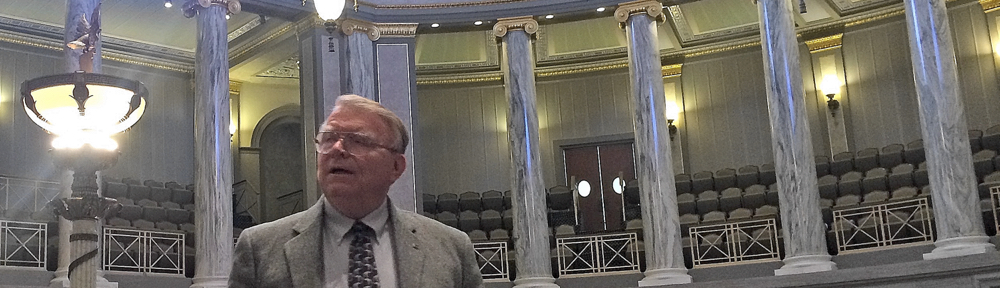
Elson Floyd died June 20. He was 59. Complications from colon cancer.
A lot of people have recalled his four years as University of Missouri System President as a progressive administration at a time when the legislature was deciding higher education wasn’t worth the financial support it had been getting. The economy was in bad shape after the 2001 terrorist attacks, you might remember.
The student newspaper at the University of Missouri-Columbia, The Maneater, takes credit for giving Floyd his nickname, E-Flo. Floyd was a personable president who enjoyed his relationships with students. He left in 2007 to become the President of Washington State University.
He took over at Missouri when the legislature was cutting the university budget by $200 million. Floyd made painful cuts and worked hard to keep tuition as affordable as possible under the circumstances but the university still increased tuition by twenty percent in his first year in office.
Floyd is remembered by many because he tried to get Northwest Missouri State into the University of Missouri System. He convinced the university system to prohibit discrimination on the basis of sexual orientation. Two university research parks were started while he was there. Scholarships were increased for disadvantaged students. Enrollment increased. He elevated the university’s image as a significant part of state economic development.
His tenure was blemished by basketball player Ricky Clemons, who left a Columbia halfway house to attend a July 4th party at the Floyd house. He had to deal with a faculty mutiny at UMKC because of the behavior of the campus chancellor.
But I remember him because he made a phone call real early one morning.
Southwest Missouri State University for years had wanted to change its name to Missouri State University and the push intensified in 2005. The University of Missouri quickly adopted a bunker mentality and started forecasting that the sky would fall if the second-largest university in the state were allowed to change its name. Forget that most other states have a ”________ State.” Forget that Southwest Missouri State had long ago outgrown its regional name. Columbia campus partisans were convinced the University of Missouri would be devastated if not destroyed if Southwest Missouri State changed its name. Mizzou was the state’s foremost research university and its status would be threatened if that bunch in Springfield were allowed to change the school name and keep growing in influence.
The Mizzou Alumni Association tried to mobilize the alumni to overwhelm lawmakers with opposition. Heck, ten members of the Senate in 2005 had degrees from the Columbia campus. Five more had degrees from UMKC or UMSL. Only four were graduates of Southwest Missouri State. If all of the Missouri system graduates in the Senate opposed the idea, it wouldn’t fly. But not all of them did.
The Alumni Association showed no interest in rational discussion of the issues. It became an accelerator-to-the-firewall opposition organ for UMC. This MU grad who got the fevered letters and the alumni magazine with its over-the-top condemnation of the very idea of a name change for Southwest Missouri State wondered if the folks in Columbia were suffering a worrying decline in rationality. Some pointed letters to the association went back from an address that coincides with the house where I live or from my email address in response to the “fire in the theatre” emails I was getting.
Those exchanges are probably in a file somewhere. In one of them I suggested it would be more proper for the state’s leading university to support the efforts of all institutions of higher education to lift themselves to a higher standing and standard instead of trying to pound one growing university back into its place. I thought Southwest Missouri State president Charles Keiser had a good point when he said, “The name doesn’t describe something the University wants to become; it describes what we are,” Keiser and Elson Floyd had been discussing the issue for some time.
Late in the game, UMC partisans came up with the most outlandish claim of all. UMC’s status is carved in stone and cannot be changed, they claimed. They pointed to the words “State University” carved into part of the stone wall of the resources museum at the capitol to mean that the University of Missouri is THE state university and therefore no other school can call itself Missouri State University.
The words were carved about 1915 when Missouri had one state university and a series of regional normal schools, or teachers colleges. It was not important in 2005 that Missouri’s normal school were or had been re-named (Region) STATE UNIVERSITY. I pointed out that the words were carved in the same wing of the state museum that listed the state’s other resources then, some of which had lost their status as primary resources in the years since. The folks in Columbia also didn’t take too kindly to the idea that if opponents of Southwest Missouri State’s name change wanted things to stay as they had been in 1915 they should be glad for the legislature to cut funding for UMC to 1915 levels, including salaries of faculty and administrators.
All of the alarms UMC was sounding didn’t keep the House from passing the name change bill, overwhelmingly, 120-35. When it got to the Senate, Columbia Senator Chuck Graham (a University of Illinois graduate representing the University of Missouri) launched a filibuster, hoping to kill the bill. He seized the floor about 7:30 on a February night.
While Graham and a few friends rattled on and on about what a terrible thing this would be, negotiations were going on behind the scenes. SMS had a couple of people trying to find some language that would make sure SMS would not gobble up the Columbia campus if the bill passed. I was at the press table watching all of this play out, hoping the talkathon would end before I had to drag myself to the Missourinet newsroom to do my morning newscasts.
About 3:30 a.m., Graham or one of his cohorts—I think it was Graham—said he’d relinquish the floor if Floyd asked him to. That led one of the SMS negotiators to call Floyd, who called the University curators. That’s when he called the capitol and said it was time to end all of this. Stop the filibuster. Let the bill come to a vote. I was in the newsroom by then, listening to the ongoing debate on the internet while preparing the morning’s newscasts.
But Mizzou wanted a pound or two of flesh. About 5:30 a.m., Graham—as I recall—met with one of the SMS folks and demanded some protective wording be added to the bill that limited what Missouri State University could do. SMS could never become a land-grant university, which meant that the school could not get federal funding that goes with the designation. It couldn’t offer professional programs duplicating those in Columbia. It can’t call itself a research institution. In retrospect, the changes appear to be more about saving some face for the Columbia interests than burdening Missouri State University.
So the bill was passed at about 7 a.m. The House approved the amendment and sent the bill to Governor Matt Blunt who signed it on March 17, saying “There was a real spirit of cooperation on this. President Keiser and Dr. Floyd were able to understand that they could work together to provide the degree programs that will be beneficial to Missouri students.”
I don’t recall the University Alumni Association making any such graceful statements afterward.
That was ten years ago this year. And what do we see this decade later?
Well, the columns are still standing in Columbia. Jesse Hall has not collapsed. The University of Missouri-Columbia has built a lot of new buildings and is fixing up old ones and the student population has boomed so much that student apartments are being thrown up all over the place, and there are no pieces of the sky laying on the ground.
Claudette Riley looked at what has happened to Missouri State in the decade since that long night and the months of overwrought rhetoric coming out of the Columbia campus in an article in the Springfield News-Leader on June 22, two days after Elson Floyd’s death. “The new moniker is widely credited with raising the profile of Springfield’s largest education institution. It has also been credited with fueling the university’s ongoing ush to grow and diversity enrollment, expand academic offerings, and increase private giving—which, in turn, helps pay for better buildings,” she wrote.
Today’s school president, Clif Smart, is quoted as saying, “It would be hard for you to pick a factor that the name change didn’t impact.” And the VP for research and economic development and international programs, jim Baker, told her, “There is a status attached to the name. There is a pride that goes with it. I don’t think we’d have 24,000 students now if we didn’t change the name.”
One result that Columbia partisans would have shuddered at the thought of a decade ago is what Riley calls “MSU’s strong, collaborative relationship with the University of Missouri system.” Smart says MSU and UMC are now closer to being partners, noting, “We are a statewide university and they’re much more comfortable interacting with us.”
At a time when the University of Missouri was at its blustering, intimidating best, its president said it was time to stop, and let another school call itself what it already was.
The tributes to E-Flo that this scribe has seen haven’t mentioned what might be his greatest and still growing legacy. He was the man who made a phone call early one morning that changed higher education in Missouri. A statesman called a politician one day and generations will benefit from the opportunities they will have because he did.


