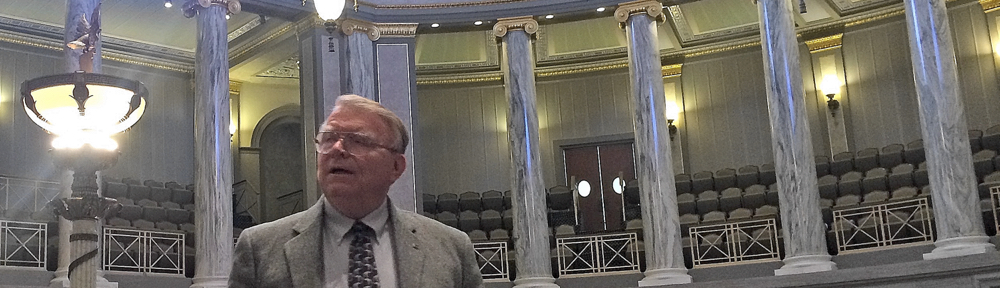
Leaving the Pulpit

(I bought my first computer from a former priest who was married to a former nun. Dr. Frank Crane, who we feature each Monday, left the Methodist pulpit to become a newspaper columnist.  He explained, “I began to find out that I did not fit as a denominational leader…I was not interested in denominational aims…There never was any clash over doctrines. I believed, and still believed, in the great fundamentals the church stands for. But the machinery repelled me. I could not throw myself into the great and fascinating business of propagandizing the essentials because I had to work too hard at the nonessentials…My whole aim and enthusiasm is for the individual, not for the corporate body.” A century after he wrote those words, mainline churches are pondering what to do—not with ministers who leave the pulpit, but young people who don’t come through the doors.  Dr. Crane left the formal ministry voluntarily; he was not DEfrocked, but he became one of—-)

THE UNFROCKED

There was a curious banquet held at Paris not long ago. There met a  hundred and fifty former priests and former preachers who did not blush either for their past or for their present.

To one class of men society seems peculiarly unjust: to the unfrocked.  The man who leaves the ministry, no matter how conscientious and sincere his motives, is always look up askance. We persist in regarding him as if were tainted with the flavor of desertion and disloyalty.

Why? Is it not more honorable to leave holy orders, when one no longer believes the articles of faith, or when one is convinced of the inutility of the institution, when the  development of one’s mind and heart has led him honestly to these convictions, than to remain and be insincere?

Does not the church itself believe that an honest layman, no matter  what his views, is better than a dishonest clergyman?

For all that, the rupture between the parson and his organization is  always painful. Laymen hardly welcome him. By a strange illogicality we are usually cold to the men who enter our ranks for conscience’s sake. We mistrust them; we put pressure upon them to conceal their past as something of which to be ashamed; as a rule, they have a hard time making a living.

Among the former clergymen at the banquet mentioned we may note three lawyers, two police magistrates, two farmers, a physician, two artists, two capitalists, one mayor, besides commercial travelers, university professors, accountants, and public school teachers.

They have formed a union which proposes, according to its bylaws,  never to proselyte or in any way attempt to induce men to leave the ministry, but to extend a helping hand to those who, on their own initiative, have severed their ecclesiastical ties, and to help them in their endeavors to gain an honest livelihood.

It will do no harm to the church—it can only do good—to make the way as easy as possible for those who have ceased to be in harmony with its faith or its methods to get out.

In most instances men enter the ministry when young. When they arrive at maturity their convictions may in all honor have undergone a change. It should not be taken as a matter of course that their reluctance to continue in the ministry means a loss of religion or of personal integrity. The minister may discover that, while his religious sentiment is as profound as ever, he is not adapted by nature or gifts to be a clergyman.

His retirement from church office may be as heroic and worthy of praise as his entrance into it.

The Unanswered Question

There is an unanswered question that we did not address in Monday’s observation in this space about the governor’s accusation that a newspaper had “hacked” a state education department website.

It is unfortunate that Governor Parson refused to take questions after last week’s press conference in which he said he wants St. Louis Post-Dispatch reporter Josh Renaud criminally charged for notifying the state he had found personal information about thousands of school teachers easily obtainable from a Department of Education website.

Someone should have asked—and we are confident WOULD have asked—“Did the story tell the truth?”

That has been the critical question for 300 years whenever a United States political figure does not like what a reporter has written about him or her—since 1734 when New York’s Royal Governor, William Cosby, jailed newspaper publisher John Peter Zenger for eight months on a charge of libel.  Cosby proclaimed Zenger’s criticisms of his actions amounted to “divers scandalous, virulent, false and seditious reflections,” an 18th Century equivalent, perhaps, to Governor Parson’s complaint that the Post-Dispatch and Renaud were involved in a “political game” intended to “embarrass the state and sell headlines for their news outlet.”

The jury in the Zenger trial was out for only ten minutes before finding him not guilty. His  attorney had argued that a statement cannot be libelous if it is true regardless of the discomfort it causes someone, in this case the Royal Governor. More than fifty years later, Freedom of the Press became part of the nation’s constitution.

More than a century ago, a Missouri Capitol reporter was jailed for reporting the truth. Robert Holloway of the long-defunct St. Louis Republic was jailed after reporting in 1917 that a Cole County Grand Jury had indicted a top state official for selling coal from the state’s coal supply.  The official was John W. Scott, the former Commissioner of the Permanent Seat of Government.  Holloway also reported the grand jury was investigating whether Penitentiary Warden D. C. McClung improperly used state property. Grand jury proceedings, even today, are supposed to be secret.

His story ran before any indictments had been made public, leading the judge who had convened the grand jury to haul Holloway before him to tell where he had gotten his information. When Holloway refused to reveal his source, the judge jailed him until he talked, or until that grand jury’s term ran out. The Missouri Supreme Court upheld the order.

State Historical Society Executive Director Gary Kremer, who wrote about the Holloway case for the Jefferson City newspaper several years ago, has a picture of Holloway seated at his typewriter next to a barred jail window as he continued to report, his stories datelined “Cole County Jail.” He finally was released after two months on a promise to appear before a new grand jury if it called him.  It refused to take up the whole issue when it was convened. Those who had been indicted by the earlier grand jury were found not guilty.  Holloway remained a reporter, off and on, for most of the next three decades.

But he remains, as far as we have been able to determine, the only Capitol reporter ever jailed by the state of Missouri for telling the truth.

The governor’s call for Cole County Prosecutor Locke Thompson to take action against the newspaper gives Thompson a lot to think about.  There’s the First Amendment protection of press freedom. The newspaper attorney doubts the state’s law on computer tampering sufficiently applies to this case because the computer code allowing anyone to access the information was readily available through the Department of Education’s website.

There might also be a question of whether the state law on computer tampering is unconstitutional prior restraint on reporting information gained through legal means from a state computer. And proving the newspaper published the information with malicious or criminal intent will be difficult.  To the contrary, the newspaper’s actions to withhold the story until the department fixed the problem the investigation pinpointed is a strong argument against criminal intent.

But the basic question remains.  Did the reporter tell the truth?  There is no acceptable “yes, but” response. Zenger-Holloway-Renaud (or the name of any reporter since 1734) are linked together by that question.

And that is the only question that matters.

Racing: Larson is first of four

by Bob Priddy  Missourinet Contributing Editor

(NASCAR)—NASCAR’s hottest driver of 2021 has guaranteed himself a shot at the Cup championship.  Kyle Larson held off teammate William Byron through restart after restart to win the last 500-mile race of the year, finishing half a second in front at Texas Speedway. It’s his eighth win of the year and makes him the first driver assured of being one of four drivers to race for the championship at Phoenix November 7.

Larson, who led 256 of the 334 laps could not get Byron out of his rear view mirror in several restarts in the last phase of the race. Although he dominated the race, six restarts in the last race stage—four of them in the last 30 laps—challenged him to get the break ahead of the bunched-up field before the driver in the outside lane, usually Byron, could nose ahead. Christopher Bell, Brad Keselowski, and Kevin Harvick rounded out the top five in the race.  Bell and Harvick dropped out of playoff picture last week.

Three drivers among the eight semi-finalists filled the next three positions at Texas: Ryan Blaney, defending champion Chase Elliott, and Kyle Busch. Denny Hamlin kept his championship hopes alive despite a spin with 21 laps left that dropped him to last among cars on the leader’s lap and a crash with seven laps remaining. His pit crew kept his car operable and he brought it home 11th.  Fifteen cars finished on the lead lap.

The eighth contender, Joey Logano, suffered a rare engine failure and wound up 30th, putting him in a must-win situation in the remaining two races of this playoff stage if he is to contend for the championship.

Larson, Blaney, Hamlin, and Busch hold the top four spots. Elliott is five points below the cut line. Brad Keselowski trails by 15. Martin Truex Jr., who left the race with twenty laps left, is down 22. Logano is eighth.

The playoffs continue at the Kansas Speedway next Sunday.

(INDYCAR)—Alex Palou, the new INDYCAR champion, won his championship on a road course he’d never visited before.  But he had driven the course a lot.

Palou, on Dale Earnhardt Junior’s podcast (IndyCar Champion Alex Palou: “You Get More Into Fights Than Us” – YouTube), explained, “I’d never been there. It’s like the most important race of my life.”   So he want iRacing—driving a computer program that simulated the Long Beach track.  ‘I needed as many laps as possible. I think I did driving, like, 17-18 hours” in one day.

He went into the race with a healthy lead in points and had to finish only eleventh to clinch the trophy. He finished fourth to become the first Spaniard to win an INDYCAR title, the seventh youngest champion and the first driver younger than 25 to win a championship since teammate Scott Dixon got the first of his six eighteen years ago (he’s 24).

Palou has a special diet when he wins a race—a big chicken dinner.  He told USA Today’s “For the Win” podcast that the custom began when he was racing in Japan where “you don’t have the food we normally have…So the only thing that was similar was Spanish food—and it was bad food for you; it’s not salad—it was fried chicken. And I love friend chicken…So it was a perfect fit.”

Since winning the championship, he’s been making a lot of appearances and “I think I’ve had loads of fried chicken.”

He has also had a chance to see a different kind of racing close-up.  He was at Charlotte earlier this month for the race on the Charlotte Roval, the combination of oval and road course. “There is nothing close to a NASCAR stock car,” he said.  The car is huge. It’s mind-blowing. It’s a really big car.  That is what makes NASCAR so amazing on track—lots of weight, lots of power. It’s difficult for the drivers to handle.”

Would he like to strap in one?  Of course. He’s a racer.  But just for some test laps.  Open-wheel racing is still his thing.

(FORMULA 1)—No wheels turned in competition in F1 this week.  Max Verstappen and Lewis Hamilton renew their hot rivalry for the championship Sunday at the Circuit of the Americas near Austin, Texas. Verstappen took a six-point lead on Hamilton at the Turkish Grand Prix a week ago.

Formula 1 has six races left this year, including Austin. It finishes up on December 12 in Abu Dhabi.

(picture credits: Bob Priddy and Dirty Mo Media/Youtube).


It’s What We Do

We are replacing today’s usual reflection on life by Dr. Frank Crane with a reflection on a regrettable reaction by our governor to a good piece of journalism in which the journalist did what journalists are supposed to do journalistically and did what a good citizen should have done ethically.

In all my years of covering Missouri politics I have never heard of any of our top leaders suggest a reporter should be jailed for giving the state a chance to correct a serious problem before a story was published.

Let’s be clear:

There is nothing wrong with testing whether the information about us held by government is safely held.  You would expect a journalist to defend another journalist who was able to prove some private information held by the Department of Elementary and Secondary Education wasn’t so private after all.

And I am.

Good journalists test and challenge systems, people, programs, and policies to see if they are what they claim to be.  It’s a responsibility we have.  If I can get information about you that the government claims is protected, how safe are you from those who want that information for malicious purposes?

We were involved in just such an issue many years ago and it exposed a weakness in state government that could have exposed everybody’s most important private information.  This is the story, as I remember it.

Steve Forsythe was the bureau chief for United Press International back then. In those days there were two highly-competitive national wire services.  Steve’s office in the capitol was next door to the Associated Press office in room 200 , which now is carved up into several legislative offices.

One day, Steve called the Department of Revenue because he couldn’t find his previous year’s income tax return, something he needed for the current year’s return.  Could the department send him a copy of his previous year’s return?  Yes, he was told. What’s your address? And a few days later it showed up in his mail box.

Steve was a helluva reporter who instantly realized what had happened.   The Missourinet was a UPI client.  He called me and we talked about what he had learned and we decided on a test.

We lured one of State Auditor Jim Antonio’s employees to call the department and use the same line that Steve had used. The department gladly agreed to mail the previous year’s tax return to her.

—except the return she asked for was that of State Revenue Director Gerald Goldberg.   And the address she gave was mine.

A few days later, a fat envelope arrived in my mailbox.

Steve and I went to the Jefferson Building that afternoon and, as I recall it, stopped Director Goldberg in the lobby as he was returning from lunch.  I handed him the envelope and asked him to open it.  He was stunned to see his personal state income tax return inside it.  There was a brief moment of, I suppose we could say, anger. But as Steve explained to him why we had done what we had done, he calmed down.  On the spot he said he’d immediately look into the situation.  I don’t think he wound up thanking us but we didn’t expect any thanks.

We could have asked for anybody’s tax return, I suppose, even Governor Teasdale’s although that might have been a harder ask.  But this was bad enough.

There naturally was a certain amount of hand-wringing and anguish and probably some hostile thoughts about two reporters who were not known as friendly toward the administration to begin with pulling a stunt like this. But rather quickly, the department recognized that we had not opened that envelope and we had not looked at the director’s return, had not made any beneficial use of the information, had not yet run a story, and that we certainly did not intend anything malicious in our actions.

Antonio was less than enthusiastic that we had used one of his trusted employees as a tool for our investigation, but he also recognized the problem we had pinpointed.

The department almost immediately changed its policies to outlaw accepting telephone requests such as the ones that led to the stories UPI and The Missourinet later ran and instituted a process designed to protect the confidentiality of those returns.

From time to time in later years I wondered if I should see if the department’s policies had slipped back to those days when Steve and I embarrassed it.   But I never did.   Every year, Nancy and I file our state tax returns and assume you can’t have them mailed to you with just a phone call.

I suppose Governor Teasdale could have demanded a criminal investigation of our actions but he didn’t.  His Department of Revenue just fixed the problem.  Steve went on to a long career with UPI, which eventually lost in the competition for wire service clients to the AP and closed its capitol bureau.  I went on to a long career with The Missourinet, which still serves a lot of radio stations in Missouri. We didn’t often care if we ruffled some feathers from time to time as long as we were reporting the truth—and that always was our goal.

Good reporters do what they are called to do—question, investigate, test, and report.  Sometimes those whose skirts that turn out to be dustier than they think they are don’t like the findings.

One big difference between the days when Steve’s tax return and the security of private information turned into a state policy-changing news story and today, when a reporter’s news story about the security of private information has led to threatened criminal charges, is the change in times. We are living in stressful times that not only breed physical and political disease, but tend to breed reactions that are less prudent than necessary.

But that won’t discourage good reporters from doing what they have a calling to do.  And the day it does, all of us are losers, even those who are embarrassed by what reporters find.


Food at It’s Best

“Ignorance and laziness have won,” said retired British journalist John Richards a while ago.

Richards, who turned 96 when he made that observation, started the Apostrophe Protection Society about twenty years ago.  He crusaded for the correct use of the “much abused” apostrophe.  But he has given up.   He told the London Evening Standard late in 2019 there were two reasons for disbanding his organization: “One is that at 96 I am cutting back on my commitments and the second is that fewer organisations and individuals are now caring about the correct use of the apostrophe in the English Language. We, and our many supporters worldwide, have done our best but the ignorance and laziness present in modern times have won.”

His society was a small one.  Depressingly small, it seems.  He told the Standard he started the APS after he saw the “same mistakes over and over again.”  He hoped to find a half-dozen people who felt the same way.  He didn’t find a half-dozen.  Within a month of his announcement of the founding of the society, he said, “I received over 500 letters of support, not only from all corners of the United Kingdom, but also from America, Australia, France, Sweden, Hong Kong and Canada.

But that wasn’t enough (Note the apostrophe).

That sentence is an example of one of the three simple rules Richards has given for proper use of the apostrophe.

  1. They are used to denote a missing letter or letters.
  2. They are used to denote possession.
  3. Apostrophes are never used to denote plurals.

And there’s a corollary.  “It’s” only means “it is.”  The possessive version is “its.”  The cat had its breakfast.

Otherwise, this sign says “Food at it is best.”  The Towne Grill in Jefferson City isn’t (note the proper use of the apostrophe to symbolize the elimination of the letter “o”) going to change its (note proper use of the possessive) sign.  It has become an institution in Missouri’s capital city, a quirky but incorrect use of the apostrophe that is part of the city’s (proper use of the apostrophe to denote the possessive) culture.

The Apostrophe Protection Society seems so English.  The story about it reminded us of Professor Henry Higgins in Lerner & Lowe’s Broadway musical “My Fair Lady,” of a half-century ago.  Professor Higgins decided to teach an untutored London flower girl to speak proper English and lamented:

An Englishman’s way of speaking absolutely classifies him
The moment he talks he makes some other Englishman despise him
One common language I’m afraid we’ll never get
Oh, why can’t the English learn to

Set a good example to people whose
English is painful to your ears?
The Scots and the Irish leave you close to tears
There even are places where English completely disappears

In America, they haven’t used it for years!

To end this on a couple of more serious notes:

First, John Richards died earlier this year—March 30.  He was 97. Mr. Richards’s Washington Post obituary is at: https://www.washingtonpost.com/local/obituaries/john-richards-dead/2021/04/25/9c7c1994-a425-11eb-a774-7b47ceb36ee8_story.html.

Second, I had a friend named Ed Bliss who used to write news for Edward R. Murrow and Walter Cronkite at CBS.  Ed, who died several years ago, often conducted newswriting seminars at our conventions of news directors. I can still hear him say, “We have become a nation slovenly with language. The slovenliness in grammar, punctuation, and spelling is all about us.”

If we lack respect for our language in speaking and writing, we limit our abilities as a people to communicate effectively and we damage the trust we can have in one another. Today, we shout more than we speak; we talk but we don’t listen; we tweet more than we write; we dismiss one another with disparaging personal assessments.  In the midst of this noise, this transformation of the grace of our language into crudeness, it is no wonder that a group that upheld something as small as an apostrophe should feel that “ignorance and laziness” have won.

It’s not just the continued improper use of apostrophes that should concern us.  Our language deserves better use than we are making of it. We cannot respect one another if we do not respect the language we use with one another.


Racing:  Eight Remain in the Hunt

By Bob Priddy, Missourinet Contributing Editor

(NASCAR)—-From sixteen to twelve, and now only eight drivers remain in the fight for NASCAR’s 2021 Cup championship.

Adding color to the competition are two guys, one still in the championship hunt and one who knocked himself out of it in the cutdown race at the Charlotte Roval.

Kyle Larson climbed all the way to the winner’s circle after an early race mishap, getting his seventh win of the year.  He has the top seed in the three-race series that will cut the final competitors to four for the last race of the year.

Larson’s alternator lost its belt and his battery started going flat at the end of the second stage of the race. But his pit crew put in a new battery and put on a new alternator belt—without losing a lap. However, he had dropped from 6th to 36th when he got back on the track. But he carved his way through the field and back into the top ten with 31 laps left and was second with eleven laps left. He got past Denny Hamlin for the lead with eight laps left and beat Tyler Reddick to the flag by about eight-tenths of a second.

Hamlin has the second seed for the next round with Martin Truex Jr., Ryan Blaney and Kyle Busch filing the rest of the top five positions.  The remaining three drivers are Chase Elliott, Joey Logano, and Brad Keselowski.

Kevin Harvick took himself out of title contention when he charged too hard into the first turn with eleven laps left, trying to stay ahead of Elliott and Truex, and went straight into the SAFER barrier.  His departure from the race was good news to Elliott with whom he has had a metal-bending feud going since the Bristol race three weeks ago when Harvick accused Elliott of denying him his first win of the year. Earlier in the race, Harvick had bumped Elliot into the turn eight wall, damaging the rear of the defending NASCAR champion’s car and jeopardizing his chances of advancing in the playoffs.

Elliott’s crew taped the pieces together so he could continue and he wound twelfth.  Harvick’s self-elimination put him 33rd for the day and out of the final eight for the first time since NASCAR went to the current playoff system.

Neither driver showed any contrition about their on-track ongoing dispute, which NASCAR noticed.

NASCAR’s senior vice-president for competition, Scott Miller, told SirusXM radio the Harvick-Elliott snit has to come to an end. “We spoke to them after the thing at Bristol…We don’t need that continuing on and we’ll do what we think is necessary to kind of get that one calmed down.”

Harvick was joined by Christopher Bell, Kurt Busch and Tyler Reddick as drivers no longer contending for the championship.

Unlike stick-and-ball sports, NASCAR playoffs are not a win-or-go home proposition. The four eliminated drivers will still be racing wins in the last four races.

(INDYCAR)—More driver lineups are falling into place for the 2022 INDYCAR season.

Jack Harvey will be in the Rahal-Letterman-Lanigan car next year, replacing Santino Ferrucci.  Ferrucci is believed to be in the running for the third RLL seat that had been occupied by Takuma Sato in 2021.  Sato says his chances of a season-long INDYCAR ride next year are only about 50-50 although he is rumored to be under consideration by Dale Coyne and Rick Ware’s team.  Graham Rahal drives the other team car.

Simon Pagenaud has left Penske and has signed with Meyer-Shank Racing, taking the seat Harvey had held in 2021. He’ll team with Helio Castroneves for a full 2022 schedule.

(FORMULA 1)—Frequent F1 bridesmaid Valtteri Bottas inherited pole position for the Turkish Grand Prix when teammate Lewis Hamilton was penalized ten starting positions for an engine change and refused to give up first place afterwards.  He finished almost fifteen seconds ahead of Max Verstappen in a race dogged by rain.

Verstappen reclaimed the Formula 1 points lead over Hamilton, who finished tenth and thought he would have done much better if he had not been called to the pits for new tires with seven laps to go while running third.  He wound up fifth and dropped out of the points lead to now trail by six.

(photo credits: Bob Priddy)


Just try being happy

(There are plenty of reasons to be down in the dumps.  Politics. Health. Lousy football results. Masks. The ongoing hassles of the pandemic. Dr. Frank Crane suggests your problem might be the result of just not trying hard enough to be happy.  He calls it —)

THE MIRTH CURE

There are all manner of cures, from mud baths and Perkins’s Patent Porous Plaster up to  Thought Vibrations, but the grandest of all is the Mirth Cure.

It keeps well in any climate, is guaranteed under the pure food and drug law, doesn’t cost a cent, and has helped others. Why not you?

The formula is found in the writings of the wisest man, who was a Jewish king and philosopher. He said: “A merry heart doeth good like a medicine.”

Note—he did not say a merry wife, though she certainly does good (perhaps he had too many wives and was afraid he would be asked which one). He did not say a merry husband, though he helps some. Nor did he say merry children, nor a merry house, nor a merry occupation, nor any such thing.

For his wise old eyes saw too deeply into life to make the mistake of supposing that circumstances are the root of joy. He knew that the real fountain of mirth is the heart.

If you have a merry heart it makes no difference what may be your position, whether you be a tramp on the road, a scrubwoman in an office building, a brakeman, a street car conductor, a merchant man, or even a college president. You are an electric light in the fog of human    despondency, sunshine breaking through earth sorrow clouds, water to parched souls.

Did you ever hear the story of “The Happy Man’s Shirt?” It is an old one, but one of those that ought constantly be re-told.

There was once a king who was smitten with sadness and disgust of life. He had gorged at all human pleasures, could no more be amused, and now was like to die.

They called in the soothsayers and medicine men, but none could suggest a remedy. At last they sent to an old hermit who lived in the wood, who said, “The case is simple. Let the king sleep all night in a happy man’s shirt, and he will be healed.”

Whereupon the king ordered that the palace be searched, a happy man be found and his shirt brought. But no happy man could be discovered in the palace.

Then they sought through the city and then throughout the length and breadth of the kingdom, but no man could they lay hands upon who would declare, without reservation or secret evasion of mind whatever, that he was entirely happy.

A little group of the king’s courtiers was returning home disconsolate, and as they rode along the highway they espied a beggar sitting under a tree, playing with the autumn leaves and smiling to himself.

“Hola!” they shouted. “Are you happy?”

“Surely!” replied the beggar.

“Why, you’re nothing but a beggar! You don’t know where you are going to get your dinner, do you?”

“Oh, no. But it isn’t dinner time yet. I had a good breakfast.”

Then they told him of the king’s plight and besought him to give them  his shirt forthwith, adding that it should be returned to him filled with gold pieces.

At that the ragged man lay back on the grass and laughed as if he  would expire.

“Come,” said the royal attendants, “We have no time for trifling. Off with your shirt, or we will jerk it off.”

“Hold hard, gentlemen,” said the beggar, striving to control his mirth.  “That is just what I am laughing at. I Ain’t Got No shirt!”

So they went and told the king that but one happy man could be  unearthed in all his realm, and that one was shirtless.

And the king had sense enough to perceive that happiness does not  depend on the shirt you sleep in, nor the bed on which you lie, nor the house that covers you— no, nor any external thing, but comes from the heart within you.

Thus was he cured, and arose and went about his business; and thus  also may you be cured, if so be that there is still left unparalyzed in you the power to think.

The Pro Tem

Jim Mathewson died a few days ago.  He was one of a dwindling number of state senators from a different era when “Senator” wasn’t a word; it was an honor.

It was a pre-term limits Senate before Missourians hypocritically denied themselves the right to vote for legislators they wanted to continue representing them.

It was the era of Harold Caskey and John Schneider, of A. Clifford Jones and Emory Melton, of John Russell and Wayne Goode, Betty Sims and Harry Wiggins, Danny Staples, Morris Westfall and others who respected the institution and honored its written and unwritten rules, who treated the Senate as a body rather than a series of factions.  It was a Senate where the filibuster was a legitimate tactic because the majority on any issue knew it might be the minority on any other issue and the object was compromise that produced progress, before a time when an unyielding steamroller ignored the possibility that someday roles might be reversed and a time might someday come when payback would be a steamroller run by the other side.

It was a time of bare-knuckle politics, have no doubt about that. But eye-gouging and rabbit punches weren’t tolerated.

Jim Mathewson was the leader of the state senate for eight years.  Nobody will ever equal that record or even match it as long as good men and good women are banished from public service because voters fell for the pitch of those who capitalized on the idea that those we trust in our elections every two or four  years instantly become untrustworthy.

Jim Mathewson was a Horatio Alger story, a poor boy who made good because he never gave up, eventually rising to what he argued was the most powerful office in state government, more powerful than the governor, in fact.

He was elected to the House in 1974, then moved up to the Senate in 1980. He was born on a forty-acre farm in Benton County to a “very poor” family. He father left when he was five years old and although he came back six years later, the two were never close. The fact that the family was poor, and he knew it was poor, was a motivating factor in his life. He told a State Historical Society interviewer, “I think it made me meaner and tougher and harder working.”

For a time he and his wife, Doris, ran a steakhouse in Sedalia until it burned down and there was little insurance. Some friends, seeing he had no real livelihood, decided to file him for State Representative, something Mathewson had no interest in being. He beat an incumbent, though, and got elected to a job paying, then, $8,400 a year, about one-eighth what he was making with the steakhouse.

“I got hooked!” he told the interviewer, “and I got hooked bad.”  He was a personable guy and a few years later he started getting some important committee assignments. And he started building bridges. “I’m of the Democrat philosophy, but I’ve never been offended by anyone that was of the Republican philosophy. We just happened to think different on some issues. I believe that Republicans love their family just like I love mine. I believe that they’re Christians just like I believe I am. I believe that they’re going to go to Heaven just like I am. They’re just kind of warped in their thought process about [things] while they’re here. Okay? (chuckling) And I say that jokingly, because I have probably as many friends that are Republicans as I do Democrats.”

Pure Mathewson. Taking his work seriously but not himself (a fellow Capitol reporter remarked a few years later that it seemed legislators had gotten that idea backward—and, frankly, sometimes it seems he is right).

But he was so focused on being a legislator that he wasn’t making much money in the real world. He narrowly avoided bankruptcy only because the father he hardly knew left enough in his estate for Mathewson to pay off debts. He was able to re-establish himself as a businessman in Sedalia.  He began to rise in authority and popularity among fellow Democrats in the Senate and in 1988 he was elected President Pro Tem, the leader of the Senate.

Why did he want the job?   “The power,” he openly admitted.  “The President Pro Tem of the Senate in many, many ways is the most powerful person there is in the state of Missouri. Even more powerful than the Governor because you control all the gubernatorial appointments! And a Governor cannot appoint anyone if they can’t get it by the President Pro Tem of the Senate. Because the President Pro Tem of the Senate is usually smart enough to make themselves chairman of the Gubernatorial Appointments Committee. And the President Pro Tem appoints all the committees, including the all-powerful Appropriations Committee where all the budget comes from. Not only do appoint the chair, but you appoint the members. So generally you have control over that, as you do over most of the committees — or all the committees, really, because you appoint all the chairs. So you know, I wanted to be that person. I wanted to feel that I was not only a person who could be a follower but I wanted to prove that I could be a person that was a leader. It was a unanimous election in our caucus and on the floor every time. So I feel awfully proud of that. It was a good thing.”

He thought he could have been elected for another term but felt it was time for someone else. A few years later, Republicans gained control of the Senate and the last few years were nowhere nearly as rewarding as the rest of his career had been.  The take-no-prisoners style of the new majority grated on a man who thought he had helped maintain the historically collegial atmosphere of the chamber—“the body,” he called it.

There’s one other thing about Jim Mathewson to tell you about.  He was the first Senate President Pro Tem to occupy the physical office of the Pro Tem.  The room complex next to the south end of the Senate Lounge had been the office of the President of the Senate, the Lieutenant Governor, from the day the Capitol was first occupied.  I tell about it in the Capitol history book that I hope goes to the publisher before the end of the year:

The Senate takeover of the Lieutenant Governor’s office space finally happened in the fall of 1988 through the efforts of outgoing President Pro Tem John Scott, who had grown tired of dashing back and forth from his fourth floor office to the Senate Chamber. Senator Jim Mathewson of Sedalia, the incoming President Pro Tem, remembered that Scott approached him at the end of the September veto session and said, “Don’t you think it’s a darned shame that all of these years that the Speaker’s had that office right there on the corner where he can have meetings?”


It’s convenient. Everybody knows where it is and they all run in there and they meet and they settle issues and so forth, press conferences and whatever, and we have to use our individual offices when we’re President pro-Tem, and we hold the same power as does the Speaker.  Why don’t we create a special President pro-Tem’s office?


Mathewson asked, “Which one d’you have in mind?” Scott answered, “The Lieutenant Governor’s office.” Scott and Mathewson decided to enlist the support of the Senate’s top Republican, Richard Webster…Webster had done some research and told them, “The truth of the matter is there’s no provision in the constitution or the statutes that says the Lieutenant Governor even gets an office.” Scott introduced a resolution at the end of the veto session that let the Senate take control of the office after that year’s election. 

            Shortly after Mel Carnahan won the Lieutenant Governorship, he asked Mathewson not to kick him out of the office.  “Yeah, Mel, I am,” Mathewson told him,


And he said, “You can’t do that.” And I said, “Yeah, I can.”  And he said, “Well, by what authority?’ And I said, “We did the research. That office belongs to the Senate. The Senate voted…that the Pro Tem would have that office, and I guess that’s me, Mel, because the caucus just elected me and we’ve got twenty-two votes. I think I’m probably going to be Pro-Tem.” And he…got red-faced as hell…and said, “You’re not going to do this.” And I said, “Yeah, I am, Mel. Gonna do it.  Sorry.”


Carnahan threatened a lawsuit but Mathewson played hardball: “You can do that but let me remind you of something that’s just going to offend you further…You don’t have a great big budget already. You take on the Senate and you won’t have any.” Carnahan stomped out of Mathewson’s office, returning more cool-headed a few days later to ask Mathewson what could be done if he accepted the plan.  Mathewson, Scott, Webster, and Carnahan quickly went to the first floor to look at a complex of Senate staff rooms in the northeast corner of the building. Mathewson told Carnahan the Senate would pay to remodel the space if he would take it. Carnahan agreed a few days later.  Mathewson kept his promise to have the new office ready for Carnahan by the time he was sworn in at the start of 1989.

A few years later, then-Lt. Governor Peter Kinder convinced his friend from Cape Girardeau, Senate Administrator Mike Keathley, to have the auditor swap office spaces with the Lt. Governor’s office space.

Mathewson couldn’t run for another term in 2004. He seldom returned to the Capitol. His day was already slipping away, his desk in the chamber and his office occupied by a new generation of Senators.

Are they worse people than Jim Mathewson was?  As people, I don’t think so.  As Senators, as Jim and the others of his era might perceive them in their behavior as senators, maybe.

But comparing generations against each other is hard and risks being unfair because nostalgia is not fair. Perhaps it is accurate to say that today’s senators are not like yesterday’s senators. Sometimes the old lions growling in the weeds who remember those of the Mathewson generation think “Senator” has become just a word. It will be interesting to hear the eulogies (many years from now, we hope) for those who have come after his era.

He concluded his interview with the State Historical Society by saying:

“You know, sometimes you’ve got to hang your life out there. And I have time and time again, and I’m proud of the fact that I did it and I have no regrets! My attitude is this: If the issue is important enough to do, then it’s more important than my political future. And I’ll do it.”

That’s worth thinking about.

(If you want to read Jim’s entire interview—and those of us who knew him can hear his voice as we read the transcript—go to “James L. Mathewson State Historical Society oral history” and click on the icon on the upper right for a download.)

Racing: History at Talladega

By Bob Priddy, Missourinet Contributing Editor

(NASCAR)—William Darrell Wallace, known to friends and fans as “Bubba,” has been declared the winner of the rain-shortened race at Talladega, a historic win at a track with great historic significance to the first African-American driver to win a race in NASCAR’s highest division in 57 years.

Wallace, the only black driver in NASCAR Cup competition, drives for a new team owned by basketball star Michael Jordan and fellow driver Denny Hamlin.  The race, postponed from Sunday because of rain, was called after 117 of the scheduled 188 laps Monday because of more rain.  Wallace, who had started 19th, drove his way to the front five laps from the end, passing Kurt Busch to become the 19th driver to lead the race on the track that traditionally features nose-to-tail racing and at least one big crash.  A wreck on the 116th lap, just before the rains came, froze the field with Wallace at the head of the pack.

Restrictor plate races at the big high-banked tracks of Daytona and Talladega are traditionally mad and unpredictable scrambles but Wallace has shown flashes of strength in those races.  He has finished second twice at Daytona although his best previous finish at Talladega was 14th.

He finished ahead of two Ford teammates, Brad Keselowski and Joey Logano.  Bush was squeezed back to fourth, just ahead of Christopher Bell.

The next race, on the Charlotte Roval, will be a cut-down race in which four drivers are eliminated from the chase for the championship.  Kevin Harvick, who led more laps in the Talladega race than any other driver, was shuffled back to eighth when the red flag came out, short-circuiting his hopes of climbing into the top eight in the points chase. He’s nine points out of the playoff field heading to Charlotte.  Christopher Bell’s fifth-place run still leaves him 28 points back.  William Byron, who tangled with two other cars just before the rains hit, is in a must-win situation if he is to advance, as is Alex Bowman, whose chances for a good finished vanished when his car was badly damaged in an early-race wreck with three other competitors.

The victory in the playoff race will not propel Wallace into the next three-race runoff round because he was not among the top sixteen drivers in the points when the regular season ended.

(THE BACKSTORY)—Wallace’s victory was a popular one among his colleagues who showed their support of him by pushing his car to the front of the starting field at Talladega in June, last year, after a noose was reported on the pull-down rope of the door of his garage at the track.  The FBI investigated and determined that the noose had been there since the previous October, at a time when it could not have been predicted Wallace’s team would later use the garage.  Wallace supported the finding.

Wallace was born almost three years after the death of the only other black driver to win a top-level NASCAR race.  His victory comes a little more than 100 years after the birth of Wendell Scott, who passed Richard Petty with 25 laps to go on the half-mile dirt track at Jacksonville Florida in 1964 and went on to win. He was not announced as the winner, however—some say it was because of the racist culture of the time—and the win originally went to Buck Baker, who was two laps behind. NASCAR discovered two hours after the race that Scott had won but he was not officially awarded the win for two more years.  He never received a trophy.  NASCAR presented his family with the trophy he had earned in 2010, seven years before Bubba Wallace ran his first NASCAR Cup race.

Scott ran his last NASCAR race in 1973 but it was injuries he suffered in a crash at Talladega earlier in the year that forced him to retire.  He died in 1990. He never had a sponsor.  His low-budget owner-driver operation nonetheless saw him finish in the top ten in the points standings four times in a thirteen-year, 495-race career.  He finished in the top ten at the end of 147 races.

Bubba Wallace’s team has had full sponsorship all year.  Next year, 23XII Racing (23 was Jordan’s jersey number and XII refers to Hamlin’s car number, 11) will expand to a second car with former NASCAR champion Kurt Busch as driver.

(INDYCAR)—Wheels already are turning for the 2022 INDYCAR season.  The Indianapolis Motor Speedway’s Rookie Orientation Program tomorrow will feature two drivers who focused on road courses this year, Jimmie Johnson and Romain Grosjean.

Johnson, who raced on the track’s road course this year, is not unfamiliar with the big oval. He ran eighteen Brickyard 400s in his NASCAR days and won four times.  But this will be his first time on the oval in an open-wheel car.  He has tested an Indycar on an oval however, running some test laps at the Texas Speedway. He has expressed an interest in running the Indianapolis 500 in May but has not committed to the other ovals on the schedule at Texas, Iowa, and Gateway.

Joining him in getting the feel of the big track is Romain Grosjean, the former Formula 1 driver who built a big following in the series this year.  He got a taste of oval racing late in the season at Gateway’s Worldwide Technology Raceway in August.  It will be his first run for his new team-owner, Michael Andretti.  He’s moving over from Dale Coyne racing.

Before drivers are allowed to run on the Indianapolis oval, they have to prove they can handle it.  The program requires them to run ten laps at 205-210 mph, fifteen more at 210=215, and then 15 laps at more than 215.

The big test will come in May.  In this year’s 33-car starting field, Simona DeSilvestro had the slowest four-lap qualifying run at 228.353. Will Power had the slowest qualifying lap at 227,535.

Scott Dixon sat on the pole at 231.685 with a fast lap of 232.757.

The last NASCAR driver to run the 500 was Kurt Busch, who was the rookie of the year with his sixth place finish in 2014. “The Indianapolis 500 will blow you away,” he said after the race. Johnson could become the nineteenth driver to drive in both the Indianapolis 500 and the Brickyard 400, which was first run in 1994.

(FORMULA 1)—Formula 1 was off last weekend. It resumes racing in Istanbul with the Turkish Grand Prix. Lewis Hamilton is clinging to a two-point lead over Max Verstappen. \

(Photo credits:  Bob Priddy; Wendell Scott—NASCAR Hall of Fame)


The Basic Question

(In our quieter moments, all of us probably have questioned our existence. Most of us find it unprofitable to dwell on the issue because it gets in the way of living. But there are those who (often sequestered) ponder this matter. Do we exist only because of combinations of atoms set in motion billions of years ago by the Big Bang? And if there is life elsewhere in the universe, what will our discovery of it mean to our understanding of what we are and how we became what we are? Dr. Frank Crane is among those who have asked—-)

WHY WAS I BORN?

There is one question upon the answer to which rests the success or failure of life.

It is the question: “Why was I born?”

A strange fact is that nobody knows the answer. The purpose which the Creator had in mind when he made me has never been known, will never be known.

Curious that the most fateful of all problems should be forever  unanswerable!

We may believe this or that to be the reason; we cannot KNOW.

Notwithstanding this fact, the net result of my life depends upon the  THEORY I form to answer this query.

But how can I tell which theory is best when there is no means of knowing which is true?

There is a way to tell which theory is, if not true, at least approximately  true. This way is suggested by what is called PRAGMATISM.

That is to say: That answer to the question is most likely to be true Which WILL WORK .

We cannot answer the question, “Why was I born?” by investigating Causes. The secrets of life are beyond us. The Creator will not be interviewed.

But we can select an answer by noting RESULTS. For instance:

“I was made in order that I might get all the pleasure possible out of        life.” This solution means wreckage. Its fallacy is proved by insane hospitals, feeble-minded asylums, and by those murders, adulteries, and heartbreaks that constantly attend the end of the pleasure seeker.

“I was made in order that I might escape this evil world and get safely into a better one after death.” Such an answer leads logically to the asceticism that marked the dark ages and the hard morbidity that characterized Puritanism.

“I was born to labor for others” means a race of slaves.

“I was born to live and to enjoy myself upon the fruits of others’ labor”  means a class of snobs .

The most satisfactory answer, in twentieth century terms, is: “I was born to express what forces my Creator planted in me; to develop my instincts and talents under the   guidance of reason; to find permanent happiness by fostering the higher, more altruistic, and spirit impulses and by subduing the violence of the more brutal impulses. I was born to find love and my own work, and through these liberty. In one word the purpose of creating me was that I should be as GREAT as possible.”

Only by this answer do we get strength without cruelty, virtue without narrowness, love without contamination, reverence without superstition, joy without excess.

I do not know this answer is correct. I believe it to be the most NEARLY correct for the simple reason that IT WORKS .