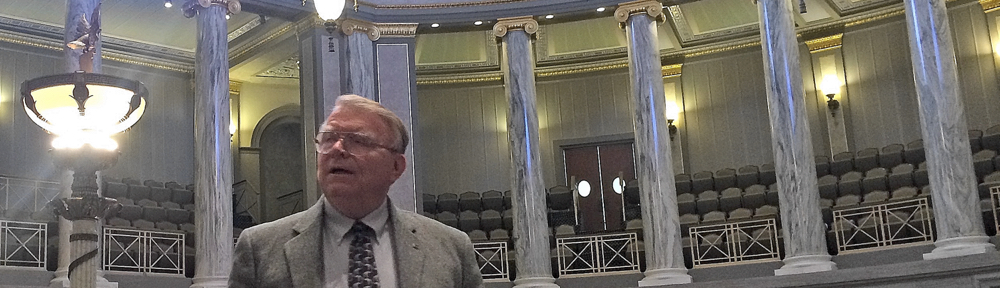
Jim

I knew only one person who had anything bad to say about Jim Spainhower, the only person in public office I ever would have given any thought at all to working for—-and I still would have refused had he ever offered.    

I missed Jim’s funeral yesterday (Tuesday) because of a couple of things that required staying at home. But Nancy was among several folks from Jefferson City and a lot of other places who were there to say goodbye.  One phrase was heard over and over, or circulated over and over on social media—“good man.”  

Jim had been out of the public eye for a long time.  He was 90 when he died.  It has been almost forty years since he left the State Treasurer’s office after losing a primary race for governor in 1980. 

I met Jim the first time when he was the featured speaker at one of the retreats held in the spring and fall of each year by the college group at the First Christian Church in Columbia.  He was a close friend of our student program minister, Eldon Drennan, and had not yet entered politics.  He was straightforward, thoughtful, eloquent, never presuming to be the only repository of scriptural knowledge.  About the time I graduated, he became a state representative while also remaining a minister in Marshall.  

Later, I covered part of his political career as a reporter.  And still later, when Eldon formed a social/religious studies group made up of Jim and Joanne, Eldon and Ilene, and some other folks from Columbia and Jefferson City, Jim Spainhower was included and became the only political office-holder who was ever welcome in our home. 

Jim knew, however, that except for those few occasions when we gathered in that group, I was always the reporter and he was always the politician.  

I played softball with several of his young employees in the Treasurer’s office, one of who was a second baseman named Bob Holden.  Pretty good with a glove.  Singles hitter.  We were just young guys who liked to play softball.  Never talked politics between innings that I can recall. 

Jim wrote a book called Pulpit, Pew, and Politics and told me when my first book came out that I was entitled to begin my prayers with, “O Thou who also has written a book….”  

 The world was different then, of course.  Today’s religious-political alliance that seeks power to mandate by law those policies that are not convincing enough from the pulpit to bring voluntary participation had not yet materialized. And Jim’s profession of faith in his book fell far short of today’s efforts to claim exclusive access to the path of salvation and to turn dogma into statute:

And although a lifelong Democrat, I know that all political wisdom is not confined to my party. I admire the Democratic party for its record of policy-making on behalf of the underprivileged and needy, but I also admit that there have been periods in this nation’s history whenother parties have better served them.  

I am a member of the Christian faith and of the Democratic party. I declare my religious and political membership in neither a spirit of pride nor by way of apology but only to help the reader better understand and interpret the views expressed…Although I am a Christian, I do not believe all religious truth is confined to the Christian faith.  Jesus did say he came to reveal the way, the truth, and the life but he did not claim his to be the only way, the only truth, the only life.  I am convinced that Jesus’ life and words emphasize the truth about God in whatever religious garment it may be clothed. I have been blessed with the friendship of manypersons of the Jewish faith and impressed by their personal dedication to thesame principles of truth, honor, and justice that my Christian faith has taughtme to uphold. I know we worship the same God.

Membership in a political party does not require unreasonable partisanship. Nor does it necessitate unthinking, blind loyalty to every position a party takes. Parties themselves are so contradictory that the member who insists on following its dictates without raising questions is certain to end up as a fool…

  I stress these points  because it is necessary to guard against making an ideological god out of one’s political party affiliation….Any government, though, that does not consider the moral and ethical implications of policy-making will soon face a disturbing spiritual crisis among those who are governed…I strongly believe that too little emphasis has been placed on the role of religion in providing the ethical ingredient needed to complement political expertise in a well-governed society.

Jim was the youngest of fourteen children, raised in Stanberry, a graduate of Maryville High School.  He became an ordained minister in 1953 and during his eight years in the Missouri House, he earned his master’s and doctorate degrees in political science.

 State Treasurer William E. Robinson, who could have been thefirst state treasurer to succeed himself—thanks to a change in state law—raninto some serious legal problems (he was acquitted) and didn’t run again, Jimwon the office. And it was Jim Spainhower who became the first State Treasurerwho succeeded himself with a second four-year term. He got sixty-nine percentof the vote.  The only statewide office-holder to beat that record since was Auditor Tom Schweich, who ran without major opposition in the general election of 2014.

He was inaugurated for his second term only a few minutesbefore Joseph Teasdale took the office of governor and told a small audience suffering in the most miserable weather in the history of Missouri’s outdoor inaugurations, “I am firmly convinced that the will of God in this election to the office of governor has been manifested through your free will to vote according to the dictates of your conscience.”

Jim later told me, “Never trust a politician with a messianic complex.”  

Four years later, when he could not seek another term as treasurer, Jim ran against Teasdale, whose administration had a checkered record.  He lost in the 1980 primary.Teasdale later lost to Christopher Bond by ten times more votes than he won with against Bond in ’76. 

In 2004, the next time a sitting governor, Bob Holden, was challenged in a primary election (by Claire McCaskill), I called Spainhower and Teasdale and asked them to reflect on how the contested primary in 1980 affected the Democratic party in the general election.  Jim still would not refer to Teasdale by name and Teasdale still blamed Spainhower’s opposition in August for his loss in November.  Forget about the old saw that time heals all wounds.  Not in this case.

After Jim left public office he became the President of the School of the Ozarks at Point Lookout, succeeding the school’s founder, M. Graham Clark.  But he was never comfortable in that role because, as we recall the story, Clark kept an office elsewhere in the same building and Jim felt people still went to Clark with an issue instead of going to him.  When the chance came to become the head of Lindenwood College, Jim moved on. 

Even after he retired as an educator, he remained a pastor.  And a friend although it has been many years since we saw each other.  

Near the end of his book, Jim wrote:

If I have one single ambition in life it is to finish my days on earth knowing that, for the most part, I have done my best to serve God in the manner he desires. I recognize my fallibility and know that when death is just a moment away it will bring to close a life that failed many times to measure up to God’s expectations. But I desire that those failures be as few in number as possible…

I have always taken great comfort in the words of Abraham Lincoln when censored for his unwavering policy in defense of the union…”I am not bound to win, but I am bound to be true. I am not bound to succeed, but I am bound to live up to what light I have. I must stand with anybody that stands right; stand with him while he stands right and part company with him when he goes wrong.”

The reaction to word of his death both at the funeral and on social media has been universal: “He was a good man.”  

Yes, he was. 

                                                            -0-

The value of a vote

Newly-elected members of the Missouri legislature have been going to “legislator school” for a few days, trying to absorb what all those departments, divisions, and institutions look like and are all about;  how to make a speech; how to cast a vote; what cubbyhole office they’ll get (especially on the House side); where the bathrooms are, and so forth.  

 This is only a brief brush with the real world they wanted to join.  The pressure-cooker that is a legislative session will become all too real early next month. We imagine that most of these newbies think they are starting a career.  They are, indeed, doing that.  But they also are starting to create their legacy.  And what will that legacy be after the next two to sixteen years? 

We have come across an old poem that makes that point.

Back on September 13, 1856, the Hannibal Tri-Weekly Messenger printed an unsigned poem in the weeks leading to that year’s general election.  Those who are in legislator school might want to read it in the context of their life to-be:

They knew that I was poor,

And they thought that I was base.

They thought I would endure

To be covered with disgrace—

They thought me of their tribe

Who in filthy lucre dote.

So they offered me a bribe

For my vote, boys, for my vote.

O, shame upon my betters

Who would my conscience buy!

But I’ll not wear their fetters

Not I, indeed, not I!

My vote!  It is not mine

To do with what I will;

To cast like pearl to swine

To these wallows in ill.

It is my country’s due,

And I’ll give it while I can,

To the honest and the true,

Like a man!  Like a man!

O, shame upon my betters

Who would my conscience buy,

But I’ll not wear their fetters,

Not I, indeed, not I!

No, no, I’ll hold my vote

As a treasure and a trust.

My dishonor none shall quote

When I’m mingled with dust;

And my children when I’m gone

Shall be strengthened by the thought

That their father was not one

To be bought! To be bought!

O, Shame upon my betters

Who would my conscience buy.

But I will not wear their fetters. Not I, indeed, not I!

The language is old but the sentiment remains current. Thenewbies will wrap up legislator school later this week.  The real world will await them less thanthree weeks later.   It’s always interesting to watch what happens to them.    

Grasping to retain power, regardless

We’re watching with interest efforts in Wisconsin by Republicans to limit the power of a newly-elected Democratic governor who will replace Scott Walker.                The New York Times reported yesterday:

“The long list of proposals Republicans want to consider also includes wide efforts to shore up their strength before Tony Evers, the Democrat who beat Gov. Scott Walker last month, takes office: new limits on early voting, a shift in the timing of the 2020 presidential primary in Wisconsin, and new authority for lawmakers on state litigation. The Republican plan would also slash the power of the incoming attorney general, who is also a Democrat…In recent years, single parties have come to dominate state legislatures, allowing lawmakers to make significant policy changes in states even as Washington wrestled with gridlock. But in states like Wisconsin and Michigan, where Democrats regained governor’s offices in capitals that Republicans fully controlled for years, Republicans are making last-minute efforts to weaken their powers…It is a model pioneered in North Carolina, where Republican lawmakers in 2016 tried to restrict the power of the governor after a Democrat was narrowly elected to the post. That set off a bitter court battle that continues to this day.”

There is nothing new in this.  In fact one of the most egregious examples happened here in Missouri. Only then it was Democrats who had controlled the state government including the legislature during the depression in a way that could make today’s two-thirds Republican legislature jealous. The state constitution then in effect required the Speaker of the House to make the official announcement of the election results at the start of the next legislative session so the winners could be inaugurated a few days later.

Governor Lloyd Stark, who had broken with the political boss in Kansas City, Tom Pendergast, could not succeed himself but in the process of what happened after the election he became the longest-serving single-term governor in Missouri history. With the demise of the statewide Pendergast machine, the organization run by St. Louis Mayor Bernard Dickmann became the dominant machine power within the Democratic Party.

Forrest c. Donnell (whose name was pronounced as if it was “Donald” without the “d”) campaigned heavily against Democrat machine politics and beat Lawrence McDaniel, his former Sunday School pupil, by 3,613 votes, the second-closest margin in state history. Democrats retained the other statewide offices.

Two weeks later, Democratic State Committee chairman C. Marion Hulen of Mexico proclaimed there was “an imposing array of reports, evidence of illegal use of large sums of money and of vote buying, of irregular voting and of alleged frauds.”  Another committee member claimed there was enough evidence to show McDaniel had won by 7,500 votes.

When the House convened on January 8, 1941, it passed a resolution barring Speaker Morris Osburn from announcing the results until a ten-member committee (of which six were Democrats) examined the ballots. Attorney General Roy McKittrick, one of those re-elected in November, held such an action was legal.

The committee recommended that Osburn certify the re-election of all of the Democratic candidates but it said Donnell should not be certified because of mistakes and fraudulent voting in the governor’s race.  The Republican committee members called the report a fraud and noted nobody had presented the committee with any evidence of fraud.

Inauguration day was January 13.  But there was no parade, no big event in the rotunda (inaugurations were indoors then), no inaugural ball.  Secretary of State Dwight Brown, Auditor Forrest Smith, and Attorney General McKittrick were sworn in for their third terms at the Supreme Court.  Lieutenant Governor Frank Harris, also a third-termer, took his oath in the state senate chamber because he constitutionally was the President of the Senate. Wilson Bell was sworn in as treasurer for his first term.

Donnell could have been sworn in by a Justice of the Peace (an office later replaced by magistrate judges who were even later replaced by associate circuit judges on the government charts) or some other qualified officer but he rejected the suggestion, saying he wanted to avoid further chaos.  Instead, he went to Jefferson City and asked the Supreme Court to order Osburn to announce him as the winner.

With those actions, Lloyd Stark could not leave office. He was to serve until his successor had been elected and qualified to take over. He was, to put it politely, urinarily agitated.

In what was to have been his final State of the State speech he announced he had vetoed the joint resolution seeking an investigation and said he would not approve spending any money for any such thing. He called for Donnell to be seated as governor and for any dispute about the results to “proceed in a legal and proper manner.”

His fellow democrats, not happy with his position, started an “absolutely bipartisan” recount anyway.  In mid-February the Supreme Court ordered the legislature to declare Donnell governor.  Osborn read the official document on February 20 declaring Donnell the winner.  The Senate majority leader immediately announced that McDaniel would file a declaration contesting the results.

Newspaper editorial writers from both sides of the aisle flayed the Democrats, the Joplin Globe saying “thousands of Democrats” had been “nauseated from the stench from the original office-stealing effort.”

Donnell finally was sworn in on February 26, in the rotunda. Stark, who said he had been “living in a suitcase since January thirteenth,” quickly headed back to St. Louis and his private law practice.

McDaniel’s 226-page election contest petition claimed that a complete recount would show him the winner by 30,000 votes.  State Republican Chairman Charles Ferguson laughed, particularly at the claim that hundreds of non-residents had voted for Donnell in Newton County in southwest Missouri: “It stands to reason that five or six hundred strangers could not show up to vote in a town as small as Neosho and get away with it.”  Neosho’s population that year was 5,318.

Donnell’s response was fifty-thousand words long and accused Democrats of the things they had said his campaign did.

The chairman of the recount committee, Senator Phil M. Donnelly of Lebanon, said the recount would not start until mid-April.   When it did, it was a disaster for McDaniel and the Democrats. By late May reports indicated recounts in eighty-one counties and St. Louis City had ADDED four-thousand votes to Donnell’s total. McDaniel met with Donnelly and agreed to file a letter withdrawing his request for a recount.  He did so without consulting party leaders who had pushed him to demand the recount and who had cooked up the claims of massive Republican vote fraud. McDaniel’s statement later seemed to be a slap at Hulen and his party allies when McDaniel said he had been “misled” by those who claimed he should be declared the winner.

The House and Senate met in joint session and in ten minutes declared the recount over with Donnell the winner.  Because the recount was never completed, his official victory margin remains 3,613 votes.

Democrats paid a heavy price for this escapade.  Several saw the writing on the wall and did not run again in 1942.  Several who did run lost their primary elections and many of those who got through the primaries were whipped in November as Republicans regained control of the House and pulled into a tie in the Senate.

Donnell was succeeded by Senator Donnelly, the senator who led the aborted recount effort. Donnelly later became the first governor to serve two full terms although he had to serve them separately because he was barred from succeeding himself but not prohibited from being governor again.

While Donnell was governor, a constitutional convention was called.  The new constitution, approved after he left office, prevents another effort to “steal” the governor’s election.  It says the Secretary of State, not the Speaker of the House, will certify the winners.


Appointment King

Governor Parson is making a new place in Missouri history for himself with each appointment of someone to an otherwise elective office at the top level of state government.   By the time he appoints a new state treasurer, he will have appointed three of the remaining top five state government officials and four of the top six jobs will be filled with people who were  not chosen by a public vote to fill those offices: governor, lieutenant governor, attorney general, treasurer.

But this is not the first time most top state offices have been filled by people not elected to those positions. But the only other time involved war/

As Missouri was being sucked into the Civil War, pro-South Governor Claiborne F. Jackson called a convention of 99 men to decide if Missouri should join the confederacy.  He was shocked to find that not a single secessionist was elected.  When he fled the capitol in the face of advancing Union troops in June, 1861, twenty members of the convention went with him.

The executive committee of the Convention of 99 met in Jefferson City in late July and called for remaining members of the convention to reassemble.  On July 30 the remaining convention members declared all existing state offices vacant.  It then installed former Missouri Supreme Court Judge Hamilton Gamble as the provisional governor and appointed other Union loyalists to other state offices.  All seats in the legislature were declared vacant and the convention members became the acting government.  The constitutional propriety of all of these actions has been a matter of speculation from that time to this but as historian Duane Meyer, the author of the standard Missouri history book used for decades has noted, when the U. S. Army is present to make sure the actions of the governing group are carried out, the niceties of the law or the constitution are secondary. Meyer wrote that the state convention

obviously …had no authority to take such actions (as vacating offices), since Governor Jackson was the popularly-elected chief of state. However, in the time of war, legality is frequently supplanted by expediency, and in so acting, these Missouri politicians established an illegal provisional government to fill the breach left by the secessionist exiles…In retrospect, we must admit that the actions of the state convention were unprecedented, brash, and illegal. However, since federal troops in Missouri upheld the actions of the convention, no one could argue.

Former Congressman Willard P. Hall of St. Joseph was appointed Lt. Governor and succeeded Gamble when he died at the end of 1864.  The office, incidentally, remained vacant until Lt. Governor George Smith was elected in the election of 1865.  Former Congressman Mordecai Oliver of Richmond became Secretary of State until ‘65’s elections.  When Treasurer Alfred W. Morrison refused to take a loyalty oath after being caught by federal troops while he was fleeing with thousands of state dollars in his pockets, he was replaced by artist George Caleb Bingham.  When Attorney General J. Proctor Knott refused to take the loyalty oath he was replaced by Aikman Welch of Johnson County.

William S. Moseley of New Madrid County took the loyalty oath and remained as state auditor.

So during the Civil War when the remains of the Convention of 99 replaced the legislature, FIVE  of  our six state officers were not elected by the people to their positions.

We’re waiting for the Missouri Supreme Court to rule on whether Mike Kehoe can continue to occupy the Lt. Governor’s office and Eric Schmitt won’t be the new Attorney General until January.  But it appears Governor Parson will be remembered as the governor who appointed three top state leaders and this will be a time when four state leaders are serving in offices they were not elected to fill.

The nice thing about the current situation is that it hasn’t taken a war to create it.

A GODDESS COMES TO EARTH

Ceres, a lady of myth and mystery who has extended blessings to state capitol visitors for ninety-four years, has been brought to earth by mortals who love her and care for her.
She’s in Chicago now and will be staying there about a year before she comes home to the capitol.
She’s a ten-feet four-inches tall, two-thousand pound bronze statue whose presence among flesh-and-blood humans was an emotional event for many of those who spoke quietly in loving terms as they walked around the flatbed trailer on which she’d been carefully laid after days and hours of preparation for her removal from the capitol dome.
She’s beautiful.
We’re going to spend some time in this entry telling her story, which is as ancient as the Greek and Roman empires, as recent as last week, and is beginning a new chapter. We’ll be drawing on the research we did for The Art of the Missouri Capitol: History in Canvas, Stone, and Bronze and for the upcoming book about the history of the building.

WHO IS CERES?
Ceres is a figure from Roman mythology whose Greek counterpart is Demeter. She’s the goddess of grain, of agriculture, of fertility, a representative of Mother Earth. We’ll use the Roman version of her story here. She was a sister of Jupiter who was impregnated by Jupiter (family relationships among gods and goddesses apparently were not frowned upon in the myth
The family weirdness continues with Pluto kidnapping Proserpina with plans to marry her and live in the underworld. Mama Ceres, as you might expect, was not favorably disposed to such an arrangement. As she searched for her daughter, she stopped the growth of crops and caused deserts, acts that alarmed Jupiter to send Mercury to the underworld to convince Pluto to let Proserpina return to the surface.
Pluto blackmailed Proserpina. He forced her to agree to return to the underworld for part of the year. When Proserpina showed up, Ceres was happy and as long as the two were together the earth was fertile and crops grew, trees had leaves, and the grass grew. But when Proserpina has to return to Pluto, Ceres becomes depressed and the earth begins to lose its productivity and the trees start to lose their leaves and the lawn finally stops growing.
So we have brought Ceres to earth at a time when she supposedly becomes depressed because she misses Proserpina—which might explain the chilly and snowy day of falling leaves and dying lawns when she came down. Although the capitol restoration workers say she’ll be put back up in a year, regardless of the weather, we think it would be more appropriate to put her back in place at a time when the wind blows warmer, the trees are budding, the days are growing longer, and so is the grass.
That’s the best we can figure out this complicated family relationship of gods and goddesses in ancient Rome and ancient Greece.
Regardless, let’s hope that Proserpina, unknown to her mother, already is living in Chicago (known for many years for its underworld history) and hears that Mom is going to be in town, and that they get together. We’re ready for a quick return of spring.

WHY CERES?

Simple. She’s the goddess of agriculture, among other things.  Although Missouri is becoming more urban, its number one industry remains agriculture. It was even moreso when she was commissioned, cast, and put into place.

THE MISSOURI CAPITOL WAS NOT HER INTENDED SITE
It not only was not the intended site, but the statue of Ceres appears to be less than an original design.
For example, the Smithsonian Learning Center has this statue titled “Maidehood,” a version of which also is in the Brookgreen Gardens in South Carolina.
The hand is up, not down, and the gown is more revealing than the attire of Ceres. But the design similarities are unmistakable.
Then there is this work from the Panama-Pacific Exposition of 1915, also by Sherry Fry:
She’s called “Peace” in this version.
Fry originally intended the statue to fulfill a commission for Grant’s Tomb in New York. But an undated newspaper clipping in the papers of Decoration Commission member Cora Painter says, “When he visited the Missouri Capitol, he was struck with the thought that there was the building to which his theme was fitted and he executed the model for Missouri instead of New York.”

SHE’S NOT THE ONLY CAPITOL CERES
We aren’t the only state capitol with a statue of Ceres. Vermont’s capitol in Montpelier has had a Ceres statue since 1858. As this is written, sculptor Chris Miller is carving—from Honduran Mahogany— the third Ceres statue to adorn the statehouse dome. The clay model he is working from was done by Jerry Williams, who usually works in granite. The first two wooden statues fell victims to rot after about eighty years each.
(The picture is from Sevendaysvt.com)

WHO DECIDED SHE SHOULD BE UP THERE?
The original decision was made by the State Capitol Commission Board, the predecessor of the Capitol Decoration Commission. And for a time, there was some consideration of making her out of something else.
The capitol architectural firm of Tracy and Swartwout (pronounced Swart-out) proposed a ten-foot statue of Ceres, the goddess of agriculture “fully robed and head erect.” They suggested, “In her right hand she carried the torch of education and in her left, which hangs by her side, are a few blades of wheat.” The Capitol Commission Board approved the idea in September, 1915 then wondered whether the statue should be made of sheet copper instead of bronze, what the thickness of copper should be if that was the material of choice, and what would be the cost difference.
By mid-1916 the board was waiting for the great bonze doors to arrive for the south front of the building and had started casting up sums to see what else it could buy. It thought there would be enough for a statue of Ceres on the dome, among other things. The W. F. Norman Sheet Metal Manufacturing Company of Nevada, the home town of commissioner Theodore Lacaff, sent the board a plaster model of a proposed twelve-foot ball statue that could be made of 48-ounce of sheet copper for $2,480.
But the board was hit with a Missouri Supreme Court ruling that almost drained its bank account, leaving it without funds for the statue or to hire sculptors to carve figures for the main pediment.

Architect Egerton Swartwout called the board’s suggested cost of the statue “absolutely inadequate” and noted the price of bronze had gone up so much since war broke out in Europe that the board could not afford the bronze for the statue much less pay for casting it. He warned of vendors who would “sell you a lot of junk which they too often put on court houses and other such buildings, like the Civil War Memorials that are scattered through the land, made out of stamped tin.”
Swartwout suggested the statue be made of hammered sheet copper, the material used in the Statue of Liberty. Norman said copper and bronze were scarce because the government was not allowing their use for anything but war work. Norman endorsed the idea of Ceres “since such stress is being laid upon the importance of cereals” at the time and the Missouri War Production Board was encouraging, and getting, great improvements in state agriculture production. Although Norman later got an option on some copper of the same weight used in the Statue of Liberty, the Ceres project wound up on the Capitol Commission Board’s scrap heap.
The Jefferson City Daily Capital News observed that the war had caused Ceres “to gracefully sidestep the honor of standing on top of the capitol dome and beaming down upon a peaceful world. Gallantly Ceres gives way for old glory who will proudly wave over the most beautiful state capitol in the Union.” But, forecast the newspaper, “When victory ends the war, Ceres will have her inning.” Sherry Fry’s bronze Ceres statue was hauled to the top of the dome in the fall of 1924, made of bronze. It would be more than six decades before the Norman Company got some of its products in the capitol, when it installed the tin ceiling in the office of Senator Harold Caskey.

THE SCULPTOR
The statue was designed by Sherry Edmundson Fry, an Iowa-born sculptor who began his career when he shaped a figure from clay scooped from a ditch near his Creston, Iowa home. His father refused to support his desire to study are in college so Fry picked potatoes to work his way through Grinnell College.
After graduation, Fry worked with sculptors Lorado Taft and Charles Milligan in Chicago before moving to New York to work for Karl Bitter, who created the original “Signing of the Treaty” panel that is on the river side of the capitol. He signed on as a crewman aboard a cattle boat bound for France so he could study at the leading art institutes in Paris. Fry continued his studies in Italy before returning to France where he met Des Moines businessman James Edmundson who hired him to create a sculpted image of his father. Fry so admired Edmundson that he took the man’s last name as his middle name. (The Archives of American Art in Washington, D. C., has the only photograph of Fry we have been able to track down.
)During World War I, Fry was part of the newly-formed Army Camouflage Corps, one of the leaders of which was Evarts Tracy, whose architectural firm designed the Missouri Capitol. Tracy appears to have been the connection that got Fry the Ceres commission. He was paid $15,000 for this work (about $215,000 today).

THE REAL WOMAN, PERHAPS
We have suggested that the inspiration for the figure on our capitol’s dome might have been Audrey Munson, considered the country’s first supermodel. We have only circumstantial evidence because the records of the Capitol Decoration Commission have disappeared (we maintain a hope somebody will find some dust-covered file boxes in their attic or in a long-forgotten closet corner that will contain those records) and we have not located any of Fry’s personal papers

 Audrey was the favorite model for New York sculptors—the New York American referred to her as the “queen of Artists’ Studios”—including those who decorated our capitol, for more than a decade. She was such a popular subject that the organizers of the 1915 Panama-Pacific Exposition in San Francisco published a guide book of the exposition statues that featured her face and body. More than half of the statues at the exposition were of Audrey.
Audrey Munson went into movies and became the first woman to appear nude in an American mainline movie. Her family put her in a mental institution in 1931. She died there in 1996 at the age of 104, thirty years after Fry’s death.

SIZE

Some of those who saw Ceres on the trailer after she was brought down were surprised that she isn’t bigger. It’s a matter of proportion and the Capitol Decoration Commission that commissioned the statue wanted to make sure the statue did not overwhelm the building’s design nor would it be insignificantly small. When Sherry Fry submitted a design, a steeplejack made a two-dimensional wallboard silhouette that he hoisted into position atop the dome. Commission members and others on the ground walked around the dome to study the figure from all angles and found, as one chronicler put it, the statue “stood out, bold, distinct, and beautiful.”
By contrast, Thomas Crawford’s statue of “Freedom” on our nation’s capitol is nineteen feet-six inches high and weighs fifteen-thousand pounds. The statue was cast in Rome, where Crawford had his studio. It was shipped to this country in six crates and put together atop the capitol in 1863. Your loyal observer frankly thinks that she is too large for that dome but—to the surprise of some, perhaps—he was not around in 1863 to protest. Neither was Crawford, who died in 1857.

BRINGING HER DOWN

No one is alive today to see her return to earth who saw Ceres, or at least the top part of her, hoisted to the dome in 1924. For most of a century we have had only photographs from airplanes or long lenses to show us her beauty.
Unless you went to Columbia.
Before Sherry Fry was allowed to cast a bronze statue, he had to submit a half-size preliminary sculpture to the Decoration Commission. Many of the preliminary drawings, paintings, window designs and sculptural models were taken to the University of Missouri School of Art and Archaeology by commission chairman John Pickard, the founder of the university’s art history department. Some preliminary painting are in the Ellis Library. The plaster models of the south front frieze line some of the hallways on the top floor of Jesse Hall, the main administration building. Unfortunately (as of our last visit there) there are no signs telling anyone what those encased things are.

For years, Fry’s preliminary model of Ceres was in Pickard Hall on the Francis Quadrangle but when that building was closed after it was found to be contaminated by radioactive elements left from research in the early 1900s the museum was moved to what’s known as Mizzou North, the former Ellis Fischel Cancer Hospital on the business loop. The statue is still there although it has lost a hand and some toes.

In 1995 some folks made their way to the top of the dome to check on Ceres’ condition. A few days before she was brought down, the Office of Administration had a photographer on the dome with her. Until workers started preparing to bring her down several days ago, nobody had gone face-to-face with the goddess since ‘95. Unless they’d been to Columbia.

It’s hard to compare the face of the plaster model with the face of the final bronze statue because of light and perspective. But it appears to us Fry made a slight alteration in the face of Ceres, perhaps slightly lengthening it, when he made the final version. (Compare with the statue’s face at the end.)

Two guys were essential to the safe return of Ceres to earth. One was Zack Franklin who ran the big crane that reached up and over to Ceres and gently lifted her from her perch and gently lowered her to the trailer below. Lt. Governor Mike Kehoe (who commemorated their roles) called Franklin “the most important man in Missouri during the five to seven minutes Ceres was in the air.”

The eyes for Franklin on the platform far above was James Stafford, talking by radio to the crane operator as the delicate task of attaching the hook to the carefully-wrapped harness around the statue. It was fitting that Stafford should be intimately involved in the process. His great-grandfather had been one of the workers who constructed the building that Ceres has presided over all this time.


So she came down, wrapped in a state flag that was a last-minute thought earlier that morning, turning to seemingly bless the building over which she presided or maybe to wave goodbye for a little while, and then for the first time in more than nine decades, she was allowed to lie down.


FACING THE WRONG WAY?
We don’t know where this got started, the idea that when Ceres was winched to the dome in 1924 that workers turned her the wrong way before anchoring her. We have never found any contemporary accounts saying that.
We’re not sure what the rationale is for that idea other than north Missouri is the state’s main corn, wheat, and beans producing region while the south (except for the Bootheel) is better at raising rocks.
One person has suggested she faces south to reflect Missouri’s Confederate heritage, in effect turning her back on the North. Again, we have never found any contemporary comment or account indicating that is the case. It is true that “Dixie” was part of the inauguration ceremonies for new governors in those days but we do not believe the Capitol Decoration Commission was in any way motivated to turn its goal of appropriately decorating the building into a political statement.

So why does she face south—and WILL face south when she returns from Chicago (as shown in Lloyd Grotjan’s photo from our Art book)? Because the south front of the Capitol is where the people come for admittance to the halls of their government. Her hand is extended in blessing to the people of Missouri who gather below her for inaugurations, rallies, concerts—-for some years in the hot summers the mainline Protestant churches held joint worship services on the lawn—or just to visit the state’s greatest symbol. It would be extremely poor manners if the patron goddess of Missouri turned her back on her people.
We wouldn’t be surprised if that was what the commission thought when Ceres ascended in 1924.

AND A FINAL NOTE—
Some of us think the beauty of Ceres should not be so far away that Missourians cannot be touched by it for another century or so. Perhaps those restoring the Capitol would consider doing what has been done with “Freedom” in the National Capitol.
The full-size plaster model for that statue that was used to cast the bronze statue on top of the building was stored in pieces for more than 130 years before it was restored by the Architect of the Capitol in 1929. It stands today in Emancipation Hall of the U. S. Capitol’s Visitor Center.
The United States Capitol Historical Society sells a nine-inch tall version of the statue made of crushed marble removed during the renovation of the east front of the building and mixed with resin. It sells for forty-six dollars. An much smaller replica is available as a Christmas ornament.
Oklahoma, which finally put a dome on its Capitol is topped by a twenty-two foot tall statue, a nine-foot replica of which is in the rotunda.
Today’s laser scanning and 3-D printing technology could produce an accurate reproduction of Ceres that would make a striking attraction in the Capitol Museum or to the Capitol visitor’s center that is talked about from time to time. And a small but well-detailed version made of the dust from the stones removed during the present restoration and repair project could be a solid seller at the tour desk.

Beauty should not be hidden, even if it is in plain sight, 250 feet above those who would admire it.


“Two roads diverged—”

“In a yellow wood,” wrote Robert Frost

“And sorry I could not travel both and be one traveler, long I stood and looked down one as far as I could to where it bent in the undergrowth.”

Two years ago, Missourians elected a charismatic young man who promised to make his state office something special, something different, something clean.

Two years ago, Missourians elected another charismatic young man who promised to make his state office something special, something different, something clean.

One of those young men took a road that has led him downhill into the darkness of the undergrowth, out of sight, and probably away from his dream of much bigger things—although there have been reports of some sounds coming out of that darkness that he’d like to come back for another trip.

The second young man last Tuesday took a road that is leading him up, to a sunny future, and perhaps an opportunity to reach the destination the first man thought he was going toward.

Poetry can take some interesting political turns.

Two roads.  One paved, one gravel.  One that would have been important to maintaining and bringing jobs.  One that is paved now but facing reduction to gravel in the future. Missourians have chosen the gravel road into uncertainty’s undergrowth with their rejection of the latest gas tax increase.  Our state legislators and other state leaders who have made economic development a constant theme of their work have failed to convince voters that a tax increase would result in the good roads necessary to encourage economic growth.

They have sewn the wind by preaching the evils of taxes and the blessings of tax cuts and tax breaks, particularly for businesses that presumably will create more jobs.  But industry wants good roads to ship in manufacturing materials and equipment and good roads to ship products out.

“The people know better how to spend their money than government does,” we have heard them say repeatedly.  Again, the people have decided to keep their money and spend it for things better than building roads and bridges and interchanges to companies that might have provided jobs to those same people and their relatives and friends.

The people have decided they want a higher minimum wage, meaning many of those who might benefit from better roads and the better jobs they could help create will have more money for themselves.

Two roads.  Two men.  Two political philosophies.  But we travel with them and we are the ones who often decide which road they, and we, take—a road rising to the future or a gravel road descending into the dark undergrowth.

“And that has made all the difference.”

—or will, perhaps.

The loyal opposition

The makeup of our congressional and legislative representation was defined yesterday.  Come January, a new political chemistry will be brewed in Washington and in Jefferson City because of the decisions made in thousands of ballot boxes.

Your respectful observer wants to talk about a loser today and what that loser said many years ago about the role of the losing side.

Lynne Olson’s book, Those Angry Days: Roosevelt, Lindbergh, and America’s Fight Over World War II, 1939-1941 triggered this interest that was increased by a Kansas City Star editorial found while researching the 1940 election in Missouri.

The loser was Wendell Willkie, a name that rings only faint bells is the minds of most political observers today other than those who know he lost the presidency to Franklin D. Roosevelt, who won his third term.

A week after the election, Willke went on the radio for a nationwide address. In his speech he borrowed from a phrase created in Britain in 1826—the loyal opposition—and defined it for Americans.

That speech is worth considering in these times because of what opposition has become.

Willkie’s grandson, Wendell Willkie II, wrote of his grandfather in The Atlantic earlier this year that some people have compared his grandfather’s Republican nomination for president to Donald Trump’s nomination in 2016. Both had been Democrats. Both were/are prominent business executives. Neither had held public office. “Each substantially challenged and redefined then-prevailing Republican Party doctrine,” he wrote.  But after that, the two men have profoundly different worldviews:

Willkie is remembered for his optimistic, inspiring vision of America. A thoughtful student of history and economics, he powerfully articulated classically liberal ideals of political and economic freedom.  For all of our nation’s faults, he passionately believed in American exceptionalism. He took on unpopular causes, and battled discrimination and intolerance. But he also believed the world would be a far more dangerous place without American leadership.

Willke was a Republican who fought the New Deal while favoring America’s active support of Britain against Germany—at a time when American isolationism, with Charles Lindbergh as its most prominent advocate and presidential contenders Thomas Dewey and Robert Taft speaking for it, was powerful.

His position in the Republican Party rose when Germany invaded France and other countries and isolationism began to lose public favor. He was nominated on the sixth ballot of the GOP convention.

Republicans were split on intervention in Europe with the America First movement strongly involved with the party.  As Willkie’s grandson put it, “Today, many politicians insist they put country over party, but do little to prove their ultimate loyalties. Willkie was different.”

Britain was in desperate condition and Roosevelt faced stern public opposition to sending military aid to the island and laws forbidding sending military vessels built for Britain’s defense. But this country had some old destroyers not built for that reason that could be transferred.

The plan gained public support but Roosevelt knew it could become a problem for him in the campaign. So he asked Willkie to do something extraordinary.

Olson recounts that Roosevelt sent emissaries to ask Willkie to forego making the destroyer deal a part of his campaign. Willke said he could not make a public statement of support that would deepen splits within his own party but he promised he would not attack the deal after Roosevelt announced it.  “It was astonishing thing to ask of an opponent—to turn his back on a controversial issue that almost certainly would help him politically,” says Olson.

But that’s not all.  The nation was divided despite the obviously growing threat of war on whether the draft should be re-instituted. If Willkie opposed it, isolationist Democrats would join Republicans to block it.   But in August, 1940, Willke announced support for “some form of selective service.”   He later said he would continue to support the draft even if it cost him the election.

Roosevelt won with 27.3 million votes. Willkie had 22.3 million. The Electoral College numbers made the race look like a runaway.  Sam Pryor, Willkie’s Eastern campaign manager, told him afterward, “You could have been president if you had worked with the party organization.”

The Kansas City Star said a day after his Armistice Day radio address a week after the election that it  contained “no bitterness…no narrow partisanship…The main principle that Mr. Willkie desired to impress upon his audience was the high function of a loyal opposition in the American system…It showed…the quality of constructive criticism that the President, as a patriotic American, would do well to take into account in meeting the difficult problems that confront the nation.”

The Star characterized the speech as “an appeal to reason, not to emotion.” We offer his speech to you in these much different times with little hope that recalling it will change the daily rhetorical tragedies that now befall our system, but with some hope that it might mean something useful to somebody, a sad observation of how far our leaders have sunk.

Cooperation but Loyal Opposition

DISCORD AND DISUNITY WILL ARISE IF OPPOSITION IS SUPPRESSED

By WENDELL L. WILLKIE, Presidential nominee of the Republican Party in 1940

Delivered over the radio, November 11, 1940

Vital Speeches of the Day, Vol VII, pp. 103-106

PEOPLE of America: Twenty-two years ago today a great conflict raging on the battlefields of Europe came to an end. The guns were silent. A new era of peace began and for that era the people of our Western World—our democratic world—held the highest hopes.

Those hopes have not been fulfilled. The democratic way of life did not become stronger—it became weaker. The spirit of constitutional government flickered like a dying lamp. And within the last year or so the light from that lamp has disappeared entirely upon the Continent of Europe.

We in America watched darkness fall upon Europe. And as we watched there approached an important time for us—the national election of 1940.

In that election, and in our attitudes after that election, the rest of the world would see an example of democracy in action, an example of a great people faithful to their Constitution and to their elected representatives.

The campaign preceding this election stirred us deeply. Millions upon millions of us who had never been active in politics took part in it. The people flocked to the polling places in greater numbers than ever before in history.

Nearly fifty million people exercised on November 5 the right of the franchise—the precious right which we inherited from our forefathers, and which we must cherish and pass on to future generations.

Thus it came about that although constitutional government had been blotted out elsewhere, here in America men and women kept it triumphantly alive.

No matter which side you were on, on that day, remember that this great, free expression of our faith in the free system of government must have given hope to millions upon millions of others—on the heroic island of Britain—in the ruined cities of France and Belgium—yes, perhaps even to people in Germany and Italy. It has given hope wherever man hopes to be free.

In the campaign preceding this election serious issues were at stake. People became bitter. Many things were said which, in calmer moments, might have been left unsaid or might have been worded more thoughtfully.

But we Americans know that the bitterness is a distortion, not a true reflection, of what is in our hearts. I can truthfully say that there is no bitterness in mine. I hope there is none in yours.

We have elected Franklin Roosevelt President. He is your President. He is my President. We all of us owe him the respect due to his high office. We give him that respect. We will support him with our best efforts for our country. And we pray that God may guide his hand during the next four years in the supreme task of administering the affairs of the people.

It is a fundamental principle of the democratic system that the majority rules. The function of the minority, however, is equally fundamental. It is about the function of that minority—22,000,000 people, nearly half of our electorate— that I wish to talk to you tonight.

A vital element in the balanced operation of democracy is a strong, alert and watchful opposition. That is our task for the next four years. We must constitute ourselves a vigorous, loyal and public-spirited opposition party.

It has been suggested that in order to present a united front to a threatening world the minority should now surrender its convictions and join the majority. This would mean that in the United States of America there would be only one dominant party—only one economic philosophy—only one political philosophy of life. This is a totalitarian idea—it is a slave idea—it must be rejected utterly.

The British people are unified with a unity almost unexampled in history for its endurance and its valor. Yet that unity coexists with an unimpaired freedom of criticism and of suggestion.

In the continual debates of the House of Commons and the House of Lords all of the government’s policies, its taxation, its expenditures, its military and naval policies, its basic economic policies are brought under steady, friendly, loyal critical review. Britain survives free. Let us Americans choose no lesser freedom.

In Britain some opposition party leaders are members of the government and some say that a similar device should be adopted here. That is a false conception of our government. When a leader of the British Liberal party or a member of the British Labor party becomes a member of the Churchill Cabinet he becomes—from the British parliamentary point of view—an equal of Mr. Churchill’s.

This is because the British Cabinet is a committee of the House of Parliament. It is a committee of equals, wherein the Prime Minister is chairman, a lofty chairman indeed and yet but a chairman. The other members are his colleagues.

With us the situation, as you well know, is different. Our executive branch is not a committee of our legislative branch. Our President is independent of our Congress. The members of his Cabinet are not his colleagues. They are his administrative subordinates. They are subject to his orders.

An American President could fill his whole Cabinet with leaders of the opposition party and still our administration would not be a two-party administration. It would be an administration of a majority President giving orders to minority representatives of his own choosing. These representatives must concur in the President’s convictions. If they do not they have no alternative except to resign.

Clearly no such device as this can give us in this country any self-respecting agreement between majority and minority for concerted effort toward the national welfare. Such a plan for us would be but the shadow—not the substance—of unity.

Our American unity cannot be made with words or with gestures. It must be forged between the ideas of the opposition and the practices and policies of the Administration. Ours is a government of principles, and not one merely of men. Any member of the minority party, though willing to die for his country, still retains the right to criticize the policies of the government. This right is imbedded in our constitutional system.

We, who stand ready to serve our country behind our Commander-in-Chief, nevertheless retain the right, and I will say the duty, to debate the course of our government. Ours is a two-party system. Should we ever permit one party to dominate our lives entirely, democracy would collapse and we would have dictatorship.

Therefore, to you who have so sincerely given yourselves to this cause, which you chose me to lead, I say: “Your function during the next four years is that of the loyal opposition.” You believe deeply in the principles that we stood for in the recent election. And principles are not like foot-ball suits to be put on in order to play a game and then taken off when the game is over.

It is your Constitutional duty to debate the policies of this or any other administration and to express yourselves freely and openly to those who represent you in your State and national government.

Let me raise a single warning. Ours is a very powerful opposition. On November 5 we were a minority by only a few million votes. Let us not, therefore, fall into the partisan error of opposing things just for the sake of opposition. Ours must not be an opposition against—it must be an opposition for—an opposition for a strong America, a productive America. For only the productive can be strong and only the strong can be free.

Now let me however remind you of some of the principles for which we fought and which we hold as sincerely today as we did yesterday.

We do not believe in unlimited spending of borrowed money by the Federal government—the piling up of bureaucracy—the control of our electorate by political machines, however successful—the usurpation of powers reserved to Congress—the subjugation of the courts—the concentration of enormous authority in the hands of the Executive—the discouragement of enterprise—and the continuance of economic dependence for millions of our citizens upon government. Nor do we believe in verbal provocation to war.

On the other hand we stand for a free America—an America of opportunity created by the enterprise and imagination of its citizens. We believe that this is the only kind of an America in which democracy can in the long run exist. This is the only kind of an America that offers hope for our youth and expanding life for all our people.

Under our philosophy, the primary purpose of government is to serve its people and to keep them from hurting one another. For this reason our Federal Government has regulatory laws and commissions.

For this reason we must fight for the rights of labor, for assistance to the farmer, and for protection for the unemployed, the aged and the physically handicapped.

But while our government must thus regulate and protect us, it must not dominate our lives. We, the people, are the masters. We, the people, must build this country. And we, the people, must hold our elected representatives responsible to us for the care they take of our national credit, our democratic institutions and the fundamental laws of our land.

It is in the light of these principles, and not of petty partisan politics, that our opposition must be conducted. Itis in the light of these principles that we must join in debate, without selfishness and without fear.

Let me take as an example the danger that threatens us through our national debt.

Two days after the election, this Administration recommended that the national debt limit be increased from $49,000,000,000 to $65,000,000,000.

Immediately after that announcement, prices on the New York Stock Exchange and other exchanges jumped sharply upward. This was not a sign of health, but a sign of fever. Those who are familiar with these things agree unanimously that the announcement of the Treasury indicated a danger —sooner or later—of inflation.

Now you all know what inflation means. You have lately watched its poisonous course in Europe. It means a rapid decline in the purchasing power of money—a decline in what the dollar will buy. Stated the other way round, inflation means a rise in the price of everything—food, rent, clothing, amusements, automobiles—necessities and luxuries. Invariably these prices rise faster than wages, with the result that the workers suffer and the standard of living declines.

Nor no man is wise enough to say exactly how big the national debt can become, before causing serious inflation. But some sort of limit certainly exists, beyond which lies financial chaos. Such chaos would inevitably mean the loss of our social gains, the destruction of our savings, the ruin of every little property owner, and the creation of vast unemployment and hardships. It would mean, finally, the rise of dictatorship. Those have been the results of financial collapse in every country in the history of the world. The only way that we can avoid them is to remain sound and solvent.

It is not incumbent upon any American to remain silent concerning such a danger. I shall not be silent and I hope you will not be. This is one of your functions as a member of the minority. But in fulfilling our duties as an opposition party we must be careful to be constructive. We must help to show the way.

Thus, in order to counteract the threat of inflation and to correct some of our economic errors, I see five steps for our government to take immediately.

First, all Federal expenditures except those for national defense and necessary relief ought to be cut to the bone and below the bone. Work relief, obviously, has to be maintained, but every effort should be made to substitute for relief productive jobs.

Second, the building of new plants and new machinery for the defense program should be accomplished as far as possible by private capital. There should be no nationalization under the guise of defense of any American industry with a consequent outlay of Federal funds.

Third, taxes should be levied so as to approach as nearly as possible the pay-as-you-go plan. Obviously, we cannot hope to pay for all the defense program as we go. But we must do our best. That is part of the sacrifice that we must make to defend this democracy.

Fourth—Taxes and government restrictions should be adjusted to take the brakes off private enterprise so as to give it freedom under wise regulation, to release new investments and new energies and thus to increase the national income. I do not believe we can hope to bear the debt and taxes arising out of this defense program with a national income of less than one hundred billion-dollars—our present national income is only $70,000,000,000—unless we lower the standard of living of every man and woman who works. But if we can increase our national income to $100,000,000,000 we can pay for this defense program out of the increase produced if we free private enterprise—not for profiteering but for natural development.

Fifth, and finally, our government must change its punitive attitude toward both little and big businessmen. Regulations there must be—we of the opposition have consistently recommended that. But the day of witch hunting must be over.

If this administration has the unity of America really at heart it must consider without prejudice and with an open mind such recommendations of the opposition.

National unity can only be achieved by recognizing and giving serious weight to the viewpoint of the opposition. Such a policy can come only from the administration itself. It will be from the suppression of the opposition that discord and disunity will arise. The administration has the ultimate power to force us apart or to bind us together.

And now a word about the most important immediate task that confronts this nation. On this, all Americans are of one purpose. There is no disagreement among us about the defense of America. We stand united behind the defense program. But here particularly, as a minority party, our role is an important one. It is to be constantly watchful to see that America is effectively safeguarded and that the vast expenditure of funds which we have voted for that purpose is not wasted.

And in so far as I have the privilege to speak to you, I express once more the hope that we help to maintain the rim of freedom in Britain and elsewhere by supplying those defenders with materials and equipment. This should be done to the limit of our ability but with due regard to our own defense.

On this point, I think I can say without boast, that never in the history of American Presidential campaigns has a candidate gone further than I did in attempting to create a united front.

However, I believe that our aid should be given by constitutional methods and with the approval, accord and ratification of Congress. Only thus can the people determine from time to time the course they wish to take and the hazards they wish to run.

Mr. Roosevelt and I both promised the people in the course of the campaign that if we were elected we would keep this country out of war unless attacked. Mr. Roosevelt was re-elected and this solemn pledge for him I know will be fulfilled, and I know the American people desire him to keep it sacred.

Since November 5 I have received thousands and thousands of letters—tens of thousands of them. I have personally read a great portion of these communications. I am profoundly touched. They come from all parts of our country and from all kinds of people. They come from Catholics and Protestants, Jews and Christians, colored people and white people. They come from workers and farmers and clerks and businessmen—men and women of all the occupations that make up our American life.

All of these letters and telegrams, almost without exception, urge that the cause that we have been fighting for be carried on.

In your enthusiasm for our cause you founded thousands of organizations. They are your own organizations, financed by you and directed by you. It is appropriate for you to continue them if you feel so inclined. I hope you do continue them. It is not, however, appropriate to continue these organizations in my name. I do not want this great cause to be weakened by even a semblance of any personal advantage to any individual. I feel too deeply about it for that; 1944 will take care of itself. It is of the very essence of my belief that democracy is fruitful of leadership.

I want to see all of us dedicate ourselves to the principles for which we fought. My fight for those principles has just begun. I shall advocate them in the future as ardently and as confidently as I have in the past. As Woodrow Wilson once said: “I would rather lose in a cause that I know someday will triumph than to triumph in a cause that I know some day will fail.”

Whatever I may undertake in the coming years, I shall be working shoulder to shoulder with you for the defense of our free way of life, for the better understanding of our economic system and for the development of that new America whose vision lies within every one of us.

Meanwhile, let us be proud, let us be happy in the fight that we have made. We have brought our cause to the attention of the world. Millions have welcomed it. As time goes on millions more will find in it the hope that they are looking for. We can go on from here with the words of Abraham Lincoln in our hearts:

“With malice toward none, with charity for all, with firmness in the right as God gives us to see the right, let us finish the work we are in, to bind up the nation’s wounds. . . . to do all which may achieve and cherish a just and lasting peace among ourselves and with all nations.”

Good night. And God bless and keep every one of you.

(Photo credit: TheAtlantic.com)


Notes from a quiet street—elections issue

A week from today is elections day.  We look forward to elections days for the wrong reasons.  Instead of being excited about taking part in the voting process we are excited because it’s the end of that interminable period when our intelligence is assaulted 30 seconds at a time—all the time, it seems, on the television.

—and when our mailboxes are stuffed with mailers of questionable veracity usually provided by people without the courtesy or the courage to admit they paid for the appropriately-named junk mail.

Interestingly, at the end of the day, a lot of people will transfer from being the kind of people they campaigned against to being those people. And what will they do to correct the impressions their voters have about government?

-0-

We have been interested in some of the reasons various groups don’t want us to vote for a new system of drawing legislative districts after the 2020 census.  One side says it would be a mistake to let the state demographer (a person who spends his or her life analyzing population and population trends) draw new districts because they’ll just use statistics and will come up with districts that are more gerrymandered that some districts from the last go-around.  Others worry that letting the demographer draw the districts will weaken the political power of this or that group.   We must have been mistaken all these years because we thought reapportionment dealt with representation rather than power. Silly us.

Could it be that the state demographer won’t care if two legislative incumbents wind up in the same district instead of benefitting from a process that is suspected of protecting incumbents or at least their party majorities?  As far as the demographer coming up with screwball districts, surely that person couldn’t do worse than the creation of the present Fifth Congressional District that I dubbed the “dead lizard” district after the last congressional redistricting (it looks like a dead lizard lying on its back with its feet in the air) that has a former Mayor of Kansas City representing a rural area as far east as Marshall.

What the heck.  We can always change the constitution back to the present system if the legislative districts after the 2020 census are as bad as some interest groups forecast they will be, can’t we?

-0-

Elections almost always have issues created by petition campaigns.  It’s an important freedom we have as citizens to propose laws or to ask for a statewide vote on something the legislature did that raises questions in the minds of enough people that they want citizens to have the final say.  But that freedom can carry with it unintended consequences because petitions don’t go through the refining process of legislative committee hearings, debates, votes, and compromises where possible.   Of course the legislature sometimes fumbles an issue and in both cases ballot issues can be issues financially backed by a special interest if not an individual.

Voters have an often-overlooked responsibility to get out the spy glass and read all the fine print in the election legal notices.  We haven’t talked to very many folks who have done that. So we get what we get and the courts often have to figure out what we got regardless of what we thought we were getting.

-0-

The best part of election day is that all of the junk mail campaign propaganda that goes straight to our waste baskets will be replaced by Christmas catalogues.  We prefer Christmas catalogs for several reasons.  They don’t forecast national or international catastrophes if we buy something offered by another catalog.  They usually are honest about their products (the pictures usually are more accurate than the pictures of the hamburgers at fast foot joints). We have never gotten an L. L. Bean catalogue that suggests the products in a Land’s End catalogue are dangerous to our well-being because of who wears them or because of who the wearers hang out with.

And they don’t proclaim exclusive knowledge of what our “values” are.  The Vermont Country Store is filled with traditional values—soap on a rope, Adams Clove chewing gum, old-fashioned popcorn makers or hand-cranked ice-cream makers, or dresses whose styles are timeless.  Coldwater Creek is for people whose values tend toward the stylish with a little “bling” thrown in.   We have yet to see the Vermont Country Store catalogue that says the Coldwater Creek catalogue is too liberal to be good for us.

In short, the catalogues have a lot more things that we will buy than most of the campaign junk mail that winds up in landfills instead of recycle bins.

-0-

Jefferson City is building a new fire station, replacing an older one in the east end of town (the building will be for sale, by the way, in case you want a unique home, assuming you can get a zoning change).  News of the planned sale of the old fire house brings to mind our old friend Derry Brownfield, who used to occasionally remind us why fire engines are red:

“Because they have eight wheels and four people on them, and four plus eight is 12, and there are 12 inches in a foot, and one foot is a ruler, and Queen Elizabeth was a ruler, and Queen Elizabeth was also a ship, and the ship sailed the seas, and in the seas are fish, and fish have fins, and the Finns fought the Russians, and the Russians are red, and fire trucks are always ‘russian’ around.”

Uh-huh.

-0-

Go vote next Tuesday.  Do yourself and your state a favor and spend the next seven days with your reading glass studying all that fine print.

-0-

It’s only a band-aid but I’ll wear it

A new product came on the market in 1920.  The Band-Aid (registered trademark symbol is supposed to be here) became so popular that its name has become a generic term for anything that temporarily solves a problem.

Missourians will vote on a gas tax increase in a few days and I’m going to vote for it because I am part of the problem the proposed tax increase seeks to temporarily solve.

My car’s dash tells me all kinds of stuff including the cumulative fuel mileage since I bought the car in 2014.  This is the way it looked yesterday.

Another “screen” told me that I have driven this car about 63,000 miles.  In all of that driving, town and highway, summer and winter, short trips to the grocery store or longer trips to, say, Nashville or Indianapolis, this car has averaged 25.4 miles per gallon, pretty good for a 300 hp car that can hit 60 in a little over five seconds.

This car replaced one that got 26 mpg, tops, on a long trip.  Obviously I don’t burn as much gas in this newer car as I did in the older one making me one of those who doesn’t contribute as much in gas taxes with the present car as I did with my previous one. But I drive the same roads most of the time and cross the same bridges most of the time as I did with the previous car.

I am, therefore, one of hundreds of thousands of the people on our roads who are the collective cause of our Transportation Department’s long decline in financial ability to operate our highways.

As a good and responsible citizen who prefers not to replace his shock absorbers anytime soon or fall through a bridge floor, I’m going to vote to increase the tax on the gas I burn.

Frankly, it’s kind of a chicken way to go about it—a ten-cent increase that’s phased in during four years so the percentage increase is small enough that it won’t be too painful to the parsimonious Missourians who have been told for a couple of decades now that it’s okay to think state services and programs can get by on less and less and less and less because the people know better how to spend their money than the government does.

But the potholes and the patches have become such an inconvenience to motorists that maybe they’ll decide the government really can make better use of 2.5 cents than they can.

But this is only a band-aid.   Only a temporary solution.  A good friend is a reason the gas tax isn’t a long-term solution to the problems with our transportation system.

My friend recently bought a Tesla 3.   He likes it a lot.   He’s had it for about a month and has not put a single gallon of gas in it.  (Anybody who buys gas for their Tesla might be planning on setting the thing on fire.) Tesla claims drivers can get 310 miles out of a full battery charge but battery technology is moving quickly and when a 500-mile battery car hits the market at a reasonable price, watch out.

Even 310 miles isn’t bad.  We’ve been told Teslas come with a directory that can be called up on the big cockpit screen and shows where there are chargers—such as these we saw the other day at a fast foot place in Limon, Colorado. It’s like of like the printed directories that came out in the 1970s when a lot of people started driving diesels, showing them where there were gas stations with diesel pumps for cars.

You’ll notice there’s a Tesla like the one my friend has that is getting a re-charge while the driver is inside the Limon restaurant enjoying a casual cheeseburger or something.  Tesla says it has 1,359 Supercharger stations with 11, 234 superchargers like those in Limon. Plug in for thirty minutes and you’re good for another 170 miles.  That gets you to 480 miles with a lunch stop on the way.

Tesla is quickly getting competitors and that means prices will become more reasonable and that means more of us will be paying zero gas taxes before long.  I have thought that each of the last two cars I have bought would be the last completely gas-powered vehicles I would own.  A Tesla, by the way, will get to 60 in about half the time my current car does.

So a ten-cent gas tax increase (spread through four years) is only a band-aid.  It’s going to take more than a Band-Aid to permanently assure our road system doesn’t go back to gravel.  We hope those who formulated the ten cent (after four years) gas tax increase are thinking about what comes when tens of thousands of motorists don’t use gasoline or diesel fuel at all.

I’m going to vote for the band-aid.  The four-year phase-in means it’s flesh-colored so it’s not so noticeable.

What would you save?

We caught some video a few weeks ago of North Carolinians who had fled their homes and who had taken refuge at the Charlotte Motor Speedway, which was providing parking space for trailers and RVs, camping facilities, and food service to hurricane refugees.  Some of the folks were interviewed about what they had brought with them.

One woman’s pickup truck contained a small chest freezer with all of her home’s frozen food, ready for hookup to an electrical supply.  She also brought along a generator.  A family of seven brought five dogs.  One family brought some children’s drawings and a blanket with family handprints on it. Another family brought things it would use while away from home; the father had stayed at the house in a rural area to prevent looting.

Watching news coverage of various and recent natural disasters such as forest fires and hurricanes and floods, we started thinking about a group consensus exercise we have done from time to time.

If you had a few minutes or a few hours, to flee from your endangered home, what would you take?   We are assuming your first priority is yourself and any other family members.  But after that?  Here’s a list of possibilities.  Feel free to add others in the comment section below.

Computers

Wallet

Passport

Pets

Cell phone

Coin collection

Television(s)

Clothes

Children’s (Grandchildren’s ) Refrigerator drawings

Family archives

Financial records

Video games

Family heirlooms

Jewelry

Medicines or medical supplies

Wedding dress and/or album

Art collection (prints, posters, originals, etc.)

Favorite furniture

Mom’s recipes

Cameras

An additional vehicle or vehicles

Antiques

Baseball card collection

Food

Guns

Family Bible

Insurance policies

Sleeping bags

Tools

I’ve run consensus exercises with groups using a similar list.  Admittedly the exercise assumes there is at least SOME time to grab things although many disasters such as house fires in the middle of the night require instant escape in whatever sleeping attire is being worn—or whatever clothing can be grabbed on the way out.

The answers show generational differences.  Younger people are more likely to take the material things—the television set, the pets, the tools, the jewelry.  Older folks are likely to make memories the priority—pictures, recordings, some family heirlooms.  Younger folks grab things they can replace. Older folks grab things that cannot be replaced.

When I was a high school freshman, I dashed out the front door of my house one morning to get on the school bus.  Six hours later a man met me in the principal’s office to tell me that my parents were okay but all we had left were the clothes we were wearing, the family car, and whatever was in my gym locker.  A person never forgets what was lost in a disaster. A small nugget of fear deep inside never goes away.  And sometimes people spend the rest of their lives trying to recover what was lost (which is why I have a complete set of Fran Striker’s Lone Ranger novels on the bookshelf five feet from where I am sitting).

Many people have their family photographs, documents, and all kinds of other things stored in the cloud, which might alter the disaster-grab priorities.  But a lot of us haven’t gone there yet.

There are three places in our home where we keep family archives, one of them a basement cabinet filled with thousands and thousands of slides.  I’ve made up my mind that if I had the time, those would be the first things to go in the minivan—after the second row seats had been removed, if possible—then the computer. What would you save, beyond yourself, if you had the time to save something?   It’s worth thinking about.

Because we never know.