Reductio ad absurdum

The life of retirement on this quiet street provides an opportunity for time to reflect on some of the great political thinking of our times as well as some of the not-so-great ideas. State legislators can be counted on as great thought-fodder producers. They’ll be back in the big-time fodder-manufacturing business in about, hmmmm, ten weeks.  Personal experience has led to the observation that selective self-righteousness always produces fodder. The quality of the fodder sometimes can be measured by a Latin phrase.

Latin does not often spring to the mind of the journalist, but we recall that the introduction of a couple of proposals during the 2015 legislature sent us scurrying to our source for Latin expressions.  It was the first session in which we were not present to subtly suggest some ideas were bereft of intelligence.

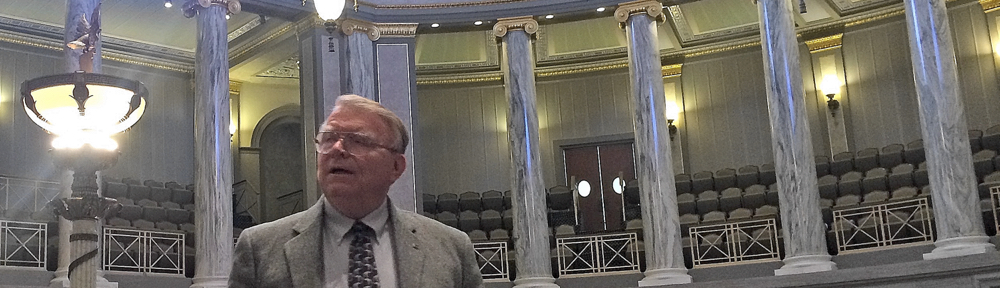
One proposal could have eliminated the sales tax that provides the bulk of funds for the Missouri Department of Conservation.  The department wanted to know where the state would find the $110 million dollars to pay many department’s bills if voters kill the tax. The representative didn’t have an answer to that question.

On the other side of the rotunda, a senator wanted to eliminate hunting and fishing permits because, he said, Missourians already pay the conservation sales tax and charging a fee to hunt the critters the conservation sales tax provides habitat for is double taxation.  That’s another $40 million dollars the department would not have so it can pay for all of the stuff it does.

Neither of these fellows suggested how the department could continue to function if it lost $150 million dollars a year, about 85% of its funding.  And if you think the legislature would look very hard for a new funding source, you don’t have a clue about the ideology of the legislative majority.

For example, the legislature started fiscal year 2014-2015 more than $400 million short of the amount it promised public schools they’d be getting by then under the school funding formula.  Do you really think a legislature that lacks interest in meeting its responsibility to pay for the education of Missouri’s children would show any great interest in finding new money to take care of deer, turkeys, otters, elk, prairie chickens, trout, bats, hellbenders, glades, and what little prairie there is left in Missouri?

The legislature solved the problem of funding shortages for education.  It rewrote the formula to reduce its responsibility.

We think the Latin phrase that tops our discussion today means “reduction to absurdity,” a concept that goes back to the great Greek seekers of logical thought who tested the truth of an  argument by seeing if it remained valid when extended to the point of absurdity.

The representative who wanted an end to the conservation sales tax said it’s not “good politics” to have a funding source “that never has an end to it.”  He wanted a statewide vote on whether to continue it.

Hmmmm.   Let’s extend his argument. Had he thought of a proposal for a statewide vote on the income tax?   The state sales tax?  The cigarette tax?   The alcoholic beverage tax?  Since the Farm Bureau jumped to support his bill back then, we wondered if the same standard should apply to the soil conservation and state parks sales tax. Those taxes don’t seem to have any ends either.

There were all kinds of opportunities for “good politics” then.  And if we listen to our legislators who continue to argue that lower taxes will mean more businesses will come to Missouri and create all kinds of new jobs, the expansion of the “good politics” plan could create a business development expansion that would make the Oklahoma Land Rush look like a small-town homecoming parade.

Now, let’s look at the senator’s double taxation argument.  There are all kinds of double taxation that also should be eliminated under his reasoning. We pay a sales tax for the opportunity to own our cars and our trucks and our snowmobiles and our wave runners.  But then we pay a second tax so we can stick a license plate on the front and the rear of the things, or put decals on the side.  And then we have to pay a third tax if we want to put fuel in them. And property taxes, don’t forget them. Forget double taxation.  We’re talking about QUADRUPLE taxation!!!

We pay property taxes that help finance our public schools and universities.  But then we have to pay laboratory fees, sports fees, band fees—and we have to pay to buy or rent textbooks so our children can learn something in the schools we’ve already paid taxes to support, sometimes higher taxes because the legislature continues to refuse to meet its self-imposed obligations. Clearly, those who use our schools are being taxed every bit as unfairly as the people with guns and bows and arrows are being taxed (don’t forget the sales taxes they paid to buy those things) to use the woods where the deer and the turkey play.

We pay taxes to finance our court systems at the county level.  And then we pay additional tax after tax after tax hidden behind the phrase “court fees” for various and sundry parts of the judicial system.  People who make mistakes that put them in court are being double-taxed. In fact, they’re being taxed in multiples, not just as a double tax.

There are astonishing possibilities for even more “good government” in other categories we haven’t touched on here.

The Representative withdrew his proposal fairly soon after introducing it after publicity about it raised big questions about the devastation it would cause. The Senator’s bill underwent major modification and was reduced to something that applied only to people living outside Missouri but who owned at least 75 acres here, which doesn’t exactly peg the logic meter.

We realize it’s never fair to criticize the efforts of others if the critic has no alternatives to offer.  In that spirit is a suggestion that lawmakers should avoid such pennyy-ante tax and fee proposals and focus on a broader “good government” system that lets taxpayers decide how to spend their money—because as we have often heard some legislators say, the taxpayers know how to spend their money better than government does. For example:

—-A law that designates each month as “pledge month” for certain government programs and services.  Let Missourians phone in amounts they would pledge for those services.   January could be Department of Natural Resources and Department of Public Safety Pledge Month.  February could be Department of Transportation and Department of Agriculture Pledge Month.  And so it would go.  We could eliminate an entire large state agency under this plan and that would make advocates of smaller government ecstatic.   We wouldn’t need a Department of Revenue any more. We could set up a smaller Office of Pledge Compliance and save a bundle.

We wonder how things would go for Legislature and Elected Statewide Officials Pledge Month.

Or perhaps we could have a statewide car wash for the Highway Patrol weekend.  A Statewide Social Services Bake Sale weekend.  A statewide garage sale for Mental Health.

Take a Conservation Agent to Lunch Day at the venison chili parish picnic.

See, folks, all the great thinking is not exclusive to legislative chambers when it comes to tax policy.  Any of us can think of things those people think about.


Electronic Wampum

Saw an article in The Hill last week that, “The value of most cryptocurrencies have plummeted in recent weeks, wiping out billions of dollars of wealth.”

Aside from the story needing a good editor (it should be “the value….HAS plummeted), I confess that I do not have the slightest idea why I should buy, sell, or invest in cryptocurrency.  And the Super Bowl commercials for it were pretty useless for me.  I wonder if they were paid for in cryptocurrency.

As I understand what I read from “helpful” internet sites, it’s a kind of currency that exists “digitally or virtually.”  There is no central or national issuing agency for the stuff.  There’s no FDIC.  It seems to be an anarchic system that creates something out of nothing other than the mind of someone who decides to start issuing “it.”  That person decides how many dollars buy a unit of whatever “it” is and people go nuts buying some of it. The person who creates it gets a lot of dollars and the person who buys it gets——

Well, some kind of units that have no physical properties. In other words, you can’t reach in your pocket and pull out some cryptochange to put in the parking meter. There’s nothing printed on paper for me to pull out of my wallet to buy a lottery ticket.

I get the idea that beads, shells, buttons, coins, and pieces of paper have value only if two parties agree on what their value is. But there seems to be no single worldwide party that determines what any particular “unit” is worth, as in an Indian Rupee is worth so many United States dollars, which are backed by a bunch of gold stored in Kentucky, which is itself valuable because somebody has decided it is.  But at least it is something somebody can see, touch, feel and perhaps even smell.

How much in “real” money will it cost me to buy 1,000 cryptosomethings?  And if I buy it or them as an investment, how will I realize any “real” money in return? Is this stuff more secure than the money I have stashed through the investment counselors at my local bank—who I don’t think have any, of my chidren’t inheritance invested in this electronic wampum.

Apparently there are coins of some kind, or tokens, or something in at least some of these operations but what is the common substance or means of exchange that establishes their worth—as in a dollar is the equivalent of so many Euros, or so many rubles equal a dollar?

Can I pay my taxes in cryptocurrency? When I look in the church offering plate and see that it’s pretty empty of tangible funds can I be comforted to know that it is heaped with non-tangible units?  Some sources say this stuff appears to be like stock.  If I buy some for $X and then sell it for $Z I might be liable for a capital gains tax and I would have to pay that in dollars.

Right?

But when I buy stock in American Veeblefleetzer, I know there’s a brick and mortar building tht is making veeblefleetzers.  If I invest in cryptostuff, am I investing in air?

I went to Kaspersky.com, which seems to know something about this, but I was not comforted when I was told, “If you own cryptocurrency, you don’t own anything tangible.  What you own is a key that allows you to move a record or a unit of measure from one person to another without a trusted third party.”

Kind of like our ancestors traded three beaver skins for a knife, I guess.  Except it’s not.

In this case it seems as if it’s more three  beaver skin units for a VIRTUAL knife unit—which I guess can be used to skin more beavers units that are chewing down tree units and building dam units on stream units.

Are the human equivalents of this system Unit-arians?   I spoke to a group of them a few months ago.  They looked pretty real to me.  I think I touched one or two of them and they seemed very solid.  Not virtual.

Curiously, Kaspersky says using a credit card to buy cryptothings is “risky.” Well, I guess using a piece of tangible plastic to buy a virtual unit of something that is stored in an electronic wallet that I cannot carry my credit card in, in my pocket, is——

Darned if I know.

Can you imagine what a turmoil things would be in if Missouri tried to pay for Medicaid expansion in cryptocurrency?

Here’s something else that I wonder about:

If, sometime in the future after I have departed this bewildering new economic world, these means of exchange that have been so common for centuries are completely replaced by cryptothings, what will be the purpose of Fort Knox?

Will gold reserves mean anything in a world where there is no central or issuing agency for various cryptocurrencies that might be established, the value is which is determined by whomever does the establishing?

Will a Pound still be a Pound the world around? You know, pound, as in £?

The Yen?

The Rupee?

The Leu?

The Sol?

The Euro?

I guess they’ll have value as collector’s items.  And then people will use virtual currency to buy them as decorative collectables and people of the future will look a our clothes and wonder what pockets were for.

The Casinos in Our Pockets

We lived in an “appointment” world in 1993, when the first Missouri laws governing casino gambling were written.  Voters had approved riverboat gambling, as it was called then, in 1992. The first casinos on boats would open in the spring of 1994.

Many of us still got our national news with the 5:30 network newscasts on television and our local news at 6 and 10 p.m. when those laws were written.

If we wanted to buy new clothes, we went to a clothing store during the hours it was open.  We went to grocery stores during their open hours to get our food.

We knew when each day we could go to the mailbox to get letters from friends and relatives.

And by the end of the year we knew that if we wanted to gamble we would have to go to the riverboat at a certain time to be admitted.

The Station Casino-St. Charles and the President Casino on the moored Admiral riverboat opened May 27, 1994. Gamblers could board the boat in St. Charles from 9 a.m. to 1 p.m. for a two-hour cruise (for which they paid three to five dollars, depending on the day). If they missed the cruise time, they had to wait for the boat to come back so we could pay to get aboard for the next trip.

The President never cruised. It was permanently moored near the Gateway Arch because the old aluminum Admiral had no engines. Gamblers would pay two dollars during the week and five dollars on weekends and could board every two hours from 10 a.m. to midnight.

But the world was changing and the change accelerated each year. “Appointment living” was beginning to diminish although many of us did not realize it at the time.

There were some hints, however.

The Pew Research Center reported in 1994 that the percentage of Americans getting news from the internet at least once a week had more than tripled since 1991, going from 11-million to 36-million news users.

The number of hosts on the internet tripled from January, 1994 to January, 1996, the year something called a “browser” was created—Netscape, the same year that the island nation of Antigua and Barbuda passed a Free Trade and Processing Act allowing licenses to be given to companies wanting to allow internet users to gamble. By the end of the year there were fifteen gambling websites. The next year there were 200 and by 1998, a study was published showing online gaming revenues had topped $830-million. Modern online gambling in this country dates from November 22, 2010 when the New Jersey Senate passed a bill allowing certain forms of online gambling.

It was about that time that the casino industry was starting to see an erosion in patronage. In Missouri, casino admissions reached almost 54.3-million in FY 2005 then declined for three years before climbing back to almost equal 2005’s number. Admissions began annual declines after FY 2011.  In FY 2019 (the last full year before the pandemic crippled casino business), casino admissions had declined by 49%.

Various reasons for the decline can be suggested but the end result seems to be the same—people just don’t go to where casinos are.

So the casinos have to go where the people are.

The situation is not unique to the casino industry. It is part of our changing lifestyles and those changes have become more obvious with the COVID-19 Pandemic that has forced casino closures for in-person business and quarantines for many who would patronize them.

We no longer live in an “appointment” world.  We can buy clothing at any time of the day off the internet.  We can use the internet to get our groceries delivered.  We can order deliveries to our homes from our favorite restaurants.  The same with our pharmaceuticals. Telemedicine is eliminating some office and hospital trips.

Casino betting can happen 24 hours a day because, as one source has observed, “everyone has a casino in their pocket.”  Casinos are looking for new products that can be offered through the ubiquity of the internet that we call up on our ubiquitous cell phones.  First is sports wagering. But later, Missouri legislators are likely to be asked to let table game betting to take place remotely.

Those who find gambling a reprehensible sin will find nothing redeeming about gambling on the internet.  But thousands of other Missourians will welcome the opportunities—as they welcome opportunities to grocery shop from home.

In a world where less and less of life is lived by appointment, the gaming industry knows it must change. And it is, as it should.

Missouri’s casino gambling laws must change, too.  Laws written and fees created in the days of physical customer presence in casinos need to be changed to account for virtual presence.  State services relying on gambling fees and taxes will be increasingly diminished as appointment gambling diminishes.  Casinos, profiting from laws of the 1990s appointment culture, resist modernization of the law. It is understandable that they do.

What is not understandable is why the Missouri General Assembly would not want to protect the state’s interests by bringing our laws from the appointment era into the virtual, but very real, era.


The parable of the caretakers’ wealthy friends

And the professor came among them as they convened to determine the welfare of the people.

And the professor said unto them, “Do not foolishly assume that following an unchanging law benefits the great mass of people who have chosen you to make wise decisions on their behalf.  Nor should you find it adequate to proclaim that enriching a few by adhering strictly to the law is good.”

And he said, “Suppose you, as caretakers of the common good, approve a generous spending plan of $32 billion for the benefit of those who have chosen you. And suppose you determine that $32 billion is adequate for the future and ignore the undeserving who believe your good stewardship of financial resources has become inadequate.

“But inevitably the system generates $33 billion in the next year, and $35 billion in the second.  By following the law, friends and supporters of those who established the “adequate” amount can divide the excess totaling $4.5-billion.

“But in the fullness of time,” said the professor, “those who are limited might rise up and say to those they assume to be their caretakers, ‘This is unfair for inflation has reduced the buying power of $32 billion to only $26 billion and those who rely on actually having $32 billion are becoming impoverished and the people who elect the caretakers are suffering.’”

“’You have established by the growth in wealth of your friends and supporters, year after year, the true value of the $32 billion. Yet you have refused to adjust the law to be fair to the greater number of those you serve while bowing to the wishes of supporters who offer benefits to you for being with them.’”

“’But we are only following the law.  We are meeting all of our obligations,’” you respond. “We are blameless.”

And the professor cast disdainful eyes upon them and said, “Your professions are hollow and self-serving! Those you proclaim are well-served are instead growing thin, yea, their ribs are beginning to show.  In the interests of fairness and justice, it is time—yea, it is PAST time—to adjust the law so that they shall be fulfilled.”

“But,” the caretakers said to the professor, “we do not understand why we should be forced to give our excess back to those who fall under the law.”

The professor rose and he said with passion, “Wisdom without honor has become greed.  You have impoverished those you claimed to help and it is time for those remaining with honor to show the courage to recognize what you have done and to correct it to the benefit of the greater public welfare.”

But the friends and supporters did not care about those who were being impoverished as they grew wealthier.  “You cannot change the law,” they said.  “Giving the impoverished dollars that are worth dollars would be punishment for our success.  Have pity on us for we are your friends.”

And the professor stood nearby hoping the caretakers of the public good would see the hollowness, self-serving, and greed of the supporters who demanded protection from those who trusted the caretakers to be just.


Alright alright alright

—-As potential next Texas Governor Matthew McConaughey says.

Governor Parson is going to ask the legislature next year to give salaried state workers a 5.5% pay raise and pay hourly workers $15 an hour.

The governor proposes; the legislature disposes.  We’ve all heard that.  So proposing is one thing. Accomplishing something is something else.  But this is a good move.

The state minimum wage is now $11.15.   And salaries for our state workers consistently have been among the bottom five or six states.  Openpayrolls.com calculates the average state employee last year made $28,871, 56.2% below the national average for government employees.

The minimum wage boost would affect about 11,000 state workers.

A review of state employee salaries five years ago by the data-mining study organization, Stacker.com ranked Missouri 47th out of 51 with the highest and the lowest salaries in the same general field—education.  With the average monthly salary of state and local employees then, the average monthly pay for all state and local employees was $3,746. The highest paid industry was listed as “Education,” where the average higher education monthly pay was $6,796. The lowest monthly salary then was in elementary and secondary education: $2.394.

Myron Cohen, a comedian who was a frequent guest on Ed Sullivan’s “Toast of the Town” show, used to tell the story of a fellow who came home from work early and found a naked man in his bedroom closet.  “What are you doing in there?” he is asked.  “Well,” says the naked man, “w-well…..everybody has to be somewhere.”

Somebody has to be at the low end of everything, including state employees.  Missouri has been content to be that “somebody” in too many categories for far too long.  The governor’s proposal is not likely to raise Missouri’s state workers very many notches on the poorly-paid lists.  But a pay raise of about five percent for hourly workers and 5.5% for salaried employees will be a big jump for our friends and neighbors who don’t deserve the disdain they often feel when they disappear each day into the offices and cubicles where the business of a 6.1-million member corporation called Missouri is run.

Unfortunately, there are reports of legislatures in several states that are seeing all of the federal COVID relief and infrastructure funds pouring in and they have started thinking of cutting taxes instead of realizing the advantages that come from the one-time infusion while maintaining competent levels of service under current taxing levels.

We hope Missouri’s legislature will not adopt the same attitude—-although we know there are those who will continue the state’s tradition of taking steps that make it harder for the state to pay for the promises it has made to its citizens for services and programs.

Just this once, let the deserving folks in cubicles have a little financial elbow room.


Notes from a Quiet Street (Fall Colors edition)

(Being a compendium of random thoughts that don’t merit full bloggiation.)

Would someone, preferably one of the people Missourians have sent to the U. S. Senate or the U.S. House, enlighten us about why we have a federal debt limit if it can be increased at congressional will?

And, members of our Washington delegation, don’t get all puffy about how you oppose raising it when you and your colleagues previous DID raise it.

Please write a 500-word theme about how you will pay back this debt. If you expect to pass this course, do not give me the tiresome argument that if government reduces its ability to pay for its programs, the public will create more economic growth that will reduce the debt.

There will be no grading on the curve. This is strictly pass/fail.

-0-

When it was announced a few days ago that the nation was averaging 1900 COVID deaths a day for the first time since last March and that 90% of COVID patients in hospitals are unvaccinated, an ugly stroke of capitalist brilliance overwhelmed me.

Monogrammed body bags.  There’s a big constituency for this product—the thousands of people who refuse to get vaccinated.  Take your personal bag to the hospital with you so you can go out in style.

It would be the last status statement, a last chance to be SOMEBODY instead of just some body.

It will be a wonderful memento for your survivors and an inspirational symbol of your stalwart independence.  Could become a family heirloom.

And there would be a good market for used ones.  Run an ad on the internet, or maybe in the newspaper, or offer it on EBay: “Body bag, reasonably priced. Great savings if your initials are _____ (fill in appropriate letters).”

If ya don’t got it, flaunt it.

0-0-0

The University of Missouri football team, a few days ago, held a charitable event for the athletic department of Southeast Missouri State University. The Tigers gave the Red Hawks $550,000 and all the team from Cape Girardeau had to do was get the snot beaten out of it again at Faurot Field.

Early in the season we see a lot of these games, usually routs.  We’re not sure they should really count on the season’s record of either team but they do—-because they are two college football teams and they do play and somebody keeps score.

Smaller schools are willing to take on these challenges because—in this case $550,000—they get a relative ton of money for athletic programs that come nowhere near having the resources bigger schools have.  If being a punching bag one Saturday afternoon makes sure there are volleyball and soccer and other minor games available for student-athletes in Cape Girardeau, the price is worth it.

0-0-0

We are sure we are not the only ones to think, or to say when buying a new car, “This is probably the last gas-powered car I’ll ever own.” We’ve said it for the last two cars we’ve bought and the second one is coming up on eight years old. Will there be a third?  Two developments in the past few days make it clear the future is silently roaring (if such thing is possible) our way.

New York’s new governor, Kathy Hochul, has signed a new law saying every new passenger car or truck sold in the state must be zero-emission vehicles by 2035.   Medium and heavy-duty trucks have a 2045 goal. This is a huge goal—electric vehicles constituted only two percent of sales last year. The new law is similar to an executive order issued by the governor of California earlier.  Big difference: executive orders are not laws.

That’s plenty of time to develop EVS that don’t need to recharged on round trips to St. Louis or Kansas City.

In fact, one such car is coming over the horizon.

We’ve said that we’ll start to seriously look at an electric vehicle has a 500-mile battery.  There is such a vehicle and the EPA says its range is 520 miles, topping Tesla’s best by more than 100 miles.  The company is called Lucid and it plans to start deliveries of its cars before the end of the year. Lucid is a Silicon Valley-founded company that recently picked Casa Grande, Arizona as the site for its first purpose-built EV factory in North America. It will start by making 10,000 cars a year and plans expansion to produce more than 300,000 a year.

Prices are believed to start at about $77,000. They’re going to have to come down a few tens to be affordable to people such as I am.

Still…….

The future is coming.

0-0-0

The big inaugural/bicentennial parade in Jefferson City on Saturday, September 18t, was a week premature.   True, Missouri was admitted to the Union on August 10, 1821.  But people living out here in central Missouri didn’t know about it until September 25 when the proclamation was published by The Missouri intelligencer¸ in Franklin—Missouri’s first newspaper outside of St. Louis.   Folks in St. Louis celebrated twenty days earlier when Missouri’s first newspaper, The Missouri Gazette and Public Advertiser, published the proclamation.  No big stories or headlines Just the proclamation.  That’s the primitive reporting style of the day.


Running government as a business, or—-

It’s an easy suggestion to make: Government should be run like a business. We first heard this piece of oratory so long ago we have forgotten when and we’re sure it wasn’t original then.  So let’s test the validity of that idea. We’ll test it by reversing it. Suppose you ran your business the way Missouri government is run.

The first thing you would do because it would be popular with your customers is cut prices.  Customers like free stuff and if it can’t be free, it should be priced as lowly as possible.  People will like your store a lot because they will pay as little as possible for the merchandise. The best way to keep your prices low is to pay your employees as little as possible. Many won’t stay very long but that’s okay.  There are always more where they came from.

Of course, your merchandise won’t be of the quality of some of your competitors because you’re holding down the prices and you couldn’t afford better merchandise anyway. Your customers won’t complain about the inferiority of the product until it falls apart on them when they need it the most.  And their complaints will be easy to ignore because most of the others are satisfied with inferiority or mediocrity.

You won’t be able to pay for the new roof your store needs.  The parking lot will develop cracks and potholes you can’t afford to fix.  The place might not be as clean because there’s not enough money for a cleaning crew.  A lot of your business equipment is outdated because you can’t afford new stuff that will speed up payment processes or handle orders. You don’t have the money to train employees to use the new equipment anyway.  Your customers won’t mind the inefficiencies as long as you’re cheap enough.

You think about all of this for a while and you realize you’ll make the money you need to fix all of these problems if you just lower your prices some more, which will produce more customers who will in the long run spend more money.  You also can get by with fewer employees. That will help you become more prosperous and shoppers won’t mind if there are fewer people to wait on them or fewer people who can help them find something or order something.

Yep.  That’s the answer.  Keep prices low. Don’t worry about quality. Don’t bother with retaining employees. People will love you because they don’t have to pay much. Of course, they won’t get much.

Run your business the way government is run. Watch government be run the way you run your business.

Prosperity is just around the corner!

The simple folk

(“What do the simple folk do?” is a song from the 1960s Broadway musical hit Camelot.” Guinevere and King Arthur discuss the lives of commoners and what they do “when they’re blue.” Guinevere notes, “They obviously outshine us at turning tears to mirth, and tricks a royal highness is minus from birth.”  Arthur’s final conclusion, after listing several things the simple folk do is, “They sit around and wonder what royal folk would do.”

Dr. Frank Crane suggests those not burdened with noblesse oblige do quite well—because it doesn’t occur to them that they should be living—-)

A MISERABLE LIFE

Poverty is a point of view.

It all depends upon what you are used to, and upon what you see others enjoying

The average realistic author who seeks to harrow the reader ‘ s feelings with his account of the wretchedness of existence is simply performing the trick of bringing a man with one set of tastes into the life of a man with another set of tastes .

The king deceives himself if he thinks the cobbler unhappy, for the   cobbler has never been king.

The poet is mistaken when he imagines the life of a rough teamster to be miserable, for the teamster is a teamster and not a poet.

Leaving actual pain out of account, most lives are reasonably content  so long as they are what they are and do not view themselves from the point of what they are not .

Much of the description of the hollowness and emptiness of existence  we find in George Gissing or Upton Sinclair and their ilk might be thus parodied:

“Little do we suspect the sorrows of the poor. The days crept on with leaden feet for   Archibald Vandergold. There was no golf nor lawn tennis. Only the full routine of behaving himself and earning a living.

“In his little flat there was only one servant and she was absent  Thursdays.

“There were no mistresses nor chorus girls to eat lobster and drink  Veuve Cliquot with him at 1 a. m. No, only one wife and a child.

“He had to reach for the bread at table himself, and pass his own plate when he wanted another piece of ham. No butler stood behind his chair and whisked away his plate every time he took another spoonful of beans. Like all the dreary bourgeois to whose class he belonged, he did his own buttling.

“To arise in the morning and select your own collar, tie your own tie, and stoop over to put on your own shoes until the temples throb with the constrained attitude, to have no valet to turn on the hot water for your bath, but to be compelled to handle the faucet yourself; to go out to the dining room and drink your coffee instead of having James bring it to you as you lie abed; to ride downtown on a tramway instead of taking a morning gallop upon your thoroughbred; to have no polo ponies, no private yacht, not even to belong to a club; to have no box at the opera where you can wear your dress suit and loll about and converse with duchesses and millionaires’ daughters in Robert W. Chambers’s* dialogues; such is the life of that submerged class which the reader of the average magazine society yarn hates to think about.

“Little do we suspect the sorrows of the poor. Archibald Vandergold felt his humiliation. His bathtub was not of porphyry. His cigarette case was not gold with his monogram on it; it was leather and carried the advertisement of a coal dealer.

“He actually went to church Sundays with his wife and child and not to a gilt restaurant with another man’s wife.

“The darkness of his narrow existence can be imagined when it is added that he actually liked his wife, liked to go to church, enjoyed being decent, and was interested in his business.

“And, pardon my vulgarity in saying it, but the whole fetid truth must be told—the poor wretch did not own an automobile!”

*American science fiction and historical fiction writer 1865-1933)

It takes a town to make a town

(We want our city to be greater than it is, more than it has been to its own citizens and to those who visit or will visit it.  But the town has to WANT to be greater than it is and that means its citizens must want it to be more than it is, not for their own benefit, but for the benefit of generations to come.  It’s not a job to be left to the city council or the chamber of commerce. This observation, written by Dr. Frank Crane shortly after the end of the First World War and published in The Delineator magazine, remains valid today as he suggests we put—)

YOUR HOMETOWN FIRST

Work for your own town.

Beautify it. Improve it. Make it attractive.

The World War and the Treaty of Peace and the Protective Tariff and all such things are important subjects but what’s the good of cleaning up the world unless you sweep your own doorstep?

The city whose main street is dirty, sordid-looking, cluttered, uninviting, suffers much. Such a city wants to be cleaned, recreated, made a thing of beauty so that people will come from miles to see it.

The best advertisement of your business if the town you live in.

Towns get reputations as well as men. Make your town talked of all through the state. It will thus draw people. And where the people come, there is prosperity. It does not take money. It takes cooperation.

Get together. Organize for civic improvement. Develop the civic nerve.

Rid your town of one eyesore after another. Clean up the vacant lots and plant them in gardens. Make a cluttered yard a disgrace. Make public opinion too hot for those who will help.

It pays.  It will promote law and order. It will help in the education of your children. It will draw factories and other business enterprises to your locality.

Shiftlessness, untidiness, dirt and selfishness as shown in your streets and buildings react upon your people.

Such things make your boys and girls grow up hating their home town.

Make your home town a children’s paradise, something their memory will lovingly turn back to.

Look after your amusements, your parks, your playgrounds, your theatres and all other forms of communal enjoyment.

Make your home town happy.

It pays.

Before there was Dave Ramsey—

(There was Dr. Frank Crane who dispensed the same advice.  He did it with one column, not a series of lessons that detail how to accomplish the same goals Dr. Crane espoused.  The bottom line for both is—use common sense.  Dr. Crane wrote this in 1920.  See if it doesn’t sound like the kind of basic advice we see in Dave’s daily columns as he explores—-)

THRIFT

Thrift simply means the application of thought to money.

It doesn’t mean saving merely. It means to think every time you have to do with m

It means to make money with energy, to spend money wisely, and to save money systematically.

Some people have the idea that it denotes a superior person not to care about money. This idea is wrong. It indicates a lack of sense and a lack of morals.

Money carelessness means unhappiness by and by. It is one of the surest ways to slump into self-pity if not to crime.

The first thing needed in order to be thrifty is principle. You must make up  your mind and stick to it.

Principle number one is that a person can live on nine-tenths of what he does live on.  If you spend $1,000 a year you can get along on $900. Save the other $100.

To make $10 and spend nine means success.  To make $10 and spend $11 means ruin.  Which way are you headed?

Thrift is a general moral tonic. It develops character. It takes self-denial and hence creates self-mastery, which is the thing that every human being needs.