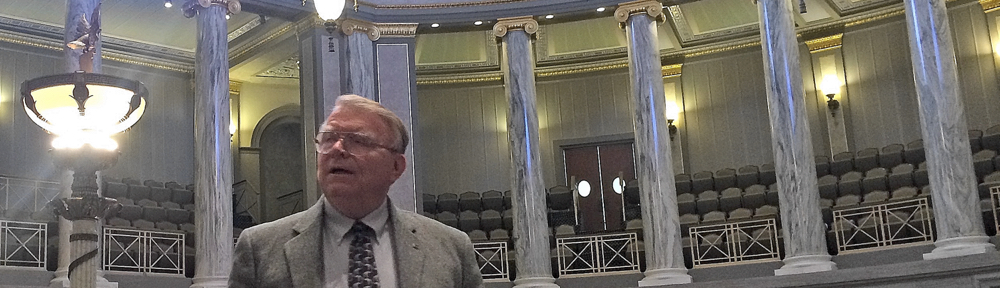
Who should represent Missouri?

(Before we plunge into this week’s issue, we’d like to update last week’s post.  The Kansas City Star reported last Saturday that the federal prosecutor had announced the influx of federal agents in Kansas City had produced 97 arrests for homicides (5), illegal possession of firearms, various forms of drug trafficking, carjacking and being fugitives with outstanding warrants against them. In Portland, Homeland Security agents withdrew from the federal building area and although protests continued in the area they were described as “mostly peaceful.”)

In our last entry we suggested that our president and his allies on the right have spoken with forked tongues on the issue of states’ rights.  On the one hand, the president has maintained it is the states’ responsibility to fight the coronavirus but in this campaign year when it suits his purpose to override states’ rights, he has sent federal militarized forces to cities with Democratic mayors presumably to fight violent crime although no local or state officials asked for that help.

A recent incident indicates the left side of the aisle is not immune to politically-oriented efforts to ignore the rights of states and to try to capitalize on the public mood. Our example is not as severe as our entry was last week, but it shows, we hope, that neither side has clean hands on this issue.

House Speaker Nancy Pelosi recently asked the Congressional Joint Committee on the Library to remove eleven statues from Statuary Hall in the Capitol because they are men associated with the Confederacy.  The House has approved a resolution formalizing that request and it is before the Senate as we compose this.

Our senior Senator Roy Blunt, a former history teacher and a Vice-President of The State Historical Society of Missouri, has objected.  Almost 160 years ago, the federal government agreed to let the states decide which two famous state figures should be in the hall.  Some states already have replaced statues of white supremacists and confederate leaders with figures deemed more appropriate.  Blunt thinks a hearing would be good and he wants to know what states want to do.

The two Missourians who’ve been in Statuary Hall since 1895 are Senator Thomas Hart Benton and Francis Preston Blair, Junior, a Union General who represented the state in the House and in the Senate.  Last year, the legislature passed a resolution to replace Benton with a statue of Harry S Truman.  It hasn’t been done yet and we have suggested that the legislature has targeted the wrong man for replacement.

Given these times, the legislature might want to reconsider which of our statues is replaced.  Benton represents the self-contradictory figure of which we find many in our pre-Civil War history. He owned slaves but came to oppose the institution, and refused the legislature’s orders that he follow its sentiments on protecting slavery, especially as the frontier expanded. That position cost him his seat in the U. S. Senate. We have found no record that he freed his slaves.

Our other statue is that of Francis Preston Blair Jr., who was a Union General but also an undeniable racist. He owned slaves and when the issue of emancipation came up, he proposed sending freed slaves to Central and South America. When he was the Democratic Vice-Presidential candidate in 1868 his anti-emancipation speeches weakened the party’s effort, including his theme that African-Americans were “a semi-barbarous race…who are worshipers of fetishes and polygamists (who wanted to) subject the white woman to their unbridled lust.”

Harry Truman would be a fitting replacement for either man, Blair in particular.  Truman has a bust in the National Capitol already—with the others who have served as Vice President.  We have our own suggestion for proper representatives for Missouri. (At the end we’ll have a list of most of the statues that, though of marble and bronze, have feet of clay).

We have no problem with a Truman statue representing Missouri and we realize a lot of people have contributed a lot of money to create one.  But we think our idea says much more about our state and the qualities of the people who should be in that hall and the qualities of the people who represent Missouri.

Other than a few women and Native Americans, the figures in Statuary Hall tilt heavily in favor of politicians and generals. But we think of two men who were neither but would better symbolize everything our state should always strive to be than any political figure or general ever has or could.  Not that anybody would listen, but we would love to see our state represented by statues of

Stan Musial and Buck O’Neil.

I met both of them, briefly.  In 1985 on the World Series Special passenger train Governor Ashcroft arranged to travel across the state from Kansas City to St. Louis for the third game of the Series, I asked Musial to tell me about the last time the Cardinals traveled by train.  It was the trip back from Chicago after Musial had gotten his 3,000th hit.  We talked for a few minutes.  He laughed.  My God! What a wonderful laugh!  I still have that interview somewhere.  And the day his bust was unveiled for the Hall of Famous Missourians at the Capitol he spent time talking baseball and other things, laughing often and then playing the harmonica he always carried.  It was easy to love Stan Musial.

I cannot tell you a single thing John Ashcroft did or said as Governor—-except that he arranged that train trip during which I got to talk to Stan Musial.

When President Obama presented Musial with the Presidential Medal of Freedom, Bernie Micklasz wrote in the St. Louis Post-Dispatch:

“We’re a polarized nation in many ways. We dig into our respective corners. Republicans vs. Democrats. Liberals vs. Conservatives. We snarl at each other. We don’t seem to agree on much. But we can agree on this: Stan Musial transcends all of that. When it comes to The Man, there are no differences in ideology or opinion. It’s unanimous: We love The Man. Even at the late innings of his life, Musial still brings people together and makes them happy.”

“He’s been doing this for what, 70 years? I don’t believe Musial has ever received enough credit for the way he conducted himself during an extremely sensitive time in our history, during the period of baseball’s integration. Musial didn’t make speeches. He didn’t use a media platform. He simply went out of his way to show kindness and concern to African-American players who had to deal with intense hostility in the workplace.”

Buck O’Neil, the great symbol of Negro Leagues baseball (and so much more than that), finally got his bust in the Hall of Famous Missourians, too, at the State Capitol although he still deserves a full plaque in Cooperstown.  The great Cubs player, Ernie Banks, advised us to, “Just follow Buck O’Neil. This man is a leader. He’s a genius. He understands people. He understands life…All of us should learn from this man. He’s an ambassador; he’s a humanitarian. We should follow him…”  Buck had plenty of reason to be bitter because he was never allowed to play a major league game.  But I heard him say one day, “Waste no tears for me. I didn’t come along too early—I was right on time.”

I sang a song with him one day.  A lot of people in a lot of meetings with him got to sing with him, too. He recalled in his autobiography, “Sometimes at the end of my speeches I ask the audience to join hands and sing a little song. It goes like this: ‘The greatest thing in all my life is loving you.’ At first the audience is a little shy about holding hands and singing that corny song, but by and by, they all clasp one another’s hands and the voices get louder and louder. They give it up. Got to give it up.”  I gave it up, holding hands with strangers, that day.

It will never happen of course, the placement of these two men in Statuary Hall as representatives of our state. But I can’t think of two other people who could represent what all Missourians should want to be and to serve as representatives of the best that Missouri could be than these two men.

0-0-0-0

Although Speaker Pelosi refers to eleven statues, there are more that might be candidates for removal.  We’ve looked at the list and here are those whose places of honor might come under scrutiny:

Alabama—Confederate General joseph Wheeler.

Arkansas—Judge U.M. Rose, supporter of the Confederacy, slave owner; and Senator James Paul Clarke, white supremacist.

Florida—Confederate General E. Kirby Smith

George—Confederate Vice-President Alexander Stephens

Louisiana—Edward White Jr., Confederate soldier who as member of the U. S. Supreme Court upheld the “separate but equal” concept.

Mississippi—Confederate President Jefferson Davis and James Z. George, Confederate Colonel and member of the state’s secession convention.

Missouri—Blair Jr., and Benton

North Carolina—Abraham B. Vance, Confederate officer; Charles Aycock, white supremacist

South Carolina—John Calhoun, defender of slavery, Wade Hampton, Confederate officer and post-war leader of the “lost cause” movement.

Tennessee—Andrew Jackson, slave owner and president who forced the Cherokees off their lands in the Carolinas and onto the Trail of Tears to Oklahoma.

Virginia—Robert E. Lee, Confederate Commander

West Virginia—John E. Kenna—Confederate officer at age 16.

In addition, Speaker Pelosi wants the bust of Chief Justice Roger B. Taney to be removed from the busts of Supreme Court justices because of his authorship of the Dred Scott decision.


Us vs. It—part IX, keep your distance

We’re back to this series of us against the virus because the virus is coming back, too. An increasing number of states are seeing terrible eruptions of cases and deaths and some of our numbers are on the rise. Each time Governor Parson has a virus update briefing he closes with urgings that we be responsible, social distance, wash our hands, and so on. He’s leaving it up to us to decide whether to wear masks. Personally, we’re scared enough about this virus that we do wear ours. I have three in my car and one at home for formal occasions—a dignified dark blue that matches my blazer.

We’ve come across a graphic description of how social distancing stay-at-home orders, and other other measures can work when a pandemic moves in. Please look at this graph as the virus begins to return to Missouri.

An organization calling itself Quartz.com, which says it provides global news and insights, has analyzed the big difference in Spanish Flu victims in Philadelphia and in St. Louis in 1918. Reporter Michael Coren writes that Philadelphia held a big parade despite warnings about soldiers carrying the Spanish Influenza virus. Two-hundred thousand people attended. Three days later, every bed in the city’s thirty-one hospitals was filled with a Spanish Flu victim. A week after the parade, the disease had killed 4,500 people. Only then did the local political leaders close the city.

St. Louis, under the aggressive leadership of City Health Director Max Starkloff, closed all of its schools, libraries, courtrooms, playgrounds, and churches within two days of learning of its first cases. The city banned gatherings of more than twenty people. It limited the number of people who could ride streetcars, and store and factory work shifts were staggered. The National Academy of Sciences reported in 20017 that per capita deaths in St. Louis were less than half the death rate of Philadelphia, thanks to Starkloff’s quick actions and the population’s response to his leadership.

The operative phrase is “death rate,” because Philadelphia was the nation’s third-largest city with a population of about 1.8-million then. St. Louis was the nation’s FOURTH-largest city at almost 700,000.

The graph that accompanies Coren’s article makes the point well.

We had a statewide lockdown in Missouri. Governor Parson began to lift it in early May and hopes Missourians have the good sense at a time when the virus is finding renewed energy to take steps that will avoid a rollback of the reopening. If we want to keep the jobs we have just recovered, and recover more; if we want to return to schools safely in a few weeks; if we want to keep being with friends again, we must not underestimate the capriciousness of this virus that we now know can attack and kill anyone of any age or condition. Hospitalizations are on the rise in Missouri. Seriously. Deaths seem to have moderated but we’ll look at the numbers in the next week to watch for indications of what our July 4th weekend behavior meant and whether the increased case numbers accelerate our death rate.

This stuff does not play games.

Our study of the 1918 pandemic earlier this year indicated viruses such as the one in 1918 and the one now seemingly can explode, and when they do, it’s awfully late to decide people need to dig in at home or think about masking-up. We cannot be blind to what is happening in other states, including states such as Idaho, Montana, and South Dakota. We can hope we somehow escape a second surge of the first wave, but reality better be sobering to even the most hopeful.

Nancy and I try to go outside and walk a mile or two every sunny day, breathing in fresh air (hoping that walking fast enough to speed up the heart and the lungs will make them stronger in case we, unfortunately, become positive in ways beyond thinking; Nancy and I got “nosed” last week and we were negative. But this is a new week.). We miss our social circles of friends from various activities but we don’t want to give them anything nor do we want them to give us anything but continued friendship.

There are, of course, those who will say wearing a mask is a blow against their freedom. We submit to them, and to everybody else, the story often told by the Chairman of the Prohibition National Committee in the 1880s, John B. Finch, who would say, “This arm is my arm….it’s not yours. Up here I have a right to strike out with it as I please. I go over there with these gentlemen and swing my arm and exercise the natural right which you have granted; I hit one man on the nose, another under the ear, and as I go down the stairs on my head, I cry out:

‘Is this not a free country?’

‘Yes, sir.’

‘Have I not a right to swing my arm?’

‘Yes, but your right to swing your arm leaves off where my right not to have my nose struck begins.’

“Here,” Finch would say, “civil government comes in to prevent bloodshed, adjust rights, and settle disputes.”

Our civil government in Missouri prefers each of us understands our obligation to the rest of us, whether it is swinging our arms, or spreading a virus. But we are confident our governor WILL tighten things down again if we fail in our personal actions to be as responsible as he wants us to be.

We hope all of you will look at the chart above and understand how important it is for us to endure the slight inconveniences necessary to protect one another. If we don’t get to see our friends for several more months, the minutes we spend behind a mask and the hours and days we spend binge-watching streaming-channel programs will improve the chances they will be there to be seen.

And we will be there to see them.

Better names

If we are to remove the names of traitors from our military bases—and we should—whose names deserve to replace them? The issue requires some thought and some understanding of the purposes of the bases.

Rudi Keller is a longtime friend whose company I used to enjoy during my days as an active member of the Capitol press corps. Not only is he a fine reporter, but he is an excellent historian. During the Civil War Bicentennial, Rudi wrote hundreds of columns about life in central Missouri during the war. The columns were turned into two books, one covering 1861 and the other 1862. I hope that someday, somehow, his work covering other three years of the war are published.

Rudi is now the news editor of the Columbia Daily Tribune. He still finds time to write news stories and some opinion pieces published in the Tribune and in other Gatehouse-owned newspapers. A couple of weeks ago he offered some “humble suggestions for new base names,” a response to suggestions our military bases named for Confederate officers should get new, more honorable names. His ideas are worthy of consideration by the people who have the power to make changes.

Last Thursday, U.S. Sen. Josh Hawley voted against an amendment to the National Defense Authorization Act directing that new names be chosen for bases honoring Confederate military heroes. The amendment targets 10 military bases — all in states that initiated a war to preserve the right to own another human being.

In a statement to reporters, Hawley played the history card. We’ve seen it before, used to defend everything from flying the Confederate battle flag at the South Carolina capitol to keeping statues of violent racists in places of honor.

“I just don’t think that Congress mandating that these be renamed and attempting to erase that part of our history is a way that you deal with that history,” Hawley said.

Well, as the Tribune’s resident expert on the Civil War, I would recommend that Hawley ask his colleague, U.S. Sen. Roy Blunt, for some books on the generals whose names adorn some of the nation’s most important military installations. Blunt, you see, was once a high school history teacher and is a trustee of the State Historical Society of Missouri.

Blunt is not advocating for the names to remain on the bases. In fact, he suggested to reporters that renaming some or all would be appropriate.

“If you want to continue to name forts after soldiers, there have been a lot of great soldiers who have come along since the Civil War,” Blunt said, according to CNN.

Blunt noted that Braxton Bragg, whose name is on the largest military base in the world, was “probably the worst commanding general in the entire Confederate Army. He’s an interesting guy to name a fort after.”

But in case Hawley is too busy to read some books, here’s a short list of reasons why renaming those bases is a good idea. As Blunt noted, some of them have less-than-inspiring records of military achievement.

FORT LEE

We’ll start with Fort Lee in Virginia, named for Gen. Robert E. Lee.

Lee was an audacious, enormously successful commander and an inspiration to his troops. He was scrupulously honest, a brilliant engineer and he had a lasting impact on higher education after the war with his reorganization of what is now Washington and Lee University.

But instead of fighting for the nation that had given him an education, employed him and made him prosperous, he took up arms against it. That, in the Constitution, is the definition of treason.

Lee’s greatest military achievements were as an enemy of the United States. If he had been any more successful, the property occupied by Fort Lee would not be in the United States.

Fort Lee is a training center. How about Fort Steuben, for Friedrich Wilhelm von Steuben? A Prussian officer, he served in the Revolutionary War teaching basic military drill, tactics and discipline.

FORT HOOD

Fort Hood, in Texas, is named after John Bell Hood, an aggressive commander who destroyed through incompetence the last effective Confederate Army fighting west of the Appalachian Mountains.

Fort Hood is the army’s base for deploying heavy armored forces. How about renaming it Fort Patton, after the aggressive World War II Gen. George Patton? At a crucial moment of the war, he spearheaded an armored drive to defeat the last Nazi offensive in western Europe.

FORT BENNING

Fort Benning in Georgia is named for Henry L. Benning, a competent fighter who served under Hood. Benning was never a grand strategist and never held an independent command.

Fort Benning is where the U.S. Army trains its airborne troops and is the home of its infantry school. How about renaming it for Gen. Anthony “Nuts” McAuliffe? He was the commander of the 101st Airborne Division when it was surrounded at Bastogne, Belgium and acquired his nickname from the one-word answer he gave when Germans demanded his surrender.

FORT GORDON

Fort Gordon in Georgia is named for Gen. John Brown Gordon, who was an aggressive and audacious commander but who, after the war, opposed the Reconstruction policies that gave civil, social and economic rights to freed slaves. He is believed by many to have been the leader of the Ku Klux Klan in Georgia, although he is also on the record as having made some statements of benevolence to the people freed by the South’s defeat in the war to preserve slavery.

Fort Gordon is the Army’s center for signal and cyber security. Perhaps a better name would be Fort Lowe, for Thaddeus S.C. Lowe, who organized the Union Army Balloon Corps, which provided aerial reconnaissance of Confederate positions reported by a telegraph wire from a platform tethered up to 500 feet above the ground.

FORT BRAGG

Fort Bragg, North Carolina, is named after Braxton Bragg, as Blunt noted, one of the South’s least successful generals. On two separate occasions, Bragg had major strategic victories within his grasp but failed at the moment of execution.

Perhaps a fitting name would be Fort Washington, in recognition of the fact that George Washington led a meager, ill-fed and ill-clad force in the Revolution. The name applied to the world’s largest base would celebrate the power of what Washington started.

FORT POLK

Fort Polk, Louisiana, a joint readiness and training center, is named for Gen. Leonidas Polk, who did not survive the Civil War. As a military leader, he made a major strategic blunder early in the war that cost the Confederacy the chance to turn Kentucky to its side.

As a readiness center, perhaps it would be better named for Gen. George Thomas, who held his command in readiness at Nashville during an ice storm and struck at Hood when the weather warmed, scattering the rebel army and ending any substantial resistance in the war’s western theater.

FORT PICKETT

Fort Pickett, a Virginia Army National Guard installation, is named for George Pickett, who gave his name to the famously futile Pickett’s Charge at Gettysburg. If the military wants a symbol of bravery in the name of a forlorn hope, perhaps it could remain Fort Pickett.

I offer the name Fort Johnson-Brown, for Gen. Hazel Johnson-Brown, the first black woman to become a general in the U.S. Army and, in retirement, a professor of nursing at George Mason University in Virginia.

FORT A.P. HILL

Fort A.P. Hill, an Army training and maneuver center in Virginia, is named for Gen. A.P. Hill, who died in the last days of the war after a distinguished battle record. Like Lee, Hill was educated by the United States at West Point and turned on the loyalties of a 14-year U.S. Army career to take up arms against his country.

It could be renamed Fort Sherman, for Gen. William Tecumseh Sherman. While Gen. Ulysses Grant was piling up casualties in Virginia in 1864, Sherman mainly used flanking maneuvers to drive Confederate Gen. Joseph E. Johnston back almost 100 miles to Atlanta.

FORT RUCKER

Fort Rucker, Alabama, is named after Gen. Edmund Rucker. A cavalry leader, Rucker was a competent commander and after the war, a business partner of Nathan Bedford Forrest, first Grand Wizard of the Ku Klux Klan.

Fort Rucker bills itself as the home of Army aviation. How about naming it Fort Doolittle, for Jimmy Doolittle, who commanded the daring raid in which B-25 bombers launched from an aircraft carrier to bomb the home islands of Japan in early 1942? The raid did little damage but it did bring a big morale boost to a nation reeling from the Pearl Harbor attack and notified the Japanese that the U.S. had immense power to strike out.

If anyone is squeamish about the name Doolittle because it sounds like the camp for slackers, it could be Fort Wright, for the Wright Brothers, who built the first successful airplane and sold the Army its first air machine.

CAMP BEAUREGARD

And we come to Camp Beauregard, established as a training base during World War I and now operated by the Louisiana National Guard. It is named for Gen. P.G.T. Beauregard, commander of the forces that opened the war with the bombardment of Fort Sumter.

Beauregard won the First Battle of Bull Run, a battle he easily could have lost, but had few additional successes. His forté was dreaming up grandiose plans for a vast, strategic move with himself in command.

The camp is one of the oldest ones in existence from World War I. Might I suggest to the fine state of Louisiana one of their own, Natalie Scott, as the new namesake?

Known to be one of only three Red Cross workers to serve in World War I and II, Scott returned home from World War I a heroine. She was the only American woman to earn France’s highest medal for courage, the Croix de Guerre.

The current names are legacies of a time when racism turned those men’s traitorous conduct into a romantic legend of an honorable defense of home against invaders.

Time has consigned that legend to the ash heap of history and the base names should go with it.

Thanks, Rudi.


If one of your ancestors owned slaves—

—should their name be erased from your family tree?

Should Jefferson City and Jefferson County change their names because Thomas Jefferson owned slaves?

Should towns named for the Five Civilized Tribes or their leaders change their names because the Cherokee, Choctaw, Creek (Muscogee), Chickasaw, and Seminole tribes sided with the Confederacy during the Civil War?

We began thinking of these questions a few days ago when we saw a Kansas City Star comment suggesting a fountain and a parkway named for J. C. Nichols be renamed because he was a racist whose real estate developments defined Kansas City’s history of racism that lingers in the minds of many citizens today, and upon hearing of a petition circulated by a University of Missouri student to remove a statue of slaveholder Thomas Jefferson from Francis Quadrangle (where the columns are in Columbia) and after seeing a news account that protestors in North Portland, Oregon had pulled down a statue of Jefferson at a high school named for him.

New to the discussion is that military bases should no longer be named for Confederate officers such as Braxton Bragg, John Bell Hood, Henry Benning Robert E. Lee, and others.

These are troubling issues and troubling questions in troubling times. Today, let’s consider Thomas Jefferson. The military bases will wait for a later posting.

Correcting the historical narrative is better than trying to erase it, for we learn nothing from erased history and we can learn everything from placing history’s people and events in context. Hasty action in emotional days might rob those in the future of needed guidance in shaping their eras.

University of Missouri Curators correctly decided to leave the Jefferson statue on Francis Quadrangle although the petitions had more than two-thousand signatures. University System President Mun Choi said, “We learn from history. We contextualize historical figures with complex legacies. We don’t remove history.”

To remove the statue of Jefferson because he owned slaves would also remove the statue of someone who was the main author of the Declaration of Independence, the creator of the Virginia Statute of Religious Freedom, the founder of the University of Virginia (three things he wanted on his original tombstone that also is at the University of Missouri-Columbia), and the president whose administration added most of the land west of the Mississippi River that made us a nation stretching from the Atlantic to the Pacific. Dr. Choi and the curators had it right.

Here’s a more intimate dimension to this issue:

Several years ago when I was a guest lecturer at Kent State University, I met a sharp, earnest African-American student, Shannon Lanier, and this then-girlfriend (now his wife, Chandra, and mother of their three children). He told me he was the sixth-great grandson of Thomas Jefferson and his slave Sally Hemings, whom some identify as the half-sister of Jefferson’s wife. Martha Jefferson died at the age of 33 in 1782. Shannon already had co-authored a book about Jefferson’s black descendants. DNA studies indicate Tom and Sally had six children, four of them surviving to adulthood. Many white Jefferson descendants accept the Hemings descendants as part of the Jefferson heritage.

I wonder how those African-American Jefferson descendants would feel if they knew a proposal had been made at the University of Missouri to remove a statue of their most famous ancestor. Would the removal place them in the position of being branded as products of some kind of unforgivable Original Sin? Is their existence the result of some kind of unforgiveable disobedience of widely-accepted contemporary codes against sexual relations between different races (a code often ignored in plantation America, including here in Missouri)?

The censuring of Jefferson as a slave-owner could be seen as a disparagement of hundreds of his descendants, a continuation of the idea that any child born out of wedlock—let alone also born of an interracial relationship—should bear a mark of historic illegitimacy.

And what difference does it make in the long run? The importance of a life is not how it begins but how it is lived. That is why a rush to judgment in emotionally-charged times can be perilous.

As Shannon put it on CBS This Morning, on February 14, 2019, “Sometimes, I’m proud of his accomplishments and sometimes I hate him for not doing more…We can’t necessarily judge history with contemporary eyes but we can learn from history and the mistakes that our past leaders have made.” (https://www.youtube.com/watch?v=PTC_UFAhrvA)

The PBS Newshour ran an extended piece that featured other descendants of Sally and Tom commenting on a Monticello exhibit about Sally. (https://www.youtube.com/watch?v=0Gm3HtijrMQ)

The New York Times ran a Farah Stockman’s story on June 16, 2018 (https://www.nytimes.com/2018/06/16/us/jefferson-sally-hemings-descendants.html) about the feelings of Hemings descendants about the exhibit. One of those descendants, former employee of the National Archives in Washington, D. C., Julius “Calvin” Jefferson, took pride in his slave ancestors: “They were there at the beginning of the country. When you are of African descent, you are told that we had nothing to do with that. I’ve realized that members of my family had a lot to do with that. The contributions that the slave community did at this one plantation afforded Thomas Jefferson the leisure to be the genius that he became.”

Additionally, how, if we are to follow the wishes of those advocating removing monuments of racists and slave-holders, should we treat the thirty-nine men who signed the United States Constitution in 1787? Or the 56 who signed the Declaration of Independence? Some of them were slave-holders yet they gave us the Declaration that declared we were a nation on equal standing with other nations and asserted the immortal line we are fond of quoting today despite the times in which it originated—All men are created equal—and then produced a Constitution that, with its Bill of Rights, defines our country as the republic that it is.

There is danger in applying a moral standard of our time to punish our ancestors for the values they held in morally different societies. To brand them for being part of an acceptable culture that would not be acceptable today runs the risk of diminishing our opportunities to learn from them. Failing to remember our past with its disgraceful as well as its noble moments is to risk an ignorance that could produce regrettable repetitions.

Thomas Jefferson, J. C. Nichols and all of those in our pasts whose flaws we recognize because of our contemporary values give us important context as we correct today’s shortcomings.

Tomorrow is more important than yesterday. But knowing about yesterday is vitally important in helping us shape that tomorrow. Ignorance of history is more dangerous than knowledge of it. Historic events and historical figures are products of their times. Placing people and events within the standards of their eras gives them a reality that we cannot ignore as we consider who we are today and who we will seem to be when we join them as history.

Our presence in these times is a history lesson for tomorrow whether we like it or not or whether those who come after like us or not.

Pulitzer Prize-winning historian Jon Meacham a few days ago on MSNBC discussed how he evaluates historical figures:

Was the person or the institution being memorialized ultimately devoted to the pursuit of a more perfect union or were they for ending the constitutional experiment altogether. And by that test, even the most flawed white Americans—Andrew Jackson, James Madison, Thomas Jefferson, George Washington, could be memorialized and understood as imperfect people who nevertheless were about defending a system that ultimately gave us the 13th, 14th, and 15th Amendments that ultimately gave us the Civil Rights Act, the Voting Rights Act, Woman Suffrage. From Seneca Falls to Selma to Stonewall, the story of the country has been one of all-too-gradual liberation and we should build our monuments; we should focus our collective commemorative memory around those moments.

Taken as a whole, was Jefferson’s life a quest for that “more perfect union?” Yes, it was and is the reason his statues should remain in Columbia and elsewhere, a representation of a man who—as is true of all of us—is greater than his shortcomings.

Dr. Crane on History

(Demonstrations in recent weeks have dramatized the effect the past has on the present. Our Wednesday posts for the next couple of weeks will address a couple of the issues that have spun off of those demonstrations. It’s appropriate, therefore, that we offer Dr. Crane’s thoughts on—)

THE PAST

A good deal of morbid nonsense has been said and written and thought about the Past.

The Past is irrevocable, we have been told in sermon and story—you cannot escape the past—the Past can never be changed—and so on, and so on—the whole trend of this thought being that the Past is a kind of Sherlock Holmes dogging our steps forever, a sinister nemesis waiting its chance to strike us down, the account-book of an angry God sure to confront us some day.

All of this is morbid, most of it is dramatic; the underlying sentiment of it is false, weakening, and septic.

As a matter of fact, our Past, as Maeterlinck* says, depends on our Present and changes with it.

What the Past is depends upon the way you are now using it. Its effect upon your destiny will be gauged by how you translate it into the Future.

If we brood over the Past, and weaken ourselves with vain regrets, with self-contempt and remorse, then it will poison and undo us.

But no matter what it contains of our sin or folly, we can, by a right use of it now, make it minister to our welfare.

First, we can learn wisdom from it. By it we can realize our faults to be corrected and our offenses to be atoned for. And with this wisdom we can go onto better things.

The only true repentance is so to use th Past as to enable us to build a better future. Weeping and wailing and brooding are the luxuries of morbidity.

The Past is beneath our feet. We can go down into it and wallow in impotent grief, or we can step upon it to higher things.

The great enemy of life is Despair. The great friend of life is Hope. Despair paralyzes, ruins. Hope energizes, “for we are saved by hope.”

Up! Face the future! Whatever the Past has been, let it nerve you to spend your remaining days unfaithfulness and loyalty to your better self!

So Tennyson, with clear insight, with sane instinct for moral truth, wrote:

“I hold it truth, with him (Goethe) who sings

To one clear harp in divers tones,

That men may rise in stepping stones

Of their dead selves to higher things.”

*Maurice Maeterlinck (1862-1849) won the Nobel Prize for Literature in 1911 in recognition of his “many-sided literary activities.”


Wrappers

NFL Commissioner Roger Goodell issued a statement about ten days ago in which he said the NFL had been wrong in not listening to players’ protests against racism and police brutality. He said the NFL supports the Black Lives Matter movement now:

”Without Black players, there would be no National Football League. And the protests around the country are emblematic of the centuries of silence, inequality and oppression of Black players, coaches, fans and staff. We are listening. I am listening, and I will be reaching out to players who have raised their voices and others on how we can improve and go forward for a better and more united NFL family.”

Some have applauded the apparent awakening of the NFL to the issue. Some think the continued refusal of the league to re-sign Colin Kaepernick, who caused the initial stir by kneeling during the National Anthem, is a continuing sign the NFL is just talking a good game.

The proof of the league’s sincerity will be written in the future.

The message struck the President of the United States squarely in the knee, and the resulting jerk produced a Trumpian response that ignores the issue behind the message but helps stoke the fires of his loyal base. “Could it be even remotely possible that…he was intimating that it would be O. K. for the players to KNEEL, or not to stand, for the National Anthem, thereby disrespecting our Country and our Flag?”

I’m going to get in trouble from here to the end today.

I am one of those who loves our country and respects the flag that is its symbol for the good it has achieved as well as what our country can be. Should be. But that does not mean I should ignore the times when that flag has stood for regretful things or regretful things that linger.

I wonder if President Trump has ever visited an Indian reservation. I have. Some are better off than others and some are very poor, places where the ancestors of today’s inhabitants were forced to go so another race could appropriate their lands. I have, for example, stood at the edge of the ditch at Wounded Knee where so many were killed while the American Flag was flying overhead.

I can understand how the American Flag has a different meaning to those who live in those places.

I wonder if President Trump has ever thought about doing something to improve lives in ghettos and barrios or would visit one, mentally capable of understanding what he was seeing and what he was being told and then had the capacity to do something other than tweet about the experience.

I can understand how the American Flag lacks the meaning in those places that the President demands for it from his comfortable office.

I wonder if President Trump has ever visited the remains of an internment camp into which Japanese-Americans were herded a few years before he was born because they were considered security risks although their families might have been Americans for generations. I have.

I can understand why some descendants of those internees can see the American Flag differently from the President’s view that he seems to think is the only acceptable view.

It is easy for those whose lives have not included oppression or social uncertainty to wrap ourselves in a national symbol and feel warm and comfortable in it. But the flag is more than a wrapper. The problem with wrapping oneself in a flag of self-righteousness is that the wrapper can obscure one’s view of the real world around them.

The flag is my symbol, not just his. And I will decide what it symbolizes to me at any particular time. He will not dictate to me what the American Flag can mean and how I may legally express that meaning.

Among other things, the American Flag stands for moving beyond the status quo. The American Flag symbolizes a people always reaching for more, moving for more, developing more, creating more. The flag symbolizes a nation that would not be confined to thirteen states on the Atlantic coast. It symbolizes a nation that would not tolerate state-sponsored religion. It symbolizes a nation that, in time, would not tolerate a system of buying and selling people. It symbolizes a nation that demanded equality with other nations and got it. It symbolizes a people always asking, as Carl Sandburg put it, “Where to, what next?”

It symbolizes a nation with flaws and scars—and the best it can become despite them.

But moving beyond the status quo also means extending opportunity beyond the privileged. Moving beyond the status quo implies a public responsibility to one another so that allmight seek life, liberty, and the pursuit of happiness without fear.

Going beyond the status quo requires those who are comfortable with it to recognize enforcing the status quo stifles the very values the wrappers claim to cherish and leads to resentment and challenge.

Do not tell me, Mr. President, that I may not take a knee in a country that speaks of hope for better days but is seen by many as doing little to bring them to those people. Do not tell me, Mr. President, that your ideas of freedom are the only ideas I am allowed to have. Do not tell me it is un-American to kneel during the National Anthem, or to refuse to say “Under God” as part of the Pledge of Allegiance, or in some other way indicate that I believe the American Flag represents still unfulfilled goals that we should never rest in reaching for.

I am an American and I will decide the meaning of our national symbols, not you. My respect for them is based on what they mean we can be. And what we can be is surely better than what we are.

I want to make America great. And that is why I will kneel if I choose to do so. And if I remain standing with my hand over my heart, it is because I choose to believe in what must be, not what is.

I will choose how I interpret the flag. I will not wrap myself in it and proclaim that only I am righteous enough to interpret its meaning. I will not wrap myself in it and demean those who see it through different eyes. That, frankly, is un-American.

A flag cannot be inspirational and aspirational if it is wrapped. It can only be those things if it is free to blow with the winds of change.

There is a strong breeze blowing in our land today. This is a time to let the flag fly so all may see it in their own ways and be guided by it to better tomorrows.

Flag day and Dr. Crane

Flag Day was yesterday. It commemorates the day the Continental Congress adopted the design of the American flag in 1777, two years to the day after the Congress created the “American Continental Army.” President Woodrow Wilson issued a proclamation in 1916 designating June 14 as Flag Day. National Flag Day came along by Congressional Act in 1949. A year after Wilson’s proclamation, we were at war and forces were being gathered to go to Europe. Dr. Frank Crane wrote about the symbolism of our flag for the YMCA publication, Association Men in the June, 1917 edition. There are many today who will find his writing overblown and unrelated to the real world. But in some of the things he writes, we find statements that would support some of the things many of us are hoping will happen and that many in our streets today are demanding TO happen. Now.)

THE FLAG

When you see the Stars and Stripes displayed, son, stand up and take off your hat!

Somebody may titter. It is in our English blood to deride all expression of noble sentiment. You may blaspheme in the street and stagger drunken in public places, and the bystanders will not pay much attention to you; but if you should get down on your knees in the street and pray to Almighty God, or if you should stand bareheaded while a company of old soldiers march by with their fag to the breeze, some people will think you are showing off.

But don’t you mind! When Old Glory comes along, salute, and let them think what they please! When you hear the band play The Star Spangled Banner, while you are in a restaurant or hotel dining-room, get up, even if you rise alone; stand there, and don’t be ashamed of it, either!

For of all the signs and symbols since the world began there is never another so full of meaning as the flag of this country.

That piece of red, white and blue bunting means five thousand years of struggle upward. It is the full-blown flower of ages of fighting for liberty. It is the century plant of human hope in bloom.

It means the answered prayer of generations of slaves, of the helots of Greece, of the human chattels of Rome, of the vassals of feudalism, of the serfs of Russia, of the blacks of America, of all who, whipped and cursed, have crawled from the cradle to the grave through all time.

Your flag stands for humanity, for an equal opportunity to all the sons of men. Of course, we haven’t arrived yet at that goal; there are many injustices yet among us, many senseless and cruel customs of the past still clinging to us, but the only hope of righting the wrongs of men lies in the feeling produced in our bosoms by the sight of that flag.

It stands for no race. It is not like an Austrian, Turkish or German flag. It stands for men, men of any blood who will come and live with us under its protection. It is the only banner that means mankind.

It stands for a great nation on earth free from the curse and burden of militarism and devoted to the arts of peace.

It means the richest, happiest, youngest people on the globe.

Other flags mean a glorious past, this flag a glorious future. It is not so much the flag of our fathers as it is the flag of our children, and of all children’s children yet unborn. It is the flag of tomorrow. It is the signal of the “Good Time Coming.” It is not the flag of your king, it is the flag of yourself and of all your neighbors.

It has a power concealed in its folds and scatters abroad an influence from its flutterings. That power and influence mean that in due time, slowly and by force of law, yet surely as the footsteps of God, the last ancient fraud shall be smitten, the last unearned privilege removed, the last irregularity set right, the last man shall have a place to work and a living wage, the last woman shall have all her rights of person and of citizenship, and the last and least of children shall be sheltered and trained and equipped by the sovereign State, and so have their right to live.

Don’t be ashamed when your
throat chokes and the tears come, as you see it flying from the mast of a ship
in the Bay of Gibraltar or the port of Singapore. You will never have a
worthier emotion.

That flag is the cream of all religions, the concentrated essence of the best impulses of the human race; reverence it as you would the signature of the Deity.

By hundreds and by thousands, the wretched victims of old-world caste are streaming westward, seeking here the thing that flag stands for—opportunity.

It stands for the quick against the dead, the youth of the world against its senility.


Crisis Buffet

We are trying to think of a time when a Missouri governor has had as many major issues to deal with at one time as Governor Parson has on his plate now.

We can’t think of one.

In addition to the normal burden of duties governors have, there has been added to this one’s plate the state’s response to a worldwide pandemic, the related collapse of the state’s economy and its hundreds of large and small widespread ripples to which state government is either a party or to which it must respond, civil unrest that must be dealt with on a daily—or nightly—basis at a time when the responsibility of government to restore or maintain order is under intense scrutiny, and questions about the role of government in correcting the social and political ills that are behind the disorder. So far the governor has not had to deal with major natural disasters—a devastating tornado or a historic flood for examples.

Plus—it’s a campaign year. Additionally, the instability of national leadership, legislative action to overturn the will of the people on the so-called “Clean Missouri” initiate of 2016, and the August ballot issue to expand Medicaid and the state funding responsibilities that will go with it constitute a salad bar of issues to go with the buffet of crises facing a governor who has been given an average-sized plate.

Governor Henry Caulfield in late 1931 once ordered an immediate 26% cut in the state budget to deal with the depression’s major impact on state finances when retail sales were down by half and unemployment was rising toward a 1932 level of thirty-eight percent. His successor, Guy B. Park in 1933 faced a state treasury holding only $15,000 with a $300,000 payroll to meet. Central Missouri Trust Company loaned the state enough money to pay its bills and to match available federal funds for depression relief until a special legislative session could enact new revenue measures—a gross receipts tax that was later replaced with the state’s first sales tax.

A plethora of problems faced Republican Governor Forrest Donnell in 1941, the first being the refusal of the Democrat-dominated legislature to certify his election at the start of the year and, as the year wound down, putting Missouri on a war footing.

Governor Warren Hearnes faced civil unrest during the Civil Rights era and in the wake of the murder of Martin Luther King, calling out the National Guard at times to maintain order.

Other governors have dealt with killer heat waves or 500-year floods. But the Parson administration will be remembered for 2020, a year in which crisis after crisis came to Missouri.

We have watched his almost-daily briefings and have watched as he and administration members and private organizations have scrambled and worked to deal with the COVID-19 pandemic and its myriad effects. The civil unrest in the streets will remain as extreme civil discomfort long after the streets are clear and a record is yet to be written on whether Missouri—and the nation—at last really will do something about that discomfort after decades of talk but insufficient progress being made to limit chances for the streets to blaze again.

The economy will come back although it might take years. Missouri and the country had finally put the 2008 recession far back in its rear view mirror when all of this hit but that experience should remind us that a quick fix to today’s economic ills can best be hoped for but not counted on.

A couple of times we have seen Governor Parson show some irritation with a reporter or a published story during his briefing, a circumstance that might best have been handled with a phone call rather than a public criticism. But we’re willing to cut him a little slack, given the pressures he feels, the burden he carries, and the daily stress of a job that has become far more than any governor we know about. The passage of time will evaluate whether his leadership in this unprecedented time is, or was, effective and long-lasting.

Missouri has seldom needed as steady a hand on the tiller as we need one now. Missourians viewing today’s challenges and responses through their personal partisan lenses might differ on how this governor is doing in the moment. But he is Theodore Roosevelt’s man in the arena.

“It is not the critic who counts; not the man who points out how the strong man stumbles, or where the doer of deeds could have done them better. The credit belongs to the man who is actually in the arena, whose face is marred by dust and sweat and blood; who strives valiantly; who errs, who comes short again and again, because there is no effort without error and shortcoming; but who does actually strive to do the deeds; who knows great enthusiasms, the great devotions; who spends himself in a worthy cause; who at the best knows in the end the triumph of high achievement, and who at the worst, if he fails, at least fails while daring greatly, so that his place shall never be with those cold and timid souls who neither know victory nor defeat.”

Who among us would want to be carrying the burden of office that this governor is carrying? Who among us would want to be in the arena he is in?

Frankly, we think he is fighting the good fight. And we look forward to the day—as he undoubtedly does—when we can again live off a menu rather than deal with a crisis buffet.

Us vs. It—part IX, prayer and politics.

Last Sunday was Ascension Sunday in our faith tradition. Our minister remarked that he had seen a joke circulating on Facebook that when Jesus ascended into Heaven, he became the first person to work from home.

President Trump, just before the holiday weekend, ordered churches to open “right now” for face-to-face worship. As he has done in the past, he claimed exclusive power to override local and state orders for worship-in-place limits. The president who has proclaimed that it’s up to states and their governors to fight the Coronavirus, with his administration only as a backup, seemed to think on the issue of opening churches that governors and states (and mayors and cities) have no business standing in his way when it comes to letting congregations, uh, congregate.

As is often the case with this president, he was claiming a power he does not have and the motive behind a statement, a bluster, a tweet, a fabrication, a rant—whatever—is a matter of what benefits him.

It isn’t all that hard to see who President Trump really tried to please with his sudden “order.” Politico reported his bolt-from-the-blue announcement Friday was the result of “a sudden shift in support…among religious conservatives is triggering alarm bells inside his reelection campaign.” A couple of reputable religious polling organizations show a “staggering decline in the president’s favorability among white evangelicals and white Catholics.” Both groups strongly supported Trump in 2016. The Public Religion Research Institute last month showed double-digit drops in favorability among mainline Protestants (down 18%), white Catholics (down 12%) and white evangelicals (down 11%).

Once again, it appears the president responded to his advisors who said, “You’ve got to do something!”

The PRRI cited above is run by Dr. Robert P. Jones, who has Baptist roots, a Master of Divinity degree from Southwest Baptist University in Bolivar and who once was an Assistant Professor of Religious Studies at Missouri State University in Springfield. His 2016 book, The End of White Christian America is a thoughtful study of cultural changes underway in our country, the fears of some that are motivating some political considerations and actions, and an analysis of how the white Christian culture that has dominated the course of this nation can maintain significance in the face of ongoing and inevitable cultural change.

The President last Friday didn’t answer any questions that inevitably would have been asked about his ongoing claim that he has absolute power over such things as this.

One indisputable thing he did say in his Friday announcement is, “In America, we need more prayer, not less.” He’s correct, of course, although he might not like many of the prayers that are being offered. Plus, prayers don’t have to be said inside a religious building to be heard. This observer has heard prayers on street corners. In fact, he and his wife were once stopped on a street in Philadelphia—near the cemetery where Benjamin Franklin is buried—but a great big fella who grabbed my right hand and her left and offered up a mighty prayer for our well-being. Scared the living bejeezus out of us for a second or two. But on reflection, it was kind of nice.

We know the President will be deeply disappointed and maybe angry that our church is ignoring his pronouncement. We don’t plan to gather in our sanctuary at First Christian in Jefferson City until June 7. We hope he doesn’t become upset that Governor Parson did not force us to gather there last Sunday.

It often has been observed that a church is not a building. When a pastor says, “Good morning, church,” the pastor is not talking to a structure but to a flock.

Someone, we tuned in too late to hear who it was on the radio Sunday morning, suggested the President probably hasn’t read the Bible very much, particularly the sixth chapter of the Gospel of Matthew in which Jesus suggests (as we in these times might interpret it) that it is not necessary to gather in groups under a roof to pray. In fact, it seemed to suggest just the opposite:

“Be careful not to practice your righteousness in front of others to be seen by them. If you do, you will have no reward from your Father in heaven…And when you pray, do not be like the hypocrites, for they love to pray standing in the synagogues and on the street corners to be seen by others. Truly I tell you, they have received their reward in full. But when you pray, go into your room, close the door and pray to your Father, who is unseen. Then your Father, who sees what is done in secret, will reward you..

Baptist minister Rod Kennedy, who is doing an interim ministry at the First Baptist Church in Ottawa, Kansas, responded to the President’s demand that churches open “right now” on his Facebook page:

President Trump,

On behalf of my Baptist congregation, I want to thank you for your concern for houses of worship. We respectfully decline your suggestion that we reopen. The Frist Amendment, religious freedom, separation of church and state,—all that constitutes our right to ignore you.

I’m not drinking bleach, taking suspected drugs, or buying your demagoguery. We will let you know when our church decides to reopen. After all, we are a free, independent Baptist congregation and government interference iirritates our Baptist gumption.

When churches do re-open we would be happy to see you in church every Sunday. It might help you find some divine wisdom.

If you want to help, wear a mask, stop being divisive, make sure voting will be easy in November, and stop mocking, threatening, and demeaning others. It’s not a religious practice.

Kennedy, who describes himself as a “Catholic Baptist,” retired after twelve years at the First Baptist Church of Dayton, Ohio. He has no trouble pointing out the differences he has with the more fundamentalist members of the diverse denomination. He posted a couple of longer additional messages to the President and the responses illustrate the wide differences among Baptists—and among those of other denominations who call themselves Christian. See https://baptistnews.com/article/self-described-catholic-baptist-leaves-ohio-church-embarks-on-writing-career/#.Xsrq8mhKiUk if you want to know more about him and if you’re a Facebooker, you can go to his page or if you want to hear what he sounds like in the pulpit, go to the First Baptist Church webpage in Ottawa, Kansas.

Last Sunday morning, we went to the presidential webpage to check on President Trump’s schedule for Sunday, May 24:

President Donald Trump has no public events on his schedule today and is expected to remain in the White House with the first family. With the ongoing coronavirus outbreak and current recovery efforts, the president is likely to meet with national leaders and public officials regarding the needs of the coming week.

Mmmmm-hmm. Churches are essential but not so essential that he would do what he urged millions of Americans, particularly his faithful followers (read that any way you would prefer) to do—go to church even “with the ongoing coronavirus outbreak and current recovery efforts.” Wonder why he didn’t tell Melania and Baron Sunday morning, “We’re going to church—right now!”  Instead he went out and he worshipped the putter and the driver.

Sometime when the man gets all worked up like this, we wish somebody would say, “Oh, go take a pill!” But—– hasn’t he already been doing that?

Us vs. It—part VII, Thoughts from a Quiet Street, Pandemic edition

A lot more thinking happens on the quiet street when you can’t mingle with your usual social groups and when you have to stand in the middle of the street to talk to your neighbor. It is amazing how profound one can be if the only one you can talk to up close is yourself.

0-0

We’ve been keeping a journal of our thoughts about the pandemic year since March 28. No idea when we’ll stop because there’s no idea when the virus will stop. It’s not too late for you to start one, too. And you should. The State Historical Society has suggested it as a worthwhile time-filler for you and as a valuable historical resource in the future for those who want to see what life was like during this event. The society has some journals from the Spanish Influenza years and they give us some insight behind the newspaper headlines we have in our microfilmed newspaper files (about 60-million pages worth). Personally, a lot of mental wandering goes on as we reflect on each day’s events. Hopes and fears. Anger and frustration. Funny occurrences. Next-door sorrow. The disappearance of our children’s inheritances. Struggles to pay the rent, the mortgage, and the grocery and pharmacy bills. The sound of birds as we take our daily walks. The real story of this era will be found in the daily journals we keep and put into historical societies and other archives. And what we are experiencing can be instructive decades from now (we hope) when another pandemic sweeps the world.

As long as you are cooped up, write about it. It can be therapeutic.

0-0

Today, tomorrow, and Friday are all that’s left of this legislative session, a historic one because of the circumstances facing it. The legislative session of 1820 when lawmakers created state government, the sessions leading up to the Civil War and the turbulent governance years during the war, and the longest session in history after adoption of the 1945 Constitution might be considered equally unique. The 1945 session that started on January 3 lasted 240 days for the House, which adjourned on December 12, 1946, about three weeks before the 1947 session began. The Senate met for 251 days and adjourned on November 25. The legislature met every other year back then but the 1945 session ran through ‘46 because the legislature had to change so many laws to make them conform to the new Constitution.

0-0

This session will be remembered because of the virus that extended spring break, caused a re-write of the state budget, and rewrote the rules for floor debate, not to mention the images of masked people in committee hearings and on the chamber floors. Depending on how irrational the omnibus bills that have materialized in the closing weeks because so many different issues were combined in one bill because of lack of time for regular processes, we might see an unusual number of vetoes or court cases challenging the legality of the bills passed.

0-0

This business of quarantining might not seem as difficult to retired people as those with jobs. Retired people have been working from home for years.

0-0

We do wish our state and national leaders would don masks when they go out in crowds or to check on how well businesses are reopening. This is not a time for, “Do as I say, not as I do.” Please, folks, be the example of what you promote.

0-0

We suppose a lot of you have binge-watched a lot of television in the last several weeks. Your vigilant observer and his faithful companion are going to have to make a list of all the shows we’ve been binge-watching, just to keep track of which ones we’ve exhausted, which ones we’ve tried and didn’t think merited continuing, and which ones are still active. The other night we accidentally watched a third episode of something we gave up on after two shows several weeks ago. If we don’t keep a list we’re probably going to waste another 46 minutes on the fourth episode sometime in the future.

0-0

Nancy has the sewing machine humming today making masks. She made a mask for informal occasions last week and she’s working on a “tuxedo” mask for me now that I can wear for a formal occasion or when I want to look as dignified as I can look with hair that hasn’t been this long since the high school senior play when I was a cousin in “Hillbilly Wedding.” You probably haven’t heard of it. For good reason.

0-0

Cole County kicks off its bicentennial year with an event at Marion on June 5th. Maybe I can wear my formal mask for that. Marion was the first county seat of Cole County, back before Moniteau County was split away from us. Our first courthouse and county jail were built on Howard’s Bluff, just down Highway 179 from the Marion Access to the Missouri River. For most of the county’s history, we’ve been told it was named for Stephen Cole, “pioneer settler and Indian fighter.” But that’s about all we’ve known about him. We’ve spent the last couple of months or more trying to learn more about him. And we’ve come up with some surprising stuff. If you want to know about it, come out to Marion on June 5th. We’re going to be joined by some Cole ancestors.

0-0

As far as we have been able to determine, Stephen Cole was never in Cole County unless he stopped here while canoeing back and forth from Boonville to St. Charles.

0-0

Something we’ve noticed when we go on our almost-daily two mile walks through the neighborhood. Men drivers who go past us are more likely to wave than the women. And all drivers have a tendency to swerve into the other lane of the street even though we’re hugging the curb when they go by.   We always walk toward oncoming traffic, which we were taught long ago is the proper way to do it.

0-0

A few nights ago we were on YouTube and came across Johnny Carson’s 17th anniversary Tonight Show. It occurred to us that we enjoyed Carson because he was funny. Today’s late-night hosts seem to have lost that spirit. Of course, Johnny Carson didn’t have Donald Trump to kick around.

0-0

Therefore, we’re thinking of using this space next week for some Coronavirus humor.