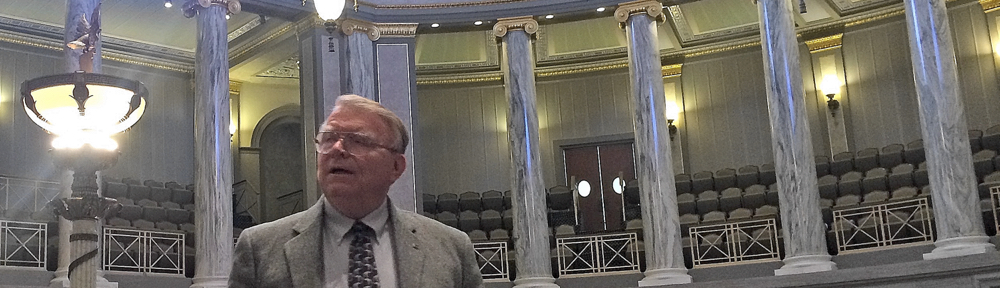
The District

What if Jefferson City had become like Washington, D. C.? What if it wasn’t the county seat of Cole County? What if the state capitol was not even in any county?

What if everything within a four-mile radius of the Missouri Capitol, south of the river, was the District of Jefferson?

On February 26, 1923, Representative Casper M. Edwards of Malden offered a proposed constitutional amendment to create such a district. If the legislature approved it, the matter would go to a statewide vote in November, 1924. His proposed four-mile line would have taken in almost all of the city, at the time a town of more than fifteen-thousand people (and growing fast; the population would be almost fifty percent bigger in 1930)

All laws governing the district would be decided by the General Assembly which also would appoint all local authorities.

The proposed district would have devastated Cole County’s tax base, of course, and would have required relocation of the county seat. But where would it go? The population in the farmland outside of Jefferson City at the time would have been pretty small. Russellville had 364 people in 1920; St. Thomas, probably not more than 150; Lohman had 120 in1920; St. Martins, Taos, and Wardsville had a few hundred each. Osage City was unincorporated.

We could have had one heckuva fight for the county seat! Or maybe later laws would have merged the remainder of Cole County with surrounding counties.

We haven’t found any records of what Edwards was thinking about or what prompted him to suggest the District of Jefferson. While some contemporary accounts contemplated the district as being like the District of Columbia, it’s likely Edwards did not intend his proposed district to be part of no state. Even then, Missouri had districts of various kinds.

We’re not sure how much square mileage his plan would have totaled, but today, Jefferson City sprawls over almost 37.6 square miles (about 26 square miles fewer than Columbia but six more than Joplin, eight more than Cape Girardeau, eight fewer than St. Joseph) so the city would have grown far outside his circle. The Jefferson City Country Club is 5.4 miles from the Capitol, for instance. Binder Park is 3.2 miles farther west. (And it’s pronounced BIN-der, not BINE-der. It’s named for a German fellow who was a powerful civic leader in the late 19th and early 20th centuries.)

And what a mess would things be if the General Assembly was the agency that appointed local officials?

Citizens might have been offended by losing their rights to vote for members of the city council, the mayor and the municipal judge. Instead of a local police department, would there be a state police department and would it be in charge of penitentiary security and capitol safety as well as making sure the city streets were safe?

Would the appointment of local officials mean no election of school board members? Who, then, would hire teachers and on what basis. Would state taxpayers be financing the local high school football team?

Would the city have been more prosperous if state funds made up its budget? What would it be like if the legislature-appointed mayor had to go before the appropriations committees each year to ask for money for everything the city has or does now?

Good Heavens!

Fortunately for the City of Jefferson (that’s what its real name is), Edwards’ resolution was assigned to the House Committee on Constitutional Amendments and was not heard from again.

Who was this guy Edwards anyway?

He was a Representative from Dunklin County for three terms, born in Farmington in 1870, a lawyer and a newspaper publisher. Robert Sidney Douglas, in his 1912 History of Southeast Missouri, wrote that the Malden Clipper moved to Kennett in 1886 and became the Dunklin County News, a weekly paper. Several years later Casper Edwards formed Edwards Publishing Company, and took over the News. He was described as “a brilliant and forceful writer.” He finally sold the paper to the Malden Printing Company. The newspaper continued until 1931 when it became the Twice A Week Dunklin Democrat until 1956 when it became the Daily Dunklin Democrat, which continues to publish in Kennett.

Edwards died of a head injury suffered when his car overturned down an embankment near Malden in August of 1936. He appeared not seriously injured by died five hours later of a cerebral hemorrhage. One newspaper report said the hemorrhage was brought on by “excitement over the accident.

Another account said he had practice law in Malden since 1900, had been an Assistant Attorney General under John Barker (1913-1917), and had published newspapers in Malden, Caruthersville, and Van Buren.

As we have noticed, from time to time, discovering a long-forgotten incident while prowling through old newspapers can lead to being involuntarily drawn down a path to other stories. This is one of those. It eventually leads to a poem saluting a legislative colleague who had died, the story of a disappearing rabbit, the discovery of a huge hoard of bat guano, and the early days of Missouri tourism.

It’s a long and winding road from the story of the Casper Edwards and the District of Jefferson and we’ll have to tell it some other time.


A good time for a critical review

As we have researched issues related to funding for construction of a National Steamboat Museum and a State Museum building, we have come to the conclusion that somebody should empanel a commission, task force, or committee to see if the laws and regulations on casino gambling in Missouri are best serving the interests of the six-million people who live here or are best serving the interests of the owners of thirteen businesses, all of which are headquartered in other states.

Frankly, we think things have evolved to the advantage of the latter and to the disadvantage of the best interests of the people of Missouri.

We don’t know if there has developed some kind of mysterious mental vortex on this matter, but it’s good to see that Speaker of the House Elijah Haahr has established an interim committee on gaming headed by Representative Dan Shaul of Imperial.

The committee already has held a hearing on Video Lottery Terminals. Efforts are being made to legalize them. Some people in the casino industry see them as illegal competition and folks in the home-dock cities of our casino boats are concerned those terminals will further erode patronage at casinos and the steadily-eroding financial support those cities draw from casino admission fees.

About two months ago, Platte County Prosecutor Eric Zahnd sued a company that provides VLTs. He says the company has put a couple of the illegal machines in stores in Parkville, where police seized five of the machines last year. The company says the machines are not “betting devices” because lottery results already are determined before the player uses the machine. The case apparently is set for hearing in December.

We understand from talking to Rep. Shaul that the committee also will examine issues such as proposed sports wagering and other things.

We’ve had casinos in Missouri since the spring of 1994. There is ample evidence that at least one part of casino law is badly outdated, allowing the casinos to make large profits at the expense of their home dock cities, veterans, and others. And there are some serious questions about proposed sports wagering legislation.

Speaker Haahr has taken an important initiative and members of the committee and members of the legislature next year might be asked to exhibit courage during an election season in the face of a politically-powerful industry to tilt the tables back to a more fair level for the all of the people of Missouri rather than thirteen businesses.

There is nothing wrong with casinos making a lot of money. The problem is how they keep it. And after a quarter-century, it’s time for a fair but critical look at an industry that seems (from this perspective at least) to have only one goal: to take as much money out of Missouri as possible—by obeying the law. But are laws passed in the early 90s valid a quarter-century later?

They are to the casinos, who correctly note they are obeying laws and regulations. But are they fair to the people who elect members of the legislature to watch out for the welfare of all of the people of Missouri?

Speaker Haahr has appointed the committee to answer that important question.

Where was it?

When the permanent seat of state government was moved from St. Charles to Jefferson City on October 1, 1826, it was headquartered in a building known as The Governor’s House. Not the capitol.

It was called the Governor’s House because it contained a couple of rooms for the lodging of the Governor and his office. The House of Representatives chamber was on the first floor. The Senate was on the second floor, an appropriate positioning for the body known at state and federal levels as “the upper house.’   Rooms for other state officers were in the building.

That was fine for Governor John Miller, a bachelor. But his successor, Daniel Dunklin, had a family, a situation that led to construction of an executive mansion nearby.

There were plans for a specific capitol but they didn’t come about until the Governor’s House burned in 1837 with a terrible loss of early records. The historical record is sketchy about what happened after the fire. How long did the gutted walls of the brick building remain? How was that area used between then and 1871 when the Governor’s Mansion was built?

Just where was the first seat of government on that lot?

Two conjectural drawings exist of that first building. One appears to show the building near the corner of Madison Street and Capitol Avenue. The other places the building closer to the bluff where it would be more visible to people traveling on the Missouri River.

We know it must have been fairly close because contemporary accounts say wet blankets were used to keep the mansion roof from catching fire from sparks blown from the burning original Governor’s House and a map from about 1843 indicates the 1826 building was near the present Executive Mansion site and the first Executive Mansion was built at the northwest corner of Madison Street at Capitol Avenue (which was Main Street then). We know from written records that the house was used during the Civil War by the officer in charge of the federal force that occupied the capital of Missouri.

How much of the current mansion, if any, is on or in the footprint of the first government building in the City of Jefferson?

There are some issues, often small ones, that get wrapped around a historian’s mind and won’t let go. Where were those buildings?

For several administrations this dabbler in archaeology (Nancy and I have spent several weeks in southwest Colorado mapping and finding pueblos either in the cliffs or on the ground of the Mancos River valley area near Mesa Verde) has wished somebody would be allowed to peel back the grass (in one way or another) at the Governor’s Mansion and in the process peel back the historical record to find the remains of the buildings that have occupied that space. Maybe there’s equipment that can survey the area without disturbing the lawn and pinpoint places to investigate without wiping out tent space. With the state’s first family in temporary quarters while major repairs and restorations are done at the old house, this might be a time to electronically see what’s under the yard.

The problem is that the lawn is often used for entertainment. Big tents are pitched and gatherings are held and digging up the lawn would disrupt those. But my goodness, what might we learn about the place where government began at its permanent location?

What’s under there?   Where was that first building in Jefferson City where some of Missouri’s greatest citizens of the first half of the Nineteenth Century walked, negotiated, and thundered?

0000

Almost There

We’re only about six weeks away from opening the new future for our past.

It’s a building. But it’s more than just a building. It’s a statement. And, My God! What a statement it is.

Employees of the State Historical Society of Missouri are overseeing the move of thousands of cubic feet of documents, artworks, microfilmed newspapers, and other items from our corner of the basement of the Ellis Library on the University Campus to the new Center for Missouri Studies on Elm Street, just across from Peace Park on the north edge of the University campus. Our manuscript collection alone totals seventeen-thousand cubic feet. If we stood all of the pages in that collection on end, they could cover six football fields. And that doesn’t count the 54-million pages of newspapers on microfilm or twenty-thousand pieces of art, or maps, or sculpture or——-

—or all of the things we have gathered in our own 121-year history that tell the story of Missouri back to the days before it was called Missouri.

We’re going to officially open the place on Saturday, August 10, the 198th anniversary of Missouri becoming a state. It’s going to be a big deal. We’re going to have an outdoor ceremony to start and then we’ll move into the awesome lobby to finish up and to serve various celebratory goodies.

It’s been thirty years or so since the society began to seriously consider moving into a better place to serve the public and to serve the cause of history. It’s been a decade or so since our executive director, Gary Kremer, began a career-long effort to create the Center for Missouri Studies and to find a way to put up a building worthy of Missouri’s heritage.

We thought of some locations that didn’t work out. We drew some plans that didn’t work out. Gary talked to governors and legislators and those conversations didn’t work out—-for a while. But then the idea began to take hold and finally, about five years ago, the legislature provided $35 million for a Center for Missouri Studies.

We were blessed with the leadership of two extraordinary people during those years. Gary, of course (on the left), and Steve Limbaugh, whose enthusiasm and counsel was so central to the effort that we changed the constitution to let him be the first society president who could be elected to succeed himself.

For Steve, there was a special link to the society and to seeing the new building materialize. In 1915, when the society moved out of its then-quarters in Academic Hall (later renamed to honor University of Missouri President Richard Jesse) into the then-new university library, a law student who became Steve’s grandfather and still later became the society president, helped carry things from the FIRST old place to what is becoming the SECOND old place. Steve’s grandpa was Rush Limbaugh Sr., or as his biographer calls him, “The Original Rush Limbaugh.”

A lot of people for several generations of society leadership dreamed of what we are about to celebrate August 10. Many of them will be with us in our memories and, we hope, in spirit.

Three years ago we broke ground on what had been a deteriorating parking lot one-half block big. Only then did I begin to grasp how large this project would become. I saw the plans, the three-dimensional model that was less than a foot tall. I saw the architects’ drawings of the building’s exterior. But even now, after many hard-hat visits, my mind has trouble grasping the scope of what is soon to open.

Throughout this process, one of our staffers already has spent more time in the building than anybody other than the workers who have transformed lines on paper into the building we will dedicate in a few weeks. When our Senior Associate Executive Director, Gerald Hirsch, joined us a dozen years ago, he had no idea he would be our designated eyes watching each detail of the construction. But he’s been the go-to guy for dealing with any problems, adjustments, or changes that we’ve had to deal with.

I look from street level at this startling structure and I am always reminded of President Lincoln’s admonition to Congress on December 1, 1862: “Fellow citizens, we cannot escape history.”

On this corner on the southern edge of downtown Columbia and the northern edge of the University of Missouri will be the material expression of Lincoln’s words.   The Historical Society of Missouri is moving from its easily-overlooked quarters in the library basement into this statement building. It is unique in the architecture of the university. And in its boldness, the building proclaims that history must be part of our character and that we dare not ignore it and dare not lose conscious thought that we create more of it each day.

We, today, are responsible for tomorrow’s history. And before we make that history, we should keep in mind something else Lincoln said that day: “We…will be remembered in spite of ourselves. No personal significance, or insignificance, can spare one or another of us.”

Perhaps if we consider the history we are making, which sometimes seems not to recall the history we and our ancestors made, our prospects for the future will be better.

We’ll dedicate this building, this statement on August 10. Join us.


Sponsorships

State government never has enough money to fix the roads, educate our kids, take care of those of us in our declining years, pay our prison guards and state employees  enough to get off of food stamps, maintain hundreds of buildings it owns, keep our air and water safe, and a lot of other things.

I woke up on a Monday morning a few weeks ago with the solution.  I think it was the day after I’d watched the Indianapolis 500 in person and the NASCAR 600-mile race at Charlotte that evening on the telly.  It came to me that state government could make millions if it followed an economic model based on racing.

A few years ago the stock car race at Indianapolis was called something like the Your Name Here Crown Royal Brickyard 400 Powered by Big Machine Records.  Each year the name of some citizen—a private citizen who was a veteran or someone who had voluntarily done something of public benefit would be picked to fill in the “Your Name Here” part of the event name—a nice thing to do to recognize the importance of people like most of us who do good stuff just because we do good stuff.

And if you watch any of these events, you know that the first thing the winners do in the post-race interview is thank all the sponsors whose logos adorned their cars and are sewn onto their fire-resistant driving suits. “You know, Goodyear (Firestone) gave us an awesome tire today and our (Chevrolet, Honda, Toyota, Ford) had awesome power.  I’d like to thank Bass Pro, M&Ms, Budweiser, Coke, Monster Energy, Gainbridge, NAPA, and all my other sponsors who make this possible—and the fans, you’re the BEST!!!”

Suppose state government was run like that.

At the end of a legislative session, the Speaker and the President Pro Tem, in their joint news conference, began with “We have had an awesome, productive session here at the Anheuser-Busch Capitol powered by Ameren.”

“The Monsanto Department of Agriculture driven by the Missouri Farm Bureau will be better equipped than ever to regulate corporate farming through the Tyson CAFO Division.

“The Master Lock Department of Corrections employees are getting a significant pay increase; The Depends Division of Aging is expanding its services significantly; the Tracker Marine Water Patrol is able to hire more officers; and the Dollar General Department of Revenue is going to install new computers to get our H&R Block tax refunds out faster.

“The Cabela’s Department of Conservation sales tax renewal has been put on the ballot next year.  The Wikipedia Department of Higher Education driven by Nike has been given more authority to approve such programs as the Shook, Hardy & Bacon Law School at UMKC, the Wal-Mart Business School in Columbia, the Eagle Forum Liberal Studies program at UMSL, and technology developed at the Hewlett-Packard 3-D Missouri University of Science and Technology will now be capable of building new football facilities on our campuses for pennies..  And we found additional funding for the Cologuard Department of Health and its Purdue Pharma Division of Drug and Alcohol Abuse.

We also were able to put a proposal on the ballot next year to increase funding for the Quikcrete Department of Transportation.

“We couldn’t do all of the great things we’ve done in the 101st Session of the Citizens United General Assembly fueled by Laffer Economics without the support of all of our state’s other great sponsors.

“And we appreciate the participation of you citizens out there.  We couldn’t do this without all of you. You’re the BEST!!!”

And the confetti made from 1,994 un-passed bills would rain down and the legislative leaders would spray champagne (or, more likely, shaken-up Bud) all over each other in the Chamber of Commerce and Industry Legislative Victory Circle (previously known as the rotunda) and the legislative mascot dressed as the Official State Dessert would dance to a celebratory song performed by Sheryl Crowe, who next year will be chosen as a project by a third-grade class studying state government to be the subject of a bill designating her as the Official State Country Singer.

This would never work, of course.  We can’t see members of the legislature in uniforms that have state government sponsors’ patches all over them during the sessions or campaigning in outfits that have the logos of their donors.  And the Senate would just flat out refuse to tolerate anything that would eliminate Seersucker Wednesdays.

Even if government tried something like this, the Supreme Court would be tied up for years in lawsuits determining whether sponsorships should be calculated as Total State Revenue under the Hancock Amendment, thereby triggering tax refunds that would undermine the entire idea.  And Clean Missouri would get another ballot proposal approved by voters that would tie the Missouri Ethics Commission into knots trying to define whether sponsors constitute campaign donors.

Hate to say it folks.  In the real world, if we want better services or more services or better roads or prison guards who don’t have to hold two other jobs, it’s us taxpayers who will have to be the sponsors of state government.    And after all, shouldn’t we want to be

THE BEST?

Notes from a quiet (and perhaps flooded) street

Might one offer an observation about the extensive coverage of rainfall by the television weatherfolk?    They do an excellent job when weather is awful except for one thing.

What does it mean when they say the Missouri River is expected to crest at—for example—32.3 feet at Jefferson City?   Will there be 32 feet of water over the Jefferson City Airport?  Or in the River Bottom area west of the Capitol?  Will the community garden in what once was Cedar City (and the nearby Highway 63) have 32 feet of water over it?

Uh, no.

When we did flood stories at the Missourinet, we never used numbers like that.  Here’s why.

Flood stage at Jefferson City is 23 feet.   That means that a Corps of Engineers river gauge is someplace that measures the bank of the Missouri River at 723 feet above sea level.  The altitude changes as the river flows east or downhill. (Bank full at Washington is only 720 feet, or “20 feet” as is commonly said.)  Any water higher than that means the river is out of its banks.

So, 32 feet means the river is nine feet above bank full at Jefferson City.  It always seemed to us to be more meaningful to report the river was expected to crest nine feet over flood stage.  And a flood stage at 30.2 feet at Washington means the river will be about ten feet above bank full there.  Nine feet and ten feet are more meaningful to people who are five-feet-ten inches tall than thirty-two feet.

The record flood crest at Jefferson City in 1993, by the way was 38.65 feet, or as we reported it, 15.65 feet over flood stage.   There’s a graphic example of the accuracy of reporting flooding using the 15.65 feet standard we used.  Go to the restaurant at the airport and look at the markings on the door which record the levels of various floods.  The mark for the 1993 flood is almost at the ceiling level of the restaurant, about sixteen feet up, not thirty-two.

Having gotten that out of my craw—-

-0-

A few days before the end of the legislative session, your observer watched some of the debate in the House about whether undocumented immigrants living in Missouri should be denied in-state tuition and financial aid when attending our state colleges and universities.

Among those banned from paying in-state tuition and financial assistance using tax dollars were the DACA people, children brought here at a young age by their undocumented parents.  The legislation says the state universities can use their own resources to provide that assistance or to make up the difference between in-state tuition and international student tuition.

The Columbia Daily Tribune had a story about then noting there were 6,000 people in Missouri approved for the Deferred Action for Childhood Arrivals program, or eligible for it.


A thought occurred during the discussion: Why couldn’t our universities, state or private, offer a course for those students that would lead to American citizenship, online for adults and especially for DACA high school students and current college students?  Might solve a few problems.

Might not be a bad idea to have a lot of our non-DACA students enroll, too.

-0-

Come to think of it:  The capitol is awash in third-graders each spring, students who are taking their courses in Missouri government.   They sit in the visitors’ galleries for a few minutes and are introduced by their legislator and given a round of applause and then go downstairs to look at the old stage coach and the mammoth tooth.

It will be nine years before they graduate, months ahead of casting their first vote.  That’s a long time to remember what they saw and learned as third-graders.

I THINK I can remember the name of my teacher and the building I attended in third grade.  But that didn’t make me qualified to cast a learned vote the first time I had the chance to do so.

-0-

I was driven out of retirement this year to lobby for the steamboat museum bill in the legislature.  The opportunity to help do something great for my town and my state forced me back into coat and tie more times in the last four months than I have worn them in the last four years. I found that I was regularly turning the wrong way to get to a meeting with a legislator in the most efficient way.  I had forgotten my way around the Capitol.

I confess there are some things I liked about being a lobbyist and being back in the capitol while the legal sausage was being made.  In all of my years as a reporter, my contacts with legislators were arms-length business arrangements.  As a lobbyist I got to spend a half-hour or more—sometimes less—in the office talking to lawmakers. And I met some REALLY interesting people, particularly the members of this year’s freshman class.

But, boy, did I miss my guilt-free naps. (A few times I hid behind a column in a side gallery of the House and snatched a doze—but those instances sometimes ran afoul of a school group that came in to see five minutes of debate that I’m sure didn’t teach them a darned thing about their government in action.  Or inaction.) And living by my own clock.  And going around in tennis shoes all day.  And going to the Y three days a week for the fellowship there that replaced the relationships I had while I was working.

But the chambers are dark and cool now.  And my naps have returned.  Until January when we take a stronger, better organized run at building a National Steamboat Museum in Jefferson City.  You’re welcome to join the effort.

-0-

It was interesting to know that some things haven’t changed at all.  About three weeks before the end of the session, the place starts to get kind of squirrelly.  That’s about when the House gets all huffy because the Senate hasn’t turned fully to debating House-passed bills. And the Senate gets in a snit because the House hasn’t switched to Senate-passed bills.  And the budget isn’t done with the deadline looming.


In the second week, a purported compromise budget comes out and the chambers start and stop on no particular schedule depending on who’s filibustering what bill or which chamber thinks its conferees didn’t stand up for their chamber’s priorities, and whether to stop the entire process to have more conferences on a small part of a multi-billion dollar budget, and the Senate decides a “day” can actually last until sunrise the next morning or longer.

And the last week when legislators are like desert-crossing cattle who catch a whiff of water in the distance and scramble to get a bill dead a month ago resurrected and added to something moderately akin to the topic, thereby adding to the legend that “nothing is dead in the Senate until the gavel falls at 6 p.m. on the last Friday.”   And, oh, what a blessing that falling gavel is.

-0-

The end of a session today is nothing compared to the days when the odd-year sessions ended at MIDNIGHT on June 15, usually with a “midnight special” appropriations bill just before adjournment that created funding for new programs approved during the session. The only people who knew what was in it likely were the people who hay-baled it together in the closing hours. Pandemonium hardly describes those nights when everybody was beyond exhaustion and more than a few were seriously—shall we say “impaired?”—because of social visits to numerous offices which were well-equipped with adult liquids.


And at midnight, many lawmakers went out to the Ramada Inn to celebrate surviving another session.  The Capitol press corps would start writing stories about the session, a process that was not nearly as much fun as falling in the swimming pool at the Ramada. Both groups would pack it in about sunrise—except for those of us who had newscasts all day Saturday.

One of the best things the legislature ever did was change the adjournment time to 6 p.m. on a Friday night.

Now—-

If we could only get rid of term limits now—–


Adjournment!


The sound of a gavel at 6 p.m. on the last day of a legislative session is the sound of freedom, of welcome relief for lawmakers, lobbyists, staff members, reporters, and others who for weeks have been under growing pressure to grasp success in the face of rapidly shrinking time. Within minutes after the gavel falls, the roads out of Jefferson City will be occupied by cars with license places beginning with the letters S and R, followed by their district numbers, speeding homeward and back to real life.

The members of the first session of the 100th General Assembly of the State of Missouri will repeat actions hundreds of their legislative ancestors knew well long ago. The capitol press corps will have a few hours to recap the day for it can go home, also exhausted but buoyed by the relief that adjournment brings them to.

The correspondent for the Liberty Tribune wrote at the end of a very long March 2, 1855, “As it is late at night and I am worn down with fatigue, and constant application, I beg leave to do as the Dutchman’s team did in the sands of the Mexican desert—just quit.”  His column was published in the March 16 edition.

Yet, before I take my final leave of you, Mr. Editor, I would like to picture to your mind’s eye the scene of the last day of the session.  The day was bright and balmy—a lovely spring day with its light and shade—its sun and its showers—gay groups of ladies in and about the Capitol—Old Nature was loosing the bands of winter, and the tide of the mighty stream that sweeps the base of the capitol was rapidly increasing in strength. The shrill whistle of the steamboat at the wharf called away one-third of the members, with hearts buoyant to see their long-absent wives, sweet-hearts and little ones. The stage coaches were all filled and crammed with departing members and their trunks and sacks of public documents to enlighten the dear people. Private vehicles were rattling along the streets loaded to the guards with absconding legislators. All was bustle, hurry, confusion, mixture and disorder. The confusion of tongues at Babel, or the cloven tongues on the day of Pentecost, could scarcely have been more wonderful or picturesque. The Speaker’s hammer, the very symbol of authority, was as little heeded as the woodpecker’s tattoo, on the hollow tree.  Several ineffectual efforts were made to introduce bills—to call up bills—to make reports—to pass resolutions &c.  A member would rise at his desk and at the top of his voice cry out Mr. Speaker! A dozen voices at the same time, still a little louder. Mr. Speaker! Rap, rap, rap goes the Speaker’s gavel. Another member shouts out Mr. Speaker, I move to have the St. Louis riot act read, as this appears to be “an unlawful assemblage of persons!” At length, after many attempts to do business, within a thin and disorderly house, a resolution was passed deferring all the business on the clerk’s table and in the hands of the committees, until the first Monday in November next. Resolutions were then passed by both houses, notifying his excellency, Gov. Sterling Price, that they had completed their business for the present sitting, and appointing a committee to wait upon him with a copy of the resolutions.—In a short time the committee returned stating that the Governor had no further communications to make with either house of the General Assembly. A motion was then put and carried to adjourn over to the first Monday of November next.  Then, sir, scatterment took place which I shall not further attempt to describe.

Yours respectively, Publius.

The legislature in those days met in the winter months after the crops were in and before the next planting season.  It was allowed to carry over unpassed bills from one year to the next within the two-year session.  A lot of things have changed in the 164 years since “Publius” filed his report. But one thing remains.

When the gavel falls at 6 p.m. today, scatterment will take place once again.


Why wait to become a victim?

We have talked to about 115 members of the legislature about the bill to build a national steamboat museum in Jefferson City that will house the holdings of the Arabia Steamboat Museum when its lease runs out in Kansas City in 2026

A few of them have told us casino interests have talked to them, too. That’s not unexpected because the primary financing for the museum projects we’re talking about comes from increasing the casinos’ admission fee by a dollar—which would eat into the annual windfall casinos get because the fee has not changed since it was established in law a quarter-century ago although the value of the dollar has.

We’ve been told of a couple of the messages given to some of these lawmakers.

First: that the casinos will come after them in 2020 if they vote for our bill.

Second: for those with casinos in their districts, that they’ll be blamed for any employee layoffs at their casinos if they vote to increase the admission fee.

As far as the second issue goes: That’s so much dishwater.  And we have the numbers to prove that casino employment has nothing to do with admission fees; it’s a function of the number of people playing casino games—-and that number hit its lowest level in twenty years in the last fiscal year, leaving casinos with about 25% fewer employees than they had a few years ago—something we’re pretty sure they’ve never mentioned to their home communities.

And that gets us to—-

Some advice for legislators who have gotten these messages or will get them—or some other message intended to influence their votes on our issue. And it holds true any time someone threatens retaliation for your vote—on whatever issue.

Go after THEM. First.

Don’t keep it a secret.  Don’t wait to become their victim.

Remember who you are.  You are the one who writes the laws, not them.  You are the one charged by your constituents with watching out for their broader interests, which might not be the best interests of a smaller but influential interest.

You are the one who supports something good for all Missourians rather than bowing to pressure from a few very well-to-do special interests whose only concern is how much money they can take out of the state.

You are the one who goes home for long weekends during the legislative session. You are the one who is in your district every day seven months of the year.  You are the one who talks to folks at the coffee shop or the restaurant.  You are the ones who speak to the civic clubs. You are the ones who send out a newsletter to your constituents. You are the ones likely to be interviewed on the hometown radio station or by the local newspaper—which might print your newsletters.

You are the one who can tell the folks at home the things the industry won’t.

You control the message every day, every week, not just at campaign time. You are the one who has every opportunity to explain why you have supported the broad public interest in the face of the narrower interests that think they can force you to let them write the laws that govern their operations.

Opponents of legislation such as our steamboat museum bill hope you won’t tell your constituents what they’ve said to you.  But you have every opportunity to do it.  And we can’t think of a single reason why you shouldn’t.

A few years ago, several legislators were told that if they didn’t vote the way a powerful private citizen wanted them to vote, they would find themselves facing well-financed opponents backed by the private citizen’s checkbook.  All of them won—after telling their constituents about the effort to bully them.

Let’s also be clear that there is nothing wrong with someone supporting a candidate that has views different from your own, views that might be more favorable to those who differ with you politically and philosophically. You should have to defend yourself in the competition of ideas.

But you don’t have to wait silently for someone to make you the victim they say you will become because you cast your vote for a greater public good than theirs.

Remember who you are.

-0-

They never give up, do they?

The newest trick by the casino industry to escape any taxes on another slug of money removed from customers’ pockets has been heard by a House committee.  No action’s been taken and it’s likely too late in the session for this latest scheme to make it into the statute books. But there’s always next year.

If the bill somehow passes this year, that casinos will take another $100,000,000–plus out of Missouri in the next four years. And big boatloads annually after that.

It’s another broken promise by the industry.

Since the day casino gambling was legalized in Missouri, most of the tax on the industry’s adjusted gross receipts has been earmarked for education. For 25 years, that’s been okay with the casinos.

Not anymore.

A trend that could, in time, wipe out all of the gambling money going to education has been gaining momentum in the last four years.  The casinos are giving out coupons to customers allowing them to get free plays at machines and gaming tables. And they seem to be giving out more and more.   The legislative fiscal oversight office says the growth in taxes collected by the state in the last four years from these free play coupons has averaged 8.73%.  In Fiscal 2018, the state collected $37.8 million dollars from those taxes. Thirty-four million went to the “gaming proceeds for education” fund. The rest went to the home docking cities.  More about that later.

The casinos think there should be no tax charged on the money casinos take in from people using those free play coupons. None. They propose completely phasing out the 21% tax on money they make from these promotions in the next five years.

Some if this is kind of technical so I ran it past an accountant who gave me some help. When you read the technical stuff, that is the part from my advisor.

Here’s how it would work.

Suppose you wager $100 at the casino, twenty dollars from the coupon the casino has given you and eighty more out of your own pocket. You win $40 (half of it from the coupon and half of it from your own pocket).  You walk out of the casino sixty dollars in the hole.  The casino, by giving you a twenty-dollar coupon has made sixty dollars.

That’s how the current law works.  The state collects 21% of the sixty dollars you left behind, or $12.60.

The argument from the casino side seems to be that the $20 coupon comes from the casino’s previously-taxed adjusted gross receipts.  So it shouldn’t have to pay tax again when the $20 comes back.

The industry claims it recognizes only $80 in revenue, that it paid out $40, so its adjusted gross receipts are forty dollars, not sixty and therefore owes the state only $8.40, one-third less than the present law requires.

Whatever.

What the casinos want is to pay NO tax. The bill says, “Promotional play receipts shall not be taxed after June 30, 2023.”

Thus, the bill seems from here to say the casino that gets a business tax deduction with its promotional coupon would be excused from paying any gaming taxes on adjusted gross receipts generated by that coupon when it is gambled.

My accountant friend thinks the casinos are creating an un-level playing field (imagine that, casinos have tilted tables!) where the wagers are not taxed but the patron winnings from those wagers are still allowed to be deducted from the casino gross receipts, thus lowering the casino’s AGR taxes.

There’s an even greater hazard here.

The casinos want to pay no taxes on promotional play receipts. There is nothing in this bill that prohibits casinos from issuing promotional play coupons to every customer. And as the oversight division of fiscal research points out, the casinos’ use of promotional play has been increasing.

Fiscal research estimates the state will collect $244,650,481 under the existing 21% tax on promotional play between this fiscal year (FY2019) and FY2023.  If the present tax says in effect—as it has all this time—the state would collect an additional $62,457,772 in FY2024 and each year after that.

BUT if this bill passes this year and the tax rate is gradually reduced to zero, the state would collect only $138,624,390 during that same period, and would collect nothing in FY2024 and every year after that.  That’s a loss of $106,026,891 during that phase-in period plus the $62.4 million each year afterwards. .

But it’s not just the education fund that will get hurt with this demand from the casinos.  Ten percent of the adjusted gross receipts tax goes to the home dock cities that already are seeing their funding reduced because the dollar they get from casino admission fees isn’t worth anywhere near a dollar.  Fiscal research estimates they will lose $10,602,610 by the end of FY2023 and will lose $6,245,777 each year after that.

Many years ago the casino industry agreed that the tax on adjusted gross receipts would go for education with a little bit to the home dock cities.  At that time all of the promotional play was taxed. If this bill passes, hundreds of millions of dollars more will go to casino corporate headquarters instead of being used to underwrite a small percentage of Missouri’s school funding and meet additional costs the home dock communities have because they have welcomed a casino.

As usual, the casinos get richer and richer while the causes that are supposed to benefit from casino taxes get poorer and poorer.

Just another example of an industry that cares not one whit about the people of Missouri, its education system, or even for the communities that think they’re great corporate citizens.

They’re not.

But they never give up, do they?

The man who isn’t there (but he really is)

Some of the sports wagering bills going through the legislature’s digestive process this year bring to mind Hughes Mearns poem that begins:

Yesterday upon the stair I met a man who wasn’t there…

Some bills establish a process by which someone can bet on sporting events remotely.  But whether in doing so they are the person who isn’t there is open to question.  So today, let’s look at the casino industry’s efforts to avoid paying admission fees for the largest segment of new gamblers it hopes to attract by legalizing sports betting, people the industry thinks should not be considered there.

This issue is important for the Missouri Gaming Commission’s worthy causes—including veterans homes and cemeteries—and for the casino industry’s home dock cities, which also rely on income from the casino admission fees. And, of course, there’s the museums proposal from Jefferson City that also asks for admissions fee money.

Reading the bills instead of just listening to the casino industry explain them raises or should raise some red flags. We will raise a few today—and we won’t even get much into the industry’s effort to direct the conversation in the direction of how much it is willing to be taxed.

Casino attendance has been declining since its peak in FY 2010-2011, dropping in fiscal year 2018 to its lowest level in twenty years. Casinos hope that opening sports books in the casinos will draw people back, particularly new people, and those new people will discover other kinds of gaming while they’re there for sports wagering.

It’s unlikely to produce a BIG turnaround in attendance, certainly nothing that will return casinos to the halcyon days when they were reporting fifty-million admissions or more (a decade ending in fiscal year 2012). But as the bills are now written, it will add millions to the casinos profits, although a relatively small amount compared to the overall adjusted gross receipts, largely because they don’t think about seventy percent of the sports bettors should be counted as casino admissions.  We’ll confront that strategy in a minute.

The proposed legislation gives our thirteen casinos a monopoly on sports betting. The bills require casinos to have a specific area set aside and staffed within the casino to handle those bets. A person who enters the casino wanting to bet that the Cardinals will beat the Cubs by more than fifteen runs must go to that specifically defined area where that person will offer to make a wager.  The casino will accept that offer and, when the final score is St. Louis 19, Chicago 3, the bettor will be paid.  If the score is 19-4, the casino keeps the bettor’s money.  The acceptance, handling, processing and final resolution of the bet is handled within that prescribed area of the casino.

But the casinos also want to allow betting through use of computer, whether it’s a big desktop tower or a cell phone or maybe the increasingly sophisticated things people put on their wrists these days. And that is likely to be most of the sports bettors.  They call it “remote” betting although some definitions of “remote” are debatable.

A webpage that keeps track of gaming trends in Nevada and elsewhere, playnevada.com, reports that 70 percent of all sports wagering in New Jersey, the first state to legalize online sports betting after last year’s Supreme Court ruling, were placed online.  It also reported Nevada, which seemingly has video gambling machines in every supermarket, business, bathroom, airport terminal, and anywhere else that people go, reports mobile sports wagering is used from twenty-five percent to more than fifty percent of the betting in Nevada’s many sportsbooks.  It’s difficult in Nevada’s case to be more specific because—and this is something we might come back to in a later post for a different reason—Nevada does not separate mobile and on-site wagering. That’s why it’s harder in Nevada than it is in New Jersey to determine what percent of sports wagering is done outside casinos.

Missouri’s proposed legislation would separate on-site wagering from remote wagering, which could be detrimental to veterans services or to home-dock communities that rely on in-person wagering in the sports book area but also could provide a major increase in casino profits. Missouri’s casinos want it that way and expect the legislature to rubber-stamp the idea.

As we compose this, we don’t know the final form sports wagering legislation will have if it makes it to the governor this year.  So we’re going to construct a scenario based on common provisions in the bills and a few differing provisions in some bills.

Missouri’s proposals don’t let just anybody dial a casino, and bet on sports. A bettor first has to go to the casino (where that person presumably will have to enter, thus triggering a two-dollar admission fee for the state) and register, open a betting account, and get a password.  That person then can leave and bet from anywhere in Missouri.  At least one proposal allows betting from other states if the other state lets Missourians place bets there.  It’s called reciprocity. On the other hand is a proposal that allows betting a few feet from the gambling area—-which doesn’t sound very “remote.”

If those provisions are in the bill that gets passed, the way will be clear for Betting Bertie to place a bet in say, Boonville, even if he is in Bevier.  He does. And he loses. Since he was not in the casino personally there is no admission fee paid to the state.  The bucks Betting Bertie of Bevier bet at Boonville go straight to the boat’s bottom line. The casino gets richer. The veterans and the home dock community get no benefit at all from this increased business because Betting Bernie doesn’t set his boots inside the Boonville boat.  At least that’s the way things are proposed.

Now comes the part likely to get the casino industry lathered up.

We argue, and we would bet that a number of members of the legislature might agree, that requiring Betting Bertie to physically go to Boonville to register as a bettor constitutes the creation of a presence within the sports book area. The bills require casinos to keep detailed records in the casino of Bertie’s betting.

If Betting Bertie does not place a bet, it’s as if he’s not present that day. But if he does put down a bet that is accepted by the casino, processed by the casino, and paid off by the casino in the sports book area as required, he has activated that established presence and has electronically entered that casino.  And because the casino has accepted the bet, processed it, and paid it, it has acknowledged that he has had that presence in that casino.

Because the casino has decided to admit him to the sportsbook area with his bet, the two-dollar admission fee should apply as surely to him as it would apply to someone who walked in. A bet is a bet whether it is made by someone sitting in a comfortable chair staring at all the big screen teevees or whether it is made by someone sitting in an office chair in Bevier.  Both parties have entered the casino, one physically and the other electronically. Admission is admission—at least if the casino wants either bettor’s money. It cannot get Bertie’s money if it does not acknowledge the presence it as established for him by accepting his application and giving him his password.

Casinos will argue that physical and electronic admissions are different. But the end result is the same—the casino is most likely to win and the principle of winning is the same whether that person walks in or phones in. There is no bet if there is no acknowledged presence.

To put it more directly: The casino recognizes the arrival of the electronic bettor because it maintains a space for that person’s arrival thanks to the required registration and subsequent password issuance.  The password is the equivalent of the turnstile the on-site bettor has to go through to place a bet.

By making the password the electronic equivalent of the turnstile, the legislature can make sure that casinos don’t game the system further than they already do by claiming seventy percent of sports betting is different from the on-site betting, thus benefitting only the casino and not improving funding for veterans (and others) and home dock cities. The casino industry likes to cite Las Vegas practices in advocating a part of this bill and remember: Nevada does not separate mobile and on-site betting.

There is precedent within existing law that argues for our point.

If free passes or complimentary admission tickets are issued, the excursion boat licensee shall pay to the commission the same fee upon these passes or complimentary tickets as if they were sold at the regular and usual admission rate.

The provision kept casinos in the early days when real excursions were anticipated from declaring that everyone entering the gaming floor had been given a free pass or complimentary ticket.  As proposed statutes are written now, electronic entrance to the gaming floor and remote placement of bets is the equivalent of a free pass or complimentary ticket that, without existing law, would be treated as a non-admission. A strong argument can be made that it should not be considered as any kind of a free pass or complimentary ticket. And we suspect there are people who would support the concept—veterans groups and home-dock communities for example—who would be losers because the casinos are proposing an end-run around the admissions issue.  Why shouldn’t these bills consider remotely-placed bets to be “admissions” when the bets are received, processed, and (if necessary) paid in the casino or on behalf of the casino by a third party that conducts the wagering at the casino?

The answer is simple: the casinos don’t want them treated that way because if remote betting is not considered an “admission” there is no admission fee obligation to the state and to the host communities.  The casino thus increases its gross receipts without increasing any payments for veterans homes and cemeteries or home-dock communities and other causes. As we’ve noted before, they’re already getting tens of millions of dollars in windfalls because the admission fees are not inflation-adjusted each year and they fight aggressively if anyone suggests they should be.  By not considering remotely-placed but in-house processed bets as “admissions” their windfall will get windier.

Some additional proposed language that on first blush seems to be fairly benign appears on second blush to be much less than that.  Here’s how that works:

One of the bills appears to make that point when it says, “All sports wagers…shall be deemed initiated, received, and otherwise made on the property of an excursion gambling boat within this state.”  While that language would appear to support the points just made, please note the phrase “on the property.” Another bill seems to clarify that wording by saying sports bettors can wager on sports at “a hotel, restaurant, or other amenity that is operated by the certificate holder and subject to the supervision of the (gaming) commission.” A restaurant twenty feet from the turnstile to the gaming floor is an okay place “on the property” from which to place a bet. We suspect there are some folks who don’t think that quite qualifies as “remote.”

The definition of “on the property” is troublesome.  On one hand, the casino must establish a specific area where sports wagering is done and processed by the casino. On the other hand are suggestions that someone can be anywhere, even right outside the turnstile leading to the casino, or in a room of a hotel owned by the casino. These provisions seem to sanction avoidance of physically entering the specified area or of even entering the broader casino betting floor while on casino property, thus avoiding an “admission” and thus avoiding the two-dollar admission fee..

That is why it is important that the use of the password—from wherever—should constitute entrance to (or admission to) the specific area set aside for sports wagering and thus trigger the admission fee.

We hope the General Assembly’s final version of a sports wagering bill does not allow the casinos to ignore existing standards that require admission fees—that help veterans, home-dock communities and others—for seventy-percent of those the industry hopes to lure inside its specified sports betting areas physically as well as electronically.

—because the man who isn’t there

really will be there.