Rookie camp

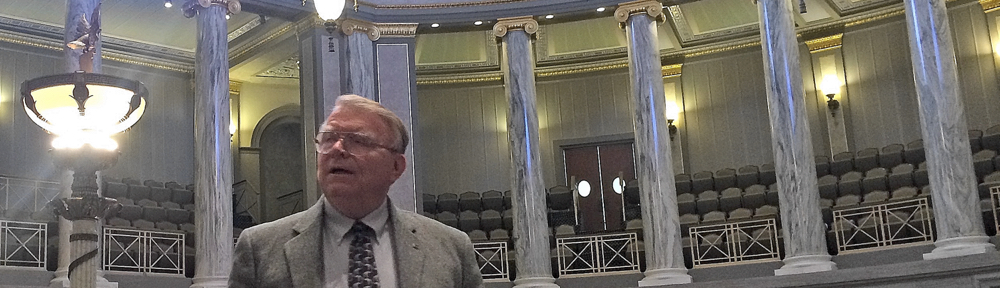
Newly-elected state representatives have finished a week of rookie camp.  There’s a more formal name for it, but that’s what it is—a week getting to know state institutions and facilities, names and places, finding out where their offices are and where the bathrooms are in the capitol, learning the protocols of being a state rep including how to address one another during debate, how to introduce legislation, and who are some of the people in the hallways who will be their new best friends.

The House has asked your correspondent to come in at the end of rookie camp and talk about the capitol press corps and their relationship to it, the history of the capitol and the legislature, and to admonish these new folks to do nothing that would embarrass themselves, the legislature, or their families back home while they’re serving.

Afterwards we split the group into two segments for behind the scenes tours.  Dana Miller, the Assistant Chief Clerk of the House (also Chairman of the State Capitol Commission) took one group and I took the other, then we switched.  She led her group through some of the hidden spaces of the building and I took my group into the public areas.

The tours gave both of us a chance to talk about the condition of the Capitol—and there’s a lot to talk about these days.  More than a year ago the legislature set aside forty million borrowed dollars to make long-delayed repairs to critical parts of the building’s substructure. The first part of that work was completed during rookie camp, the rebuilding of the south front steps, the east steps, the terraces and the carriage entrance.  For years water has leaked through increasingly chipped steps into the Capitol basement, weakening the entire area and contributing to mold problems in the basement where a lot of people work, eat, and hold hearings.  Several other much-needed repairs also have been made.

Next summer will see the start of phase two that will include repairs to the building’s exterior stone work, rebuilding the plaza on the river side of the building, repairs to the Fountain of the Centaurs, and more terrace work.

My part of the tour involved showing the folks some of the architectural features and decorations on the interior.  While the exterior of the building is getting the repairs and restorations it deserves, the interior continues to deteriorate.  We looked at several places of peeling paint, unrestored paintings by great artists, and poorly-lighted areas that keep visitors from enjoying and learning Missouri history from the artwork that makes our capitol unique.  We talked about the plans that began almost two decades ago to restore the interior of the building, plans that were stopped with the terrorist attacks in 2001 that forced diversion of the millions of dollars set aside for that work to make up for state government’s revenue loss in the wake of the economic drop after the attacks.

It’s hard to know where the restoration of our state’s greatest symbol will go next as it moves through its centennial era to the 100th anniversary of its dedication in 2024.  The bonding money will be used up by the second phase of superstructure work. The state budget is unlikely to grow, or grow very much, in coming years because of the current tax structure while financial demands for basic services and operations are expected to keep growing.  Given priorities such as education, health, mental health, prisons, and social services, it’s hard to think there will be much left over to make the inside of the Missouri Capitol the jewel its designers and builders wanted it to be.

The new people that voters elected to represent them in the legislature got a taste of the enormity of their obligations, possibilities, and responsibilities—as well as the possible pitfalls that await them—during rookie camp.

It has dawned on this observer that he covered his first story in the capitol in 1967, fifty years after the ancestors of today’s legislators held a one-day meeting in the unfinished House and Senate chambers so lawmakers who would not be back for the next session two years later could say they had served in the new capitol.  That means that I have covered and watched people like these rookies for half of the building’s history.  So I took the liberty to sermonize:

State capitols are intended to be grand representations of the greatness of their states. They are intended to be inspirations to citizens, statements of democracy, and symbols of the permanence, the stability, and the power of a state to care for and to protect its people.  The very motto of our state is carved in Latin on the south front: “Let the welfare of the people be the supreme law.”  Not a few people.  ALL of the people.

Understanding that you are here to protect and care for ALL of the people, not just the powerful few who have the capacity to make you feel important will be one of your greatest challenges.

It is easy to speak in phrases of nobility and inspiration, statements of democracy and so forth because it is always easier to speak of nobility and dignity and greatness than it is to recognize shortcomings, deterioration, and decay.

So I urge you to see your capitol in its entirety and be unafraid to acknowledge that it suffers from inattention; that it is easy to say, “My office is fine” while ignoring a cracked column at the top, the quick and easy slathering-on of coat after coat of paint that covers problems but robs the building of its beauty and character, to ignore the cracked and peeling paint, the mold and leakage problems in the basement.  Notice your capitol and reflect on what else it says about government’s attitude toward its people—and whether you will spend your career just slathering on a coat of paint that covers, but will not solve, problems and masks a dingy reality that is easily ignored.  For in truth, this building also represents Missouri in ways too many choose to ignore.  Its deteriorating structure, its peeling paint, and its unrestored great works of art carry a message of needs unmet, problems uncorrected, responsibilities avoided, and obligations covered over. 

So welcome to OUR capitol.  But it is YOUR responsibility.  And it is not just the capitol; it is the entire state that is your responsibility.

There will be thirty-nine new members of the House and one person in the Senate who has not served in the legislature before when the General Assembly convenes under new state leadership in a few days.  While some see glasses half empty, we choose to see them half full—of opportunities that come with the fresh eyes of those who went through legislative rookie camp and those who are still going through their own rookie camps called transition.

So we lift our half-full glass.  Here’s to the rookies!

Notes From a Quiet Street    VIII/2016 

Something seems to be wrong with our telephone.  It only rings a couple of times a day and the only people who seem able to get through are Nancy’s sisters.  We must have said something wrong to President Obama, who called us three days in a row, because he hasn’t called back.

Gary Scharnhorst, in his book Mark Twain on Potholes & Politics, cites a letter to the editor of The New York World published on Christmas Day, 1894:

“It is my heart-warm and world-embracing Christmas hope and aspiration that all of us—the high, the low, the rich, the poor, the admired, the despised, the loved, the hated, the civilized, the savage—may eventually be gathered together in a heaven of everlasting rest and peace and bliss—except the inventor of the telephone.”

If Mr. Twain were with us today he might change the last line to say “except the inventor of the robocall.”

—–

Ashley and Brian let your correspondent play reporter on election night, doing reports on The Missourinet about legislative and congressional races and the ballot proposals. It was a lot of fun and the best part was that now I could go home at 3 a.m. and not worry about getting up an hour later to do morning newscasts until the rest of the staff could return from the victory/loss parties.

—–

Got up and made the usual morning trip to the Y.  Thought it appropriate to wear a red shirt.   The one that says, “Of course I’m right, I’m Bob.”   Because I am.  Bob. Some of you dispute the accuracy of the first part.  But it’s my shirt.

—–

We got a notice from the Social Security people that we’re getting an increase in our monthly benefits next year.   The national average is four dollars a month.  We didn’t get any cost of living increase this year.  Who does the Social Security Administration think we are?  State employees?

Came across an article from Collier’s magazine from 1905 recently that began, “For the first time in forty years there has been no lobby maintained at the capital of Missouri during a session of the state legislature.  Lobbyists visited the Capitol, it is true, but they did so occasionally and their stay was brief.  When they appeared they came only to argue bills before committees; their coming was known, and at the time of their appearance the hour of their departure also was made known in advance.”

Lobbyists were running scared in 1905 after a major bribery scandal of 1903 exposed exchanges of cash and other favors between lawmakers and lobbyists.  New governor Joseph Folk, who earned the office as a corruption fighting prosecutor, added to the concerns when he was sworn in on January 9, 1905 and said “professional lobbying should be made a crime.”

That’s one issue this year’s candidates for governor missed.  Among others.

Given the number of candidates this year who sneered at “career politicians” who apparently think they can retain their status as amateur politicians now that they’ve been elected, perhaps they might think of Holy Joe Folk, as he was called, and pass a law allowing only amateur lobbyists so the field will be level.

Your faithful observer cannot recall the last time he observed so little post-season baseball.                                                                       —

Or in-season Tiger football.

As we travel throughout Missouri we find ourselves increasingly unable to understand why the most expensive gas we put in our car is in Jefferson City.  By far.  We fueled up in Kearney for a dollar-79 and in Nevada for the same amount a week later.  The gas stations on the street leading to our house were charging two-oh-seven and two-oh-nine at the time.  Some fluctuation in prices is understandable. But “absurd” is the word that kept going through our mind as we drove between stations on the way home.

We try not to re-fuel in Jefferson City.  There’s one station that’s usually three to seven cents cheaper and if we must put gas in our car in Jefferson City, we’ll go there.  Otherwise, gas stations closer to home are good only for lottery tickets.

—-

Voters have spoken strongly—again—that limits must be imposed on the financing of campaigns.   Now we will see if there are lawsuits to throw out the limits.  We will be watching one group especially closely if the big money people win in court to see if legislators and other politicians who are quick to blast the court system for “ignoring the will of the people” will say that in this instance.  A lawsuit might be unnecessary, however. Opponents of campaign limits were saying before the election they know an end-around of the new law so they can keep pouring boatloads of money into campaigns.  We’ll be interested to see if the legislature does anything about it—to make sure the will of the people is truly honored.

It’s not cynicism that prompts the observation.  It’s observation that prompts the cynicism.

Corrupt career politicians

Your observer has thought throughout this campaign of writing something about the demagoguery behind the phrase “corrupt career politicians” that has been thrown around by challengers who seem to lack the intelligence to say how they will solve the problems of the state and the nation and think name-calling is the highest intellectual standard they need to display.

Then we read Jason Hancock’s article in The Kansas City Star Tuesday.  In a year when “corrupt career politicians” has been such a buzz phrase that relies on an intentionally uninformed public’s distrust of government, the Missouri Senate majority appears to have volunteered to become a poster child.

Jason’s article says Republican state senators are soliciting money from people who want to buy “face-to-face meetings with GOP leaders when they return to the state Capitol to begin legislating in January.”

A $5,000 donation will buy, among other things, a dinner with the Senate Republican leadership team during the first two weeks of the session.

Suppose you can’t afford 5K.  No problem.  Senate President Pro Tem Ron Richard of Joplin and Majority Floor Leader Mike Kehoe of Jefferson City would love to have breakfast with you for just $2,500.

If you or your organization don’t have that much, well, you might have to go hungry in more ways than one in the 2017 session.  We say “might” because, despite appearances to the contrary, we don’t want to actually accuse Richard and Kehoe of participating in “pay for play.”

Wonder how much a “hello” might cost as one of the majority senate leaders goes the few steps across the hall from his office into the chamber.

This news breaks less than six months after legislators were patting themselves on the back for working on ethics bills—and passing some, toothless though they were.

Missouri remains the only state in the nation without campaign contribution limits and no ban on gifts to legislators from lobbyists. Nor, it is obvious, is there any limit on how much the leaders can charge those wanting to get close to them for breakfast and dinner. But building confidence in government by the electorate has been one of the lowest priorities of the legislature for a long time.  Now, you might ask, can it get any lower?

Republicans outnumber Democrats in the Senate 2-1.  Of the seventeen seats up for election next week, four Republicans and Four Democrats have no significant challengers.  So before the contested seats are decided, Republicans are guaranteed to hold their majority, 18-7.  If the Democrats are to break the two-thirds GOP control of the Senate, they must win six of the nine contested elections next Tuesday.

Fat chance.

If you’re supremely confident that you will be in total control of a situation, why worry about ethics and appearances of impropriety?  Make it profitable.

Dinner (or breakfast) might be served.  But public confidence sure isn’t.

The cowboy code

In the gentler time in which your observer of the passing scene grew up, when most matinee movie heroes were clean-shaven, wore white hats and rode Palomino horses while villains were facially grubby, wore black hats and rode dark horses, when people were killed without huge doses of blood, guts, and brain matter being sprayed about, when nude scenes were those showing the hero’s horse without a saddle, three good guys set a tone for their young admirers to live by.

Oh, there were others on the screen and on the radio—and later on television (although this young viewer was always disappointed that Clayton Moore’s television Lone Ranger lacked the authoritative deep voice of  Brace Beemer’s radio Lone Ranger), but Gene Autry, Roy Rogers, and the Lone Ranger were the ones who not only exemplified by their actions what good people were supposed to be but who also had written codes of conduct that might seem quaint today but were—it seems through the tinted glasses of nostalgia—part of the upbringing of a few generations that seemed more—-well, courteous.

loneroygene

We know society in those days had its dark sides—-we don’t recall any black cowboy heroes on the movie screens of our childhood movie houses, for example, and the Lone Ranger was the only movie hero that had a minority sidekick—unless you count the Cisco Kid and Pancho.  But in our insulated world, our radio and movie heroes told us how we should behave.

In these days when language is loose and clothes are sometimes even looser, when too many movies and TV shows are a series of explosions around which is stitched a weak plot, when our politics have become crude and our policies have tended toward narrowness, perhaps a reminder of what our cowboy heroes expected of us is in order.

Gene Autry’s Cowboy Code said:

The Cowboy must never shoot first, hit a smaller man, or take unfair advantage.  He must never go back on his word, or trust confided in him. He must always tell the truth.  He must be gentle with children, the elderly, and animals. He must not advocate or possess racially or religiously intolerant ideas. He must help people in distress.  He must be a good worker.  He must keep himself clean in thought, speech, action, and personal habits.  He must respect women, parents, and his nation’s laws.  The Cowboy is a patriot. 

Your correspondent was a proud member of the Roy Rogers Riders Club and as I recall, my membership card had ten rules:

Be neat and clean.  Be courteous and polite.  Always obey your parents. Protect the weak and help them. Be brave but never take chances.  Study hard and learn all you can.  Be kind to animals and take care of them. Eat all your food and never waste any.  Love God and go to Sunday school regularly.  Always respect our flag and our country.

Fran Striker, who created the Lone Ranger for Detroit Radio Station WXYZ in 1933, composed the Lone Ranger’s creed:

I believe that to have a friend, a man must be one; that all men are created equal and that everyone has within himself the power to make this a better world; that God put the firewood there, but every man must gather and light it himself; in being prepared physically, mentally, and morally to fight when necessary for that which is right; that a man should make the most of what equipment he has; that “this government, of the people, by the people, and for the people,” shall live always; that men should live by the rule of what is best for the greatest number; that sooner or later…somewhere…somehow…we must settle with the world and make payment for what we have taken; that all things change but the truth, and the truth alone lives on forever. I believe in my Creator, my country, my fellow man. 

Sometimes, as we watch campaigns and legislatures, it seems that our cowboy heroes aren’t the only things that have ridden off into the sunset.

Sigh.

(About the picture:  It was taken November 29, 1981 at the Hollywood Christmas Parade.  Left to Right:  Iron Eyes Cody, Clayton Moore, Roy, Gene, and Pat Buttram.  The picture was taken at a time when Jack Wrather, who owned the rights to The Lone Ranger, got a court order barring Moore from appearing as the Masked Man.  Moore wore the wrap-around sun glasses until Wrather relented in 1984. http://www.westernclippings.com/treasures/westerntreasures_gallery_10.shtml)

Save the cursives   

Our computer has just helped make the case for what appears below.  This entry originally was written in a cursive type face.  But when the words were transferred to Word Press for posting, the computer threw a bucket of 21st-Century cold water on the Twentieth Century author and issued a Borg-like warning that all resistance is futile (Star Trek fans will understand).  Feel free to transcribe it in longhand to appreciate the original intent.

How sad that we have reached a point where a machine keeps you from reading what you have written as it was written.  However—-

Some school districts no longer teach cursive handwriting, what some call longhand. The means of creating the Declaration of Independence, the Emancipation Proclamation, letters home from the battlefront, and thousands of our greatest and/or most popular books has been dismissed by the Common Core Standards. Missouri is one of 42 states to adopt Common Core although it was done only with a certain amount of legislative thrashing around that led to formation of a committee to recommend our own standards which turned out to be pretty much Common Core.

Killing cursive was the idea of the National Governors Association (have you tried to read the signatures of our governors or other high officials; they’re hardly good examples of cursive?) and the Council of Chief State School Officers.  States can, if they wish, put the teaching of cursive back into their schools.

But don’t make Common Core any more of a whipping boy than necessary.  Cursive fell out of favor with the enactment of No Child Left Behind, which did not include it on tests that led to rating of schools under NCLB. And if it’s not something that’s being assessed so schools can be rated on their quality of teaching, why teach it?

Life experiences have taught most of us that a lot of life is made up of things that were learned but not assessed in school.  We’ve talked to some teachers who worry that their schools are so obsessed with assessments that teaching and learning are diminished.

Why is this system of writing that most of us practice with varying degrees of legibility so suddenly so, so—Twentieth Century?  Well, say critics, cursive just takes too darn much time.  And as students move through their education and into the workplace, cursive handwriting isn’t as useful a skill as using a keyboard.

Why, heck, it’s not going to be very long at this rate before a replacement for Common Core rates schools on how well their students use their thumbs.  The rest of the hand is reserved for Olympic sports or musical instruments.

Some people believe cursive writing hones motor skills in children.  Some think it encourages gracefulness in an otherwise decreasingly graceful world.  We saw a story that ran on ABC News quoting an associate professor at the University of Staganger Reading Centre (it’s in Norway) who doesn’t dismiss typewriting but who says, “Handwriting seems, based on empirical evidence from neuroscience, to play a larger role in the visual recognition and learning of letters.”  Translated, said ABC, “Those who learn to write by hand learn better.”

Some researchers suggest that the fastest handwriting involves the use of a mix of cursive and printed letters.  One researcher thinks people writing by hand can gain speed that way without losing legibility.

Cursive writing has all but disappeared in the legislative chambers of the Missouri Capitol.  It is so rare as to invite comment when a lawmaker submits a handwritten amendment to be considered in debate.  Hours of time are wasted each year while the chambers “stand at ease” so someone with a suddenly brilliant idea can consult with a staff member sitting at a computer who knows how to put together a string of words on a keyboard.   Some observers link a perceived decline in the intellectual capacity of our lawmakers to the decline in the use of pen and paper and handwritten amendments.  We are taking an official neutral position for now.

There are plenty of articles on the pros and cons of cursive writing.  But we’ve come up with our own ideas of why teaching cursive writing remains important.  It’s simple.

If you can’t write it, you can’t read it.  And not everything written is on a web page somewhere.  Sometimes you have to be able to read the original document.  Maybe it’s grandfather’s letter from Vietnam to his girl at home.  Maybe it’s the middle pages of the old family Bible where your family records have been kept for generations. Maybe it’s the original survey of your property. It could be anything and it could be highly meaningful.

There is something about seeing the original final version of the Declaration of Independence and the final engrossed copy of the Constitution at the National Archives in Washington.  Something about those handwritten words says something about the human striving that went into the creation of those documents.  Your observer has yet to see a thumb-written message that indicates any striving, and precious little thought, has gone into the expression of something.  Your observer has not yet seen anything noble written by thumbs.

Yes, these meanderings are written on a keyboard.  But at least, all ten fingers are used.

Not all handwritten things are easily read.  Many years ago, a friend sent a prominent Missouri lawyer a letter that told him, “Send me something I can read.”   Your faithful scribe has been working for a couple of weeks transcribing an 1846 lawsuit challenging the ownership of the land on which Jefferson City stands.   Some of the writing displays the elegance of a learned hand of the 18th and 19th century.  But there have been times when it has taken fifteen minutes to figure out one word.  And in typing the transcript of the documents, there are several blanks where the scrawl is so bad that we just ran up a white flag.

We fear the day that a new foreign language will be added to the list of college courses:  Cursive 101.  Advanced Cursive.  Honors Cursive.  Practical Cursive.  Maybe colleges of education will offer a course such as Teaching Cursive 256.  It would be an elective.

Wonder what the final exam would be like.

Term Limits—I

The Governor of Illinois, who does not appear to be in charge of a state government whose problems make any of our problems in Missouri seem relatively minor, is leading the charge to get a term limits proposal on the ballot there in 2018.  He’s even set up one of those tax-exempt political action committees that doesn’t have to tell the public he is trying to manipulate who is financing his efforts.

But he is counting on Illinois making the same mistake Missouri made more than two decades ago by enacting term limits.

Governor Bruce Rauner even appears in the television commercials urging the public to throw out “career politicians” who “go to Springfield and don’t leave,” as some of the supposedly common folks in his commercials say.

Your observer has been asked from time to time to talk to groups and reflect on his career covering Missouri politics for more than four decades.  The speech usually focuses on the mistake Missourians made in the 1990s when they threw away their right to vote for their state senators and representatives because of corruption in government.

There are a lot of reasons term limits for legislators is lousy public policy and have become obviously lousy public policy in our state.  We’ve put the label on this entry that we have because we might come back to this topic at other times.  But let’s begin with these reasons term limits is a bad idea.

  1. It takes away a citizen’s right to vote.
  2. It aims at the wrong target.
  3. Voters might support it but they don’t mean it

And our neighbors in Illinois are about to fall for the concept the same way Missourians did.

Point one:  Passing term limits because one legislative leader has misbehaved or is perceived as misbehaving (although never criminally charged, as is the case in Illinois) means citizens are giving up their right to vote for THEIR representatives or THEIR senators.  Citizens in part of Jefferson City were deprived of his right to vote (for example) for Bill Deeken for a fifth term in the House a few years ago—although he might have been overwhelmingly popular for the work he did on their behalf because term limits say even the most effective representative cannot continue to serve his or her constituents for more than eight years.  Sorry folks.  Your right to vote for a candidate of your choice is a right only four times.   Likewise, voters in a central Missouri senate district were deprived of their right to let Carl Vogel serve them for a third term because their right to vote was limited to twice for Carl.

Point two:  Related to point one but in a different way. The problem in Illinois now and the problem in Missouri then had to do with POWER, not SERVICE. But term limits advocates here then and in Illinois now are focusing on the wrong target.  Illinois has a problem with House and Senate leaders who have been in POWER for decades and are so powerful that some believe they have more authority over government operations than the governor does, which is the real reason Rauner is so out front in the term limits campaign there.  Plus he’s up for his second term in ’18 and some polls show he’s less popular than he would like to be.

Point three:  Illinois voters are being asked to approve, in 2018, the same kinds of limits Missouri has, meaning the clock won’t start running until 2020 and lawmakers elected that year will not be allowed to run for their seats in 2028.  That means the long-time figures voters want to oust can be re-elected to serve another decade after voters approve limits.

And Missouri’s record shows voters WILL re-elect them.

Missourians approved term limits in 1992. Those elected in 1994 could not serve more than eight years in the House and eight in the Senate.   For house members, it meant that those elected in 1994 could be re-elected in ’96, ’98, and 2000.   For those in the Senate, those elected in 1994 could be re-elected in 1998 and then they would be done after two terms or four years.

The 2001 State Manual shows twelve of the thirty-four senators were serving terms three through eight because voters who agreed two terms is enough, when given a chance to elect them to two MORE terms after term limits kicked in, did so.  John Schneider was serving his eighth term because he had already served six before the term limits law went into effect that limited him to two more—and voters who had said eight years is enough promptly elected him to a total of 32.

In the House, 57 of the 163 members were serving their fifth term or more. If voters really believe eight years is enough, shouldn’t the voters have shown they really believe it by voting these 57 Representatives and twelve Senators out of office sometime along the way?

They didn’t in Missouri and there is no reason to believe Illinois voters will be any different. Voters were not honest with themselves here.  There’s no reason to think they’ll be honest with themselves in Illinois if they adopt term limits.

If term limits are to effectively balance the powers of the three branches of government, their focus should be on limiting the time a legislator can be in a position of power, not on the ability of voters to choose the people they want to be their voices in the capitol.

Let’s put it this way (and we know we should not ask a question if we do not wish to hear the answer, but think about this ):  What is the greater danger:  One lawmaker who controls drafting of the state budget for twenty years or one lawmaker that you know from your district who represents your interest for twenty years?  Who has the capability of doing the most damage?  Who is least accessible to your interests versus who do you and your fellow citizens have the most direct ability to influence with your votes?

That is the greatest flaw in term limits.  It diminishes voter influence rather than enhancing it. And it doesn’t address the real problem.

Instead of restricting the POWER of the Speaker of the House or the President pro Tem of the Senate, term limits restricts the powers of the voters.

Instead of moving to equalize campaign opportunities for incumbents and opponents by improving campaign finance and legislative ethics standards and instead limiting the time an individual can wield power, backers of term limits aim for the wrong target and convince voters to shoot themselves in the foot.

We did it in Missouri and we have been living with a worsening limp for more than twenty years.

And our neighbors to the east, Illinois, might be drawing the same bullseye on their boots.

Notes from a quiet street—VII /2016

—random observations not worth the effort to type hundreds and hundreds of words.  Several dozen, though.

We have made a slight correction in our earlier entry (September 27) about this being a historic election to reflect that both candidates for governor are divorced, rather than just one as we originally noted, making this election even more noteworthy as the first that matches two divorced candidates for the office (although one has remarried)

The Tax Foundation says Missouri has the nation’s 15th most favorable business tax climate. The only one of our surrounding states with a better ranking is Tennessee.  Kansas ranks 22, Illinois 23, Nebraska 25, Oklahoma 31, Kentucky 34, Arkansas 38, Iowa 40.

We’ve been listening to candidates critical of Missouri’s slow economic growth (Business Insider said earlier this year we had the tenth worst economy in the country and the Federal Bureau of Labor Statistics said we were the 14th worst state for economic growth.) and promise that they would generate more jobs if we could just cut taxes on business even more.

Hmmmm.  How could our economy be doing so poorly after legislative policy-makers have made this state so business-tax friendly?

They might maintain, as some have maintained, that the silver bullet is Right-to-Work. The Business Insider rankings list non-RTW states with the first and third best economies (DC is in between).  Eight of the top 15 states are non-RTW (including DC), and 15 of the top 24 are non-RTW states.  And it says nine of the bottom eleven states ARE Right-to-work.

Rankings, of course, are what you make of them.

—–

A lot of critical words have been written about Donald Trump and his apparent avoidance of taxes and his proclamation that failing to pay taxes makes him smart.  Is it not fair to recognize he was only taking advantages of tax law provisions that allowed him to escape taxes.  He is hardly the first businessman or woman to have accountants smart enough to do that.  It is politically profitable to jump all over Trump and what many perceive as his arrogance on the subject.  Unfortunately it does not appear to be politically profitable for those in Washington and in our state capitols to change them. Hillary Clinton says she will do it, though.

We will wait for the second debate to see if Trump will close his own loopholes to show his solidity with the common people or if Mrs. Clinton will explain how she’ll do it without the blessing of Congress.

As long as we’re watching the Official Political Bizarre Meter needle move into uncharted territory, we note the legislative session is now just three months away.  We have seen some pretty bizarre circumstances in four decades-plus of watching our lawmakers but having one House member serving with another member who, she says, raped her would move the needle pretty close to the peg.

—–

If voters approve the campaign contribution limit proposal on the ballot in November, there is likely to be a legal challenge.  Regardless of the outcome of the lawsuit, the approval by voters should send a message to a legislature that has made special efforts to avoid the issue.  We will learn how deaf the General Assembly can be to such a message if it passes and the court challenge is successful.

The state Supreme Court has ruled that a company that sells frozen meals to airlines is not entitled to a refund of sales taxes it paid under protest.   The ruling certainly raised our eyebrows.

We had no idea until now that those pretzels had been frozen.

—-

A lot more work is going to get down around the house by Missouri baseball fans this October because both of our teams failed to make the playoffs. But the darkness of the baseball parks in St. Louis and Kansas City serves to remind us that baseball is a human endeavor.  Players age. Muscles pull.  Bones break.  Tendons tear.

Major League Baseball is divided into seasons to remind us that disappointment is temporary and hope is eternal.

——

Speaking of Chicago where “hope” is pronounced “Cubs”:   We had a reason to look up the 1966 White Sox records the other day.  The leading pitcher that year is still part of the game although not in person. Tommy John is 73 now.  He won 124 games before the surgery; 164 after it in a 26-year career. Wonder if some statistician has added up the Won-Loss records after all the TJ surgeries done through the years.

——

We were listening to the radio the other night and heard an announcer promoting an upcoming European cruise on the Dunooby River.

A couple of seconds later when it sank in, your observant listener about drove off the road.

Dunooby, spelled D-a-n-u-b-e.

—–

But let us not be too critical of the young announcer.  Remember that we live in a state that has towns like Versails and New MADrud.

A fruit basket of legislation

The 2016 legislature is now fully history with the completion of the veto session that saw a baker’s dozen bills passed despite Governor Nixon’s vetoes.  The end result is kind of like the fruit baskets that some hotels put in the rooms of important people when they check in.  Apples, oranges, bananas, cheeses, crackers—stuff like that.

So let’s check our 2016 veto session basket and compare some of the apples, the oranges, and other goodies that have been left for us.

As one friend put it last week, the legislature passed bills that make it easier to get a gun but harder to vote.   However, you will still have to pay a sales tax on the gun that you can take to your yoga lesson or your dance class, which won’t be able to charge you a sales tax.

(Hmmmm.  This situation obviously cries out for legislative correction next year.  If something as benign as a yoga or a dance lesson cannot charge a sales tax, why should something as essential to life, liberty, and the pursuit of happiness as the AR-15 you can take to those lesson to protect yourself against the threat of violence from people learning yoga—a non-Christian discipline brought here, no doubt, by IMMIGRANTS—and the fox trot—invented by a man who once appeared in a play with the suspicious name of “Mr. Frisky of Frisco”—require a sales tax payment?)

The legislature corrected what seems to be the politically-incorrect “Indian giver” policy that the government that giveth disaster payments can taketh part of those payments back in income taxes. Kind of defeats the purpose, doesn’t it? Governor Nixon didn’t think so. The legislature did.

(We are aware that some consider the phrase “Indian giver” quite offensive and we apologize for its use.  We could not think of a less offensive, widely-understood, phrase that fit the situation.  NPR has looked into the history of it: http://www.npr.org/sections/codeswitch/2013/09/02/217295339/the-history-behind-the-phrase-dont-be-an-indian-giver.  We don’t know if it lets us off the hook for using it, but reading the story is informative.).

While the legislature has given tax breaks to those who can afford yoga or dancing lessons, it has passed the bill that Nixon said would run up the costs of health care for Missourians who have trouble paying for healthcare.  Among the numerous provisions in Senate Bill 608 are ones that would charge low-income Missourians eight dollars if they seek help at an emergency room when somebody decides they’re not really having an emergency, and to fine people who are in the Medicaid (MOHealthNet here) program who for whatever reason miss an appointment.  No other appointment is allowed until they’ve paid a penalty that can reach $20, not a small sum for those covered by Medicaid.

After the veto session, Nixon announced he was withholding $59 million dollars appropriated in the spring session for several programs because the tax cuts approved in the veto session would leave the state short of money to fully fund those programs. Senate Majority Leader Mike Kehoe’s blistering critique of the withholds says Nixon’s claim is “absolutely false and is a poorly camouflaged attempt to hide personal pride and political retribution behind the guise of a policy decision.”  Three observations about that:

  1. We have noticed that the bill setting up fines for Medicaid patients who miss doctors’ appointments does not seem to indicate where that fine money would go.  Perhaps legislative leaders who have bemoaned the withholdings might think of passing a bill putting those fines into the state’s general revenue account, thereby lessening the need to reduce programs by $59 million.
  2. In July, Nixon announced he was withholding $115.5 million because projected state income did not appear likely to be enough to support those appropriations.
  3. Just two years ago, voters approved the legislature’s request to let it reinstate in the budget money withheld by the Governor, in effect overriding the withholds. While legislators criticized Nixon for withholding the $59 million, they passed up chances to override any of the $115.5 million in withholdings he made in July, hardly a show of confidence in the power they sought and got.

But it sets up an interesting situation to look forward to in January when supplemental appropriations requests are usually filed that seek to fund some programs that will run short of money before the end of the fiscal year.  By then, Nixon’s term in office will be measured in days. The legislature could consider about $175 million in appropriations that wouldn’t be approved until he’s gone—if the legislature has the confidence of Kehoe’s convictions that at least some of those funds shouldn’t have been withheld.  The attitude of Nixon’s successor could play a role in that process but the legislature nonetheless will have an opportunity to exercise its traditional and its new spending authority.

And we and it will be watching to see if Kehoe’s assertion that Nixon will by then have released some of those funds to “go into the bottomless pit of entitlement growth, mostly likely in the form of additional Medicaid,” as Kehoe claims Nixon has done before, diverting the withheld funds “away from children, schools and roads” to increase entitlements.

But if the legislature is as confident as Kehoe is that the withholdings are unnecessary, why did it do nothing about the spring withholds during the veto session?

The yoga, dancing, Medicaid fines, and seemingly contradictory attitudes and actions on withheld funds might be the cheese and crackers in this basket.

The Medicaid fines are another example of the Missouri legislature telling the federal government to “go fish.”  The Centers for Medicare and Medicaid Services, federal agencies, say those missed-appointment fees are not allowed. Oh, well, as has been said too often in the General Assembly, just pass the bill and let the courts figure it out.

The legislature has not been averse in recent years to suggesting the feds take rod and reel and go away.

It’s been seven years since the Missouri legislature put its thumb to its nose and told the federal government it was not going to play along with the Federal Real ID ACT of 2005.  The tolerant TSA has said Missourians can still use their state drivers licenses to get on airplanes or get into federal courthouses and hospitals, although only until January 22, 1918. (We’ll see who blinks first.) But you better have an alternate ID (a passport is good) to get into nuclear power plants and military bases. The legislature passed a law in 2009 that bans the state from complying with the Federal Real ID law.  Some lawmakers are at least talking about the wisdom of that move.  Or the lack of it.

You understand the logic in this, don’t you? The legislature wants Missouri voters to present a photo ID to vote for people seeking federal office but doesn’t think that photo ID should meet federal standards that would let those voters visit their children at federal sites such as Fort Leonard Wood.  We’re not sure if we’re talking about two kinds of apples or whether we’re talking about a pear and a cumquat.

Regardless, voters will have the final say in November when they decide if they want to make it harder to cast their ballots in the future by having to show a non-federal compliant photo ID card.

There are other items in the fruit basket but these seem to be the ones on top. There’s one more but it seems to be a meat and potatoes type of thing, (well, meat) not a fruit basket issue. However—

House Bill 1414 seems to say that information gathered by the state under a federal law on animal disease traceability will have to be kept secret by the state agriculture department.  Furthermore, whistleblowers can be sued for as much as $10,000.  In fairness, we note that your observer did not observe any of the committee testimony or hear any of the debate, but we’re probably going to have more uncertainty in the future when we stand in front of the grocery store meat counter or consider processed meat meals in the frozen food section because this veto was overridden. And we might ponder as we stand there wondering what we are not allowed to know about the food before us how the Missouri legislature could tell someone in the state agriculture department that exercising their free speech rights in the interest of the public health and welfare might cost them $10,000.

Has our legislature put a lemon in the fruit basket?

The objections of the governor notwithstanding

Jay Nixon has been the legislature’s favorite punching bag for most of his eight years in office. And the legislature has delivered some farewell belts in this year’s veto session.  Whatever legacy Nixon might claim in December or January after his eight years in office, his legacy as the most overridden governor in Missouri History will be large.

Several causes can be attributed to that record, not the least of which is that the legislature is two-thirds-plus in both chambers Republican and Nixon is a Democrat who talks as if he gets along well with the other side while the other side says he’s been aloof and uncommunicative.

The first veto overridden in Missouri was in 1820 when our first Governor, Alexander McNair, vetoed the bill establishing the compensation of members of the legislature.

Until Jay Nixon, whose override total will be in the 90s by the time the legislature is done with him, the override champion was Daniel Dunklin, who served in the 1830s.  In those days, the legislature granted divorces.  And overrides could happen by simple majorities in each chamber.  The 1875 Constitution established the two-third vote for overrides.

Understand that divorce in those days was hard to get.  In fact, divorce didn’t become a matter for the courts exclusively to handle until 1853.  A lot of women just packed up and went somewhere else rather than try to get a divorce, a divorce being something of a family disgrace in those days anyway.  A woman—or a man–who could not afford, financially or socially, to get a court-ordered divorce, sometimes asked the legislature to grant one.

But Dunklin wasn’t sure the legislature had the power to grant divorces.  He vetoed a dozen bills granting divorces including one that granted thirty-five of them.

His message of January 5, 1833 explaining to the Senate why he vetoed a bill granting Mary Ann (Lawrence) Dunlap a divorce from husband David, says he did so for two important reasons:

one the Constitutionality, the other the expediency of a bill to grant a divorce by the Legislature. Can the Legislature constitutionally exercise the power claimed to pass this bill? If it can, then is it expedient to engage in this species of Legislation? I will make but one remark as to the expediency. When parties are divorced by the Legislature, it is valid only in the State granting it. When divorced by the Court, it is valid in every State in the Union…With this remark, I will dismiss the question of expediency; and however opposed I may be to the practice of legislating in such cases, I would not withhold my assent to this bill, were there no Constitutional objections.

Dunklin was concerned that legislatively-granted divorces infringed on the constitutional separation of powers.

To which of the departments does it “properly belong” to exercise the power to grant this divorce? If to the Legislative, then the Judicial cannot exercise the power, if to the Judicial, then the Legislative cannot exercise it. Before I proceed to answer the question, let me remark, that the Legislature is not asked to reinstate a right forfeited to the government; nor to remove a disability created by the government; but to absolve one of the parties from obligation to perform certain duties, (such as continence and kindness), contracted by previous marriage—Then I ask, to which of the departments of government, does it “properly belong,” to exercise the power to grant this divorce?

Marriage, he noted, is a civil contract that carries certain obligations.  But he argued the obligations were not only a matter between the two parties who entered into the contract. But Dunklin noted that the public also has an interest in the benefits that results from contracts, a circumstance that involved the political as well as the legal branch of government.  Therefore, was the political arm of government entitled to take jurisdiction because “of the nature of the contract itself?”

If, he argued, a marriage contract is a matter of “law or equity,” the powers to grand divorces lay with the courts, not the legislature.

Dunklin dug into the laws of other states.  And what he found is interesting in today’s divorce climate as well as the diversity of attitudes that existed in his time.  In Georgia, Alabama, and Mississippi, the process was bifurcated.  The judicial departments settled the facts, then the legislature decided whether those facts were sufficient to grant a divorce.  In colonial Massachusetts and New Hampshire, the early constitutions gave the power to the governors and the legislative councils although that was later changed giving the power to the judiciary. Dunklin found five states with constitutional provisions addressing the issue.  Only Virginia and Maryland had the power specifically assigned to the legislatures although the courts had the authority to rule on the legality of marriages.  In the other seventeen states, the judiciary had powers over divorces and in fourteen of those seventeen states, that authority rested exclusively with the judiciary.  Only Missouri, Illinois and Kentucky had the confusing judicial/legislative question.

Dunklin concluded:

Here is great weight of authority shewing that the power to grant divorces, ought to belong to the courts of law; yet, it does not conclusively prove, at least to my mind, that the power could not, consistently with the nature of the contract, be exercised by the Legislature. Then, why withhold my approval of this bill?—It is because every branch of this government has concurred in assigning the power to grant divorces to the Judiciary…But it may be said that it is as reasonable to question the constitutionality of that law as the constitutionality of this bill. To prove that law unconstitutional, will require it to be shown that the marital right is exclusively political, and that the Legislature has the exclusive right to exercise powers over it. The only authority for such an opinion, that has fallen in my way is the practice of the States of Virginia and Maryland, while the practice of the other twenty-two States is directly to the contrary. Were it not for the law “concerning divorces and alimony,” I should have no constitutional objection to approving this bill. But if that law be constitutional (and I believe it to be so) then it is incompatible with my duty, according to my construction of the 2d Article of the Constitution of this State to approve this bill. It is therefore returned to the Senate, where it originated.

Governors who veto bills outline their reasons in veto messages like this one, as Governor Nixon did with the bills or parts of bills he vetoed this year.  And the legislature in 2016, has done to several of those vetoed bills what the legislature did in 1833.  It has overridden the vetoes, “the objections of the governor notwithstanding.”  Mary Ann and David Lawrence split.

Echoes of Dunklin’s investigation into marriage and the state’s place in determining what obligations there are in a marriage, in fact what marriage IS, are still being heard in various forms in today’s legislature. And differences of opinion remain between the governor and the legislature.

Governor Dunklin’s record as the most overridden governor in Missouri history stood for almost 180 years. We wonder if some scribe in the year 2196 will write about Jay Nixon the way we have written about Daniel Dunklin.

One hundred and eighty years.  Now, THAT’S a legacy.

Whaddya wanna bet—

—that when the legislature returns to the Capitol this week to consider extending Governor Nixon’s world record as the most veto-overridden governor in Missouri history that those who want to make it harder for Missourians to vote will trot out the absentee voting mess in St. Louis as an example of the voter fraud that the bill will stop?

It will be a bogus argument for a bogus bill.

If you haven’t been pay attention to this issue (and who can think of anything else when we have Hillary and Donnie going about the land?) here’s a quick tutorial.

It seems that in St. Louis, some people played games with the absentee ballots in the August primary and now a judge has ordered a do-over election to decide who will be the Democratic nominee in the 78th House district, and thus the winner of that seat because there’s no Republican opposition.  Incumbent Penny Hubbard had more votes than challenger Bruce Franks, Jr.  But a St. Louis Post-Dispatch investigation found two people who said people claiming to be Hubbard campaign workers filled out ballots for them. There were at least sixty times when a single voter submitted two applications for an absentee ballot although they said they had not applied twice. The newspaper says more than a dozen people whose absentee applications claimed they were incapacitated sold reporters they never made such a claim and don’t know who did.  And two former election board employees said Hubbard’s husband “routinely delivered stacks of election ballots” to the board.

People who went to the polls on August 2 elected Franks 1997-1787.   But when the absentee votes were counted, Hubbard had 416 and he had 114, enough for her to defeat Franks by ninety votes in the overall total.

House Bill 1631, the voter photo ID bill, would require people to have a photo-identification card when they go to the polling place to cast a ballot.  If they don’t they have to get in another line and somebody will take their picture.  Under present law, all any of us have to do is show the poll clerks the card issued by our county clerk, or in the case of the big cities by the election board, and we can cast our ballot.

This law would not go into effect unless voters in November decide they want to make it harder to cast their own ballots in future elections. Missouri voters have twice in our experience given away their own right to vote so it would not be surprising if they decided in November to weaken their right again.

Part of the fallout from all of this St. Louis stuff has become part of the Blunt-Kander race for the U. S. Senate.  Blunt is a former Secretary of State and Kander is the incumbent Secretary of State.  Partisans on both sides are sniping at the other about this issue when they should be arguing about the national issues that Senators deal with or are not dealing with.  But that’s part of the political circus.  If you focus enough attention on the sideshow, you might be able to distract public attention away from the donkey and elephant show that has left the center ring a shambles.

But the St. Louis mess is just too easy for the ID advocates to jump on as they try to justify in the veto session overriding Nixon’s veto of the photo ID bill—even though the St. Louis mess has nothing whatsoever to do with casting ballots at the polls.

Rounding up absentee voters, especially in nursing homes and in neighborhoods where many elderly people live, is a time-honored part of elections everywhere. And some of the practices that the newspaper has highlighted might be worth exploring by the legislative elections committees. Perhaps requiring election authority-issued photo IDs of those who solicit absentee ballots is worth considering as a start.

But trying to tie the voter photo-ID bill to the 78th House district problems would be nothing more than, well, bogus.

But that’s not the first time that word has been applied to voter photo-ID legislation in Missouri.