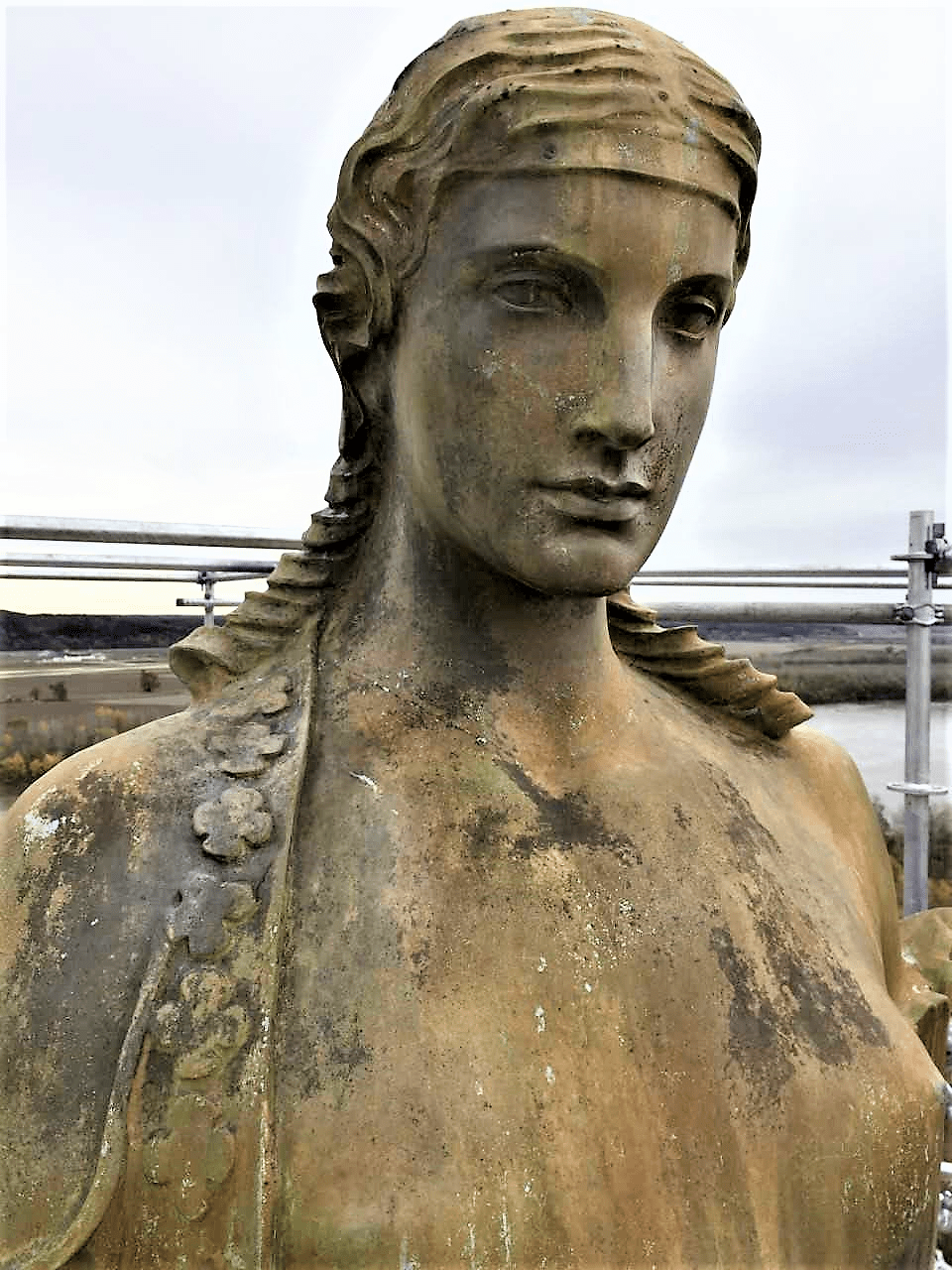
Ceres, a lady of myth and mystery who has extended blessings to state capitol visitors for ninety-four years, has been brought to earth by mortals who love her and care for her.
She’s in Chicago now and will be staying there about a year before she comes home to the capitol.
 She’s a ten-feet four-inches tall, two-thousand pound bronze statue whose presence among flesh-and-blood humans was an emotional event for many of those who spoke quietly in loving terms as they walked around the flatbed trailer on which she’d been carefully laid after days and hours of preparation for her removal from the capitol dome.
She’s beautiful.
We’re going to spend some time in this entry telling her story, which is as ancient as the Greek and Roman empires, as recent as last week, and is beginning a new chapter. We’ll be drawing on the research we did for The Art of the Missouri Capitol: History in Canvas, Stone, and Bronze and for the upcoming book about the history of the building.
WHO IS CERES?
Ceres is a figure from Roman mythology whose Greek counterpart is Demeter. She’s the goddess of grain, of agriculture, of fertility, a representative of Mother Earth. We’ll use the Roman version of her story here. She was a sister of Jupiter who was impregnated by Jupiter (family relationships among gods and goddesses apparently were not frowned upon in the myth
The family weirdness continues with Pluto kidnapping Proserpina with plans to marry her and live in the underworld. Mama Ceres, as you might expect, was not favorably disposed to such an arrangement. As she searched for her daughter, she stopped the growth of crops and caused deserts, acts that alarmed Jupiter to send Mercury to the underworld to convince Pluto to let Proserpina return to the surface.
Pluto blackmailed Proserpina. He forced her to agree to return to the underworld for part of the year. When Proserpina showed up, Ceres was happy and as long as the two were together the earth was fertile and crops grew, trees had leaves, and the grass grew. But when Proserpina has to return to Pluto, Ceres becomes depressed and the earth begins to lose its productivity and the trees start to lose their leaves and the lawn finally stops growing.
So we have brought Ceres to earth at a time when she supposedly becomes depressed because she misses Proserpina—which might explain the chilly and snowy day of falling leaves and dying lawns when she came down. Although the capitol restoration workers say she’ll be put back up in a year, regardless of the weather, we think it would be more appropriate to put her back in place at a time when the wind blows warmer, the trees are budding, the days are growing longer, and so is the grass.
That’s the best we can figure out this complicated family relationship of gods and goddesses in ancient Rome and ancient Greece.
Regardless, let’s hope that Proserpina, unknown to her mother, already is living in Chicago (known for many years for its underworld history) and hears that Mom is going to be in town, and that they get together. We’re ready for a quick return of spring.
WHY CERES?
Simple. She’s the goddess of agriculture, among other things. Although Missouri is becoming more urban, its number one industry remains agriculture. It was even moreso when she was commissioned, cast, and put into place.
THE MISSOURI CAPITOL WAS NOT HER INTENDED SITE
It not only was not the intended site, but the statue of Ceres appears to be less than an original design.
For example, the Smithsonian Learning Center has this statue titled “Maidehood,” a version of which also is in the Brookgreen Gardens in South Carolina.
 The hand is up, not down, and the gown is more revealing than the attire of Ceres. But the design similarities are unmistakable.
Then there is this work from the Panama-Pacific Exposition of 1915, also by Sherry Fry:
 She’s called “Peace” in this version.
Fry originally intended the statue to fulfill a commission for Grant’s Tomb in New York. But an undated newspaper clipping in the papers of Decoration Commission member Cora Painter says, “When he visited the Missouri Capitol, he was struck with the thought that there was the building to which his theme was fitted and he executed the model for Missouri instead of New York.”

SHE’S NOT THE ONLY CAPITOL CERES
We aren’t the only state capitol with a statue of Ceres. Vermont’s capitol in Montpelier has had a Ceres statue since 1858. As this is written, sculptor Chris Miller is carving—from Honduran Mahogany— the third Ceres statue to adorn the statehouse dome. The clay model he is working from was done by Jerry Williams, who usually works in granite. The first two wooden statues fell victims to rot after about eighty years each.
(The picture is from Sevendaysvt.com)
WHO DECIDED SHE SHOULD BE UP THERE?
The original decision was made by the State Capitol Commission Board, the predecessor of the Capitol Decoration Commission. And for a time, there was some consideration of making her out of something else.
The capitol architectural firm of Tracy and Swartwout (pronounced Swart-out) proposed a ten-foot statue of Ceres, the goddess of agriculture “fully robed and head erect.” They suggested, “In her right hand she carried the torch of education and in her left, which hangs by her side, are a few blades of wheat.” The Capitol Commission Board approved the idea in September, 1915 then wondered whether the statue should be made of sheet copper instead of bronze, what the thickness of copper should be if that was the material of choice, and what would be the cost difference.
By mid-1916 the board was waiting for the great bonze doors to arrive for the south front of the building and had started casting up sums to see what else it could buy. It thought there would be enough for a statue of Ceres on the dome, among other things. The W. F. Norman Sheet Metal Manufacturing Company of Nevada, the home town of commissioner Theodore Lacaff, sent the board a plaster model of a proposed twelve-foot ball statue that could be made of 48-ounce of sheet copper for $2,480.
But the board was hit with a Missouri Supreme Court ruling that almost drained its bank account, leaving it without funds for the statue or to hire sculptors to carve figures for the main pediment.
 Architect Egerton Swartwout called the board’s suggested cost of the statue “absolutely inadequate” and noted the price of bronze had gone up so much since war broke out in Europe that the board could not afford the bronze for the statue much less pay for casting it. He warned of vendors who would “sell you a lot of junk which they too often put on court houses and other such buildings, like the Civil War Memorials that are scattered through the land, made out of stamped tin.”
Swartwout suggested the statue be made of hammered sheet copper, the material used in the Statue of Liberty. Norman said copper and bronze were scarce because the government was not allowing their use for anything but war work. Norman endorsed the idea of Ceres “since such stress is being laid upon the importance of cereals” at the time and the Missouri War Production Board was encouraging, and getting, great improvements in state agriculture production. Although Norman later got an option on some copper of the same weight used in the Statue of Liberty, the Ceres project wound up on the Capitol Commission Board’s scrap heap.
The Jefferson City Daily Capital News observed that the war had caused Ceres “to gracefully sidestep the honor of standing on top of the capitol dome and beaming down upon a peaceful world. Gallantly Ceres gives way for old glory who will proudly wave over the most beautiful state capitol in the Union.” But, forecast the newspaper, “When victory ends the war, Ceres will have her inning.” Sherry Fry’s bronze Ceres statue was hauled to the top of the dome in the fall of 1924, made of bronze. It would be more than six decades before the Norman Company got some of its products in the capitol, when it installed the tin ceiling in the office of Senator Harold Caskey.
THE SCULPTOR
The statue was designed by Sherry Edmundson Fry, an Iowa-born sculptor who began his career when he shaped a figure from clay scooped from a ditch near his Creston, Iowa home. His father refused to support his desire to study are in college so Fry picked potatoes to work his way through Grinnell College.
 After graduation, Fry worked with sculptors Lorado Taft and Charles Milligan in Chicago before moving to New York to work for Karl Bitter, who created the original “Signing of the Treaty” panel that is on the river side of the capitol. He signed on as a crewman aboard a cattle boat bound for France so he could study at the leading art institutes in Paris. Fry continued his studies in Italy before returning to France where he met Des Moines businessman James Edmundson who hired him to create a sculpted image of his father. Fry so admired Edmundson that he took the man’s last name as his middle name. (The Archives of American Art in Washington, D. C., has the only photograph of Fry we have been able to track down.
)During World War I, Fry was part of the newly-formed Army Camouflage Corps, one of the leaders of which was Evarts Tracy, whose architectural firm designed the Missouri Capitol. Tracy appears to have been the connection that got Fry the Ceres commission. He was paid $15,000 for this work (about $215,000 today).
THE REAL WOMAN, PERHAPS
We have suggested that the inspiration for the figure on our capitol’s dome might have been Audrey Munson, considered the country’s first supermodel. We have only circumstantial evidence because the records of the Capitol Decoration Commission have disappeared (we maintain a hope somebody will find some dust-covered file boxes in their attic or in a long-forgotten closet corner that will contain those records) and we have not located any of Fry’s personal papers
 Audrey was the favorite model for New York sculptors—the New York American referred to her as the “queen of Artists’ Studios”—including those who decorated our capitol, for more than a decade. She was such a popular subject that the organizers of the 1915 Panama-Pacific Exposition in San Francisco published a guide book of the exposition statues that featured her face and body. More than half of the statues at the exposition were of Audrey.
Audrey Munson went into movies and became the first woman to appear nude in an American mainline movie. Her family put her in a mental institution in 1931. She died there in 1996 at the age of 104, thirty years after Fry’s death.
SIZE

Some of those who saw Ceres on the trailer after she was brought down were surprised that she isn’t bigger. It’s a matter of proportion and the Capitol Decoration Commission that commissioned the statue wanted to make sure the statue did not overwhelm the building’s design nor would it be insignificantly small. When Sherry Fry submitted a design, a steeplejack made a two-dimensional wallboard silhouette that he hoisted into position atop the dome. Commission members and others on the ground walked around the dome to study the figure from all angles and found, as one chronicler put it, the statue “stood out, bold, distinct, and beautiful.”
By contrast, Thomas Crawford’s statue of “Freedom” on our nation’s capitol is nineteen feet-six inches high and weighs fifteen-thousand pounds. The statue was cast in Rome, where Crawford had his studio. It was shipped to this country in six crates and put together atop the capitol in 1863. Your loyal observer frankly thinks that she is too large for that dome but—to the surprise of some, perhaps—he was not around in 1863 to protest. Neither was Crawford, who died in 1857.
BRINGING HER DOWN
 No one is alive today to see her return to earth who saw Ceres, or at least the top part of her, hoisted to the dome in 1924. For most of a century we have had only photographs from airplanes or long lenses to show us her beauty.
Unless you went to Columbia.
Before Sherry Fry was allowed to cast a bronze statue, he had to submit a half-size preliminary sculpture to the Decoration Commission. Many of the preliminary drawings, paintings, window designs and sculptural models were taken to the University of Missouri School of Art and Archaeology by commission chairman John Pickard, the founder of the university’s art history department. Some preliminary painting are in the Ellis Library. The plaster models of the south front frieze line some of the hallways on the top floor of Jesse Hall, the main administration building. Unfortunately (as of our last visit there) there are no signs telling anyone what those encased things are.

For years, Fry’s preliminary model of Ceres was in Pickard Hall on the Francis Quadrangle but when that building was closed after it was found to be contaminated by radioactive elements left from research in the early 1900s the museum was moved to what’s known as Mizzou North, the former Ellis Fischel Cancer Hospital on the business loop. The statue is still there although it has lost a hand and some toes.

In 1995 some folks made their way to the top of the dome to check on Ceres’ condition. A few days before she was brought down, the Office of Administration had a photographer on the dome with her. Until workers started preparing to bring her down several days ago, nobody had gone face-to-face with the goddess since ‘95. Unless they’d been to Columbia.
It’s hard to compare the face of the plaster model with the face of the final bronze statue because of light and perspective. But it appears to us Fry made a slight alteration in the face of Ceres, perhaps slightly lengthening it, when he made the final version. (Compare with the statue’s face at the end.)

Two guys were essential to the safe return of Ceres to earth. One was Zack Franklin who ran the big crane that reached up and over to Ceres and gently lifted her from her perch and gently lowered her to the trailer below. Lt. Governor Mike Kehoe (who commemorated their roles) called Franklin “the most important man in Missouri during the five to seven minutes Ceres was in the air.”
 The eyes for Franklin on the platform far above was James Stafford, talking by radio to the crane operator as the delicate task of attaching the hook to the carefully-wrapped harness around the statue. It was fitting that Stafford should be intimately involved in the process. His great-grandfather had been one of the workers who constructed the building that Ceres has presided over all this time.
So she came down, wrapped in a state flag that was a last-minute thought earlier that morning, turning to seemingly bless the building over which she presided or maybe to wave goodbye for a little while, and then for the first time in more than nine decades, she was allowed to lie down.

FACING THE WRONG WAY?
We don’t know where this got started, the idea that when Ceres was winched to the dome in 1924 that workers turned her the wrong way before anchoring her. We have never found any contemporary accounts saying that.
We’re not sure what the rationale is for that idea other than north Missouri is the state’s main corn, wheat, and beans producing region while the south (except for the Bootheel) is better at raising rocks.
One person has suggested she faces south to reflect Missouri’s Confederate heritage, in effect turning her back on the North. Again, we have never found any contemporary comment or account indicating that is the case. It is true that “Dixie” was part of the inauguration ceremonies for new governors in those days but we do not believe the Capitol Decoration Commission was in any way motivated to turn its goal of appropriately decorating the building into a political statement.

So why does she face south—and WILL face south when she returns from Chicago (as shown in Lloyd Grotjan’s photo from our Art book)? Because the south front of the Capitol is where the people come for admittance to the halls of their government. Her hand is extended in blessing to the people of Missouri who gather below her for inaugurations, rallies, concerts—-for some years in the hot summers the mainline Protestant churches held joint worship services on the lawn—or just to visit the state’s greatest symbol. It would be extremely poor manners if the patron goddess of Missouri turned her back on her people.
We wouldn’t be surprised if that was what the commission thought when Ceres ascended in 1924.
AND A FINAL NOTE—
Some of us think the beauty of Ceres should not be so far away that Missourians cannot be touched by it for another century or so. Perhaps those restoring the Capitol would consider doing what has been done with “Freedom” in the National Capitol.
The full-size plaster model for that statue that was used to cast the bronze statue on top of the building was stored in pieces for more than 130 years before it was restored by the Architect of the Capitol in 1929. It stands today in Emancipation Hall of the U. S. Capitol’s Visitor Center.
The United States Capitol Historical Society sells a nine-inch tall version of the statue made of crushed marble removed during the renovation of the east front of the building and mixed with resin. It sells for forty-six dollars. An much smaller replica is available as a Christmas ornament.
Oklahoma, which finally put a dome on its Capitol is topped by a twenty-two foot tall statue, a nine-foot replica of which is in the rotunda.
Today’s laser scanning and 3-D printing technology could produce an accurate reproduction of Ceres that would make a striking attraction in the Capitol Museum or to the Capitol visitor’s center that is talked about from time to time. And a small but well-detailed version made of the dust from the stones removed during the present restoration and repair project could be a solid seller at the tour desk.
 Beauty should not be hidden, even if it is in plain sight, 250 feet above those who would admire it.