A Congressman Steps Down; Thousands Protest 

It would be nice if the headline reflected reality.  But in the case of Congressman Sam Graves, a native of Tarkio in the far northwest corner of Missouri, it’s not his retirement that has triggered the protests.  We’re going to offer some quick, surface, observations about these two separate events and how Missouri’s chaotic 2026 elections just got more interesting.

I remember Sam Graves mostly because he caused me some sleepless nights. More on that later.

Sam is now 62. He has served 26 of those years in Congress. He might just be hitting his prime and he’s leaving. The website legistorm.com calculates the average age of members of the U.S. House is 58 (for all of Congress it’s 61.5). However, he has served twice as long as the average length of service for U.S. Representatives. In fact, Graves is 32nd in seniority among the 435 members of the House (the Dean of the House is Kentucky Congressman Harold Rogers who is 88 and in his 45th year, his 23rd term and he will seek a 24th.).

The longest-serving Congressman from Missouri was Clarence Cannon, from Elsberry, in northeast Missouri. He died in office after 41 years 69 days and planning for more before a fatal heart attack in 1964. He ranks 29th as the longest-serving member of the U.S. House, 49th  on a list that also includes Senators.

In 1963, the year Graves was born, country music star Jim Reeves put out a song by fellow singer and songwriter Bill Anderson called “I’ve Enjoyed About as Much of This as I Can Stand.”  We don’t know if he has heard the song but in joining 35 other Republicans who are leaving, we wouldn’t be surprised if several of them felt that way (there are 21 Democrats who have decided there’s more to life, too).

Already, several fellow Republicans and at least three Democrats have filed or expressed an interest in filing for his seat and it would be no surprise if the numbers did not increase on both sides.

The Sixth Congressional District is a rural one that covers the entire sparsely-settled rural north Missouri—36 of our 114 counties. It has been solidly conservative for a long, long time.

But the political climate nationwide seems to be changing. Last weekend there were at least 33 “No Kings” rallies in Missouri, nine in the Kansas City area, eight in the St. Louis area, thirteen outstate and three more in northwest Missouri.

Here is something to ponder for the sixth district.  A “No Kings” rally in Quincy, Illinois—not listed among 33—probably had some attraction for some northeast Missourians in the sixth district. TEN of the scheduled rallies on the Missouri side of the Mississippi were in Graves’ present district.  Ten of them. Excelsior Springs, Harrisonville, Kearney, Liberty, Platte City, Madison, Moberly, Maryville, Chillicothe, and St. Joseph.

The “No Kings” movement has survived the winter and the Trump administration’s headline activities from Minnesota to Iran.  The sixth district will not have an incumbent with all of the vote-getting power that goes with incumbency.

The sixth district—in whatever form it winds up being after legislative action and courts reviews—might be more in play than it has been for two decades. And both parties know it full well.

Getting back to Sam—pardon the unfamiliarity but he was “Senator” when I covered him in the legislature and the last time I saw him I called him, “Sam,” an uncharacteristic familiarity that I almost never allow myself with present or past political figures.

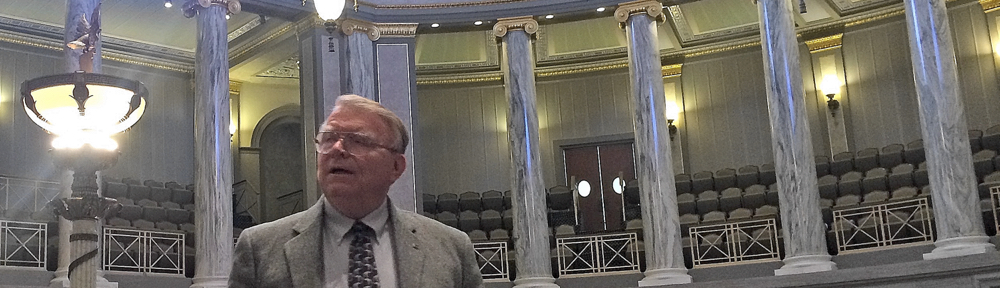
There he is from the Missouri Official Manual (the Blue Book by more familiar name) for his first term in the Senate. He was in the Senate for the last years of Democrat-domination of state government.  I recall that he was collegial with good relationships on the other side of the aisle.

But the main thing about him that I recall is that he kept me up all night on at least two occasions.  Sam was not afraid of a filibuster but he rarely took a leading role and didn’t do it so often as to be tiring—as some have done more recently. And he was entertaining, something most filibuster participants never approach.

There were some senators after him who were so boring that I gave one of them a list of books to read that would at least educate those who had to endure them.  Sadly, the list went unused.

He talked about being a poor farm boy whose only pet, a three-legged dog named “Tripod,” was the star of some of his stories. The best performance, however, was the night he threatened to read the names of every high school student in his district who was graduating that year. Every time he was interrupted, he started over. As I recall, he finally forced a compromise on the issue under discussion—which is what filibusters should be for if participants respect them.

The only better filibuster story-teller than Sam Graves was Senator Danny Staples of Eminence.  I made sure I turned on my recorder whenever he asked another member, “Senator, did you know…..” because I knew what was coming.  The State Historical Society has several hours of Staples’ recordings. There are hundreds of other cassettes in the oral history collection that I have to listen to and label one of these days and there has to be some Sam Graves stories on them.  Or on the memory chips we used in later recorders.

He was a work horse not a show horse in his political career, as we observed him up close and from a distance. He’s young enough to have a long and prosperous K-Street career in Washington. K-Street is a street known for its offices of the special interest groups.

The folks in the sixth district would be well-served to seek out another work horse in November.

-o-

The Sounds of Their Voices

I’ve been working on some of the history of my church and once again I have become curious about how the denomination’s founders sounded when they spoke, exhorted, preached, etc.

Two of the group that established the denomination were former Scottish Presbyterian ministers who broke with the church over limits in participation at the Lord’s Table.  But both men had been born and raised in Ireland. One live 57 years after coming to this country. Did he still sound Scots-Irish at the end?

When Andrew Jackson shouted his favorite oath, “By the Eternal!” did he have a southern accent? It probably wouldn’t have been as deep as the accents we associate with Georgia, Mississippi and Alabama, but would there have been something?

Did Benjamin Franklin speak as Howard DeSilva portrays him in the musical 1776 or as Robert Preston portrayed him in the musical some years earlier, Ben Franklin in Paris?

Two people in particular intrigue me, one because I’m a native of Illinois and wonder about Abraham Lincoln’s voice at Gettysburg,  and the other because he is such a towering historical figure and a national founder, Thomas Jefferson.

Lena Torres has written about Jefferson on soundcy.com:

Descriptions suggest he spoke with a soft, measured tone, reflecting his reserved and thoughtful nature, while his Virginia upbringing likely influenced his accent, which would have been characteristic of the Tidewater region. Additionally, his extensive education and role as a diplomat may have imbued his speech with a formal, articulate quality. While we can only speculate, piecing together these details offers a glimpse into how one of America’s Founding Fathers might have sounded.

Thomas Jefferson’s voice, though lost to time, likely carried the distinct cadence of Tidewater Virginia, a region steeped in colonial history. This accent, shaped by the linguistic currents of 18th-century Britain, would have been a hallmark of his speech. Imagine a voice that blended the formality of British English with the emerging nuances of American pronunciation—a linguistic bridge between the Old World and the New…

A practical way to approximate Jefferson’s accent is to listen to recordings of modern British Received Pronunciation (RP) and then soften it with the gentle rhythms of the American South. Think of it as a hybrid—not quite British, yet not fully American as we know it today. For instance, the word “water” might have sounded more like “wah-tuh,” with a subtle elongation of the vowel, a relic of his British-influenced upbringing.

She writes a lot more at Unveiling Thomas Jefferson’s Voice: Reconstructing The Third President’s Speech | SoundCy

And Lincoln?  Was he like some actors who have portrayed him—Gregory Peck, or Raymond Massey, as deep voices and deliberate delivery, or the softer and higher-pitched voice of actor Royal Dano at Disneyland ((2098) GREAT MOMENTS WITH MR. LINCOLN Restored Disneyland Vinyl LP – YouTube 28:19 in for the audio animatronic figure’s speech)

A 2011 article for Smithsonian Magazine quotes Lincoln researcher Harold Holzer liked the way actor Sam Waterston (of Law & Order fame) voiced him in Ken Burns’ documentary about the Civil War and in other performances (Sam Waterston Reading The Gettysburg Address #gettysburg #gettysburgaddress).

But the closest might have been Daniel Day Lewis’ interpretation in the movie Lincoln. (Lincoln “Now” scene)

(He explained in an interview how he developed it (BBC News – Daniel Day-Lewis on finding Lincoln’s voice).

Holzer says in the article, “Lincoln’s voice, as far as period descriptions go, was a little shriller, a little higher…People said that his voice carried into crowds beautifully. Just because the tone was high doesn’t mean it wasn’t far-reaching.”

Getting back to Jefferson, Torres has some thoughts about then and now:

In a world where loudness often equates to importance, Jefferson’s soft-spoken, low-pitched, and deliberate style reminds us of the power of restraint. Whether in leadership, education, or personal interactions, adopting a measured tone can elevate your message, making it more memorable and impactful. Experiment with this approach in your next presentation or conversation, and observe how a quieter, more intentional voice can command respect and foster deeper engagement.

I hope we rediscover that in our political discourses.


It’s Time to Order Another Obelisk 

The Missouri Veterans Memorial at the Capitol is a quiet place,  of a slow-moving cascade of water flowing into a reflecting pool around which people can ponder how much is lost to war.

And how much will be.

To the east of the pool is a shaded walk that takes visitors past nine memorial obelisks remembering the nine wars in which Missourians have fought since statehood in 1821—Mexican War, Civil War, Spanish-American War, World Wars I and II, Korea, Vietnam, Persian Gulf, and finally the war in Iraq and Afghanistan.

Now, less than a year after the ninth obelisk was dedicated—after an end date of that long war was determined—it is time to plan for a tenth one.

As this is written, no Missourian has been killed in Trump’s War—-which is not what it will be called in the black granite when the tenth obelisk is installed.  As of now, it probably will say “Iran War,” but it’s too early to carve anything into stone because we don’t know what the scope of this conflict will finally be.

Nor, apparently, does the man who ordered it. He started the war and now he is whining that NATO is giving him no help.

NATO, the people he has spent the last several years insulting and threatening, seems content to letting President Trump stew in his own juice.  NATO is more about protecting Ukraine (remember Ukraine, Mr, President?) and itself than helping President Trump.

The Coalition of the Willing has become the Coalition of the Unwilling.

To refresh our minds:  then-President George W. Bush declared at a NATO summit in 2002 that if Iraq President Saddam Hussein did not disarm (he was accused of having weapons of mass destruction), that the United States would assemble a “coalition of the willing” to do it for him.

Saddam didn’t. So George Bush’s United States and troops from 48 other countries backed the plan. Four countries eventually put boots on the ground—us, the UK, Australia, and Poland). More than three dozen other countries provided some troops but not major numbers. Some don’t even had standing armies but provide other kinds of help.

The coalition did not hold and it became a topic of political ridicule (Busch had offered foreign aid to participants, a policy that one columnist termed “a coalition of the billing” and another observer considered “a coalition of the shilling.”) By mid-2009 everybody but the United States and the United Kingdom coalition had backed away.  The Coalition of the Willing was considered ended in 2010.

President Bush assembled his coalition before the fight began.  President Trump just barged right in—BOMBED his way right in—to a new war and did not ask for help until Iran fought back and closed the Straits of Hormuz. Only then did he look for friends in NATO only to find he didn’t have very many anymore.

He’s watching his foreign policy by sledgehammer wielded by amateurs turn into quicksand. He is so desperate that he has lessened some sanctions against Russia—imposed as a reaction to the invasion of Ukraine—in an effort to relieve some pressure on the oil supply which seemingly could help finance further Russian operations against Ukraine, if we understand where this policy is leading.  He’s firing missiles the way kids fire bottle rockets on July 4th while China watches our war-making or defensive armaments dwindle and also watches Taiwan. The early talk about not using troops is ominously sounding like —using troops.

Some observers have suggested that Iran is Trump’s Ukraine.

“Some people will die, I guess,” the President has said.

Order the tenth obelisk. Too bad the state can’t send the bill for it to President Trump.

A few weeks ago, my state representative, Dave Griffith, asked me if I could find how many Missourians died in the wars of the eighth and ninth obelisks (Gulf War, Iraq and Afghanistan).  I could not locate numbers but I did find a website that listed the names of all of the military people who died in those conflicts. I picked out the Missouri names and sent them to him.

Their names won’t be on the obelisks although the number of those who died will be someday.

Their names are on their own monuments scattered throughout the graveyards of Missouri and elsewhere, unfortunately soon to be joined by similar monuments from Trump’s War.  Here is the list from President Bush’s War, with the date of official notification.  We pray their tragic coalition will not be joined by a new coalition from Mr. Trump’s War, but we fear it will be.

Let us know if your loved one killed in these long wars is not on the list.

Continue reading

The Boodle Scandal, part Two

Monday we promised you an opportunity to see a forgotten Missouri political, one of the most sensational ones of the Twentieth Century. Muckraker Lincoln Steffens described how money can distort public policy, a common and visible public concern today.

What was this scandal about?  An innocent everyday-used substance that is part of our diet today. Steffens’ magazine article is long. As you read it, you might think, “Nothing has changed.”  We’ll comment afterward what happened to some of the participants in his historic controversy.

Enemies of the Republic

Lincoln Steffens

[Reprinted from McClures, VOL. XXIll, October, 1904 No.6]

THE POLITICAL LEADERS WHO ARE SELLING OUT THE STATE OF MISSOURI, AND THE LEADING BUSINESS MEN WHO ARE BUYING IT – BUSINESS AS TREASON-CORRUPTION AS REVOLUTION

EVERY time I attempted to trace to its sources the political corruption of a city ring, the stream of pollution branched off in the most unexpected directions and spread out in a network of veins and arteries so complex that hardly any part of the body politic seemed clear of it. It flowed out of the majority party into the minority; out of politics into vice and crime; out of business into politics, and back into business; from the boss, down through the police to the prostitute, and up through the practice of law, into the courts; and big throbbing arteries ran out through the country over the State to the Nation-and back. No wonder cities can’t get municipal reform! No wonder Minneapolis, having cleaned out its police ring of vice grafters, now discovers boodle in the council ! No wonder Chicago, with council-reform and boodle beaten, finds itself a Minneapolis of police and administrative graft! No wonder Pittsburg, when it broke out of its local ring, fell, amazed, into a State ring! No wonder New York, with good government, votes itself back into Tammany Hall!

They are on the wrong track; we are, all of us, on the wrong track. You can’t reform a city by reforming part of it. You can’t reform a city alone. You can’t reform politics alone. And as for corruption and the understanding thereof, we cannot run ’round and ’round in municipal rings and understand ring corruption; it isn’t a ring thing. We cannot remain in one city, or ten, and comprehend municipal corruption; it isn’t a local thing. We cannot “stick to a party,” and follow party corruption; it isn’t a partizan thing. And I have found that I cannot confine myself to politics and grasp all the ramifications of political corruption; it isn’t political corruption. It’s corruption. The corruption of our American politics is our American corruption, political, but financial and industrial too.

Miss Tarbell is showing it in the trust, Mr. Baker in the labor union, and my gropings into the misgovernment of cities have drawn me everywhere, but, always, always out of politics into business, and out of the cities into the state. Business started the corruption of politics in Pittsburg; upholds it in Philadelphia; boomed with it in Chicago and withered with its reform; and in New York, business financed the return of Tammany Hall. Here, then, is; our guide out of the labyrinth. Not the political ring, but big business,-that is! the crux of the situation.

Our political corruption is a system, a regularly established custom of the country, by which our political leaders are hired, by bribery by the license to loot, and by quiet moral # support, to conduct the government of city, state, and nation, not for the common good, but for the special interests of private business. Not the politician, then, not the bribe-taker, but the bribe-giver, the man we are so proud of, our successful business man-he is the source and the sustenance of our bad government. The captain of industry is the man to catch. His is the trail to follow.

We have struck that trail before. Whenever we followed the successful politician his tracks led us into it, but also they led us out of the cities-from Pittsburg to the State Legislature at Harrisburg; from Philadelphia, through Pennsylvania, to the National Legislature at Washington. To go on was to go into state and national politics and I was after the political corruption of the city ring then. Now I know that these are all one. The trail of the political leader and the trail of the commercial leader are parallels which mark the plain, main road that leads off the dead level of the cities, up through the States into the United States, out of the political ring. into the System, the living System of our actual government. The highway of corruption is the ” road to success.”

Almost any State would start us right, but Missouri is the most promising.

Continue reading

The Boodle Scandal, Part One

I want to take you back to the early Twentieth Century when muckraking reporters such as Lincoln Steffens, Ida Tarbell, Ray Stannard Baker, Upton Sinclair, and Jacob Riis—to name a few—were writing powerful newspaper and magazine articles exposing the ugly underside of government and business and the partnerships between the two that sometimes amounted to a betrayal of our country or our state for their personal or corporate benefit.

Today we call them investigative reporters, people who burrow into the inner workings of business/government relationships that corruptly enrich a few and harm the many—not unlike too many things we are seeing today at the national and even the state levels wherever you might live.

In our entries today and on Wednesday we are going to bring you Lincoln Steffens’ “Enemies of the Republic” from the October, 1904 issue of McClures magazine.  But first, we need to set the stage.

“Boodle” in those days referred to bribery.  A boodler was one who gave or who accepted bribes to influence public policy.

The story of the great boodle scandal in Missouri came to me many years ago in researching the stories of the ministers of my church in Jefferson City and the brief career here of Crayton S. Brooks, a fiery temperance preacher who came to what was then a pretty wide open town particularly when the legislature was in session every other year.

On Sunday evening, March 1, 1903 Rev. Crayton S. Brooks—whose preaching earlier had led to the closing of pool halls and gambling houses—asserted from his pulpit at the First Christian Church four blocks from the Capitol that “there were $1,000 bills being exchanged in Jefferson City by men not in the habit of handling such amounts of money,” the implication being that they were buying votes in the legislature.

St. Louis Post-Dispatch reporter Joseph J. McAuliffe happened to be in one of the pews that night and wrote about the sermon. There is a lot I wish we knew about their relationship  and why a St. Louis reporter “happened” to be at the church that night, but we do know that Brooks admired St. Louis prosecutor Joe Folk for his earlier work to bring down Ed Butler, the St. Louis political boss and had made a trip to St. Louis earlier in the year, although the accounts do not say why, leaving the door open to some speculation.

Representative Edward Eversole of St. Louis was named to lead a committee investigation and started summoning witnesses from among the lobbying corps. He said, “We saw men we wanted standing about the corridors and lobby of the Capitol four deep, but as soon as one or two were served there was a wild stampede and the greatest time you ever heard of getting out of town.”

He investigation eventually led to the indictments of four Senators who were accused of taking bribes for their votes on a bill concerning the ingredients of baking powder. Steffans will explain that in  his article.  Lieutenant Governor John Adams Lee, who planned to run for governor in 1904, was exposed as the middle man who delivered the bribes from the Royal Baking Powder Trust to the four legislators, resigned and fled to Chicago.

Steffens’ article said, “There is nothing partisan about graft. Only the people are loyal to party. The ” hated” trusts, all big grafters, go with the majority. In Democratic Missouri, the Democracy is the party of “capital.” The Democratic political leaders, crying down the trusts, corner the voters like wheat, form a political trust, and sell out the sovereignty of the people to the corporation lobby. And the lobby runs the State, not only in the interest of its principals, but against the interest of the people.”

In 1992, Missourians adopted term limits, an amendment that missed the target it should have hit and as we have seen in the years since opened the door to loss of legislative independence and replaced it with—too often—outside influence.  As it was put in 1992, adoption of term limits will end corporate memory in the legislature and the power to set public policy will pass from the legislative chambers to the hallways.

I watched it happen. Only after term limits went into effect did I hear the sponsor of a bill ask someone with an amendment, “Have you run this by so-and-so in the hall?” The question became unnecessary as cell phones proliferated and lawmakers could get messages while debating bills.  House and Senate rules ban lobbyists from the legislative floors.  But the cell phone’s texting app puts them there electronically.

Ineffective campaign spending limits and a U. S. Supreme Court ruling that corporations are, for political speech purposes, to be considered “people,” have had a profound effect on who gets access, how much of it they get and how they become manipulative of the process.

Understand that this is not saying all of our elected officials are crooked or can be bought. We have to trust the people we elect but we also must be aware of the awful pressures they endure to serve and the all-consuming world they live in for four intense months every year. Political courage sometimes is weakened in that climate because they are human and we sometimes are disappointed when the podium we put them on is not as high as we think it is.

We voters have a responsibility to pay attention to the issues they are dealing with so that our lawmakers are regularly reminded who they really work for.

Citizen cynicism is easy to come by and is a reflection on the citizen who refuses to maintain at least a modicum of awareness and is therefore less likely to be “cornered like wheat.”

That is where the reporter has a place—to expose as well as report. A good reporter has to have a bit of the spirit of Lincoln Steffens inside and our media must recognize the responsibility they have to be unafraid to rake muck when necessary.

Good reporters do not want to be liked by the people they report about. Nor do they want to be hated. They do hope to be respected as a necessary element of a free society. And they should be conscious of their responsibilities to citizens on both sides the aisle. They also must be unafraid, and expect those who employ them to be unafraid, too.

On Wednesday, you will read Lincoln Steffens’ Enemies of the Republic. It, unfortunately, has elements of truth that you will recognize in our present times.

(Picture Credit: Brooks—St. Louis Republic

The Missouri  Optimist

Two years from now, we will observe the sesquicentennial of the publication of the first edition of the Blue Book, the Official State Manual as it is more formally called. Secretary of State Michael McGrath published it in 1878 not only to list the people and agencies that constituted Missouri government then but to use it as a one-man state chamber of commerce.  Amidst his extensive horn-blowing, we find some things still true of ourselves. We also find some things to which we still should aspire almost 150 years later.

This is his Foreword to “The Almanac and Official Directory of Missouri:”

MISSOURI. It is a truth that must be admitted, that very many outside of Missouri, and some even in it, know but little of its vast resources or of its immense wealth and unexampled prosperity, and when told scarcely believe it, so great is the extent and magnitude thereof.

There is no territory of equal size on the continent which contain so varied and such large quantities of the most useful minerals. Missouri may safely challenge the world to produce a Superior in this respect.

It is estimated by those who have computed the quantity of Iron in Pilot Knob and Iron Mountain, that there is, above the surface of these mountains alone, iron sufficient to afford an annual supply of 1,000,000 tons for two hundred years.

Lead and Zinc Ores are found almost everywhere in South Missouri, and the lead mines of Granby, Joplin, and Mine LaMotte, are almost inexhaustible.

Iron and Coal underlie some of the richest lands in the State. In many cases it is difficult to determine whether the agricultural or mineral resources are most remunerative. If Missouri were as densely populated as England, it would have a population of 25,000,000, and by the extent and diversity of its resources is far better able to support this vast number in competency and independence than England is to maintain its present population. This seems incredible but is nevertheless the fact.

 Missouri presents to the farmer conditions of soil and climate favorable to his calling. The richness of the soil cannot be surpassed. Farms, after bearing without artificial fertilization twenty-five successive crops, have failed to show scarcely any decrease in productiveness; water is abundant, and streams and springs are found in every portion of it,

Its climate is delightful; the winters are short and mild, and the summers long and temperate. In Missouri, agriculture will compensate the skillful and industrious follower with independence and wordly riches. To it manufacturers are invited, with the offer of rich facilities, and if natural adaptation, be any evidence of the future, Missouri will at no distant day become the workshop of the Great Valley of the Mississippi.

It is unnecessary to enumerate the articles that ought to be manufactured in it; there is scarcely a want or luxury of domestic manufacture known to the human family but what can be readily supplied from it. Railroads traverse all portions of the State, and reach almost every city, town and village in it.

Missouri, being already rated the fifth State in the confederation, and soon to become the fourth with an area exactly equal to that of all the New England States put togeiher, and once and a half as large as tbe great State of New York; and in the City of St. Louis, now the third in size and population in the Union, as its Metropolis, it requires no prophecy to foretell the millions who will within the next twenty years seek homes within it.

A calculation based upon the census is all that the prediction demands. The present population, according to the last State census of 2,100,000 is entirely insufficient to develop her vast resources, and it therefore seeks the co-operation of colonists from the Eastern, Northern, and Southern States, and of the sturdy and industrious immigrants who annually arrive in this free country, fleeing from oligarchal and despotic governments, to better themselves. It invites also the overcrowded of the seaboard cities of this country, to cross the father of waters and make their homes within her.

Missouri may be regarded as offering greater inducements, as to climate, soil and fertility to the farmer, artisan, laborer, colonist and immigrant than any of the other States or parts of the country. Missouri promises to all a cordial welcome, and liberal compensation for labor. Millions may settle within her borders without exhausting the ample means in store for them. Her schools, both public and private, are the best in the country.

It may be said without fear of contradiction that Missouri is today the most prosperous and best governed State in the Union. In fact, no location in the Republic presents a more encouraging field for the honest laborer or the aspiring citizen.

Tbe contentions of the war have long since disappeared. Liberalism and toleration in politics and religion, are noted characteristics of her people. They are generous, hospitable and enterprising. Among them poverty and humble birth present no barrier to the attainment of wealth, distinction and honor. True merit is the criterion of success, and is fostered by hearty encouragement and profitable recognition.

Occupying, as she does already, a front rank among the States of the Union, it is easy to forecast her future as one of glory and renown! M. K. McG.

We recognize this is a certain amount of puffery intended to promote Missouri and we frankly see the same sort of thing today although in modern language.

One line jumps out, however.

The present population, according to the last State census of 2,100,000 is entirely insufficient to develop her vast resources, and it therefore seeks the co-operation of colonists from the Eastern, Northern, and Southern States, and of the sturdy and industrious immigrants who annually arrive in this free country, fleeing from oligarchal and despotic governments, to better themselves.

Would he write that about us today?


Heroes and Hats

I don’t remember when I decided I liked Willie Nelson.  Maybe it’s because I spent my Saturday afternoons at the Grand Theatre in Sullivan, Illinois watching western double features, sometimes with a serial and a cartoon or two, sitting next to my friend Chuck Woolen in a pair of seats that he had marked by cutting a small notch in the shared arm rest.

The last time I was in the old theatre, now called the Little Theatre on the Square where they do stage shows and musicals, that notch was still there.

I was a member of the Roy Rogers Riders Club and was distressed that a family trip caused me to miss that Saturday’s “meeting” and a chance to pick up the latest Roy Rogers souvenir—a drinking glass one day, as I recall.

It’s awfully hard to resist a good western movie—High Noon, Shane, the Searchers, The Gunfighter, 3:10 to Yuma, Broken Trail, Open Range, Tombstone/Wyatt Earp, Silverado and the ultimate television series—Lonesome Dove (the book grabbed me like no other with first line: “Augustus McCrae walked out onto the porch to discover his two pigs fighting over a dead rattlesnake.”)

I can’t think of another actor who was made to wear a battered cowboy hat better than Robert Duvall was—

Poe and Faulkner, Salinger and Fitzgerald, Vonnegut and Hawthorne and Melville and Hemingway, the Russian greats that I gave up on by the third page because I couldn’t pronounce their character’s names, and all those other high-faulutin’ writers my English professors thought I should adore never started a book that caught me like Lonesome Dove.  I’ve read stuff from most of those guys but none of them wrote about anybody like Gus McCrae.

The other day, I started thinking about two of Willie’s songs that I always have liked as a sad dialogue by a old cowboy wistfully evaluating his life—and also a gypsy touring artist wondering if he shouldn’t have listened to his mother.

Wonder what it would sound like if somebody did a mix of Willie singing the first part and Waylon singing the boldface lines—–

Mamas, don’t let your babies grow up to be cowboys
Don’t let ’em pick guitars and drive them old trucks
Make ’em be doctors and lawyers and such
Mamas, don’t let your babies grow up to be cowboys
‘Cause they’ll never stay home and they’re always alone
Even with someone they love

I grew up a-dreamin’ of bein’ a cowboy
And lovin’ the cowboy ways
Pursuin’ the life of my high-ridin’ heroes
I burned up my childhood days
I learned all the rules of a modern-day drifter
Don’t you hold on to nothin’ too long
Take what you need from the ladies, then leave them
With the words of a sad country song

Cowboys ain’t easy to love and they’re harder to hold
They’d rather give you a song than diamonds or gold
Lonestar belt buckles and old faded Levis
And each night begins a new day
If you don’t understand him, and he don’t die young
He’ll probably just ride away

Cowboys are special with their own brand of misery
From bein’ alone too long
You can die from the cold in the arms of a night man
Knowin’ well that your best days are gone.

Pickin’ up hookers instead of my pen
I let the words of my youth fade away
Old worn-out saddles, and old worn-out memories
With no one and no place to stay

Cowboys like smoky old pool rooms and clear mountain mornings
Little warm puppies and children and girls of the night
Them that don’t know him won’t like him and them that do
Sometimes won’t know how to take him
He ain’t wrong, he’s just different but his pride won’t let him
Do things to make you think he’s right.

My heroes have always been cowboys
And they still are, it seems
Sadly, in search of, and one step in back of
Themselves and their slow-movin’ dreams

Sadly, in search of, and one step in back of  themselves and their slow-movin’ dreams

Willie and Waylon sang them but Ed Bruce and his wife, Patsy, wrote “Mama…” He first recorded it in 1975 and his version hit number 15 on Billboard’s Hot Country Singles charts that year and into ’76. It’s one of the top 100 country songs of all time. Rolling Stone in 2024 ranked it 69th on its 200 greatest country songs.

Waylon recorded “Heroes” in 1976 and Willie made it even more popular in 1980 as part of the soundtrack to the Robert Redford/Jane Fonda movie, The Electric Horseman.  Sharon Vaughn wrote it and Willie took it to number one on the country hit list. The Western Writers of America say it’s one of their 100 favorite western songs.

Regardless, my heroes always have been cowboys although I grew up to be one of those who became an “and such.”

Photo credits: Slaker Hats, Open Range)

Sports:  Billikens Rising; Tigers Muddling; Baseball Starting, etc. 

By Bob Priddy, Missourinet Contributing Editor

We’re a little frustrated today so we’re going to lead off with a basketball team that’s consistently exciting and consistently able to win.  They’re ranked and the Missouri Tigers are continuing to play themselves into the NIT

(BILLIKENS)—The top-20 St. Louis Billikens sit atop the Atlantic 10 Conference roaring back from a 14-point halftime deficit to outscore second-place Virginia Commonwealth 55-22 in the second half and claiming an 88-72 win that featured a brawl in the last minute.  The Billikens are now 25-2 and undefeated in seventeen games at home.

The Bills were sparked by 6-6 guard Kellen Thames, who had 16 points and five steals.  Longtime Missouri fans will ask if Kellen is the son of Kelly Thames, who was a four-year starter at Mizzou whose greater prominence was limited by a knee injury. Yes, he is. Dad was his coach at Pattonville High.  Kellen was the key in a 21-2 surge in the second half when he scored seven straight points, giving the Billikens an eleven point lead with seven minutes left. They never let VCU closer than seven points after that.

SLU guard Quentin Jones, his team 19 points ahead, was dribbling out the clock when VCU’s Nyk Lewis grabbed the ball and after a few steps launched a half-court shot just before St. Louis’ Bobby Avila shoved him out of bounds. VCU’s Barry Evans shoved Avila and the benches emptied. At the end, a bunch of players got excused from the court, enough that Virginia had only four players on the court when Evens hit all three free throws and the clock ran out.

(MIZZ)—Missouri played the 19 and 20 teams in the country last week and split—and they were lucky to get that.

Missouri led by 21 with nine minutes to play before 19th ranked Vanderbilt turned the game inside out. Only by the Tigers making five free throws down the stretch and the rim-out of a Vanderbilt Hail Mary shot as the clock reached zero did Missouri post a skin-of-the-teeth with.

Saturday night, Missouri was on the road against 20th ranked Arkansas. The Razorbacks made nine of their last ten shots to take a six-point halftime lead.  Missouri, as has often happened this year, could not get a stop when they needed one, and Arkansas went on runs of 8-2 and 13-4 to win 96-84.

Missouri drops to 18-9 and 8-6 in the conference. They play Tennessee tonight in Columbia. Tennessee comes in 10-4, and 20-7, one of three teams in second place behind Alabama.  Missouri is one of four teams tied for fourth. They finish the season at home against Mississippi State 5=9. 13-14), at Oklahoma (3-11, 13-14) and at home against Arkansas.

(CARDINALS)—St. Louis opened it spring training games with a weekend split, a 5-2 loss to Washington and a 6-5 win against Houston.

Matthew Liberatore and Dustin May seem to be headed toward being 1-2 in the starting rotation. Spring training will determine 3-5.  Kyle Leahy had a strong start against Houston—18 of 29 pitches in the strike zone—three Ks, two groundouts and a popout. Leahy has been a reliever most of his career but the Cardinals want to stretch him into a starter during spring training.

Newly-signed Ramon Urias is in camp, a 2022 gold glover, likely to play second and third as backup for rookie second baseman J.J. Wetherhold and Nolan Gorman, who is tabbed to be the starting third baseman. Urias is returning to the Cardinals system. He made it to Triple-A before he was DFA’s in 2020. He was with the Orioles and the Astros last year, hit .241 with 11 home runs and 44 RBIs. He has a one-year contract with an option.

(Royals)—The Kansas City Royals seem to have their pitching rotation pretty well set as they start play in the Cactus league—Cole Ragans, Seth Lugo, Michael Wacha, and Kris Bubic seems to have the first four slots tied down with Noah Cameron a contender for the final slot. Sunday’s outing by Bailey Falter, who came to KC from Pittsburgh last year was a sold one, indicating Kansas City could be headed into the regular season with a solid long reliever for them.

Falter started, went two innings, gave up one hit but no runs. Falter made 24 starts for Pittsburgh and Kansas city last year—two starts and two relief jobs for KC.

The Royals took two of three to open spring training in Arizona. The Cardinals split their first two games in the Grapefruit League.

(CHIEFS)—-The Kansas City Chiefs have created some more salary cap space by cutting loose defensive end Mike Dana, who has two Super Bowl rings.  Dana was drafted by the Chiefs in 2020 and would have made about nine million dollars this year, his final contract season.

The Chiefs have been working hard to create more cash heading into the free agent signing season in about two weeks. A few days ago, the team restructured Patrick Mahomes’ contract to lower the amount that applied to the salary cap by about $43.6 million dollars.

Dana was credited with 21.5 sacks in his six years with the team, along with six pass defenses and a half-dozen forced fumbles.

The Chiefs are expected to shed some other veteran players in coming weeks to increase their salary cap space.

This week, Chiefs coaches are in Indianapolis for the “meat market,” the scouting combine workouts that might help decide who to draft out of college.

(HAWKS)—The St. Louis Battlehawks’ UFL season starts in a month—March 28th to be exact, when they play the DC Defenders in the dome.   St. Louis Public Radio reports the co-owner of the league, Mike Repole, has suggested the Hawks abandon the dome and play its games in Energized Park, the home of the St. Louis pro soccer team.

Repole thinks UFL games in a big stadium don’t look good on TV because crowds aren’t big enough. St. Louis averaged a league-leading 30,000 fans last year, more than double the crowds at the second most popular team.  The soccer park, however, holds only 22,000 fans. He says talks with the soccer club about using its stadium are only preliminary.

Six of the eight UFL teams will play at soccer parks this year.

Repole needs to do a selling job on Battlehawks coach Ricky Proehl, one of the stars of the St. Louis Rams, who says he understands how Repole wants to see full stadiums.  But he hopes to grow crowds in the Dome to 40,000 this year with the tailgating atmosphere that would still be available at the Dome continuing to build the team’s culture.

The Dome at America’s center was spiffed up two years ago with new turf and lighting upgrades.

Now—people to whom 100 mph isn’t anything special.

(NASCAR)—Aerodynamics are important to NASCAR competitors, especially on super speedways with their high banks.  Cars that are damaged by bumping and grinding  or by track crashes are supposed to lose their competitive edge.

—which is why Tyler Reddick’s win at Atlanta Sunday was something of a surprise. Look at his car:

Reddick was part of a nine-car crash 36 laps from the scheduled end. He dropped two laps back while in the pits for repairs but charged back to 27th place for a win in two overtimes that he pronounced as “crazy.”  He’s the first driver to win the first two races of the season since Matt Kenseth did it in 2009. It has happened only four other times.

The 260 lap race saw a record 57 lead changes among fourteen drivers. More than one-fourth of the race laps were run under caution because of numerous crashes.

(INDYCAR)—The people who don’t use fenders are speeding closer to the beginning of their season with road course and oval testing, the latter on the Phoenix oval.

The winner of the 2016 Indianapolis 500, Alexander Rossi had the hot laps in both the morning and the afternoon sessions, topping out at 174.542 on the one-mile oval.  Rossi, who hasn’t been in victory lane since August, eight years ago, is driving for Ed Carpenter Racing now with teammate Christian Rasmussen, whose third place finish at Worldwide Technology Raceway was his first IndyCar podium finish, followed by his first win later at Milwaukee.

The test drew all 25 drivers expected to start the season next Sunday on the streets of St. Petersburg, Florida. They’ll be back at Phoenix for a race on the following Saturday, March 7. The race will mark an IndyCar return to Phoenix. The series last raced there in 2018.

Other highlights of the test: Penske’s Josef Newgarden was second-fastest overall with new teammate David Malukas close behind.

The tests were important to former F1 driver Mick Schumacher, who was the top rookie on the speed charts.  He ran seven miles an hour faster on day two, topping out at just under 172.

The most active driver was Will Power, who drove 259 of the total 4,853 laps turned in by all drivers. He’s getting comfortable with his new ride for Andretti Global.

(Photo credits: Thames–St. Louis University; Dana—Kansas City Chiefs; Reddick—Dirk Bizub, Racing America on SI; Rossi—Bob Priddy at WWTR 2025)

Olympian Words

Those whose undies quickly got into a knot when some of our Olympic athletes questioned their nation’s course seem to live by the motto, “My country right or wrong.”

They aren’t right—correction—they aren’t correct.

Those young people know what their country is experiencing and that knowledge will bode well for this country as their generation grows in experience and influence. National polls indicate a significant part of the citizenry agree with them.

The erroneous interpretation of that famous comment spiced up the first days of the Olympic games and led to some pretty tasteless retorts to the concerns expressed by those Olympians about the direction of our country.

Let’s begin by setting the record straight on this famous quotation. Should it be the guiding principle of our patriotism/ Or is it, as one source has put it, “a jingoistic war cry?”

There are various versions of this statement.

This is the original statement, from Commodore Stephen Decatur, a hero of the War of 1812, who reportedly offered a toast: “My Country! In her intercourse with foreign nations, may she always be in the right, but our country, right or wrong.”

Leaving out the words that precede the six words at the end short-changes the total message.

In 1871, one of Missouri’s U. S. Senators, Carl Schurz, got into a debate with fellow Senator Matthew Carpenter of Wisconsin, a power in Reconstruction America, who had quoted Decatur in one of his fiery orations.  Schurz told Carpenter the sentiment should be, “My country, right or wrong; if right, to be kept right; and if wrong, to be set right.” Reports indicate his interpretation led to thunderous applause from the Senate gallery.

Olympic freestyle skier Hunter Hess told reporters, “It brings up mixed emotions to represent the U.S. right now. I think it’s a little hard. There’s obviously a lot going on that I’m not the biggest fan of, and I think a lot of people aren’t. Just because I’m wearing the flag doesn’t mean I represent everything that’s going on in the U.S.”

Figure skater Amber Glenn referred to Trump policies against the LGBTQ community and said, “I hope I can use my voice and this platform to help people stay strong in these hard times.”

Snowboarder Chloe Kim, the daughter of immigrants, told interviewers, “I think in moments like these, it is really important for us to unite and kind of stand up for one another for all that’s going on and I think that I’m really proud to represent the United States.”

They represent the best that American can be body.

Our President, of course, couldn’t stand it when the athletes exercised their free speech rights. He went on Untruth Social to call Hess “a real loser” and said it was “very hard to root for someone like this.”

Vice-President Vance added, ”You’re not here to pop off about politics. So when Olympic athletes enter the political arena, they should expect some pushback.”

I guess Vance is saying it would be just fine if these athletes “popped off’ at home although their comments would not be any less irritating to the constantly irritable—and irritation-producing—administration.

Republican Senator Jim Jordan, a Trumpian, called the remarks “ridiculous,” and said, “It’s an honor to get to represent the greatest country in history in the Olympic Games. That makes no sense to me. I haven’t seen some of the things they’ve said, but if they’re disparaging the country while representing it, that makes no sense.”

Sorry, Senator, It does make sense. The freedom to question power is inbred in the American character. It’s how we became an independent nation 250 years ago. Democratic Senator Chris Coons of Delaware understands that. “There is nothing more patriotic than questioning your own country when its leadership makes decisions that are so sharply out of line with our values and traditions,” he said.

As far as “disparaging the country while representing it,” perhaps Jordan should consider the degrading things his President has said. They are far worse. John Stewart created a montage for his Daily Show to examine the hypocrisy of Jordan, Vance, and other defenders.  In the montage, President Trump proclaims, “Our country is now a cesspool.”

“We are a nation in decline.”

We’re in a failing country; we’re in a country that’s being laughed at.”

“We’re a dumping ground. We’re like a garbage can.”

“Our country is going to Hell.”

“We have blood, death, and suffering on a scale once untenable.”

“…a third world hell hole ruled by censors, perverts, criminals and thugs.”

I guess we could give him credit for speaking the truth (to himself although he doesn’t recognize it) on some of these points. His crude words and actions validate what our athletes voiced.

What our Olympians were saying is more closely attuned to something the great English statesman William Burke said in 1790:  To make us love our country, our country ought to be lovely.”

A book written in 1958 that became a best seller was called “The Ugly American.”  It’ still in print.  The title has more than some relevance today. And there has been no reason for these Olympians to say so because—-

—-a lot of the rest of the world has the same impression of what our country has become—and our President seems to be the epitome of that book’s title.

They show us grace on the ice, courage on the ski jump and on the bobsled run, subtlety on the curling floor, and daring as they skate at frightening speeds on a small track.  They are in deeds as well as in words representatives not of the United States that unfortunately is, but of what the United States can be—and will be as their generation, having witnessed these times, become shapers of better times to come.

(photo credit: NPR)

George 

I’ve written about George Will before in these entries, a conservative columnist I admired for his thinking in a time when many on both sides don’t, for his eloquence at a time when many merely shout and curse, his insight when many prefer not looking below an ugly surface. Earlier this week, he used something odd from FOX News as the springboard for a powerful essay about an obviously deteriorating, clearly fearful, increasingly worried about how he will be remembered and his efforts to erase history, particularly history of black people. George Will turns 85 on May 4 and unlike our President, he is very much still all there.

If you are a dyed in the wool Trump fan, you won’t make it to the end. If you are a Republican who still believes in service to the country rather than a country serving a President, you might find yourself surprised by how much you agree. If you are a Democrat, you’ll think George nailed it.

From our hilltop, we will not argue with him.  Even when we have disagreed with him, we would not want to debate him. Here’s George with our Friday bonus: (1800) 1 Minute Ago: Trump Falls Apart Staff Handling Him Legacy Panic & Black History Erasure |George Will – YouTube

(We just checked a few minutes ago and saw that the video has been taken down. However, Cockatoo has provided a transcript.  The video ran about 23 minutes.  We’ve adjusted some of the time cues in the interest of complete sentences.)

Something very unusual happened this week. Donald Trump held a cabinet meeting, the kind of organized event where he sits at a very long table, surrounded by people who just agree with everything he says. But this time, things went differently. In the middle of his unclear remarks about trade deals and made up economic wins, Fox News did something they almost never do. They stopped showing it. They just cut away, went to a commercial break, and came back talking about something else entirely.

0:38

When your own supportive news channel, the one that spent years defending everything you said, explaining away every mistake and cleaning up every power grab, decides they can no longer show you to their viewers. That tells you everything you need to know. This wasn’t Fox News protecting Trump. This was Fox News protecting their audience from Trump.

1:02

Because what they saw in that cabinet room was a man clearly falling apart mentally and physically. Even they knew there was no way to put a positive spin on what everyone could plainly see. Let’s look at what actually happened in that meeting, because the clips that got out are truly disturbing. Trump tried to explain recent economic numbers, and I say tried very generously. What he really did was throw out random figures, confuse countries with companies, and at one point completely forgot what he was saying in the middle of a sentence. He said, and these are his exact words, we’re bringing back $400 billion, maybe $500 billion, some say $600 billion from China, from Canada, from the European Union, which is basically Germany if you think about it. And nobody has ever seen numbers like this, the biggest numbers in history.

1:59

None of that means anything. Those aren’t policy ideas. That’s not even a twisted version of the truth. That’s a man reaching for numbers he thinks sound impressive while having no clue what he’s actually talking about. But it’s not just what he said. Look at how he looked physically. The way he gripped the table. The way he leaned forward like he needed the furniture to hold himself up, the way his staff, Carolyn Levitt, Stephen Miller, whoever was there, watched him, the way nurses watch a patient ready to jump in if something went wrong. And afterward, he didn’t take any questions. He didn’t walk over to the reporters. His team rushed him out of there as fast as his weakening body could go. Because they know. Every single one of them knows. Here’s what has become completely obvious.

2:58

Donald Trump’s staff isn’t serving him anymore. They’re handling him. There’s a big difference. Compare how much he appears in public now to his first term. Back then, whether you liked him or not, the man was everywhere. Daily press briefings, hour-long unplanned rants. He would stand in front of his helicopter and just talk.

3:22

It was stream of consciousness, sure, but he was alert and present. Now he barely shows up. When he does, everything is carefully planned. He uses a teleprompter for remarks that he would have made off the top of his head in 2017. Only pre-approved questions are allowed. Media access is limited. And the moment anything goes off script, they pull him away.

3:50

Why? Because the people around him, Stephen Miller, Elon Musk, JD Vance, are no longer working to advance Donald Trump’s goals. They’re pushing their own. While he falls apart in front of everyone.

4:06

There were recent reports that Miller runs a separate private communication line with Trump, feeding him information all day long, basically creating an unofficial power structure that goes around the official White House chain of command. That’s not loyal staff work. That’s a power grab. That’s someone making themselves the real decision-maker, while the president, in name only, gets worse and worse. Elon Musk has openly disagreed with Trump’s own policy statements.

4:44

J.D. Vance is already doing his own interviews, presenting himself as the calm, reliable leader of the administration. These people aren’t serving Trump. They’re using him. They’re getting rich, pushing their own plans, playing the stock market with inside information, and just waiting for the unavoidable moment when he’s too far gone to stop them. Donald Trump has become a figurehead in his own White House, and everyone around him knows it. But here’s where it gets really telling. Here’s where Trump’s mental state becomes impossible to look away from.

5:20 You may have heard about this already. Donald Trump is currently holding up federal infrastructure money, specifically funding for the Gateway Project, which is vital transportation infrastructure for the Northeast, unless he gets his name put on Dallas Airport and Penn Station in New York. Read that one more time. The President of the United States is using blackmail against a sitting senator, Chuck Schumer, to get public buildings renamed after himself. On the surface, this is just sad. It’s the behavior of a deeply insecure narcissist who never got enough attention growing up.

5:43

But it goes deeper than that. Because when you look at the pattern of what Trump has been doing over the past few months, a clear picture forms. And that picture is of a man in total panic about how he’ll be remembered. He renamed the Kennedy Center to include his own name, making it the John F. Kennedy and Donald J. Trump Center for the Performing Arts. He couldn’t even let JFK have that one thing to himself. He’s ordered the construction of a huge arch in Washington DC, a literal monument to himself that historians have compared to the kind of ego-driven projects built by Saddam Hussein and Stalin in their final years. He’s trying to rename military bases, government buildings, any structure that has federal money attached to it. Why?

Why this sudden obsession with monuments? Because history shows us that when dictators sense the end is near, whether that’s political, physical, or both, they speed up their monument building. Saddam Hussein’s palace construction went into overdrive in the late 1990s when international sanctions had him isolated. Stalin’s worship of his own image grew stronger as his paranoia and health got worse in his last years. It’s a pattern. When authoritarian leaders know their time is running out, they try to lock themselves into stone because they understand something basic.

They’ve lost control of their own story. And Trump knows he’s lost control. You can see it in his social media posts. You can hear it in the way he’s been talking lately. He started this week, and I’m not making this up, talking about whether he’s going to get into heaven. He just posted it out of nowhere. He wrote something like, the nasty fake news keeps reporting that I said I’m not going to heaven. It was a joke, but they reported seriously because they’re terrible people who want to make me look bad. First of all, nobody was reporting that. He brought it up on his own. He’s the one who can’t stop thinking about it.

8:13

Second, Donald Trump, a man who never talked about God except to win over religious voters, who couldn’t name a single Bible verse when asked, who famously said he’s never asked God for forgiveness, is now fixated on whether God will judge him. That’s not politics. That’s psychology. That’s a man facing the reality of his own death and realizing that no amount of spin can change what’s coming. There are reports from inside Mar-a-Lago that he’s been having conversations about his funeral, about how people will remember him, about what will be said about him after he’s gone. He’s trying to negotiate with history in real time, and he’s losing that negotiation.

You want to know the most perfect symbol of Trump’s panic about his legacy? The Kennedy Center situation. After Trump forced his name onto the building, after he held a big renaming ceremony, after he stood there smiling like he’d done something meaningful, the Kennedy Center shut down. Just closed, with no set date to reopen.

Officially, they said it was for renovations and reorganization. But let’s be honest about what really happened. Donald Trump couldn’t stand the idea that his name would be next to the legacy of a real president. A president remembered for his vision, his way with words, and his sacrifice. So rather than let that comparison exist, rather than risk the building not getting the worship he demanded, he just closed it. He took his ball and went home. And here’s my prediction. Write it down and come back to it.

In 10 years, every monument Trump is building right now will be a source of embarrassment. Hotels will remove the Trump name to avoid being boycotted and some already have. Buildings will be given new names. The arch will be torn down or turned into something else. His own children will try to distance themselves from the brand and some already are. The monuments he’s so desperately trying to build won’t protect his legacy.

10:27

They’ll become places people visit to laugh. People will go see Trump’s folly, the way they visit Confederate monuments, not to honor them, but to remember what we got past. Donald Trump senses this. He knows this, and it’s destroying him inside.

10:46

But here’s the thing. This isn’t just about one aging man’s vanity. This obsession with monuments, this panic about his legacy, it’s connected to something much more dangerous. It’s connected to what his administration is trying to cover up. Because at the exact same time Trump is trying to build monuments to himself, his administration is systematically wiping out other people’s history, specifically black history.

11:17

It started right away, from day one of this administration. The rollback of diversity, equity, and inclusion programs. The removal of materials from the Smithsonian. The changes to school curriculum, forcing schools to take out discussions of slavery, Jim Crow laws, and the civil rights movement from American history classes. Remember the Enola Gay situation? They ran a computer search for the word gay in federal museum records and just started deleting things. They removed an entire exhibit about the plane that dropped the atomic bomb because the word gay appeared in its name. That’s the level of foolishness we’re dealing with. But it’s foolishness in service of a very specific goal, which is erasing history.

12:11

Now a lot of people rightly said, of course Trump wants to erase black history. He’s a racist. His administration is full of white supremacists. They don’t want those stories to be told. That’s true. But it’s not the whole truth. Because the reason they’re erasing black history isn’t just hatred.

12:32

It’s a deliberate strategy. Fascism needs people to forget history. Authoritarian rule cannot survive if people remember how it works, what it looks like, who it targets, and how it has been fought before. There was a podcast conversation recently between Andrew Schultz and Charlemagne the God that captured this perfectly. Schultz, who, let’s remember, defended Trump, made excuses for Trump, told people they were overreacting about Trump, was now expressing shock at what he was seeing. I never thought I’d see this in America, he said. People being shot in the streets by federal agents, families being ripped apart, armed thugs with badges hunting people down for no reason. And Charlemagne said something so simple, so obvious, and so powerful in response. He said, you never thought it would happen to white people. Because here’s the reality. This is American history. This has always been American history. Where do you think policing in America came from? Slave patrols. That’s it.

13:46

That’s the origin. Armed men given power by the government to hunt down black people, return them to slavery, and terrorize communities into obedience. That’s where American policing started.

14:01

The ICE raids happening right now—agents breaking into homes without warrants, tearing families apart, making people disappear into detention centers. That’s not new. That’s a copy of the Fugitive Slave Laws, where federal agents were given the power to hunt human beings across state lines and drag them back into bondage. The heavily armed police beating protesters in the streets, the government surveillance tracking activists, The criminalization of people helping each other. Black Americans have been living through this for 400 years. Indigenous Americans wrote the book on it with their own blood. What’s happening now isn’t Trump inventing American authoritarianism.

14:48

It’s American authoritarianism finally reaching everyone. And that’s exactly why they need to erase black history. Because if Americans knew that history, if they truly understood it, they would immediately recognize what’s happening right now. If we knew Frederick Douglass, we would know how to speak truth to power. If we knew Harriet Tubman, we would know how to build secret networks of resistance. If we knew Ida B. Wells, we would know how to document terrible acts and force the country to face them. If we knew Fannie Lou Hamer, we would know how to document terrible acts and force the country to face them. If we knew Fannie Lou Hamer, we would know how to organize at the local level and fight corrupt systems. If we knew about the Black Panther Party’s free breakfast program, we would know how to build community support networks that make us less dependent on a government that wants us helpless.

15:44

If we knew about the labor movements led by A. Philip Randolph and Bayard Rustin, we would know how to shut down the economy when those in power refuse to listen. They’re not erasing history because they hate the past. They’re erasing it because they’re afraid of a well-informed future. They’re terrified that if you knew how black Americans resisted slavery, Jim Crow, and mass incarceration, you would know exactly how to resist them. That’s why Trump’s monument-building and history-erasing are two sides of the same authoritarian coin. Build monuments to the regime. Erase monuments to resistance. Control the past. Control the future. Except it’s not going to work. Because here’s what Donald Trump can’t seem to grasp. His legacy is already written. It’s done. It’s finished. No amount of marble or fancy stone or renamed airports is going to change it.

16:56

January 6th will be studies for centuries, not as a patriotic uprising, not as a protest that got out of hand, but as a fascist attempt to overthrow the government by a president who refused to accept that he lost an election. His face will be next to the word insurrection in history textbooks forever. His COVID response, telling people to inject bleach, holding packed rallies while hundreds of thousands of people died, tearing apart pandemic preparedness systems because Obama built them. That’s his legacy. His family separation policy, children locked in cages, toddlers forced to represent themselves in immigration court, thousands of families permanently broken apart. That’s his legacy.

17:46

His two impeachments, his 34 felony convictions, his being found liable for sexual assault, his fraud convictions, his theft of classified documents. That’s his legacy. Future generations aren’t going to ask, was Trump a great president? They’re going to ask, how on earth did Americans fall for this twice? His name isn’t going to stand for greatness.

18:14

It’s going to stand for American decline, the weakening of democracy, and the conman who nearly destroyed the republic. Every monument he builds is one more thing to tear down. Every name he puts on a building is one more name to scrub off. Every arch he orders is one more structure future generations will demolish. That’s his real legacy, and he can’t change it. But you wanna know what the real monument to this era will be? It’s not going to be his arch. It’s not going to be his renamed airport. It’s going to be the resistance. The millions of women who marched the day after his inauguration and kept marching. The sanctuary cities that refused to become part of his deportation machine, the election workers who protected democracy while he sent a mob after them, the journalists he called enemies of the people who kept reporting the truth anyway, the lawyers who filed lawsuit after lawsuit to block his worst actions, the mutual aid networks that fed people when his government shut down. The young people organizing climate protests while he gutted environmental protections.

19:35

The families torn apart by ice who are fighting to be brought back together. The trans kids he tried to erase who refused to disappear. That’s the monument. That’s what will be taught. Not his buildings, not his speeches, but the fact that millions of Americans looked at his authoritarianism and said, no, not here, not us, not ever. The monument to this era is every person who resisted.

20:06

And that monument is being built right now, in real time, by all of us. Which brings me back to Chuck Schumer and that airport naming deal. Senator Schumer, you have one job right now, one very simple job. Do not negotiate with someone using threats. Do not build monuments to tyrants. Do not give this man one more piece of legacy preservation while he’s actively tearing apart American democracy. The answer to Trump’s blackmail should be simple. No. Build the Gateway Project because it’s critical infrastructure and name it after the workers who built it, not the would-be dictator who held it hostage.

20:55

This is a test not just for Schumer, but for every Democrat who claims to be part of the opposition. Are you actually going to push back? Or are you going to make deals with fascism because it’s the easier path?

21:11

But more than that, this is a test for all of us, because Trump’s team is counting on us being worn out. They’re counting on us forgetting. They’re counting on us not remembering how we got here and who showed us the way out. So here’s what we do.

21:27

We write down everything. Every abuse, every lie, every crime. We create the record they’re trying to destroy. We learn the history they’re trying to hide. Read Frederick Douglass, read James Baldwin, read Ida B. Wells, read the scholars they’re removing from universities.

21:48

Learn the strategies of resistance they don’t want you to know about. And we build the other side of the story right now while they’re still in power, so that when this era ends, and it will end, the history that gets taught is the true one. Not Trump’s fantasy, not his monuments, but the real story of what happened and how we made it through. They want us to forget. Our job is to remember everything. If you’ve read this far, you’re part of the resistance. You’re part of that counter-monument we’re building, and I hope you’ll keep building it with me.

Chuck Schumer, do the right thing. No airports, no monuments, no deals with autocrats. And to everyone else, keep fighting. Keep writing things down. Keep learning the history they’re trying to erase. Keep learning the history they’re trying to erase. They’re counting on your silence. Don’t give it to them.