A pithy observation

Saw something I hadn’t seen in about fifty years a few weeks ago.

(I wonder if I’ll ever be comfortable saying I remember things that happened fifty or sixty years ago?  Probably not the only old coot who thinks about that.)

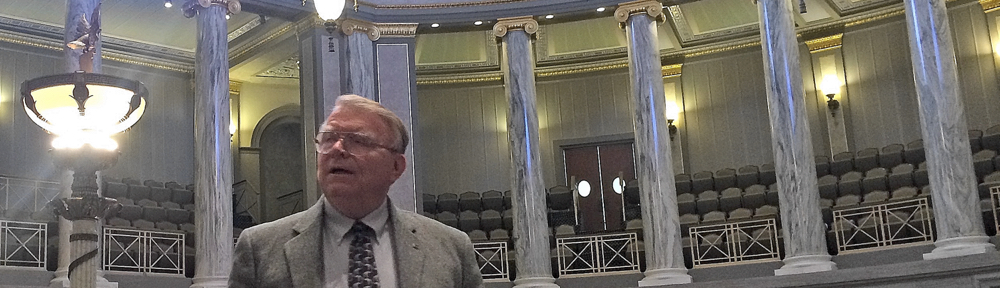
A fellow named Bill Powers of Martinsville, Indiana, was wearing what appeared to be a pith helmet.

Bill was one of the hundreds of people who don yellow shirts every year and volunteer to help hundreds of thousands of people find their way peacefully and safely at the Indianapolis Motor Speedway.  He’s been one of those volunteers for twenty-seven years.  His wife was another “yellow shirt” as we call them in another part of the track.  Twenty-seven years.  That’s probably pretty close to the average.  A lot of folks take a lot of pride in being part of the logistical force behind The Greatest Spectacle in Racing, year after year.

Bill was one of those checking the credentials of folks entering the pits or the garage area at the Speedway.

It was the pith helmet that stopped me as I headed to the garages from the pits on the last practice day before the race.  Not a real pith helmet. It’s a modern reproduction, painted yellow with Speedway insignia attached.  He told me that he and Eric Sample, who was working in the parking area, had them.  I hope they catch on.

A check with Speedway historian Donald Davidson confirmed the pith helmets were replaced with caps about 1966 or 1967.

Real pith helmets are made of pith, a material from an Indian swamp plant called the Sola. It also can be made of cork or other fibrous material. It’s light weight and is intended to shade the head and the face of the wearer from the sun. The first ones were worn by Spanish forces in the East Indies and then adapted by the French when they became involved in what was called Indochina (now Vietnam), where the weather is humid.  In time, it was seen, for good or ill, as symbolizing colonial rule as more and more European countries took control of areas of the Far East.  It became standard headgear for people living in tropical climates and is still worn by soldiers and civilians in Vietnam and is ceremonial dress for some military units in Britain, Canada, and Monaco. Some of our mail carriers still use them and some U. S. Marine instructors still use them.

They haven’t been at the Speedway in a long time. But maybe Eric and Bill have re-started something.  Frankly, this reporter thinks Bill looks pretty distinguished in his. Didn’t get a chance to talk to Eric.  Finding him would have been kind of a needle/haystack proposition.  The attendance on race day was estimated at about 300,000.

The Indianapolis 500 is called the single largest one-day sporting event in the world.

Think about the logistics of a Missouri Tiger football game when the team is really good and drawing 75,000 fans to Memorial Stadium in Columbia.  People are needed to direct fans to parking places, to collect money for tickets or parking fees, to run concession stands, to clean up spilled food and drink, to treat those overcome by heat, steep stairs, and booze, to usher people to the right seats—it goes on and on.

Now imagine a crowd four times that size on a 93-degree day, some of them there to just party, not to pay much attention to the amazing displays of skill that are happening on the track.  Imagine pre-game ceremonies that involve hundreds of marching band performers, thousands of fans on the track before the start-engines command is given, parades of vehicles with honored guests, singers, a military flyover—sometimes by a plane from our own Whiteman Air Force Base, and finally the start of the race.

You need a lot of people to herd a lot of folks in and out of various venues, numerous grandstand sections, restrooms, a big museum, food and drink concessions, souvenir stands, inspection stations where large coolers, backpacks and purses are checked—just getting through the “in” and “out” gates.

A large percentage of those helpful people are the volunteers in the yellow shirts like Bill Powers.  And they are unfailingly nice—at least we’ve never run into one who was anything but courteous and helpful (and firm when necessary).  I’m not sure I could keep my cool on a hot, congested day as these folks do year after year.

Go here, not there.  You’ll find what you’re looking for over there.  You’re not allowed beyond this point, sorry.  If you hear one blow a whistle, look around. Something might be coming—a tractor pulling a race car, a crew member with a stack of tires, an ambulance, a truck, maybe even a race car by itself—and they move pretty fast sometimes even when not on the track.  You are in the way and maybe in harm’s way if you don’t move.  Nothing personal, just be aware.

We’ve said it before. It’s too bad we don’t have people in yellow shirts like Bill keeping order at a disorderly time in our politics.  Somebody in a yellow shirt and a pith helmet could do a lot of good there.

(photo credits: Rick Gevers, Bob Priddy)

There used to be some courtesy—

It is hard to imagine that we will ever see something like this article that was in the Jackson Independent, published in Cape Girardeau County on January 5, 1828:

GOOD EXAMPLE TO ELECTORS

The following resolution was unanimously adopted at a meeting of the friends of General Jackson, held in Northumberland County, Kentucky—

Resolved, That we will through the contest for the Presidential Chair, disprove of any vulgar, harsh and unbecoming epithets, or language used, either in relation to our own candidate or the administration party, believing that such things tend to inflame the public mind unnecessarily, and have injurious effects upon the morals of our country.

—Where are those followers of Andy Jackson when we need them?

0000

Sport

We have reached the time of year when we face crises galore, when many people become passionate about trivial events, when one’s emotions are strained, where hard feelings are generated and superiority is established, when detailed analysis of events dominates much of the public discussion and arguments—even fisticuffs—are motivated by events that in reality have only passing impact on our daily lives.

It’s World Series time in baseball. College football fans are starting to evaluate the value of life on the basis of bowl eligibility.  Pro football fans bemoan the one misplay that dooms the home team or keeps a Super Bowl dream alive.  Pro basketball and hockey fans already are agonizing over or exulting about the puck or the ball that barely missed the net—or got into it at the last second.   College basketball fans soon will cheer the home team in its quest for the post-season or demonstrate their hate for a traditional rival.  In fact, Missouri has (be still my beating heart!) played Kansas in a basketball game!

This is the time of year when games don’t end when the clock or the innings or the quarters run out.  It’s a time when we forget these are only games that have their most meaning during the time they are played. The world will not be more peaceful and safe because they were played.  Homeless people will still live in boxes or in doorways.  Children will still starve and die in desperate circumstances.

We were reminded of those sentiments recently when we re-discovered one of our favorite sports books that puts all of this in perspective.   It’s Heywood Hale Broun’s Tumultuous Merriment, which came out in 1979, a memoir of the decade he spent as a “color commentator” for CBS Sports.  A better word probably is “essayist.”   He was, in our memory, the sports counterpart to Charles Kuralt, the other CBS correspondent on the road. He was the fellow with the great moustache and the colorful sport coat who always saw sports with more perceptive eyes that did not focus on the final outcome.

If you remember him and/or you have some qualms about the value of sports in general and big-time sport in particular, you might want to search out a copy of this book.

Broun began his book with a definition of “sport” from Samuel Johnson’s eighteen-century dictionary: Play; diversion; games; frolick and tumultuous merriment and then asks, “Who now, save an occasional small child, regards sport as diversion or as tumultuous merriment? How much frolick is there in the Ohio State-Michigan game, the modern Olympics, the Little League championship of a crossroads country town?”

He says it is “somber tosh” to explain play as a way to serve wish-fulfillment, or a way to work off hostility, or a way to burn off excess energy, or something that “builds character, creates a healthy moral climate, builds bonds of fellowship, and gives a chance to earn big money with the pros.”

Coaches, he wrote, dare not admit they are just teaching a diversion.  To avoid being paid like English professors, they must “pose as saviors of youth, muscular alchemists who can take the base metal of bad boys and produce golden lads, saints who can block and shoot baskets.”

“It is to our discredit that we swallow all this stuff,” he wrote.  And he had no patience with those who cited the Duke of Wellington’s contention that the Battle of Waterloo had been won  on the playing fields of Eton.  Better, he argued, to remember what the Duke said as he watched troops whose preparation for war had consisted of playing rugby and cricket: “I don’t know if they frighten Napoleon, but by God, they frighten me!”

Broun charges our games “ruthlessly” root fun out of our games “lest it soften our fiber.”  But he says fun need not disappear as the stakes increase and tension grows.  After all, he says, our games are not open heart surgery—where there is real tension and the stakes are really high.

“We are only grotesque when we apply the standards suitable to the gladiator to our Little League children,” he wrote. “It is unfair to make them the surrogates of our flab-shackled daydreams.”

He did not begrudge the high salaries paid to the professionals by the corporations that own their teams but he finds the talk of money turns the athlete and his agent into dullards and he wonders why he even cares whether they win or lose.   Broun said he could get the same kind of behavior at a sales convention.

“After all, one game is not really more important than another in the cosmic scheme of things,” he wrote. “But it’s wonderful fun to pretend and we all have expended a lot of pretense on the Super Bowls, the World Series, the Triple Crown and football games like Yale-Harvard, Oho State-Michigan, or Texas-Oklahoma.”

Broun notes that “small children, more than their elders, demand a structure of immutable rules in their games” regardless of where the games are played. The rules are made up to fit the circumstances, but the rules must be followed.  And that, he says, is why we are fascinated by games. “They are the only activities of life where the rules are, metaphorically or actually, written on the top of the box.”  Life, on the other hand, is a place where the rules quickly can change for a participant, which is why we find relief to “escape into the small, known, well-defined structure of a game.”

“We agree, for the time we play it at least, to its importance, and everything else is lost in the shadows behind the sidelines,” he wrote.  Cheating only thrusts the participant back into the uncertainty of the real world.  “If winning is overwhelmingly important, and is the only reason for playing, we must break the ‘rule’ if no one is looking, or bend it if someone is.”

Broun discovered a game that he thought represented the purity that “sport” in its truest form should be while covering a story at the D. D. Palmer College of Chiropracty in Davenport, Iowa: Rugby.  Perhaps, he reasoned, the game’s lack of the “war game precision” of football that left spectators unable to have strategic discussions about why a team won or lost, and who was responsible, is why rugby has never caught on here. “What rugby does provide,” he wrote, “is an immense amount of pleasure to its players…The air is always filled with fiercely happy cries as the packed scrum into which the ball is dropped dissolves into a thirty-man whirlpool.

“For all the talk of American coaches about team effort, it is possible in sports like football and baseball to put the blame for a loss on an individual, the man who struck out with the bases loaded, dropped a fly ball in the ninth, couldn’t hold a pass, missed a crucial kick. In true team sports like rugby this finger-pointing is a lot more difficult, which is why I found the players at Palmer, scab-nosed to a man, full of good cheer after bashing about on a cold and muddy day.”

He reminds us:

“The actual importance of the contest is immaterial to both spectators and players once the period of magic has begun.  The level of excitement is subconsciously chosen by those present and after a time exists beyond their control…All of us should play as if life and honor depended on it, and all of us should cheer as if it were Lucifer State versus Angel U. in the arena; but at game’s end all of us should recognize that paradise was neither won nor lost. None of us should emulate those middle-aged men who stare glumly into the bottom of a highball glass when they think of a shot that failed to drop in the last second of some long-ago basketball game…

“Let it not be said, although I’m afraid it will, that young men are preparing for a stern world where mistakes are not forgotten, and that they should have a stern preparation for that world.

Sport is a preparation for more sport and not a businessmen’s ROTC…You can’t tackle economics or block logistics.

“Boys and girls, men and women, can all be distorted by the philosophies that use games to grotesque ends…A coach is not a priest. Games are not life. There is no authority save the Rule, which all players have agreed on, and there is no fun like playing a game for the sake of a game.”

Broun died in 2001.  He was 83.

We’re not sure if his words are any more useful or meaningful in shaping the world of sport and the public’s attitude toward it today than they were in 1979.  Or even whether there is some wisdom in them for the game of politics.

But then again, “There is no authority save the Rule,” and we risk a lot when we decide on or off the playing field that The Rule is expendable.

(Photo credits: paulikreport.com)

Heywood Hale Broun, Tumultuous Merriment, New York, Richard Marek Publishers, 1979

A t-shirt, a tweet, and history

Seen at a truck stop in Effingham, Illinois:

A grey T-shirt with the pictures of former Illinois Governors Rod Blagojevich and George Ryan and the words, “Illinois, Where our Governors Make Our License Plates.”

For historical accuracy, future t-shirts might include Governors Otto Kerner, Jr. (mail fraud), and Dan Walker (bank fraud) among those whose careers took them from having license plate number one to a place where they wore a number stitched onto their clothes.  Walker capitalized on his name by walking the state during his 1971 gubernatorial campaign, inspiring Jackson County, Missouri, prosecutor Joseph P. Teasdale to become known as “Walking Joe Teasdale” during an unsuccessfully 1972 primary campaign for governor.  Teasdale didn’t walk as much during his successful 1976 campaign, but supporters wore lapel pins showing a shoe with a hole in the sole, an idea borrowed from a pin used by Adlai Stevenson in his 1952 Presidential campaign.  Stevenson was a Governor of Illinois who did NOT go to prison. Instead, he went to the United Nations as United States Ambassador during the Kennedy/Johnson administrations.  He is remembered for the dramatic moment when he unveiled aerial photographs of Russian missile installations in Cuba and directly asked Soviet Ambassador Valerian Zorin if the country was installing nuclear missiles there and proclaimed he would be waiting “until hell freezes over” to get an answer.

It was Stevenson who proposed the agreement that ended the Cuban Missile Crisis—our removal of Jupiter missiles from Turkey (they were obsolete anyway) if the Soviets took their missiles out of Cuba, a deal that did not become public for many years.  He knew that some of President Kennedy’s advisors would consider him a coward for making such a suggestion, but he commented, “Perhaps we need a coward in the room when we’re talking nuclear war.”

Wonder how many people who see those t-shirts ever think about all the real history behind the sardonic message on them and the resonance some of that history might have in today’s world.

We stopped for fuel in Effingham on our way back from watching the first Japanese driver win the Indianapolis 500.  By then, a Denver sportswriter had taken to Twitter to say he was uncomfortable with a Japanese driver winning the race on Memorial Day weekend because of the death of one of his father’s Army Air Corps colleagues in the Battle of Okinawa.  He later issued a public apology and noted his father had flown many missions including unarmed reconnaissance missions over Japan during World War II.  But the Denver Post has fired him.

We resist today writing of Twitter’s capacity to bring out the worst in us—and the best although your observer considers it generally to be “The Theatre of the Inane”—and others have written about the decency of Takuma Sato (who is celebrating at the “Kissing the Bricks” post-race ceremony at the start-finish line) who has spoken of his concern about a quarter-million people in his homeland who are still suffering from the earthquake and tsunami a few years ago.  Instead we refer you to an entry in the old Missourinet blog that we posted three years ago about a place 225 miles or so southeast of Denver that tells a different story from the unfortunate Denver tweets.

http://blog.missourinet.com/2014/09/30/summits-sewers-and-students/

History has many parts.  As we see in this year’s story of the Denver sportswriter and in the 2014 stories of high school students and a high plains historical site, there often are shadows over it.

There is danger lurking whenever any of us try to distill the past or the present into 140 characters.


Who has left the stadium

No, there’s no question mark.  It’s a statement, not an inquiry.

I became worried as baseball’s spring training neared its end and fairly concerned when opening day arrived.  So, finally, I asked a friend at Downtown Book plus Toy if they had seen it.   Nope.  They handle so many books and magazines they hadn’t missed it. But I sure did.  So they tried to order it for me.

It’s not going to come in.  Maybe it’ll never be back.

And baseball won’t be the same.

One of the signs that winter can’t last forever has been the appearance on the magazine rack of my local book store of the red-covered annual publication with baseball players on the front and the team picture of the World Series winner on the back.  Who’s Who in Baseball, a publication letting readers immerse themselves in the career statistics of just about all the guys who put on major league uniforms each year, has gone away.

The months of February, March, and early April had a big hole in them this year for people who love baseball.  During those last dark days of winter and through those first tantalizing days of early spring, baseball fans could immerse themselves in seeing who was close to a milestone.  Could somebody get to their 600th home run this year?   Or their 300th win as a pitcher?  Is there any pitcher close to 3,000 strikeouts?  In today’s home-run culture, how many guys have 300 or 400 stolen bases?  Who was traded for who in 1999?  What was the last year that aging pitcher had a winning record or a respectable ERA?  Who’s Who in Baseball was the annual hint that better days were coming even if you rooted for a team you knew was probably going to be one of the worst.  Now, apparently, it’s gone.  And at this house, baseball season is a little bit incomplete.

Maybe we should blame the Chicago Cubs.  Who’s Who in Baseball began four years after the Cubs won the World Series in 1908.  Could it be that the possibility of putting a picture of the Cubs on the back cover of the publication was just more than the publishers could bear?  Is publication death preferable to admitting the Cubs won the World Series?

Here’s what happened.

Last spring, about the time the 2016 season was starting, Harris Publications shut down. It’s official farewell statement talked about the struggles the magazine industry has had “in the face of the rapid ascendance of digital media, changing consumer content preferences, magazine wholesaler struggles and consolidation in the supply chain. We have tried mightily to persevere against these forces, but have been unable to overcome these challenges.”

Last July, the assets of Harris Publications, including rights to seventy-four titles, were acquired by Athlon Media Group. That doesn’t mean those titles will survive. A company spokesman didn’t hold out much hope for Who’s Who in Baseball or many of the other Harris titles after the acquisition by putting out this statement:

“We’ll continue to evolve our content from print centric platforms into over-the-top (OTT) media to gain knowledge and strength in visual platforms. Vertical titles, such as Harris Publications, are a perfect venue for this space.”

Yeah, whatever.

Fact is, we can go to the internet and look up all kinds of stats on any player past or present.  But there’s something about browsing through a print version of WWIB as some call it (we think it’s kind of sacrilegious) just to see what catches the eye.  “Browse” shows up on web pages sometimes but it’s just not the same with a tablet or a smartphone.  At least not to this writer’s generation.  But this writer’s generation is kind of like the dinosaurs after the big meteor hit, aren’t we?

The oldest edition in my collection includes a player whose career began in 1942.  It includes people such as Hoyt Wilhelm, Robin Roberts, Warren Spahn, Vic Davalillo, Mike Cuellar, Dick Hall, and Gaylord Perry.  Leafing through those old editions brings these guys back to life, back to a time when they were throwing smoke and spitters and dashing about the base paths and the outfields.  There’s something about looking at their stats when they were our heroes.

But it’s gone now.

February and March are going to seem a little colder from now on.

Missouri’s greatest racer

NASCAR took the Easter weekend off so let’s talk about Missouri’s greatest racer.

It’s always dangerous to crown someone as “the greatest who ever…,” especially someone who is not nationally-known.  But when nationally-famous people in the business say a person back home was the best there ever was, the credentials start to look pretty solid. Such is the case with Larry Phillips, “The roughest, toughest, meanest, craziest, and grouchiest son of a gun who ever climbed into a race car.”  

Former NASCAR Cup series crew chief James Ince also remembered Larry Phillips “as tough as they come (some would say dirty), smart and does everything at 100%.”

Fan voting has started for the NASCAR Hall of Fame induction class of 2018. Larry Phillips is on the list. Again.   Five people from the list of twenty finalists will be chosen May 24th by a Hall of Fame voting panel.

Fans can vote as many as FIFTY times a day for as many as five drivers.  The final choice will be made by a 54-member voting panel.  The top five people favored by fans will be considered the choice of an equivalent 55th panelist. The panel will meet on May 24th and the five new members of the Hall will be announced during the Memorial Day events at Charlotte Motor Speedway. The most ardent supporters of Larry Phillips probably would prefer voters cast fifty votes each day for Phillips and forget about voting for another four.  The vote for Phillips thus has a bigger impact.

It’s been sixteen years since Phillips drove the last race of a forty-year career, long enough for a new generation of fans to be unfamiliar with the name.  They might recognize the names of Ken Schrader, Rusty and Kenny Wallace, Mark Martin, and Jamie McMurray—all of whom cut their teeth on Missouri tracks.  But Larry Phillips?

Larry Philips taught those guys a lot about being racing drivers.  Two of them, Rusty Wallace and Mark Martin, are Hall of Famers now.  And they think Larry Phillips should be with them.

Phillips was from Springfield and nobody knows how many races he won.  Maybe as many as two-thousand says Ince.  He drove only one race in NASCAR’s top series, starting 24th and finishing 13th in the 1976 California 500.  Martin thinks he could have done well at that level; Ince agrees but told RacinToday.com’s Jim Pedley that Phillips wouldn’t put up with the Cup Series’ B.S.

He started racing about 1960 and ran hundreds of races, mostly at short tracks in Missouri, Arkansas, Oklahoma, and Kansas.  Even he didn’t know how many races he ran or won.  He told the Springfield Leader & Press in 1982, “I’ll race anytime, anywhere.”

In a 1975 race at Fort Smith, Arkansas, he rear-ended another car and both cars caught fire, leaving him with burns on seventy-percent of his body.  Doctors didn’t think he’d race for two years, if ever.  He was winning again a year later.

Phillips said a combination of things made him the winner he was, telling the newspaper, “Phillips the driver and Phillips the car builder both play important parts. Anybody can drive a car like I have and do well. But being able to adjust the racer to the track conditions whether it be tires, weight, adjustment of the chassis, whatever, that is where Phillips the builder is a big factor.”

Phillips dominated what is now the Whelen All-American Series, racing at NASCAR-sanctioned short-tracks in cars he built and maintained, often against drivers in other cars he had built.  He’s the only person to win the All-American Series national championship five times.  He won five regional championships and thirteen track titles (six at Bolivar Speedway, five at Lebanon I-44 Speedway, and two more at Kansas City’s Lakeside Speedway).

And here’s something that might raise an eyebrow or two:  He did not win his first national championship until 1989 when he was 47.  He became the first driver to win back-to-back championships in 1991-92 and duplicated that performance in 1995-96.

One of his local championships was at Lebanon in ’94.  He was interviewed after winning the title: https://www.youtube.com/watch?v=tE8mTlxRnfE

Right at the beginning of that clip, you might notice Phillips drop a cigarette.  He had a lighter in his car so he could smoke during caution laps.

In 1992, the fifty-year old Phillips won thirty-two of forty races, beating 22-year old Greg Biffle for the national title.   In his thirteen seasons in the series, Phillips won 226 of the 308 feature races he ran.  He finished in the top five in thirty-seven races he didn’t win.  In thirteen years competing in that series, he was outside the top ten only thirty-three times.

Those who knew him well say he cared about racing and winning, plain and simple.  Money?  Trophies?  Fame?  Phillips looked at his trophies as clutter.  He told Ince he hauled them off to a dump one day.  It’s not known how many trophies there were but Ince remembered they filled half a forty-foot trailer “floor to ceiling.”  Ince says Phillips was interested in checks, not trophies.

Mark Martin was just a kid from Batesville, Arkansas when he went to work in Phillips’ shop in Springfield.   On weekends they would race each other.

“Anybody who raced against him will remember him,” Martin (right) told Pedley. “He was unique. He was fast, won lots of races and beat a lot of people with slower cars…Larry would try every trick in the books.”  And Rusty Wallace called him “the best driver I’ve ever seen.”   He was first nominated to the NASCAR Hall of Fame in 2014.  But the guys who ran in the big-time are the ones who get most of the attention at voting time.

Jamie McMurray’s first year running late models was 1997.  He told a Springfield News-Leader reporter a couple of years ago, “I had watched him for those years that I ran my modified and he won every single night, it seemed like.”


McMurray won the track championship at Lebanon in 1997.  Larry Phillips was second. Just five years later he was running in NASCAR’s top series where he won his second time out.  In 2010, he won the Daytona 500.  But by then, Larry Phillips was gone.

Phillips was diagnosed with lung cancer in May, 2000 and began chemotherapy a month later—and still went out weekend after weekend and won races.  He ran his last race in April, 2001 in Lebanon and led for a good part of it.  But his cancer treatments had sapped his endurance and he finished second.  Finishing second was not what Larry Phillips was about.  He took the car, went home, and never raced again.  He died September 21, 2004.

He has some stiff competition in the voting from a lot of nationally-recognized names.  But a lot of folks who saw him race or raced against him think he could have whipped ‘em all at Lebanon. Or Bolivar. Or just about anywhere.

If you have the time and inclination to vote fifty times a day for Missouri’s greatest racer, you can do it at: http://www.nascarhall.com/inductees/fan-vote.

(Photo credits: hometracks.nascar.com; missourilegends.com; Midwest racing archive; racintoday.com)

(This entry also was posted on The Missourinet sports page)

Notes from a quiet street  2017-I

(Miscellaneous musings of more than 140 characters, usually, but not enough words to be fully blogicious.)

We found ourselves wandering through an otherwise unoccupied mind one recent day when ice or the threat of ice was limiting more fruitful occupations or ambitions.

An observation after two years of retirement:  If you put on slippers instead of shoes when you get dressed in the morning, the chances are above average that you will not step outside your house more than three times during the day and you will stay outside no more than two minutes each time.  One of the trips will be to get the morning paper. Another will be to get the mail.

We are reminded of the closing lines of the movie “Patton,” a quote from the general read by George C. Scott:  “For over a thousand years Roman conquerors returning from the wars enjoyed the honor of triumph, a tumultuous parade. In the procession came trumpeteers, musicians and strange animals from conquered territories, together with carts laden with treasure and captured armaments. The conquerors rode in a triumphal chariot, the dazed prisoners walking in chains before him. Sometimes his children robed in white stood with him in the chariot or rode the trace horses. A slave stood behind the conqueror holding a golden crown and whispering in his ear a warning: that all glory is fleeting.”

NASCAR sent us a note the other day that now is the time to load up on 2017 driver merchandise—everything from baby clothes to pull-along coolers with your favorite driver’s colors and numbers.  We thought it would be interesting to look at Carl Edwards’ stuff, which went from merchandise to memorabilia pretty fast.  Hats and t-shirts are about ten to twenty dollars off.  Jackets are forty dollars off.  And so it went with other items that became examples of the truth of Patton’s remark that “all glory is fleeting.”  Superstar today, clearance table tomorrow.  Such is life.

We were headed to Nevada, in southwest Missouri, a few weeks ago to deliver a couple of copies of our Capitol art book to Cavender’s Book Store when we came upon a large crowd of black birds somewhere near Preston clearing the road of remnants of an unfortunate creature, bite by bite.  As we neared them, the birds all took frantic flight—except for one, a much bigger bird that seemed to just spread its wings and gracefully elevate. As he lifted off, I spotted the large fan of white tail feathers and then a white head.  I swear he looked back over his shoulder, perhaps to see if my car did any damage to his snack. It’s kind of a gruesome story, I suppose.  But I’ll remember the Eagle I saw a few days before Christmas long after I’ve forgotten the rest of the long trip on a chilly, rainy, December day or even Christmas itself.

Our state has a new chemistry set in an old box.  About one-fourth of the members of the Missouri House are brand new.  The governor, as we have noted several times, is fresh to the world of political office-holding.  Five of our six top state officeholders are new to those offices.  The chemistry in our Capitol is entirely different.  It’s going to be interesting to see how the elements mix.

More than a dozen years ago, someone suggested the Missourinet start using Twitter.  The example of Twitter that was given to us was a series of twits, tweets, toots—whatever they are (perhaps depending on the sender)—from a former colleague who was telling the world he was at an airport, then that he was waiting to board his plane, then that he was in his seat, then that he was waiting to take off.  We all thought Twitter was silly and superficial, an attitude borne out a few weeks later when another friend send a message that she was on her way home from work but had to stop at a store to get a sump pump.  Your observer started calling Twitter, “The Theatre of the Inane.”

Well——?

—-

We are reminded by all the discussion about punitive tariffs on American-company vehicles made in and imported from other countries of a talk we had a long time ago with Kenneth Rothman, a two-term Speaker of the House who was Missouri’s first Jewish statewide elected official, Lieutenant Governor, 1981-1985.  He bought a little farm near Jefferson City during those years and wanted to get a little American-made pickup truck to use out there.  But he learned Ford’s compact pickup was made by Mazda; Chevrolet’s little truck was made by Isuzu, and Dodge’s compact truck was made by Mitsubishi.  He finally found an American-made small pickup truck that was manufactured in Westmoreland, Pennsylvania.  A Volkswagen.

We have friends who flee to Arizona and Florida during these months. We pity them for the loss of their sense of adventure.

121 characters.  Including spaces.


The senator, the judge, the Boss, and the Quail

Time is running short this year for people who like to kill one of our state symbols.  The 2016-17 quail season ends soon—January 15, Sunday.  The legislature declared the Bobwhite Quail our official state game bird in 2007.  We watched the debates that resulted from a project to teach elementary school students how the legislature works by getting the legislature to establish a new state symbol.  But none of the debaters mentioned the greatest tribute ever paid on the Senate floor to the quail.

The speech also has some historical threads that involve one of the unique gubernatorial elections in state history, a scandal, and creation of an important state agency.  When you’ve finished reading the tribute to the quail we’ll tell you the additional history that goes with it.

State Senator Francis M. Wilson, an avid quail hunter from Platte County, stood in the Senate March 7, 1911 to support his bill preventing the killing of quail until December, 1914 because the bird numbers had dropped so much.  He argued that the prairie chicken and the wild turkey had almost been exterminated in Missouri and quail were on the verge.  He said the state game and fish warden was trying to stock the state with Hungarian Partridges, which look like quail.  He said those birds plus the rapid multiplication of protected quail would be a service to farmers and would become numerous enough to allow quail hunting to resume. Observers said he convinced a previously hostile senate to pass the bill. His colleagues were so impressed that Wilson was asked to reduce his remarks to writing so they could be printed in the Senate Journal.  He spoke off the cuff but wrote down his recollections of what he said. If you’re an avid quail hunter, you might find this century-old tribute to the official state game bird of some interest. If you’re not, we invite you to look at an example of what was then called “spread-eagle oratory.”  Yes, we note the juxtaposition of eagle and quail.

The quail is among the most ancient of game birds. In some form, differing in habits and appearance, either gay with the plumage of sunny climes, or grave with the subdued colors of cheerless landscapes, it has been found throughout the world.

If we search for its origin it is obscured in the mists of antiquity. The Bible tells us of the Almighty furnishing this toothsome bird to nourish and strengthen the Israelites during their wanderings in the wilderness. In all ages it has given the historian his brightest glimpse of bird life, and the poet inspiration for his sweetest song. The name given this royal bird differs with the locality and folk-lore of the people, but throughout the eastern states, from the pineries of Maine to the flowery fields of Florida and westward to the foothills of the mountains, it is known as “Bob White”—the true name adopted by all ornithologists. And so it is for the protection and preservation of this messenger of civilization, proud aristocrat of farm and field and orchard that I press this measure upon the Senate. Senators from favored sections of the State, where these birds are fairly plentiful, argue that to enact such a law would be unjust to their constituents. In this I find no comfort for them, but on the contrary one of the strongest arguments favoring the passage of the bill. History repeats itself. Within the memory of many of my distinguished colleagues, the princely domain which I represent was indeed a “hunters’ paradise.” Deer broke covert from every brake; wild pigeons clouded the sun as vast flocks passed from feeding to roosting places; wild turkeys in almost countless numbers were everywhere; prairie chickens abode with us in contentment; wild geese—harbingers of coming fall and spring—covered the sandbars of our rivers, or on mighty wing rushed through the air, but,

“There is a Power whose care Teaches thy way along that pathless coast, The desert and illimitable air, Lone wandering, but not lost.”


But how sad the change. How sorrowful the retrospect. In secluded places, scattered far and wide over a limited section of our State, the deer are making their last gallant stand; wild pigeons live only in the glorious traditions of our great Commonwealth; the prairie chicken is now rara avis, and the wild goose calls in alarm his scattered few, as high above its would-be murderers, they cleave the blue of kindly skies as they hasten to the few asylums in the far away Southland, or in the frozen regions of the north. It has been given to me to witness the almost incredible destruction of this valuable game—not at the hands of true sportsmen, for they have long waged unequal battle to stay the wholesale and inexcusable slaughter—but to satisfy the inordinate greed of the “game hog,” and his foster brother, the “pot-hunter,” who slew and still slay merely that they may boast of their prowess with the gun, and to furnish a precarious living for the market hunter who stains himself with the butchery of these gentle creatures our Creator gave as a blessing. Senators, what is true of my section of the State will be in a few years the sad story you will have to tell of man’s inhumanity to game life. It will then be everlastingly too late to repine. “The moving finger writes; and having writ, moves on; nor all your piety, nor wit shall lure it back to cancel half a line, nor all your tears wash out a word of it.”

What a splendid fight Bob White is making against the combined hosts of his enemies, and what a fine battle the farmers of my district are waging to save him from extinction. None know better than the farmer and the orchardist the incalculable benefit he is to field, garden and orchard. From “early morn ’till dewy eve,” bright of eye and swift of leg, the Bob Whites are busy with the destruction of noxious insects and weed pests. He is not regarded as a trespasser, but is entertained as a royal guest, whose stay we would have indefinitely prolonged. True, it has taken science a long time to discover what our agriculturists have always known about the value of this bird as his chief assistant among the feathered tribe, but it is now proclaiming its manifold virtues.

It is officially recorded that examination of many hundreds of the stomachs and crops of these birds disclose them crowded with the seeds of noxious and troublesome weeds, his diet for almost half the year. Upon this a Government report, says: “It is reasonable to suppose that in the states of Virginia and North Carolina from September 1 to April 30, there are four Bob Whites to each square mile of land, or 354,820 in the two states. The crop of each bird is filled twice a day and holds half an ounce of seed. Since at each of the two daily meals, weed seeds constitute at least half the contents of the crop, or one-fourth of an ounce, a half ounce daily is consumed by each bird. On this basis, the total amount of weed seeds consumed by Bob Whites from September 1 to April 30, in Virginia and North Carolina alone amounts to 1,341 tons.” May I inquire what the harvest of weeds would have been had each of these seeds produced? Does not this plead trumpet-tongued in his defense? But this is not all science teaches of the aid this bird is giving- those who toil that we may live. Where insects abound, Bob White plays no favorites in his labors of extermination. Alike he wars upon the chinch bug, the grasshopper, the potato bug, the cotton-boll-weevil, the codling moth and other devastating bugs of forest, field and orchard. In a letter to the Department of Agriculture, touching the voracious appetite of this bird for such pests, a gentleman from Kansas writes: “On opening the crop, we found about two tablespoonfuls of chinch bugs,” and when a further consultation of authorities disclose that this bug has cost the farmers at least 100 millions of dollars per year, you may well stand aghast at the formidable array of facts and figures—which admit of no dispute—that Bob White, above all his feather brothers, is entitled to the proud name of the Farmer’s Friend.

It is not alone as an assistant that this bird is so firmly fixed in the affections of the farmer. Incense to its many other virtues rise from countless happy homes all over the land. Rich in sentiment, with ear atune to nature’s symphonies, the farmer revels in the music Bob White contributes to the melody of the Almighty’s musicians. No bright tinted troubadour of the air, flashing here and there like a thing of light, his gorgeous breast almost bursting with rich excess of song, charms him from the seductive call of his best-loved bird friend. Spring has Come. Here and there the brown patches of earth again become the nursery of tender grasses and modest flowers, and all nature is yielding to the annual miracle which heals the scars on winter’s grave with the sweet assurance that we too shall live again. From afar, soft as the mellow tones of a flute, its sharp, staccato whistle, changed by the witchery of the season into the coy notes of love’s first story, comes Bob White! Ah! Bob White. Again the music of his soul changes. The shy wooer of the demure little lady nearby, becomes bold as a knight errant, and as his ardor and jealousy keep pace, from stump, or rail or broken thicket branch or wherever her eyes, kindling with the fires of coming allegiance will fall upon his knightly bearing, or ears hear his ardent protestations, again the call, but now the ringing challenge of the mail-clad warrior ready to do battle in the lists for his lady love. The theater of his song changes again with the coming of June, life’s time of thrift. The earth riots in the blazonry of bloom. The covenants of spring have been redeemed and summer sings of the fatness of field and vine in the coming autumn. While the dew is yet wet on the green of the leaves and gold of the flowers, Bob White banishes sleep with his insistent call, Wheat’s ripe! Wheat’s ripe! His faithful mate is not far. In some neglected spot, where security is found, she is busy with the duties of maternity and again his chuckling notes, All’s well! All’s well! as from “The orchard, the meadow, the deep tangled wild-wood” he gives full throated utterance of his ecstatic joy. What is more charming to the ear than the music of the quail, wafted from wheat shocks as the rays of the rising sun turn from orange to gold the “beauty of the valleys and the glory of the hills?” It surpasses the ripple of the brook, which poets say is nature’s grandest melody. The tenderest memories of my boyhood days are linked with hazy summer, when the air was freighted with the perfume of flowers, fruits and berries and the cheery whistle of Bob White rang through the old orchard. Through the years come hymns of happy reapers, singing in seas of shimmering grain, the sound of bells, tinkling the way of homeward plodding herds, the voices of harvest toilers chanting the dirge of dying day and mingling with it all Bob White’s musical farewell as failing light slips down the cloud-isles of the sunset.

“Dies the day, and from afar away, Under the evening stars, Dies the echo as dies the day, Droops with the dew in the new-mown hay, Sinks and sleeps in the scent of the May, Dreamily, faint and far.”

Mr. President! I am a devotee of the rod and gun, and from the standpoint of a true sportsman—which I claim to be—my pulse always beats quick when I behold that seed time has passed, and the fruitage of the earth has come to its own. “Magnificent Autumn! He comes not like a pilgrim clad in russet weed; he comes not like a hermit clad in gray; but he come like a warrior with the stain of blood upon his brazen mail. His crimson scarf is rent His scarlet banner drips with gore.” The call “Bob White” is silent, but from stubble, pasture, tangled copse and corn fields, standing rank on rank like Huzzars in their uniforms of gold and silver, we hear his peculiar covey call. It falls upon the impatient ear of the sportsman with unmeasured delight. Tired of the grind of the busy mill of business, the weary sentinels of his brain give warning that it is only the wine of nature which quickens the sluggish blood, brings new light to careworn eyes, and paints the pallid cheek with the ruddy glow of health. As he fills his pockets with shells, his faithful dog leaps about him, eager to match his gift of nose with the cunning of this winsome bird. The east is crimsoning with the coming of a perfect day. The Frost King has scattered his jewels with lavish hand, and from bough and twig and stiffened blade of grass, like diamonds in the corona of Queens, they glow and flash with many colored fires as they herald the growing glory of the sun. Bob White is ready for gun and dog in the perfection of limb and wing, feeling assured that if these fail his mimicry of plumage with his surroundings may defeat the “tainted gale” as pointer or setter ranges far and wide o’er the scented heather in its search. But not so. There is a stiffening of the muscles; like an exquisitely carved statue, the dog “stands.” There is a whirr of wings and the air is full of smoke. Again the quest is taken up, and so through the hours of the too short day, over hill and plain—with few birds perhaps—but with renewed health and strength, the weary hunter turns homeward. The day is done. Lights appear as he draws near home. Loved ones run to meet him at the gate, their faces shining with expectant hope as they inquire, How are you! What luck! As he turns to enter man’s only asylum of perfect rest, there comes faintly the covey call again, as

“Shrill and shy from the dusk they cry, Faintly from over the hill; Out of the gray where shadows lie, Out of the gold where sheaves are high, Covey to covey, call and reply, Plaintively, shy and shrill.”

After this speech, which some felt equal to George Graham Vest’s “Eulogy on a Dog,” the Senate passed the bill but the House defeated it, assuring an uncertain future for the quail.

Now, here’s more of the story.

Francis M. Wilson, the son of a congressman, and known in his time as the Red-Headed Peckerwood from Platte County, was elected to the state senate in 1899 to fill a vacancy.  He lost a race for Congress in 1904 but was elected back to the state senate in 1908 and was re-elected twice.  He resigned from the senate to become the federal prosecuting attorney for the western district of Missouri, a position he held until 1920.  He lost the Democratic nomination for governor in 1928 but with the strong support of Kansas City political boss Tom Pendergast, won his primary in 1932 and seemed to be a lock to become governor. Truman biographer David McCullough calls him “a freckled, old-fashioned Missouri stump speaker who excelled at charming country crowds with his poetic tributes to the natural splendors of their beloved state.” He had suffered from bleeding ulcers for some time and one morning about three weeks before the election, he complained of feeling poorly and died a short time later. McCullough says that when someone suggested an undertaker be called, Mrs. Wilson refused to allow it until Pendergast was notified. When Pendergast arrived, he immediately asked the family if they favored someone to replace Wilson on the ticket.  Guy B. Park, they said.  “Who the hell is Guy Park?” asked Pendergast—in McCullough’s telling of the story.  Four hours later, Pendergast called back and said it was okay to call a mortician.  Guy B. Park had agreed to run. He was elected by a large margin and remained such a Pendergast ally that the Executive Mansion sometimes was called “Uncle Tom’s Cabin.”

Park appointed a new state Game and Fish Commissioner, Wilbur Buford, who noted at the end of his first year that there had been a complete turnover of employees, all patronage hires, a situation that was of increasing concern for Missouri outdoorsmen.  Their concerns led to the formation of the Conservation Federation of Missouri, which promptly began circulating petitions to establish a state conservation department isolated from political patronage. Voters approved the plan in Park’s last year in office, a quarter-century after Wilson’s tribute, the same year they elected Lloyd C. Stark as the new governor.

Stark also had Pendergast support but turned on the Boss and started helping the federal prosecutors build a case against him and the state insurance superintendent who had conspired in a massive fraud case. Stark had another motive—to weaken Pendergast support for Senator Harry Truman because Stark wanted to run against Truman in 1940. In the summer of 1937, Stark appointed the first four conservation commissioners: Buford, Columbia businessman E. Sidney Stephens, State Planning Commission member Albert Greensfelder of St. Louis, and Missouri Ruralist editor John F. Case.  Stephens, who father had headed the commission that supervised construction of the Capitol, became the first chairman of the new commission.

And with that, the quail that Francis M. Wilson so loved gained the guardian they needed and an agency that makes sure there can be quail seasons in Missouri.

Grace

In a year that will not be remembered for its examples of grace, especially public grace, the sports world provided one at a time when anger and giant disappointment could have produced an example of ugliness.

Columbia racing driver Carl Edwards showed us a prime example of grace in this graceless year. For those who do not follow automobile racing as we do, here’s some background. .

Carl has been competing at NASCAR’s highest level for a dozen years.  He has finished second twice in the championship standings.  He is one of four extremely talented drivers who compete at this level for Joe Gibbs, the former NFL coach whose teams won three Super Bowls.

NASCAR determines is champion each year by taking the top sixteen drivers in points after the first twenty-six races and putting them through a series of elimination rounds until four drivers remain in the last race of the season to compete for the championship.  Carl Edwards made it to the final four by winning a race in the semifinal round at a time when he was on the verge of elimination because an earlier crash had left him far out of contention.

One of his competitors in the last race was teammate Kyle Busch, who had won the championship in a miracle season last year after missing the first eleven races with injuries.  Another competitor was Jimmie Johnson, who was hoping to win the championship for a record-tying seventh time.   The other competitor was Joey Logano, a young driver who has matured and succeeded driving for Roger Penske, one of the biggest names in motorsports competition.  Now, let’s set the scene:

The championship is within Carl’s grasp with just ten laps left after the racers have been slowed under a caution flag caused by an incident with another car.  He is on the inside of the front row, a prime place to reassert his leadership when the green flag is waved to go racing again.   If he can get a good jump, he’ll be running in clean air—a critical factor in cars designed to take advantage of aerodynamics—and headed for that elusive title.

Logano knows he has one shot at getting past him on that restart.  He dives low going into the first turn. Very low.  Carl knows his only hope is to drop low in the track to block Logano.   The front of Logano’s car touches the rear bumper of Edwards’ car, sending Edwards into the inside wall, then bouncing back across the track through traffic where he is hit from behind with such force by another driver that his car goes up on the other car’s hood before spinning off into the outside wall.  All hope of the championship is gone after what he called “the race of my life up to then.”

Few of us ever know the pressures of competing for anything at this level. And the intensity of “this level” is hard for any of us to imagine.  There are no halftimes, no timeouts, no free throws where you can catch your breath.  There are no shift changes as in hockey.  There are no innings that are split into two parts.  This is three or four hours in a fire-protective suit, sitting in a metal oven at temperatures of one-hundred-thirty degrees, travelling at frightening speeds (to you and me) surrounded by thirty-nine other people seeking the same thing you are seeking. And you are doing it at three times the speed limit with no rumble stripes to remind you that you have one of your wheels an inch from where it should be.

You are so close to being the very best in this sport that you can touch it.  And then in two seconds you are sitting in your stopped, wadded-up, smoking car knowing that everything you have worked for during the last nine months is now impossible.  One of your competitors has wrecked your car and your hopes.

NASCAR requires drivers whose cars crash out of a race to go to an infield care hospital to be checked for injuries, including concussions.  Track workers escort the driver from the wreckage of their car to an ambulance which whisks them away.  But that didn’t happen with Carl Edwards, who watched a replay of the crash on a big video screen that tracks have, and then walked with his NASCAR escort through the pits to Joey Logano’s pit.

That is not normally a good sign.  Angry words are often exchanged or shouted.  We’ve seen punches thrown.

Carl Edwards climbed to the top of a stand where Logano’s crew chief and others were sitting.  And he told them the crash was entirely his fault, that he wished Logano well, and shook hands with the guys on Logano’s pit box. “That’s just racing,” he told them. “Good luck to you guys.”

In an interview after getting checked at the infield hospital, he said, “I pushed the issue as far as I could because I figured that was the race there…I couldn’t go to bed tonight and think that I gave him that lane.” Logano finished second in the race behind Johnson, who dodged the crash and led the last two laps for become champion for the seventh time.

“We were racing for the championship and that’s the race,” said Logano afterwards.  And he echoed Carl Edwards, “That’s just racing.”

After the roar of the race, after the take-no-prisoners competition for their sport’s highest honor the neither achieved—

there was grace,

a reminder in this graceless time that the quality still is within us.  And it is not demeaning to show it.

Notes from a Quiet Street—VI

—being another chapter of ruminations on things not worth full blogifying.

—-

Good Lord!!! When is Chris Koster going to quit telling us the Farm Bureau has done the unthinkable and has endorsed a Democrat and when is Eric Greitens going to stop talking about being God’s gift to veterans and start talking about the rest of us?   Or do candidates no longer feel any obligation to tell us how they’re going to work with the legislature to rebuild our infrastructure, keep college kids from accumulating debts they’ll carry into middle age, take care of our mentally ill, and see that we are safe from one another?

—–

That’s a key, you know.  The major national candidates seem to be running for dictator, not president. They’re all about what THEY are going to do, as if there is no congress that will be involved. Do we expect much more from our candidates for governor?

——

And how many of the candidates who are blaming today’s woes on “career politicians” will admit that they want to be “career politicians?”   We haven’t heard one of them say they only want to serve two years (or four) and then rejoin the masses.

—-

Your obedient servant has been reading again.  The new book is Donald F. Kettl’s Escaping Jurassic Government: How to Recover America’s Lost Commitment to Competence.   He believes it is possible.

Kettl is a former dean of the University of Maryland’s Public Policy School and is a fellow of the Brookings Institution, named for Missourian Robert S. Brookings.  It’s considered pretty even-handed. The Quarterly Journal of Economics, after analyzing a decade of Congressional records, found Conservatives quoted its findings about as often as Liberals.

It’s a pretty interesting read for government groupies.  We’ll be talking more about it later, no doubt. Feel free to read ahead of us.

—–

This might be a good place to list from time to time how Missouri stacks up with other states in various programs.  Our first entries:  49th in support of public defenders, says the public defender office.  The Brookings Institution in August listed us the nation’s sixth best state for advanced manufacturing job growth and 9th for output growth in that category.  A new audit says Missouri has had the lowest public university tuition increases in the last eight years (for which Governor Nixon delivers a big pat on the back to himself—although supplemental and degree fees have gone up 112% to make up for that accomplishment).  But the state ranks 39th in state appropriations to higher education per student, 43rd in state funding per $1,000 personal income.  Governor Nixon says our unemployment benefits rank 43rd out of all fifty states. We had some other rankings in an earlier post: https://bobpriddy.net/2016/08/02/missouri-nothing-special/

—-

Did you know that the University of Missouri football team has won a national award?   This graduate of the school did not.  It wasn’t in the latest alumni magazine.  No press release about it has come to our email.

It’s not like the recognition came from some obscure special-interest group. Nope. This one came from ESPN.  And we wouldn’t have known about it if fellow UMC graduate Ray Hartmann hadn’t written about it.

https://www.stlmag.com/news/think-again/mizzou-football-players-racial-protest/

Thanks, Ray.

—-

Went to a class reunion recently in Illinois and listened to classmates talk about the disastrous state of Illinois government that they say is largely controlled by Speaker of the House Michael Madigan of Chicago, who has been the Speaker for 32 of the last 34 years. If you’ve paid attention to the news, you know that Illinois government is far messier than Missouri government (at least we don’t put our governors in prison).  These folks think term limits is the only way to get rid of political bosses like Madigan.  We told them term limits is the last thing Illinois should do to itself—that it’s been the worst thing to happen to Missouri government since post-Civil War loyalty oaths.  Madigan is 74 but my friends in Illinois worry that he’s immortal.

Their county’s state representative is seeking his fourth term this year. His predecessor served six terms before being elected to the state senate. Giving up the right to re-elect your own state representative or senator to get rid of one representative from another district is, as we unfortunately have seen in Missouri, a foolish thing to do.

—-

The highway signs on the way back told us to drive in the right lane unless we were passing.  But, doggone it, the passing lane is always so much smoother.

Could Missourians at least approve enough of a gas tax increase to fix the driving lanes?

—-

We have tried—and have failed—to recall a single candidate for significant office in Missouri or elsewhere who blamed himself or herself for their loss.  It’s always somebody else’s fault—the media, unfair statements from an opponent (ignoring their own unfair statements about that opponent), a “rigged” election system even after the loser had to win a primary under the same system to become a general election loser.  We’ve never heard any losers admit, “The people didn’t buy my stuff.”

Donald Trump already is putting together his list of excuses.  He’s already saying the election will be “rigged” if he loses. And, of course, the blasted media for reporting what he says.  Interesting, isn’t it, that the system that let him brag about how many primaries he won and how many votes he got wasn’t “rigged” then?

We haven’t heard who might be on Hillary Clinton’s list if she loses.  The press, of course, would probably be there. We suppose the vast right-wing conspiracy would be on it, too.

I’ve got news for these folks.  We in the news media don’t mind getting blamed.  In fact, the last thing most real reporters want is to hear a candidate crediting them for an election victory.

—-

The Russian Olympic doping scandal and the banning of most Russian athletes and the NCAA’s investigation of the University of Missouri basketball program appear to have something in common.

Today’s athletes and coaches get punished for the sins of their predecessors.  That strikes us unfair.

We’re not sure how this could be done legally, but wouldn’t it be better for the NCAA to develop a way to fine an offending coach an amount (plus a penalty) equal to the amount of the scholarships the offending players received during the coach’s tenure and maybe require the offending players to refund to the University the amount they received for their scholarships?.  Or something like that.  Making the players refund their scholarship money might be a little draconian, though.  We’re not sure if they should know better when they’re 17 or 18.

And maybe an athletic director should get slapped around a little bit, too.