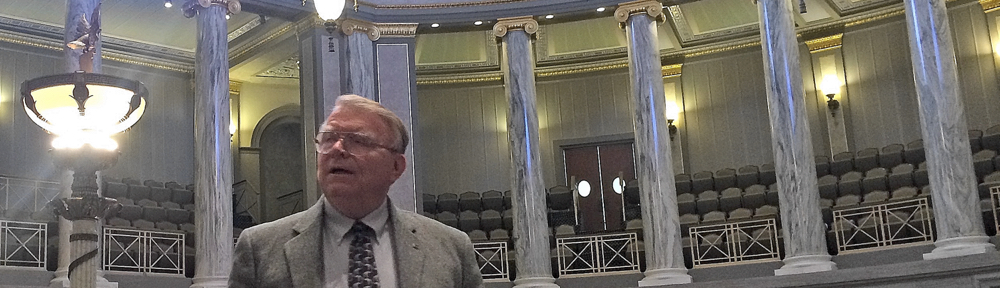
Michael Collins

He was the first person who could see where every human in the universe was.

Michael Collins was the Command Module Pilot on the Apollo XI mission that put the first two men on the moon.  For twenty-one hours he was alone in the CMP, Columbia, while Neil Armstrong and Buzz Armstrong “were doing their small stepping and giant leaping” on the Moon, as he put it a year later in Jefferson City.  He had watched them leave in the Eagle landing module headed for the surface.  He could look out a window and see the Earth, the only other place with humans.

No man had ever been in such a lonely position as he was in July, 1969. For part of those 21 hours, he was behind the Moon, completely alone with no communications either with earth or with the two men on the surface.

Michael Collins died yesterday. He was 90.  Only one man remains alive who shared that experience: Ken Mattingly, now 85, who was the Command Module Pilot on Apollo 16.

Only four of the moonwalkers are still with us: Buzz Aldrin, 91; Dave Scott, 88; and Charlie Duke and Harrison Schmidt, both 85.  Six men who flew to the Moon but did not land are still among us—Mattingly, Tom Stafford, 90; Fred Haise, 87; and all three members of the Apollo 8 crew—Frank Borman and Jim Lovell, both 93, and Bill Anders, who is 87.

We remember Michael Collins for the day we sat about twenty feet from him (and the other two astronauts) at the Capitol on the first anniversary of the Moon landing.  NASA had put the Columbia capsule on a big truck and sent it on a tour of state capitols.  It happened to be in Jefferson City that day.  And the radio station I as working for decided to broadcast the events at the capitol.

One of my most cherished possessions is a photograph showing me at the station table with the three astronauts in the foreground. As I recall it, Governor Hearnes’ press secretary, Jerry Bryan, sent the picture to NASA and the three guys signed it.

All three had remarks that day but I thought Collins’ comments were the most meaningful—and prophetic.

“I was born in 1930 and with luck I expect to see out the end of this century.  And when I am thinking about it in 1999, I expect to remember the 1970s as a time when oddly enough, man was hesitant about pushing his frontiers back. And in 1999 we just simply won’t be able to understand that fact because by then it will have become clearly apparent that man does in fact have the capability to step out and explore his solar system and that is something we definitely should do.”

When Collins made those remarks, Apollo XII already had successfully landed on the moon the previous November. But Apollo XIII had become the program’s most famous failure in April.  The Apollo program was in suspension while the investigation of that flight went on and there would not be another Moon landing until January of ’71, with Apollo XIV.

More ominous, however, had been the announcement in January of 1970 that the twentieth mission had been cancelled. There already had been a decline in public interest in the program, despite the drama of XIII, by the time Michael Collins spoke in Jefferson City.  “Been there, done that,” in the short attention span public mind.

About two months after the astronauts were in Jefferson City, NASA cancelled flights 15-19 and then restructured the crews for what would become the last three flights to the Moon—numbers 15-17.

Those events give a special context to what Collins said on that hot July day at the capitol.

None of the Apollo XI crew ever flew in space again.  NASA wanted Collins to stay in the program but he had decided Apollo XI would be his second, and last, trip to space (he and John Young had flown Gemini 10, practicing maneuvers necessary for a Moon landing). But he left a few months later, with no regrets. He wrote in his first book, Carrying the Fire, “I know that I would be a liar or a fool if I said that I have the best of the three Apollo 11 seats, but I can say with truth and equanimity that I am perfectly satisfied with the one I have. This venture has been structured for three men, and I consider my third to be as necessary as either of the other two.”

He was the Assistant Secretary of State for Public Affairs for a while but found “long hours…flying a great mahogany desk” was not a fit.  About a year later he became the third director of the National Air and Space Museum. He set a goal of having a building on the National Mall by the time of the national bicentennial, 1976.  The ribbon was cut by President Ford for the building on July 1, 1976.  A museum statement issued upon his death said, “That building and the museum it houses stand as a lasting legacy” to “an astronaut and statesman.”

His support for pushing the frontiers back, as he put it in Jefferson City in 1970 never waivered.  On the tenth anniversary of the first landing, he said, “It’s human nature to stretch, to go, to see, to understand. Exploration is not a choice really—it’s an imperative.”

In these times when we our vision is so often by terrestrial concerns and often-petty bickering about them, we need not forget his belief that within us is the need “to stretch, to go, to see, to understand.”

Perhaps if we look less at one another with suspicion and instead see one another as having those innate desires to achieve, we might find light.

-0-

Hal

Let me tell you about meeting Mark Twain.

Well—-Hal Holbrook, actually.

He was Mark Twain longer than Mark Twain was Mark Twain. Actor Hal Holbrook died about two weeks ago although word of his death didn’t come out until this week. He was 95.

I saw “Mark Twain Tonight” the first time at the Stephens Playhouse in Columbia, as I recall, in the early 1960s and I think maybe a second time there.  Definitely a third time many years later at Jesse Hall at the University and a final time on May 16, 2014 at the Miller Performing Arts Center here in Jefferson City.  Nancy and I got to be part of the meet-and-greet bunch backstage after the show in Columbia and then again at the Miller Center.

There is an interesting, perhaps remarkable, story about his Jefferson City performance.

Mark Comley, my successor as president of the Community Concert Association, shared my enthusiasm for Holbrook as Twain.  The association decided to go for broke and bring him to the Miller Center even though he cost every penny of our annual budget.  But we thought a sell-out would justify the investment even if it didn’t quite cover the entire cost and we’d gain some recognition for the association that would pay off in the next season. I was disappointed that we didn’t sell every seat in the auditorium.  Big crowd, but it was disappointing to see that so many people in our city passed up a chance to see one of the great acts in the history of the American theatre.

It was the last day of the legislative session and as usual, the last week was exhausting.  I missed most of the first half of the show and didn’t have the energy for an after-show dinner at Madison’s (they kept their back room open so the concert board and guests could dine with Holbrook at midnight).

Holbrook was 89 then and showed plenty of energy in the show and in the post-show meet-and-greet afterward. He had removed his makeup (he told me in an interview in 2016 that he had to use less of it as he aged into the age of Twain, who he portrayed as being 70).

He stopped and spent time with each person. I told him I had hoped we’d be able to get him to the Capitol to see the various tributes to Twain (the Huck Finn art of the Benton mural, the bust of Twain in the rotunda’s Hall of Famous Missourians, and a—in my opinion— fairly undistinguished portrait of him) as well as a painting in the Senate of Francis Preston Blair Junior, the son of the man Holbrook played in the movie, Lincoln.

We took a couple of friends with us, Larry and Peggy Veatch who had lived in Hannibal for many years where Larry was the minister of the First Christian Church for a long time—and Holbrook had spent part of his performance on Twain’s ruminations on religion.  He and Larry had quite a conversation.

Mark (Comley) told me a remarkable story about midnight dinner the next time I saw him. It seems that Mark’s favorite routine is Twain’s recounting of the story of the skipper of little boat impressed of his own self-importance who crosses paths with another ship and its skipper who put him in his place.   Holbrook often used the story, originally told by Twain at a dinner in his honor in Liverpool, England on July 10, 1907 to close his shows. He hadn’t done it at the Miller Center and Mark mentioned it to Holbrook at the dinner.   Holbrook grew quiet for a time–And then did the entire routine. You can see it as Holbrook sometimes did it on stage:

https://www.youtube.com/watch?v=F_rTMNnxwSE

Mark figured that Holbrook had gone quiet for a little while because he was sorting through the hundreds or thousands of Twain stories stored in his memory until he found the story of “The Mary Ann.”

The first half of his shows were filled with wry and humorous observation of Twain.  The second half of the show turned serious pretty soon when he did the reading from Huckelberry Finn when the boy has to decide if he’s going to lie to protect his friend Jim, the room was always absolutely still, the audience moving only so much as necessary to breathe.

He spent about an hour with me on the phone in 2004 when he was appearing at then-Central Missouri State, the University of Missouri-Columbia, then at Kansas University. That was his 50th year of being Mark Twain.

Somewhere, in a box of recordings of interviews and events we covered in forty years at the Missourinet is a CD of that interview.  I’ll find it someday and post it.  I do remember that he told me he often updates his show with new Twain material but he never went beyond Twain’s thoughts. He never thought, “What would Twain say” about contemporary issues.  But Twain’s social commentary covered such a wide range of topics that many of his observations of 19th century situations fit contemporary events.

Holbrook didn’t exactly invent the one-man show portraying a historic figure but as Mark Dawidziak at the Center for Mark Twain Studies  put it, “Holbrook not only unleased platoons of Mark Twain impersonators (several in almost every state), he popularized the one man show about American figures. He soon was followed by James Whitmore as Will Rogers, (then as Harry Truman, and Theodore Roosevelt), Henry Fonda as Clarence Darrow, Julie Harris as Emily Dickinson, and Robert Morse as Truman Capote, just to name a few.”

But, in truth, many of the Twain impersonators weren’t really impersonating Twain.  They were impersonating Holbrook.

Samuel Clemens started using the pen name of Mark Twain in 1863. He died in 1910 at the age of 75 after 47 years if being Twain.

Hal Holbrook retired his act, and himself, in 2017, his health no longer strong enough for tours and performances.  He had been Mark Twain (among other characters in numerous movies and TV shows) for seventy years.

The worst in us is never far away

It’s comfortable to think the virulent racism of long ago is no longer part of our lives.  But it is.  It’s hidden and when it exposes itself it does so with such vengeance that witnesses might be left gasping.

More likely it’s white witnesses who are left gasping by the searing viciousness that is not so surprising to black people, even today in our supposedly accepting society. And I suppose it shouldn’t have been the surprise that it was in this time of increasingly-public white nationalism.

It happened last week at a meeting of a city council committee considering whether to remove a rock with a bronze plaque on it saying Confederate General Sterling Price decided in 1864 not to attack Jefferson City.  I had thought it was a fairly benign thing a few months ago when people asked me about it.  But the more I have looked into it, how it wound up where it is, who Price was, and what his brief siege was about, the more convinced I am that the continued presence of this marker is a blot on my town.

Some brief background: General Sterling Price was a former Missouri governor who had three times sworn loyalty to the United States and vowed to defend it from enemies, foreign and domestic.  But in 1861 he turned his back on those oaths and became one of those enemies who sought to destroy our nation as it then existed. In the fall of 1864 he led a last-gasp effort to recapture Missouri for the South, leading a rag-tag army of 12,000 poorly-equipped soldiers, thinking he might be able to capture St. Louis (impossible because it was full of Union troops), Jefferson City (where Confederate Governor Thomas C. Reynolds who was traveling with him could be sworn in as the legitimate governor of a now-Southern state) and then Westport and in the process turn the tide in the 1864 election and get rid of Lincoln so a truce could be arranged that would preserve the South and its slaves.

The United Daughters of the Confederacy, a group aligned with the Ku Klux Klan at the time the marker was presented in 1933 (its webpage makes it clear it no longer subscribes to its past attitudes), wrote the language on the bronze plaque.

We won’t go into a lengthy discussion of why some people think the marker should be removed but, in short, the idea is that the values behind its presentation are not the city’s values, does not reflect the true history of what happened here, and it casts a shadow over the lives of many African-Americans who see it as a symbol of a time when black people were told they had a place in this town and it wasn’t where white people were.

A woman named Jackie Coleman, who I did not know about until a couple of weeks ago, was among the list of people who shared with the city council their thoughts about “the rock” as it is called. She said she was “appalled” that the marker was on city property because, “It’s not what Jefferson City is about.”  A little later she told the council, “I know discrimination. If you don’t want to get rid of the rock you are saying you don’t care about me.”  The council took no action but referred the issue to two of its committees.

At the Public Works Committee meeting last Thursday I suggested the council pay more attention to what she and others said about their experiences in Jefferson City—and the experiences of their ancestors—more than the council pays attention to the philosophical arguments about history that people like me were making, valid though they might be.  While most of the argument is about Price, the KKK, the UDC, the proper telling of history, etc., the feelings of Jackie Coleman and others who spoke with her are about LIFE and how the marker casts a shadow over them, even now.

She spoke right after I did last Thursday and I was gratified that she found my remarks good. I hope I was not the only person stunned in the council chamber by what came next.

Before I tell you about it I want you to understand that there are some words that we have become too cautious in using when their use is most valuable in understanding what a circumstance is.  Some words are so brutal and so cruel that referring to them as “the –word” relieves us of confronting the remorseless attitude behind them.  I am going to use one of those words and by now you know what it is.

Jackie read an unsigned letter she received after the City Council meeting saying, “What is wrong with teaching our youth about history, that the Civil War was not fought over slavery but over state rights. People like you are causing a racial divide.”   She said the letter called her a nigger or referred to niggers thirteen times. It concluded, “Why don’t you just move and leave our nice town. I don’t belong to the KKK but you are an example of why it should exist.”  She told the committee the rock created that letter. “This is an offensive rock to me. We have to call it what it is,” and she concluded, “A citizen of Jefferson City getting a letter like this is appalling.”

Of course the letter was unsigned. Flaming bigotry has never counted courage as one of its qualities. If the writer thought he or she could intimidate Jackie Coleman, that person is stupid along with being a coward.

One of the points I hope I made with the committee—and that I will make again at the full council meeting if given a chance to speak—is that the Capital City of Missouri has no business protecting a symbol that excites cowards such as this letter-writer to prove once again that the worst we can be is never far away.

The rock must go. But I’m afraid its shadow will remain, not visible but resentfully lurking beneath the surface waiting to erupt.

And that, to use Jackie’s word, is appalling.

If one of your ancestors owned slaves—

—should their name be erased from your family tree?

Should Jefferson City and Jefferson County change their names because Thomas Jefferson owned slaves?

Should towns named for the Five Civilized Tribes or their leaders change their names because the Cherokee, Choctaw, Creek (Muscogee), Chickasaw, and Seminole tribes sided with the Confederacy during the Civil War?

We began thinking of these questions a few days ago when we saw a Kansas City Star comment suggesting a fountain and a parkway named for J. C. Nichols be renamed because he was a racist whose real estate developments defined Kansas City’s history of racism that lingers in the minds of many citizens today, and upon hearing of a petition circulated by a University of Missouri student to remove a statue of slaveholder Thomas Jefferson from Francis Quadrangle (where the columns are in Columbia) and after seeing a news account that protestors in North Portland, Oregon had pulled down a statue of Jefferson at a high school named for him.

New to the discussion is that military bases should no longer be named for Confederate officers such as Braxton Bragg, John Bell Hood, Henry Benning Robert E. Lee, and others.

These are troubling issues and troubling questions in troubling times. Today, let’s consider Thomas Jefferson. The military bases will wait for a later posting.

Correcting the historical narrative is better than trying to erase it, for we learn nothing from erased history and we can learn everything from placing history’s people and events in context. Hasty action in emotional days might rob those in the future of needed guidance in shaping their eras.

University of Missouri Curators correctly decided to leave the Jefferson statue on Francis Quadrangle although the petitions had more than two-thousand signatures. University System President Mun Choi said, “We learn from history. We contextualize historical figures with complex legacies. We don’t remove history.”

To remove the statue of Jefferson because he owned slaves would also remove the statue of someone who was the main author of the Declaration of Independence, the creator of the Virginia Statute of Religious Freedom, the founder of the University of Virginia (three things he wanted on his original tombstone that also is at the University of Missouri-Columbia), and the president whose administration added most of the land west of the Mississippi River that made us a nation stretching from the Atlantic to the Pacific. Dr. Choi and the curators had it right.

Here’s a more intimate dimension to this issue:

Several years ago when I was a guest lecturer at Kent State University, I met a sharp, earnest African-American student, Shannon Lanier, and this then-girlfriend (now his wife, Chandra, and mother of their three children). He told me he was the sixth-great grandson of Thomas Jefferson and his slave Sally Hemings, whom some identify as the half-sister of Jefferson’s wife. Martha Jefferson died at the age of 33 in 1782. Shannon already had co-authored a book about Jefferson’s black descendants. DNA studies indicate Tom and Sally had six children, four of them surviving to adulthood. Many white Jefferson descendants accept the Hemings descendants as part of the Jefferson heritage.

I wonder how those African-American Jefferson descendants would feel if they knew a proposal had been made at the University of Missouri to remove a statue of their most famous ancestor. Would the removal place them in the position of being branded as products of some kind of unforgivable Original Sin? Is their existence the result of some kind of unforgiveable disobedience of widely-accepted contemporary codes against sexual relations between different races (a code often ignored in plantation America, including here in Missouri)?

The censuring of Jefferson as a slave-owner could be seen as a disparagement of hundreds of his descendants, a continuation of the idea that any child born out of wedlock—let alone also born of an interracial relationship—should bear a mark of historic illegitimacy.

And what difference does it make in the long run? The importance of a life is not how it begins but how it is lived. That is why a rush to judgment in emotionally-charged times can be perilous.

As Shannon put it on CBS This Morning, on February 14, 2019, “Sometimes, I’m proud of his accomplishments and sometimes I hate him for not doing more…We can’t necessarily judge history with contemporary eyes but we can learn from history and the mistakes that our past leaders have made.” (https://www.youtube.com/watch?v=PTC_UFAhrvA)

The PBS Newshour ran an extended piece that featured other descendants of Sally and Tom commenting on a Monticello exhibit about Sally. (https://www.youtube.com/watch?v=0Gm3HtijrMQ)

The New York Times ran a Farah Stockman’s story on June 16, 2018 (https://www.nytimes.com/2018/06/16/us/jefferson-sally-hemings-descendants.html) about the feelings of Hemings descendants about the exhibit. One of those descendants, former employee of the National Archives in Washington, D. C., Julius “Calvin” Jefferson, took pride in his slave ancestors: “They were there at the beginning of the country. When you are of African descent, you are told that we had nothing to do with that. I’ve realized that members of my family had a lot to do with that. The contributions that the slave community did at this one plantation afforded Thomas Jefferson the leisure to be the genius that he became.”

Additionally, how, if we are to follow the wishes of those advocating removing monuments of racists and slave-holders, should we treat the thirty-nine men who signed the United States Constitution in 1787? Or the 56 who signed the Declaration of Independence? Some of them were slave-holders yet they gave us the Declaration that declared we were a nation on equal standing with other nations and asserted the immortal line we are fond of quoting today despite the times in which it originated—All men are created equal—and then produced a Constitution that, with its Bill of Rights, defines our country as the republic that it is.

There is danger in applying a moral standard of our time to punish our ancestors for the values they held in morally different societies. To brand them for being part of an acceptable culture that would not be acceptable today runs the risk of diminishing our opportunities to learn from them. Failing to remember our past with its disgraceful as well as its noble moments is to risk an ignorance that could produce regrettable repetitions.

Thomas Jefferson, J. C. Nichols and all of those in our pasts whose flaws we recognize because of our contemporary values give us important context as we correct today’s shortcomings.

Tomorrow is more important than yesterday. But knowing about yesterday is vitally important in helping us shape that tomorrow. Ignorance of history is more dangerous than knowledge of it. Historic events and historical figures are products of their times. Placing people and events within the standards of their eras gives them a reality that we cannot ignore as we consider who we are today and who we will seem to be when we join them as history.

Our presence in these times is a history lesson for tomorrow whether we like it or not or whether those who come after like us or not.

Pulitzer Prize-winning historian Jon Meacham a few days ago on MSNBC discussed how he evaluates historical figures:

Was the person or the institution being memorialized ultimately devoted to the pursuit of a more perfect union or were they for ending the constitutional experiment altogether. And by that test, even the most flawed white Americans—Andrew Jackson, James Madison, Thomas Jefferson, George Washington, could be memorialized and understood as imperfect people who nevertheless were about defending a system that ultimately gave us the 13th, 14th, and 15th Amendments that ultimately gave us the Civil Rights Act, the Voting Rights Act, Woman Suffrage. From Seneca Falls to Selma to Stonewall, the story of the country has been one of all-too-gradual liberation and we should build our monuments; we should focus our collective commemorative memory around those moments.

Taken as a whole, was Jefferson’s life a quest for that “more perfect union?” Yes, it was and is the reason his statues should remain in Columbia and elsewhere, a representation of a man who—as is true of all of us—is greater than his shortcomings.

Jefferson City vs. the Pandemic, 1918—II

A look back at the Spanish Influenza pandemic of 1918 might help us understand how the Coronavirus could run its course in 2020. There are some important things to remember, however. First, Jefferson City, a town of about 14,500 people, had one hospital, St. Mary’s, which was adequate under normal circumstances but faced the same issues today’s hospitals are facing. The other thing to remember is that in 1918 there were no vaccines available or on the horizon. Quinine, which gained popularity in the 1830s thanks largely to Arrow Rock Dr. John Sappington, was tried as a medicine in 1918 but showed no indication that it helped.

In many cases, what happened then is happening now. But in many other ways, today’s conditions, cures, and treatments are a far cry from what our parents, grandparents, and great-grandparents faced.

In recounting these sad and tragic days in 2020’s nervous and uncertain days, we hope we are not leaving the impression that the Coronavirus will have the same course or the same deadly results. Although health officials are struggling to find a cure, medical care is more than a century advanced from the days of the Spanish influenza. It is obvious now that it is likely to be with us for a while and we are likely to lose some people. But we are better prepared today because we know what happened long ago.

It was a bittersweet time. The Great War was ending about the time the Spanish Influenza was at its peak.

A new concern entered Jefferson City discussions in mid-November, 1918 when the National Tuberculosis Association voiced fears the flu epidemic could lead to substantial increases in tuberculosis, perhaps as much as ten percent for the next two years. The NTA said the influenza “weakens a person’s physical vitality and lowers a person’s resistance to the disease.”

The first case of the flu in the penitentiary led to an immediate quarantine reported by the local press on November 17. The first inmate death was reported.

When Mrs. Will Ruprecht died November 20th, the funeral at her home was private “on account of influenza restrictions.”   Home funerals were common in those days before Jefferson City had its first funeral home.

Thirty-nine new cases in two days in the city was considered a “slight falling off” from the previous week but there had been four deaths in the last four days.

The State Board of Health sent around word on November 21 that it would be okay for cities to remove the “more or less drastic measures” intended to limit the disease’s spread. The next day the city had 25 new cases of the influenza.

The day the controls were lifted in Jefferson City, a two year old boy died. The next day, “a beautiful young life went out” when a popular 24-year old woman “just budding into sweet womanhood” died at her home. Robert F. Mueller, “an excellent harness maker,” died the next day and police posted ten more placards on the doors of home signifying they were quarantined. The week ending November 22 saw 173 new cases. The next week the total dropped to 109. People were dying daily and the Federal Public Health Service reported the number of cases nationally was approaching 350,000. The Missouri Capitol was fumigated a second time.

It was December now, likely the longest six weeks in city history.

Community Nurse Ruth Porter, now recovered from her bout with the flu, said her case load had was double what it was in October. Fortunately, the Council of Clubs had bought a car for her to use in her home visits. She had 34 people under her care as of December 13.

The State Prison Board reluctantly admitted more than 100 flu cases behind the walls. State Health Board Secretary George H. Jones reported the state’s October death total of 3,145 represented half of all deaths in Missouri.

The Red Cross was looking for a building that could accommodate patients when St. Mary’s Hospital couldn’t handle any more. The hospital’s own annex became the spill-over building, capable of holding 25 additional patients.

“I am astounded at the death rate of this epidemic,” said the former Assistant State Highway Engineer J. P. Davis, an experienced sanitary engineer who believed in disinfectants. He suggested all of the back yards in town be cleaned up and disinfected. He also suggested the city use a flushing tank filled with a germicide “rather than men with brooms” to clean the streets.

The penitentiary got a gallon of pneumonia serum from the Mayo Sanitarium in Rochester, Minnesota, and quickly inoculated all of the convicts. It was too late for seven of them. Three days later the total was 13 inmate deaths.

But there seemed to be a glimmer of good news when the city’s doctors reported new cases were down fifty percent although the death of Oscar Walther at St. Mary’s Hospital put the city death total into the thirties.

The Daily Capital News asked, “Isn’t it time the state of Missouri was giving some attention to the health of its citizens? It is a sad commentary upon our humanity that we give more thought and spend more money on the health of hogs and cattle than we do upon men and women. The Board of Health has no power to do anything and no money to do anything with.” It was a valid point, but a state health department was not created until a new constitution was adopted almost thirty years later.

Four days before Christmas, the prison announced the deaths of three more inmates raised the total dead there to 22. A study of the fatalities showed 17 of those inmates had been in the prison for less than a year. The penitentiary blamed local jails because, “Many of the prisoners come to the penitentiary run-down physically and are in no condition to have the influenza.” The seriousness of the situation in the prison became apparent with the prison doctor’s end-of-the year report. The prison hospital usually had 20-30 admissions a month and a total of only 32 in October and November. In December it was 459. The final death toll was 26 inmates from pneumonia resulting from the flu.

An important sign that the flu was abating came when the school board decided to reopen schools on December 31. They’d been closed since October 10 and the school days would be lengthened by 45 minutes in an effort to catch up the students on their learning before graduation in late May.

St. Mary’s Hospital reported at the end of the year it had handled 154 flu cases. Forty-one patients had died during the year, “25 were brought in in a dying condition,” most likely influenza victims, many with flu-caused pneumonia.

By the end of January the city death toll was at least 34, fifteen of them people who died at home, plus the 26 prison inmates. Many other deaths were reported throughout the county.

On February 20, 1919, St. Mary’s Hospital caught fire. All 35 patients were removed safely, some taken to the top floor of the Governor’s Mansion and the rest housed in the 14-room vacant mansion of the late Jacob F. Moerschel a Jefferson City brewer who donated the land on which the hospital was built. The fourth floor of the hospital was destroyed, as was the roof, and the rest of the building was heavily damaged by water. A $75,000 fund-raising effort was started to rebuild the hospital, which served the city until 2014 when a new St. Mary’s opened.

The flu made a small comeback in March but by early June, Community Nurse Ruth Porter was reporting “General health conditions have never been half as good as they are now.”

Except—-

Tuberculosis cases resulting from the influenza epidemic were increasing in “staggering” proportions.

The city, the state, the nation survived the worst epidemic in American history up to that time in 1918-19. Most of the great-great-grandchildren of those who were victims of and survivors of the great Spanish flu epidemic will survive the Coronavirus epidemic in 2020. But we know from history that we might be facing a weeks-long struggle. Many will be sick. Some will die.

And then life will go on—as it did after the great pandemic of 1918-1919.

Jefferson City vs. the Pandemic, 1918—I

We are facing weeks of uncertainty, nobody knows how many, as we are stalked by a dark shadow that threatens to envelop us with the scariest health challenge in more than a century. We are taking the Coronavirus seriously because our ancestors throughout the world were devastated by a virus known as the “Spanish Influenza”—-although it didn’t start in Spain—and the terrible outcome has remained a specter within our culture. Now it is here and many find themselves trying not to think of their mortality.

The 1918-18 influenza epidemic might have started right next door to us. In Kansas, not Spain. Its first major flare-up was at Camp Funston, a World War One training camp at Fort Riley, Kansas. In March, 1918, five-hundred soldiers got sick. The outbreak quickly waned, perhaps because many of the Funston soldiers headed to Europe after war was declared in April.

The flu spread from there throughout the world, mutated, and eventually came back to the States.

By the time it had run its course, the worldwide death total was at least 50-million people, maybe 100-million. In this country, 670,000 deaths were attributed to it, more than the combined death counts in both world wars, Korea and Vietnam.   Missouri’s total was 12,250.   To put that in some context, the population of Jefferson City at the time was a little less than 14,500.

In those days there were two primary information sources: the newspapers and the telephone. The newspapers brought our ancestors news about the slow course of the disaster. The speculation (“analysis” if you will) of the day was two people on the telephone talking to one another.

Missouri had no cases of Spanish Influenza when St. Louis Health Commissioner Max Starkloff issued three “don’ts” to fight the spread of the disease “if it reaches here.”

—Don’t cough or sneeze unless your mouth is protected by a handkerchief.                                 —Don’t, if you can avoid it, sleep in the same room with another person if you have influenza.   —Don’t fail to call a doctor when the first symptoms are felt.

Less than three weeks later, on October 8, the Jefferson City Daily Capital News reported the Secretary of the State Council of Defense, Frank Robinson, had been sent to the “quarantine hospital” suffering from apparent Spanish Influenza. “Local physicians are not alarmed over the prospect in any way, but they are ready to take all precautions necessary,” aid the paper.

The very next day the newspaper reported the city had fifteen cases of the flu. The mayor called a meeting of physicians, ministers, and heads of the city schools to decide if schools, churches, and theatres should be closed. The state prison was under quarantine.

On October 10, the schools were closed, churches cancelled services indefinitely, students at Lincoln Institute were forbidden to leave the campus, gatherings of more than fifteen people were prohibited, and streets were to be flushed each morning. “These precautions are deemed sufficient to prevent the spread of the influenza epidemic in the city,” said the newspaper.

The next day city had “no fewer than 50 cases.” By October 15th, there were 65 and former Madison Hotel clerk Raymond Smith had become the city’s first fatality. Among the newly-infected people: City Physician, Dr. Edward Mansur, who was in bed with a “mild form.”

The next day, another man died, Missouri Pacific engineer Charles Alcorn, whose flu degenerated into a fatal pneumonia.

On October 17th, the city had 150 cases and a day later the number topped 185. The city already had a serious shortage of nurses and by the 22nd, Community Nurse Ruth Porter had taken to her bed with the flu.

Churches were allowed to have services for the first time in two weeks but the theatres remained closed. So were schools.

Forty-two new cases were recorded October 23-26. Dr. Mansur was able to visit some ill folks that day but was back in bed the next day. The number of cases passed 300 by the end of October.

About a dozen people had died by November 14 when the newspaper published a large public notice on the front page citing “Unusual measures” that were to be taken to “remove the influenza from our city.” Some of them sound familiar today. Others tell us about some of the sanitation issues of the day:

—Spend a lot of time out of doors but away from crowds.

—Open doors and windows of your homes, especially in the bedrooms, for a few hours each day and clean out dirty corners.

—If anyone in your home has had a cold or even felt bad fumigate their bedrooms at least if not the entire house. Fumigation can be done by anyone in three or four hours with Sulphur or formaldehyde candles which can be purchased at any drug store at small cost.

—It is the duty as well as a law that every contagious disease be reported to the City Physician for the protection of yourself as well as your neighbor.

—Business houses are urged to at least fumigate their stores one night this week. Formaldehyde is inexpensive and harmless, also there is no fire hazard. Those businesses serving other than alcoholic beverages must wash glasses and china used by patrons in hot water and with soap. Saloons must wash glasses used by patrons more thoroughly than usual. Water basins used for the washing must be emptied and refilled at least four times a day. And care must be exercised to keep large numbers of people from gathering in those businesses. Even small groups must be made to spread out. Any business allowing more than 15 people to assemble or enter the place at one time could be closed.

—All business places must have prominent signs asking people not to cough or sneeze in their places. Such signs will cause people to cough or sneeze into their handkerchief.

—Factory superintendents must take the temperature of all employees at least once a day and anyone who is 99 or more must be sent home and not allowed to return until he has a doctor’s certification that he is not affected with a contagious disease, particularly the flu. Each factory must be fumigated at least once a week.

The city board of health agreed a couple of days later to delay any closings for four days. If, on November 22, “there is not a decreased number of influenza cases reported daily in the city, the businesses houses will be closing tight for four days in an effort to stamp out the disease.”

The Miller and Weiss Pool Hall on Madison Street was closed for a week after a policeman found thirty-one people inside.

But people kept getting sick. And people kept dying. The Capital City—as well as all of Missouri and the nation—was fighting a plague with no medicine that could stop it.

We’ll have more next week.


A face of Missouri

What do we read in the face that is a symbol of our state?   What would she say to us about who we are and who we should be?

Her right hand is outstretched in blessing but her gaze is challenging.

She is waiting for us to say something. What would we say? What should we say?

She will tolerate no nonsense. No fawning. Flattery will get us nothing. Neither will bluster. Threaten her with harm and she won’t change expression while she breaks your arm. Offer her flowers of friendship and she will be thankful but flowers won’t get you very far.

Her eyes see through us.

We wonder what we should say. Nothing that would compliment her beauty. She knows she is beautiful and has no need to flaunt it or to expect others to tell her what she already knows about herself.

She is strong of will, confident in her intelligence that is obvious to those who come face-to-face with her.

What is she saying to us just by her look at us?

This is one intimidating lady.

You can be better than you are, she says. You might have greatness but do not stop achieving it. Get on with the business of loving your neighbor. Don’t ignore those who need you. And stop whining about things. Be meaningful, not just important.

Don’t dispense and don’t accept BS.

Obfuscation won’t work with me. Don’t try it.

Be better. You can be but you too often don’t want to be and you know it.

You can be more than yourself. Get with it.

I won’t tell you how to do it. You’re capable of figuring that out.

I was the goddess of agriculture, grain, and fertility to the ancient Romans. I was kind and benevolent and anything that was “fit for Ceres” was very good, splendid in fact. I represented the love a mother bears for her child.

You will not see me this way for the rest of your lifetime, probably. But I will be atop your Capitol and I will be watching you as a mother watches her child.

Do not disappoint your mother.

Straighten up. Behave. Be “fit for Ceres.”

            (Ceres. Sunday night, December 8, 2019, waiting to “go home.”)


Notes from a quiet street (holidays edition)

We’re puzzled by President Trump’s pronouncements that some people are “human scum.” Apparently he has forgotten that there are good people on both sides.

-0-

Ceres will be on display this weekend at the capitol before she’s hoisted back into her position on top of the dome. She’s back from her year-long “spa treatment” at a bronze restoration company in Chicago. We expect a lot of folks to go to the capitol to see her before she goes back up. Who knows, it might be another ninety years before she comes back down.

However, the folks in Chicago did some detailed 3D scans of the old girl. The Capitol Commission hasn’t decided what to do with them yet. There’s been some discussion of creating a Ceres hologram somewhere inside the capitol so we won’t have to wait ninety more years to see her up close.   Your observer has advocated for years flying drones or something around the dome to do just such a scan so 12-inch reproductions could be made and sold at the tour desk.

-0-

Speaking of Ceres: One of the questions we’ve been asked several times is whether she was supposed to face north instead of south (or at least, north as we think of it in Jefferson City—an observation about that in a minute). We think she was always intended to face south.

North advocates say it’s odd that the patron goddess of agriculture isn’t facing the most fertile farmlands in Missouri and is instead facing the rocky Ozarks.   Not really. She’s facing south because that’s the entrance to the capitol and she’s extending a hand of welcome to those who come to the building. It wouldn’t do to have her turn her back on visitors.

-0-

Now, is she facing south? No. We think she’s actually facing, uh, southwest.   Columbia is north; Fulton is northeast. Check a map that shows where north is.

Many years ago, Jefferson City officials realized house numbering was a scrambled mess because some houses, say, were in the 400 block of West Kneecap Street while houses right behind them on West Headache Avenue had numbers starting with 700. It wasn’t a problem in the earliest days of the town when it was a nice grid. But when it spread and the streets began to snake along the high ground that conformed to the meandering river channel, numbering became scrambled.

It was a huge deal when the city launched a house renumbering program that brought things into a more sensible system that would make it easier for police or fire or other service people to find out where something was happening or had happened. A lot of folks didn’t like getting new numbers but they had to go out to Westlake/s Hardware or maybe uptown of Schleer Brothers Hardware Store (imagine that: a hardware store on High Street. And a grocery store. And a dime store.) and buy new numbers to put on their walls, mail boxes, and doors.   But they finally did.

-0-

We’ve often observed that our church as a hymn, “In Christ there is no east or west; In him, no north or south” and we’ve suggested the substitution of “Jefferson City” for “Christ” would give us an accurate city anthem.

-0-

Our city has a contest for the best house Christmas lights. There’s a place just up the block from our house where the folks seem to take great delight in the darkening months’ holidays, not with lights but with balloons. This year there are inflatable figures of Snoopy and Charlie Brown and other Christmasy things. We always look forward to the fall holiday season when we see the latest Halloween inflatables , then the Thanksgiving ones and, now, Charlie Brown figures, including Snoopy’s Sopwith Camel, complete with turning propeller.

-0-

Something from the Jefferson City Daily Democrat-Tribune in June of 1914, a headline reading “Beautifying the River Front.”

Nothing is more unsightly than railroad tracks between a city and its river front. It was a mistake to ever permit the railroad tracks to be constructed between the city and the river. Under the circumstances, there is nothing to be done but to arch over the tracks, or at least a part of them…

The article was about an early drawing by the architects of the soon-to-be new capitol showing a terrace over the tracks on the capitol’s river side with steps leading down to the water. That part of the capitol project was never done, of course. But the often-maligned proposed Bicentennial Bridge might materialize that hope of 105-years ago.

-0-

For the record, the last time a state official was impeached and removed from office in Missouri was when Secretary of State Judi Moriarty was removed from office for post-dating her son’s document filing as a candidate for the Missouri House. Eric Greitens quit before articles of impeachment could be taken up in the House. In about 1968 there was a circuit judge in St. Louis named John Hasler who had taken a fatherly interest in a woman whose divorce case he was hearing. But he resigned before the trial could be held. And the last impeachment before THAT was probably State Treasurer Larry Brunk in the 1930s, who was charged by the House but the Senate couldn’t get a two-thirds vote against him. Brunk had been a state senator a few years earlier. The Brunk case is considered one of the reasons the new constitution adopted in 1945 eliminated trial by the Senate and put it before the Missouri Supreme Court.

-0-

And in each of those cases, we are sure there were good people on both sides.

The empty months ahead

There are few things more lonesome than a baseball diamond in the winter.

And winter can come early.

A few times a week I drive past a ball diamond next to Missouri Boulevard in Jefferson City, vacant already for a couple of months since the end of youth baseball. Sometimes I’m out near Binder Park, west of town, where I played a lot of games and left one of them in an ambulance. They are lifeless in the cold, gray light of autumn and soon, winter.

Slow pitch softball. I was reduced to playing slow-pitch softball on those diamonds, all that was left after fast-pitch ball dried up—and, to be honest, after age and the middle-age spread settled in. I had played a lot of fast-pitch ball on the in-town diamonds. But when slope-pitch is all that’s left, it’s at least something related to baseball and that’s what keeps people going to the diamonds and doing things the real players in Kansas City or St. Louis do, or imagining they’re doing them.

There is something intrinsically wrong with girls and women playing fast-pitch softball while men have deserted the challenge of the sport so they can slaughter something lobbed their way. Perhaps there is some misguided testosterone-fueled belief that thinking a guy hitting a lobbed pitch a long way is impressively masculine, especially among the young (who should be playing fast-pitch and leaving the slow-pitch game to the old, fat guys who have only that game left to keep them mentally young).

You want to see good, hard, competitive softball? Don’t watch the men and boys play in what once were called “looper leagues.”   Go watch high school and college women’s softball. That’s a GAME!

Busch Stadium now has joined Kauffman Stadium as one of those lonesome places. The Cardinals, a boom-and-bust team all year long, went bust big-time against the Nationals this week. Quite simply, they proved they are the Not-Ready-For-Prime-Time-Players.

But both teams have some young guys who will be a year more mature next year, ready to hit thirty points higher, perhaps more likely to lay off sliders that ate them alive this year. Both teams have some veterans with possibilities yet. Both teams have some veterans we shall not see much longer, maybe not even next year.

Next year. It’s the promise that helps us survive the lonely days ahead.

Maybe our clubs will play more interesting baseball next year. And more consistent ball. And better ball. Maybe the young guys who were too often strikeout-bait this year will be on the base paths instead of back in the dugout more. Maybe the older guys have at least one more solid season in them. Maybe it will occur to someone that batters beat the shift by hitting the ball away from it instead of trying to hit the ball over it.

Maybe the batters won’t watch the first pitch strike go past them. Every time.

This year our teams had 2692 hits between them. And 2825 strikeouts.   But they hit 372 home runs. Some people look at those numbers and argue they are what makes baseball boring.

The Cardinals, down by three in their last game, put men on base late and what was it the announcers were saying on the tube? “The tying run is at the plate.” Or “the leading run is at the plate” as if that batter’s job was to put the ball into the hands of a fan rather than the glove of an outfielder.

About the only thing more boring than waiting for lightning to strike is sunbathing.

Lightning didn’t strike for the Cardinals in their four games against Washington. David Freese wasn’t at the plate—in fact, he retired a few days ago. Maybe he can throw out the first pitch for the Cardinals’ home opener next March.

We talk baseball a lot at the YMCA three mornings a week. By “we” I mean three or four or five folks who can talk and pedal at the same time or talk and walk on the elliptical machine at the same time. And every single one of us was so dratted tired of watching batters take the first pitch, hit into the shift, and strike out.

The Royals struck out 1,405 times on the way to a 103-loss season. The Cardinals struck out even more often—1,420 times—but somehow won 91 games.

Twenty-eight hundred and twenty times, our major league hitters failed to put the ball in play. They failed to put it in play 133 more times than they succeeded in doing so. The Cardinals scored ten runs in one inning without a home run in the last playoff game against Atlanta.

Put

The

Ball

In

Play.

Make the other guys field it and throw it. Anything can happen. Nothing happens when somebody walks back to the dugout from home plate.

Put the ball in play and the home runs will come. In between them there will be something interesting to watch.

We pretty much agree in those conversations at the Y that it’s better to have somebody hitting .245 who makes the other team handle the ball than it is to have somebody hitting .245 who occasionally is a lightning bolt but otherwise lets the fans get a good sunbath.

So the season is gone. The big parks and the little diamonds are growing cold. The lights are off. The concession stands are closed. The seats are empty—whether they are the aluminum bleachers at Binder Park or the luxury suite seats in Kansas City and St. Louis.

One day a week there is something called football. A couple of days a week there will be basketball or hockey.   For a lot of us those are just poor substitutes.

Eventually it will be February again, a short month and by the end of it there is baseball again. And the young will rise up and the old will fade away. Soon the young will be old.

But the game never ages. We do. It doesn’t. It will sustain us through the bleak winter until that time it can mesmerize us or drive us crazy again.

But next year, please: Don’t always let the first pitch go by. Don’t try to beat the shift by hitting into it. And for Heaven’s sake, learn to put the ball into play.

The District

What if Jefferson City had become like Washington, D. C.? What if it wasn’t the county seat of Cole County? What if the state capitol was not even in any county?

What if everything within a four-mile radius of the Missouri Capitol, south of the river, was the District of Jefferson?

On February 26, 1923, Representative Casper M. Edwards of Malden offered a proposed constitutional amendment to create such a district. If the legislature approved it, the matter would go to a statewide vote in November, 1924. His proposed four-mile line would have taken in almost all of the city, at the time a town of more than fifteen-thousand people (and growing fast; the population would be almost fifty percent bigger in 1930)

All laws governing the district would be decided by the General Assembly which also would appoint all local authorities.

The proposed district would have devastated Cole County’s tax base, of course, and would have required relocation of the county seat. But where would it go? The population in the farmland outside of Jefferson City at the time would have been pretty small. Russellville had 364 people in 1920; St. Thomas, probably not more than 150; Lohman had 120 in1920; St. Martins, Taos, and Wardsville had a few hundred each. Osage City was unincorporated.

We could have had one heckuva fight for the county seat! Or maybe later laws would have merged the remainder of Cole County with surrounding counties.

We haven’t found any records of what Edwards was thinking about or what prompted him to suggest the District of Jefferson. While some contemporary accounts contemplated the district as being like the District of Columbia, it’s likely Edwards did not intend his proposed district to be part of no state. Even then, Missouri had districts of various kinds.

We’re not sure how much square mileage his plan would have totaled, but today, Jefferson City sprawls over almost 37.6 square miles (about 26 square miles fewer than Columbia but six more than Joplin, eight more than Cape Girardeau, eight fewer than St. Joseph) so the city would have grown far outside his circle. The Jefferson City Country Club is 5.4 miles from the Capitol, for instance. Binder Park is 3.2 miles farther west. (And it’s pronounced BIN-der, not BINE-der. It’s named for a German fellow who was a powerful civic leader in the late 19th and early 20th centuries.)

And what a mess would things be if the General Assembly was the agency that appointed local officials?

Citizens might have been offended by losing their rights to vote for members of the city council, the mayor and the municipal judge. Instead of a local police department, would there be a state police department and would it be in charge of penitentiary security and capitol safety as well as making sure the city streets were safe?

Would the appointment of local officials mean no election of school board members? Who, then, would hire teachers and on what basis. Would state taxpayers be financing the local high school football team?

Would the city have been more prosperous if state funds made up its budget? What would it be like if the legislature-appointed mayor had to go before the appropriations committees each year to ask for money for everything the city has or does now?

Good Heavens!

Fortunately for the City of Jefferson (that’s what its real name is), Edwards’ resolution was assigned to the House Committee on Constitutional Amendments and was not heard from again.

Who was this guy Edwards anyway?

He was a Representative from Dunklin County for three terms, born in Farmington in 1870, a lawyer and a newspaper publisher. Robert Sidney Douglas, in his 1912 History of Southeast Missouri, wrote that the Malden Clipper moved to Kennett in 1886 and became the Dunklin County News, a weekly paper. Several years later Casper Edwards formed Edwards Publishing Company, and took over the News. He was described as “a brilliant and forceful writer.” He finally sold the paper to the Malden Printing Company. The newspaper continued until 1931 when it became the Twice A Week Dunklin Democrat until 1956 when it became the Daily Dunklin Democrat, which continues to publish in Kennett.

Edwards died of a head injury suffered when his car overturned down an embankment near Malden in August of 1936. He appeared not seriously injured by died five hours later of a cerebral hemorrhage. One newspaper report said the hemorrhage was brought on by “excitement over the accident.

Another account said he had practice law in Malden since 1900, had been an Assistant Attorney General under John Barker (1913-1917), and had published newspapers in Malden, Caruthersville, and Van Buren.

As we have noticed, from time to time, discovering a long-forgotten incident while prowling through old newspapers can lead to being involuntarily drawn down a path to other stories. This is one of those. It eventually leads to a poem saluting a legislative colleague who had died, the story of a disappearing rabbit, the discovery of a huge hoard of bat guano, and the early days of Missouri tourism.

It’s a long and winding road from the story of the Casper Edwards and the District of Jefferson and we’ll have to tell it some other time.