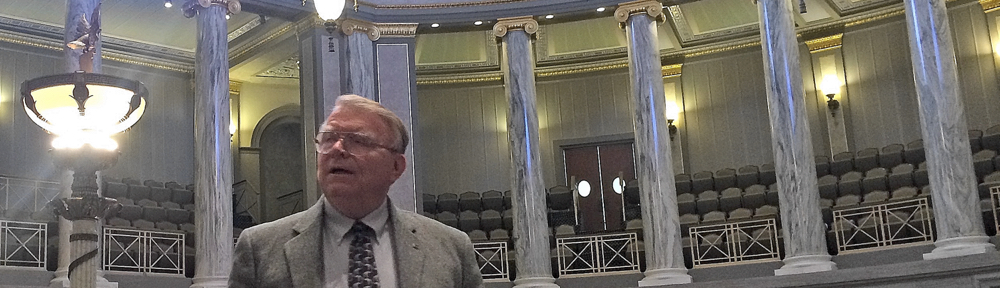
Almost There

We’re only about six weeks away from opening the new future for our past.

It’s a building. But it’s more than just a building. It’s a statement. And, My God! What a statement it is.

Employees of the State Historical Society of Missouri are overseeing the move of thousands of cubic feet of documents, artworks, microfilmed newspapers, and other items from our corner of the basement of the Ellis Library on the University Campus to the new Center for Missouri Studies on Elm Street, just across from Peace Park on the north edge of the University campus. Our manuscript collection alone totals seventeen-thousand cubic feet. If we stood all of the pages in that collection on end, they could cover six football fields. And that doesn’t count the 54-million pages of newspapers on microfilm or twenty-thousand pieces of art, or maps, or sculpture or——-

—or all of the things we have gathered in our own 121-year history that tell the story of Missouri back to the days before it was called Missouri.

We’re going to officially open the place on Saturday, August 10, the 198th anniversary of Missouri becoming a state. It’s going to be a big deal. We’re going to have an outdoor ceremony to start and then we’ll move into the awesome lobby to finish up and to serve various celebratory goodies.

It’s been thirty years or so since the society began to seriously consider moving into a better place to serve the public and to serve the cause of history. It’s been a decade or so since our executive director, Gary Kremer, began a career-long effort to create the Center for Missouri Studies and to find a way to put up a building worthy of Missouri’s heritage.

We thought of some locations that didn’t work out. We drew some plans that didn’t work out. Gary talked to governors and legislators and those conversations didn’t work out—-for a while. But then the idea began to take hold and finally, about five years ago, the legislature provided $35 million for a Center for Missouri Studies.

We were blessed with the leadership of two extraordinary people during those years. Gary, of course (on the left), and Steve Limbaugh, whose enthusiasm and counsel was so central to the effort that we changed the constitution to let him be the first society president who could be elected to succeed himself.

For Steve, there was a special link to the society and to seeing the new building materialize. In 1915, when the society moved out of its then-quarters in Academic Hall (later renamed to honor University of Missouri President Richard Jesse) into the then-new university library, a law student who became Steve’s grandfather and still later became the society president, helped carry things from the FIRST old place to what is becoming the SECOND old place. Steve’s grandpa was Rush Limbaugh Sr., or as his biographer calls him, “The Original Rush Limbaugh.”

A lot of people for several generations of society leadership dreamed of what we are about to celebrate August 10. Many of them will be with us in our memories and, we hope, in spirit.

Three years ago we broke ground on what had been a deteriorating parking lot one-half block big. Only then did I begin to grasp how large this project would become. I saw the plans, the three-dimensional model that was less than a foot tall. I saw the architects’ drawings of the building’s exterior. But even now, after many hard-hat visits, my mind has trouble grasping the scope of what is soon to open.

Throughout this process, one of our staffers already has spent more time in the building than anybody other than the workers who have transformed lines on paper into the building we will dedicate in a few weeks. When our Senior Associate Executive Director, Gerald Hirsch, joined us a dozen years ago, he had no idea he would be our designated eyes watching each detail of the construction. But he’s been the go-to guy for dealing with any problems, adjustments, or changes that we’ve had to deal with.

I look from street level at this startling structure and I am always reminded of President Lincoln’s admonition to Congress on December 1, 1862: “Fellow citizens, we cannot escape history.”

On this corner on the southern edge of downtown Columbia and the northern edge of the University of Missouri will be the material expression of Lincoln’s words.   The Historical Society of Missouri is moving from its easily-overlooked quarters in the library basement into this statement building. It is unique in the architecture of the university. And in its boldness, the building proclaims that history must be part of our character and that we dare not ignore it and dare not lose conscious thought that we create more of it each day.

We, today, are responsible for tomorrow’s history. And before we make that history, we should keep in mind something else Lincoln said that day: “We…will be remembered in spite of ourselves. No personal significance, or insignificance, can spare one or another of us.”

Perhaps if we consider the history we are making, which sometimes seems not to recall the history we and our ancestors made, our prospects for the future will be better.

We’ll dedicate this building, this statement on August 10. Join us.


Notes from a quiet street, Monsoon season edition

(Being a compilation of observation not reaching the level of full blogviation.)

Has it occurred to anyone else that the wrapped Capitol dome kind of looks like the Stanley Cup?   Maybe if you squint a little?   Kinda? Sorta?

090

We’ve heard several folks who don’t watch hockey remark that they were glued to the Stanley Cup finals. “That’s really intense,” one of them has said a couple of times, referring to the constant, fast, physical play.   Some folks who watched the games because a Missouri team was playing—and making history by winning—are likely to watch games next year because they’re hockey.

The fact that the Royals are dismal and the cardinals have been fighting hard to achieve mediocrity probably drove some of those fans to the Blues games.

One of the observers also has remarked that the championship by the Blues makes the absence of an NFL team in St. Louis a whole lot less important.

-0-

Back when we were covering the Senate, Eric Schmitt claimed to be the tallest state senator in Missouri history. We found some ancient references indicating he had some historic rivals but the record remained fuzzy enough that Schmitt remained firm in his convictions although we think we introduced reasonable doubt in at least one case.   He is now definitely the tallest State Treasurer in Missouri history.

But he is not the biggest man ever to work at the Capitol.

Until somebody comes along to disprove the information, we’ll report that title belongs to Clyde Perkins, a former restaurant man from Barnard. The Jefferson City Daily Democrat reported in January of 1923 that Perkins had been hired as an accountant for the House Accounts Committee. House Speaker Oak Hunter was the big guy in the capitol until then at 274 pounds.

The article about Perkins’ appointment said he had been “off his feed” since losing an election the previous November in Nodaway County, but he thought he’d be back at full strength when he regained fifty pounds. Perkins was to be paid five dollars a day. That’s about $74 a day in 2018 money, $370 for a five-day week. Probably not enough to sustain a man very long who weighed 476 pounds..

A 2008 Nodaway County history by Michael J. Steiner says Perkins topped out at 536. Steiner’s book has a picture of two women, each standing in one leg of Perkins’ bib overalls.

Clyde was called “Fatty” by the people back home in those less-sensitive times.  He was the Nodaway County Treasurer when he died at the age of 44 in April, 1936. His death certificate says a contributing cause of death was “extreme obesity; patient weighed 480 pounds.”

Better to be tall, we guess.

Administration of the death penalty in Missouri was a local affair, hanging in the counties, until the late 1930s when the gas chamber was built at the state penitentiary.

The Cole County Democrat observed on February 7, 1907, “The residents of Jefferson City get mad at least every two years. When the legislature meets some untamed jackass introduces a bill to have all hangings pulled off in (the) penitentiary. No person with sense enough to grease a gimlet can blame them for getting angry. The idea of making Jefferson City the human slaughter pen for the state is disgusting in the extreme.”

The disgust lasted three decades.

The legislature in 1937 approved asphyxiation by lethal gas at the state penitentiary instead of hanging at county seats. The first victim of the new gas chamber was a 100-pound pig that stopped struggling three minutes after fifteen cyanide eggs were dropped into a crock of sulphuric acid on December 13. The death of the pig convinced state officials that the gas chamber could be safely used on humans.

Three months later it was. John Brown and William Wright were strapped to the side-by-side chairs at 6:18 p.m. on March 3, 1938. The fumes hit them three minutes later. Medical personnel say they died within three or four minutes. A newspaper story recounted, “Only twenty-five witnesses—as compared with thousands which often-times made ‘Roman Holidays’ out of hangings—peered through the five windows to watch the lethal gas deaths.”

Prisoners were gassed from 1938 to 1965 in Jefferson City. The first drug-induced execution, in 1989, was done in the gas chamber before executions were moved to Potosi, then to Bonne Terre. Gas couldn’t be used because the rubber seal around the chamber door had rotted through disuse and the gas would have been fatal to witnesses, too.

Today, people on tours of the old pen can go into the gas chamber. Many of them get their pictures taken sitting in the chairs.

It is still legal to use gas for Missouri executions. But there’s no place in the state where such an execution could be held safely.

Well, that was pretty heavy, wasn’t it? Here’s something a little lighter.

About three years back (April of 2016) we put together a fanciful discussion of how a member of the family became his own grandfather, kind of along the lines of the famous 1940s popular and country song.

Well, friends, that song isn’t as absurd as it might seem.

Herewith is a story we discovered while trying to find something else in the State Historical Society newspaper library, straight from the Jefferson City Daily Democrat-Tribune of July 29, 1924:

HIS BROTHER WILL BE HIS FATHER IN LAW

Frank Lueckenhoff, well known and popular merchant at St. Thomas, and Miss Frances Sommerhauser, step-daughter of H. J. Lueckenhoff, the grooms [sic] brother, are to be married next month, according to word received from St. Thomas.

Mr. Lueckenhoff’s brother will be his father-in-law and his sister-in-law will become his mother-in-law.

Henry J. Lueckenhoff, the older brother married the widow of John Sommerhauser. She had two daughters and Frank Leuckenhoff (the spelling changed in this paragraph) marries the oldest one next month.

Sponsorships

State government never has enough money to fix the roads, educate our kids, take care of those of us in our declining years, pay our prison guards and state employees  enough to get off of food stamps, maintain hundreds of buildings it owns, keep our air and water safe, and a lot of other things.

I woke up on a Monday morning a few weeks ago with the solution.  I think it was the day after I’d watched the Indianapolis 500 in person and the NASCAR 600-mile race at Charlotte that evening on the telly.  It came to me that state government could make millions if it followed an economic model based on racing.

A few years ago the stock car race at Indianapolis was called something like the Your Name Here Crown Royal Brickyard 400 Powered by Big Machine Records.  Each year the name of some citizen—a private citizen who was a veteran or someone who had voluntarily done something of public benefit would be picked to fill in the “Your Name Here” part of the event name—a nice thing to do to recognize the importance of people like most of us who do good stuff just because we do good stuff.

And if you watch any of these events, you know that the first thing the winners do in the post-race interview is thank all the sponsors whose logos adorned their cars and are sewn onto their fire-resistant driving suits. “You know, Goodyear (Firestone) gave us an awesome tire today and our (Chevrolet, Honda, Toyota, Ford) had awesome power.  I’d like to thank Bass Pro, M&Ms, Budweiser, Coke, Monster Energy, Gainbridge, NAPA, and all my other sponsors who make this possible—and the fans, you’re the BEST!!!”

Suppose state government was run like that.

At the end of a legislative session, the Speaker and the President Pro Tem, in their joint news conference, began with “We have had an awesome, productive session here at the Anheuser-Busch Capitol powered by Ameren.”

“The Monsanto Department of Agriculture driven by the Missouri Farm Bureau will be better equipped than ever to regulate corporate farming through the Tyson CAFO Division.

“The Master Lock Department of Corrections employees are getting a significant pay increase; The Depends Division of Aging is expanding its services significantly; the Tracker Marine Water Patrol is able to hire more officers; and the Dollar General Department of Revenue is going to install new computers to get our H&R Block tax refunds out faster.

“The Cabela’s Department of Conservation sales tax renewal has been put on the ballot next year.  The Wikipedia Department of Higher Education driven by Nike has been given more authority to approve such programs as the Shook, Hardy & Bacon Law School at UMKC, the Wal-Mart Business School in Columbia, the Eagle Forum Liberal Studies program at UMSL, and technology developed at the Hewlett-Packard 3-D Missouri University of Science and Technology will now be capable of building new football facilities on our campuses for pennies..  And we found additional funding for the Cologuard Department of Health and its Purdue Pharma Division of Drug and Alcohol Abuse.

We also were able to put a proposal on the ballot next year to increase funding for the Quikcrete Department of Transportation.

“We couldn’t do all of the great things we’ve done in the 101st Session of the Citizens United General Assembly fueled by Laffer Economics without the support of all of our state’s other great sponsors.

“And we appreciate the participation of you citizens out there.  We couldn’t do this without all of you. You’re the BEST!!!”

And the confetti made from 1,994 un-passed bills would rain down and the legislative leaders would spray champagne (or, more likely, shaken-up Bud) all over each other in the Chamber of Commerce and Industry Legislative Victory Circle (previously known as the rotunda) and the legislative mascot dressed as the Official State Dessert would dance to a celebratory song performed by Sheryl Crowe, who next year will be chosen as a project by a third-grade class studying state government to be the subject of a bill designating her as the Official State Country Singer.

This would never work, of course.  We can’t see members of the legislature in uniforms that have state government sponsors’ patches all over them during the sessions or campaigning in outfits that have the logos of their donors.  And the Senate would just flat out refuse to tolerate anything that would eliminate Seersucker Wednesdays.

Even if government tried something like this, the Supreme Court would be tied up for years in lawsuits determining whether sponsorships should be calculated as Total State Revenue under the Hancock Amendment, thereby triggering tax refunds that would undermine the entire idea.  And Clean Missouri would get another ballot proposal approved by voters that would tie the Missouri Ethics Commission into knots trying to define whether sponsors constitute campaign donors.

Hate to say it folks.  In the real world, if we want better services or more services or better roads or prison guards who don’t have to hold two other jobs, it’s us taxpayers who will have to be the sponsors of state government.    And after all, shouldn’t we want to be

THE BEST?

“Our” disasters

There’s something about a disaster that becomes personal even to those who are not damaged by it.   Many people take a personal ownership of it, even take a peculiar personal pride in it even if their property stays dry and intact.

We’re seeing some of that in Jefferson City in the wake of our tornado a few days before the Memorial Day Weekend and the accompanying flooding.  This is “our” disaster and we see and will see other disasters through our lens.

It’s not unusual.  Those of us who remember the 1993 flooding measure floods in other parts of the country against that one and in some odd way find satisfaction in thinking, “Theirs isn’t as bad as ours was.”   The Joplin tornado has become our measuring stick when we see reports of tornado disasters in other parts of the country.  Theirs isn’t as bad as ours was.

Until the disaster takes off OUR porch, blows down OUR house, destroys OUR business.

OUR tornado took nobody’s life.  It damaged about 200 buildings in Jefferson City, some of which will have to be removed because they cannot be repaired, but compared to Joplin it was a little thing.

Except it’s OUR thing.   And now we will consider ourselves kin to Joplin and we will see reports of tornadoes in other places through OUR lens, not in terms of extent of damage but in terms of fellowship.  We have now joined the fellowship of them.

We don’t know if the folks in Joplin, on hearing of the tornado that hit Eldon then Jefferson City, have thought inwardly, “Huh! We had it a lot worse than they did.”   But it is likely natural that some of them would have evaluated our situation against the extent of their disaster.

We’re still waiting to see if our rainy spring continues, as it did in 1993, and pushes later flood crests that establish new references that end observations such as, “Yeah, it looks pretty bad.  But back in ’93…,” the same way that the 1993 flood ended observations from the real old-timers that, “I remember back in 1951…”

In Eldon and in Jefferson City right now, though, the focus is on recovery. The comparisons with later disasters will come after the debris is cleared away, the buildings that can be saved are saved, and the buildings that cannot be rescued are bulldozed down and the lots where they stood grow new grass.

I haven’t consulted with Nancy yet, but if we win the big lottery jackpot(s) I think I’d like to offer one-million dollars to the Historic City of Jefferson, which has worked for years to revitalize East Capitol Avenue where some of the historic structures might become those grass-filled lots, to be used to supplement insurance payments to rebuild those damaged homes—even those now seemingly destined for destruction.  Gutting the destroyed interior and building a modern inside structure while salvaging the historic exterior would be a goal worth some of those lottery winnings.

But I’m not going to win the lottery.  Somebody else somewhere else always buys a winning ticket just before or just after I buy mine (I tell myself that).  I think I will send a much, much, much smaller amount, though.  And maybe others capable of greater philanthropic capacity will want to participate more grandly in saving what some think cannot be saved.

After all, it is OUR disaster. And part of comparing OUR disaster to those elsewhere in the future should include what we do now to save the things we are told can’t be saved.

History tells us an Act of God can be countered by godly acts that rescue people and the past from the worst that has happened.

I bought another lottery ticket a few days ago.  And I also wrote a check.

Food for thought

We stopped in Terre Haute, Indiana on our annual trip to cover the Indianapolis 500 for the Missourinet and as we nibbled on our bad-for-us hamburger and fries, we found an article in the local newspaper, the Tribune-Star, by Morton J. Marcus that we know will upset the Missouri Farm Bureau and other farm-advocacy organizations, Governor Parson, our friends at the Brownfield network, and numerous other people who continue to advocate for something Marcus thinks is an anachronism: agriculture as an important part of Missouri’s (and Indiana’s) economy.

We offer this as food for thought in a changing world—which has an unchanging reliance on the subject on which Marcus’ appears to have some relevant points. You are welcome to add your grains of thought to his observations in our “comments” section.

The article appeared in the Tribune-Star on May 22. It was published in the Indianapolis Business Journal the next day.

Last week, the governor of Missouri was interviewed on NPR and stated that farming was the number one industry in his state. I’ve heard the same claim from Indiana politicians. In fact, one Hoosier solon claimed farming was “the backbone of Indiana’s economy.” I responded, “Every corpse has a backbone.”

Why do people in Missouri and Indiana believe such exaggeration? Perhaps, at one time (in the 19th century) it was true. Farming does take up a lot of the land we see when traveling from one place to another. Plus, the farm lobby is still disproportionately strong.

How important is farming? Folks from Purdue love to say, “If you eat, you’re are part of farming.” Oh, so true! Plus, if you eat, you’re part of trucking, dentistry, and waste disposal.

Let’s look at three different measures not provided by the biggest farm lobby of all, the U.S. Department of Agriculture:

First, value added, the part of Gross Domestic Product (GDP), our basic measure of economic activity, attributed to Agriculture nationally (including farming, forestry, fisheries and hunting) is 0.8%, or 19th of 19 private sector industries. Number one is (drum roll… ) real estate, rental and leasing at 13.3%, followed by manufacturing at 11.4% of GDP.

To be blunt, total value added from farming is less than 0.8% of the U.S. economy. What will the farm lobby say? “Well, you’ve got to remember farmers buy lots of stuff and lots of money passes through their hands that wouldn’t be spent if we didn’t have farming.”

No one is talking about not having farming! That’s the argument of a child, not an industry. We measure economic activity as the value of the goods sold less the value of goods purchased. That’s what we call value added. And the sum of value added by all economic activity in the marketplace is GDP.

For Missouri, agriculture (Ag) is 1.1% of the state’s GDP. For Indiana, Ag is 0.9% of the state’s GDP. In each of those two states, Ag is 19th of the 19 major private sector economic activities in GDP. Only in South Dakota does Ag exceed 5% of the state’s GDP.

Second, personal income, the sum of earnings, rent, dividends, interest, and transfer payments (Social Security, Medicare, unemployment compensation, etc.) are received by — guess who? — persons. Farm earnings are net of the expenses of farmers, but include government subsidies. How many carpenters, janitors, teachers, surgeons can say the same?

In the nation, farming accounts for 0.4% of total personal income. In Missouri, the figure is 0.46%, in Indiana 0.33%.

Third, jobs. Farming, fishing and forestry account for a lofty 0.34% of jobs in the U.S., 0.18% in Missouri, and 0.12% in the Hoosier Holyland.

These are data for 2018. Not 1820, which might have been the source for the governor of Missouri. They are from the U.S. Bureau of Economic Analysis and the U.S. Bureau of Labor Statistics, not the fake news agents working in the speech-writing cubicle of every statehouse.

A couple of observations from your, uh, loyal observer:  I grew up in a farming community, on a five-acre farm. We rented our pasture to people with horses. I spent summers baling hay and cutting weeds out of Illinois bean fields in the days before pre-emergent herbicides.  Today, it seems, the phrase “small family farm” is a phrase for a time long gone.  HOWEVER, there is no doubt that the people who farm, whether they are a dwindling number of individuals or operations that have become corporations for various reasons, raise the food that feeds a growing population.  But whether agriculture is the “backbone” of our state’s economy in the 21st Century is an issue that Morton Marcus has rightfully raised.  Perhaps it is time to find a new defining phrase for the importance of agriculture.  But in doing so, we cannot forget that this industry that is a shrinking part of our total GDP is the source of our food.

A modern assessment of the economic value of agriculture in the greater scheme of the nation’s economy does not violate the old bumper sticker that says, “Don’t criticize agriculture with your mouth full.”  If anything, the comments from Marcus should make us appreciate, on a personal level, the importance to our well-being of agriculture in whatever business model its participants follow.

(Who is this Morton J. Marcus fellow?  He writes entertaining, informative, and sometimes provocative columns, a compilation of which you can find at https://howeypolitics.com/Content/Columns/Morton-Marcus/10/23.  He is director emeritus of the Business Research Center at Indiana University’s Kelley School of Business.  He taught economics there for more than thirty years and was an advisor on economic development and taxation to a half-dozen Indiana governors. One of his degrees in economics is from Washington University in St. Louis.  He has a bunch of other qualifications.  One write-up of his qualifications for his columns notes, however, “None of his advice has been taken.”)


Notes from a quiet (and perhaps flooded) street

Might one offer an observation about the extensive coverage of rainfall by the television weatherfolk?    They do an excellent job when weather is awful except for one thing.

What does it mean when they say the Missouri River is expected to crest at—for example—32.3 feet at Jefferson City?   Will there be 32 feet of water over the Jefferson City Airport?  Or in the River Bottom area west of the Capitol?  Will the community garden in what once was Cedar City (and the nearby Highway 63) have 32 feet of water over it?

Uh, no.

When we did flood stories at the Missourinet, we never used numbers like that.  Here’s why.

Flood stage at Jefferson City is 23 feet.   That means that a Corps of Engineers river gauge is someplace that measures the bank of the Missouri River at 723 feet above sea level.  The altitude changes as the river flows east or downhill. (Bank full at Washington is only 720 feet, or “20 feet” as is commonly said.)  Any water higher than that means the river is out of its banks.

So, 32 feet means the river is nine feet above bank full at Jefferson City.  It always seemed to us to be more meaningful to report the river was expected to crest nine feet over flood stage.  And a flood stage at 30.2 feet at Washington means the river will be about ten feet above bank full there.  Nine feet and ten feet are more meaningful to people who are five-feet-ten inches tall than thirty-two feet.

The record flood crest at Jefferson City in 1993, by the way was 38.65 feet, or as we reported it, 15.65 feet over flood stage.   There’s a graphic example of the accuracy of reporting flooding using the 15.65 feet standard we used.  Go to the restaurant at the airport and look at the markings on the door which record the levels of various floods.  The mark for the 1993 flood is almost at the ceiling level of the restaurant, about sixteen feet up, not thirty-two.

Having gotten that out of my craw—-

-0-

A few days before the end of the legislative session, your observer watched some of the debate in the House about whether undocumented immigrants living in Missouri should be denied in-state tuition and financial aid when attending our state colleges and universities.

Among those banned from paying in-state tuition and financial assistance using tax dollars were the DACA people, children brought here at a young age by their undocumented parents.  The legislation says the state universities can use their own resources to provide that assistance or to make up the difference between in-state tuition and international student tuition.

The Columbia Daily Tribune had a story about then noting there were 6,000 people in Missouri approved for the Deferred Action for Childhood Arrivals program, or eligible for it.


A thought occurred during the discussion: Why couldn’t our universities, state or private, offer a course for those students that would lead to American citizenship, online for adults and especially for DACA high school students and current college students?  Might solve a few problems.

Might not be a bad idea to have a lot of our non-DACA students enroll, too.

-0-

Come to think of it:  The capitol is awash in third-graders each spring, students who are taking their courses in Missouri government.   They sit in the visitors’ galleries for a few minutes and are introduced by their legislator and given a round of applause and then go downstairs to look at the old stage coach and the mammoth tooth.

It will be nine years before they graduate, months ahead of casting their first vote.  That’s a long time to remember what they saw and learned as third-graders.

I THINK I can remember the name of my teacher and the building I attended in third grade.  But that didn’t make me qualified to cast a learned vote the first time I had the chance to do so.

-0-

I was driven out of retirement this year to lobby for the steamboat museum bill in the legislature.  The opportunity to help do something great for my town and my state forced me back into coat and tie more times in the last four months than I have worn them in the last four years. I found that I was regularly turning the wrong way to get to a meeting with a legislator in the most efficient way.  I had forgotten my way around the Capitol.

I confess there are some things I liked about being a lobbyist and being back in the capitol while the legal sausage was being made.  In all of my years as a reporter, my contacts with legislators were arms-length business arrangements.  As a lobbyist I got to spend a half-hour or more—sometimes less—in the office talking to lawmakers. And I met some REALLY interesting people, particularly the members of this year’s freshman class.

But, boy, did I miss my guilt-free naps. (A few times I hid behind a column in a side gallery of the House and snatched a doze—but those instances sometimes ran afoul of a school group that came in to see five minutes of debate that I’m sure didn’t teach them a darned thing about their government in action.  Or inaction.) And living by my own clock.  And going around in tennis shoes all day.  And going to the Y three days a week for the fellowship there that replaced the relationships I had while I was working.

But the chambers are dark and cool now.  And my naps have returned.  Until January when we take a stronger, better organized run at building a National Steamboat Museum in Jefferson City.  You’re welcome to join the effort.

-0-

It was interesting to know that some things haven’t changed at all.  About three weeks before the end of the session, the place starts to get kind of squirrelly.  That’s about when the House gets all huffy because the Senate hasn’t turned fully to debating House-passed bills. And the Senate gets in a snit because the House hasn’t switched to Senate-passed bills.  And the budget isn’t done with the deadline looming.


In the second week, a purported compromise budget comes out and the chambers start and stop on no particular schedule depending on who’s filibustering what bill or which chamber thinks its conferees didn’t stand up for their chamber’s priorities, and whether to stop the entire process to have more conferences on a small part of a multi-billion dollar budget, and the Senate decides a “day” can actually last until sunrise the next morning or longer.

And the last week when legislators are like desert-crossing cattle who catch a whiff of water in the distance and scramble to get a bill dead a month ago resurrected and added to something moderately akin to the topic, thereby adding to the legend that “nothing is dead in the Senate until the gavel falls at 6 p.m. on the last Friday.”   And, oh, what a blessing that falling gavel is.

-0-

The end of a session today is nothing compared to the days when the odd-year sessions ended at MIDNIGHT on June 15, usually with a “midnight special” appropriations bill just before adjournment that created funding for new programs approved during the session. The only people who knew what was in it likely were the people who hay-baled it together in the closing hours. Pandemonium hardly describes those nights when everybody was beyond exhaustion and more than a few were seriously—shall we say “impaired?”—because of social visits to numerous offices which were well-equipped with adult liquids.


And at midnight, many lawmakers went out to the Ramada Inn to celebrate surviving another session.  The Capitol press corps would start writing stories about the session, a process that was not nearly as much fun as falling in the swimming pool at the Ramada. Both groups would pack it in about sunrise—except for those of us who had newscasts all day Saturday.

One of the best things the legislature ever did was change the adjournment time to 6 p.m. on a Friday night.

Now—-

If we could only get rid of term limits now—–


Adjournment!


The sound of a gavel at 6 p.m. on the last day of a legislative session is the sound of freedom, of welcome relief for lawmakers, lobbyists, staff members, reporters, and others who for weeks have been under growing pressure to grasp success in the face of rapidly shrinking time. Within minutes after the gavel falls, the roads out of Jefferson City will be occupied by cars with license places beginning with the letters S and R, followed by their district numbers, speeding homeward and back to real life.

The members of the first session of the 100th General Assembly of the State of Missouri will repeat actions hundreds of their legislative ancestors knew well long ago. The capitol press corps will have a few hours to recap the day for it can go home, also exhausted but buoyed by the relief that adjournment brings them to.

The correspondent for the Liberty Tribune wrote at the end of a very long March 2, 1855, “As it is late at night and I am worn down with fatigue, and constant application, I beg leave to do as the Dutchman’s team did in the sands of the Mexican desert—just quit.”  His column was published in the March 16 edition.

Yet, before I take my final leave of you, Mr. Editor, I would like to picture to your mind’s eye the scene of the last day of the session.  The day was bright and balmy—a lovely spring day with its light and shade—its sun and its showers—gay groups of ladies in and about the Capitol—Old Nature was loosing the bands of winter, and the tide of the mighty stream that sweeps the base of the capitol was rapidly increasing in strength. The shrill whistle of the steamboat at the wharf called away one-third of the members, with hearts buoyant to see their long-absent wives, sweet-hearts and little ones. The stage coaches were all filled and crammed with departing members and their trunks and sacks of public documents to enlighten the dear people. Private vehicles were rattling along the streets loaded to the guards with absconding legislators. All was bustle, hurry, confusion, mixture and disorder. The confusion of tongues at Babel, or the cloven tongues on the day of Pentecost, could scarcely have been more wonderful or picturesque. The Speaker’s hammer, the very symbol of authority, was as little heeded as the woodpecker’s tattoo, on the hollow tree.  Several ineffectual efforts were made to introduce bills—to call up bills—to make reports—to pass resolutions &c.  A member would rise at his desk and at the top of his voice cry out Mr. Speaker! A dozen voices at the same time, still a little louder. Mr. Speaker! Rap, rap, rap goes the Speaker’s gavel. Another member shouts out Mr. Speaker, I move to have the St. Louis riot act read, as this appears to be “an unlawful assemblage of persons!” At length, after many attempts to do business, within a thin and disorderly house, a resolution was passed deferring all the business on the clerk’s table and in the hands of the committees, until the first Monday in November next. Resolutions were then passed by both houses, notifying his excellency, Gov. Sterling Price, that they had completed their business for the present sitting, and appointing a committee to wait upon him with a copy of the resolutions.—In a short time the committee returned stating that the Governor had no further communications to make with either house of the General Assembly. A motion was then put and carried to adjourn over to the first Monday of November next.  Then, sir, scatterment took place which I shall not further attempt to describe.

Yours respectively, Publius.

The legislature in those days met in the winter months after the crops were in and before the next planting season.  It was allowed to carry over unpassed bills from one year to the next within the two-year session.  A lot of things have changed in the 164 years since “Publius” filed his report. But one thing remains.

When the gavel falls at 6 p.m. today, scatterment will take place once again.


Into the World

It’s graduation season, the time when hundreds of thousands of young people will be leaving the family nest bound for college, the military, or independent grownup life.

They’re empty or near-empty vessels who will be filled with life experiences that might make them entirely different people in thirty years than they are now.  When they return for class reunions they will find with the passing years that are less a class and more a diverse community.

Kelly Pool, the former Centralia newspaper publisher who was the Secretary for the Capitol Commission Board that oversaw construction of the capitol lived to be ninety years old. Eventually he was editor emeritus of the Jefferson City Post-Tribune and wrote an entire newspaper page of reflections and inspirational thoughts each week for many years. In late 1943, he looked at the way people respond to the “youth will be served” slogan and found many people didn’t agree with it—although thousands of “youngsters” were fighting World War II.  But Pool argued the old saying is true and “more and more the world is coming to recognize the power and grandeur of youth.”

The world is young—always will be,” he wrote. “Youth will has always been in the vanguard,” he said as he put together a list to prove his point:

Alexander conquered the world at 26.

Napoleon made all Europe tremble at 25.

Cortez conquered Mexico at 26.

Alexander Hamilton led Congress at 36.

Clay and Calhoun led Congress at 29.

Henry Clay became speaker at 34.

Calhoun was secretary of war at 35.

Daniel Webster was without peer at 30.

Judge Story was on the supreme court at 32.

Goethe was a literary giant at 24.

Schiller was in the forefront of literature at 22.

Burns wrote his best poetry at 24.

Byron’s first work appeared at 19.

Dickens brought out “Pickwick Papers” at 24.

Schubert and Mozart died at less than 35.

Raphael ravished the world at 20.

Michelangelo made stone to live at 24.

Galileo’s great discovery was at 19.

Newton was at his zenith when only 25.

Edison harnessed lightning when only 23.

Martin Luther shook the Vatican at 20.

Calvin wrote his “Institute” at 21.

(“Judge Story” was a reference to Justice Joseph Story, 1779-1845, who is best known as the Justice who read the decision in the Amistad case. John Calvin as a post-Luther Reformation thinker and pastor whose writings led to the formation of Presbyterianism.)

All of which, wrote Pool, is that “our boys and girls should not let the precious hours of their youth be wasted. Begin early to make your mark in the world, and drive hard to become one of the youths who ‘will be served.”

J. Kelly Pool continued to write his “Kellygrams” pages each week for the newspaper until shortly before his death at the age of 90 in 1951.

Why wait to become a victim?

We have talked to about 115 members of the legislature about the bill to build a national steamboat museum in Jefferson City that will house the holdings of the Arabia Steamboat Museum when its lease runs out in Kansas City in 2026

A few of them have told us casino interests have talked to them, too. That’s not unexpected because the primary financing for the museum projects we’re talking about comes from increasing the casinos’ admission fee by a dollar—which would eat into the annual windfall casinos get because the fee has not changed since it was established in law a quarter-century ago although the value of the dollar has.

We’ve been told of a couple of the messages given to some of these lawmakers.

First: that the casinos will come after them in 2020 if they vote for our bill.

Second: for those with casinos in their districts, that they’ll be blamed for any employee layoffs at their casinos if they vote to increase the admission fee.

As far as the second issue goes: That’s so much dishwater.  And we have the numbers to prove that casino employment has nothing to do with admission fees; it’s a function of the number of people playing casino games—-and that number hit its lowest level in twenty years in the last fiscal year, leaving casinos with about 25% fewer employees than they had a few years ago—something we’re pretty sure they’ve never mentioned to their home communities.

And that gets us to—-

Some advice for legislators who have gotten these messages or will get them—or some other message intended to influence their votes on our issue. And it holds true any time someone threatens retaliation for your vote—on whatever issue.

Go after THEM. First.

Don’t keep it a secret.  Don’t wait to become their victim.

Remember who you are.  You are the one who writes the laws, not them.  You are the one charged by your constituents with watching out for their broader interests, which might not be the best interests of a smaller but influential interest.

You are the one who supports something good for all Missourians rather than bowing to pressure from a few very well-to-do special interests whose only concern is how much money they can take out of the state.

You are the one who goes home for long weekends during the legislative session. You are the one who is in your district every day seven months of the year.  You are the one who talks to folks at the coffee shop or the restaurant.  You are the ones who speak to the civic clubs. You are the ones who send out a newsletter to your constituents. You are the ones likely to be interviewed on the hometown radio station or by the local newspaper—which might print your newsletters.

You are the one who can tell the folks at home the things the industry won’t.

You control the message every day, every week, not just at campaign time. You are the one who has every opportunity to explain why you have supported the broad public interest in the face of the narrower interests that think they can force you to let them write the laws that govern their operations.

Opponents of legislation such as our steamboat museum bill hope you won’t tell your constituents what they’ve said to you.  But you have every opportunity to do it.  And we can’t think of a single reason why you shouldn’t.

A few years ago, several legislators were told that if they didn’t vote the way a powerful private citizen wanted them to vote, they would find themselves facing well-financed opponents backed by the private citizen’s checkbook.  All of them won—after telling their constituents about the effort to bully them.

Let’s also be clear that there is nothing wrong with someone supporting a candidate that has views different from your own, views that might be more favorable to those who differ with you politically and philosophically. You should have to defend yourself in the competition of ideas.

But you don’t have to wait silently for someone to make you the victim they say you will become because you cast your vote for a greater public good than theirs.

Remember who you are.

-0-

They never give up, do they?

The newest trick by the casino industry to escape any taxes on another slug of money removed from customers’ pockets has been heard by a House committee.  No action’s been taken and it’s likely too late in the session for this latest scheme to make it into the statute books. But there’s always next year.

If the bill somehow passes this year, that casinos will take another $100,000,000–plus out of Missouri in the next four years. And big boatloads annually after that.

It’s another broken promise by the industry.

Since the day casino gambling was legalized in Missouri, most of the tax on the industry’s adjusted gross receipts has been earmarked for education. For 25 years, that’s been okay with the casinos.

Not anymore.

A trend that could, in time, wipe out all of the gambling money going to education has been gaining momentum in the last four years.  The casinos are giving out coupons to customers allowing them to get free plays at machines and gaming tables. And they seem to be giving out more and more.   The legislative fiscal oversight office says the growth in taxes collected by the state in the last four years from these free play coupons has averaged 8.73%.  In Fiscal 2018, the state collected $37.8 million dollars from those taxes. Thirty-four million went to the “gaming proceeds for education” fund. The rest went to the home docking cities.  More about that later.

The casinos think there should be no tax charged on the money casinos take in from people using those free play coupons. None. They propose completely phasing out the 21% tax on money they make from these promotions in the next five years.

Some if this is kind of technical so I ran it past an accountant who gave me some help. When you read the technical stuff, that is the part from my advisor.

Here’s how it would work.

Suppose you wager $100 at the casino, twenty dollars from the coupon the casino has given you and eighty more out of your own pocket. You win $40 (half of it from the coupon and half of it from your own pocket).  You walk out of the casino sixty dollars in the hole.  The casino, by giving you a twenty-dollar coupon has made sixty dollars.

That’s how the current law works.  The state collects 21% of the sixty dollars you left behind, or $12.60.

The argument from the casino side seems to be that the $20 coupon comes from the casino’s previously-taxed adjusted gross receipts.  So it shouldn’t have to pay tax again when the $20 comes back.

The industry claims it recognizes only $80 in revenue, that it paid out $40, so its adjusted gross receipts are forty dollars, not sixty and therefore owes the state only $8.40, one-third less than the present law requires.

Whatever.

What the casinos want is to pay NO tax. The bill says, “Promotional play receipts shall not be taxed after June 30, 2023.”

Thus, the bill seems from here to say the casino that gets a business tax deduction with its promotional coupon would be excused from paying any gaming taxes on adjusted gross receipts generated by that coupon when it is gambled.

My accountant friend thinks the casinos are creating an un-level playing field (imagine that, casinos have tilted tables!) where the wagers are not taxed but the patron winnings from those wagers are still allowed to be deducted from the casino gross receipts, thus lowering the casino’s AGR taxes.

There’s an even greater hazard here.

The casinos want to pay no taxes on promotional play receipts. There is nothing in this bill that prohibits casinos from issuing promotional play coupons to every customer. And as the oversight division of fiscal research points out, the casinos’ use of promotional play has been increasing.

Fiscal research estimates the state will collect $244,650,481 under the existing 21% tax on promotional play between this fiscal year (FY2019) and FY2023.  If the present tax says in effect—as it has all this time—the state would collect an additional $62,457,772 in FY2024 and each year after that.

BUT if this bill passes this year and the tax rate is gradually reduced to zero, the state would collect only $138,624,390 during that same period, and would collect nothing in FY2024 and every year after that.  That’s a loss of $106,026,891 during that phase-in period plus the $62.4 million each year afterwards. .

But it’s not just the education fund that will get hurt with this demand from the casinos.  Ten percent of the adjusted gross receipts tax goes to the home dock cities that already are seeing their funding reduced because the dollar they get from casino admission fees isn’t worth anywhere near a dollar.  Fiscal research estimates they will lose $10,602,610 by the end of FY2023 and will lose $6,245,777 each year after that.

Many years ago the casino industry agreed that the tax on adjusted gross receipts would go for education with a little bit to the home dock cities.  At that time all of the promotional play was taxed. If this bill passes, hundreds of millions of dollars more will go to casino corporate headquarters instead of being used to underwrite a small percentage of Missouri’s school funding and meet additional costs the home dock communities have because they have welcomed a casino.

As usual, the casinos get richer and richer while the causes that are supposed to benefit from casino taxes get poorer and poorer.

Just another example of an industry that cares not one whit about the people of Missouri, its education system, or even for the communities that think they’re great corporate citizens.

They’re not.

But they never give up, do they?